Breaking Views : Fertiliser makers face long wait for free lunch

Stunted growth

Making fertiliser affordable is an urgent need to avoid a food inflation crisis. European producers are stopping and starting output because of soaring natural gas prices. The spiking cost of the input for churning out ammonia and urea means the crucial crop nutrients are unaffordable for many farmers. State aid can help if it arrives on time.

Ammonia and urea help farmers turbocharge their output, enhance leafy growth, and make plants look lush. Supplies are under threat because Russia is the second largest producer of ammonia, urea and potash. Elsewhere, Norway’s $14 billion Yara International, one of the world’s biggest fertiliser makers and present in more than 50 countries, has just restarted production in Italy and France after curtailing it last month. Austria’s Borealis cut its ammonia production around the same time and was considering a halt for economic reasons.

Cash-strapped farmers operating on wafer-thin margins are compounding the disruption. Urea Egypt futures prices are at $1,010 per metric tonne. In 2020 the price was $246. A large farm in Europe, of say 120 acres, would need to spend over $1,000 on urea in 2022, assuming it uses 20 pounds (9.1 kg) of urea per acre. In 2020, the same farm would have paid about $270.

To avoid the hefty costs, farmers are stretching out their existing stocks and hoping yields don’t suffer. Given that urea is typically spread on crops in the winter months in Europe, lower yields may only become apparent next year. Production cuts, even temporary ones, will spur a vicious cycle. If less fertiliser is available, that will further drive up prices.

To ensure steady supply, rich-world governments could subsidise the costs of Yara and other fertiliser makers, as politicians in poorer countries routinely do. Taking emergency action to bring urea prices back down to non-stressed levels where they were two years ago would cost over $140 million per month based on Europe’s consumption in 2019. But urea only accounts for some 20% of nitrogen-based fertiliser consumption, per Fertilizers Europe, so the actual bill would be a lot higher.

The stop and starts of private companies make efforts to construct aid harder, and European governments are laser-focused on immediate crises like keeping the continent’s lights on. But officials will rue their inertia if they wait for crops to fail.

FT : Thoma Bravo agrees $6.9bn deal for cyber security group SailPoint

Thoma Bravo agrees $6.9bn deal for cyber security group SailPoint
Leveraged buyout market is roaring back to life after a pause amid rising volatility and war in Ukraine

US private equity group Thoma Bravo is buying cyber security company SailPoint Technologies for $6.9bn, the latest in a flurry of deals that signals the leveraged buyout market is roaring back to life after a pause amid rising volatility and the war in Ukraine.

Thoma Bravo, which manages more than $100bn in assets, will pay $65.25 a share for SailPoint, two people with direct knowledge of the details told the Financial Times. The deal is expected to be announced later on Monday morning.

Texas-based SailPoint is used by businesses to give employees secure access to remote working software and to protect cloud computing infrastructure from hackers.

The purchase price is a 31.5 per cent premium to SailPoint’s closing share price on Friday and is the second time Thoma Bravo is investing. The group first bought into SailPoint in 2014 and listed it on the New York Stock Exchange three years later. It exited its holding by the end of 2018, filings show.

Monday’s takeover highlights the increased interest in acquisitions among private equity buyers, particularly in the software sector, which sold off sharply at the start of the year.

Thoma Bravo and SailPoint declined to comment.

In March, Thoma Bravo agreed the $10.7bn takeover of enterprise software company Anaplan, the first large takeover after Russia invaded Ukraine in late February.

Elliott Management has also led two large private equity-backed deals this year, taking software company Citrix private alongside Vista Equity Partners for $16.5bn in January, and buying television ratings company Nielsen for $16bn with Canadian group Brookfield late last month.

Private equity groups in the US have been able to raise billions in traditional bank financing, or from private lenders, despite rising geopolitical risks, inflation and the prospect of higher interest rates.

A consortium led by Advent International and Permira Advisers was able to close the $14bn buyout of cyber security company McAfee in early March, raising billions from bank lenders as markets fell sharply in the days after Russia invaded Ukraine.

For its takeover of Anaplan, Thoma Bravo bypassed bank lenders and instead raised financing from a group of private lenders led by Owl Rock, Blackstone, Apollo Global and Golub Capital.

The people with knowledge of the transaction said SailPoint’s financing will also come from private lenders, including some that financed the Anaplan takeover.

Private equity groups had their strongest ever start to the year in the first quarter, deploying vast cash piles accumulated during the pandemic. There were $288bn of private equity-backed deals, a 17 per cent rise compared with the first three months of 2021, according to Refinitiv data.

Bankers and lenders have also told the FT they have seen a sharp rise in private equity deal activity in recent weeks.

However, the market for private equity buyouts comes as the overall deal market slowed sharply this year. Just over $1tn of deals were struck in the first quarter, 23 per cent lower than in the same period last year.

(ZH) Hedge Fund CIO: "We Have Never Experienced An Economic Cycle That Looks Any

Hedge Fund CIO: "We Have Never Experienced An Economic Cycle That Looks Anything Like This"

By Eric Peters, CIO of One River ASset Management
“My massive bias is to believe things always work out okay,” said Simplicity, walking Occam’s Razor. “But today somehow feels unique, and when I look at supply and demand in oil, grains, base metals too, there’s an undeniable tail risk here,” he said, having analyzed the fundamentals of such things over a long career.
“Without a perfect North American growing season, there will be shortages, perhaps we’ll have them even with perfection, it’s too early to be sure.” And Simplicity paused, sharpened by decades of trading markets that oscillate wildly in times of great uncertainty as producers, consumers and speculators struggle to balance supply and demand. “It’s critical to size your positions small enough so that you don’t discover you’re trading a 3-year perspective with a 3-day stop-loss.”
Overall:
“One thing is certain: To be effective, the Fed will have to inflict more losses on stock and bond investors than it has so far,” said Bill Dudley, former Fed President, saying bluntly what his active-duty central bankers barely dare whisper.
“Market participants expect higher short-term rates to undermine economic growth and force the Fed to reverse course in 2024 and 2025 - but these very expectations are preventing the tightening of financial conditions that would make such an outcome more likely,” explained Dudley, scratching the surface of the disquieting predicament the Federal Reserve now finds itself in.
And because the world’s developed-market central banks adopted US policy in recent decades, the Fed’s quandary is now a global phenomenon. “This would mean hiking the federal funds rate considerably higher than currently anticipated. One way or another, to get inflation under control, the Fed will need to push bond yields high and stock prices lower,” Dudley said.
Cooling an over-heated, capacity-constrained, hyper-financialized economy, in a time of deglobalization and war, without first tightening financial conditions is proving rather difficult. Like all complex problems, this one took decades to create.
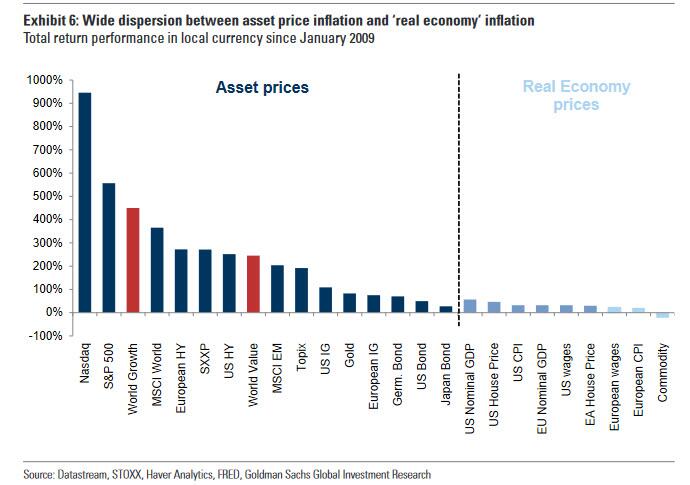
Back when the US economy had less debt and leverage, when financial assets had lower valuations, and when wealth was less concentrated, the ups and downs of the real economy drove financial markets. In such a world, the Fed quite easily used conventional rate policies to influence our behaviors to achieve their objectives.
When those became less effective, they introduced unconventional policies, and forward guided their intentions to become highly predictable. The effect was the hyper-financialization of our economy.
Now, with such high levels of debt, leverage, valuations, and wealth-concentration, it is financial markets that drive the real economy, not the other way around. We have never experienced a modern economic cycle that looks anything like this. And Dudley may be right in his prescription. But if it is one thing, it is certainly not certain.
* * *
Rate of Change: “Looking back on the 1970s, you find 3 distinct inflationary cycles,” said the CIO. “Inflation first peaked in 1970 at just over 6%, then backed off,” he continued. “It peaked again in 1975 at around 12%, declined, then made a final push to nearly 15% in 1980.” That was it. “In the first two cycles, equities fell when inflation rose, and rose when inflation fell,” he said. “Then in the third cycle, inflation went up and for some reason equities did too. I don’t know why. But maybe it’s not only about inflation, but also the rate of change of inflation.”
Autarky: “What’s the really fancy word for it?” asked the CIO, annoyed that he couldn’t recall it. I simply shrugged, quite happy to keep it simple. “Anyhow, screw it, it’s some word that refers to nations which strive to become self-sufficient, economically independent,” he said. “There will be a move toward that for the years, decades probably. What the hell is that word?” he asked, sighed. “But the thing is, not every country can become self-sufficient so as much as everyone will want to if they need to, hardly anyone can, and that’ll slow the whole process.”
“This is really driving me nuts,” said the CIO. “But I’m not going to Google it, I’ll remember the word, it’s right there, I can just about touch it,” he said. I had already found it but didn’t want to rob him of the pleasure. “What’s more likely to happen will be a shift toward trade blocks, unions of like-minded nations, partners, allies.” I was tempted to suggest such a world would be bifurcated, but that word is a bit much for me, and besides, I was pretty sure that meant two-worlds, when in fact there could be three or more. “This word is driving me crazy.”
Domo Arigato: “The age of optimization and maximization is over,” said the CIO. “It will be replaced by a resurgence of manufacturing, and Japan is filled with such companies,” he said. “Japanese equities have been penalized for years because they employed inadequate financial engineering.” Now they’re comparatively cheap. “With the weakening Yen, Japan’s minimum wage priced in US dollars is the cheapest in the G-7,” he said. “The percent of Japan’s workforce near the minimum wage is high. And the real exchange rate is back to where it was in 1975."
WSJ : China’s Auto Sales Drop More Than 10% as Covid Restrictions Hit

China’s Auto Sales Drop More Than 10% as Covid Restrictions Hit
Lockdowns in Shanghai and Jilin province affect production and consumer purchases

China’s car sales fell more than 10% in March, as car makers grappled with extended manufacturing halts and the country’s strict Covid-19 lockdowns disrupted supply chains.

Passenger-car sales dropped 10.5% year over year in March to 1.58 million vehicles, as the shutdowns in cities affected auto production and consumer purchases, the China Passenger Car Association said Monday. Quarterly sales were also affected, falling 4.5% from a year earlier to 4.92 million vehicles, the association said.

Since March, with Covid cases rising, China has resorted to strict lockdowns in Shanghai and the northern province of Jilin to contain the spread of the highly contagious Omicron variant. Both areas, major centers of auto manufacturing in China, are home to plants run by auto makers such as SAIC Motor Corp., General Motors Co. and Volkswagen AG.

Monday’s data points to further evidence of how China’s policy to use stringent lockdowns to snuff out the virus is weighing on economic growth, with car and component production disrupted due to plant shutdowns and logistics delays. Some of the larger manufacturers are operating in a bubble-like environment, with workers living in the closed factory campus to maintain operations.

The world’s biggest car market is likely to see pressure grow, including from weakened demand said Cui Dongshu, secretary-general of the association.

“The Covid infections have had a tremendous impact on the production of car makers, while consumers are going out less for car purchases,” Mr. Cui said.

Sales of electric and plug-in hybrid cars in the quarter were a bright spot for the industry. Sales of such vehicles more than doubled to 1.07 million vehicles from a year earlier, the association’s data showed.

Tesla Inc.’s TSLA -3.00% Shanghai factory is in the midst of the longest production halt since it started manufacturing in late 2019, after shutting operations on March 28 because of the lockdown there.

With the city still shut down, Tesla has drafted plans to prepare for a scenario where the company wouldn’t be able to resume production until the end of April, people familiar with the matter said. A Tesla spokeswoman didn’t immediately respond to a request for comment.

FT : Can crypto fill the gap left by Russian money in the UK?

Can crypto fill the gap left by Russian money in the UK?
By connecting himself so personally to the concept, the chancellor is taking a big punt himself

Out with the oligarchs. In with the cryptogarchs.

That’s certainly how it came across. One minute the UK government, in line with western policy towards Kremlin-linked business figures, was imposing stiff sanctions on the likes of Roman Abramovich and Mikhail Fridman, effectively ending an era of ingratiating such Russian billionaires. The next it was throwing its weight behind “UK Crypto”, an effort to “seize the capitalist energy” of the City of London and make the UK a “hospitable place for crypto”.

Not since El Salvador took the contentious and unprecedented decision to adopt bitcoin as legal tender last year has a government rolled out a red carpet for crypto with such panache.

This portrayal is, of course, a little unfair. Last week’s unveiling by the Treasury of its plans to embrace a crypto ecosystem is cautious, once you read the small print. There is much talk of effective regulation. There is an emphasis on stablecoins — those supposedly anchored to old-world currencies such as the dollar — rather than Wild West bitcoin or ethereum. And the greatest enthusiasm seems directed at the architecture that underpins crypto, so-called distributed ledger technology such as blockchain, which has widespread support.

NFTs — the art world’s incarnation of crypto — are as insubstantial a mania as any since the tulip bulb madness of 17th-century Holland

The government is quite right to be expressing support for innovation and cutting-edge technology. As long as the frameworks are thought through, making the UK a magnet for digital investment is a laudable policy — and a crucial one if the City is to retain its prowess in international finance.

Some aspects of the crypto landscape may genuinely fulfil some of the stated benefits, such as greater efficiency, though problems scaling blockchain have been persistent, and the long-made criticism still applies: this is a technology looking for a problem, rather than a much-needed solution.

But merits aside, the look last week was not a good one. Chancellor Rishi Sunak’s enthusiastic embrace of so-called non-fungible tokens, as he urged the Royal Mint to develop an NFT to sit alongside its suite of collectable commemorative coins, was particularly ill-judged.

Wanting to strike a cutting-edge image is all very well. But NFTs — the art world’s incarnation of crypto — are as insubstantial a mania as any since the tulip bulb madness of 17th-century Holland. By connecting himself so personally to the concept, the chancellor is taking as big a punt as any NFT investor (even if the risk of that association has been trumped in recent days by the mounting row over his wife’s tax status).

The government says it wants to be “in on the ground floor” of this nascent market so that it can “lead the way”. Yet plenty of other countries, from Singapore to Spain, have been earlier adopters of crypto policies. To date, the UK has been shockingly slow to curb dubious practices. Promised legal changes to give the Financial Conduct Authority powers over misleading crypto advertising have yet to materialise. Nothing of note has been done to tackle social media misinformation.

During my multiple visits to British secondary schools in recent months, as part of the FT’s Financial Literacy and Inclusion Campaign, students have frequently asked questions about crypto investment. Many have felt encouraged to buy crypto by social media influencers. Many have lost large sums. Few have really understood what they have been doing, or the risks involved. Cracking down on social media “pump and dump” abuses, and forcing crypto operators to explain risks clearly, would be an admirable government initiative — but launching a chummy campaign for the industry, and endorsing it with its own NFT is hardly that.

At the same time the crypto cult exudes an oligarch-like arrogance. It is ruinously wasteful of energy, clashing head-on with the government’s supposed green credentials. It has a casual attitude to tax liabilities, largely unchallenged by HM Revenue & Customs. (The FCA estimated there are 2.3mn crypto investors in the UK, but HMRC has sent capital gains tax “nudge letters” to barely 8,000.)

Full-on bitcoin aficionados, of course, might argue that this is core to crypto’s raison d’être: it was conceived as an anarchic revolt against the state’s control of the monetary system. Sure enough, at a Miami conference last week, tech entrepreneur Peter Thiel hailed crypto as a “revolutionary youth movement” against the “finance gerontocracy”. So its use — as a wildly speculative punt and an anonymised means to pay for illegal drugs, launder money or evade sanctions — is maybe natural enough.

Such talk would, you might think, make the Treasury wary. Instead, it seems blinded by the bling. In the aftermath of the 2008 financial crisis, Adair Turner, then chair of the now defunct Financial Services Authority watchdog, memorably lambasted much of the finance industry as “socially useless”. How much more fitting is that description of today’s crypto craze?

FT : Electric vehicle targets ‘impossible’ without changes to lithium pipeline

Electric vehicle targets ‘impossible’ without changes to lithium pipeline
West has been ‘remarkably slow’ to develop robust supply chains, says Australian producer

Battery manufacturers are confronting a severe lithium shortage, highlighting the need to challenge China’s dominance of raw material supply chains, an Australian lithium producer has warned.

Stuart Crow, chair of Lake Resources, said western companies and governments had failed to build adequate supply chains for lithium, making the sudden boom in electric vehicle manufacturing unsustainable.

“There simply isn’t going to be enough lithium on the face of the planet, regardless of who expands and who delivers, it just won’t be there,” he said. “The carmakers are starting to sense that maybe the battery makers aren’t going to be able to deliver.”

Lithium-ion batteries play a critical role for governments hoping to decarbonise their economies, and the west is working to loosen China’s grip on the lithium supply chain and processing capacity in particular. Disruption from the war in Ukraine and subsequent sanctions imposed on Russia have also underlined the importance of supply security.

Lake Resources’ share price more than doubled in March, giving it a market capitalisation of A$2.5bn (US$1.9bn), after it signed a memorandum of understanding with the Japanese import-export group Hanwa to deliver 25,000 tonnes of lithium carbonate a year. On Monday, the company announced it had signed another non-binding offtake deal with US carmaker Ford.

“Right now China owns basically 70-80 per cent of the entire supply chain for electric vehicles and lithium-ion batteries, and therefore energy storage,” Crow said. “The west has been remarkably slow to adopt a strategy to try and assist and secure a supply chain.”

Daniel Morgan, a mining analyst at investment bank Barrenjoey, said it was “impossible for the [EV production] targets being made by either carmakers or governments to be met”. He added: “There’s a great love of throwing out lofty targets, but where the rubber hits the road it’s not going to happen.”

Lake Resources, which is listed on the Australian Securities Exchange, is developing a lithium production plant in Argentina. There it will use technology developed by US company Lilac Solutions, backed by Bill Gates, to extract lithium directly from brine, rather than via the more common evaporation method.

It plans to produce 50,000 tonnes of lithium carbonate a year by 2025 and is focused on building supply chains that bypass China.

Lake Resources’ plant in Argentina has by itself yet to produce any lithium carbonate, despite having been set up in 2015. Crow said that was a result of the time it takes to develop lithium projects, which carmakers had not adequately factored in when setting their EV production targets.

“The forecasts for the [lithium] deficit this year vary from 50,000 tonnes per annum out to 400,000 tonnes, on a market that looks potentially to produce 450,000 tonnes a year,” he said. “Anecdotally, we’re hearing stories of two very large battery makers in the market trying to source 150,000 tonnes [each] of lithium hydroxide this year. And with 450,000 tonnes of supply, it’s not going to happen.”

While the US wants half of all car sales to be EVs by 2030, the EU has proposed banning internal combustion engine car sales altogether by 2035. Major marques including Volkswagen, Ford, Stellantis, General Motors and Toyota have all announced ambitious targets to ramp up EV production and phase out petrol cars.

The International Energy Agency estimates global EV sales must reach 47mn a year by 2030 to ensure transport emissions are consistent with its “sustainable development scenario”, which would keep global warming “well below” 2C in line with the Paris climate accord.

Mining group Rio Tinto predicts demand for lithium will rise by 25-35 per cent a year over the next decade.

Barrenjoey’s Morgan said 28mn EV sales by 2030 was a more realistic projection, but even that would not be possible with current announced lithium projects. Indeed, it would require lithium production to increase six-fold between now and 2030.

“There’s eight years until 2030. We need to start hearing about new projects now,” he said, adding that it was a “great time to be a miner”.

>>> Europe : Brokers Upgrades & Downgrades - 11th of April 2022 V2(+)

>>> Up
* Adevinta Raised to Buy at Goldman; PT 118.50 kroner
* Aixtron Up to Outperform at Exane BNP on MicroLED Opportunity
* Ediliziacrobatica Raised to Buy at Intesa Sanpaolo (+)
* Nexans Raised to Add at AlphaValue/Baader
* Schibsted Raised to Buy at Goldman; PT 326.90 kroner
* Schlumberger NV Raised to Overweight at Piper Sandler; PT $55
* TGS Raised to Buy at SEB Equities; PT 175 kroner

>>> Down
* AMS cut to Neutral from Outperfotm at Exane (+)
* Encavis Cut to Equal-Weight at Barclays; PT 19 euros
* Metro Bank Cut to Hold at Investec; PT 105 pence (+)
* Nvidia Cut to Neutral at Baird; PT $225 (+)
* Polytec Holding Cut to Hold at M.M. Warburg; PT 7.50 euros (+)
* ProSieben Cut to Neutral at Goldman; PT 13.10 euros
* RTL Cut to Neutral at Goldman; PT 60.74 euros
* Stroeer Cut to Sell at Goldman; PT 62.10 euros
* WPP Cut to Neutral at Goldman; PT 1,235 pence

>>> Initiation
* Kraft Bank Rated New Buy at SpareBank; PT 13 kroner
* Medartis Resumed Market Perform at ZKB (+)
* Patrizia Rated New Buy at Bankhaus Metzler; PT 21.10 euros (+)
* Richemont Started at Buy by Jefferies, Target Started at CHF140 by Jefferies
* Tinybuild Rated New Add at Numis; PT 210 pence

>>> Call
* AG Barr Raised at Berenberg on ‘Underappreciated Transformation’
* Airbus 1Q Deliveries in Line, Orders ‘Solid,’ Jefferies Says (+)
* Aixtron Up to Outperform at Exane BNP on MicroLED Opportunity
* Goldman Strategists See Risks to European Margins, Revenues
* Omer-Decugis Rated New Buy at Stifel; PT 10.50 euros (+)
* Richemont a New Buy at Jefferies With Cartier Still the Standout
* Sainsbury Up to Buy on Resilient U.K. Consumers, Jefferies Says
* Citi Stays Cautious on Fintech, Sees Near-Term Risks at Temenos
* Wood Raised to Hold at Jefferies on Upcoming Major Catalysts

>>> Monday Morning Papers

Monday Morning Papers Summary

LA REPUBBLICA
-The first polls and analyses of electoral flows are favorable to Marine Le Pen, who has reached the runoff ballot for the second time in 5 years. But compared to 2017 everything is differentMarine Le Pen’s performance allows her to aim for the presidency well beyond the results of the first round of the presidential elections in France, which saw Emmanuel Macron take a small lead over Rassemblement National candidate by more than three points. With the polls closed, a large part of defeated candidates have immediately endorsed the incumbent president.
-The Italian prime minister Mario Draghi, who will be in Algeria today to negotiate gas import deals, is convinced that the Lega and M5S parties will try to make the government unmanageable in the wake of Marine Le Pen’s success, which will keep the pro-European Union and NATO leaders on alert.

FRANKFURTER ALLGEMEINE ZEITUNG
-French Presidential candidate Marine Le Pen has improved on her result from five years ago and, gaining a solid 23% of the vote. She has become a serious threat to Macron's re-election. On the evening of the election, she appealed to all voters who had not voted for Macron to join her. It was "a civilizational decision," she said.
-The World Bank has revised its economic forecast for Ukraine significantly downwards as the Russian war of aggression progresses. Economists predicted on Sunday that Ukraine's gross domestic product would fall by 45.1% this year – instead of the expected drop of between 10 and 35% a month ago. Grain exports and other economic activities have "become impossible in large parts of the country due to severe damage to infrastructure," Bjerde explained. This has global consequences: Because of the war, world market prices for grain and energy, where Ukraine and Russia are among the most important exporters, have shot up significantly. The economy of Russia, which is subject to international sanctions, will shrink by 11.2%.

HANDELSBLATT
-Acute staff shortages, frequent job changes and rapidly growing inflation rates are fueling a salary bubble among skilled workers in Germany. This is shown by a study by the management consultancy Willis Towers Watson (WTW), which is available exclusively to the Handelsblatt. The analysis focused on jobs that required specialized knowledge. According to this, since the outbreak of the corona crisis, the salaries of IT system architects have increased by almost a quarter on average. Salespeople in key account areas have also earned an average of 15% more since the pandemic. The situation is similar in controlling, marketing and financial analysis.
-Russia's war against the Ukraine is hitting German medium- sized companies hard. This is the result of a representative survey by DZ Bank, which was previously available to the Handelsblatt. For this purpose, more than 1000 managing directors and decision-makers of medium-sized companies were surveyed in the period from the end of February to the end of March. This makes it the first survey to show the effects of the war.

IL SOLE 24 ORE
-More than 600 multinationals have decided and announced total or partial exits from Russia since February. In the most diverse sectors, from oil and burgers to tech and media, from banks to accounting services. From Exxon Mobil and BP to McDonald's, from Citigroup to the kings of credit cards, from McKinsey and Bain to Apple and Disney.
-An Italian delegation led by Prime Minister Mario Draghi, the Ecological Transition Ministers Roberto Cingolani and Foreign Affairs Luigi Di Maio is heading to Algeria to strengthen energy cooperation between the two countries (as follow up to a previous diplomatic visit on February 28) accompanied by Eni CEO Claudio Descalzi. The plan is to double the amount of gas that Italy imports from Algeria, adding about 9B m3/year to the 10B m3 already supplied to Italy by Eni through the Transmed gas pipeline and in order to diversify sources and gradually free up the Italy from the Russian energy yoke. Algeria is currently Italy’s largest supplier after Russia (from which Rome imports some 29B m3/year). Draghi is also expected to sign a pact for joint investments in renewables, which have great development potential in Algeria and North Africa.

LES ECHOS
-As in 2017, Emmanuel Macron and Marine Le Pen have qualified for the second round. The outgoing president came out ahead in the first round with 27.9% of the vote, according to OpinionWay estimates. It is doing better than five years ago (24%). Le Pen of the RN Party was second with around 23.3% of the vote, according to estimates. If she achieves the best score in the history of her political family in the first round of the presidential election, this may be less than she had hoped. The other big player of the first round of the election was absenteeism as 27.4% of voters shunned the ballot boxes according to estimates from Opinionway on Sunday evening.
-The big loser of the first round of the French presidential election is Valérie Pécresse. She claimed that the campaign was “the fight of a lifetime.” She actually gave everything, but her fight turned into an ordeal. For the second consecutive time, the Republican right is absent from the second round of the presidential election. The leaders of LR have not had access to power for ten years and for this political family which founded the Fifth Republic, it is more than a trauma, it is reason to question its raison d'être.

ABC
The war in Ukraine and the consequent sanctions imposed on Vladimir Putin 's Russia by the United States and the European Union (the latest version of which was approved last week) have secondary effects on the EU economies and, particularly, on an agricultural exporting power such as Spain (eighth exporter in the world and fourth at European level). Last year alone, agro-food products were sold abroad worth EUR60,118M, 11% more than in 2020. Especially fruit (EUR10,162M), meat products (EUR8,819M) and vegetables (EUR7,461M). Specifically, due to the cancellation of the Swift payment system and the strong depreciation of the ruble, countries such as Morocco, Egypt, Turkey or Israel , which had taken the place left in the Russian market by European nations such as Spain - following Russia's takeover of Crimea in 2014, are beginning to divert part of these exports to Europe.

>>> Stoxx 600 Pre-Market Indications

  • Voestalpine (VAS TH) +3%
    • Watch Europe Miners as Iron Ore Drops Over China Virus Outbreak
  • Norsk Hydro (NOH1 TH) +2.6%
  • Rolls-Royce (RRU TH) +2.3%
  • Orsted (D2G TH) +1.6%
  • M&G (7MP TH) +1.6%
  • Tomra (TMR TH) +1.4%
  • Alstom (AOMD TH) +1.1%
  • SocGen (SGE TH) +1.1%
    • SocGen Agrees to Sell Rosbank to Interros Capital
  • Vestas (VWSB TH) +1%
  • Equinor (DNQ TH) +1%
    • Watch Europe Oil Stocks as Crude Falls on China’s Virus Outbreak
  • BAE (BSP TH) -1.4%
  • GSK (GS7 TH) -1.6%
  • Continental (CON TH) -1.6%
  • Linde (LIN TH) -1.6%
  • Orange (FTE TH) -1.8%
  • Repsol (REP TH) -2.1%
    • Watch Europe Oil Stocks as Crude Falls on China’s Virus Outbreak
  • EDP (EDP TH) -2.1%
    • EDPR Gets Purchase Agreement to Sell Power From Texas Solar Park
  • Aurubis (NDA TH) -2.3%
  • Nokian Renkaat (NRE TH) -2.5%
    • Nokian Renkaat Says Sanctions’ Impact on Tire Sales Significant
  • Prosus (1TY TH) -2.7%

>>> TradeGate Pre-Market Indications

DAX:
  • Mercedes (MBG TH) -1.2%
  • Fresenius SE (FRE TH) -1.2%
  • Adidas (ADS TH) -1.2%
  • BMW (BMW TH) -1.2%
    • BMW Sees Chip Shortage Lasting Into 2023: Neue Zuercher Zeitung
  • Linde (LIN TH) -1.3%
MDAX:
  • Aixtron (AIXA TH) +2.5%
    • Aixtron Up to Outperform at Exane BNP on MicroLED Opportunity
  • Rheinmetall (RHM TH) +1.4%
  • Siltronic (WAF TH) +1.2%
    • Watch Tech, Yield-Sensitive Sectors as Treasury Yields Climb
  • Aroundtown (AT1 TH) +1.1%
  • K+S (SDF TH) +1%
  • ProSieben (PSM TH) -1.4%
    • ProSieben Cut to Neutral at Goldman; PT 13.10 euros
  • Stroeer (SAX TH) -1.9%
    • Stroeer Cut to Sell at Goldman; PT 62.10 euros
  • Aurubis (NDA TH) -2.3%
SDAX:
  • Takkt (TTK TH) +2.6%
  • LPKF (LPK TH) +2.2%
  • Schaeffler (SHA TH) +1.1%
  • Metro (B4B TH) -1.3%
  • Encavis (ECV TH) -1.8%