Nature : Course of post COVID-19 disease symptoms over time in the ComPaRe long


Course of post COVID-19 disease symptoms over time in the ComPaRe long COVID prospective e-cohort
Nature Communications volume 13, Article number: 1812 (2022)
Abstract
About 10% of people infected by severe acute respiratory syndrome coronavirus 2 experience post COVID-19 disease. We analysed data from 968 adult patients (5350 person-months) with a confirmed infection enroled in the ComPaRe long COVID cohort, a disease prevalent prospective e-cohort of such patients in France. Day-by-day prevalence of post COVID-19 symptoms was determined from patients’ responses to the Long COVID Symptom Tool, a validated self-reported questionnaire assessing 53 symptoms. Among patients symptomatic after 2 months, 85% still reported symptoms one year after their symptom onset. Evolution of symptoms showed a decreasing prevalence over time for 27/53 symptoms (e.g., loss of taste/smell); a stable prevalence over time for 18/53 symptoms (e.g., dyspnoea), and an increasing prevalence over time for 8/53 symptoms (e.g., paraesthesia). The disease impact on patients’ lives began increasing 6 months after onset. Our results are of importance to understand the natural history of post COVID-19 disease.
Introduction
As of March 2022, about 437 million people worldwide had been infected by the severe acute respiratory syndrome coronavirus 2 (SARS-CoV-2), the pathogen responsible for coronavirus disease 2019 (COVID-19)1,2. According to the United Kingdom Office for National Statistics, about 10% of them will experience post COVID-19 disease or “long COVID”, that is, the persistence of symptoms such as fatigue, dyspnoea, chest pain, cognitive disturbances, or arthralgia, for several weeks to months after their initial SARS-CoV-2 infection2,3. Research has mainly focused on the occurrence of specific long-term complications among hospitalised and non-hospitalised patients recruited during their acute COVID-19 infection4,5,6,7,8,9,10,11. To our knowledge, only a handful of studies have investigated the longitudinal evolution of symptoms among patients with persisting symptoms (i.e., with post COVID-19), but they have generally been small, retrospective or limited to single centres12,13,14. In this study, we used data from a large nationwide cohort of patients to reconstruct the day-by-day course of their symptoms from onset to 1 year after the acute phase of the infection.
Results
Participants
The ComPaRe long COVID cohort is an ongoing nationwide e-cohort of patients with post COVID-19 disease in France, nested in the ComPaRe research programme (www.compare.aphp.fr), an umbrella e-cohort of patients with chronic conditions15. The cohort started in December 2020, and recruitment is ongoing. Among the 1859 patients included in the ComPaRe long COVID cohort on October 15, 2021, we analysed the data from the 968 patients reporting: (1) a laboratory-confirmed COVID-19 infection with a positive test for SARS-CoV2 by PCR swab and/or serologic assay; (2) symptoms persisting for at least 2 months after their onset; and (3) enrolment in the cohort by August 1, 2021, and thus at least 2 months of follow-up in this analysis (Fig. 1). To improve the representativeness of results, we weighted observations by calibration on margins, so that the weighted distribution of age (<24, 25–34, 35–49, 50–69, and ≥70 years), gender, and hospitalisation during the acute phase of the disease (Yes/No) matched the data from the UK Office of National Statistics Covid Infection Survey (2 September 2021 data)16,17. Raw and weighted patients’ characteristics are presented in the Table 1. Hereafter, results presented always come from the weighted dataset. Raw results are available in the Supplementary Materials.
Fig. 1: Study flow chart.
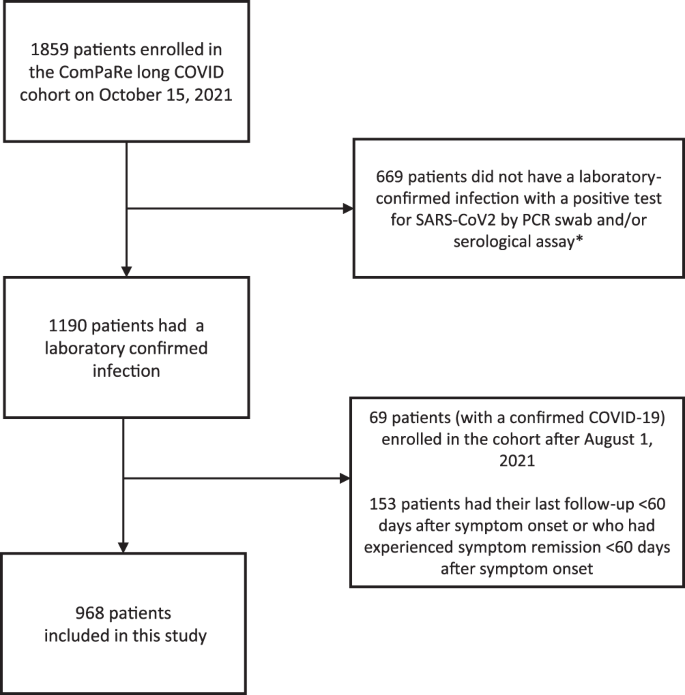
*The high number of patients without a confirmed infection is due to the limited availability of testing during the first wave of COVID-19 in March 2020, in France.
Table 1 Patients’ characteristics (n = 968).
In the weighted data, patients’ median age was 48 years (interquartile range 32–56) with 57.7% (559/968) men. In all, 35.1% (340/968) reported comorbidities, 6.3% (61/968) had chronic lung diseases, and 4.2% (41/968) high blood pressure. The median time between symptom onset and the last follow-up was 174 days (IQR 97 to 284 days). Among participants, 75 (7.7%) had been hospitalised during their acute disease and 34 (3.5%) had been admitted to an intensive care unit (ICU).
Probability of symptom persistence at 12 months
Participants were followed up every 60 days with online questionnaires available on computer or smartphone. At each observation point, patients were first asked if they still had symptoms related to COVID-19. Those reporting the persistence of symptoms completed the long COVID symptom tool (ST) and impact tool (IT), a pair of validated patient-reported instruments assessing respectively 53 symptoms and 6 dimensions of patients’ lives that can be affected by the disease18. Those reporting that they no longer had any symptoms were asked to report the date when they first noticed the absence of symptoms. Overall, our data covered 5350 person-months, with a median follow-up since cohort enrolment of 181 days (interquartile range 118 to 240 days). The proportion of patients lost to follow-up was <20% at every follow-up (Supplementary Material 1).
Remission of symptoms (i.e., disappearance of all symptoms) was observed during follow-up for 150 patients. Among those who reported full symptom remission, 50/150 (33.3%) subsequently described a relapse for at least one symptom. At 12 months, the probability of symptom persistence (including patients in remission who relapsed) was 84.9% (95% CI 79.8–90.4%) (Fig. 2).
Fig. 2: Cumulative event curve for remission of post COVID-19 symptoms.
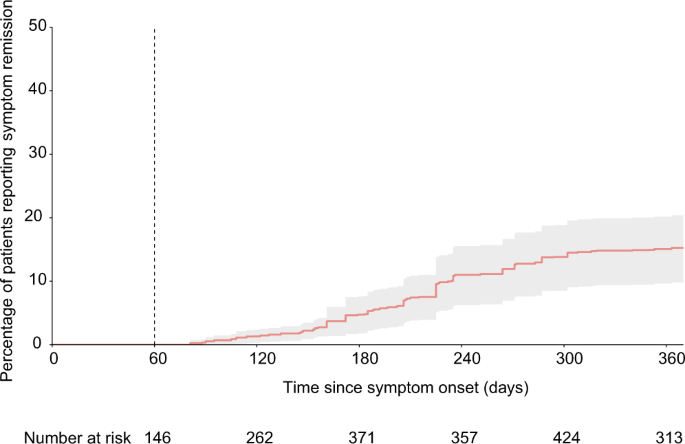
Time of remission was defined as the first time that patients reported no longer experiencing any symptoms of post COVID-19 disease. The time at risk started at entry in the cohort and ended on October 10, 2021. Follow-up data were censored at the participants’ latest observation point. Error bands represent 95% confidence intervals. Source data are provided as a Source Data file.
Day-to-day prevalence of post COVID-19 disease symptoms
We used multistate models taking both left and right censoring into account to estimate the longitudinal evolution of symptoms. In the models, each patient contributed to the data during his/her follow-up period. Because our cohort included patients enroled at different times after their initial infection, we were able to reconstruct the prevalence of each symptom, day-by-day, in the study population (Fig. 3A and Supplementary Material 2). First, 27 (51%) symptoms showed a progressive decrease in prevalence over time. Among them, loss of appetite, change/loss of taste, and cough changed most (>20% decrease). Second, 18 (34%) symptoms showed no specific change in prevalence over time. Among them, word finding problems and dyspnoea were the most prevalent. At 360 days, they affected respectively 48% and 44.5% of the population. Finally, eight symptoms showed an increase in prevalence over time. Among them, neck, back, and low back pain and paraesthesia changed most markedly (>10% increase) (Supplementary Material 3). The evolution of symptoms over time in subgroups by age, sex, and presence of comorbidities is presented in Supplementary Materials 46.
Fig. 3: Day-by-day trends in the prevalence of post COVID-19 disease symptoms (A) and of their impact on patients’ lives (B).
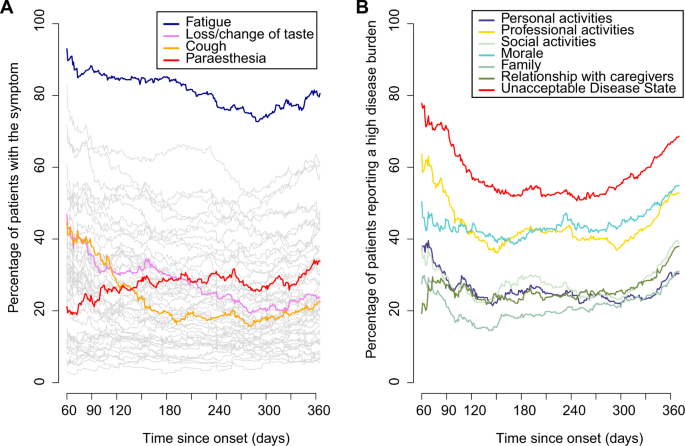
A The figure presents the day-by-day prevalence of each of the 53 symptoms assessed by the Long COVID ST (grey lines). Examples of specific symptoms have been highlighted (coloured lines). For each symptom and at each observation point, we assumed that patients could either be “experiencing” or “not experiencing” the symptom. We assumed that their state at an arbitrary time was the same as the state at their previous observation point and that their states before their first observation and after their last observation are unknown. B The figure presents the day-by-day evolution of the six domains of patients’ lives that can be affected by post COVID-19 disease and are assessed by the Long COVID IT. For each item and at each observation point, we modelled patients answers as either “reporting” a significant impact of the disease on this domain” (i.e., item score >7) or “not reporting” this impact (i.e., item score <8). We assumed that their state at an arbitrary time was the same as the state at their previous observation point and that their states before their first observation and after their last observation are unknown. The red lines represent a similar model for the Patient Acceptable Symptomatic State (PASS) of the long COVID IT, which is the long COVID IT score below which 75% of patients find that their disease state is acceptable. Source data are provided as a Source Data file.
Post COVID-19 disease is a relapsing-remitting disease. Sixty days after symptom onset, most of patients reported permanent, daily or weekly symptoms. Over time, relapses became less frequent, with a decrease in the proportion of patients reporting weekly or more frequent symptoms (including those reporting permanent symptoms) and a parallel increase in the proportion reporting relapses less than weekly (Supplementary Material 7).
Evolution over time of the impact of post COVID-19 disease on patients’ lives
Figure 3B illustrates patients’ perceptions of the impact of the disease on their lives, measured by the long COVID IT. In particular, we present the proportion of patients reporting an unacceptable disease state, defined as a score on the long COVID IT above the value at which >75% of patients consider that they could not cope with a similar level of lifelong symptoms18. This analysis revealed two distinct phases of the disease. In a first phase, from 60 to 180 days, the burden of disease progressively decreased as several symptoms disappeared, while the number of patients reporting an unacceptable symptom state diminished slowly to 50%. After 6 months, the proportion of patients reporting an unacceptable disease state increased more rapidly, with 60–70% of patients considering their disease unacceptable at that time. This secondary increase may correspond to patients’ realisation that they had a chronic disease. This U-shaped trend in the evolution of the perception of the impact of the disease on patients’ lives over time was found in subgroups defined by age and sex. (Supplementary Material 8 and 9).
Discussion
This study reports how the symptoms and impact of post COVID-19 evolve after the acute phase of the disease, in a large prospective cohort of patients with a laboratory-confirmed infection. Among patients with post COVID-19 disease, 85% still reported symptoms 1 year after symptom onset. This finding is consistent with observations in a single-centre study in Germany, where 20% of patients were free from all 14 symptoms under study at 12 months12.
The course of symptoms over time highlighted three distinct patterns that offer insight into the aetiologies and mechanisms underlying this disease. First, we observed a decrease in prevalence over time for symptoms such as loss of taste or smell, coughing, or diarrhoea. For example, the prevalence of coughing decreased from 50 to 20% of participants within the first 6 months after symptom onset before reaching a plateau. This was similar for loss of smell, with a plateau reached after 8 months. This evolution, indicating recovery from the acute phase, is slower than expected. Indeed, most guidelines still consider a cut-off of 12 weeks to distinguish ongoing symptomatic COVID-19 (i.e., signs and symptoms of COVID-19 from 4 to 12 weeks) from post COVID-19 syndrome19. For other symptoms, we showed that their prevalence increased over time. For example, the prevalence of hair loss increased over time with 8% and 15% of participants reporting it at 2 months and 1 year after onset respectively. Late symptom appearance, especially alopecia, has been reported in other studies and should be further investigated20. Finally, symptoms showing no change of prevalence over time may be caused by mechanisms that do not change rapidly over time, such as deconditioning or post-traumatic stress disorder, or due to a mixture of recovery from acute disease and late-onset symptoms appearing as a consequence of COVID-1921.
We found some differences in the evolution of symptoms between men and women; and in age groups. We hypothesise that differences may be due either to different underlying causes of the persistent symptoms or to specific factors directly affecting symptoms. For example, several studies have highlighted differences between the sexes in immune responses (in terms of levels of innate immune cytokines such as IL-8 and IL-18, induction of non-classical monocytes, and T cell activation)22 and in response to a traumatic event23.
Our results demonstrate the substantial impact of post COVID-19 disease on patients’ lives. Specifically, the course of patients’ perceptions of the impact of the disease changed similarly over time across all subgroups, with an aggravation 6 months after onset. We hypothesise that this corresponds to patients’ realisation that this novel and previously unknown disease is chronic rather than acute. This trend seemed more pronounced among younger patients, for whom post COVID-19 is more likely to be both their first contact with a chronic disease and a biographical disruption of their lives24.
Strengths of this study lie in the prospective follow-up of a large population of patients with a confirmed COVID-19 infection and their regular assessment of their symptoms using validated patient-reported outcome measures, developed from patients’ lived experience, with excellent reproducibility (intraclass correlation coefficient 0.83, 95% confidence interval 0.80–0.86)18. The use of online questionnaires reduced social desirability bias and may provide better estimates of the prevalence of sensitive symptoms such as genitourinary or cognitive disorders25.
This study has several limitations. The recruitment of volunteers in the ComPaRe long COVID cohort may have selected patients who had overall more symptoms, and our recruitment strategy included a social media and general media campaign that may have selected younger and better educated patients. Second, our sample included a majority of women. Persistent symptoms after COVID-19 are more frequent among women; for example, the odds of persistent fatigue at 1 year among women compared with men was 1.43 [1.04–1.96]26. To minimise these issues, we used a weighted dataset with weights derived from the September 2021 data from the Office of National Statistics in the United Kingdom16. Yet, because our original dataset included fewer men, results in this subgroup may lack precision. More generally, the subgroup analyses were post-hoc, and should be considered as exploratory. Third, in this study we included patients with a history of confirmed SARS-CoV-2 infection who had symptoms for at least 2 months, in accordance with the WHO’s recent consensus definition of post COVID-19 disease27. However, our data prevented us from ascertaining whether an alternative diagnosis might explain the symptoms. Fourth, as patients could enrol in the cohort at any time point after their initial infection (with an interval between symptom onset and enrolment exceeding 300 days for 25% of participants), we chose to minimise memory bias by not asking retrospectively for symptoms experienced during the infection’s acute phase. This limits our ability to describe how symptoms change immediately after the acute phase of the disease. Fifth, disease remission was defined as having no symptoms among 53. As the likelihood of having at least one symptom, at any time point, is expected to be high even in the general population, our analyses may overestimate the number of patients who still report symptoms 1 year after their symptom onset. Sixth, this study did not use a control group. Because several symptoms of post COVID-19 disease are non-specific, we cannot ascertain that the observed symptoms are different from or in addition to what might be due to intercurrent illnesses, comorbidities, ageing, or social effects of living through the pandemic. Finally, in view of the limited number of patients who were hospitalised in ICUs in our study, our results cannot be generalised to this specific population.
In conclusion, our study shows that most patients with post COVID-19 disease have symptoms evolving in different patterns but persisting through 1 year. Recovery from the acute infection is a slow process, and the prevalence for most symptoms decreased over time before plateauing 6–8 months after onset. Our results are of importance to understand the natural history of this disease, and should help physicians to inform their patients about the potential course of this disease.

>>> US Close Dow +0.40% S&P -0.27% Nasdaq -1.34% Russell -0.76% VIX

Closing Stock Market Summary

The S&P 500 declined 0.3% on Friday in a mixed session in which value stocks outperformed at the expense of growth stocks. The growth/value divide was evident in the disparity between the Nasdaq Composite (-1.3%) and Dow Jones Industrial Average (+0.4%). The Russell 2000 lost 0.8%. 

Growth stocks remained pressured by valuation concerns as long-term interest rates continued to creep higher: the 10-yr yield rose five basis points to 2.71% (+34 bps for the week). Shorter-dated rates also pushed higher, with the 2-yr yield increasing five basis points to 2.52% (+10 bps for the week). 

The mega-caps within the S&P 500 information technology (-1.4%), consumer discretionary (-1.0%), and communication services (-0.7%) sectors were among the heaviest weights on the market. The Vanguard Mega Cap Growth ETF (MGK 227.74, -2.78) fell 1.2%. 

Transportation stocks also struggled amid underlying growth concerns and negative-minded analyst recommendations. BofA Securities downgraded both Union Pacific (UNP 241.98, -2.88, -1.2%) and UPS (UPS 191.02, -1.68, -0.9%) to Neutral from Buy. The Dow Jones Transportation Average fell 0.9%. 

Conversely, the financials (+1.0%) and energy (+2.8%) sectors were the strongest performers amid the higher rates and higher oil prices ($98.18/bbl, +1.88, +2.0%). The defensive-oriented health care (+0.6%), consumer staples (+0.4%), utilities (+0.3%), and real estate (+0.3%) sectors added to their weekly gains. 

Blue-chips like UnitedHealth (UNH 545.96, +9.01, +1.7%), Walmart (WMT 157.41, +0.87, +0.6%), and Coca-Cola (KO 63.83, +0.39, +0.6%) set all-time highs, contributing to the outperformance of the Dow, on no specific news. Note, UNH will be among the first batch of companies to report Q1 earnings next week. 

Separately, the S&P 500 wavered around its 200-day moving average (4493) the entire session, ultimately closing below the key technical level amid some slippage activity into the close. 

The U.S. Dollar Index (99.84, +0.09, +0.1%), meanwhile, rose for the seventh straight session and briefly topped the 100.00 level. 

Friday's economic data was limited to Wholesale Inventories, which increased 2.5% m/m in February (consensus 2.1%) following a revised 1.1% increase (from 0.8% increase) in January. There is no data of note scheduled for Monday. 

  • Dow Jones Industrial Average -4.5% YTD
  • S&P 500 -5.8% YTD
  • Russell 2000 -11.2% YTD
  • Nasdaq Composite -12.4% YTD

>>> Weekly Market Update

Weekly Market Update: Ukraine war and Fed policy minutes keep markets under pressure

Markets opened the week unsettled amid ongoing consternation surrounding the Ukraine war as well as US Federal Reserve policy. Crude oil prices rose in the early part of the week as another round of Western sanctions on Russia was being contemplated following the unearthing of atrocities committed by Russian forces in Bucha. Europeans openly discussed a mandatory phase out of imported coal to go along with additional measures to strength energy sanctions. Western officials also stepped up their rhetoric surrounding President Putin reiterating their belief that war crimes, and potential genocide is being committed by Russia. The pressure seemed to have little baring on the ground though. By Friday, reports circulated that dozens has been killed in Russia missile attack on Ukraine railway station in Kramatorsk which was being used as an evacuation center.

US Treasury yields were jolted higher on Tuesday when Vice Chair nominee Brainard’s hawkish commentary caught investors’ attention, presaging the March FOMC minutes. Wednesday’s minutes essentially supported what we have heard from a full throated chorus of Fed officials of late. Namely, a 50 bps cut remains firmly on the table and is possible in May when the Fed is likely to begin cutting back on the balance sheet as well. According to the minutes, the monthly cap on drawdowns will likely rise to $95B by this summer, but to date officials have not decided the target size for the balance sheet at the end of the process. Increasingly aggressive calls by both Fed officials and forecasters on rates continued to push yields higher as the week progressed. By Friday, US 10-year Treasury yield rose for a sixth consecutive day, notching a new three-year high above 2.7% which resulted in an unwind in the recent curve inversion for the benchmark 2/10 year spread. Oil prices ended the week only modestly higher, with WTI below $100/bbl. For the week, the S&P fell 1.3%, the DJIA slipped 0.3%, and the Nasdaq was dove 3.9%.

In corporate news this week, newly reinstated Starbucks CEO Howard Schultz announced he would halt stock buybacks in order to invest in employees and stores, as unionization efforts accelerate at some of its locations. Costco shares hit a new 52-week high after the store chain announced double digit growth in March same store sales. Twitter added Elon Musk to its board of directors after the Tesla CEO disclosed a large position earlier in the week, though Musk will be limited to taking a 14.9% stake while he serves on the social media giant’s board. Spirit Airlines confirmed receipt of an unsolicited $33/share all-cash takeover offer from JetBlue Airways, throwing a wrench in its planned merger with Frontier Airlines.


SUN 4/3
(EU) Latvia, Estonia and Lithuania stopped imports of Russian gas from Apr 1st - press
(RU) Russian Pres Putin said to be under pressure to achieve victory in eastern Ukraine by Russian holiday Victory Day on May 9th - CNN
(RU) Russia govt spokesman Peskov: Russia will demand Rouble (RUB) payments for other goods; Russia does not want to make life difficult for Western purchasers of Russian gas
MON 4/4
(UK) FCA: To review LME approach on suspension and resumption in Nickel Trading; sees exchange remaining vigilant until situation resolved
SBUX Founder and incoming CEO Howard Schultz decides to suspend stock repurchasing program, effectively immediately
TWTR Tesla CEO Musk reports 9.2% passive stake - 13G filing
(US) US to seek Russia's suspension from UN Human Rights Council - press
(UK) Chancellor of the Exchequer (Fin Min) Sunak: It is my ambition to make the UK a global hub for cryptoasset technology
CCL Reports one-week period of March 28-April 3 was its busiest booking week in the company's history (double-digit increase from the previous record 7-day booking total)
TUES 4/5
(PE) Peru President Castillo declares state of emergency in Lima and Callao; to enforce curfew on Apr 6th due to inflation protests
(EU) EU's Dombrovskis: Sanction discussions on Russia to include energy sector with oil, coal sanctions as an option
(UR) EU's Foreign Policy Chief Borrell and EU Commission President Von der Leyen to travel to Kyiv this week - press
(RU) EU reportedly to ban Russian trucks and vessels from entering the EU; To block all transactions with VTB bank and other three Russian banks already excluded from SWIFT messaging system - press
(DE) Germany Finance Min Lindner: EU did Not find deal on corporate tax today; Poland vetoed 15% min tax implementation by 2023
(CN) Reportedly China urges Shanghai to ensure port, shipping operations - press
(UR) Czech Republic reportedly sent several T-72 tanks and BVP-1 infantry fighting vehicles to Ukraine - Czech TV
TWTR Adds Elon Musk to board of directors; To limit Musk stake to 14.9% while he serves on Board (currently 9.2% stake)
*(US) MAR ISM SERVICES INDEX: 58.3 V 58.5E
(US) Fed’s Brainard (vice chair nominee): Expects balance sheet to shrink considerably more rapidly than prior recovery; Fed ready to take stronger action if inflation and inflation expectations indicators suggest need for such action
(US) Fed's George (FOMC voter, hawk): A 50bps hike will be an option we have to consider; Fed may have to go above neutral to bring inflation down - TV interview
(NZ) Fonterra Global Dairy Trade Auction Dairy Trade price index: -1.0% v -0.9% prior
(US) Atlanta Fed GDPNow: Cuts Q1 GDP forecast to 0.9% from 1.5%
SAVE Confirms receipt of unsolicited $33/shr all-cash proposal from JetBlue Airways
*(CN) CHINA MAR CAIXIN PMI SERVICES: 42.0 V 49.7E (1st contraction in 7 months and lowest level in two years)
WEDS 4/6
(RU) Russia govt spokesman Peskov: If there is to be a successful negotiation between the Russian and Ukrainian delegations, there will have to be a meeting between Putin and Zelensky at the highest level - French tv interview
(RU) Russia Finance Min Siluanov: Had to pay Roubles (RUB) to holders of 2022 and 2042 eurobonds as foreign bank rejected to process FX payment in amount of $649.2M
(CN) China oil firms Sinopec, CNOOC and Petrochina reportedly stay away from trading new Russian cargoes for May loadings; Some independent refiners continue ESPO** crude imports - press
(CN) China vows use of monetary policy tools to aid domestic economy at the proper time and in a flexible way - Chinese media
(DE) German Chancellor Scholz: Confidentially discussing possible security guarantees with Ukraine; Not making any preparations to postpone exit from nuclear power - speaking in Berlin
(RU) UN to vote on suspending Russia from United Nations Human Rights council - press
Reportedly US banks, including Wells Fargo and Bank of America debating a plan to use Zelle to challenge Visa and Mastercard; Plan to expand Zelle to merchant payments - press
TM North America sales exec: See US sales of 15.5M units in 2022 vs 16.5M y/y, citing supply chain headwinds
(US) Association of American Railroads weekly rail traffic report for week ending Apr 2nd: 502.2K total units, -2.7% y/y
(US) USPS raises price of First-Class Mail Forever stamp by 6.5% from 58 cents to 60 cents, effective July 10th
*(US) FOMC MAR MINUTES: OFFICIALS GENERALLY EYED MONTHLY $60B CAP FOR TREASURY DRAWDOWN AND $35B FOR MBS DRAWDOWN; MANY ON FED WOULD HAVE SOUGHT 50BPS MARCH HIKE IF NOT FOR UKRAINE WAR
COST Reports Mar total SSS +12.2% (ex-gas and FX)
005930.KR Reports Prelim Q1 (KRW) Op 14.1T v 13.4Te (highest Q1 Op since 2018); Rev 77.0T v 75.0Te (Rev record high)
HPQ Berkshire Hathaway files Form 3, reports purchase of ~121M shares in the co.[~11.4% stake]
(US) Reportedly House speaker Pelosi in talks to visit Taiwan [would be the first US House Speaker to visit Taiwan in 25 years] - press
THURS 4/7
066570.KR Reports Q1 (KRW) Op 1.88T v 1.52T y/y; Rev 21.1T v 18.81T y/y
(CN) China Foreign Min spokesperson Zhao Lijian: US House Speaker Pelosi should immediately cancel her trip plan to Taiwan
(RU) Russia Foreign Min Lavrov: Ukraine presented new proposals and new draft agreement on Apr 6th, different from Istanbul ones; Ukraine proposes to discuss Crimea, Donbas status which is unacceptable
STZ Reports Q4 $2.37 adj v $2.15e, Rev $2.10B v $2.02Be; Plans $500M share repurchases in Q1
CAG Reports Q3 $0.58 v $0.57e, Rev $2.90B v $2.84Be; Guides Q4 gross inflation* 16%
*(US) INITIAL JOBLESS CLAIMS: 166K V 200KE (lowest since 1968); CONTINUING CLAIMS: 1.523M V 1.302ME
(US) Speaker Pelosi tests positive for COVID-19, trip to Asia postponed to a later date
(RU) Russia govt spokesperson Peskov: We have had significant losses of troops in Ukraine, its a tragedy - TV interview
(US) Senate confirms Biden nominee Ketanji Brown Jackson to Supreme Court by 53-47 vote (as expected)
(EU) EU reportedly to support Russian coal embargo in fifth round of sanctions - press
*(US) FEB CONSUMER CREDIT: $41.8B V $18.1BE (record level)
TSLA CEO Musk: Trailing 12-month deliveries >1.0M; Tesla seeking to produce 500K Model Y at Texas factory, to start Cybertruck production next year
AAPL Reportedly orders for the 5G iPhone SE and AirPods are stable - Digitimes
FRI 4/8
(DE) German Chancellor Scholz reportedly delaying a final decision over whether to give Ukraine high-end tanks for its battle against Russia. initially expected this week - Politico
MAERSKB.DK Launches Maersk Air Cargo unit; Expected to be fully operational as of H2 2022
*(RU) RUSSIA CENTRAL BANK (CBR) CUTS KEY 1-WEEK AUCTION RATE BY 300BPS TO 17.00% (INTRA-POLICY MOVE); Says further rate cuts possible during upcoming meetings
(EU) EU adopts 5th round of sanctions against Russia, including ban on Russian coal import from Aug 2022 and banning Russian vessels from EU ports
(EU) Reportedly EU has already started working on the 6th package of sanctions against Russia; Next objectives could be uranium and/or oil sanctions via monthly reductions, tariffs or escrow accounts, or a combination - press
(UR) Slovakia PM: Delivered its sole S-300 air defence system to Ukraine
*(CA) CANADA MAR NET CHANGE IN EMPLOYMENT: +72.5K V +79.9KE; UNEMPLOYMENT RATE: 5.3% V 5.4%

FT : Germany to provide €100bn in loans to energy groups hit by Ukraine war

Germany to provide €100bn in loans to energy groups hit by Ukraine war
‘Shock absorber’ measures will offer some relief to companies struggling with higher costs

The German government has announced an aid package to support companies hit by the fallout of the Ukraine war and the sanctions against Russia, the leading energy supplier to the eurozone’s biggest economy.

The measures include a new €100bn programme of short-term loans from state-owned KfW development bank for energy companies struggling to cover the vastly increased cost of insuring themselves against higher oil and gas prices.

The package will also provide an estimated €7bn of loans from KfW to boost liquidity at companies whose operations have been hit by the war and provide further government guarantees for bank loans to businesses with funding problems.

The aid package, described by finance minister Christian Lindner as an “economic shock absorber”, is similar but on a smaller scale to the one launched by Berlin to support companies hit by the coronavirus pandemic in 2020.

German companies have warned of dire consequences if the war in Ukraine leads to a severing of energy supplies from Russia. Some carmakers and steel producers have already had to close production due to surging energy costs and shortages of parts made in Ukraine.

The support plan, announced by Lindner and economy minister Robert Habeck on Friday, will provide “a time-limited and narrowly defined cost subsidy” for companies whose electricity costs have at least doubled since last year.

The ministers said Berlin was also planning to inject capital directly into companies via equity or hybrid investments, initially through KfW and subsequently through a separate fund. They did not say how much it could invest.

“We will cushion hardship and prevent structural breaks,” said Lindner, adding that the plan was “precisely targeted” to avoid discouraging the transition away from fossil fuels.

The new €100bn loan facility at KfW will provide some relief for German utilities, which have been warning that energy markets could seize up due to the heavy cost of insuring against higher prices through financial derivative markets.

A group representing Europe’s largest energy traders — including Shell and BP and big German utilities — made an unsuccessful appeal to central banks last month for help with extra “margin calls” required to cover their exposure to higher energy prices.

Uniper, the German utility, had to raise €10bn of extra financing this year, partly from KfW, to avoid a cash crunch after gas prices surged in the build-up to Russia’s invasion of Ukraine.

Brussels agreed this week to ban coal imports from Russia, which provides 70 per cent of the thermal coal imported by the bloc. However, the ban will only come into force in August, due to a German demand for more time to adjust to other sources.

Some EU countries are pushing for sanctions to be expanded to include a full embargo on Russian oil and gas imports, a move resisted so far by German chancellor Olaf Scholz, who has said the country needs two years to wean itself off Russian hydrocarbons completely.

Before the war began half of German gas and thermal coal imports come from Russia, which also supplies a third of the country’s oil imports.

(ZH) Why Won't The Fed Be Able To Shrink Its Balance Sheet?

Why Won't The Fed Be Able To Shrink Its Balance Sheet?

Earlier this week, Federal Reserve governor and vice-chair nominee Lael Brainard indicated the central bank will shrink its balance sheet at a “considerably” more rapid pace than it did during the previous cycle. I, Peter Schiff and a few others outside the mainstream have said the Fed won’t be able to do this.
Why not?
The Fed first expanded its balance sheet in the wake of the 2008 financial crisis. Through three rounds of quantitative easing (QE), the Fed expanded its balance sheet from under $1 trillion to $4.5 trillion. When the central bank started QE, then-Fed Chair Ben Bernanke swore the central bank wasn’t monetizing federal government debt. He said the balance sheet expansion was an emergency measure and that the Fed would eventually sell the bonds it was buying.
The Fed didn’t get around to balance sheet reduction until 2018, and it did so at a relatively slow pace. By the time it ended tightening in August 2019, the balance sheet was just below $3.8 trillion. In all, the Fed shed about $700 billion from its balance sheet in a little more than 18 months.
Why did the Fed abandon tightening in 2019?
Because in the fall of 2018, the stock market tanked and the economy went wobbly. The markets and the economy couldn’t handle even the modest monetary tightening the Fed managed to implement.
It’s important to remember that the Fed resumed QE months before the pandemic — although it didn’t call it QE. By the time the Fed launched QE 4 in 2020, the balance sheet had already expanded back to just over $4 trillion.
Over the last two years, the Fed has added another $5 trillion to the balance sheet expanding it to nearly $9 trillion.
Brainard indicated that the upcoming balance sheet runoff will be “considerably” faster than last time. She did not say what that actually means, but the Fed minutes from the March meeting shed a little bit of light on the nuts and bolts of the plan.
According to the minutes, the plan is to reduce the balance sheet by about $3 trillion over a three-year period. This would leave the balance sheet at $6 trillion – up by $2 trillion from its pre-pandemic level and more than $5 trillion above the pre-2008 financial crisis level. So much for Bernanke’s promise.
Looking at the big picture, the Fed’s plan is relatively modest. If it sticks to this plan, it will shrink the balance sheet by about $1 trillion per year.
But I don’t even think it can accomplish this.
If the central bank couldn’t run off $700 billion in 2018 without popping the bubbles and shaking up the economy, what makes anybody think it can decrease its balance sheet holdings by $3 trillion this time around with even bigger bubbles and more debt in the economy?
THE MECHANISM
I’m not basing my skepticism purely on speculation. The process of balance sheet reduction makes it extremely unlikely that the Fed can accomplish its goal.
First, you have to understand how and why the Fed expanded its balance sheet to begin with.
Through quantitative easing, the Fed buys US Treasury bonds and mortgage-backed securities with money created out of thin air on the open market. For our purposes, we’ll focus on US Treasuries.
QE accomplishes two important things for the US government. First, it injects currency and liquidity to juice the economy. (By that I mean inflate bubbles.) Second, it reduces the supply of bonds on the market and holds bond prices artificially high. Bond yields are inversely correlated with bond prices. When the price of a bond rises, the yield falls. Propping bond prices up through its artificial demand keeps interest rates low.
So, QE benefits the federal government in two ways. It allows the US Treasury to sell more bonds to finance its deficits because the Fed is absorbing some of the supply and keeping demand higher than it otherwise would be. And it keeps the government’s borrowing costs low by artificially suppressing interest rates.
Balance sheet reduction, or quantitative tightening (QT), reverses this process.
The Fed can shrink its balance sheet in two ways.
  1. Typically, the Fed rolls over the bonds on its balance sheet as they mature. In other words, it takes the money the government pays for the mature bond and buys a new one to replace it. The Fed can shrink its balance sheet simply by letting the old bonds roll off the books without replacing them. This is a relatively slow way to shrink the balance sheet.
  2. The Fed can decrease its bond holding more quickly by selling them on the open market.
Either way, it creates a big problem for the federal government. If the Fed sheds $1 trillion in bonds from its balance sheet over the next year, the US Treasury will have to find buyers for $1 trillion in additional bonds, on top of the $1 trillion or so in new bonds it will have to sell to finance the annual deficit. And it will also have to sell new bonds to replace maturing bonds that are currently out there in the market. That’s how the government Ponzi scheme works. It pays off old debt with money borrowed from new lenders.
We’re talking about $3 to $4 trillion in bonds that will need buyers over the next year.
This raises a very important question: who is going to buy all of these bonds?
The Fed ranks as the second-largest holder of US debt behind US individuals and institutions. If the Fed is out of the market, and shedding some of its holdings, who is going to fill that gap? Where will the Fed find buyers for an additional $1 trillion in Treasuries every year for the next three years, on top of all the new bonds it needs to sell to finance its massive deficits? The Fed was in the QE game to prop up the bond market. What happens when it pulls out those props?
Supply and demand dictate that as the Fed dumps bonds onto the market, supply will rise and the price will fall. That means yields will rise.
This creates another big problem for the US government.
Rising interest rates mean Uncle Sam’s borrowing costs rise. It’s the same problem you would have if the bank started rising your mortgage rate, or your credit card company raised your interest rate. The US government will have to pay more to finance its debt. That means it will have to borrow more. And that means even more bonds on the market.
This will ripple through the entire financial system and the broader economy. We saw the impacts of tightening in 2018. There is no reason to think it will be any different this time around.
The Fed can talk about balance sheet reduction all it wants. But talking and doing are two different things.

>>> US Research Calls

Research Calls

  • Upgrades:
    • AppFolio (APPF) upgraded to Overweight from Sector Weight at KeyBanc Capital Markets; tgt $143
    • Afya (AFYA) upgraded to Outperform from Neutral at Credit Suisse; tgt raised to $19
    • C.H. Robinson (CHRW) upgraded to Overweight from Neutral at JP Morgan; tgt raised to $117
    • Coupang (CPNG) upgraded to Conviction Buy from Buy at Goldman; tgt lowered to 37
    • Eurofins Scientific (ERFSF) upgraded to Hold from Reduce at HSBC Securities
    • Gatos Silver (GATO) upgraded to Sector Perform from Underperform at RBC Capital Mkts; tgt $4
    • ITT (ITT) upgraded to Buy from Neutral at UBS; tgt lowered to $95
    • Kroger (KR) upgraded to Buy from Neutral at BofA Securities; tgt raised to $75
    • Sodexo (SDXAY) upgraded to Outperform from Sector Perform at RBC Capital Mkts
    • Target (TGT) upgraded to Buy from Hold at Gordon Haskett; tgt raised to $300
    • WD-40 (WDFC) upgraded to Neutral from Underperform at DA Davidson
  • Downgrades:
    • Alcoa (AA) downgraded to Neutral from Outperform at Credit Suisse; tgt raised to $82
    • ArcBest (ARCB) downgraded to Neutral from Buy at BofA Securities; tgt $76
    • Astec Industries (ASTE) downgraded to Neutral from Outperform at Robert W. Baird; tgt $40
    • AvidXchange (AVDX) downgraded to Neutral from Buy at Goldman; tgt lowered to $10
    • Canadian Pacific (CP) downgraded to Neutral from Buy at BofA Securities; tgt $81
    • Credit Agricole SA (CRARY) downgraded to Hold from Buy at Jefferies
    • Dover (DOV) downgraded to Equal Weight from Overweight at Barclays; tgt lowered to $160
    • Essential Utilities (WTRG) downgraded to Hold from Buy at HSBC Securities; tgt $53
    • FTC Solar (FTCI) downgraded to Neutral from Overweight at Piper Sandler; tgt lowered to $4
    • HP (HPQ) downgraded to Neutral from Buy at UBS; tgt $40
    • Intertek Group (IKTSY) downgraded to Hold from Buy at HSBC Securities
    • Manitowoc (MTW) downgraded to Neutral from Outperform at Robert W. Baird; tgt $16
    • Mercury (MRCY) downgraded to Hold from Buy at Jefferies; tgt raised to $65
    • Oshkosh (OSK) downgraded to Neutral from Outperform at Robert W. Baird; tgt $92
    • Rackspace Technology (RXT) downgraded to Perform from Outperform at Oppenheimer
    • REV Group (REVG) downgraded to Neutral from Outperform at Robert W. Baird; tgt $14
    • Robinhood Markets (HOOD) downgraded to Sell from Neutral at Goldman; tgt lowered to $13
    • Saia (SAIA) downgraded to Neutral from Buy at BofA Securities; tgt $222
    • Schneider National (SNDR) downgraded to Underperform from Buy at BofA Securities; tgt $23
    • SGS SA (SGSOY) downgraded to Hold from Buy at HSBC Securities
    • Shoals Technologies (SHLS) downgraded to Neutral from Overweight at Piper Sandler; tgt lowered to $16
    • Societe Generale (SCGLY) downgraded to Hold from Buy at Jefferies
    • Terex (TEX) downgraded to Neutral from Outperform at Robert W. Baird; tgt $44
    • TFI International (TFII) downgraded to Neutral from Buy at BofA Securities; tgt $95
    • Triton International (TRTN) downgraded to Underperform from Buy at BofA Securities; tgt $53
    • Union Pacific (UNP) downgraded to Neutral from Buy at BofA Securities; tgt $258
    • UPS (UPS) downgraded to Neutral from Buy at BofA Securities; tgt $204
    • Virtus Investment Partners (VRTS) downgraded to Underweight from Overweight at Morgan Stanley; tgt lowered to $240
    • Werner Enterprises (WERN) downgraded to Underperform from Neutral at BofA Securities; tgt $38
  • Others:
    • 5E Advanced Materials (FEAM) initiated with a Buy at DA Davidson; tgt $30
    • Alcon (ALC) initiated with a Buy at Needham; tgt $95
    • Alpha Tau (DRTS) initiated with an Overweight at Piper Sandler; tgt $19
    • Colgate-Palmolive (CL) initiated with a Mkt Perform at Raymond James
    • Compass Diversified (CODI) initiated with a Buy at B. Riley Securities; tgt $33
    • Cooper (COO) initiated with a Hold at Needham
    • Crescent Energy Company (CRGY) initiated with a Buy at Truist; tgt $25
    • PagSeguro Digital (PAGS) initiated with an Overweight at Cantor Fitzgerald; tgt $25
    • Procter & Gamble (PG) initiated with an Outperform at Raymond James; tgt $175
    • Raytheon Technologies (RTX) initiated with an Outperform at RBC Capital Mkts; tgt $125
    • RxSight (RXST) initiated with a Buy at Needham; tgt $18
    • STAAR Surgical (STAA) initiated with a Buy at Needham; tgt $87
    • StoneCo (STNE) initiated with an Overweight at Cantor Fitzgerald; tgt $15
    • Terran Orbital (LLAP) initiated with a Buy at Canaccord Genuity; tgt $22

>>> US Gapping down

Gapping down
In reaction to earnings/guidance
:

  • LXP -8.2%, NRIX -2% (also provides corporate update), IMOS -0.5%

Other news:

  • HARP -4.2% (CMO departs)
  • ULCC -2.8% (Spirit Airlines to begin discussions with JetBlue Airways)
  • CWT -2.2% (to acquire Stroh's Water Company)
  • BTAI -2.1% (enters into commercial supply agreement with Arx)
  • BIIB -1.7% (Medicare releases national policy that limits coverage for aducanumab)
  • ANSS -1.1% (wins NASA contract worth up to $39.1 mln)

Analyst comments:

  • HOOD -3.4% (downgraded to Sell from Neutral at Goldman)
  • CP -2.4% (downgraded to Neutral from Buy at BofA Securities)
  • FTCI -2.4% (downgraded to Neutral from Overweight at Piper Sandler)
  • AVDX -1.8% (downgraded to Neutral from Buy at Goldman)
  • HPQ -1.7% (downgraded to Neutral from Buy at UBS)
  • ARCB -1.6% (downgraded to Neutral from Buy at BofA Securities)
  • AA -0.8% (downgraded to Neutral from Outperform at Credit Suisse)

>>> US Gapping up

Gapping up
In reaction to earnings/guidance
:

  • WDFC +9.1%, PSFE +4.7% (reaffirms guidance for Q1 and FY22; also names new CEO), UMC +2.2%, DBI +2.2%, QDEL +1.6%, TSM +0.8%, PSMT +0.7%, .

Other news:

  • GATO +5.6% (names new CEO; also announces record quarterly production)
  • CRWD +3.8% (secures Provisional Authorization to Operate at Impact Level 4; says it expects to achieve $5 bln in annual recurring revenue)
  • WOW +3.7% (co is exploring options including a sale according to Bloomberg)
  • IIPR +2.8% (announces quarterly operating activity)
  • MNOV +2.4% (announces secondary analysis of Phase 2 Trial of MN-166 (ibudilast) in Alcohol Use Disorder Published in Alcoholism: Clinical and Experimental Research)
  • WAL +1.7% (extends contract for CEO)
  • TRQ +1.7% (provides update on review of acquisition proposal RIO)
  • SAVE +1.6% (to begin discussions with JetBlue Airways)
  • GRPN +1.5% (10% owner (Pale Fire's Jan Barta) affirms increased holding and 7.8% active stake)
  • JBLU +1.3% (Spirit Airlines to begin discussions with JetBlue Airways)
  • BHP +1.1% (provides update on BHP Petroleum and Woodside merger and share distribution information)

Analyst comments:

  • CPNG +2.5% (upgraded to Conviction Buy from Buy at Goldman)
  • ITT +2.2% (upgraded to Buy from Neutral at UBS)
  • APPF +2% (upgraded to Overweight from Sector Weight at KeyBanc Capital Markets)
  • CHRW +1.2% (upgraded to Overweight from Neutral at JP Morgan)