>>> What to look at today - 11th of April 2022

Treasuries, stocks and U.S. equity futures slid Monday amid heightened worries about inflation risks and tightening financial conditions. A gauge of the dollar climbed. The 10-year Treasury yield touched 2.77%, exceeding the equivalent rate on Chinese debt for the first time since 2010. Real U.S. yields are getting closer to turning positive, a development that could be an impediment for risk assets.  An Asia-Pacific equity index shed more than 1%, dropping to the lowest since mid-March. China and Hong Kong were in the red, weighed down by the mainland’s Covid outbreak, elevated Chinese factory-gate prices and regulatory concerns in the technology sector. U.S. and European futures also declined, pointing to more challenges for global shares after the Federal Reserve last week signaled sharp interest-rate hikes and balance-sheet reduction to curb price pressures. Oil retreated on risks to demand from China’s Covid lockdowns, including extensive curbs in Shanghai. Market sentiment continues to be shaped by a hawkish Fed, commodity-market disruptions caused by Russia’s invasion of Ukraine and the prospect of an economic slowdown. China’s Covid curbs threaten to exacerbate supply-chain snarls, further stoking inflation risks. The nation’s factory gate prices increased more than expected in March.

Nikkei -0,83% Hang Seng -2,75% CSI -2,72% Shanghai -2,12% Shenzen -2,76%

Eur$ 1,0889 CNH 6,3816 CNY 6,§3720 JPY 125 GBP 1,3015 CHF 0,9353 RUB 81,45 TRY 14,7404 WTI$ 96,45 Gold 1943 BTC 4,280 -2% ETH 3180 -2,5%

S&P -0,48% Nasdaq -0,51% EuroStoxx -0,45% Dax -0,64% SMI -0,08%

Macro :
- Macron Set to Face Le Pen in French Presidential-Election Runoff
- Goldman Strategists See Risks to European Margins, Revenues
- Former Citi Executives Seek $100 Million for Crypto Hedge Funds
- Dollar Jumps on Soaring Yields; China Stocks Slump: Macro Squawk

Keep an eye on :
- AIR FP : Airbus Books 104 Gross Orders in March
- AF FP : Dutch Watchdog Rules KLM’s ‘Carbon Zero’ Ad Is Misleading
- AKERBP NO : Aker BP, Pandion Start Production From Hod B in North Sea
- ASCL LN : Ascential Weighs U.S. Spin Off of Digital Operations, Sky Says
- ATL IM : GIP, Brookfield Not Planning Hostile Move on Atlantia: Rtrs
- SPR SW : Axel Springer Pledges Focus on Culture as It Overhauls Board
_ BMW GY : BMW Sees Chip Shortage Lasting Into 2023: Neue Zuercher Zeitung
- BOSN SW : Bossard 1Q Sales CHF291.6M Vs. CHF244.8M Y/y
- BSGR NA : B&S to Buy 70% of Undisclosed French Beauty Company; No Terms
- Channal 4 IPO : U.K. Mulls Listing of Channel 4 If No Bids Are Made, Times Says
- DHER GY : Delivery Hero Completes EU1.4B-Equiv Debt Financing Syndication
- EOAN GY : E.ON Rules Out German Nuclear Power Plant Extension: FT
- FORTUM FH : Finnish Premier Signals Fortum Will Have to Exit Russia Soon
- G IM : Generali Investors Should Back Board’s Slate, Proxy Firms Say
- HEIJM NA : Heijmans Doesn’t Need to Pay Advance Compensation on Wintrack II
- LHA GY : Lufthansa Debt Climbed by $11 Billion Due to Pandemic: CEO Spohr
- TYRES FH : Nokian Renkaat Says Sanctions’ Impact on Tire Sales Significant
- NVDA US : Nvidia Seeks Holder Approval to Boost Authorized Common Shares
- ORSTED DC : Orsted to Build Coal Stockpile Due to Ukraine War Situation: FT
- RIO LN : Rusal Doesn’t Agree With Rio Taking Control of Alumina Plant
- TIT IM : Telecom Italia’s Single Network Plan Open to KKR, CEO Tells Sole
- UCG IM : UniCredit Delays Meeting for More Time to Manage Russia Exposure
- VOD LN : *VODAFONE SPAIN MULLS SALE OF FIXED BROADBAND NETWORK: EXPANSION
- VOE AV : Voestalpine to Sell Stake in Texas Steel Plant, Standard Says
- WKP LN : Workspace Says Like-For-Like Occupancy Grew in Jan.-March

>>> Europe : Brokers Upgrades & Downgrades - 11th of April 2022

>>> Up
* Adevinta Raised to Buy at Goldman; PT 118.50 kroner
* Aixtron Up to Outperform at Exane BNP on MicroLED Opportunity
* Nexans Raised to Add at AlphaValue/Baader
* Schibsted Raised to Buy at Goldman; PT 326.90 kroner
* Schlumberger NV Raised to Overweight at Piper Sandler; PT $55
* TGS Raised to Buy at SEB Equities; PT 175 kroner

>>> Down
* Encavis Cut to Equal-Weight at Barclays; PT 19 euros
* ProSieben Cut to Neutral at Goldman; PT 13.10 euros
* RTL Cut to Neutral at Goldman; PT 60.74 euros
* Stroeer Cut to Sell at Goldman; PT 62.10 euros
* WPP Cut to Neutral at Goldman; PT 1,235 pence

>>> Initiation
* Kraft Bank Rated New Buy at SpareBank; PT 13 kroner
* Richemont Started at Buy by Jefferies, Target Started at CHF140 by Jefferies
* Tinybuild Rated New Add at Numis; PT 210 pence

>>> Call
* AG Barr Raised at Berenberg on ‘Underappreciated Transformation’
* Aixtron Up to Outperform at Exane BNP on MicroLED Opportunity
* Goldman Strategists See Risks to European Margins, Revenues
* Richemont a New Buy at Jefferies With Cartier Still the Standout
* Sainsbury Up to Buy on Resilient U.K. Consumers, Jefferies Says
* Citi Stays Cautious on Fintech, Sees Near-Term Risks at Temenos
* Wood Raised to Hold at Jefferies on Upcoming Major Catalysts

(ZH) Goldman: "Is The Recession Signal Once Again Hiding In Plain Sight?"

Goldman: "Is The Recession Signal Once Again Hiding In Plain Sight?"

Two weeks ago, Goldman's head of hedge funds sales Tony Pasquariello unexpectedly took a contrarian position to the conventionally bullish house view, warning that over the next few weeks, "he called the market lower." So far he has been spot on, and stocks indeed are now lower than they were at the end of March as the retail driven melt up that started in mid-March has once again collapsed.
So what happens next? Well, it depends on whom one listens to: Goldman or Goldman, because while the bank's traditionally permabullish chief equity strategist (for common consumption) David Kostin continues to push the bank's retail clients to buy whatever Goldman has to sell, and as we noted on Friday, Goldman has been selling a lot...
... Pasquariello still refuses to jump on the bullish bandwagon, and instead in his latest Markets and Macro note says that while he is not yet ready to fully subscribe to the recession narrative, he is very close and adds that when all is said and done, "bulls are fighting uphill."
. Below we excerpt from the note which is traditionally reserved for Goldman's most lucrative institutional clients, and which presents a far less optimistic view than that one would glean from reading Goldman's generic (and generally worthless) "house" research.
From Pasquariello's latest "Markets and Macro: From QE to QT":
Let me summarize 23 points in just two lines:
  • the tectonic plates underlying the global investing ecosystem are on the move.
  • that is neither “all good” nor “all bad” for market participants, but the game is getting a lot more complicated.
here’s the run of it ... as always, a taker of feedback and good ideas:
1. Recent price action in spaces like homebuilders (see S15HOME) and transports (see GSSITRUC) has been dreadful, and cause for some contemplation. If you lived through 2006-08, when you observe these charts today, it’s hard not to wonder if the recession signal is once again hiding in plain sight. What I’m getting at here: there’s a message coming from the underbelly of the market that -- rightly or wrongly -- points, with increasing force, in the direction of a growth scare.
2. This stress in the deep cyclicals is consistent with a recent poll of our institutional client base, where over half of the respondents expect a US recession between now and the end of next year. alongside the ongoing heaviness of high yield, this also foots with the interest strip, where Eurodollars are seemingly discounting that the Fed will need to reverse course come 2024. Even though I would argue that geopolitical risk premium has been tamping down over recent weeks -- look no further than the VIX or EM currencies -- other parts of the macro complex are simultaneously dialing up warning signs around the trajectory of growth.
3. To be clear, the GFC was principally a function of the US building far too many homes, while the broader private sector built up far too much leverage. this time around, the setup is fundamentally very different: the US currently has a serious national shortage of housing ... and, the private sector financial balance is far healthier. Furthermore, despite how poorly certain parts of the market trade, also note how well some of traditional mega caps have performed: WMT, KO, JNJ, LLY and COST all marked an ATH this week (reflective of a sensible up-in-quality bias).
4. Where this leaves me: respectful of the flickering red lights on the macro dashboard, while not yet ready to fully subscribe to the recession narrative (see point 10 below). That tension supports my ongoing instinct that S&P will remain in a turbulent range trade -- sell rips over 4500, buy dips below 4200 -- with an overall portfolio bias towards commodities and quality. I also continue to believe that gap risk is more likely to be to the downside and not to the upside.
5. The upcoming barrage of Q1 earnings is apt to be fascinating given the macro cross-currents. As mentioned last week, the bar for Q1 isn’t particularly demanding: 0% expected y/y growth ex-energy, which seems low given the nominal GDP world we live in. The challenge, rather, will be H2’22 expectations of double-digit y/y growth … how guidance around that shakes out will be the key part of the story. As GMD colleague Bobby Molavi put it: “in certain cases it will be the starter gun for broad stroke sell side downward revisions.”
6. I’d argue the biggest development of the week -- a more forceful discussion of Fed balance sheet runoff -- supports a view that the bulls are fighting uphill. I’m inclined to think this is a big deal, and one which will intimidate stock operators on occasion, given what we learned way back in QE2: if you want to adjust financial conditions, the balance sheet is a much more powerful tool than the Fed Funds rate. I had actually pecked out that point before Bill Dudley took off the gloves: “if stocks don’t fall, the Fed needs to force them. In contrast to many other countries, the U.S. economy doesn’t respond directly to the level of short-term interest rates ... financial conditions need to tighten. If this doesn’t happen on its own (which seems unlikely), the Fed will have to shock markets to achieve the desired response.”
7. With respect to positioning, the disjunction between professionals and households persists: our Prime Brokerage franchise has seen selling from hedge funds for five of the past six weeks; over that same period, there’s been $46bn of inflows to equity mutual funds / ETF’s (entirely to the US; credit GMD client Scott Rubner). I suspect the collective flow-of-funds picture skews towards the negative side over the next few weeks, given the buyback blackout window and market talk of a > $300bn capital gains tax bill -- while also noting that retail is the heavy, and if they don’t back down, underlying sponsorship will remain intact.
8. While it’s a guarantee of nothing on the forward, I suspect a significant part of ongoing retail demand for equities begins and ends with a severe lack of good alternatives. Witness this check-down: the real returns on cash are terrible (consider the compounding of inflation over a five or ten-year period, it’s sobering). The nominal bonds you hold -- Treasuries, munis -- just keep selling off. the risk/reward profile of corporate bonds is not at all appealing. Crypto continues to hang in there, but it carries a very low weighting for most actors, and as much as you should love commodities, the volatility is not for anyone.
9. A non sequitur: through the end of 2021, the total return of S&P was positive in 17 of the past 19 years, and the average annual return over the prior three years was +26%. This provokes a few big picture reactions:
  • (1) while those stats belie how hugely difficult the path of risk management was along the way, for strategic holders of risky assets, the getting was so exceptionally good;
  • (2) despite an ongoing boom in genuine corporate innovation, I do worry that some of the underlying drivers that supported profit growth -- the compounding of immense Chinese GDP growth, structurally lower global inflation, low US corporate taxes and an ever lower cost of capital -- could all be in some form of retreat.
10. This is the most interesting point I read all week, credit to Jan Hatzius in GIR: “There has never been an increase in the [US] unemployment rate of more than 0.35pp (on a 3-month average basis) that wasn’t associated with a recession. The broader point is that once the labor market has overshot full employment, the path to a soft landing becomes narrow ... nevertheless, we think a recession is far from inevitable. First, the US recession sample underlying our labor market rules of thumb is small -- 12 in the entire postwar period and just 4 since 1982 -- and there are quite a few instances in other G10 economies in which moderate labor market deterioration did not result in recession. Second, in previous US labor market overheating episodes there was no source of incremental labor supply comparable to the 1-1.5 million prime-age workers that may now be poised to return to the workforce. Third, few of the financial imbalances that made the US economy vulnerable to self-feeding recessionary forces in the run up to the 2001 and 2007-2009 recessions -- especially the giant private sector deficits in the household and/or corporate sector -- are visible now."
11. quick points:
  • i. while acknowledging how volatile local price action has been, Jeff Currie’s mark-to-market on the commodities bull market is worth a glance. The punch line is vividly clear: this is a policy-driven volatility trap ... oil to $125 by year-end and GSCI +28% NTM ... “our conviction in a multi-year super cycle has risen substantially."
  • ii. speaking of commodities and inflation, next Tuesday brings a biggee: CPI. while this print could well mark the cycle high -- consensus on headline is +8.4% y/y -- I suspect the move from peak back towards trend will keep macro traders on their feet a good while longer.
  • iii. do you know when globalization peaked? if defined by global trade as a % of GDP, the peak in globalization was not in 2016 ... it was not in 2019 ... it was actually back in 2008.
  • iv. a reminder: Chinese industrial data peaked in November of 2020. in this spirit, I re-learned something else this week: Chinese debt/GDP is now running around 280%.
  • v. Brazil has enjoyed a remarkable, if surprising trading rally to start the year. For a (cautious) take on where we go from here: link.
  • vi. on the technicals of the all-important US bond market:The past 24 hours have seen some significant developments transpire in the US rates markets. the most notable is the 1yr1yr Libor Swap ending its secular downtrend with the break above its 2018 high at 3.330%. To our knowledge this is the first US rates market to end its long term bull trend”.
  • vii. in the spirit of April Fool’s -- and, my unabashed fondness for Taco Bell -- this warrants mention: “the Taco Liberty Bell was an April Fool's Day joke played by fast food restaurant chain Taco Bell. On April 1, 1996, Taco Bell took out a full-page advertisement in seven leading U.S. newspapers announcing that the company had purchased the Liberty Bell to ‘reduce the country's debt’ and renamed it the ‘Taco Liberty Bell’”.
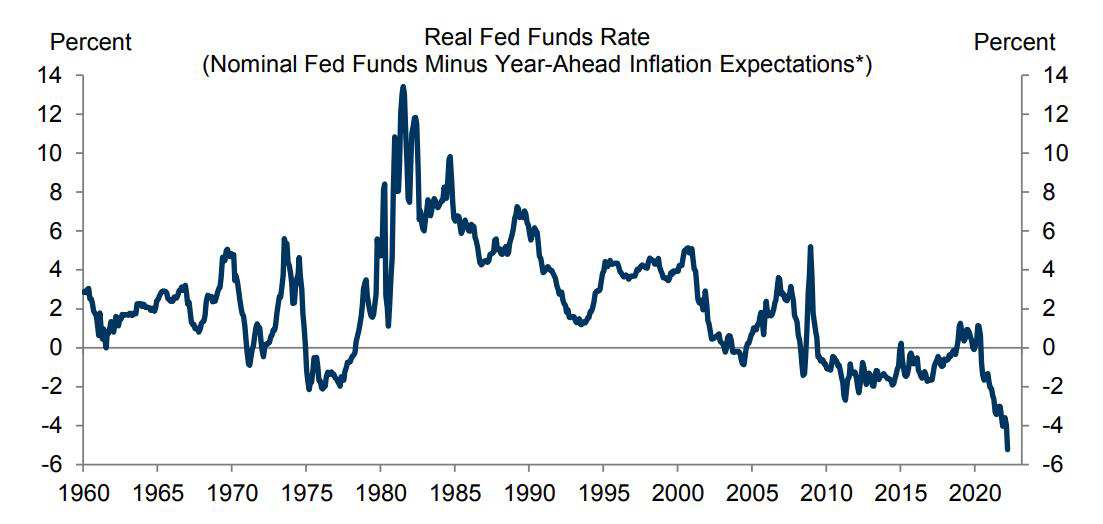
12. This plots the real Fed Funds rate, with the inflation adjustment coming from market-based expectations. It levels sets just how crazy easy the starting point is for this tightening cycle -- perhaps part of the reason stocks have held up decently of late -- while also inviting the question of “how could this possibly get any better from here”:
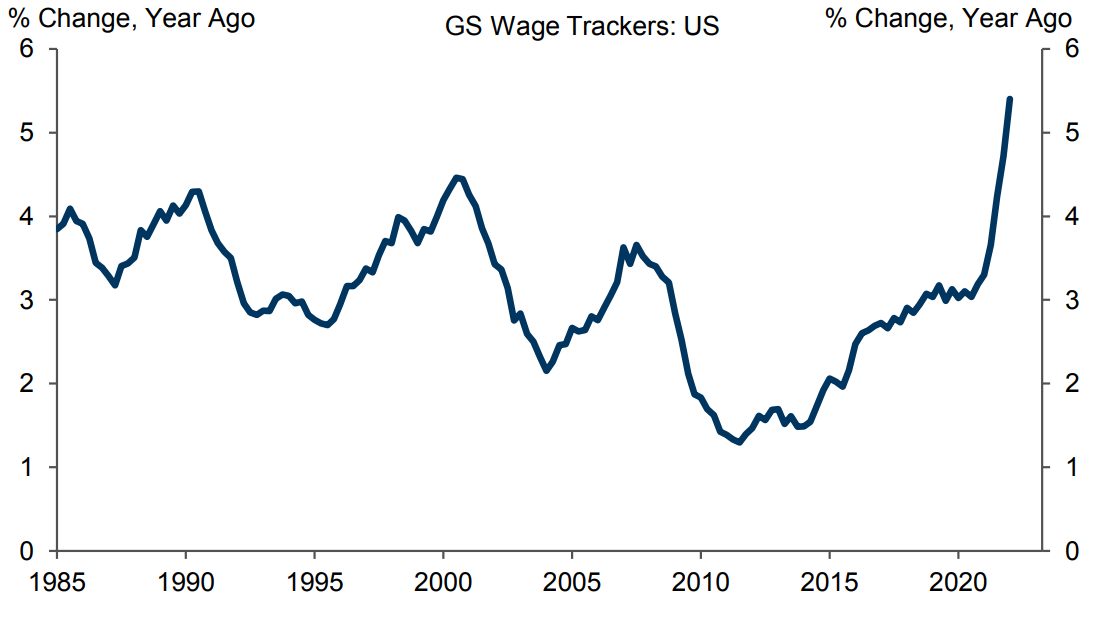
13. Then there’s this show stopper -- also subject to your interpretation -- the GS wage tracker. My view: while it’s hard to think the gradient of this slope can be sustained forever, I also don’t see it turning meaningfully lower anytime soon:
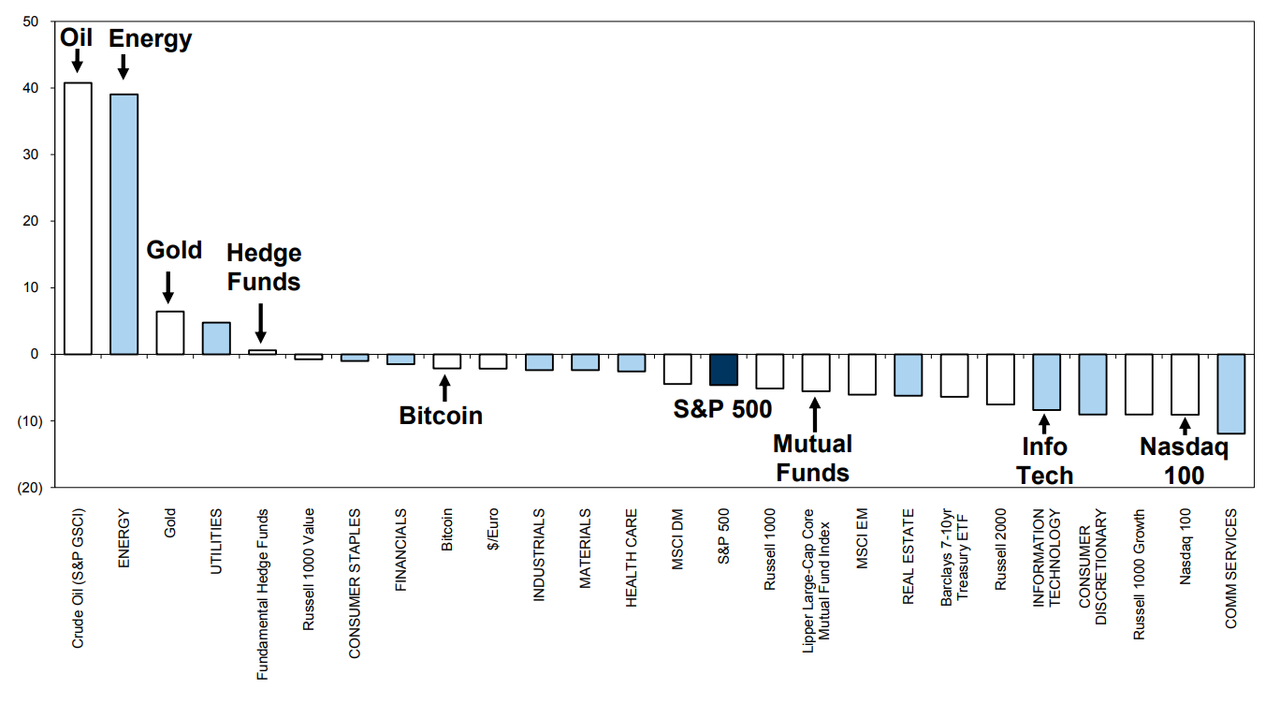
14. A chart that (actually) tells you everything you need to know about Q1:
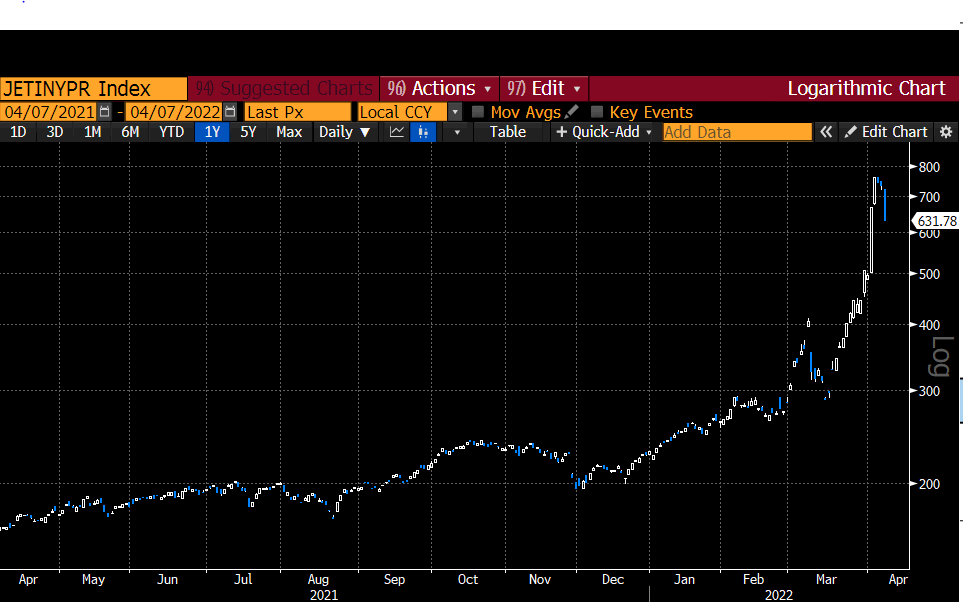
15. Speaking of energy prices ... this is what the cost of jet fuel looks like. From Callum Bruce in GIR: “ultimately, it’s a specific locational issue that is not significant to broader balances, but is nevertheless symptomatic of tight market and shows the binding, physical nature of commodity shortages and their large upside convexity at low storage levels. more of these events are in store.”
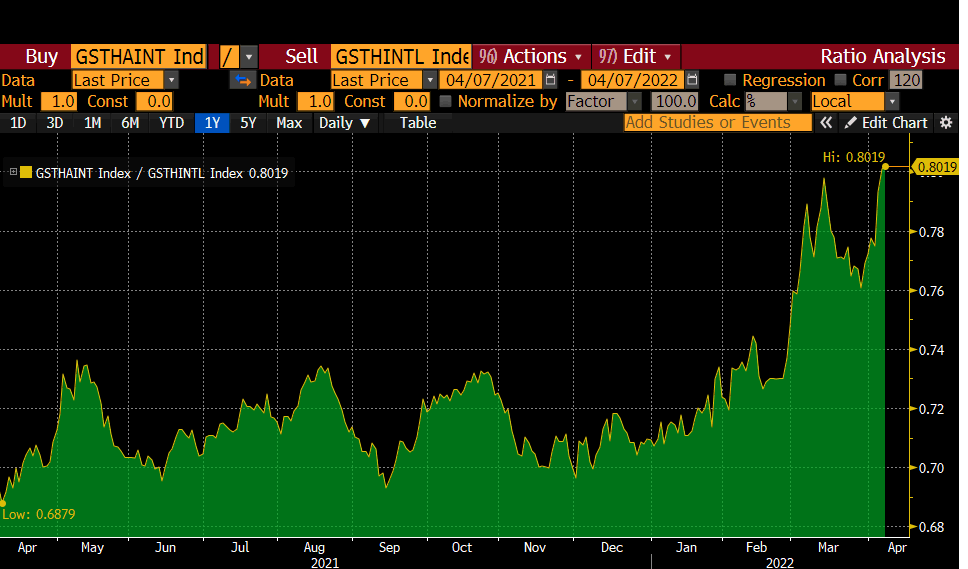
16. The more I travel around, the more I think the primary destination for capital is the US for now. In a similar vein, the market is very clearly rewarding companies with leverage to the US vs those with leverage to offshore revenues:
17. Scott Feiler, GMD: “at the idea dinners I attended in November/December, shorting the low-income consumer was the most popular idea. that was just due to compares, lack of stimulus, lack of child tax credit etc. that had not even contemplated higher gas prices. here we are though at the end of 1Q and our GS low-income basket outperformed the high-income basket by 500 bps. many of the low-income stocks have heavy consumables exposure and have simply outperformed. Our conversations have shifted dramatically the last 3 weeks, with investors looking to more middle-income type names that are heavily discretionary and have chunky dollar purchases that a consumer might forgo ... our baskets team put a basket together last week that they think addresses this theme, with the title being the ‘middle income discretionary basket’ (ticker GSCNSMDI Index).” note the ratio of this basket vs S&P.

CruncBase : The Week’s 10 Biggest Funding Rounds: Remote Brings Home $300M, Gran

The Week’s 10 Biggest Funding Rounds: Remote Brings Home $300M, Grand Ole Opry Raises $293M

Some weeks are heavy on fintech, others are big on biotech. This week, however, was all over the board. From HR solutions that help hire workers overseas to a legendary music landmark to crypto, investors spread their money far and wide. They also spread a lot of it around. Six rounds that went to U.S.-based companies were of $200 million or more.
1. Remote, $300M, human resources: Companies are finding it harder to find good employees and are having to cast a wider net. That is where San Francisco-based Remote can help. The company calls itself an “employer of record service”—allowing companies to make hires and handle payroll and compliance in countries where they don’t have existing operations. It also can help businesses manage independent contractors worldwide. That business model is attractive right now, and less than a year after closing a $150 million Series B at a valuation of more than $1 billion, Remote raised a $300 million Series C led by SoftBank Vision Fund 2.
2. Opry Entertainment Group, $293M, media: Yes, even Nashville, Tennessee’s famed Ryman Auditorium is receiving funding. Atairos and NBCUniversal took a 30 percent stake in the Opry Entertainment Group, which consists of the “Grand Ole Opry” stage show and media rights, the Ryman Auditorium, a radio station and the “Grand Ole Opry” streaming channel. The deal comes to a $293 million investment, with Atairos agreeing to invest another $30 million if certain performance targets are met. The deal values the media and entertainment company at $1.4 billion—which surely would stop even the legendary Hank Williams from “Moanin’ the Blues.”
3. (tied) Fetch Rewards, $240M, e-commerce: Everybody loves to be rewarded when they shop. Investors are hoping to be rewarded for their new deal with Madison, Wisconsin-based Fetch Rewards. Fetch, a consumer-rewards app, locked up a $240 million equity and debt round led by Hamilton Lane on behalf of clients that raised the company’s valuation to $2.5 billion. The company—whose digital loyalty and marketing platform has more than 13 million active users—has now raised more than $500 million.
4. (tied) Grafana Labs, $240M, analytics: People must really love to be able to visualize analytics. Just seven months after closing a $220 million Series C, New York-based Grafana Labs locked up a $240 million Series D led by GIC, with participation from new investor JP Morgan. The company’s open-source software platform helps monitor and visualize data. Founded in 2014, the company has now raised more than $535 million, according to Crunchbase data.
5. Binance.US, $200M-plus, crypto: San Francisco-based crypto exchange platform Binance.US—the American franchise of Binance—closed a seed round of more than $200 million at a pre-money valuation of $4.5 billion. The deal included investment by RRE Ventures, Foundation Capital, Original Capital, VanEck, Circle Ventures and others. The round is yet another signal of investors’ appetite for all things crypto—especially in this case where they are investing in the U.S. franchise of the world’s largest crypto exchange.
6. Neiman Marcus Group, $200M, retail: Dallas-based apparel retailer Neiman Marcus Group received a $200 million minority equity investment from online luxury fashion platform Farfetch.
7. LogicSource, $180M, enterprise software: Norwalk, Connecticut-based procurement platform LogicSource raised $180 million from FTV Capital. The company has now raised a total of nearly $230 million, according to Crunchbase data.
8. Clarify Health, $150M, health care: San Francisco-based Clarify Health, a cloud analytics and platform for better health care, secured a $150 million Series D financing led by SoftBank Vision Fund 2.
9. BostonGene, $150M, health care: Waltham, Massachusetts-based biomedical software developer BostonGene closed a $150 million Series B led by NEC Corp.
10. IntelyCare, $115M, health care: Quincy, Massachusetts-based IntelyCare, a tech-enabled nurse staffing platform, raised a $115 million Series C led by Janus Henderson Investors at a $1.1 billion valuation.
Big global deals
The three top deals were done outside the U.S. this week, including a raise by a retailer at a whopping $100 billion valuation—a centa-corn?

TechCrunch : The US needs a tech doctrine

The US needs a tech doctrine

The TechCrunch Global Affairs Project started with a simple premise: that technology is increasingly intertwined with global affairs and that we ought to examine what that means for both. From crypto to climate, international development to defense procurement, I hope we’ve done just that.

Reflecting on the nearly 40 pieces we’ve published over the last few months, I can’t help but see a few common threads emerge: Tech industrial policy is increasingly in favor. Emerging tech is top of mind. And where China isn’t setting the pace, it isn’t far behind.

While the U.S. has made remarkable strides in meeting these challenges (see my piece on the State Department’s new cyber bureau), it still lags on perhaps the most important one: navigating the increasing fusion of geopolitics and technology. If the U.S. is to succeed in the contest for the 21st century, it needs more than new agencies or investments in infrastructure (however large they may be). Even an industrial strategy is insufficient.

What America needs is a geopolitical technology doctrine.

What do I mean by a doctrine? Well for the most part, technology policy can be seen in two ways. The first is as a new security domain. The public and private sectors have spent billions of dollars improving our cyber capabilities to both protect our civil and military networks and acquire the ability to strike our adversaries. While many of our networks are still woefully vulnerable, we generally know the challenges and are making strides to shore up our defenses.

The second follows the thesis that the future will be won by whichever country controls (and integrates into its economy) the most advanced technologies. Thus tech policy becomes a function of broader economic competition. This is the ground on which much of our current debate is held — are we on the right track on emerging tech like 5G, quantum or artificial intelligence? Are our supply chains secure? What regulatory edge can we give American tech companies? How can we work with allies to jump-start those efforts?

These two facets of technology policy are incredibly important — and well worth the attention paid to them in this series and elsewhere. Look only to Russia, which has found itself cut off from Western tech supply chains and software updates as a result of its invasion of Ukraine.


But they shortchange a significant element of tech’s role in geopolitics that I hope we’ve raised here as well. That yes, tech is an asset. But like other economic resources (ahem, the U.S. dollar), tech can also be a leverage point that gives policymakers clever ways to further broader foreign policy interests. Yet for the most part, we have not thought systematically about how to wield this power — or protect it.

Our rivals aren’t so diffident. As with many asymmetric capabilities, it’s the authoritarian regimes, unconcerned by scruples over such things as human rights or the rule of law, that have pioneered creative and effective — if odious and unethical — geopolitical tech strategies.

Early in our series, Scott Carpenter warned about the baleful trend of dictators simply shutting down the internet to deprive their citizens of information. Matthew Hedges and Ali Al-Ahmed wrote about how regimes have deployed spyware to hunt down dissidents — and how countries like Israel have exported this technology to lubricate their own diplomacy. Jessica Brandt explored how Russia and China use social media to spread disinformation that discredits the West. And Samantha Hoffman wrote about how China uses data its firms collect to acquire intelligence around the world.

Obviously these are not practices democracies should emulate, and even if they wanted to, law, custom and democratic accountability would mostly preclude it. And the U.S. and its allies can’t make tech companies arms of the state. But they do raise important questions about where technology fits in American statecraft.

For the last two decades, American tech companies have dominated the landscape with a simple strategy: growth at all costs. And the U.S. government, equating tech’s success with America’s, has let tech — especially Big Tech — do just that, essentially ceding the regulatory space until quite recently.

But the world is too sophisticated, and “growth” too blunt a tool, for that to remain the goal moving forward. Should tech supremacy be pursued for its own sake as an expression of American soft power? For economic position? As a means to best our rivals? Or because it is something that can be weaponized?

The answer can’t just be “yes” and “more.” We need a new framework that reconciles what tech can do with what it should do — and with what we as a nation need it to do.

Even if we can agree that U.S. interests are served by technological dominance, that still leaves a crucial question unanswered: How should tech be wielded geopolitically?

Western technology export controls on Russia in response to its invasion of Ukraine are an encouraging use of geotechnological hard power. But Washington can be even more creative; it might use an emerging technology like crypto to bolster U.S. dollar dominance, like Connor Spelliscy suggested or deploy technology to enforce treaties we value, as Thomas McInerney described.

But America is most effective when it plays to its strengths, building upon alliances, networks and the rule of law. That might entail using technology as a tool to expand democracy, per Vera Zakem; stepping in, as Australia did, to build a cable to Pacific islands in lieu of China; or working with Apple and Google to protect dissidents. The U.S. should also take lessons from Ukraine’s creative information campaign against Russia to deploy in future conflicts.

Rather than fruitlessly trying to dictate outcomes, a better strategy would be to encode liberal values in emerging technologies. China has recognized that growing its tech sector is not enough if it doesn’t also set the rules of the road. That’s why it has become very successful at dominating the global fora that set new technology standards. And it’s not just a question of writing rules that benefit Chinese companies (i.e., Huawei in 5G); if authoritarian regimes are able to encode their repressive values in the rules and norms around critical emerging technology like AI, autonomous weapons or biotechnology, it could pose a serious threat to freedom and human rights everywhere. The U.S. and its allies must do the hard work to push back by attending to the patient, technical diplomacy that they have too often overlooked.

Above all, a proper geopolitical tech doctrine would, like all good strategic concepts, recognize limits. The U.S. is no longer Colossus bestriding the world, and it would be folly to think it can impose its will, even on its allies. Americans can’t achieve internet freedom just by wishing it so — and should accept that not every country’s internet needs to be identical for a free and open internet to succeed. If Apple, with a single policy decision, can cut Facebook’s market capitalization by a quarter, there’s no reason why (democratic) governments shouldn’t be able to have reasonably different regulatory regimes in their own jurisdictions.

Americans (and American tech companies) have grown used to having it all. But as technological supremacy becomes increasingly central to geopolitics, tech policy will no longer be made in a vacuum. Politics is the art of making choices, and Silicon Valley doesn’t have to like all of Washington’s. Perhaps, from Washington’s point of view, the global ambitions of American tech firms are no longer tenable if they clash with our values and interests.

What might that mean? Western tech firms have just shown that they can choose sides, voluntarily leaving Russia to either show solidarity with Ukraine or to not violate their principles by censoring their content. Meta and Elon Musk are now heroes in Ukraine; the former for permitting users to call for the death of Putin and Russians; the latter for deploying his StarLink platform to ensure Ukraine stays online.

But harder trade-offs beckon: Should Apple and Tesla give up their Chinese factories? Should America force Chinese tech firms like TikTok from its shores? Having set the precedent in Russia, these are realistic scenarios that Washington might consider — and that Silicon Valley must plan for.

Zooming out, what happens when American tech priorities conflict with broader diplomatic agendas? Should the U.S. government ally with Brussels on antitrust, or stand up on behalf of U.S. tech companies? What happens when the interests of the tech sector conflict with stability in Taiwan or progress on climate change? These are essential questions that are as yet unanswered.

Meanwhile, national security planners must consider that we are once again in an era of great power war. The Ukraine conflict has surprised many with its conventionality — but it has also proven a testing ground for new tech like drones. We are also seeing a war play out in a fully online society for the first time — don’t discount the immense soft power Ukraine has yielded through social media. Would Western support be so strong without Kiev’s polished online presence (or propaganda, as one might call it)?

A year ago, I asked how tech factored into U.S. foreign policy. America is surely in a better place than it was then. Technology is rightly taking center stage in its foreign affairs and national security agendas.

But if the U.S. is to maintain its leading global role – much less avoid falling behind its rivals — it must do more than foster innovation and develop new capabilities with little more justification than “for innovation’s sake.” It must develop a doctrine that comprehensively considers how all aspects of technological statecraft — cyber, antitrust, regulatory, supply chains, basic science, standards, not to mention the role of tech companies themselves — can best serve U.S. foreign policy objectives. Failing to do so doesn’t just risk strategic muddle, but wasting perhaps America’s greatest assets: its entrepreneurial and scientific excellence. Nothing less than American power, prestige and prosperity are at stake.

The Information : Meta Platforms is Struggling to Develop Its Own Device Chips

Meta Platforms is Struggling to Develop Its Own Device Chips

In late 2021, a team of Meta Platforms employees building a key chip for the second version of Meta’s Ray-Ban smart glasses was notified that the company had decided to go with an alternative chip from Qualcomm, according to two people familiar with the matter. The custom chip would power a variety of functions, such as taking high-quality photos and videos, on the glasses. But Meta’s augmented reality chief, Alex Himel, decided using it could delay the glasses’ launch, expected next year.

The decision was a setback for Meta’s in-house silicon unit known as Facebook Agile Silicon Team. Code-named Brasilia, the chip was part of a broader effort by Meta to control key technologies and reduce its reliance on off-the-shelf silicon providers like Qualcomm, which supplies chips for Meta’s Quest VR headsets, Portal smart video devices and the first version of the Ray-Ban glasses. By building its own power-efficient chips to manage its burgeoning stable of augmented and virtual reality devices, Meta would have far greater control over the features, size and battery life of its products and be better positioned to compete with rivals like Apple.

THE TAKEAWAY
• Meta is building custom silicon for future hardware devices
• It abandoned custom chip for Ray-Ban glasses in favor of Qualcomm alternative
• Silicon team is working on chip for future smart watch

The Brasilia chip design was far enough along that it was ready for trial production. Had it gone further, Brasilia would have been the first in a line of custom chip designs for a Meta-designed consumer device.

The flip-flop highlights the tension between Meta’s goal to build more of the underlying technology for its hardware devices and its desire to get products out quickly. Meta has also run into challenges on the software side. In recent months it abandoned an effort to build its own operating system, XROS, for its forthcoming AR glasses, The Information reported. The first version of the AR glasses will instead run on a customized version of Google’s Android OS.

The stakes are high. AR/VR devices are key to Meta CEO Mark Zuckerberg’s bet on the metaverse, a type of immersive internet in which people will move through digital environments wearing AR and VR devices.

Qualcomm is supplying the key chips for Meta’s forthcoming VR headset, externally code-named Cambria and internally known as Arcata, which is due to come out around September, according to a person familiar with the matter.

Apple, in contrast, is expected to use its own chip designs in its upcoming mixed reality headset, expected to launch later this year or in early 2023, The Information reported last year. Apple has led the way in designing its own chips for iPhones and MacBooks, while Google has begun putting its own chips into its Pixel line of smartphones and is also reportedly making the chip for its upcoming AR headset.

Differentiated Features

Custom-designed chips give hardware makers the ability to offer differentiated features such as translating foreign languages and smoothing out photos, particularly when they’re also building the software, as is the case with both Apple and Google. Buying off-the-shelf silicon from firms like Qualcomm and MediaTek, in contrast, makes it harder for device makers to offer distinctive services. Meta’s competitors in AR/VR devices—including Snap, HTC and ByteDance’s Pico Interactive—use the same Qualcomm chips.

The goal of the Brasilia chip was to add features like the ability to take higher-quality pictures than Meta’s current Ray-Ban Stories can capture, according to a person familiar with the matter. Meta is also developing chip technology to enable AR features, such as audio that sounds like it is coming from different directions and real-time visual filters and effects that are executed on an accompanying phone, according to a Meta spokesperson.

“The goal is to do something that a competitor can’t, which you can’t do if you just buy the same chips that your competitors buy—there’s very, very little differentiation in that scenario,” said Ben Bajarin, an analyst at Creative Studios who covers the consumer tech market. The fact that Apple builds the silicon for its products “allows them to do a whole host of things that others can’t and [to] laser-focus their architectural decisions to their ambitions in hardware,” he said.

While Meta will not use the new Brasilia chip itself in a new product, the company could reuse the technology behind it in other chips for future products, according to a person familiar with the matter. The FAST team is working on other products, including custom silicon components for Meta’s planned AR glasses, known internally as Orion, which are not expected to be released for several years, the person said. This silicon relates to display and machine perception, including motion detection and vision tracking. The FAST team is also focusing on a chip code-named Carson, intended for a future version of Meta’s planned smart watch.

Old Guard v New Guard

Formed in 2018, the silicon team has more than 1,000 employees and is led by Shahriar Rabii, who joined Meta that year from Google, where he worked on silicon engineering and development. FAST is part of Reality Labs—the division overseeing Meta’s AR/VR products—but is mainly based out of the company’s Sunnyvale, Calif., campus. That facility has more lab space for testing than Meta’s newly built Burlingame, Calif., campus, where most of Reality Labs is based.

The FAST team is run separately from a smaller Meta team that develops custom silicon for the company’s sprawling data-center infrastructure. That infrastructure team has about 150 people and has worked on chips for machine learning as well as encoding and decoding digital video, according to a person familiar with the matter.

Complicating FAST’s efforts is Zuckerberg’s desire to get new products into the market quickly, before rivals have a chance to establish themselves, and to remain agile, factors that proved decisive in putting an end to the Brasilia project for the Ray-Ban smart glasses.

AR chief Alex Himel, who has the power to make decisions about product and the market strategy for the Ray-Ban glasses, worried that using the Brasilia chip would delay the release of the second version, based on internal forecasts from his team about the project, according to two people familiar with the matter. Meta’s team already had experience working with Qualcomm’s chips, and hence viewed the decision to stick with them for another generation as lower risk, one of the people said. The decision caused frustration and disappointment among some inside Reality Labs who argued that the company should stick with Brasilia.

Qualcomm, meanwhile, has positioned itself as the leading chip provider in the XR industry. (XR is a catch-all term for VR, AR, and mixed reality.) The company recently announced a $100 million metaverse fund to invest in companies and developers building technologies for the metaverse. Qualcomm has also formed partnerships tied to VR and AR work with Microsoft, Niantic and Pico.

In an interview with The Information in March, Hugo Swart, vice president of XR at Qualcomm, said Meta and Qualcomm had a “very strong partnership,” noting that Qualcomm built its XR2 chip with many of Meta’s requirements baked in. Asked about Meta’s dual role as both a partner and a would-be competitor to Qualcomm, Swart made a comparison with mobile, an industry in which some of Qualcomm’s customers use a mixture of Qualcomm and their own chips. “I think that’s part of the business,” Swart said. “It’s part of how the industry operates.”

Qualcomm is currently developing two new chips that can be used for VR headsets, according to a person familiar with the matter.

The XR2 Pro, which it will likely unveil later this year, is based on the existing XR2, but the memory, or RAM, will be in a separate location rather than built on the main chip, making the device more powerful, the person said.

The XR2 Pro Generation 2, which Qualcomm might unveil in 2024, will be its first chip built specifically for XR. The existence of the chips has not previously been reported. Qualcomm declined to comment.

WSJ : Bank Deposits Could Drop for First Time Since World War II

Bank Deposits Could Drop for First Time Since World War II
Analysts have been slashing expectations for bank deposits in recent weeks as Fed rate increases ripple through the industry

U.S. banks have a streak of increasing deposits as a group every year since at least World War II. This year could break it.

Over the past two months, bank analysts have slashed their expectations for deposit levels at the biggest banks. The 24 institutions that make up the benchmark KBW Nasdaq Bank Index are now expected to see a 6% decline in deposits this year. Those 24 banks account for nearly 60% of what was $19 trillion in deposits in December, according to the Federal Deposit Insurance Corp.

While some analysts doubt the full-year decline will happen, even the possibility would have been unthinkable a few months ago. Bank deposits have grown at unprecedented rates during the pandemic. At the end of February, analysts were forecasting a 3% increase. But analysts have cut $1 trillion from their estimates since then, according to a review of FactSet data.

A decline isn’t going to hurt the banks. The flood of deposits had become a headache as it had big banks nearing regulatory limits on their capital. Banks had already been pushing many depositors aside because they weren’t able to put the money to work as loans.

The industry has $8.5 trillion more in deposits than loans, according to Barclays analysts. While loan demand is expected to increase, and the banks need deposits to fund the lending, that is more than enough.

“These are deposits they don’t really need,” said Barclays analyst Jason Goldberg.

The force stirring the change is the Federal Reserve. Forecasts from Fed officials and economists now call for sharp increases in the Fed’s core interest rate to combat inflation. That will ripple through the banking industry in myriad somewhat unpredictable ways.

“This is in no way traditional Fed tightening—and there are no models that can even remotely give us the answers,” JPMorgan Chase & Co. Chief Executive Jamie Dimon wrote in his annual shareholder letter last week.

Bank stocks have dropped along with changing Fed views. The KBW Index started the year heading higher as the S&P 500 fell. But it has lost nearly 20% since the middle of January and is now down 9.4% for the year, while the S&P 500 has lost 5.8%.

Banks were supposed to be the big beneficiaries of a slow and methodical increase in interest rates. That would allow them to charge more on loans and keep near zero the amount they are paying depositors. Banks, after all, won’t pay more for funding they don’t need. That combination would boost what had been record-low profit margins.

The last time the Fed increased rates, deposit growth slowed but was still positive, so bankers were expecting the same.

But what happened the past two years to set the stage for this year has no precedent. During the pandemic, consumers stashed away stimulus checks and businesses stockpiled cash to deal with shutdowns and supply-chain issues. Total deposits increased $5 trillion, or 35%, over the past two years, according to FDIC data.

Analysts and bankers think those aren’t likely to stay around. Citigroup estimated banks have $500 billion to $700 billion in excess noninterest paying deposits that could move quickly.

The most likely beneficiaries are money-market funds, short-term investments that often capture overflowing deposits from banks.

The money-market funds started parking the overflow at a newer program at the New York Fed for short-term storage. That program, known as the reverse repo, has about $1.7 trillion in it now after being mostly ignored since its 2013 creation.

Because it is so new, and suddenly so big, bankers and analysts have been unsure what will happen with those funds as the Fed started moving rates. For months, many viewed them as excess funds that would follow the general idea of “last in, first out.”

Now, some analysts are reversing that theory. They expect money-market funds to march their rates higher along with the Fed, which would keep them more attractive than bank deposits, especially if the Fed raises its benchmark rate a half percentage point next month, as expected.

The average rate on savings accounts stood at roughly 0.06% on March 21, according to the FDIC, compared with 0.08% for money-market accounts. Savings accounts interest rates aren’t expected to move much until loan demand and deposit levels come back into balance.

Demand for the New York Fed program has increased in recent weeks as expectations for bigger Fed hikes have emerged, said Isfar Munir, U.S. economist at Citigroup.

“We’ve had to revise our estimates entirely,” Mr. Munir said.

SCMP : China makes delivery of anti-aircraft missiles to Russian ally Serbia, sa

China makes delivery of anti-aircraft missiles to Russian ally Serbia, say military experts
  • The Chinese cargo planes with military markings were pictured at Belgrade’s Nikola Tesla airport on Sunday
  • The move raises concerns that an arms build-up in the Balkans during the war in Ukraine could threaten the fragile peace in the region

Russian ally Serbia took the delivery of a sophisticated Chinese anti-aircraft system in a veiled operation this weekend, amid Western concerns that an arms build-up in the Balkans at the time of the war in Ukraine could threaten the fragile peace in the region.
Media and military experts said on Sunday that six Chinese Air Force Y-20 transport planes landed at Belgrade’s civilian airport early on Saturday, reportedly carrying HQ-22 surface-to-air missile systems for the Serbian military.
The Chinese cargo planes with military markings were pictured at Belgrade’s Nikola Tesla airport. Serbia’s defence ministry did not immediately respond to a request from Associated Press for comment.

The arms delivery over the territory of at least two Nato member states, Turkey and Bulgaria, was seen by experts as a demonstration of China’s growing global reach.
“The Y-20s’ appearance raised eyebrows because they flew en masse as opposed to a series of single-aircraft flights,” wrote The Warzone online magazine. “The Y-20′s presence in Europe in any numbers is also still a fairly new development.”
“The Chinese carried out their demonstration of force,” said Serbian military analyst Aleksandar Radic.
Serbian President Aleksandar Vucic all but confirmed the delivery of the medium-range system that was agreed in 2019, saying on Saturday that he will present “the newest pride” of the Serbian military on Tuesday or Wednesday.
He had earlier complained that Nato countries, which represent most of Serbia’s neighbours, are refusing to allow the system’s delivery flights over their territories amid tensions over Russia’s aggression on Ukraine.

Although Serbia has voted in favour of UN resolutions that condemn the Russian attacks in Ukraine, it has refused to join international sanctions against its allies in Moscow or outright criticise the apparent atrocities committed by the Russian troops there.

Back in 2020, US officials warned Belgrade against the purchase of HQ-22 anti-aircraft systems, whose export version is known as FK-3. They said that if Serbia really wants to join the European Union and other Western alliances, it must align its military equipment with Western standards.

The Chinese missile system has been widely compared to the American Patriot and the Russian S-300 surface-to-air missile systems although it has a shorter range than more advanced S-300s. Serbia will be the first operator of the Chinese missiles in Europe.

Serbia was at war with its neighbours in the 1990s. The country, which is formally seeking EU membership, has already been boosting its armed forces with Russian and Chinese arms, including warplanes, battle tanks and other equipment.
In 2020, it took delivery of Chengdu Pterodactyl-1 drones, known in China as Wing Loong. The combat drones are able to strike targets with bombs and missiles and can be used for reconnaissance tasks.

There are fears in the West that the arming of Serbia by Russia and China could encourage the Balkan country toward another war, especially against its former province of Kosovo that proclaimed independence in 2008. Serbia, Russia and China don’t recognise Kosovo’s statehood, while the United States and most Western countries do

WWD : Galeries Lafayette Reveals Plans for Wellness Department

Galeries Lafayette Reveals Plans for Wellness Department
The holistic concept, due to open in mid-July, includes products, services, a gym and a restaurant.

PARIS — Galeries Lafayette is poised to launch an immense wellness department this summer.

The space — home to products, services, a gym and a restaurant — will be situated on the minus-one floor of the department store’s main building on Boulevard Haussmann and open in mid-July.

Galeries Lafayette has been carrying out widespread renovations over the past 18 months, throughout the coronavirus pandemic.

“We continued to improve customer journeys with the creation of a third set of escalators,” said Alexandre Liot, general manager of Galeries Lafayette Haussmann. “We renovated our historic cupola, which had not been redone since its creation.”

Other initiatives included opening (Re)Store, devoted to circular and second-hand fashion in the womenswear department.

“And then, we took the time to see what the consumer trends were and — above all — their expectations,” said Liot. “We realized our customers didn’t just want to buy goods, but they also wanted to do good for themselves. That’s what guided us on this project.

“The [post-COVID-19] department store strikes back, with everything — innovation, expectation, exclusivity — under the same roof, which is its historic strength,” he continued.

“In looking at the market’s evolution — notably in the United States, which is still very much in advance in terms of well-being, and also Japan — we said to ourselves ‘the beauty of tomorrow’ is no longer just about selling products, but also about doing yourself good,” he said.

Further, consumers today are expecting differentiation and innovation from physical stores.

Galeries Lafayette’s minus-one floor, among the most frequented, was formerly the shoe department, which was relocated to the fourth floor. That meant 32,290 square feet of space became available.

“We really wanted to create and be the reference for well-being and wellness in Paris — and even in Europe,” said Liot, who maintains nothing of this kind exists anywhere else there. “We chose the best in their areas of expertise present on [French] territory, or totally exclusive concepts not yet in France.

“We balanced the two,” he teased, without naming names of the specific brands chosen. “We will have all of the products that correspond to well-being — dietary supplements, creams, hair products. It will really be the temple of wellbeing.”

Treatment rooms are to offer the likes of massage and alternative medicine. The gym, hosting fitness classes, will be open before and after store hours.

Athleisure is to be sold on this floor, too, and there will be a restaurant serving food conceived with well-being in mind. (Also on the culinary front, Galeries Lafayette, in its Maison et Gourmet building, will add a supplementary floor dedicated to restaurants in September.)

“For this space there are codes totally different from those of the department store, from what one is used to seeing on the other floors,” the executive said of the well-being department.

The wellness market has enormous potential, having doubled in size globally over the past four years, according to the Global Wellness Report. Yet the category remains highly segmented and accessible to only a small number of people in France.

“The spirit of Galeries Lafayette is it’s everyone’s department store, and we really want this universe to be accessible to everyone,” said Liot, adding massages and other treatments will be available for 45 euros to 400 euros. “So it really democratizes access to well-being.

“We always try to be one step ahead of our environment and also of our competitors,” he said. “It is also important for us to continue putting into practice our philosophy — namely, that customers and visitors need experiences, and constantly renewed experiences. It’s a leitmotif we’ve had for a very long time.”

Liot cited the department store’s historic slogan: “Something is always happening at Galeries Lafayette.”

“We continue to live that today, with this project,” he said.