>>> Objects Of Desire: Record-Breaking Auction Sales In 2021

Objects Of Desire: Record-Breaking Auction Sales In 2021

2021 may have been the year of the NFT, but, as Visual Capitalist's Marcus Lu and Rosey Eason detail below, wealthy collectors still dropped plenty of cash on physical objects. This included the usual items like paintings and cars, as well as some more obscure ones like meteorites.
To gain insight into the world of rare collectibles, this infographic summarizes the biggest auction sales of 2021, spread across 12 different item categories.
The Numbers
The key details of these sales are listed below in tabular format. Some broke all-time records, while others set the record for 2021 specifically.
The Details
Here are some interesting facts and details about these rare collectibles, starting with:
Pablo Picasso’s Femme assise près d’une fenêtre (Marie-Thérèse)
This 1932 painting is a depiction of Picasso’s lover, Marie-Thérèse Walter (1909-1977). Walter is believed to have had a significant impact on Picasso’s work, and the pair had a child out-of-wedlock in 1935.
He loved the blondeness of her hair, her luminous complexion, her sculptural body.
– BRASSAÏ
Sold by Christie’s in New York, this was the first painting to auction for over $100 million in nearly two years. The all-time record holder is Leonardo da Vinci’s Salvator Mundi, which sold for $450 million in 2016 to Mohammed Bin Salman, the Crown Prince of Saudi Arabia.
1995 McLaren F1
Produced between 1992 and 1998, the McLaren F1 is widely regarded as one of the most desirable supercars in the world. It features many innovations that are still rare in modern road cars, including a carbon fiber monocoque (the main structure of the car), active aerodynamics on the underbody, and a centered driving position.
The F1’s legacy is cemented by the fact that only 106 were ever produced, many of which have been owned by celebrities. That includes Elon Musk, who famously crashed his F1 in 2000 without insurance.
The specific car highlighted above was sold by Gooding & Company, a classic car auction company. It has just 242 miles (390 km) on the clock, which translates to an average of 9.3 miles (15 km) being driven on the road per year.
1933 Double Eagle Coin
The 1933 Double Eagle is one of the last $20 gold coins ever produced in the United States. It dates back to an era when the U.S. dollar’s value was tied to gold, which is a system known as the gold standard. The coins were melted down when the U.S. transitioned to fiat money, and only 13 examples are known to exist today.
After selling for $18.9 million, this Double Eagle holds the title as the most valuable rare coin in the world.
The Revolver Used to Kill Billy the Kid
The Colt single-action revolver that was used to kill Billy the Kid is now the most expensive firearm ever sold at an auction. It belonged to Sheriff Pat Garrett, who killed Billy in 1881.
Billy is one of the most notorious figures from America’s wild west era and was responsible for the deaths of eight men, including two sheriff’s deputies during an escape from jail.
Because of Billy’s legacy, this revolver is lauded as one of the most desirable Western firearms in existence. Surprisingly, it was the gun’s first appearance in a public auction.
Final Text of the United States Constitution
This first-edition copy of the U.S. constitution is an incredibly rare and historically significant artifact. The story of how it sold is equally as impressive.
Bidding came down to two parties, one of which was Ken Griffin, billionaire CEO of Citadel. If you’re an investor, that name may sound familiar—Citadel was a hedge fund involved in the r/wallstreetbets saga of 2021.
The other party was ConstitutionDAO, a group of 17,000+ crypto investors who pooled together $47 million worth of Ethereum. The term “DAO” refers to a decentralized autonomous organization, which is an online entity that’s collectively owned by its members without centralized leadership—and that takes action based on transparent rules set on a public blockchain.
In the end, the copy was sold to Griffin for a total of $43.2 million. Organizers of ConstitutionDAO could not place a higher bid because they wouldn’t have had enough money to insure, store, and transport the document.
About Those NFTs…
NFTs only exist in the digital realm, but they’ve quickly become some of the world’s most valuable collectibles. How valuable, you may ask?
For starters, consider the $7.6 million sale of CryptoPunk #3100, a profile picture (PFP) NFT that depicts a blue zombie. Then there’s The Merge, a digital artwork comprised of 312,686 pieces. In December 2021, it was sold to a collective of 28,983 buyers who, altogether, paid $91.8 million.
All of this hype has led some of the world’s oldest auction houses to begin selling NFTs through online events. This includes Christie’s (founded in 1766), which surpassed $100 million in NFT auction sales in less than a year.
Whether this momentum can carry forward is questionable. Interest in NFTs has plummeted, and crypto markets remain incredibly volatile.

(ZH) The Commodity-Currency Revolution Begins...

The Commodity-Currency Revolution Begins...

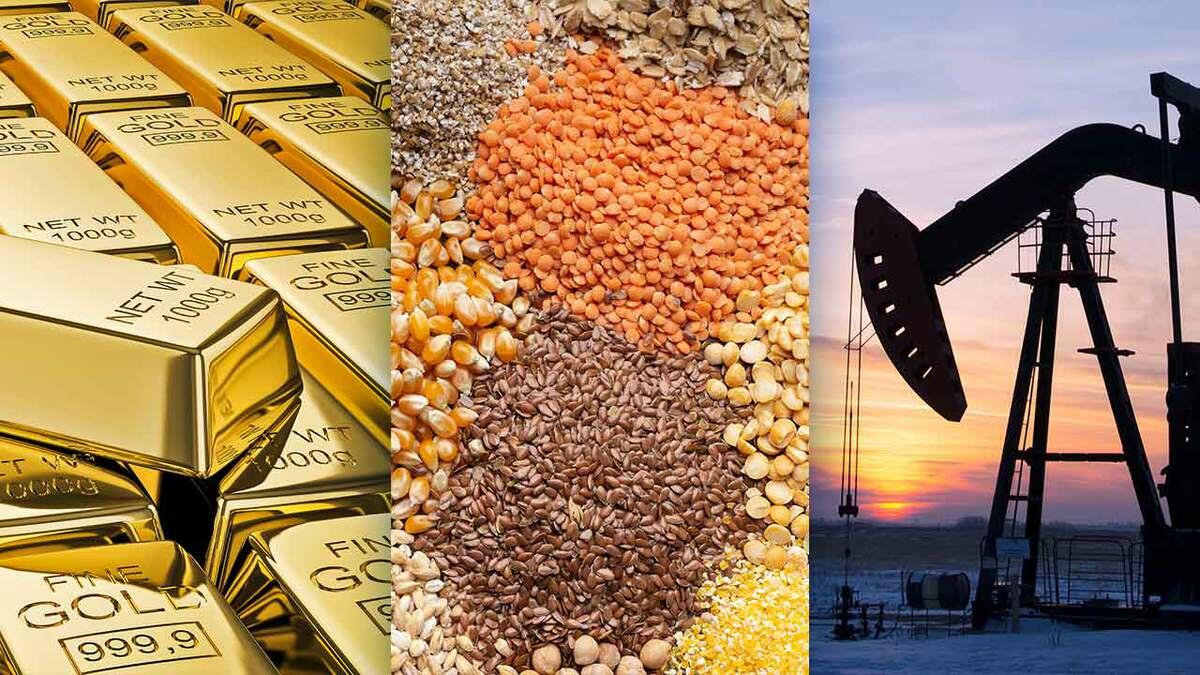
We will look back at current events and realise that they marked the change from a dollar-based global economy underwritten by financial assets to commodity-backed currencies. We face a change from collateral being purely financial in nature to becoming commodity based. It is collateral that underwrites the whole financial system.
The ending of the financially based system is being hastened by geopolitical developments. The West is desperately trying to sanction Russia into economic submission, but is only succeeding in driving up energy, commodity, and food prices against itself. Central banks will have no option but to inflate their currencies to pay for it all. Russia is linking the rouble to commodity prices through a moving gold peg instead, and China has already demonstrated an understanding of the West’s inflationary game by having stockpiled commodities and essential grains for the last two years and allowed her currency to rise against the dollar.
China and Russia are not going down the path of the West’s inflating currencies. Instead, they are moving towards a sounder money strategy with the prospect of stable interest rates and prices while the West accelerates in the opposite direction.
The Credit Suisse analyst, Zoltan Pozsar, calls it Bretton Woods III. This article looks at how it is likely to play out, concluding that the dollar and Western currencies, not the rouble, will have the greatest difficulty dealing with the end of fifty years of economic financialisation.
Pure finance is being replaced with commodity finance
It hasn’t hit the main-stream media yet, which is still reporting yesterday’s battle. But in March, the US Administration passed a death sentence on its own hegemony in a last desperate throw of the dollar dice. Not only did it misread the Russian situation with respect to its economy, but America mistakenly believed in its own power by sanctioning Russia and Putin’s oligarchs.
It may have achieved a partial blockade on Russia’s export volumes, but compensation has come from higher unit prices, benefiting Russia, and costing the Western alliance.
The consequence is a final battle in the financial war which has been brewing for decades. You do not sanction the world’s most important source of energy exports and the marginal supplier of a wide range of commodities and raw materials, including grains and fertilisers, without damaging everyone but the intended target. Worse still, the intended target has in China an extremely powerful friend, with which Russia is a partner in the world’s largest economic bloc — the Shanghai Cooperation Organisation — commanding a developing market of over 40% of the world’s population. That is the future, not the past: the past is Western wokery, punitive taxation, economies dominated by the state and its bureaucracy, anti-capitalistic socialism, and magic money trees to help pay for it all.
Despite this enormous hole in the sanctions net, the West has given itself no political option but to attempt to tighten sanctions even more. But Russia’s response is devastating for the western financial system. In two simple announcements, tying the rouble to gold for domestic credit institutions and insisting that payments for energy will only be accepted in roubles, it is calling an end to the fiat dollar era that has ruled the world from the suspension of Bretton Woods in 1971 to today.
Just over five decades ago, the dollar took over the role for itself as the global reserve asset from gold. After the seventies, which was a decade of currency, interest rate, and financial asset volatility, we all settled down into a world of increasing financialisation. London’s big bang in the early 1980s paved the way for regulated derivatives and the 1990s saw the rise of hedge funds and dotcoms. That was followed by an explosion in over-the-counter unregulated derivatives into the hundreds of trillions and securitisations which hit the speed-bump of the Lehman failure. Since then, the expansion of global credit for purely financial activities has been remarkable creating a financial asset bubble to rival anything seen in the history of financial excesses. And together with statistical suppression of the effect on consumer prices the switch of economic resources from Main Street to Wall Street has hidden the inflationary evidence of credit expansion from the public’s gaze.
All that is coming to an end with a new commoditisation — what respected flows analyst Zoltan Pozsar at Credit Suisse calls Bretton Woods III. In his enumeration the first was suspended by President Nixon in 1971, and the second ran from then until now when the dollar has ruled indisputably. That brings us to Bretton Woods III.
Russia’s insistence that importers of its energy pay in roubles and not in dollars or euros is a significant development, a direct challenge to the dollar’s role. There are no options for Russia’s “unfriendlies”, Russia’s description for the alliance united against it. The EU, which is the largest importer of Russian natural gas, either bites the bullet or scrambles for insufficient alternatives. The option is to buy natural gas and oil at reasonable rouble prices or drive prices up in euros and still not get enough to keep their economies going and the citizens warm and mobile. Either way, it seems Russia wins, and one way the EU loses.
As to Pozsar’s belief that we are on the verge of Bretton Woods III, one can see the logic of his argument. The highly inflated financial bubble marks the end of an era, fifty years in the making. Negative interest rates in the EU and Japan are not just an anomaly, but the last throw of the dice for the yen and the euro. The ECB and the Bank of Japan have bond portfolios which have wiped out their equity, and then some. All Western central banks which have indulged in QE have the same problem. Contrastingly, the Russian central bank and the Peoples Bank of China have not conducted any QE and have clean balance sheets. Rising interest rates in Western currencies are made more certain and their height even greater by Russia’s aggressive response to Western sanctions. It hastens the bankruptcy of the entire Western banking system and by bursting the highly inflated financial bubble will leave little more than hollowed-out economies.
Putin has taken as his model the 1973 Nixon/Kissinger agreement with the Saudis to only accept US dollars in payment for oil, and to use its dominant role in OPEC to force other members to follow suit. As the World’s largest energy exporter Russia now says she will only accept roubles, repeating for the rouble the petrodollar strategy. And even Saudi Arabia is now bending with the wind and accepting China’s renminbi for its oil, calling symbolic time on the Nixon/Kissinger petrodollar agreement.
The West, by which we mean America, the EU, Britain, Japan, South Korea, and a few others have set themselves up to be the fall guys. That statement barely describes the strategic stupidity — an Ignoble Award is closer to the truth. By phasing out fossil fuels before they could be replaced entirely with green energy sources, an enormous shortfall in energy supplies has arisen. With an almost religious zeal, Germany has been cutting out nuclear generation. And even as recently as last month it still ruled out extending the lifespan of its nuclear facilities. The entire G7 membership were not only unprepared for Russia turning the tables on its members, but so far, they have yet to come up with an adequate response.
Russia has effectively commoditised its currency, particularly for energy, gold, and food. It is following China down a similar path. In doing so it has undermined the dollar’s hegemony, perhaps fatally. As the driving force behind currency values, commodities will be the collateral replacing financial assets. It is interesting to observe the strength in the Mexican peso against the dollar (up 9.7% since November 2021) and the Brazilian real (up 21% over a year) And even the South African rand has risen by 11% in the last five months. That these flaky currencies are rising tells us that resource backing for currencies has its attractions beyond the rouble and renminbi.
But having turned their backs on gold, the Americans and their Western epigones lack an adequate response. If anything, they are likely to continue the fight for dollar hegemony rather than accept reality. And the more America struggles to assert its authority, the greater the likelihood of a split in the Western partnership. Europe needs Russian energy desperately, and America does not. Europe cannot afford to support American policy unconditionally.
That, of course, is Russia’s bet.
Russia’s point of view
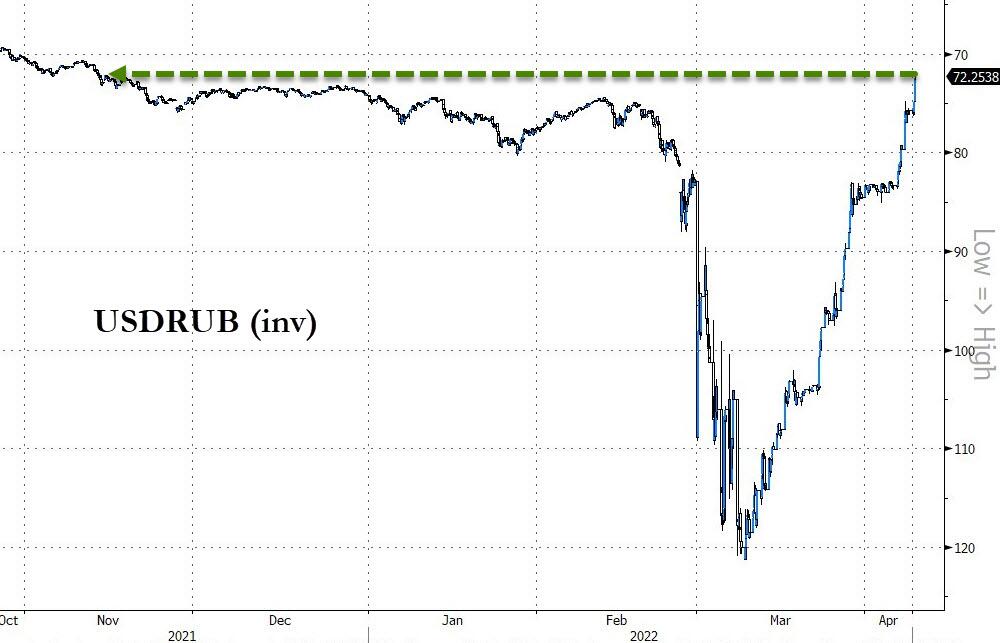
For the second time in eight years, Russia has seen its currency undermined by Western action over Ukraine. Having experienced it in 2014, this time the Russian central bank was better prepared. It had diversified out of dollars adding official gold reserves. The commercial banking system was overhauled, and the Governor of the RCB, Elvira Nabiullina, by following classical monetary policies instead of the Keynesianism of her Western contempories, has contained the fall-out from the war in Ukraine. As Figure 1 shows, the rouble halved against the dollar in a knee-jerk reaction before recovering to pre-war levels.
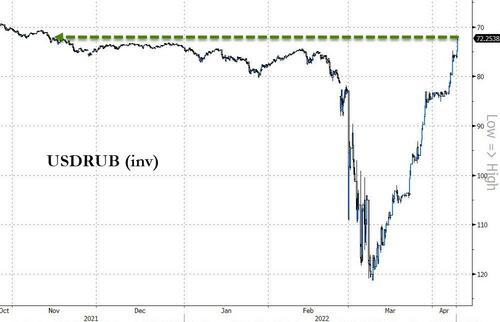
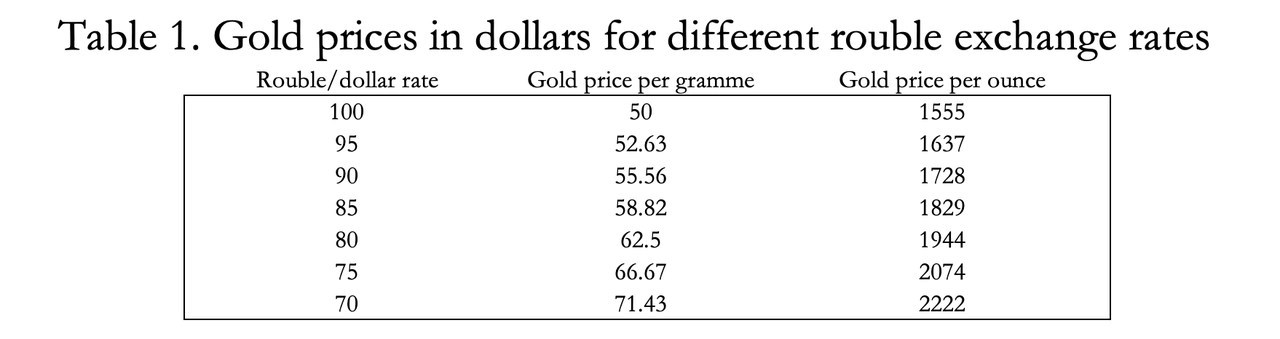
The link to commodities is gold, and the RCB announced that until end-June it stands ready to buy gold from Russian banks at 5,000 roubles per gramme. The stated purpose was to allow banks to lend against mine production, given that Russian-sourced gold is included in the sanctions. But the move has encouraged speculation that the rouble is going on a quasi- gold standard; never mind that a gold standard works the other way round with users of the currency able to exchange it for gold.
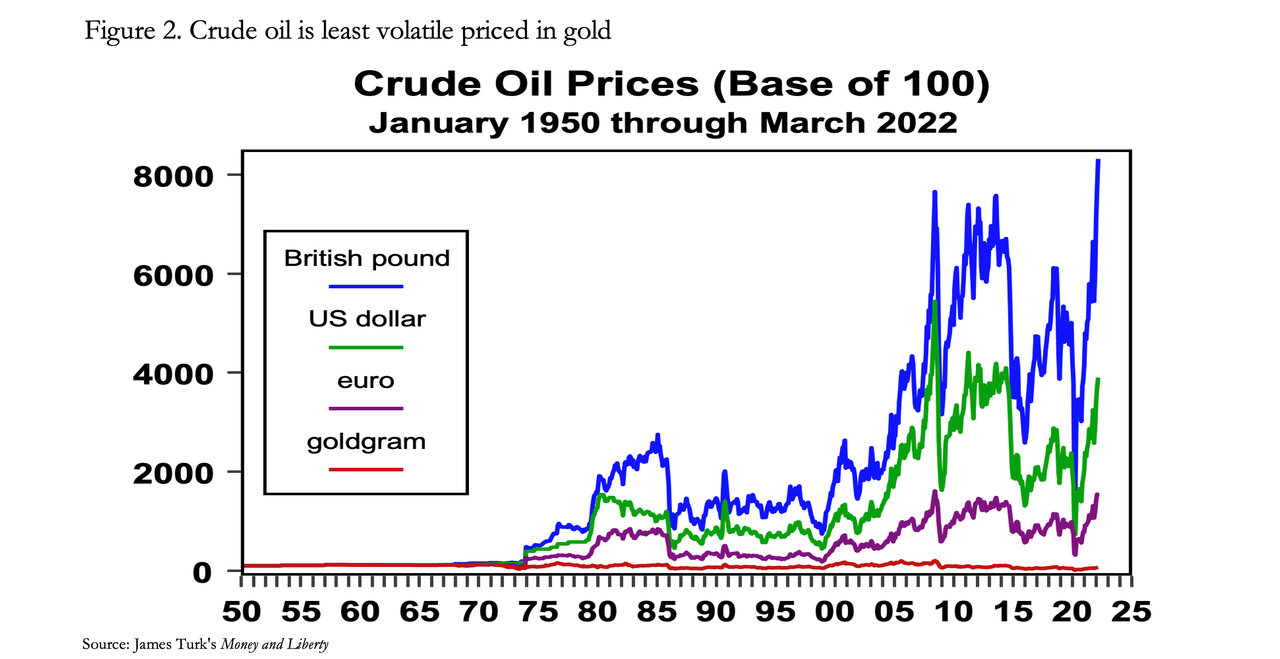
Besides being with silver the international legal definition of money (the rest being currency and credit), gold is a good proxy for commodities, as shown in Figure 2 below. Priced in goldgrams, crude oil today is 30% below where it was in the 1950, long before Nixon suspended the Bretton Woods Agreement. Meanwhile, measured in depreciating fiat currencies the price has soared and been extremely volatile along the way.
It is a similar story for other commodity prices, whereby maximum stability is to be found in prices measured in goldgrams. Taking up Pozsar’s point about currencies being increasingly linked to commodities in Bretton Woods III, it appears that Russia intends to use gold as proxy for commodities to stabilise the rouble. Instead of a fixed gold exchange rate, the RCB has wisely left itself the option to periodically revise the price it will pay for gold after 1 July.
Table 1 shows how the RCB’s current fixed rouble gold exchange rate translates into US dollars.
While non-Russian credit institutions do not have access to the facility, it appears that there is nothing to stop a Russian bank buying gold in another centre, such as Dubai, to sell to the Russian central bank for roubles. All that is needed is for the dollar/rouble rate to be favourable for the arbitrage and the ability to settle in a non-sanctioned currency, such as renminbi, or to have access to Eurodollars which it can exchange for Euroroubles (see below) from a bank outside the “unfriendlies” jurisdictions.
The dollar/rouble rate can now easily be controlled by the RCB, because how demand for roubles in short supply is handled becomes a matter of policy. Gazprom’s payment arm (Gazprombank) is currently excused the West’s sanctions and EU gas and oil payments will be channelled through it.
Broadly, there are four ways in which a Western consumer can acquire roubles:
  • By buying roubles on the foreign exchanges.
  • By depositing euros, dollars, or sterling with Gazprombank and have them do the conversion as agents.
  • By Gazprombank increasing its balance sheet to provide credit, but collateral which is not sanctioned would be required.
  • By foreign banks creating rouble credits which can be paid to Gazprombank against delivery of energy supplies.
The last of these four is certainly possible, because that is the basis of Eurodollars, which circulate outside New York’s monetary system and have become central to international liquidity. To understand the creation of Eurodollars, and therefore the possibility of a developing Eurorouble market we must delve into the world of credit creation.
There are two ways in which foreigners can hold dollar balances. The way commonly understood is through the correspondent banking system. Your bank, say in Europe, will run deposit accounts with their correspondent banks in New York (JPMorgan, Citi etc.). So, if you make a deposit in dollars, the credit to your account will reconcile with the change in your bank’s correspondent account in New York.
Now let us assume that you approach your European bank for a dollar loan. If the loan is agreed, it appears as a dollar asset on your bank’s balance sheet, which through double-entry bookkeeping is matched by a dollar liability in favour of you, the borrower. It cannot be otherwise and is the basis of all bank credit creation. But note that in the creation of these balances the American banking system is not involved in any way, which is how and why Eurodollars circulate, being fungible with but separate in origin from dollars in the US.
By the same method, we could see the birth and rapid expansion of a Eurorouble market. All that’s required is for a bank to create a loan in roubles, matched under double-entry bookkeeping with a deposit which can be used for payments. It doesn’t matter which currency the bank runs its balance sheet in, only that it has balance sheet space, access to rouble liquidity and is a credible counterparty.
This suggests that Eurozone and Japanese banks can only have limited participation because they are already very highly leveraged. The banks best able to run Eurorouble balances are the Americans and Chinese because they have more conservative asset to equity ratios. Furthermore, the large Chinese banks are majority state-owned, and already have business and currency interests with Russia giving them a head start with respect to rouble liquidity.
We have noticed that the large American banks are not shy of dealing with the Chinese despite the politics, so presumably would like the opportunity to participate in Euroroubles. But only this week, the US Government prohibited them from paying holders of Russia’s sovereign debt more than $600 million. So, we should assume the US banks cannot participate which leaves the field open to the Chinese mega-banks. And any attempt to increase sanctions on Russia, perhaps by adding Gazprombank to the sanctioned list, achieves nothing, definitely cuts out American banks from the action, and enhances the financial integration between Russia and China. The gulf between commodity-backed currencies and yesteryear’s financial fiat simply widens.
For now, further sanctions are a matter for speculation. But Gazprombank with the assistance of the Russian central bank will have a key role in providing the international market for roubles with wholesale liquidity, at least until the market acquires depth in liquidity. In return, Gazprombank can act as a recycler of dollars and euros gained through trade surpluses without them entering the official reserves. Dollars, euros yen and sterling are the unfriendlies’ currencies, so the only retentions are likely to be renminbi and gold.
In this manner we might expect roubles, gold and commodities to tend to rise in tandem. We can see the process by which, as Zoltan Pozsar put it, Bretton Woods III, a global currency regime based on commodities, can take over from Bretton Woods II, which has been characterised by the financialisation of currencies. And it’s not just Russia and her roubles. It’s a direction of travel shared by China.
The economic effects of a strong currency backed by commodities defy monetary and economic beliefs prevalent in the West. But the consequences that flow from a stronger currency are desirable: falling interest rates, wealth remaining in the private sector and an escape route from the inevitable failure of Western currencies and their capital markets. The arguments in favour of decoupling from the dollar-dominated monetary system have suddenly become compelling.
The consequences for the West
Most Western commentary is gung-ho for further sanctions against Russia. Relatively few independent commentators have pointed out that by sanctioning Russia and freezing her foreign exchange reserves, America is destroying her own hegemony. The benefits of gold reserves have also been pointedly made to those that have them. Furthermore, central banks leaving their gold reserves vaulted at Western central banks exposes them to sanctions, should a nation fall foul of America. Doubtless, the issue is being discussed around the world and some requests for repatriation of bullion are bound to follow.
There is also the problem of gold leases and swaps, vital for providing liquidity in bullion markets, but leads to false counting of reserves. This is because under the IMF’s accounting procedures, leased and swapped gold balances are recorded as if they were still under a central bank’s ownership and control, despite bullion being transferred to another party in unallocated accounts.
No one knows the extent of swaps and leases, but it is likely to be significant, given the evidence of gold price interventions over the last fifty years. Countries which have been happy to earn fees and interest to cover storage costs and turn gold bullion storage into a profitable activity (measured in fiat) are at the margin now likely to not renew swap and lease agreements and demand reallocation of bullion into earmarked accounts, which would drain liquidity from bullion markets. A rising gold price will then be bound to ensue.
Ever since the suspension of Bretton Woods in 1971, the US Government has tried to suppress gold relative to the dollar, encouraging the growth of gold derivatives to absorb demand. That gold has moved from $35 to $1920 today demonstrates the futility of these policies. But emotionally at least, the US establishment is still virulently anti-gold.
As Figure 2 above clearly shows, the link between commodity prices and gold has endured through it all. It is this factor that completely escapes popular analysis with every commodity analyst assuming in their calculations a constant objective value for the dollar and other currencies, with price subjectivity confined to the commodity alone. The use of charts and other methods of forecasting commodity prices assume as an iron rule that price changes in transactions come only from fluctuations in commodity values.
The truth behind prices measured in unbacked currencies is demonstrated by the cost of oil priced in gold having declined about 30% since the 1960s. That is reasonable given new extraction technologies and is consistent with prices tending to ease over time under a gold standard. It is only in fiat currencies that prices have soared. Clearly, gold is considerably more objective for transaction purposes than fiat currencies, which are definitely not.
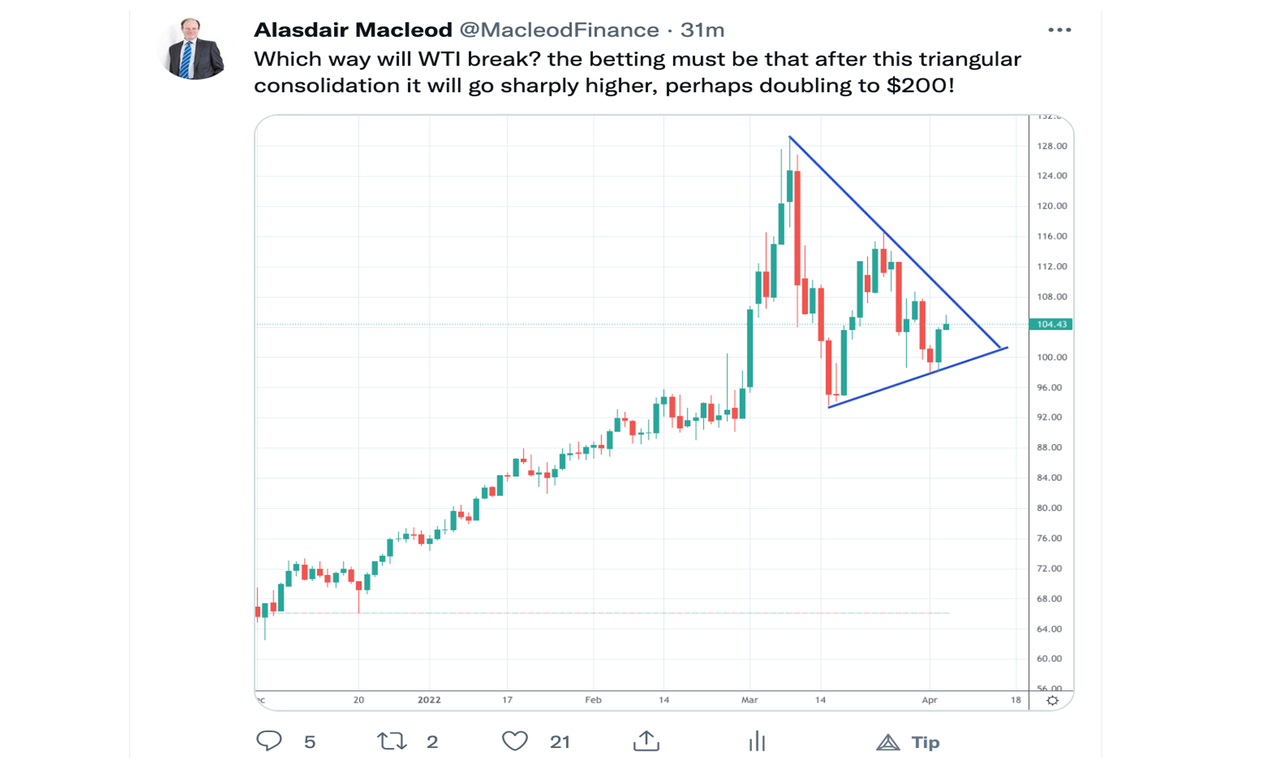
Therefore, if, as the chart in the tweet below suggests, the dollar price of oil doubles from here, it will only be because at the margin people prefer oil to dollars — not because they want oil beyond their immediate needs, but because they want dollars less.
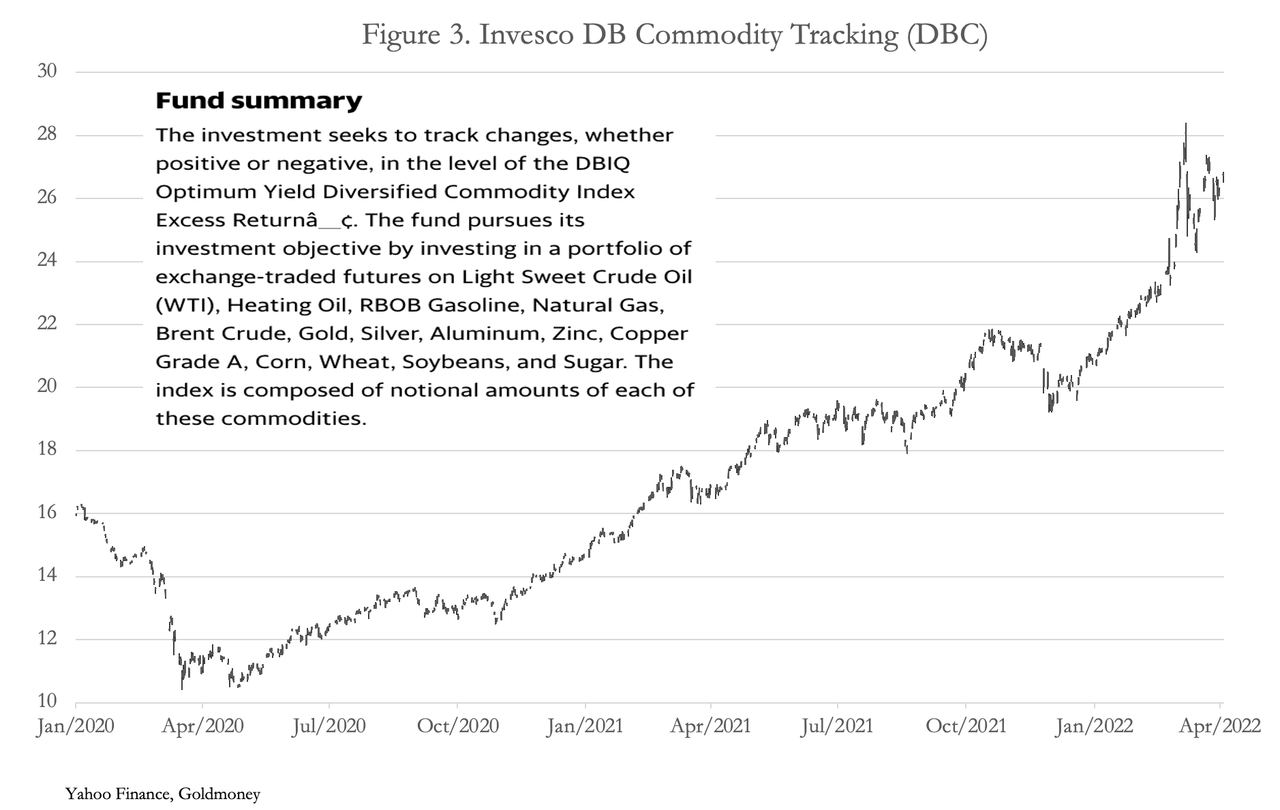
China recognised these dynamics following the Fed’s monetary policies of March 2020, when it reduced its funds rate to the zero bound and instituted QE at $120bn every month. The signal concerning the dollar’s future debasement was clear, and China began to stockpile oil, commodities, and food — just to get rid of dollars. This contributed to the rise in dollar commodity prices, which commenced from that moment, despite falling demand due to covid and supply chain problems. The effect of dollar debasement is reflected in Figure 3, which is of a popular commodity tracking ETF.
A better understanding would be to regard the increase in the value of this commodity basket not as a near doubling since March 2020, but as a near halving of the dollar’s purchasing power with respect to it.
Furthermore, the Chinese have been prescient enough to accumulate stocks of grains. The result is that 20% of the world’s population has access to 70% of the word’s maize stocks, 60% of rice, 50% of wheat and 35% of soybeans. The other 80% of the world’s population will almost certainly face acute shortages this year as exports of grain and fertiliser from Ukraine/Russia effectively cease.
China’s actions show that she has to a degree already tied her currency to commodities, recognising the dollar would lose purchasing power. And this is partially reflected in the yuan’s exchange rate against the US dollar, which since May 2020 has gained over 11%.
Implications for the dollar, euro and yen
In this article the close relationship between gold, oil, and wider commodities has been shown. It appears that Russia has found a way of tying her currency not to the dollar, but to commodities through gold, and that China has effectively been doing the same thing for two years without the gold link. The logic is to escape the consequences of currency and credit expansion for the dollar and other Western currencies as their purchasing power is undermined. And the use of a gold peg is an interesting development in this context.
We should bear in mind that according to the US Treasury TIC system foreigners own $33.24 trillion of financial securities and short-term assets including bank deposits. That is in addition to a few trillion, perhaps, in Eurodollars not recorded in the TIC statistics. These funds are only there in such quantities because of the financialisation of Western currencies, a situation we now expect to end. A change in the world’s currency order towards Pozsar’s Bretton Woods III can be expected to a substantial impact on these funds.
To prevent foreign selling of the $6.97 trillion of short-term securities and cash, interest rates would have to be raised not just to tackle rising consumer prices (a Keynesian misunderstanding about the economic role of interest rates, disproved by Gibson’s paradox) but to protect the currency on the foreign exchanges, particularly relative to the rouble and the yuan. Unfortunately, sufficiently high interest rates to encourage short-term money and deposits to stay would destabilise the values of the foreign owned $26.27 trillion in long-term securities — bonds and equities.
As the manager of US dollar interest rates, the dilemma for the Fed is made more acute by sanctions against Russia exposing the weakness of the dollar’s position. The fall in its purchasing power is magnified by soaring dollar prices for commodities, and the rise in consumer prices will be greater and sooner as a result. It is becoming possible to argue convincingly that interest rates for one-year dollar deposits should soon be in double figures, rather than the three per cent or so argued by monetary policy hawks. Whatever the numbers turn out to be, the consequences are bound to be catastrophic for financial assets and for the future of financially oriented currencies where financial assets are the principal form of collateral.
It appears that Bretton Woods II is indeed over. That being the case, America will find it virtually impossible to retain the international capital flows which have allowed it to finance the twin deficits — the budget and trade gaps. And as securities’ values fall with rising interest rates, unless the US Government takes a very sharp knife to its spending at a time of stagnating or falling economic activity, the Fed will have to step up with enhanced QE.
The excuse that QE stimulates the economy will have been worn out and exposed for what it is: the debasement of the currency as a means of hidden taxation. And the foreign capital that manages to escape from a dollar crisis is likely to seek a home elsewhere. But the other two major currencies in the dollar’s camp, the euro and yen, start from an even worse position. These are shown in Figure 4. With their purchasing power visibly collapsing the ECB and the Bank of Japan still have negative interest rates, seemingly trapped under the zero bound. Policy makers find themselves torn between the Scylla of consumer price inflation and the Charybdis of declining economic activity. A further problem is that these central banks have become substantial investors in government and other bonds (the BOJ even has equity ETFs on board) and rising bond yields are playing havoc with their balance sheets, wiping out their equity requiring a systemic recapitalisation.
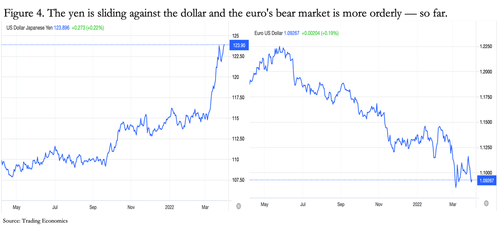
Not only are the ECB and BOJ technically bankrupt without massive capital injections, but their commercial banking networks are hugely overleveraged with their global systemically important banks — their G-SIBs — having assets relative to equity averaging over twenty times. And unlike the Brazilian real, the Mexican peso and even the South African rand, the yen and the euro are sliding against the dollar.
The response from the BOJ is one of desperately hanging on to current policies. It is rigging the market by capping the yield on the 10-year JGB at 0.25%, which is where it is now.
These currency developments are indicative of great upheavals and an approaching crisis. Financial bubbles are undoubtedly about to burst sinking fiat financial values and all that sail with them. Government bonds will be yesterday’s story because neither China nor Russia, whose currencies can be expected to survive the transition from financial to commodity orientation, run large budget deficits. That, indeed, will be part of their strength.
The financial war, so long predicted and described in my essays for Goldmoney, appears to be reaching its climax. At the end it has boiled down to who understands money and currencies best. Led by America, the West has ignored the legal definition of money, substituting fiat dollars for it instead. Monetary policy lost its anchor in realism, drifting on a sea of crackpot inflationary beliefs instead.
But Russia and China have not made the same mistake. China played along with the Keynesian game while it suited them. Consequently, while Russia may be struggling militarily, unless a miracle occurs the West seems bound to lose the financial war and we are, indeed, transiting into Pozsar’s Bretton Woods III.

FT : Market turmoil splits hedge funds into macro winners and tech losers

Market turmoil splits hedge funds into macro winners and tech losers
War and rising inflation widen the gap between best and worst performers

Market turmoil driven by Russia’s invasion of Ukraine and rising inflation has sharply divided the hedge fund industry, with macro hedge funds celebrating one of their best-ever starts to a year while technology and growth funds rack up double-digit losses.

The top 10 per cent of hedge funds gained an average of 24.3 per cent in the first quarter, while the bottom decile dropped by 15.4 per cent, according to HFR, which tracks the sector. The dispersion is one of the widest since the financial crisis.

The industry as a whole suffered losses of 0.3 per cent for the first quarter, as measured by the HFRI fund-weighted index, and larger funds tended to do better than small ones.

“I struggle to think of a quarter with more dispersion in quite a long time,” said Michael Edwards, deputy chief investment officer of Weiss Multi-Strategy Advisers.

Recommended
ExplainerFederal Reserve
Can the Fed shrink its $9tn balance sheet without causing market mayhem?

Many long-short equity hedge funds cut their exposure to US stocks and reduced leverage as the market sold off in January and February, nervous that there was further room for stocks to fall. They remained on the sidelines and pared positions further when the market finally found its footing, according to the prime brokerage arm of Goldman Sachs.

It meant that some funds missed out on a 9 per cent rally in the S&P 500 from its February lows, including in many of the technology stocks that had been badly hit at the year’s start. That drove the HFRI index for equity funds down 4 per cent.

Tiger Global was among the hardest hit: it is down 34 per cent for the quarter. Melvin Capital, Whale Rock and RiverPark’s Long/Short fund all saw drops of more than 20 per cent in the quarter, as consumer, technology and growth stocks more generally struggled. The troubles with tech were not confined to the US. Accendo Capital lost 17.8 per cent, as one of its biggest holdings, Swedish telecoms manufacturer Hexatronic, gave back some of last year’s gains.

By contrast, computer-driven and macro funds rallied strongly: HFRI’s macro index rose more than 8 per cent in the quarter.

Those gains, Edwards added, were due in part to the fact macro quant funds traded systematically. Without human sensibilities to be affected by the war in Ukraine, surge in Treasury yields and sell-off in markets, computer-driven funds were quicker to re-enter the fray compared to some flesh-and-bone hedge fund managers.

“Machines are not subject to the same Fomo [fear of missing out] and wound-licking tendencies that discretionary managers are,” he said.

Among the biggest winners this year have been the BH-DG Systematic Trading fund, run by a joint venture between hedge fund firm Brevan Howard and former Chase Manhattan trader David Gorton. The fund gained 23 per cent to late March, according to numbers sent to investors.

Meanwhile, Leda Braga’s Systematica was up nearly 18 per cent, helped by bets on commodities and bonds, and Aspect Capital is up 21.5 per cent in its Diversified fund.

Bridgewater, the world’s biggest hedge fund with about $150bn under management, gained 16.3 per cent. It told investors that its top performances came in commodities, short rates and nominal bonds.

Many of the winning funds use algorithms to predict and bet on trends and patterns in futures and other financial markets. They have profited from a huge sell-off in government bond markets this year, with yields on 2-year US Treasuries rocketing from 0.7 per cent to 2.4 per cent and 10-year yields jumping from 1.5 per cent to 2.5 per cent, as the Federal Reserve moves to tighten monetary policy.

“So far this year [performance] is spectacular,” said Philippe Jordan, president at Paris-based CFM, which manages around $9bn, and is up around 17 per cent in its Discus strategy and 7 per cent in its flagship Stratus fund. “The macro backdrop for [quant] futures trading is better than it’s been in the past 10 years.” 

The HFRI commodity funds index soared nearly 25 per cent, powered by a one-third rise in the price of crude oil and a jump for natural gas of almost two-thirds. Makuria Investment Management, which invests in commodities and companies involved in the energy transition, gained 31 per cent. “The tragic events in Ukraine merely accelerated already existing structural trends across commodity markets . . . by further increasing market tightness,” founder Mans Larsson wrote.

Other traders have also profited from the huge market moves in bonds and currencies. Odey Asset Management’s European fund gained nearly 61 per cent to mid-March, helped by bets on long-dated bond yields rising. He believes they have further to go. “There’s nothing holding down yields from here,” said founder Crispin Odey.

Equity hedge funds had a much tougher time. Funds that were positioned for rising prices suffered losses as equity markets were affected by the Ukraine war and the prospect of higher borrowing costs, and bond markets sold off rapidly.

“Extreme volatility in the rates market and the Ukraine situation delivered a difficult risk environment for all asset classes,” said Kevin Russell, chief investment officer at the UBS hedge fund unit O’Connor, which manages more than $11.2bn in assets.

Barrons : Bye, Buybacks? No, but Signs Show Some Companies Shifting Focus Away F

Bye, Buybacks? No, but Signs Show Some Companies Shifting Focus Away From Them.

There are some signs that stock buybacks, which have been a popular capital-allocation strategy for many U.S. companies, are losing some steam after starting off the year strongly.

Jill Carey Hall, equity and quantitative strategist at BofA Securities, observed in an April 5 research note that the dollar amount of first-quarter S&P 500 company buyback announcements as a percentage of market capitalization were 50% below their five-year pre-Covid average—0.4% versus 0.8%.

“We see a greater case for dividends over buybacks in 2022, so we’re expecting a pretty negligible impact to S&P 500 [earnings per share] from net buybacks,” Hall tells Barron’s.

Hall’s note adds that “while buybacks typically slow at the end of each quarter ahead of earnings season, buybacks by corporate clients slowed to their lowest weekly level in 12 months.”

At the same time, there have been a few recent examples of companies de-emphasizing or suspending share repurchases, most notably Starbucks (ticker: SBUX). Howard Schultz, the company’s founder who returned as CEO on April 4, said as one of his first orders of business that Starbucks was suspending stock buybacks effective immediately to “allow us to invest more into our people and our stores.”

In its earnings release summarizing the 2021 fiscal year, which ended last October, Starbucks said it was committing $20 billion for share repurchases and dividends over the next three years. The company spent about $2.1 billion on dividends last year but didn’t repurchase any of its common stock—though on a net basis, including share issuance, it bought back about $1.4 billion of stock in fiscal 2020 and about $10 billion in fiscal 2019.

Elsewhere, the CEO of chip maker Qualcomm (QCOM), Cristiano Amon, told CNBC recently that the company is targeting dividend increases in the high single digits or low double digits. “We are going to continue to look at an opportunistic buyback, but we want to maintain strategic flexibility also for M&A,” he said, referring to mergers and acquisitions.

If a buyback slowdown does occur this year, backward-looking data doesn’t necessarily tell the story.

First-quarter S&P 500 dividends set a record, according Howard Silverblatt, senior index analyst at S&P Dow Jones Indices, adding that buybacks “still appear to be favored over dividends.”

BofA’s Hall, however, points to recent signs that share repurchases are slowing “based on our corporate client buyback activity, which provides a real time read and generally has been correlated with directional trends.”

For example, while the dollar amount of first-quarter BofA Securities’ corporate client buybacks was above those of other first quarters following the financial crisis of more than a decade ago, they were at their lowest level in five years when measured as a percentage of the S&P 500’s market capitalization.

Hall points to rising interest rates as another factor to consider in that they could cause a slowdown of companies using debt to buy back their shares. As a result, she says, “companies might prioritize balance sheet repair” or “business investment” over buybacks.

She adds there is nothing that would directly point to Russia/Ukraine specifically affecting buybacks.

For sure, buybacks, unlike dividends, give management teams more flexibility. A dividend, which is considered sacrosanct by many investors, is much harder to cut or suspend. Still, shares of Starbucks fell by 3.7% on April 4, the day of its buyout suspension announcement, and 4.5% the following day.

Meanwhile, Hall is looking for 13% dividend growth for the S&P 500 this year, partly due to “the high demand for dividend income.”

“When looking at buybacks versus dividends,” she says, “there’s more of a case to be made for dividend growth this year.”

Barrons : Activists Find Lots of Targets and, in Private Equity, Flush Buyers

Activists Find Lots of Targets and, in Private Equity, Flush Buyers

It’s shaping up to be a busy activist season, which is producing some new investor alliances.

Activist investors have increasingly been pulling pages out of the private-equity playbook, a trend likely to continue, given synergies between the two financial specialties.

Private-equity firms had nearly $2 trillion in dry powder looking for deals as of February, according to S&P Global. Meanwhile, after two years hampered by the pandemic, activists are having no trouble finding companies in need of shareholder prodding, in light of worries over inflation, supply chains, geopolitics, the Federal Reserve, and falling share prices.

Put another way, there’s no shortage of activist ideas or money to see them through.

“This provides activists with all they need to do what they do best, which is find holes in company strategies,” Jim Rossman, co-head of capital markets advisory at Lazard , told Barron’s.

There have been 73 activist campaigns launched in the first quarter of this year, well above the 55 campaigns in the year-ago quarter. And deal making appears to continue to be an impetus for activists to target a company—either by pushing for buyouts, spinoffs, or mergers.

Last month Nielsen Holdings (ticker: NLSN), which had been targeted by Elliott Investment Management, agreed to go private in a $16 billion deal also backed by Brookfield Asset Management (BAM). And CoreLogic was taken private by private equity’s Stone Point Capital and Insight Partners last year after initially being prodded by activist fund Senator Investment Group and holding company Cannae Holdings .

Barrons : Carlyle Group’s CEO on Why the Deals Keep Coming

Carlyle Group’s CEO on Why the Deals Keep Coming

Amid a period of tectonic shifts in markets, the economy, and geopolitics, Kewsong Lee, chief executive of Carlyle Group , has reshaped the alternative-asset manager, diversifying beyond the company’s private-equity roots to capitalize on the explosive demand for private assets.

Lee had a long career as a deal maker at Warburg Pincus before making the jump to rival Carlyle (ticker: CG) in 2013. Since becoming co-CEO in 2018 and taking the reins solo in 2020, Lee has expanded the company beyond its roots in private-equity leveraged buyouts. He has shifted the focus from traditional performance fees to more-predictable fee-related earnings growth that analysts say drives shareholder returns.

“It’s a transformation where the numbers are clearly showing they are going in the right directions,” says Chris Kotowski, an analyst at Oppenheimer & Co. Carlyle reported record fee-related earnings in 2021 of $598 million, up 22% from the prior year’s total, and raised a record $51 billion in funds amid a banner year for the industry.

Kotowski thinks the company is still undervalued, given its progress, but Carlyle’s shares have begun to narrow the gap with peers over the past two years, returning almost 51%, compared with the group’s average of 53%. In its first years as a public company, the stock returned 14% from mid-2012 to 2018, lagging behind the S&P 500 index and its peer group’s average total return of 167.6%.

As the head of a global company with $301 billion in assets across sectors and industries, Lee has a bird’s-eye view of the issues that investors are grappling with. Barron’s spoke with him about Carlyle’s transformation, the outlook for private markets, and what the next iteration of globalization could look like. This is an edited version of the conversation.

Barron’s: How far along are you in the transformation you laid out in early 2021?

Kewsong Lee: Last year was a record year, and I’m confident this momentum is going to continue. Our strategy has been to accelerate the growth of the firm by building on the strengths of our core businesses, running them better than ever before, and forging into areas that will drive future growth, including infrastructure and renewables, insurance, and real estate credit. We will have a firm with greater diversification, more growth potential, and a recurring earnings stream that’s going to be very valuable to the market.

What do you think investors are missing?

No doubt Carlyle is great at the deal-doing business; we are great investors. But what’s not appreciated are intangible changes we have made to the mind-set and culture, enabling us to be great at the business of doing deals. For example, we are continuing to break down silos for more connectivity and collaboration among investment teams.

Carlyle has pushed further into credit, insurance, and other businesses. How much more do you want to diversify?

Last year, we raised $51 billion. Two-thirds was away from private equity. We are going to be focused on private markets. But private markets are expanding—well beyond private equity. Private credit is a fraction of its potential and could surpass the size of the PE market.

Real estate is huge. Infrastructure is just now starting to grow, and there is this huge business around portfolio solutions because the private market has grown so large that [chief investment officers] need help. The secular tailwinds for private markets will continue for many years to come.

What is driving that growth?

For companies, it is not just about access to capital anymore. The real edge is access to capital that comes with an ability to help them compete in an increasingly competitive world. Private capital can bring with it global networks of experts to help drive real, fundamental value. In a digital age where human capital is one of the most valuable competitive advantages, private markets are simply at an advantage to public markets.

What are your plans for the $2.5 billion on Carlyle’s balance sheet?

Witness recent credit acquisitions—CBAM and iStar—and the strategic advisory agreement with reinsurer Fortitude Re, each of which aligns with the growth areas we’ve been talking about. You will see more acquisition and investment activity in strategic areas to expand our presence, consolidate our position, and drive leadership in private markets.

What are the biggest concerns among the boards and chief executives you talk with?

CEOs and boards are wrestling with an environment with more volatility that’s projected to look quite different than it has over the past several decades. The confluence of rising rates, inflation, digital transformation and disruption, energy transition, geopolitical decoupling, and supply-chain vulnerability, among a host of other factors, will drive accelerated change. That change can create opportunities for those that can adapt quickly and pivot, so there is a lot of focus on trying to track where the puck is going.

Technology is a key consideration. Every deal is a tech deal, and it’s about how you use data and digital strategies to help drive growth.

What’s the outlook for mergers-and-acquisitions activity?

Volatility is going to create uncertainty, and CEOs are going to be cautious. While there may be a lag, eventually corporations need to figure out how to execute their plans and grow. A lot of CEOs have also learned after Covid that these are times to be bold and opportunistic—and really drive for acquisitions. Our pipelines are as busy as they have been in terms of deal flow, across all our asset classes and business lines.

Geopolitical tensions, an economic slowdown, and a drastic crackdown on technology companies in China has unnerved investors. Is that market still investible?

I know folks are saying we are decoupling. No doubt we are, but I view it less as a total decoupling and more of a new era of globalization. The challenge is how to manage that—and the risk in a decoupling and polarizing world. Any deal has to meet our ESG [environmental, social, and corporate governance] standards across the board.


Carlyle Group CEO Kewsong Lee.
Photograph by Benedict Evans
How can you invest with an ESG lens in China, given its authoritarian government and human-rights abuse allegations?

Look, this is a major region of the world and global economy. All of our clients, big and small, want to know how to invest in that part of the world. No doubt it’s very complicated, and there are issues. But that is why we have to be focused on adhering to our ESG standards that are uniform around the world.

How have the war in Ukraine and sanctions on Russia changed the face of globalization?

We are entering a new era where there is more thinking about regional ecosystems. That will create a shift from “just in time” to “just in case.”

Business leaders will have to think through implications to their supply chains, logistics, and the capital they need, including working capital, to enable a more resilient, “just in case” mentality instead. It’s early days, but clearly there are cost implications, [an impact on the] efficiency of capital usage, and huge supply, inventory, and working-capital implications.

Who benefits?

There are going to be lots of businesses that are advantaged—data companies to manage these supply chains better and new finance and payment solutions as we move toward this different ecosystem as it applies to the implications of “just in case.” There will be risks but also enormous opportunities for companies that can move quickly and adapt.

Are you worried that inflation and spiking commodity prices could pause the energy transition?

This is going to accelerate investing into alternative forms of energy, not slow it down. But it’s not an either/or. We have to do the hard work to improve companies and reduce their footprint and emissions. You can’t divest out of this problem. You have to invest your way out. We invest with an ESG lens that enables us to not just drive lower emissions, but also drive great returns.

Some see a reckoning ahead for ESG. What do you say to naysayers?

ESG is not a fad, concept, or a metric—it’s a mind-set that needs to be infused in your culture because it helps improve outcomes and drives our performance.

Where do you see froth in the market?

Liquidity driving higher and higher valuations—that game is over. There are certain aspects of the market, like momentum investing in certain sectors, which I think have come to an end. Eventually, all companies need to have a realistic path and timeline to profitability—that has become more apparent in an environment where rates are going up. When there is a tremendous amount of change, we look to invest in ways that will benefit from that change.

What investment trends will we be talking about in five years?

We have talked in the past about cybersecurity or energy security, but you are going to be hearing about food security. People are starting to realize how much wheat production and fertilizer run through the regions in conflict. The whole climate topic is going to continue to grow. Infrastructure is also going to become a huge topic. The private sector has amassed a lot of dollars to help fix problems and make critical investments in all aspects of our infrastructure.

(ZH) Where Will The Food Riots Start?

Where Will The Food Riots Start?

Global food prices have never risen so fast and have never been so high, and as have detailed multiple times in recent months (as this is not simply a one-month, 'blame it on Putin' crisis), most recently here, the pieces are in place for some serious tears to form in the social fabric of many nations.
While food prices may be generally seen as an emerging market problem, they will have an effect on developed markets too, something we will see in the upcoming French election.
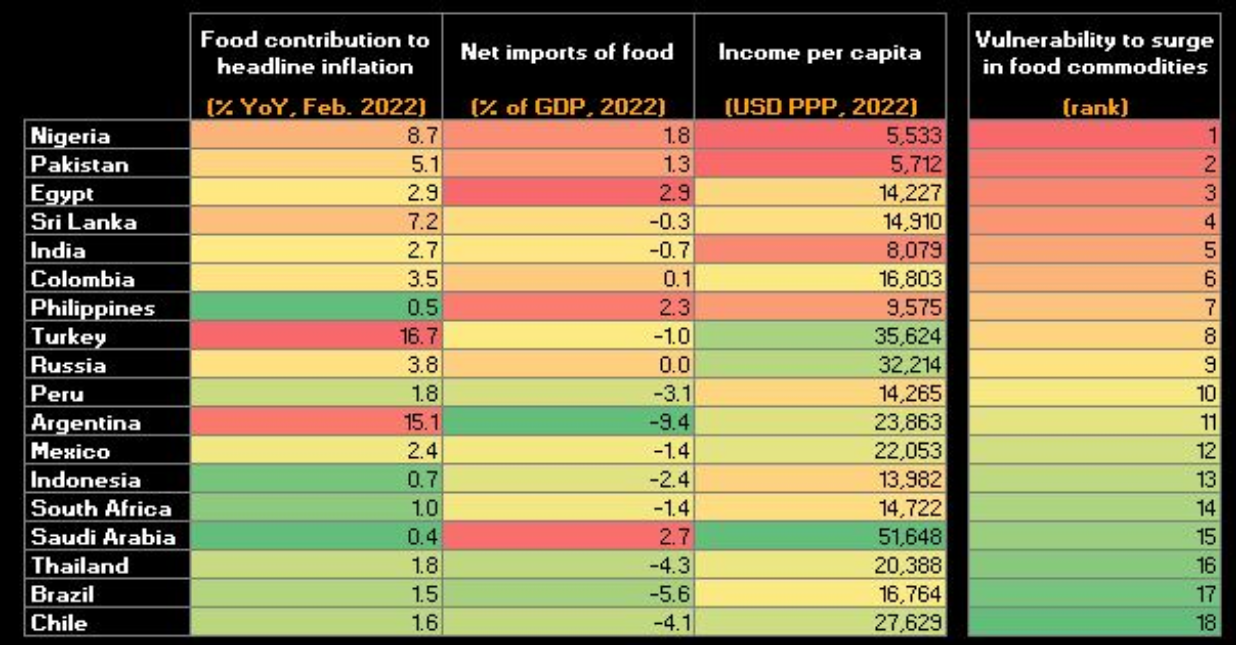
And as the following table from Bloomberg Economics shows, while Pakistan is already in the midst of a political crisis and Egypt is already coming under financial pressure (along with Peru and Sri Lanka), the surge in food prices is also adding to problems in the developed world.
Nigeria, India, Colombia, Philippines, and Turkey all bear watching, along with Russia...
In fact, as PeakProsperity's Chris Martenson details below, the inflation riots have begun. Peru and Sri Lanka both are experiencing violence as inflation spirals the prices of basic necessities higher and higher.
We’ve been here before, and recently.
The Arab Spring was a period of social unrest and riots in 2010 and 2011 that was triggered, in part, by spiking food costs.
As Alfred Henry Lewis said in 1906, “There are only nine meals between mankind and anarchy.”
But before pure anarchy comes, society experiences increasing unrest and the erosion of social bonds and niceties. That’s where we are now.
Food prices today are higher than they were in 2010, so the protests are not at all surprising. We can and should expect more of them.
Worse than that, however, is the prospect of actual famine and food shortages.
I expect true famine to emerge by the end of this year, after the northern harvest fails to cover the basic needs of 8+ billion people.
This is yet another reason why you should plant a garden. As if you needed one more, right?
The reason for the glum outlook is not just the loss of Ukraine exports, and probable loss of the planting season for quite a large portion of the Ukraine, but because of the desperate global shortages of fertilizers which have become utterly essential to today’s crop yields.
In this lesson, we learn that converting biologically active and supportive soil into barren dirt was a terrible idea.
By 2030, it is projected that phosphate will reach peak output and then begin its long slow decline. What’s the world plan for this? There isn’t one. Again, this is why local, regenerative farming is so critical to undertake at this time.