FT : Hedge fund trader who won big on GameStop backs energy stocks

Hedge fund trader who won big on GameStop backs energy stocks
Senvest Management snaps up unloved oil and gas companies

Oil and gas stocks are on track for further strong gains, as a sector shunned by ethically-minded investors regains favour, according to the hedge fund manager who made $700mn betting on meme stock GameStop.

Richard Mashaal, co-chief investment officer at New York-based Senvest Management, whose 86 per cent gains in 2021 ranked him among the best-performing hedge funds in the world, said he now has a quarter of his portfolio in fossil fuel stocks.

The shift reflects a push across the investment industry in seeking to profit from the West’s need for secure sources of energy less susceptible to geopolitical risks.

“The result of the ESG movement is that there’s been massive multiple compression [in oil and gas stocks] and we still haven’t come back from that,” said Mashaal, adding that many oil and gas companies had felt that investment capital “wouldn’t be there for them”.

“Now there are other countervailing interests, such as the security of energy supply, that have come to the fore and which are not going to go [away] anytime soon,” he said.

Senvest hit the headlines last year when it emerged as one of the biggest winners from the spectacular surge in GameStop shares. Mashaal, whose firm manages about $3.3bn in assets, had built up a stake of more than 5 per cent in the US retailer in late 2020, before a frenzy of retail investor buying in early 2021 pushed the share price up as much as 2,400 per cent.

Now he believes a surge of funding will be needed in the traditional energy sector to correct years of under-investment.

“You’ve got a couple of years before a meaningful production response can be mounted to satisfy demand. There’s a very solid outlook [for oil and gas stocks] for another year or two,” he said.

Two of Mashaal’s biggest positions in his portfolio are in Canada-based energy firms Paramount Resources and Arc Resources, which he says trade at discounts to US peers. While both stocks are trading at roughly half their all-time highs, hit in 2014 and 2008 respectively, he says they “were earning a fraction [then] of what they’re earning now”.

International oil benchmark Brent crude and US gauge West Texas Intermediate have topped $100 this year, fuelled by the Ukraine war. Oil traders have warned prices could soar to more than $200 this year, driven by a growing international boycott of Russia.

In October the FT revealed that hedge funds had been buying up and profiting from the shares of oil and gas companies discarded by ESG-focused institutional investors.

“There’s a lot of room for multiple expansion [in these stocks],” said Mashaal, adding that a high oil price had not been fully factored into these firms’ share prices.

“People realise this is not going away in the short or medium term. It’s not like ESG goes away, but we [now] need to balance it with energy security and where you want to buy your oil from,” he said.

If oil is not produced in Canada or the US “then it’s produced somewhere else, where the ESG regulations are less stringent or even non-existent”.

>>> Stoxx 600 Pre-Market Indications

  • Evotec SE (EVT TH) +2.3%
    • Evotec SE FY Adjusted Ebitda Misses Estimates
  • Leonardo (FMNB TH) +2.3%
    • Leonardo Raised to Buy at Deutsche Bank; PT 12 euros
  • Rheinmetall (RHM TH) +1.2%
  • Continental (CON TH) -1.7%
  • Deutsche Telekom (DTE TH) -1.9%
  • HeidelbergCement (HEI TH) -2%
  • ACS (OCI1 TH) -2.2%
  • Ryanair (RY4C TH) -2.2%
  • Qiagen (QIA TH) -2.3%
    • Watch Yield-Sensitive Sectors as 10-Year Yield Goes Over 2.8%
  • STMicroelectronics (SGM TH) -3.4%
    • STMicroelectronics Cut to Equal-Weight at Barclays; PT 38 euros
  • Volvo Cars (8JO TH) -3.8%
  • Commerzbank (CBK TH) -5.8%
  • Deutsche Bank (DBK TH) -7.1%
    • Holders Offer Deutsche, Commerzbank Shares Worth $2 Billion

FT : Russia relies on ‘payment theatre’ as bondholders prepare for default

Russia relies on ‘payment theatre’ as bondholders prepare for default
Moscow says it will sue if western powers force non-payment but legal experts dismiss the effectiveness of such a move

Russia has vowed to sue if sanctions force it to default on its bonds but academics and lawyers have dismissed the threat as “payment theatre” designed to project the state’s financial strength.

Over the weekend, finance minister Anton Siluanov said western sanctions were an attempt to “artificially create a man-made default” — Moscow’s first since 1998. Siluanov, who has already sought to flip some dollar repayments in to roubles, did not say who the government might sue or in which country.

But bondholders and rating agencies assume a default process is under way, and academics argue the country’s efforts to be seen as willing to make payments are political rather than practical.

“Paying contrary to expectations is a bullish political move that’s rather cheap,” said Anna Gelpern, a professor of law at Georgetown university and a senior fellow at the Peterson Institute for International Economics. “If the whole point of [the invasion of Ukraine] is partly about projecting that ‘we are a global power, respect us’ then this kind of payment theatre is quite important for [President Vladimir] Putin.”

Moscow has already missed payments on two of its dollar bonds, after US authorities blocked American banks from processing cash as part of measures to punish the country over its invasion of Ukraine. It is unclear what bearing any Russian legal action might have on the process of a default.

“If we don’t get our dollars after 30 days it’s a default,” said one Europe-based investor who holds Russian dollar bonds, referring to the grace period after last week’s scheduled coupon and principal payments.

Already, S&P Global has downgraded Russia’s credit rating to “selective default”, saying it does not expect investors to receive payment in dollars within the 30-day window. Meanwhile a panel that determines payouts on derivatives contracts on Monday ruled that state-owned Russian Railways had defaulted on its debt after an interest payment failed to reach investors within a 10-day grace period, despite the company’s attempts to pay the cash last month.


Russia’s foreign-currency bonds — like those of many sovereign borrowers — are governed by English law. Unusually, however, in the terms under which the bonds were issued, Russia said it would not submit to the jurisdiction of a foreign court.

The legal ambiguity surrounding the bonds means the Kremlin could potentially launch legal proceedings at home, according to Mitu Gulati, a law professor at the University of Virginia, who described Russia’s argument that it has been thwarted from making payments by US authorities as “not crazy”.

“To the extent they litigate they will say ‘look, we want to pay, we just can’t, somebody is stopping us’,” Gulati said. “But here’s the rub: usually it’s supposed to be some kind of exogenous event to both parties [that is preventing payment] whereas investors would argue that’s not true. You have caused this, they could say. If you don’t invade countries then you don’t get this situation. Get out of Ukraine and you can pay.”

In any event, a court in the UK would be highly unlikely to defer to a Russian court’s judgment on whether the bonds were in default, Gulati added.

Both Gulati and Gelpern likened Russia’s situation to Argentina in 2014, when a New York judge prevented Buenos Aires from making payments to holders of new debt until it had paid off older creditors, effectively forcing the country into default.

Countries typically strive to avoid default to make it easier to eventually sell new debt once the stress on government finances has eased, perhaps through a restructuring agreement with creditors. However, the severe sanctions against Russia leave little prospect of any negotiation with bondholders, or of Moscow regaining access to bond markets in the foreseeable future.

“This isn’t like a normal default,” said one investor. “As far as I’m aware no one is talking about forming bondholder groups and talking to the Russians. I don’t even think that would be legal.”

Siluanov also said Russia had no plans to borrow in 2022. “We are not planning to enter the domestic market or foreign markets this year. This makes no sense, because the cost of such borrowing would be cosmic.”

Russian bond prices have collapsed since the invasion of Ukraine, with bonds currently trading at around 22 cents on the dollar, a level that implies a default is priced in.

After the 30-day grace period has expired, bondholders are able to “accelerate” repayment, demanding they get their money back immediately if 25 per cent of the holders of a specific bond vote to do so. Such a decision is likely to depend on whether investors think they can seize any of Russia’s overseas assets in order to enforce their claims — an exercise complicated by the fact that Russian assets are largely frozen by sanctions — said Gelpern.

“The current environment is so incredibly muddled that bondholders may not want to play their one big card with no clear game plan,” Gelpern said.

“But then it’s a little bit optimistic to expect a civil negotiation [between bondholders and Moscow] to ensue any time soon,” she added, “so some may want to accelerate if they think they can reach some assets.”

>>> TradeGate Pre-Market Indications

DAX:
  • Siemens (SIE TH) -1.5%
  • RWE (RWE TH) -1.6%
  • Puma (PUM TH) -1.6%
  • Deutsche Telekom (DTE TH) -1.7%
  • Deutsche Bank (DBK TH) -6.9%
    • Holders Offer Deutsche, Commerzbank Shares Worth $2 Billion
MDAX:
  • Evotec SE (EVT TH) +1.7%
    • Evotec SE FY Adjusted Ebitda Misses Estimates
  • Rheinmetall (RHM TH) +1.4%
  • Lufthansa (LHA TH) -1.2%
  • Aixtron (AIXA TH) -1.2%
    • Watch Yield-Sensitive Sectors as 10-Year Yield Goes Over 2.8%
  • Varta (VAR1 TH) -1.3%
  • Siemens Energy (ENR TH) -1.5%
  • Commerzbank (CBK TH) -5.4%
    • Holders Offer Deutsche, Commerzbank Shares Worth $2 Billion
SDAX:
  • About You (YOU TH) +1.5%
  • Kloeckner (KCO TH) -1.2%
  • Encavis (ECV TH) -1.7%
  • AUTO1 (AG1 TH) -2%
  • Eckert & Ziegler (EUZ TH) -2.2%
  • Nordex (NDX1 TH) -2.3%

>>> What to look at today - 12th of April 2022

Asian stocks dipped Tuesday, while a selloff in bonds left the 10-year Treasury yield at the highest since 2018, as risks from high inflation, tightening monetary policy and China’s Covid outbreak ripple across markets MSCI Inc.’s Asia-Pacific equity index fell for a second day, with Japan underperforming. U.S. and European futures were in the red following a Wall Street retreat Monday that pushed losses in the technology-heavy Nasdaq 100 past $1 trillion in the past five sessions. China’s approval of the first batch of new video game licenses since July eased some of the concerns about Beijing’s gaming-sector curbs, but the market reaction was restrained. Tencent Holdings Ltd. was among firms to climb.  U.S. Treasuries declined, taking the 10-year yield past 2.80%, as the global bond rout continued. A dollar gauge is on its longest winning streak since 2020. Both trends reflect expectations that the Federal Reserve will implement its fastest tightening since 1994. Australian and New Zealand debt also dropped. Oil rebounded after a tumble that saw crude erase most of the gains sparked by Russia’s invasion of Ukraine. China’s virus outbreaks and mobility curbs, in pursuit of a controversial Covid-zero strategy, are imperiling demand.  US After Hours Quiet after hours; WULF -8% heads lower on stock offering

Nikkei -1.80% Hang Seng +0.28% CSI +1.29% Shanghai +0.96% Shenzen +0.98%

Eur$ 1.0870 CNH 6.3777 VNY 6.3678 JPY 125.47 GBP 1.3025 CHF 0.9314 RUB 81.8586 TRY 14.6750 WTI$ 96.56 +2.41% GOld 1,957.05 +0.18% BTC 40,120.40 +0.6 ETH 3017 +0.81%

S&P -0.47% Nasdaq -0.40% EuroStoxx -1.20% FTSE -0.59% Dax -1.33% SMI -0.55%

Macro :
- Treasury Yield Surge to Threaten Bull Run’s Last Resistance Line
- China’s Li Issues Third Growth Warning as Covid Takes Toll (1)

Keep an eye on :
- BLS SW : Finma Finds Market Manipulation at Blackstone Resources AG
- BIM FP : BioMerieux 1Q Sales Meets Estimates
- COFB BB : Cofinimmo to Spend EU15m on Finnish Care Home Project for IkiFit
- CBK GY : Commerzbank Holder Offers 72.5m Shares via Morgan Stanley: Terms
- ROO LN : Deliveroo Says Performance is in Line With Guidance
- DBK GY : Deutsche Bank Holder Offers Up to ~116m Shares: Terms offered @ 10.98
- EVT GY : Evotec SE FY Adjusted Ebitda Misses Estimates
- EL FP : Luxottica to Buy 90.9% of Giorgio Fedon & Figli for EU29.4M
- FAST NA : Fastned 1Q Revenue Related to Charging EU5.7M
- G IM : Mediobanca: Voting Rights of Borrowed Generali Shares Legitimate
- GIVN SW : Givaudan 1Q Sales Meets Estimates
- IFCN SW : Inficon Names Oliver Wyrsch CEO Starting Jan. 1
- KENDR NA : Kendrion Gets EU72.5m Schuldschein, EU102.5m Revolving Facility
- NOVN SW : Novartis Plans Thousands of Job Cuts Amid Cost-Savings Plan: T-A
- ROVI SM : Norbel Sells 560,690 Rovi Shares at EU67.5/Shr in Block Trade
- SCR FP : Scor to Submit Chairman Age-Limit Increase at Upcoming AGM
- GLE FP : SocGen's Russia Exit Puts Focus on ING, UniCredit in Bank Exodus
- WIE AV : Wienerberger Prelim 1Q Ebitda EU225M

>>> Europe : Brokers Upgrades & Downgrades - 12th of April 2022

>>> Up
* ASMI Raised to Overweight at Barclays; PT 425 euros
* Bank of Ireland Raised to Buy at Berenberg; PT 7.50 euros
* Legrand Raised to Buy at SocGen; PT 95 euros
* Leonardo Raised to Buy at Deutsche Bank; PT 12 euros
* Mortgage Advice Bureau Raised to Buy at Peel Hunt
* Neste Raised to Overweight at JPMorgan; PT 53 euros
* Pekao Raised to Overweight at Morgan Stanley; PT 144 zloty

>>> Down
* Elior Group Cut to Add at AlphaValue/Baader
* LSE Cut to Neutral at Exane; PT 8,600 pence
* OTP Bank Cut to Equal-Weight at Morgan Stanley; PT 13,600 forint
* Piraeus Financial Holdings Cut to Underweight at Morgan Stanley
* PKO Cut to Equal-Weight at Morgan Stanley; PT 49 zloty
* Rapala VMC Cut to Accumulate at Inderes; PT 8.20 euros
* Rolls-Royce Cut to Underweight at JPMorgan; PT 75 pence
* Safestore Cut to Hold at HSBC; PT 1,515 pence
* Salmar Cut to Hold at DNB Markets; PT 743 kroner
* Seaway 7 Cut to Neutral at SpareBank; PT 10 kroner
* STMicroelectronics Cut to Equal-Weight at Barclays; PT 38 euros
* Vantage Towers Cut to Neutral at New Street Research

>>> Initiation
* Eurazeo SE Rated New Neutral at Goldman; PT 92 euros
* Intermediate Capital Rated New Buy at Goldman; PT 2,480 pence
* Partners Group Rated New Buy at Goldman; PT 1,630 Swiss francs
* Tele2 Resumed Equal-Weight at Morgan Stanley; PT 145 kronor
* Valmet Resumed Equal-Weight at Morgan Stanley

>>> Call
* Ferrari Raised at BNP Paribas Ahead of New BEV Strategy, Outlook
* Givaudan 1Q May Provide ‘Modest’ Support For Shares: Jefferies
* Novo Nordisk Raised on Wegovy Relaunch Momentum: Morgan Stanley
* Sika Delivers Solid Revenue Beat at 1Q, Morgan Stanley Says
* Valmet Equal-Weight at Morgan Stanley With Risk Skew Balanced

>>> US After Hours Summary: Quiet after hours; WULF -8% heads lower on stock off

After Hours Summary: Quiet after hours; WULF -8% heads lower on stock offering

After Hours Gainers:

Companies trading higher in after hours in reaction to earnings/guidance: None

Companies trading higher in after hours in reaction to news: AGLE +33.7% (presents additional data from PEACE phase 3 study of Pegzilarginase), RPTX +2.2% (presents updated data from ongoing Phase 1/2 TRESR study), RKLB +1.1% (breaks ground on neutron production complex in Virginia), GROY +0.9% (provides update on Elemental offer), AMK +0.2% (issues data for March), APAM +0.1% (reports March AUM)

After Hours Losers:

Companies trading lower in after hours in reaction to earnings/guidance: None

Companies trading lower in after hours in reaction to news: WULF -8% (stock offering), LFLY -2% (stock offering), AB -1.6% (reports March AUM), BEN -0.3% (reports March AUM), ZNTL -0.2% (announces overview of clinical and preclinical data), SPXC -0.2% (acquires International Tower Lighting), GILD -0.1% (announces lift of partial clinical old on studies evaluating magrolimab)

TechCrunch : Epic raises $2B at a nearly $32B valuation to build its kid-friendl

Epic raises $2B at a nearly $32B valuation to build its kid-friendly metaverse

Fortnite-maker Epic Games announced today that it has raised $2 billion in funding from Sony and Kirkbi, the parent company of the Lego Group, with both companies investing $1 billion each. This latest funding round gives Epic a money equity valuation of $31.5 billion. Epic says the new funding will go toward its efforts to build its kid-friendly metaverse and will also support its continued growth.

Today’s announcement comes a few days after Epic revealed that it’s partnering with Lego to build a metaverse aimed at kids. The companies say they are going to shape the future of the metaverse to make it safe and fun for children while building an immersive digital experience for kids to play in.

With this new funding, Epic says all three companies aim to create new social entertainment that explores the connection between digital and physical worlds.

“As we reimagine the future of entertainment and play we need partners who share our vision. We have found this in our partnership with Sony and Kirkbi,” said Tim Sweeney, the CEO and founder Epic Games, in a statement. “This investment will accelerate our work to build the metaverse and create spaces where players can have fun with friends, brands can build creative and immersive experiences and creators can build a community and thrive.”

Prior to this funding round, Epic raised $1 billion in April 2021, featuring a $200 million Sony Group Corporation investment. Other investors included Appaloosa, Baillie Gifford, Fidelity Management & Research Company LLC, GIC, T. Rowe Price Associates-managed accounts, Ontario Teachers’ Pension Plan Board, BlackRock managed accounts, Park West, KKR, AllianceBernstein, Altimeter, Franklin Templeton and Luxor Capital.

While Epic and Lego haven’t gone into detail about their plans for their proposed metaverse, they outlined three principles that they say will ensure the digital spaces they develop are safe. The two will work together to make children’s safety and well-being a priority, to safeguard children’s privacy, and to equip children and adults with tools that give them control over their digital experience.

Epic said the digital experience will be family-friendly and empower children to become “confident creators.” The companies plan to combine their experience to ensure that this next iteration of the internet is designed with the well-being of kids in mind. There’s no word on what exactly the virtual world would look like or when the two companies plan to launch it.


There’s no clear definition of the “metaverse” just yet, mainly because it doesn’t necessarily exist, but it’s largely seen as a network of virtual spaces that will open up new ways for people to connect online. The idea of the metaverse is already proving to be unsafe for children, which will force Epic and Lego to create extensive safeguards around their planned virtual world.

The Information : 12 Charts That Show How Life Has Returned to Normal—or Not


As people ease off their couches and back to office desks after a two-year hiatus, there’s a lot to get used to.
The internet has become even more essential, for commerce, communication and entertainment. Social media platforms such as TikTok and OnlyFans saw jumps in viewership. Remote workers left city apartments to rent houses in scenic destinations. But settling into Zoom calls meant travel suffered—public transit and airlines sat barren while e-commerce and grocery-delivery services became more popular.
The following charts show how some pandemic habits have reversed as life edges toward normalcy. More businesses and schools have reopened. Conferences like South by Southwest and EthDenver were hosted in person in 2022, after a two-year pause in large gatherings. At the same time, some pandemic-era trends, like telehealth and food delivery, appear to be here to stay.

THE TAKEAWAY
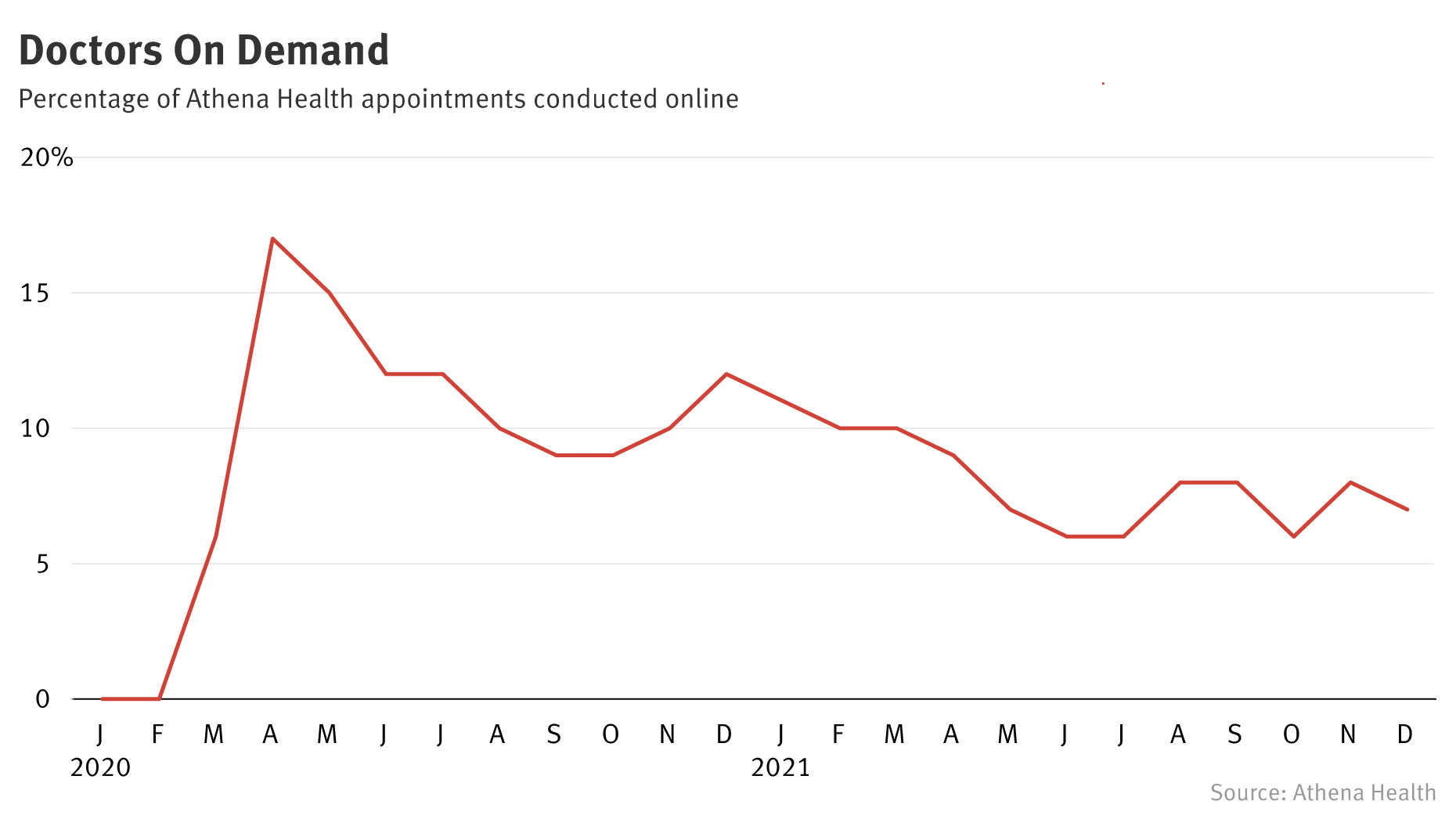
• Meal delivery and telehealth look like they’re here to stay
• Travel has rebounded after a pandemic-induced slump
• A Wall Street selloff has dampened venture investments

A New Model for Healthcare
The pandemic prompted big changes in the delivery of healthcare. At the start of 2020, fewer than 1% of medical appointments were held virtually. In a matter of weeks, that figure soared to 17%. While these numbers have since tapered off, medical professionals still show interest in video calls, phone calls and text messaging.
One Medical, which charges customers an annual subscription fee to access a chain of primary care clinics and virtual services, launched on-demand remote care in 2014. But few people used it before Covid-19, said Will Kimbrough, the company’s senior medical director, who has managed its virtual care team since 2017.
Kimbrough thinks telehealth could endure because the pandemic prompted changes in insurance contracts that helped healthcare professionals get past discomfort about providing virtual care. “A lot of providers thought, ‘How can I talk about depression without sitting in the same room with somebody?’” he said.
Good Times for a Video Social-Media Service
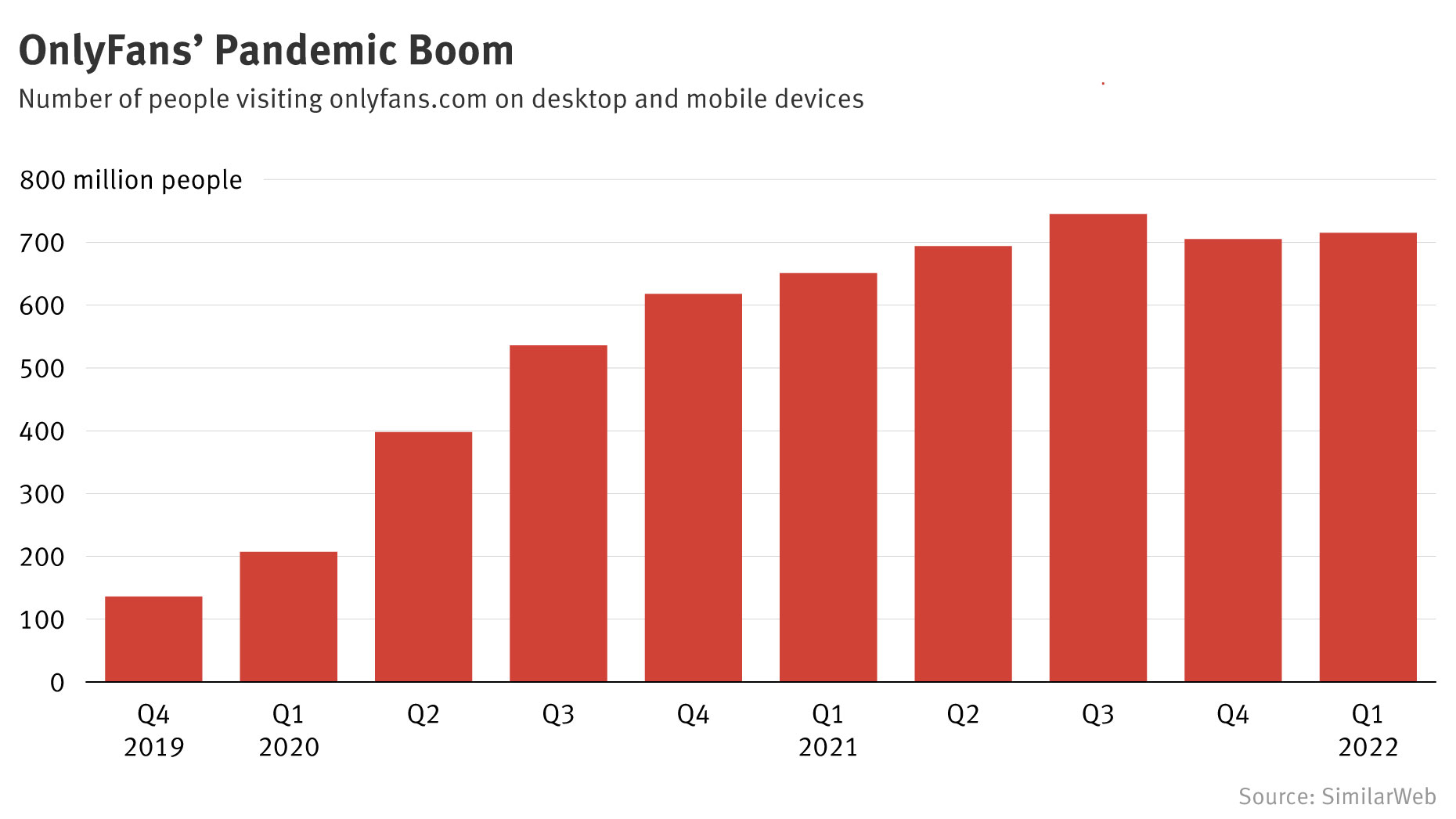
Even as some people return to clinics, others are spending dramatically more time online. Take OnlyFans, for example. The subscription-based social media platform, which is popular with sex workers, has been on a tear. It almost doubled its user base between the first and second quarters of last year, according to data from Similarweb, which tracked the number of visitors to OnlyFans’ website on desktops and mobile devices.
The number of visitors to the website peaked at around 740 million in the third quarter of last year and has remained close to that level since. This could be good for the company’s ambitions to go public. Last month, Axios reported that OnlyFans has been in talks with multiple special purpose acquisition companies with that goal in mind.
Ravi Mhatre, a partner at Lightspeed Venture Partners, thinks OnlyFans could succeed in going public, despite turmoil in the public markets and the racy nature of the startup’s business. “There aren’t that many companies that are platforms for creators that are at scale, so if they’re one of the first to go out, there’s probably going to be a lot of investors interested in them,” he said.
Online Gaming Dips
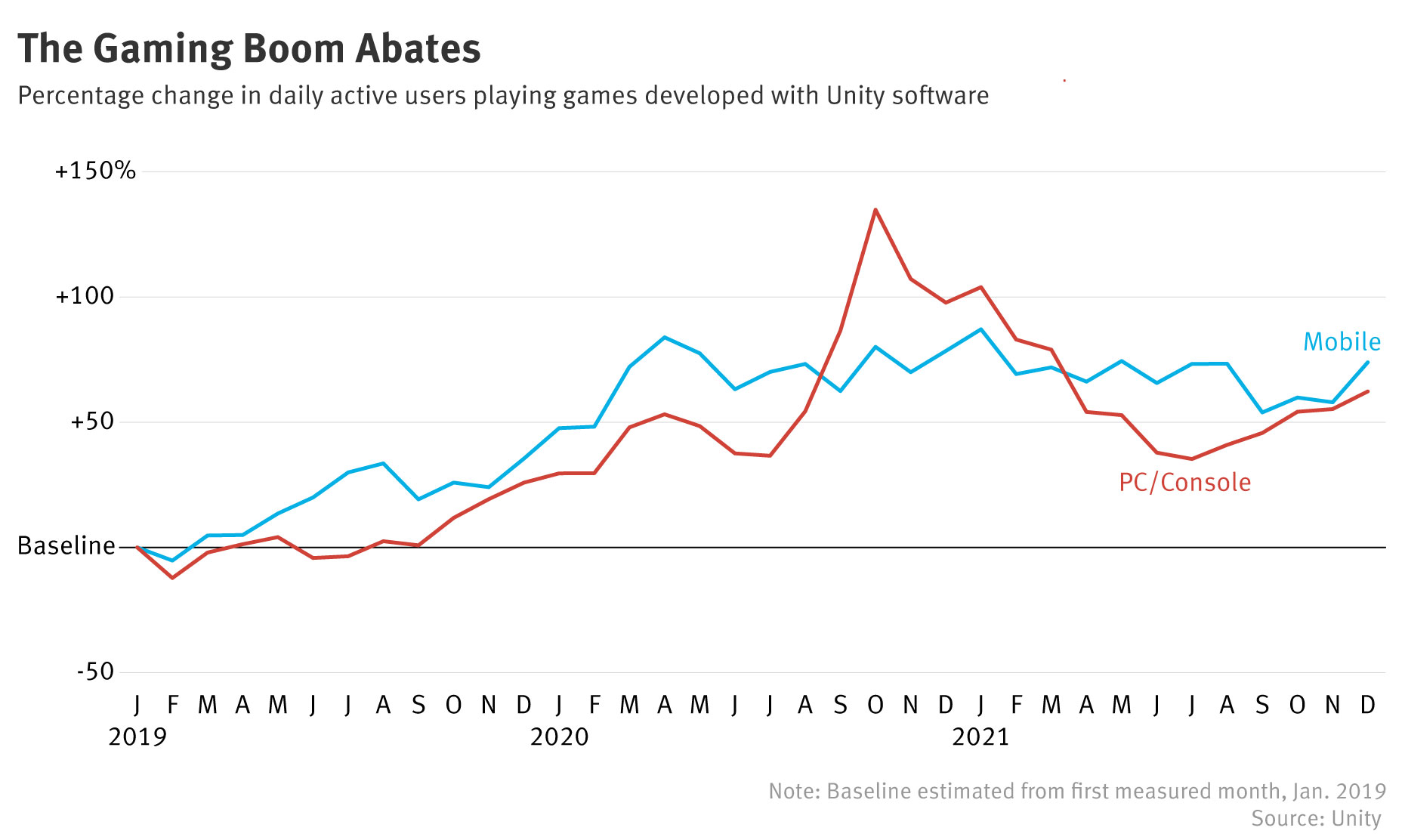
The pandemic led to a surge in online gaming that peaked in late 2020, according to statistics from Unity, which provides software used to develop games.
The surge abated last year, though more people are still gaming than before the pandemic. It’s possible that gaming has become a learned behavior, especially for some children who plugged into gaming consoles while cooped up at home.
“They play these games with their headsets on, they mic up and they’re talking to their friends and interacting socially way more through digital venues,” said Mhatre.
Sure enough, 62% of parents responding to a survey by The Information allowed their kids to play videogames, ranging from Roblox to Mario Kart. Of that share, 85% let their kids play before age 9.
Meal Delivery Endures
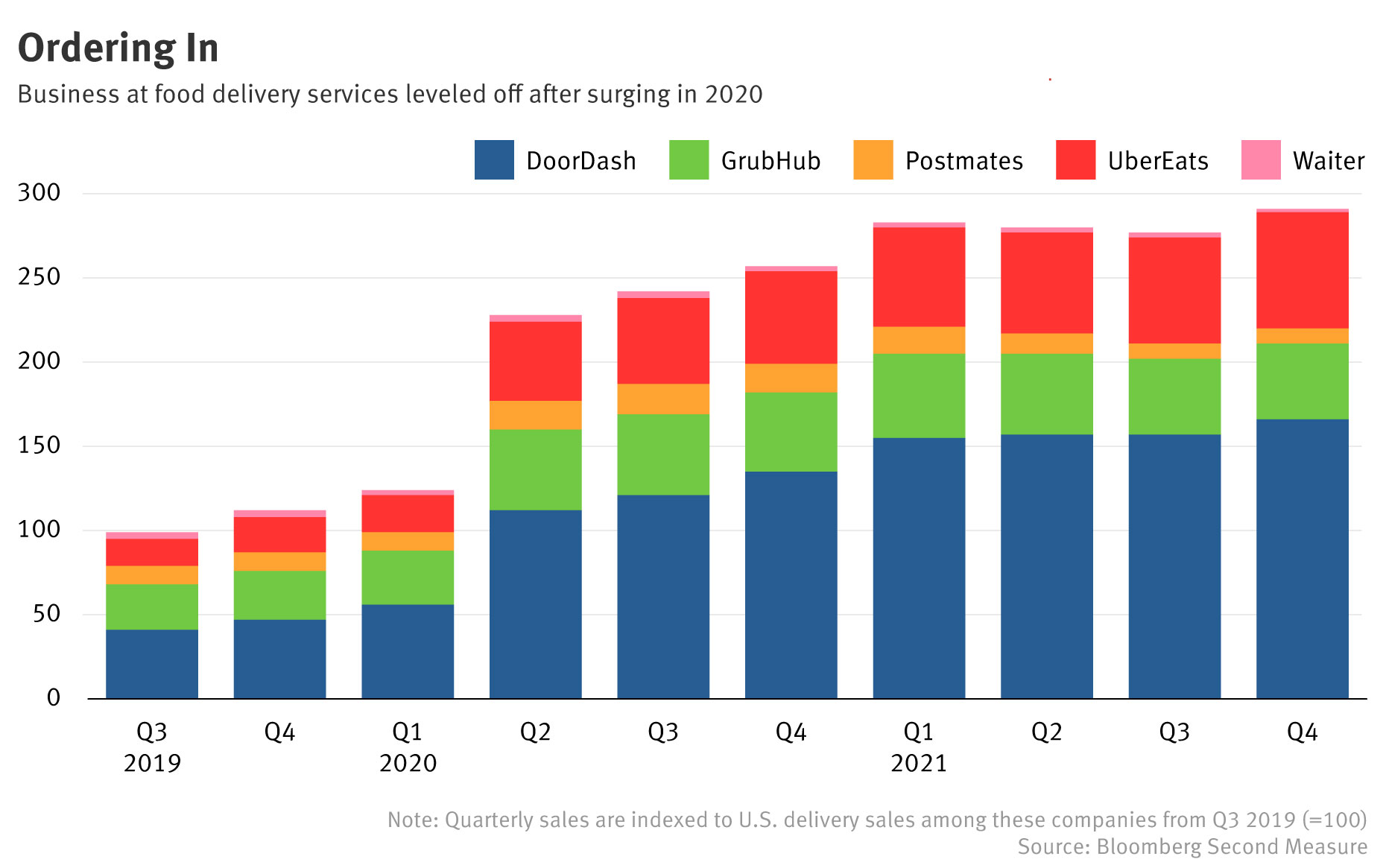
Covid-19 changed many things, including how Americans shop and dine, to the benefit of delivery services such as DoorDash, Grubhub and Uber Eats. Use of such services continued to climb last year even as many restaurants reopened, according to data from Bloomberg Second Measure.
Increasingly, delivery apps are offering food options from ghost kitchens, which prepare food only for delivery, not for in-person dining. Some of these operate as separate kitchens, while others rent space and personnel from existing restaurants and pay them a cut of their sales.
The popularity of meal-delivery services spawned a bevy of upstarts offering quick delivery of groceries and convenience items. Investors poured billions of dollars into startups like Gopuff and Getir last year. DoorDash launched DashMart, its version of 15-minute delivery, and Instacart launched a similar service. But some of these startups have hit tough times in 2022. Gopuff, which was valued at $15 billion last fall, plans to lay off hundreds of employees, around 3% of its workforce, to cut $40 million in costs.
Travel Rebounds
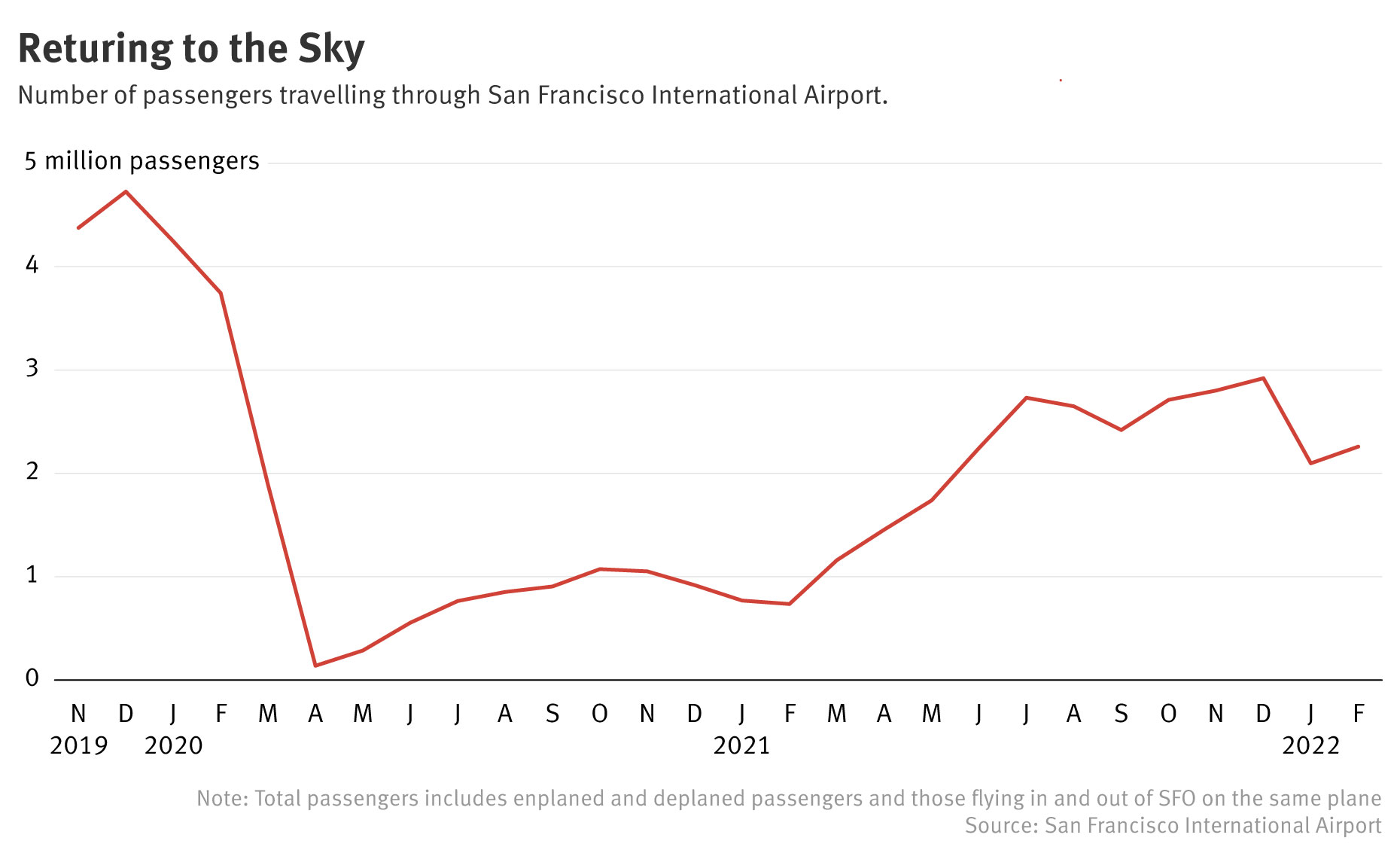
Pandemic-induced lockdowns had a devastating impact on travel. The number of passengers traveling through San Francisco International Airport, which serves the Bay Area, home to Google, Meta Platforms, Apple and other technology companies, plummeted 93% to fewer than 140,000 in April 2020, from almost 1.9 million people the prior month.
Traffic rebounded last year but remains significantly below pre-pandemic levels. More recently, air travel has had to overcome new Covid-19 variants and higher fuel costs following Russia’s invasion of Ukraine.
Where to Stay?
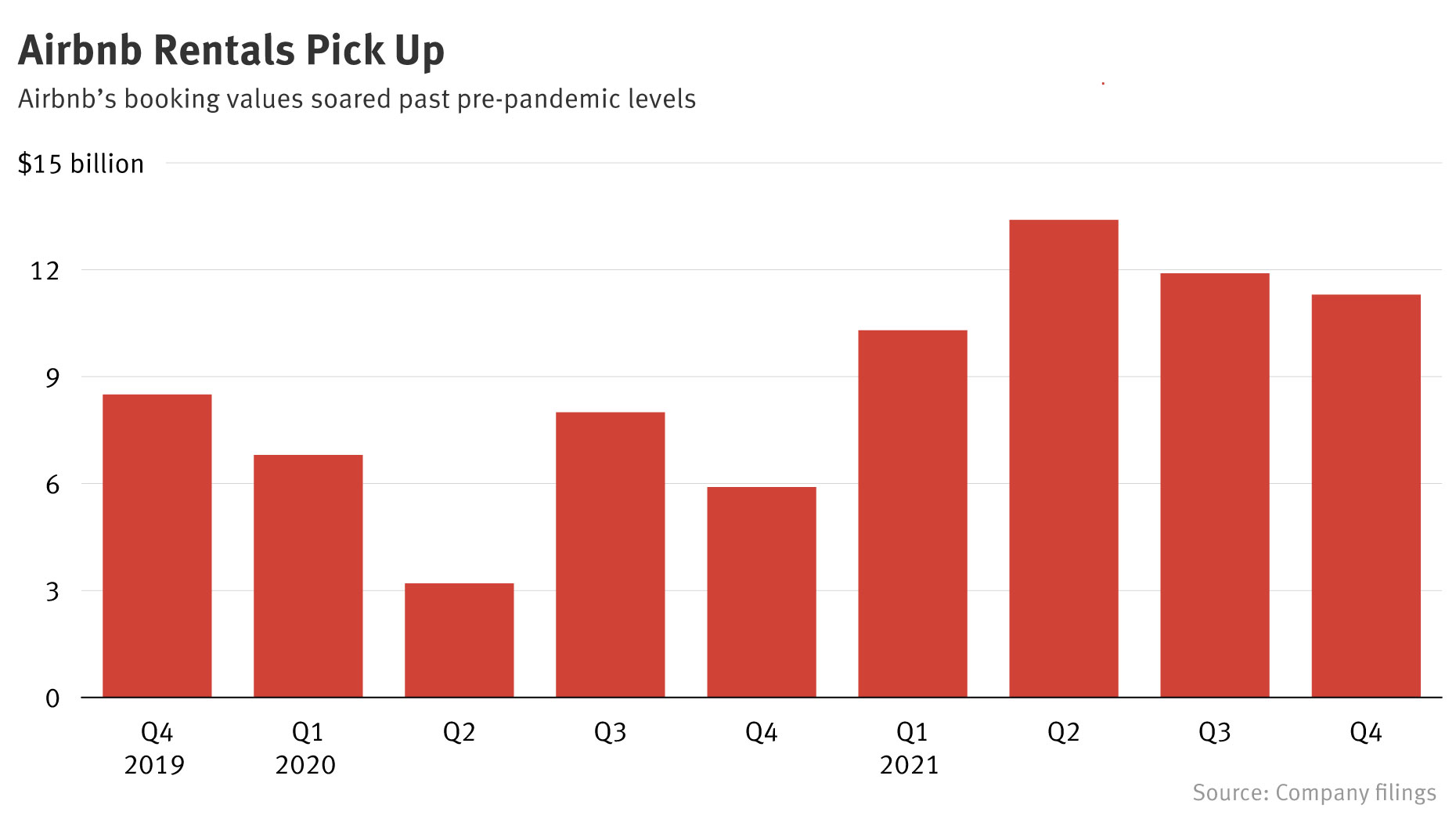
With more people traveling, it’s not surprising that Airbnb has enjoyed a renaissance. The home-sharing service was hit particularly hard as the pandemic began. Vacationers punted indefinitely on their travel plans.
But bookings began to rebound in the second half of 2020 as people with remote jobs saw an opportunity to book suburban homes with more space than small city apartments or to work from alternate locations.
Bookings remained high throughout 2021. In the fourth quarter of last year, they even exceeded the same period two years earlier, before the pandemic.
Message Received
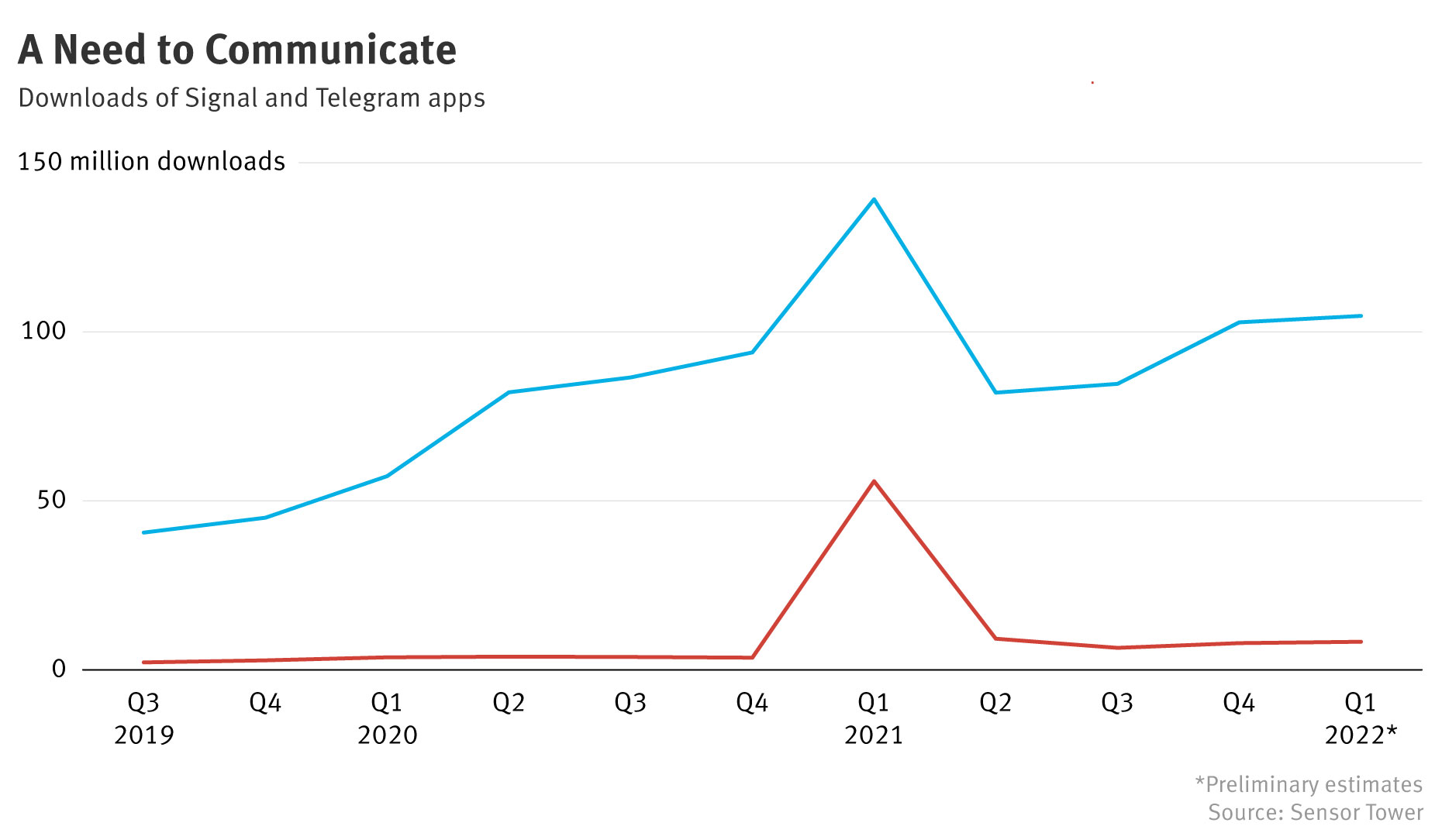
Less travel meant more desire to connect electronically. More people have been using communications apps Telegram and Signal, which both enjoyed a significant boost early in 2021 when WhatsApp told users it would begin to share data more liberally with its parent company, Meta.
More recently, Telegram has gained popularity with crypto communities. In a previous interview with The Information, Lydia Hylton, partner at Bain Capital Crypto, said many investors are turning to Telegram and Discord chats to gauge the popularity of non-fungible tokens.
Mhatre said some crypto enthusiasts use Telegram to get past the anonymity of blockchain wallets, which make it hard to identify who a person might be.
A Boom in Digital Art
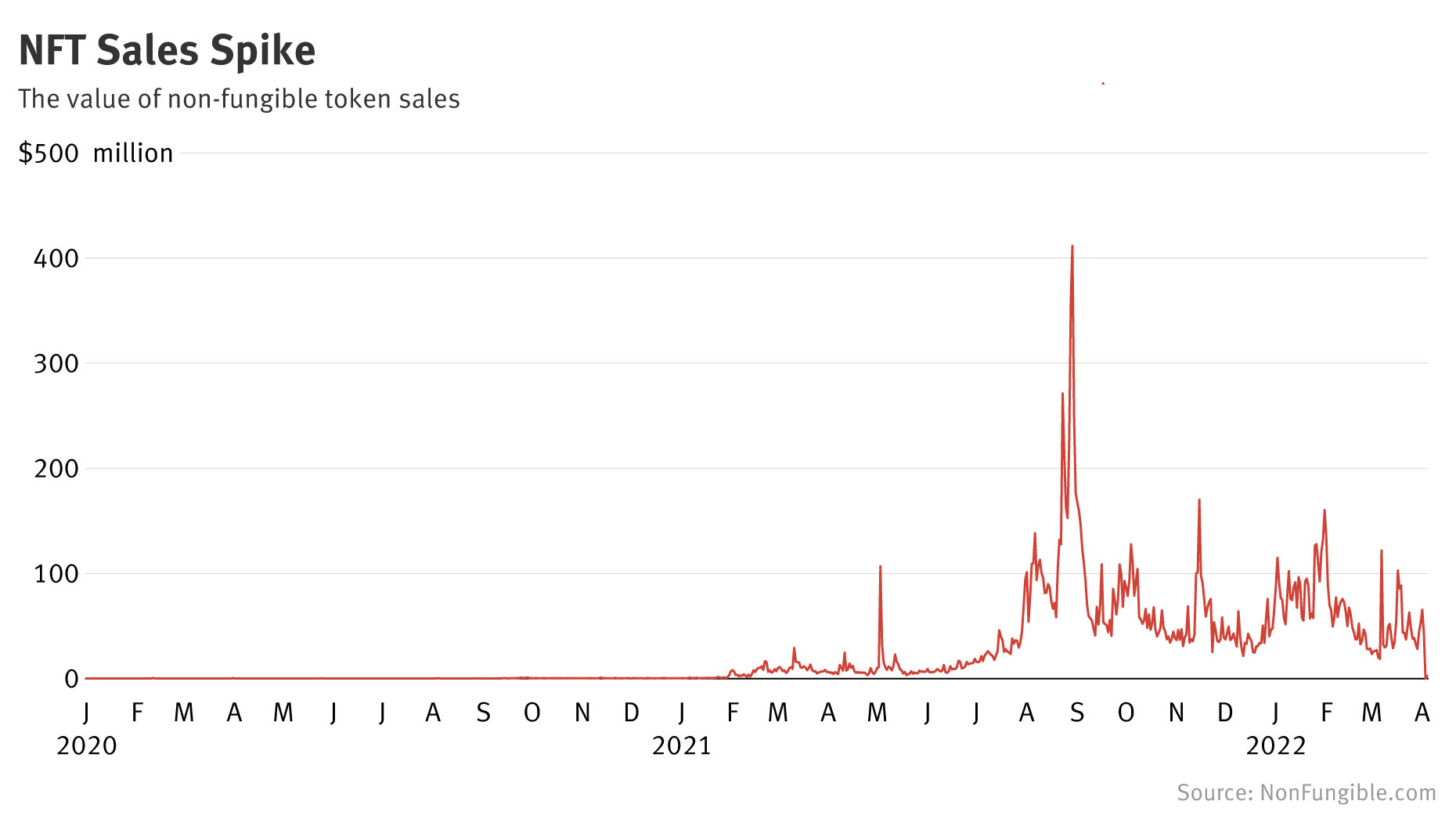
Sales of NFTs spiked last year, and then quickly fell, though the pandemic’s role isn’t clear. Some investors attribute the surge to sales of NFT art by people stuck at home during the pandemic, which has obscured other uses of the technology—in gaming, for instance.
“The hype is always about short-term gains. Long term, fundamentally, things are changing,” said Jai Das, co-founder, president and partner at Sapphire Ventures. “We’re still bullish on those” other uses.
SPAC Mania Ebbs
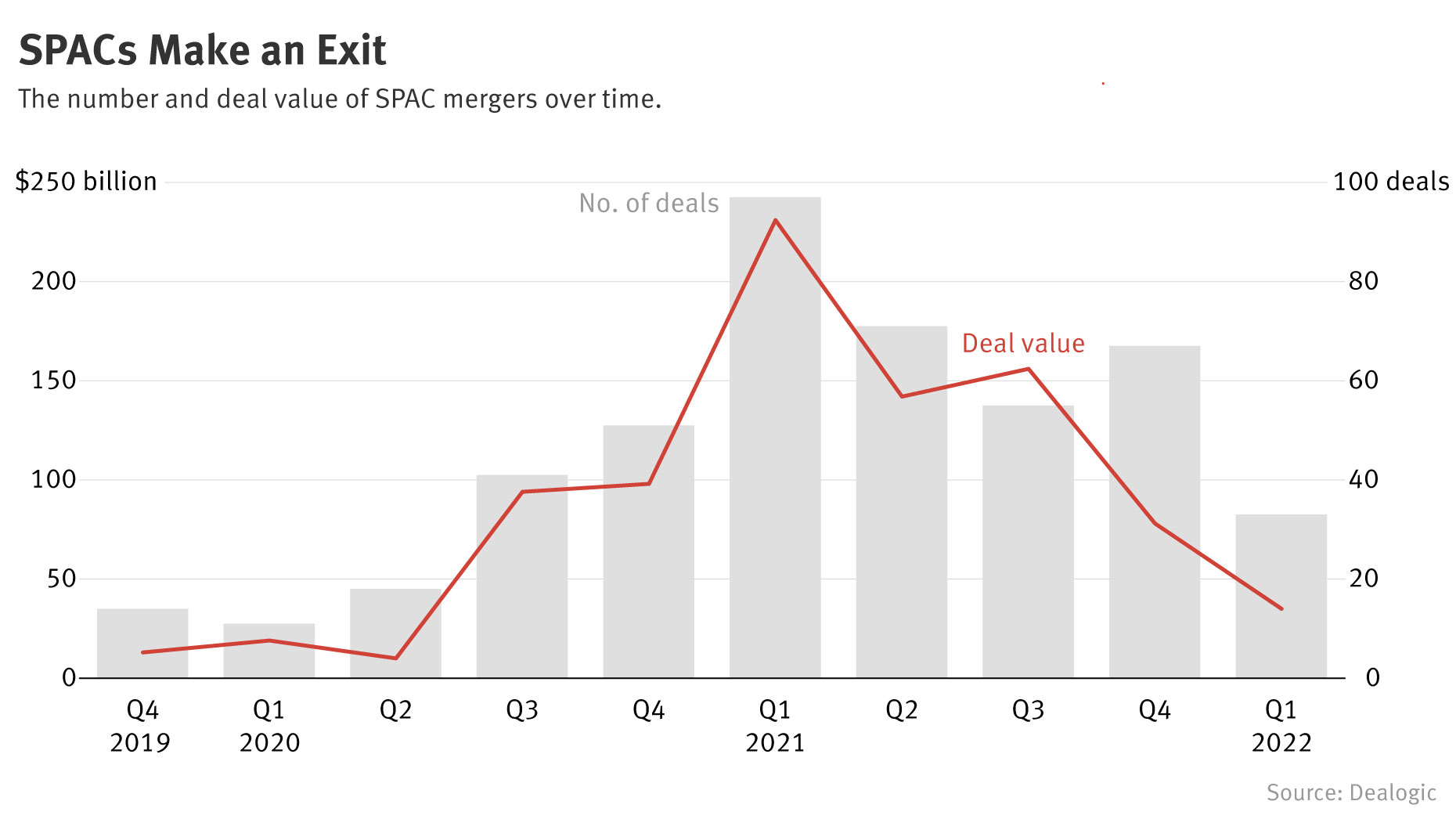
A year ago, private companies were rushing to go public through mergers with SPACs. But lackluster returns and increased regulatory scrutiny have dampened investor enthusiasm and reversed the trend.
Earlier this year, nearly 80% of companies that went public via SPAC mergers were trading below the standard $10 per share SPAC issue price.
Pamela Marcogliese, a lawyer focused on capital markets transactions, said a Securities and Exchange Commission announcement last April required SPACs to refile registration statements. This slowed things down as auditors were flooded with new financial statements. Proposed SEC rules might further discourage startups from going public via a SPAC.
Venture Investments Slow
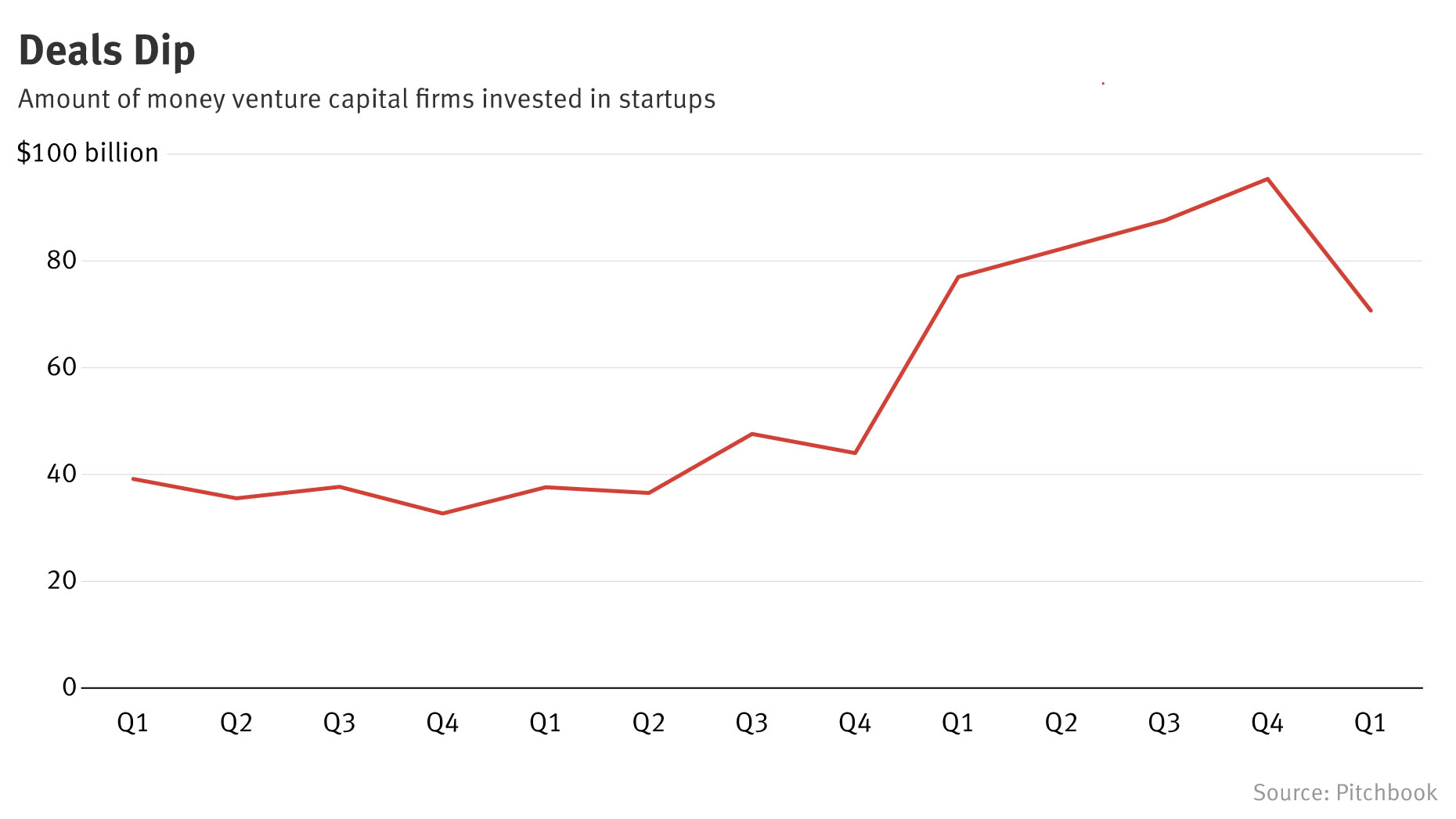
A downturn on Wall Street in the first months of this year has dampened the boom in startup investing. The number of investments made by venture capitalists in the first quarter fell almost 10% compared with the fourth quarter of last year; the amount of money invested fell even more sharply, by 25%. The dip has also encouraged some startup founders to cut costs, with the goal of saving cash for a downturn.
Ruth Foxe Blader, a partner at Anthemis, thinks some of the slowdown in venture capital investments is a correction to a flurry of activity last year. “I think it’s partly in response to the really stratospheric valuations that we saw in 2021 and the deal velocity, both of which really felt unsustainable,” she said.
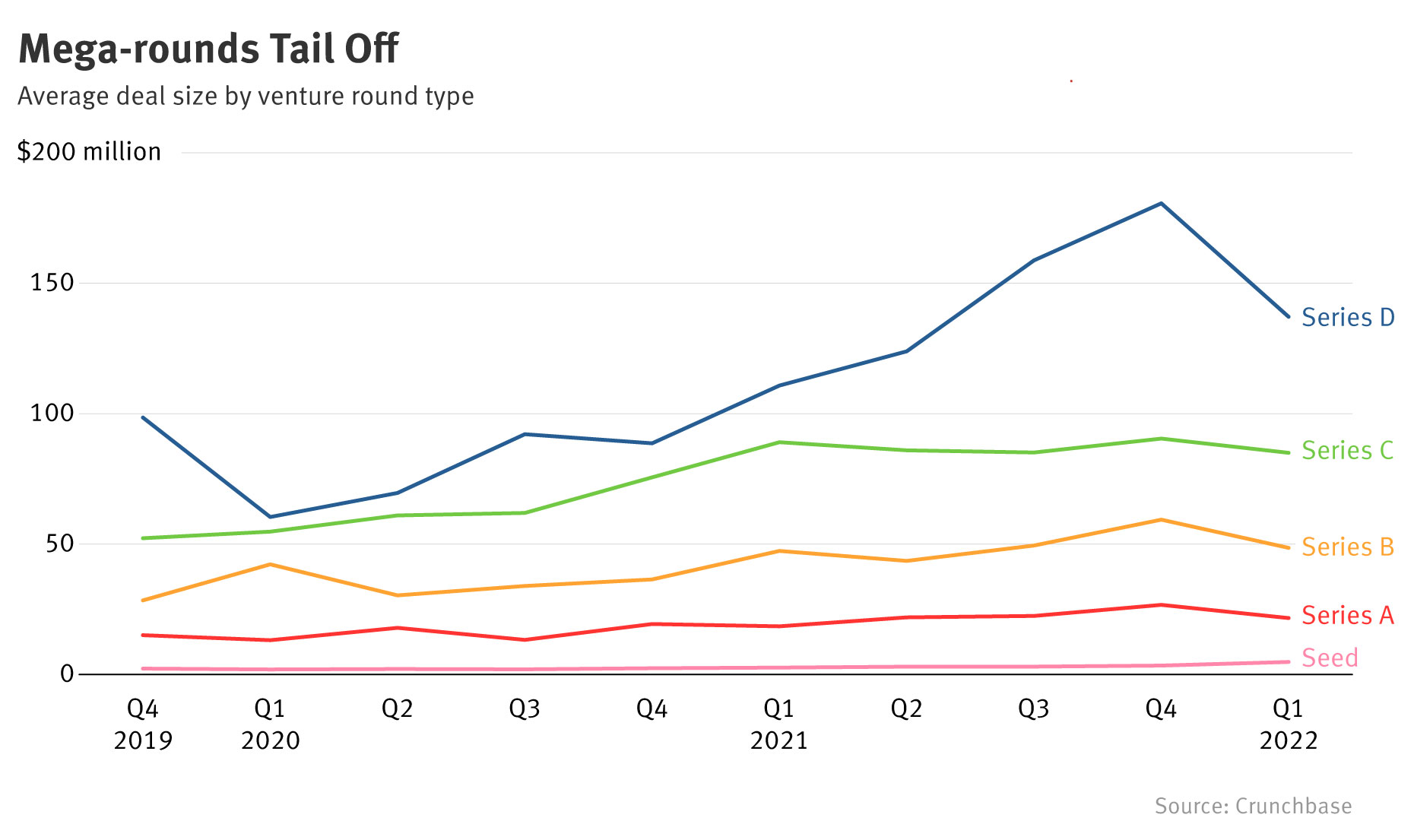
The downturn has been most pronounced for late-stage deals, the average of which had soared past $100 million last year. Blader said investors watch the public markets particularly closely for these companies, which are generally nearest to going public.
“People are scratching their heads about ‘What does the exit look like?’ and ‘How does the public market really look at this company?’ ‘Do these unit economics make a lot of sense?’” she said.
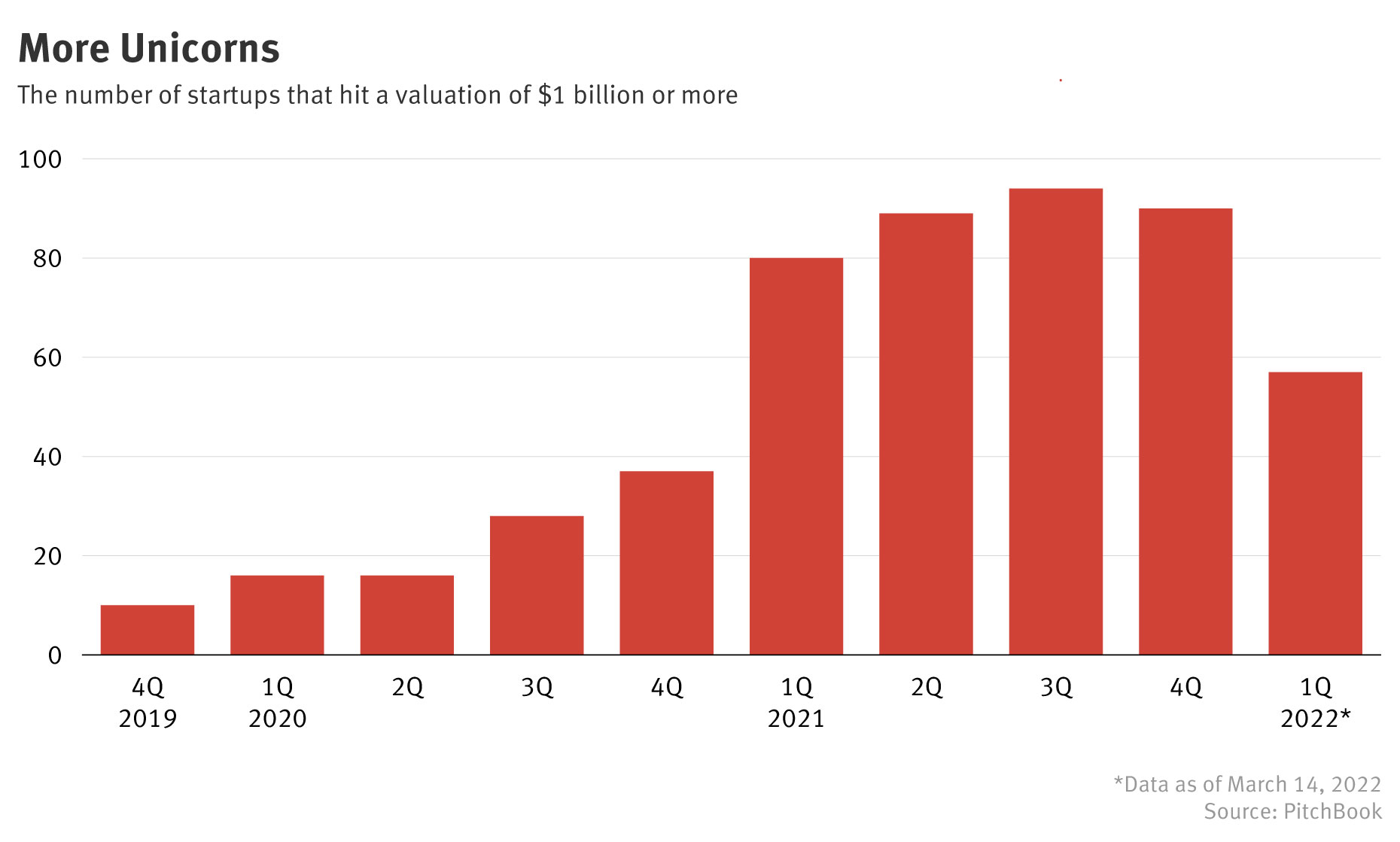
As investments drop, so do valuations, meaning fewer private companies reach unicorn status, with valuations exceeding $1 billion.
“Valuations have come down,” said Das of Sapphire Ventures. He said investors have walked away from some deals and reduced the size of their investments in others.