Research Calls
- Upgrades:
- Aptiv (APTV) upgraded to Equal Weight from Underweight at Wells Fargo; tgt raised to $112
- Brighthouse Financial (BHF) upgraded to Equal Weight from Underweight at Wells Fargo; tgt raised to $54
- Cardinal Health (CAH) upgraded to Overweight from Equal-Weight at Morgan Stanley; tgt $74
- Charles Schwab (SCHW) upgraded to Buy from Neutral at Compass Point; tgt $98
- CrowdStrike (CRWD) upgraded to Buy from Neutral at Goldman; tgt raised to $285
- Domino's Pizza (DPZ) upgraded to Buy from Neutral at Citigroup; tgt raised to $487
- Ferrari (RACE) upgraded to Outperform from Neutral at Exane BNP Paribas
- Finmeccanica SpA (FINMY) upgraded to Buy from Hold at Deutsche Bank
- First Financial (THFF) upgraded to Outperform from Mkt Perform at Raymond James; tgt $49
- Fox Corporation (FOXA) upgraded to Positive from Mixed at Vertical Group
- ICON plc (ICLR) upgraded to Buy from Hold at Deutsche Bank; tgt raised to $310
- Juniper Networks (JNPR) upgraded to Neutral from Sell at Citigroup; tgt raised to $36
- Louisiana-Pacific (LPX) upgraded to Buy from Hold at TD Securities; tgt $75
- Novo Nordisk A/S (NVO) upgraded to Equal-Weight from Underweight at Morgan Stanley
- Ryanair Hldgs (RYAAY) upgraded to Buy from Neutral at UBS
- Downgrades:
- AmerisourceBergen (ABC) downgraded to Equal-Weight from Overweight at Morgan Stanley; tgt $178
- Bancolombia S.A. (CIB) downgraded to Neutral from Overweight at JP Morgan; tgt $46
- Chegg (CHGG) downgraded to Sector Weight from Overweight at KeyBanc Capital Markets
- Cisco (CSCO) downgraded to Sell from Neutral at Citigroup; tgt lowered to $45
- Cohu (COHU) downgraded to Neutral from Buy at B. Riley Securities; tgt lowered to $30
- Dana Inc (DAN) downgraded to Equal Weight from Overweight at Wells Fargo; tgt lowered to $17
- Enjoy Technology (ENJY) downgraded to Market Perform from Outperform at Telsey Advisory Group; tgt lowered to $4
- F5 Networks (FFIV) downgraded to Equal-Weight from Overweight at Morgan Stanley; tgt lowered to $250 and removed as Top Pick
- Federated Hermes (FHI) downgraded to Sell from Neutral at Citigroup; tgt lowered to $28.50
- Fiserv (FISV) downgraded to Market Perform from Outperform at Cowen; tgt lowered to $126
- Franklin Resources (BEN) downgraded to Mkt Perform from Outperform at Keefe Bruyette; tgt $30
- Franklin Resources (BEN) downgraded to Neutral from Buy at Citigroup; tgt lowered to $28
- Hewlett Packard Enterprise (HPE) downgraded to Underweight from Equal-Weight at Morgan Stanley; tgt lowered to $15
- Ingredion (INGR) downgraded to Neutral from Outperform at Credit Suisse; tgt lowered to $94
- Invesco (IVZ) downgraded to Mkt Perform from Outperform at Keefe Bruyette; tgt $25
- JetBlue Airways (JBLU) downgraded to Underperform from Peer Perform at Wolfe Research
- Krispy Kreme, Inc. (DNUT) downgraded to Neutral from Buy at Citigroup; tgt lowered to $16
- Kulicke & Soffa (KLIC) downgraded to Neutral from Buy at B. Riley Securities; tgt lowered to $59 *
- Landos Biopharma (LABP) downgraded to Hold from Buy at Jefferies; tgt lowered to $1.40
- Mytheresa (MYTE) downgraded to Equal-Weight from Overweight at Morgan Stanley; tgt $14
- NetApp (NTAP) downgraded to Equal-Weight from Overweight at Morgan Stanley; tgt lowered to $91
- PACCAR (PCAR) downgraded to Neutral from Buy at Citigroup; tgt $90
- Rapid7 (RPD) downgraded to Neutral from Buy at Goldman; tgt $130
- Repare Therapeutics (RPTX) downgraded to Hold from Buy at Stifel; tgt $11
- Restaurant Brands Int'l (QSR) downgraded to Neutral from Buy at Citigroup; tgt lowered to $64
- Rolls Royce PLC (RYCEY) downgraded to Underweight from Neutral at JP Morgan
- Starbucks (SBUX) downgraded to Neutral from Buy at Citigroup; tgt lowered to $91
- STMicroelectronics (STM) downgraded to Equal Weight from Overweight at Barclays
- Skyworks (SWKS) downgraded to Neutral from Buy at B. Riley Securities; tgt lowered to $138
- Utz Brands (UTZ) downgraded to Neutral from Outperform at Credit Suisse; tgt lowered to $16.50
- Verint Systems (VRNT) downgraded to Neutral from Buy at Goldman; tgt $57
- Waste Mgmt (WM) downgraded to Market Perform from Outperform at BMO Capital Markets; tgt $174
- Others:
- ADTRAN (ADTN) initiated with a Buy at Rosenblatt; tgt $25
- Align Tech (ALGN) added to Tactical Underperform List at Evercore ISI
- BJ Restaurants (BJRI) initiated with a Neutral at Citigroup; tgt $29
- Bloomin' Brands (BLMN) initiated with a Neutral at Citigroup; tgt $24
- Brinker (EAT) initiated with a Neutral at Citigroup; tgt $38
- Calian Group (CLNFF) initiated with an Outperform at BMO Capital Markets
- Calix Networks (CALX) initiated with a Buy at Rosenblatt; tgt $60
- Cheesecake Factory (CAKE) initiated with a Buy at Citigroup; tgt $52
- Chipotle Mexican Grill (CMG) initiated with a Buy at Citigroup; tgt $1900
- Cracker Barrel (CBRL) initiated with a Sell at Citigroup; tgt $97
- Darden Restaurants (DRI) initiated with a Buy at Citigroup; tgt $162
- Denny's (DENN) initiated with a Neutral at Citigroup; tgt $15
- First Bancorp (FBP) assumed with an Outperform at Keefe Bruyette; tgt $17.50
- First Watch Restaurant Group (FWRG) assumed with a Buy at Citigroup; tgt lowered to $17
- HashiCorp (HCP) initiated with a Neutral at Piper Sandler; tgt $59
- Helmerich & Payne (HP) initiated with a Buy at The Benchmark Company; tgt $53
- Jack In The Box (JACK) initiated with a Neutral at Citigroup; tgt $104
- Mondelez Int'l (MDLZ) resumed with an Outperform at Credit Suisse; tgt $70
- McDonald's (MCD) assumed with a Neutral at Citigroup; tgt raised to $270
- OFG Bancorp (OFG) assumed with an Outperform at Keefe Bruyette; tgt $35
- Patrick Industries (PATK) initiated with a Buy at Truist; tgt $75
- Ping Identity (PING) initiated with a Buy at DA Davidson
- Pool (POOL) initiated with a Hold at Edward Jones
- Popular (BPOP) assumed with an Outperform at Keefe Bruyette; tgt $115
- Pyxis Tankers (PXS) initiated with a Buy at H.C. Wainwright; tgt $1.50
- QuantumScape Corporation (QS) initiated with a Hold at Deutsche Bank; tgt $20
- Sculptor Capital (SCU) added to 90-day Positive Catalyst Watch at Citigroup
- SelectQuote (SLQT) added to Tactical Underperform List at Evercore IS
- Sweetgreen (SG) initiated with a Neutral at Citigroup; tgt $32
- Syneos Health (SYNH) initiated with a Buy at Deutsche Bank; tgt $102
- T. Rowe Price (TROW) added to 30-day Negative Catalyst Watch at Citigroup
- Tenable (TENB) initiated with a Buy at DA Davidson; tgt $75
- Texas Roadhouse (TXRH) initiated with a Buy at Citigroup; tgt $105
- TORM plc (TRMD) initiated with a Buy at H.C. Wainwright; tgt $14
- Upstart (UPST) initiated with an Outperform at FBN Securities; tgt $150
- Veritone (VERI) initiated with a Neutral at UBS; tgt $18
- Wendy's (WEN) initiated with a Neutral at Citigroup; tgt $23
- Wingstop (WING) initiated with a Buy at Citigroup; tgt $160
- Xometry (XMTR) initiated with a Buy at Loop Capital; tgt $50
- Yum! Brands (YUM) initiated with a Buy at Citigroup; tgt $156
"Extraordinary" - US Consumer Prices Soar At Fastest In Over 40 Years
Having warned the world to expect "extraordinarily elevated" levels of inflation due to "Putin's Price Hike", The White House is likely in shock this morning as headline CPI rose 1.2% in March (vs +1.2% MoM) which sent the headline CPI up a shocking 8.5% YoY (vs +8.4% YoY exp and +7.9% prior) - the highest since 1981.
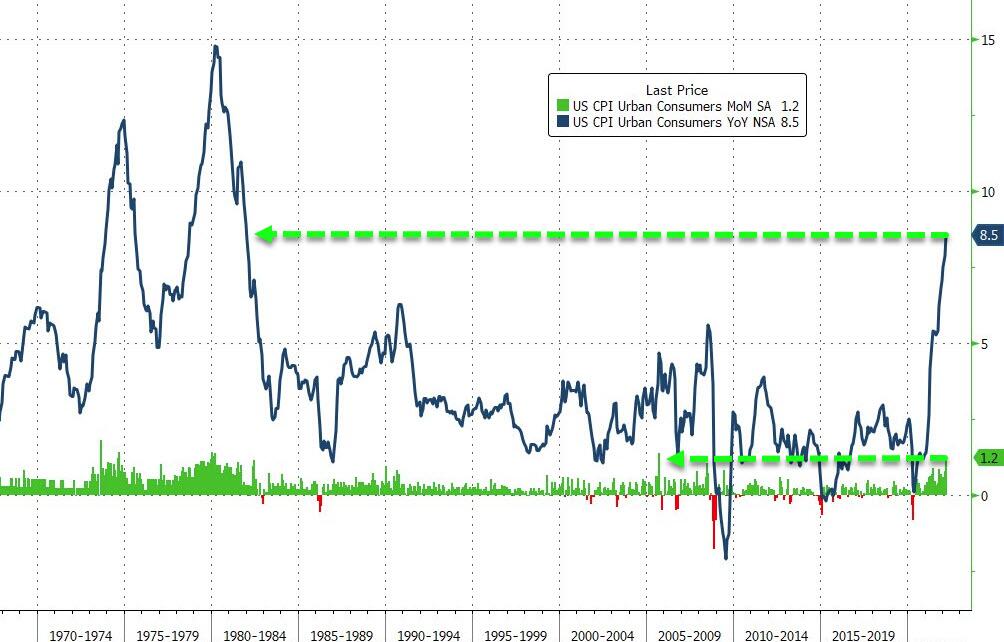
Source: Bloomberg
The 1.2% MoM rise is the biggest since Sept 2005 and CPI has risen for 22 straight months, but we note that goods inflation actually fell on a MoM basis (while energy soared)...
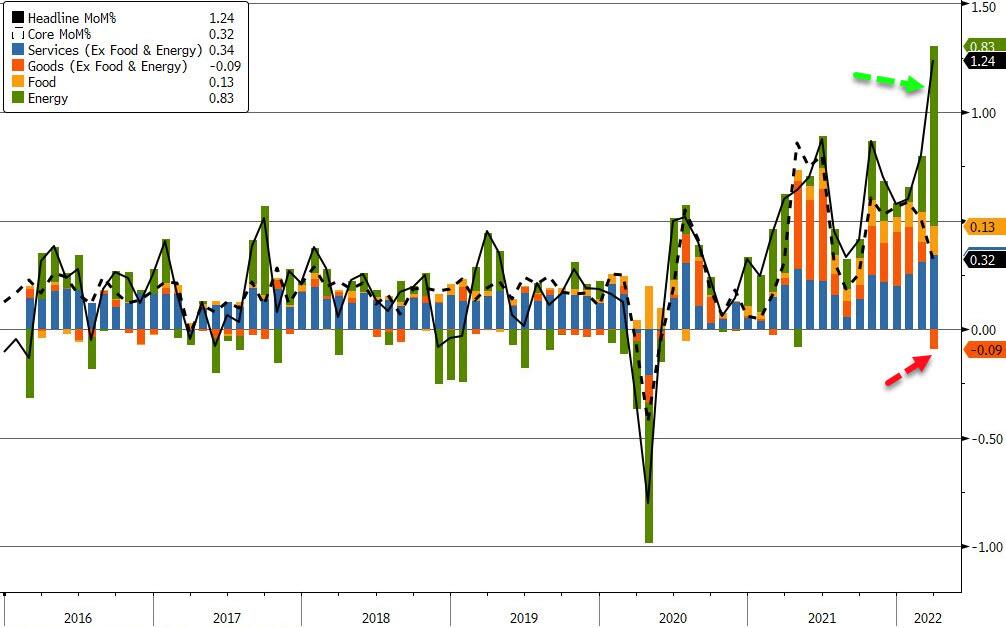
Source: Bloomberg
However, Core CPI (ex food and energy) rose just 0.3% MoM (below the +0.5% expected) and was up 6.5% YoY (above Feb's 6.4% but below the +6.6% exp).
The shelter index was by far the biggest factor in the increase, with a broad set of other indexes also contributing, including those for airline fares, household furnishings and operations, medical care, and motor vehicle insurance.
In contrast, the index for used cars and trucks fell 3.8 percent over the month.
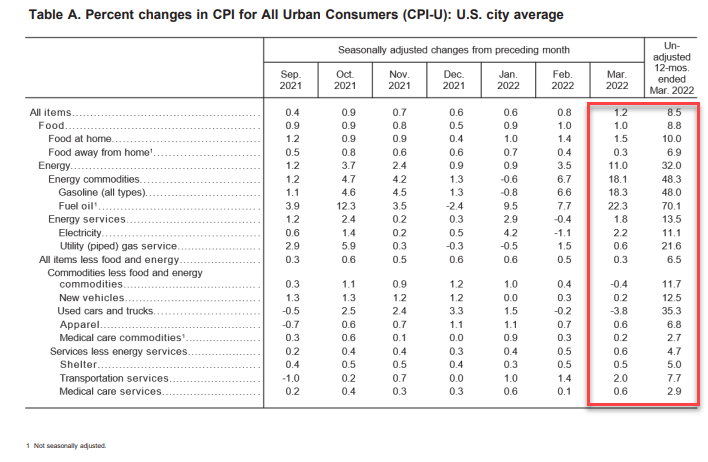
The rise in prices was dominated by Energy and goods on a year-over-year basis

Source: Bloomberg
The cost of putting a roof over your head (unless you're homeless in LA) continues to soar...
- March Shelter inflation 5.0% Y/Y, up from 4.7% in Feb, and the highest since May 1991
- March Rent inflation 4.44% Y/Y, up from 4.17% in Feb, and the highest since May 2007

Bear in mind that after this March report, inflation expectations start to step down, with second-quarter CPI seen at 7.6% and 5.7% by year-end, according to a Bloomberg survey. According to at least 6 Wall Street banks, this was the peak of the inflation wave.
And finally, and perhaps most importantly for the average American who actually has to pay for 'stuff' every day with his (or her or zher) own money, real average hourly earnings fell for the 12th straight month...

Source: Bloomberg
This confirms NBC News recent poll that showed 62% of Americans saying their incomes cannot keep up with the rising cost of living.
Still, the good news is, we all know who to blame for this right?
The bottom line: No inter-meeting or 75bps rate hike as the CPI data isn't as bad as it could have been.
If Crypto Can’t Be Used to Evade Russian Sanctions, What Is the Point?
Only small sums of money seem to have left Russia via digital currencies, which suggests their chances of ever replacing today’s government-run monetary system are low
If cryptocurrencies can’t have their moment in the sun when the entire Western monetary system is called into question, it may be time to call it quits.
As new sanctions hit Russia, the price of bitcoin keeps falling and is already 13% below where it was at the start of the year. Other digital currencies like ether and dogecoin have dropped in lockstep as stocks have stumbled, confirming once again that crypto gyrations mostly depend on broader speculative appetite.
But with U.S. lawmakers warning that cryptocurrencies could be used to bypass sanctions and many nations now aware of the perils of depending on currencies weaponized by Western governments, it is remarkable that prices aren’t reflecting the possibility of higher crypto adoption.
The likely explanation is that there isn’t much of any.
After Russia invaded Ukraine, ruble trading in bitcoin and tether hit 6.6 billion rubles on March 7, according to data firm Kaiko, compared with less than one billion before. But volumes quickly plummeted back to preinvasion levels due to U.S. card networks Visa and Mastercard suspending their Russian operations.
This suggests that crypto may have helped some people circumvent capital controls and shield their savings against a depreciating ruble, but that they were few and financially unsophisticated. Households would ideally use it to send the money to a foreign bank account, but most don’t have that ability. Crucially, the crypto market isn’t deep enough to absorb inflows of macroeconomic significance and, if it were, Moscow could ape China and force domestic banks to crack down on exchanges of rubles for crypto.
Whatever financial backdoor crypto offers, it doesn’t even seem to be big enough for expert sanction evaders.
For one, big, regulated exchanges like Binance must restrict accounts linked to sanctioned people. To be sure, there is still likely illegal activity in Russian crypto: There is evidence of new bank-deposit addresses being used on small exchanges tied to money laundering, according to Chainalysis, a firm that tracks illicit crypto transactions. But the sums liquidated are in the range of tens of millions of dollars, which is minuscule relative to the wealth of the hundreds of sanctioned individuals and entities.
Officials aren’t sitting idle either: Last week, the U.S. Treasury sanctioned Russia’s Garantex and Hydra for aiding cybercrime.
Analysts have long linked digital currencies’ value to the black market. This may be true when crypto stays within a circuit of companies with low “know your customer” controls in the niche digital economy—someone earning bitcoin from mining or ransomware can use it to buy virtual private networks or cloud hosting, for example—but the range of services on offer is small. Usually, crypto holders need to turn it into hard money by interacting with banks, and the traceability of blockchain technology becomes problematic. The idea that crypto anonymity can replace the traditional, meticulously built network of shell companies is wrong.
As Chainalysis’ director of research Kim Grauer puts it: “That’s just not how money laundering works.”
Of course, many crypto proponents prefer to dissociate it with crime and focus on how it has helped a war-torn Ukraine move money and receive $100 million in donations. Yet much of that activity is in tether, a digital currency pegged to the dollar.
The hard truth is that the only feature of cryptocurrencies that can’t be replicated by banks is the promise to sidestep government oversight. As far back as the 1905 writings of Georg Friedrich Knapp, economists have distinguished between the “chartalist” theory by which money is granted value by the power of the State and the “metalist” view that money only has true value if made up of a scarce commodity.
Crypto investors need the latter to be true, but the situation in Russia is piling up ever more evidence in favor of the former.
Ukraine War Drives Shortage in Pig Iron, Pushing Steel Prices Higher
Russia, Ukraine were top suppliers of pig iron used to make steel in the U.S.; steel companies look to Brazil, India
Pig-iron prices are surging, helping reverse a recent decline in the U.S. steel market.
Pig iron, a raw form of the metal used in the production of steel, has grown scarce in the weeks following Russia’s invasion of Ukraine, industry executives said. Two-thirds of the 6 million metric tons of pig iron imported by the U.S. last year came from those two countries, according to the U.S. Census Bureau, but the fighting brought Ukrainian shipments to a halt and importers have stopped ordering from Russia, steel executives said.
The crunch has steelmakers seeking out new suppliers in Brazil, India and elsewhere, in the midst of tightening U.S. supplies of scrap steel. Meanwhile, prices for pig iron have nearly doubled.
“There is really a concern about the availability of materials,” said Parth Jindal, director of JSW USA, a unit of India’s JSW Steel Ltd. 500228 -1.50% “The lack of pig iron and the lack of scrap in the U.S. has really pushed up prices.”
Pig iron—ore reduced to molten iron that is cast into briquettes—is mixed with scrap in electric furnaces and melted into new steel. About 70% of steel produced in the U.S. is made in electric furnaces, making the U.S. particularly reliant on scrap steel and pig iron. U.S. pig iron imports last year were 20% higher than in 2019.
Russia and Ukraine are the world’s largest sellers of pig iron, and in most years, the U.S. steel industry is the world’s biggest buyer. Since January, the price of pig iron in the U.S. has increased by 74% to $940 a metric ton, according to S&P Global Commodity Insights.
To offset more expensive pig iron, steelmakers said they are relying more on scrap steel from manufacturing waste, shredded cars and other debris. That demand has driven the price of high-quality scrap 51% higher since February, and set off a new round of price increases for finished steel, reversing months of declines. The spot-market price for the industry benchmark hot-rolled coiled sheet steel is up 48% since the beginning of March to $1,480 a ton, according to S&P Global price surveys.
“The rise in steel prices is related directly to the Russia and Ukraine war,” said Philipp Englin, chief executive of World Steel Dynamics, a market consulting firm in New Jersey.
Indiana-based steelmaker Steel Dynamics Inc. in late February was tracking what would be its last shipload of pig iron from Russia when the country invaded Ukraine. That shipment arrived March 3, but the company’s contract for additional shipments from Russia has been canceled because of the war, said Chief Executive Mark Millett.
Mr. Millett said that Steel Dynamics switched its pig iron purchases to Brazil, and the company has been able to reduce its overall usage of the commodity by improving its scrap-processing operations. By doing a more thorough job of removing copper, stainless steel and other metal that contaminates steel scrap, he said, Steel Dynamics can upgrade lower-quality scrap.
Pig iron accounts for about 10% to 20% of the raw material used to make steel in an electric furnace. Mr. Millett said that Steel Dynamics’ pig-iron usage has dropped to the lower end of that range by improving the processing of the company’s scrap.
“We have an adequate supply,” he said. “We have modified our operation to use a little less pig iron. ”
Most pig iron is produced in blast furnaces that are heated with coking coal, a type of processed coal that burns hotter and more efficiently than regular coal. Pig iron’s unusual name dates to the earliest days of steel mills, when liquid iron was poured into troughs and molds dug into the dirt floors of mills. The configurations resembled a sow with suckling piglets, and the name “pig iron” stuck.
JSW’s Mingo Junction, Ohio, mill gets its pig iron from its parent company in India. Mr. Jindal said JSW typically hasn’t sold pig iron outside of India, but the global shortages are changing that. The steelmaker’s operations in India can produce about 1 million metric tons a year of surplus pig iron for the export market, he said, and JSW recently sold a couple of shiploads of pig iron for United States Steel Corp.’s X -0.78% , Big River Steel mill in Arkansas.
Nucor Corp. , the largest steelmaker in the U.S. and a purchaser of 2.5 million metric tons of pig iron annually, said mills in China, Japan, the United Arab Emirates and Canada also have started offering pig iron.
“It’s more of a cost issue than an availability issue,” said Doug Jellison, Nucor’s executive vice president of raw materials.
American steel companies using blast furnaces typically use their molten iron to make finished steel, rather than sell pig iron to competitors. U.S. Steel recently said that it intends to devote one of the blast furnaces at its Gary, Ind., mill to produce pig iron for its Big River mill. U.S. Steel plans to double the annual steel production capacity at that mill to 6.3 million tons in 2024.
The mill’s expansion is part of the 10 million tons of additional production capacity for flat-rolled steel that is scheduled to enter service in the U.S. over the next two years. The build-out will likely keep prices for pig iron and scrap elevated for U.S. steelmakers, industry executives said.
“They need the material,” said Mark Kaplan, president of Consolidated Mill Supply Inc., an Illinois distributor of pig iron. “But companies either can’t afford it or they can’t find it.”
The private market “supercycle”
Goldman Sachs reckons that the boom in private capital has much, much further to run.
The hottest thing in finance is not passive funds, crypto or even commodities. It is private capital — things like venture capital, infrastructure, private equity and direct lending — and it is absolutely booming.
Last year, the overall size of the private capital industry rose to over $10tn, and industry data provider Preqin predicted that this will grow to almost $18bn by 2026. However, Goldman Sachs forecasts that it could actually swell to as big as $30tn by then, if it continues to make retail investor inroads and interest rates don’t go up as much as feared.
We believe future industry AUM growth dynamics of private markets will be driven by seven key factors over the medium term, including track record vs. public markets, interest rates, and the retail opportunity, among others. Assessing each of these factors in this report, we see an overall positive backdrop for industry AUM growth to continue. Moreover, we combine this 7-point framework with Preqin’s 2026 industry AUM forecast of $17.8tn and through-cycle growth since 2000 to assess the potential pathways over the next 5Y, including a blue-sky $30tn+ scenario for private markets (ie >3x from today).
Here are the relevant Goldman charts showing that upside scenario.
Now, one should always take sellside Big Numbers with a pinch of salt. Goldman Sachs stresses that this is its “blue sky” forecast. Its “grey sky” prediction is for more moderate industry size of just under $15tn by 2026, as rising interest rates and limp retail demand weigh on growth.
In a grey-sky scenario, we see scope for the growth profile of private markets AUM to reflect the one achieved between 2008 and 2012, rising at a blended CAGR of c. 8% (which is within one standard deviation of the long-term average). This scenario would result in 2026 industry AUM of US$14.8tn, which is c. 20% smaller than our base case. We believe a bearish view on industry AUM growth could be driven by a faster-than-anticipated hike in interest rates to higher levels vs. historical averages (such as if inflation were to continue rising due to wage pressure and geopolitical factors), regulatory headwinds constraining further institutional investment from pensions and endowments, a lack of retail investment in private markets, and a failure to close the gap between current and target allocations.
And here are the charts for how that scenario would shake out:
However, the fact that Goldman Sachs expects private capital to jump to almost $15tn in less than five years even in its gloomy scenario underscores just how mental things are in the space right now.
This is why there has been a mad dash by pretty much every big traditional asset manager to snap up private capital specialists in recent years, whether they operate in racier areas like private debt or less-glamorous infrastructure.
Off the top of Alphaville’s head, just the most recent (ish) deals are — deep breath — Schroders buying Greencoat and Cairn Real Estate; AllianceBernstein buying CarVal Investors; Franklin Templeton buying Lexington Partners, Benefit Street Partners and Clarion Partners; T Rowe Price buying Oak Hill; and JPMorgan Asset Management buying Campbell Global.
There are many we have forgotten, and there are undoubtedly more coming in what looks like a private capital gold rush. Anyway, for afficionados of sellside graphics, here is Goldman’s seven-factor framework for private capital.
Research Calls
- Upgrades:
- Aptiv (APTV) upgraded to Equal Weight from Underweight at Wells Fargo; tgt raised to $112
- Brighthouse Financial (BHF) upgraded to Equal Weight from Underweight at Wells Fargo; tgt raised to $54
- Cardinal Health (CAH) upgraded to Overweight from Equal-Weight at Morgan Stanley; tgt $74
- Charles Schwab (SCHW) upgraded to Buy from Neutral at Compass Point; tgt $98
- CrowdStrike (CRWD) upgraded to Buy from Neutral at Goldman; tgt raised to $285
- Domino's Pizza (DPZ) upgraded to Buy from Neutral at Citigroup; tgt raised to $487
- Ferrari (RACE) upgraded to Outperform from Neutral at Exane BNP Paribas
- Finmeccanica SpA (FINMY) upgraded to Buy from Hold at Deutsche Bank
- First Financial (THFF) upgraded to Outperform from Mkt Perform at Raymond James; tgt $49
- ICON plc (ICLR) upgraded to Buy from Hold at Deutsche Bank; tgt raised to $310
- Juniper Networks (JNPR) upgraded to Neutral from Sell at Citigroup; tgt raised to $36
- Louisiana-Pacific (LPX) upgraded to Buy from Hold at TD Securities; tgt $75
- Novo Nordisk A/S (NVO) upgraded to Equal-Weight from Underweight at Morgan Stanley
- Ryanair Hldgs (RYAAY) upgraded to Buy from Neutral at UBS
- Downgrades:
- AmerisourceBergen (ABC) downgraded to Equal-Weight from Overweight at Morgan Stanley; tgt $178
- Bancolombia S.A. (CIB) downgraded to Neutral from Overweight at JP Morgan; tgt $46
- Chegg (CHGG) downgraded to Sector Weight from Overweight at KeyBanc Capital Markets
- Cisco (CSCO) downgraded to Sell from Neutral at Citigroup; tgt lowered to $45
- Dana Inc (DAN) downgraded to Equal Weight from Overweight at Wells Fargo; tgt lowered to $17
- Enjoy Technology (ENJY) downgraded to Market Perform from Outperform at Telsey Advisory Group; tgt lowered to $4
- F5 Networks (FFIV) downgraded to Equal-Weight from Overweight at Morgan Stanley; tgt lowered to $250 and removed as Top Pick
- Federated Hermes (FHI) downgraded to Sell from Neutral at Citigroup; tgt lowered to $28.50
- Fiserv (FISV) downgraded to Market Perform from Outperform at Cowen; tgt lowered to $126
- Hewlett Packard Enterprise (HPE) downgraded to Underweight from Equal-Weight at Morgan Stanley; tgt lowered to $15
- Ingredion (INGR) downgraded to Neutral from Outperform at Credit Suisse; tgt lowered to $94
- Invesco (IVZ) downgraded to Mkt Perform from Outperform at Keefe Bruyette; tgt $25
- Krispy Kreme, Inc. (DNUT) downgraded to Neutral from Buy at Citigroup; tgt lowered to $16
- Landos Biopharma (LABP) downgraded to Hold from Buy at Jefferies; tgt lowered to $1.40
- NetApp (NTAP) downgraded to Equal-Weight from Overweight at Morgan Stanley; tgt lowered to $91
- Rapid7 (RPD) downgraded to Neutral from Buy at Goldman; tgt $130
- Repare Therapeutics (RPTX) downgraded to Hold from Buy at Stifel; tgt $11
- Rolls Royce PLC (RYCEY) downgraded to Underweight from Neutral at JP Morgan
- Starbucks (SBUX) downgraded to Neutral from Buy at Citigroup; tgt lowered to $91
- STMicroelectronics (STM) downgraded to Equal Weight from Overweight at Barclays
- Utz Brands (UTZ) downgraded to Neutral from Outperform at Credit Suisse; tgt lowered to $16.50
- Verint Systems (VRNT) downgraded to Neutral from Buy at Goldman; tgt $57
- Waste Mgmt (WM) downgraded to Market Perform from Outperform at BMO Capital Markets; tgt $174
- Others:
- ADTRAN (ADTN) initiated with a Buy at Rosenblatt; tgt $25
- BJ Restaurants (BJRI) initiated with a Neutral at Citigroup; tgt $29
- Bloomin' Brands (BLMN) initiated with a Neutral at Citigroup; tgt $24
- Calian Group (CLNFF) initiated with an Outperform at BMO Capital Markets
- Calix Networks (CALX) initiated with a Buy at Rosenblatt; tgt $60
- Cheesecake Factory (CAKE) initiated with a Buy at Citigroup; tgt $52
- Cracker Barrel (CBRL) initiated with a Sell at Citigroup; tgt $97
- Darden Restaurants (DRI) initiated with a Buy at Citigroup; tgt $162
- Denny's (DENN) initiated with a Neutral at Citigroup; tgt $15
- First Bancorp (FBP) assumed with an Outperform at Keefe Bruyette; tgt $17.50
- First Watch Restaurant Group (FWRG) assumed with a Buy at Citigroup; tgt lowered to $17
- HashiCorp (HCP) initiated with a Neutral at Piper Sandler; tgt $59
- Helmerich & Payne (HP) initiated with a Buy at The Benchmark Company; tgt $53
- Mondelez Int'l (MDLZ) resumed with an Outperform at Credit Suisse; tgt $70
- OFG Bancorp (OFG) assumed with an Outperform at Keefe Bruyette; tgt $35
- Patrick Industries (PATK) initiated with a Buy at Truist; tgt $75
- Ping Identity (PING) initiated with a Buy at DA Davidson
- Pool (POOL) initiated with a Hold at Edward Jones
- Popular (BPOP) assumed with an Outperform at Keefe Bruyette; tgt $115
- Pyxis Tankers (PXS) initiated with a Buy at H.C. Wainwright; tgt $1.50
- QuantumScape Corporation (QS) initiated with a Hold at Deutsche Bank; tgt $20
- Sweetgreen (SG) initiated with a Neutral at Citigroup; tgt $32
- Syneos Health (SYNH) initiated with a Buy at Deutsche Bank; tgt $102
- Tenable (TENB) initiated with a Buy at DA Davidson; tgt $75
- Texas Roadhouse (TXRH) initiated with a Buy at Citigroup; tgt $105
- TORM plc (TRMD) initiated with a Buy at H.C. Wainwright; tgt $14
- Veritone (VERI) initiated with a Neutral at UBS; tgt $18
- Wendy's (WEN) initiated with a Neutral at Citigroup; tgt $23
- Wingstop (WING) initiated with a Buy at Citigroup; tgt $160
- Xometry (XMTR) initiated with a Buy at Loop Capital; tgt $50
- Yum! Brands (YUM) initiated with a Buy at Citigroup; tgt $156
Gapping down
In reaction to earnings/guidance:
- MIMO -3.8%, ACI -3.7%, KMX -2.7%, GOL -1.4%
Other news:
- MYOV -20.8% (Myovant Sciences and and Pfizer (PFE) provide update on sNDA for MYFEMBREE)
- WULF -9.1% (stock offering)
- RPTX -4.9% (presents updated data from ongoing Phase 1/2 TRESR study)
- VMEO -3.3% (reports monthly metrics for March)
- ENSG -3.2% (receives new $600 million credit facility)
- LFLY -0.9% (stock offering)
- BEN -0.8% (reports March AUM)
Analyst comments:
- ENJY -4.7% (downgraded to Market Perform from Outperform at Telsey Advisory Group)
- CHGG -3.7% (downgraded to Sector Weight from Overweight at KeyBanc Capital Markets)
- HPE -3.4% (downgraded to Underweight from Equal-Weight at Morgan Stanley)
- DAN -2.8% (downgraded to Equal Weight from Overweight at Wells Fargo)
- CSCO -2.5% (downgraded to Sell from Neutral at Citigroup)
- FHI -2.3% (downgraded to Sell from Neutral at Citigroup)
- FFIV -1.6% (downgraded to Equal-Weight from Overweight at Morgan Stanley)
- DNUT -1.5% (downgraded to Neutral from Buy at Citigroup)
- ABC -1.2% (downgraded to Equal-Weight from Overweight at Morgan Stanley)
- FISV -1.1% (downgraded to Market Perform from Outperform at Cowen)
Gapping up
News:
- ATNM +27.8% (Actinum Pharma and Immedica to commercialize Iomab-B (131I apamistamab) in Europe the Middle East and North Africa)
- AGLE +17.7% (presents additional data from PEACE phase 3 study of Pegzilarginase; submits BLA to FDA for Pegzilarginase)
- SPNE +5% (announces full commercial launch of Reef TA Interbody System)
- GDYN +5% (expands in Europe ceases operations in Russia)
- APAM +4.7% (reports March AUM)
- VTGN +3.8% (VistaGen and AffaMed Complete Key Regulatory Submissions for PALISADE Global Phase 3 Clinical Trial for PH94B)
- CVAC +1.6% (CureVac and GSK Enter into pandemic preparedness contract with German Government)
- GROY +1.2% (provides update on Elemental offer)
- EWCZ +1.1% (declares special dividend of $3.30 per share)
- TAK +0.9% (Phase 3 SHP643-301 study (NCT04070326) evaluating the safety profile and pharmacokinetics of TAKHZYRO in patients 2 to <12 years of age met its objectives)
Analyst comments:
- CRWD +3.6% (upgraded to Buy from Neutral at Goldman)
- CAH +2.6% (upgraded to Overweight from Equal-Weight at Morgan Stanley)
- DPZ +0.9% (upgraded to Buy from Neutral at Citigroup)
Early premarket gappers
- Gapping up:
- AGLE +32.1%, SPNE +5%, GDYN +5%, CVAC +2.3%, APAM +2.1%, GROY +1.2%, EWCZ +1.1%
- Gapping down:
- MYOV -9.2%, WULF -9.1%, ENSG -6.4%, VMEO -3.3%, GOL -1.4%, LFLY -0.9%, RKLB -0.8%, ZNTL -0.5%