(ZH) Freight Recession Confirmed? Crashing Truck Sales Show US Growth In Jeoaprd

Freight Recession Confirmed? Crashing Truck Sales Show US Growth In Jeoaprdy

The recent Op-Ed by FreightWaves CEO Craig Fuller warning about an imminent freight recession sparked a tidal wave of selling, but in retrospect, Fuller was spot on. As Bloomberg's Simon White writes, real economic activity in the U.S. is slowing sharply, and "this is showing up in lower demand for new trucks and autos, and a tailing off in freight volumes, leaving transport stocks facing more downside."

As White picks up where Fuller left off, heavy truck sales in the U.S. are a "very good leading indicator of economic activity, with 65% of the dollar value of North American freight moved by trucks. But new truck sales have been falling sharply, now at -23% on an annual basis. New auto sales are falling at a similar rate. Truck and auto sales combined are falling at a rate previously only associated with recessions.
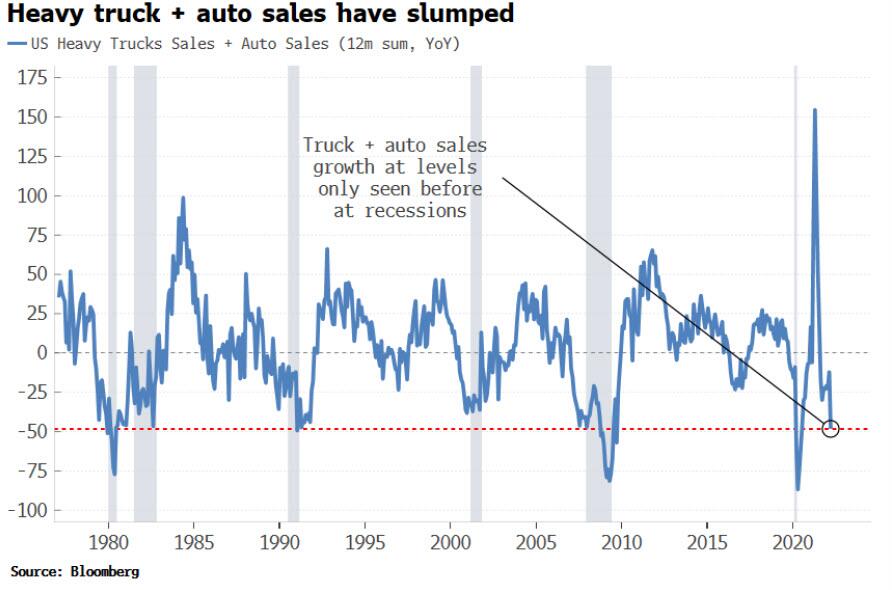
That said, White cautions readers that "before you enter your equity sell orders, this is not a recession prediction. Recessions are signaled by a rapid regime shift across many areas of the economy and markets, and there is no sign we are in the process of this happening." Nonetheless, this sharp decline in vehicle sales shows slowing growth is in the mail.
There's more: freight volume growth has also been slowing. Annual growth in containers loaded at the Port of Los Angeles is steadily heading down to 0% after hitting 20% last year. Lockdowns in China are clearly having an impact here. Cities and regions accounting for over 40% of China’s 2020 GDP are in full or partial lockdown. The Shanghai freight index is 13% lower than it was six weeks ago, the sharpest decline seen in the ten-year history of the index.
As we noted over the weekend, and as White picks up in his note, "shipping rates have been falling, but this is academic as it is virtually impossible -- while such a draconian lockdown is in place -- for exporters to load boxes in their warehouse and move the goods on to the ships."
To be sure, while lockdowns in China may be a proximate cause of falling shipping rates, "the remote cause is the fall in global liquidity as central banks step back from historically loose monetary policies to try to stem inflation." As White shows in the next chart, global liquidity has collapsed and points to continued depressed shipping rates in the coming months.
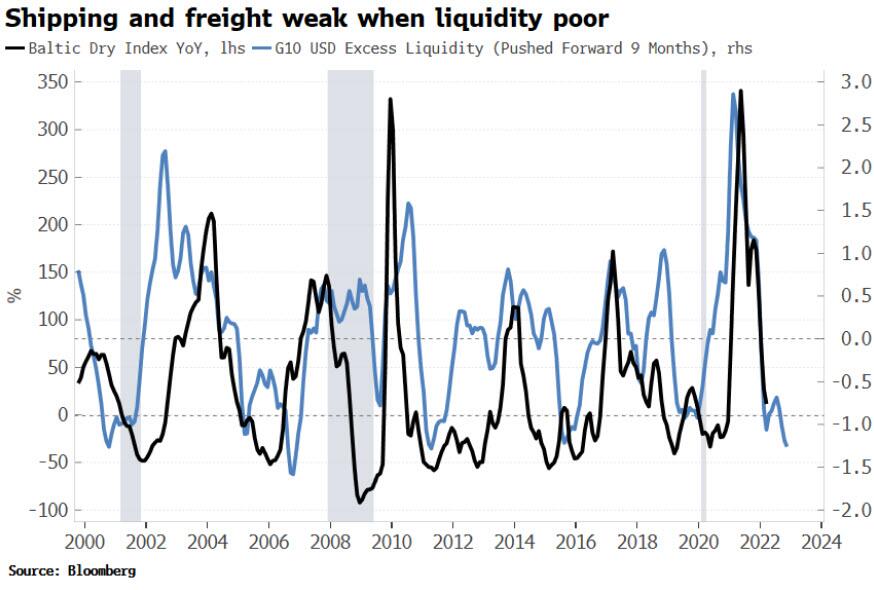
That commodities, their movement around the world, and liquidity are intrinsically linked has become starkly clear in this cycle. As a commodity producer, if you don’t have the liquidity to cover the margin on your short futures positions, bankruptcy means you can’t ship and deliver your commodities, exacerbating the rise in prices and triggering more margin calls.

This liquidity and economic-demand driven decline in shipping and truck usage points to underperformance of transport stocks. The S&P transport index is down 11% from its high made last month. Transports and autos are roughly flat to the S&P year-to-date, so should begin to lag. Furthermore, being underweight medium-to-high duration sectors is a good idea when in an inflationary regime.


FT : Jersey freezes $7bn worth of assets linked to Roman Abramovich

Jersey freezes $7bn worth of assets linked to Roman Abramovich
Channel Island’s order is another major blow to sanctions-hit Russian oligarch

A court in the Channel Island of Jersey has imposed an order freezing more than $7bn in assets linked to Roman Abramovich in a significant blow to the Russian oligarch’s fortune.

The order comes after the island’s police searched premises “suspected to be connected to the business activities of Roman Abramovich”.

“The Royal Court also imposed a formal freezing order on 12 April . . . over assets understood to be valued in excess of $7bn, which are suspected to be connected to Mr Abramovich,” the government said.

The assets were either located in Jersey or owned by entities incorporated on the island, the statement said.

The sheer scale of assets subject to the freezing order hints at the amount of wealth Abramovich appears to have sheltered in offshore tax havens, where opaque corporate structures can shield investments from public view. Forbes estimates the oligarch’s net worth at $8.2bn, while the Bloomberg Billionaires Index pegs it higher at $13.9bn.

The $7bn asset freeze against Abramovich in Jersey is just shy of the $8bn total that Switzerland has seized from all 900 Russians on the EU and US sanctions lists.

It is another blow to Abramovich, who has been hit with sanctions since Russia invaded Ukraine. UK authorities have forced him to sell Chelsea Football Club and his yachts were made to leave harbours to avoid being seized. Trading in shares in Evraz, the steelmaker in which he was a significant shareholder, remains suspended.

Jersey has previously said it was implementing all the sanctions introduced by the UK government following the invasion of Ukraine on February 24.

“In enforcing sanctions, the UK can leverage this unbelievable source of financial intelligence it has via the Crown Dependencies and British Overseas Territories,” said Tom Keatinge, director of the Centre for Financial Crime and Security Studies at the Royal United Services Institute think-tank.

“Where Jersey leads, will we see the BVI and others follow?”

Ian Gorst, Jersey’s minister for external relations and financial services, said he could not comment on matters under “active consideration” by the dependency’s Law Officers’ Department.

“The government of Jersey continues to stand alongside the UK and international partners and has implemented all UK and UN sanctions deployed in response to Russia’s actions against Ukraine,” Gorst said. “Our legislation to give force to these measures has severe criminal consequences, and any links to sanctioned entities or suspected breaches must be reported to the appropriate authorities.”

The move against Abramovich is the clearest step yet by the Channel Island’s government to seize some of the billions of dollars worth of wealthy Russians’ assets widely thought to be invested in the offshore centre.

While it was not clear on Wednesday which assets the freeze order affected, Abramovich has moved a number of his investments to Jersey in recent years from the British Virgin Islands, another offshore haven.

Recommended
The Big Read
Poison, planes and Putin: Abramovich’s race to save a fortune and stop the war

The most recent accounts of Fordstam, the vehicle that controls Chelsea Football Club, show a £1.5bn outstanding loan to the company from Camberley International Investments. Camberley transferred its registration in 2020 from the BVI to Jersey.

Multiple helicopters linked to Abramovich are owned through Jersey-registered entities, as is Sussurro, the first superyacht the oligarch bought in 1998. The Guardian reported last week that Abramovich transferred a Jersey vehicle that owned another yacht — the 50-metre Aquamarine — to his associate David Davidovich on the day Russia invaded Ukraine.

These companies are all registered at the Jersey offices of Zedra, a corporate services provider that acts for a number of Abramovich-linked entities. Zedra declined to comment.

The Jersey Evening Post reported in 2018 that the Russian oligarch had been granted residency rights on the island, under a scheme for “high value residents”, but Abramovich had difficulty renewing his UK visa shortly afterwards.

Eugene Tenenbaum, an associate of Abramovich who has served as a director of Chelsea since the oligarch took it over in 2003, is a Jersey resident, according to British corporate records.

There was no immediate response from a spokesman for Abramovich to a request for comment.

FT : Larry Tanenbaum joins Stephen Pagliuca group vying for Chelsea

Larry Tanenbaum joins Stephen Pagliuca group vying for Chelsea
NBA chair among heavyweight backers of consortium readying bid for Premiership club

Private equity billionaire and co-owner of Boston Celtics basketball team Stephen Pagliuca has revealed that Larry Tanenbaum, chair of the National Basketball Association, is among the list of heavyweight backers of his bid to buy Chelsea.

The consortium led by the co-chair of Bain Capital, a US private equity firm with $160bn of assets under management, is one of four investment groups vying to buy the Premier League side from sanctioned Russian billionaire Roman Abramovich, who is selling up in the wake of Vladimir Putin’s invasion of Ukraine.

Pagliuca said on Wednesday that he is co-managing the bid alongside Tanenbaum.

They are up against a group backed by the US-based Ricketts family, which owns the Chicago Cubs baseball team, and hedge fund billionaire Ken Griffin; private equity billionaires Josh Harris and David Blitzer; and a group led by Todd Boehly, co-owner of baseball’s Los Angeles Dodgers.

Bidders are not only competing on price but also their ability to redevelop Chelsea’s Stamford Bridge stadium, which is smaller than the home grounds of major rivals such as Manchester United.

Tanenbaum’s involvement in the consortium was revealed a day before Thursday’s deadline for final bids, as merchant bankers at Raine Group press on with the sale of the club, which has been accelerated by the geopolitical situation around the invasion of Ukraine.

Former Disney chief executive Bob Iger and his journalist wife Willow Bay, Facebook co-founder Eduardo Saverin and his wife Elaine Saverin are also backing Pagliuca’s bid.

Hollywood producer Peter Guber, co-owner of the Golden State Warriors NBA team and another investor in the Dodgers, is another member of the consortium with strong ties to the sports industry.

In February, Pagliuca led the acquisition of a majority stake in Italian football team Atalanta. Tanenbaum chairs Maple Leaf Sports and Entertainment, the owner of the Toronto Maple Leafs ice hockey team and the Toronto Raptors basketball outfit. He also helped lead Toronto’s bid to host Fifa 2026 World Cup matches.

Abramovich acquired Chelsea in 2003 and used his fortune to build the team into a trophy-winning outfit with a global brand.

The club has won the Premier League title five times during his ownership, and is among the elite group of English clubs known as the Big Six, which also includes Arsenal, Liverpool, Manchester City, Manchester United and Tottenham Hotspur.

The profile of the bidders for Chelsea suggests that American investors will soon own four of the Big Six. The US Glazer family acquired United in 2005, sports mogul Stan Kroenke owns Arsenal, and John Henry’s Fenway Sports Group controls Liverpool.

Chelsea won last season’s Uefa Champions League, Europe’s most prestigious club tournament, but was knocked out of this year’s competition by Spain’s Real Madrid this week.

Abramovich has pledged to donate the net proceeds off the sale to charity and write off £1.5bn of debt owed to him by the club.

The transaction requires special approval from the UK government, which has allowed Chelsea to continue playing matches despite sanctioning Abramovich, as well as the Premier League.

A Jersey court on Wednesday froze more than $7bn in assets linked to Abramovich, whose assets are under close scrutiny because of his ties to Putin.

WSJ : Music Streaming Service Deezer Nears SPAC Deal

Music Streaming Service Deezer Nears SPAC Deal
French business, a competitor to Spotify and Apple Music, to merge with blank-check company backed by family behind Gucci-owner Kering

French music streaming service Deezer is nearing a deal to go public by merging with a special purpose acquisition company backed by the family behind luxury titan Kering SA, KER -1.73% according to people familiar with the matter, as consumer demand for music continues to grow.

The Paris-based competitor to Spotify SPOT +2.52% Technology SA and other music streamers has 16 million active users and is available in more than 180 countries, according to its website. Deezer offers listeners a catalog of more than 90 million songs, as well as podcasts, audio books and radio channels.

Deezer is in talks to merge with Paris-listed I2PO SA, I2PO 1.55% the people said. The blank-check company is backed by France’s Pinault family, controlling shareholder of Gucci-owner Kering, and Centerview Partners banker Matthieu Pigasse. The vehicle is headed by former WarnerMedia WBD +8.75% executive Iris Knobloch.

The deal, if finalized, could be announced in coming days, the people said. The valuation of the deal couldn’t be learned.

(ZH) China Used NATO Airspace To Deliver Missiles To Serbia

China Used NATO Airspace To Deliver Missiles To Serbia

By Andrew Thornebrooke of The Epoch Times
Six Chinese military aircraft transited the airspace of Turkey and Bulgaria, both of which are NATO members, on April 11 to deliver missiles to Serbia, a key ally of Vladimir Putin’s regime in Russia.
A Xian Y-20 heavy transport aircraft flies past during the Zhuhai Air Show in Zhuhai, southern China's Guangdong province on Nov. 1, 2016
The move is likely to be regarded as a display of force, as Serbian President Aleksandar Vucic previously had said that NATO refused to let the shipments of Chinese weapons cross through the airspace of its member nations.
The Y-20 cargo planes delivered the anti-aircraft weapons systems to Serbia via the civilian Nikola Tesla airport in Belgrade.
The FK-3, which is the export version of China’s domestic HQ-22, is a ground-to-air missile system that is frequently compared to the United States’ Patriot missile system. It can reach speeds of about six times that of sound (Mach 6) and has a range of about 93 miles. One system includes 12 missiles dispersed among three launch vehicles and a separate radar vehicle.
Notably, the Chinese aircraft flew together in mass formation rather than one at a time, and used state-of-the-art MLat (multilateration) tracking systems instead of the more traditional radar. Open-source intelligence analysts also noted that at least some of the aircraft had removed the coverings for their flare and chaff countermeasures—defensive systems to help evade missile attacks—possibly signaling that the Chinese aircraft either anticipated meeting some resistance or wanted to be seen as anticipating resistance.
The shipment will allow Serbia to become the first user of Chinese missiles in Europe, and will augment an already expanding arsenal of Chinese and Russian drones, tanks, and warplanes purchased by the nation in recent years.
The incident underscored Western fears that further arms buildup in the region could erupt into conflict as Russia continues to wage its war on Ukraine, and both Chinese and Russian leaders promote their own forms of authoritarian expansionism.
Serbia is currently seeking membership into the European Union, amid concern by some to be preparing for war with its neighbors in the Balkans, particularly Kosovo.
Serbia and its neighbors were locked in a number of bitter wars throughout most of the 1990s, during which reports of ethnic cleansing were rampant. The wars reached a bloody crescendo with the 1999 NATO bombardment of Serbia (then Yugoslavia), which resulted in the deaths of some 500 civilians and the destruction of vital infrastructure and cultural monuments.
In 2008, Kosovo declared its independence from Serbia, and subsequently expressed a desire to join NATO. However, China, Russia, and Serbia have refused to acknowledge Kosovo as a legitimate nation.
With that history in mind, Kosovo’s former President Hashim Thaci accused Serbia of plotting a Crimea-like annexation of parts of the territory in 2017, before stepping down to face a war crimes tribunal for acts he allegedly committed during the Yugoslav Wars.
Serbia’s relationship with China and Russia remains somewhat uneven, however. On one hand, the nation voted in the U.N. to condemn Russia’s invasion of Ukraine, while refusing to join international sanctions against Moscow or to issue any further criticism of the Russian troops there.

>>> Europe : Brokers Upgrades & Downgrades - 13th of April 2022 V2(+)

>>> Up
* Derwent London Raised to Overweight at JPMorgan; PT 4,200 pence
* Deutsche Bank PT Raised to 9.90 euros at Bankhaus Metzler (+)
* Great Portland Raised to Overweight at JPMorgan; PT 900 pence
* ITM Power Raised to Outperform at RBC; PT 500 pence
* Sartorius Raised to Buy at Berenberg; PT 490 euros

>>> Down
* Adecco Cut to Hold at Deutsche Bank; PT 41 Swiss francs
* Adidas Cut to Reduce at Baader Helvea; PT 190 euros
* Alfa Laval Cut to Underperform at Credit Suisse; PT 270 kronor
* Aurubis Cut to Add at Baader Helvea; PT 110 euros
* BASF Cut to Hold at Stifel; PT 63 euros (+)
* Covestro Cut to Hold at Stifel; PT 53 euros (+)
* Credit Agricole Cut to Underweight at Morgan Stanley
* Credit Agricole Cut to Equal-Weight at Barclays; PT 14.10 euros
* E.On Cut to Hold at Stifel; PT 11.20 euros (+)
* Ferguson Cut to Hold at Deutsche Bank; PT 9,960 pence
* FLSmidth Cut to Sell at Handelsbanken
* Hammerson Cut to Underweight at JPMorgan; PT 28.60 pence
* Land Sec. Cut to Neutral at JPMorgan; PT 900 pence
* MTU Aero Cut to Neutral at Oddo BHF (+)
* nCino Rated New Overweight at Morgan Stanley; PT $60
* Polytec Holding Cut to Reduce at Baader Helvea; PT 6.70 euros
* Randstad Cut to Hold at Deutsche Bank; PT 54 euros
* Reynolds Cut to Hold at Stifel; PT $31
* Solaria Energia Cut to Sell at Citi; PT 17.20 euros
* Sparebanken Sor Cut to Sell at Nordea; PT 137 kroner
* WDP Cut to Equal-Weight at Barclays; PT 39 euros

>>> Initiation
* Traton Rated New Buy at M.M. Warburg; PT 31 euros (+)
* Onward Medical Rated New Buy at Bryan Garnier; PT 17 euros (+)

>>> Call
* Adidas Cut to Reduce at Baader as Outlook Becomes More ‘Cloudy’
* Barclays Strategists See 1Q Earnings Season as ‘Make or Break’ (+)
* Credit Agricole Cut to Equal-Weight by Barclays on AM Challenges (+)
* Derwent London, Great Portland Up to Overweight at JPMorgan (+)
* France/Benelux Banks Face Volatile 1Q, Credit Agricole Cut: MS
* Hammerson Cut at JPMorgan on Deteriorating Consumer Outlook (+)
* ITM Power Upgraded at RBC With Growth Significantly De-Risked (+)
* Sartorius Has ‘Unfairly’ De-Rated, Raised to Buy at Berenberg (+)
* Solaria Energia Cut to Sell as Citi Cites Market Saturation
* Tesco Results Show Market Share Growth Ambitions, Citi Says (+)
* WDP Cut at Barclays on Lowest Upside in Warehouse Coverage (+)

FT : Fed official: It’s ‘fantasy’ to think modest rate rises will tame inflation

Fed official: It’s ‘fantasy’ to think modest rate rises will tame inflation
James Bullard says US central bank must put brakes on economic activity to tackle surging prices

A top Federal Reserve official has warned it is a “fantasy” to think the US central bank can bring inflation down sufficiently without raising interest rates to a level where they constrain the economy.

James Bullard, president of the St Louis branch of the Fed, said the central bank needed to be more aggressive in its efforts to root out the highest inflation in four decades as he called for rates to rise to a point where they actively curtail growth.

The comments from Bullard, a voting member of the policy-setting Federal Open Market Committee and one of its foremost hawks, run counter to other officials, who are broadly aligned on the need to push rates closer to a “neutral” level this year.

That is the level at which rates neither fuel nor restrict economic activity and is estimated to be around 2.4 per cent. Bullard said the central bank would need to get beyond that threshold as quickly as possible this year if it wanted to bring inflation closer to the Fed’s longstanding 2 per cent target.

“There’s a bit of a fantasy, I think, in current policy in central banks,” Bullard said in an interview with the Financial Times. “Neutral is not putting downward pressure on inflation. It’s just ceasing to put upward pressure on inflation.”

“We have to put downward pressure on the component of inflation that we think is persistent,” he added. “Getting to neutral isn’t going to be enough it doesn’t look like, because while some of the inflation may moderate naturally . . . there will be a component of it which won’t.”

His comments come on the heels of new inflation data that showed consumer prices increased at an annual rate of 8.5 per cent in March following a surge in energy and fuel costs fuelled by Russia’s invasion of Ukraine.

“Core” inflation, which strips out volatile items such as food and energy, came in slightly lower than expected, but Bullard warned it would not come down without a concerted effort from the Fed and that the US was vulnerable to unforeseen shocks that could further stoke prices.

“This [inflation] report just underscores the urgency that the Fed is behind the curve and needs to get moving,” he said.

Bullard supports the Fed raising rates by half a percentage point at the next policy meeting in May, something he urged the FOMC to do at its gathering in March, when it raised them by a quarter-point.

More officials now back such a move, as well as a reduction in the size of Fed’s $9tn balance sheet soon.

He argued the Fed’s benchmark policy rate should move up “sharply” after the May meeting and endorsed a 3 percentage point increase in the federal funds rate from its current range of 0.25 to 0.50 per cent by the third quarter.

Bullard acknowledged that such a level is “aspirational” in such a short period of time, but warned the Fed’s credibility is on the line if it does not take action.

“If markets and households get the idea that the Fed’s not going to do the right thing and not going to keep inflation under control, then you have to gain credibility by actually doing things that show them that you are serious,” he said.

Bullard pointed to former Fed chair Paul Volcker’s decision to raise rates to 20 per cent at one point in the early 1980s, which did contain inflation but resulted in a sharp economic contraction that resulted in millions of job losses. Volcker had no choice other than implementing such a large increase “because the committee didn’t have enough credibility”, Bullard added.

“So far I think we’re holding on to our credibility, but if it slips away, then it’s going to be much more difficult to keep inflation under control going forward.”

Still, Bullard said he was optimistic the Fed would be able to cool down the economy without causing a recession — as it did in 1994.

>>> Stoxx 600 Pre-Market Indications

  • LVMH (MOH TH) +2.3%
    • Watch Luxury Stocks After ‘Impressive’ LVMH 1Q as China in Focus
  • Kering (PPX TH) +2.1%
  • TUI (TUI1 TH) +1.8%
  • Glencore (8GC TH) +1.6%
    • Zinc Flashes Warning Signs as LME Inventories Shrink
  • Rio Tinto (RIO1 TH) +1.2%
    • Watch European Miners as Iron Ore Falls as Zinc, Aluminum Gain
  • AstraZeneca (ZEG TH) +0.9%
  • Endesa (ENA TH) +0.8%
  • Nibe (NJB TH) +0.8%
  • SocGen (SGE TH) +0.8%
  • Lufthansa (LHA TH) +0.7%
    • Delay to Airlines Takeoff Is Unlikely to End Soon: Taking Stock
  • SAP (SAP TH) -0.6%
  • Fresenius SE (FRE TH) -0.6%
  • Deutsche Telekom (DTE TH) -0.6%
  • United Internet (UTDI TH) -0.6%
  • Covestro (1COV TH) -0.6%
  • Fresenius Medical (FME TH) -0.7%
  • ASML (ASME TH) -0.8%
  • E.On (EOAN TH) -0.8%
  • Adyen (1N8 TH) -0.8%
  • Adidas (ADS TH) -1.1%
    • Adidas Cut to Reduce at Baader as Outlook Becomes More ‘Cloudy’

>>> TradeGate Pre-Market Indications

DAX:
  • Sartorius (SRT3 TH) +2%
    • Sartorius Has ‘Unfairly’ De-Rated, Raised to Buy at Berenberg
  • Adidas (ADS TH) -0.6%
    • Adidas Cut to Reduce at Baader as Outlook Becomes More ‘Cloudy’
MDAX:
  • Evotec SE (EVT TH) +1.4%
  • Lufthansa (LHA TH) +1%
  • Deutsche Wohnen (DWNI TH) +1%
  • United Internet (UTDI TH) -0.6%
  • Aixtron (AIXA TH) -0.8%
SDAX:
  • Jenoptik (JEN TH) +2.4%
  • LPKF (LPK TH) +1.7%
  • Deutz (DEZ TH) +1.5%
  • Kloeckner (KCO TH) +1.1%
  • AUTO1 (AG1 TH) +1%
  • Bilfinger (GBF TH) -0.9%
  • Deutsche PBB (PBB TH) -1%