(ZH) Putin's 'City-Killer': Russia Launches World's Largest Nuclear-Armed Submar

Putin's 'City-Killer': Russia Launches World's Largest Nuclear-Armed Submarine

It's being popularly dubbed "Putin's city-killer" - and is also being widely acknowledged as the largest submarine in the world to be built for 30 years: Russian Navy's 'Special Mission' K-329 Belgorod has been put to see for the first time within the past days, undergoing sea trials.
Estimated at 178 meters (584 feet) long and about 15 meters (49 feet) across, it's twice the size of the UK Royal Navy's largest submarines, but more impressively is equipped with AI-guided nuclear tipped underwater drones which according to one prominent Western source are capable of hitting coastaltargets lying 6,000 miles away .
Belgorod, via Defence View
The Belgorod has been known about and teased by the Kremlin for years, but is now being hailed in Russian media as a "game changer".
One military expert with the Royal United Services Institute (RUSI), Dr. Sidharth Kaushal, explained to The Mail on Sunday:
"The Belgorod is large enough to act as a mother ship for a unique set of smaller vessels which have deep-diving capabilities and the ability to tamper with undersea infrastructure.
It's well equipped for sabotage and clandestine operations. Its Poseidon nuclear torpedoes could also be a very effective means of attacking an aircraft carrier in wartime – one against which at present no defense exists."
It was designed with the advanced Poiseidon torpedoes in mind as part of Russia's broader nuclear deterrence arsenal.
Here's more on why the gigantic Belgorod poses a major challenge for US and other Western attempts to classify and thus understand the vessel from a separate naval analysis source:
Belgorod it’s intended purpose presents Western analysts with an enigma. She will combine two seemingly contradictory roles. The first is as a host submarine (read 'mothership') for deep diving nuclear powered midget submarines. These are capable of working on cables and other objects on the sea floor. The concern in NATO is that these could include the undersea internet cables connecting Western countries. This is termed a ‘special mission’ in navy parlance (which is full of euphemisms for covert activities).
The second role is one of nuclear strike and deterrence. For this she will be armed with six ‘2м39′ Poseidon torpedoes. These are a whole new category of weapon not fielded by any another navy. They have been described as 'Intercontinental Nuclear-Powered Nuclear-Armed Autonomous Torpedoes'.
Each of these AI-driven torpedoes are themselves over 20 meters long, and at least according to Russian military claims have a practically unlimited range in terms of what they could reach across entire oceans.
The timing of the submarine's sea trial launch days ago is also a "propaganda victory" of sorts given last week's dangerous Black Sea warning shots incident off Crimea involving Russia chasing away from its waters the UK's HMS Defender.
British defense officials within days after the incident expressed "surprise" at how rapidly things escalated, given it seems they didn't expected Russia to that quickly initiate live fire warnings.

Barrons : More People Want to Travel on Private Jets. General Dynamics Stock Loo

More People Want to Travel on Private Jets. General Dynamics Stock Looks Set to Rise.

Commercial air travel gets all the attention—but investors should start paying attention to private jets.

Yes, it was a big week for the traditional airlines. United Airlines Holdings (ticker: UAL) held an investor event where it announced a massive order of new planes from Boeing (BA) and Airbus (EADSY) worth $27 billion, while also adding more premium seating, large overhead bins, and a touch more legroom for travelers. It’s a big bet on the normalization of travel, even if United stock fell 2.1% this past week, while Boeing dropped 4.7%.

But not everyone wants to return to commercial air travel, especially if she can afford not to. While commercial air travel is slowly returning to life—the number of passengers going through TSA checkpoints in June was more than triple that of a year ago, but still 25% below 2019—May business-jet departures, at 275,000, were just 1% below their October 2019 high of 278,000.

Used cars aren’t the only preowned vehicles in short supply. Getting your hands on a new business jet is proving difficult as well. Preowned jets for sale were just 4.5% of the total fleet in early June, the lowest on record, according to Cowen data. Jet manufacturers, meanwhile, are short supply to meet the demand.

It’s not a surprise that the demand for new jets has been driven by the ultrawealthy—apparently, interest from first-time buyers is particularly strong—who seem to prefer traveling on their own than sharing a seat with the hoi polloi. At the same time, large corporations are only starting to look at business jets, while foreign buyers remain few and far between. “Thus, the demand surge likely still has runway,” observes Cowen analyst Cai von Rumohr.

General Dynamics (GD) may be best positioned to take advantage of the demand, von Rumohr says. Deliveries of its Gulfsteam 500 and 600s are picking up, while its defense business is growing. Cowen sees 12% to 13% growth in earnings per share in 2022, faster than other defense companies. General Dynamics stock, however, has been doing, well, nothing. Its shares peaked at $193.59 on May 7, and have dipped 2.3% since then. What’s more, shares are up just 12% since the end of 2019, trailing the S&P 500’s 34% rise. “[General Dynamics] looks best positioned in bizjets,” says von Rumohr, who has a $230 price target on shares of General Dynamics, up 22% from Friday’s close of $188.54.

Don’t be surprised if its shares take off.

Barrons : European Dividends Are on the Mend After a Pandemic Slashing

European Dividends Are on the Mend After a Pandemic Slashing

European dividends, which endured big cuts and suspensions last year amid the pandemic, are quickly returning as stocks make solid gains across the region.

The MSCI Europe Index has returned about 15% this year as of June 30, dividends included, about the same as the S&P 500 index’s performance. The European index was recently yielding about 2.5%, versus 1.4% for the S&P 500.

“The dividends are back, and in some cases, they are back with a vengeance,” says Giorgio Caputo, portfolio manager of the JOHCM Global Income Builder fund (ticker: JOBIX). “You’ve had dividends and performance.”

The recent stock gains haven’t been confined to continental Europe. The FTSE 100, an index that tracks big companies in the United Kingdom, has returned about 11% this year. It was recently yielding 3.3%.

“You can get fantastic businesses with much higher yields than you would in the U.S., at better valuations,” says Sam Witherow, a portfolio manager in global equity income strategies at J.P. Morgan Asset Management.

Witherow points out that the JPMorgan Income Builder fund (JNBAX), which he helps manage, has increased its weighting in European stocks over the past year, reflecting an “outsize opportunity today in European income stocks.”

The global equity income portion of the fund that he helps run has about a 40% weighting in Europe, up from nearly 30% in March of 2020.

An important reason that yields are often higher in Europe is because companies there tend to favor dividends over share buybacks, unlike many U.S. companies.

Another big distinction between the U.S. and Europe last year was dividend policy on the part of regulators. There were various “blanket bans for banks and insurers” to prevent them from paying dividends, enacted by regulators including the European Central Bank and the Bank of England, Witherow says. And in other sectors, he adds, there were “implicit bans on a lot of companies that have taken government support.”

In contrast, the large U.S. banks halted buybacks in March 2020 but continued to pay out dividends, though they were capped. The Federal Reserve has lifted those restrictions.

Among the high-profile European banks that had to suspend their dividends last year were Barclays (BARC.UK), BNP Paribas (BNP.France), and Crédit Agricole (ACA.France).

All three of those banks, however, have reinstated their dividends, though not at previous levels in every case. European and British firms tend to pay out their dividends once or twice a year—not quarterly, the way most U.S. firms do.

In the meantime, investors are awaiting regulatory approval that will give those European banks more leeway to raise their dividends. “The banks have significant amounts of capital,” says Caputo, who adds that “the picture this time around is significantly better than the last crisis,” earlier in the 2000s.

Still, compared with U.S. companies, European firms had a much deeper hole to dig out of in terms of dividend cuts last year. Plenty of U.S. companies cut or suspended their payouts, but S&P 500 dividend payments rose about 1% last year versus 2019 levels.

In Europe, the dividend damage was much more severe. Overall payouts fell by roughly 35% to 40% in a “pretty shocking collapse,” as Witherow puts it.

His firm, however, expects European dividends to grow at an annual compound rate of 11% through 2025, versus 8% for U.S. companies.

Caputo says that many dividend payers in Europe, including industrial companies and utilities, are benefiting from a green initiative that is helping to finance businesses such as renewable energy through the issuance of bonds.

“You’re seeing very nice alignment between typical European dividend payers and what’s going on economically,” he says.

Case in point: Enel (ENEL.Italy), a multinational utility based in Italy. The stock, which has returned about minus 3% this year, was recently yielding about 4.7%. It’s a leader in renewable energy, Caputo says, adding, “It has an attractive yield, a great growth opportunity, and nice, sustainable income.”

Another of his fund’s holdings is Linde (LIN), a U.K.-based company that makes and distributes various industrial gases. Its assets include a hydrogen pipeline network.

The stock, which has returned about 11% this year, yields about 1.5%—on the low side. But “as Europe invests more and more in hydrogen to decarbonize, Linde is incredibly well positioned to grow its dividend over time,” says Caputo.

Witherow, meanwhile, says that one category of companies to consider is “businesses that actually did OK through Covid.”

One is LVMH Moët Hennessy Louis Vuitton (LVMUY), which yields about 1.2%. The company, which focuses on luxury brands, did cut its dividend last year but then raised it earlier this year to 2019 levels.

Witherow also points to Novo Nordisk (NOVO.Denmark), a Danish pharmaceutical firm that sports a recent yield of about 1.7%. He says the company can increase that distribution by close to 10% a year, helped by its growing obesity-drug franchise. The company, for example, recently received approval in the U.S. to market the drug Wegovy—currently used for diabetes—for weight control.

One sector that Witherow is more bearish on is oil and gas. He expects many of those companies to focus the additional cash flow that comes with a recovery on paying down debt, investing in renewable-energy projects, and buybacks. But his overall outlook for European dividends is bright.

“The harder they fall, the higher they bounce,” Witherow says.

Barrons : European Tourism Is Rebounding. These Two Stocks Are Worth the Trip.

European Tourism Is Rebounding. These Two Stocks Are Worth the Trip.

European tourism is set to resume as countries relax restrictions on the back of successful Covid-19 vaccination programs and declining rates of infection.

While Covid variants and weakening consumer confidence mean nothing is certain—the picturesque seaside village of Kokkari on the Greek island of Samos is unusually quiet for this time of year—the opportunities in Europe for investors are with hotels, car-rental companies, and airport operators that boasted strong prepandemic business models and weathered Covid in good financial shape.

The rebound will be key to the economic health of some countries. Tourism accounts for almost 15% of GDP in Spain and over 20% in Greece. While tourism this year to southern Europe is expected to be higher than in 2020, it will still be 50% to 60% below 2019 levels, says Chris Hare, an economist at HSBC, who estimates that tourism this year could contribute one to two percentage points to the GDP in southern European countries.

A better recovery story is in Northern Europe. While not as popular as the south of France and Italy, Nordic countries have suffered less of a slump in tourism. Latest data from Eurostat show the total number of nights spent at tourist accommodations in Denmark falling just 36% from April 2020 to March 2021 and about 40% for Norway and Sweden.

A hidden gem is Scandic Hotels Group (ticker: SHOT.Sweden), which operates a network of 280 hotels in the Nordic region, Germany, and the U.K.

Deutsche Bank predicts Scandic stock could rise to 40 Swedish kronor ($4.70) from a recent 35.38 kronor on permanent rent reductions on leased properties, and a rebound in hotel demand.

Morgan Stanley analyst Jamie Rollo estimates that Scandic’s stock fetches a multiple of 15.3 times expected 2023 earnings.

Scandic said in a June statement that, since April, “hotel demand has increased in all markets as a result of the gradual easing of restrictions related to the Covid-19 pandemic. Domestic leisure travel is increasing in all markets.”

Another promising European travel-recovery play is Frankfurt-based Fraport (FRA.Germany). While it is active at 31 airports around the world, the bulk of annual revenue comes from Europe. Its core business is Frankfurt Airport, which accounted for 51.8% of group sales in 2019. In 2020, Germany accounted for 73% of Fraport’s business.

Frankfurt flew 70.6 million passengers in 2019—which fell to 18.8 million in 2020—and is a hub for 100 airlines. In an earnings statement in May, Fraport said in the first three months of 2021, Frankfurt saw passenger traffic drop by 77.6% year on year to just under 2.5 million. Compared with the first quarter of 2019, it’s an even bigger decline of 83.2%, so it is well placed to benefit from the bounceback in travel.

There are other catalysts. Frankfurt Airport has been consulting with the airlines about raising airport fees at Frankfurt Airport, and will aim to reduce what were typically long lines at security prepandemic with a new hall and additional aisles at Terminal 1.

CEO Stefan Schulte said in a June speech that Fraport has “leveraged the crisis to become significantly leaner, more efficient, and therefore more competitive.”

Chu has a Buy rating and a price target of 74 euros ($88.25). Fraport’s stock is up 19.1% this year to a recent €58.80, ahead of rival Aeroports de Paris (ADP.France), which has gained 4%.

Fraport said in the May statement that group revenue is expected to reach about €2 billion in 2021, up 19.7% from €1.67 billion in 2020 but 46% below €3.7 billion in 2019.

Barrons : Forget Tesla. The More Interesting EV Race is Porsche vs. Ferrari.

Forget Tesla. The More Interesting EV Race is Porsche vs. Ferrari.

Porsche vs. Ferrari. It isn’t another movie about famous marques in epic face-offs at Le Mans, but a comparison between two competing approaches to the future of the automobile industry. For investors, it’s no contest.

That’s because it isn’t really between the luxury sports cars bearing those famous names. Like the Porsche 914 from the 1970s, which was reviled by aficionados for its Volkswagen mechanicals underneath the famous nameplate, today’s Porsche Automobil Holding (ticker: POAHY) is a holding company that consists mainly of its controlling interest in Volkswagen. And with typically Teutonic complexity, Porsche, in turn, is one of Volkswagen’s many divisions, along with VW and Audi, and owns superluxury names including Bentley, Lamborghini, and Bugatti.

In contrast, Ferrari (RACE) is what you’d expect, the manufacturer of the sports and grand touring cars bearing the legendary name. Its shares were spun off in January 2016 from Fiat Chrysler, which merged with Peugeot to create Stellantis (STLA) earlier this year. Ferrari has been fabulously successful as a stand-alone company, with its stock quadrupling in those 5½ years.

While founder Enzo Ferrari’s production goal was always to make one less car than he could sell, the company had expanded annual output by a third since going public, to over 10,000 vehicles, before a Covid-affected 10% drop last year.

A bigger concern is that Ferrari is relatively late to the race to produce an electric vehicle. The first Ferrari EV will arrive in 2025, its interim chief executive, John Elkann, said at the April annual meeting. (Benedetto Vigna, an executive at Italian semiconductor manufacturer STMicroelectronics, will take over as CEO in September.) The slowness to go electric may be understandable, given that so much of Ferrari’s visceral appeal comes from the unique character and sounds of its classic V12 and V8 engines.

Porsche Taycan
Courtesy of Porsche

Ferrari SF90 Stradale
Courtesy of Ferrari
In contrast, Porsche’s main asset, Volkswagen, has set its sights on becoming the world’s No. 1 electric vehicle maker by 2025, surpassing market leader Tesla (TSLA.) While that might be seen as a reaction to the Dieselgate scandal of the past decade, it sets up VW strongly for the transition to EVs now beginning.

UBS recently called Volkswagen and General Motors (GM) the best- positioned major auto stocks, based on several criteria, especially a strong EV sales curve. While acknowledging that Tesla remains the clear market leader, the investment firm also expressed concern about that company’s slowing demand in China, the world’s No. 1 auto market. UBS’ price target for VW’s German-traded shares sees a 40% upside.

Volkswagen has introduced the ID.4 SUV, its first vehicle designed as an electric from the ground up, to compete in the lower price range of the U.S. market with the Chevy Bolt and the Ford Mustang Mach-E EVs in the $40,000 price range, before the $7,500 federal EV tax credit. (Like Tesla, GM has sold too many EVs to qualify for that credit, but the Biden administration would like to see another one created.) These EVs from the legacy auto makers significantly undercut the Tesla Model Y compact SUV, which typically is configured to sell in the $50,000 range.

Porsche—Volkswagen’s biggest profit center, followed by its Audi luxury line—also offers the high-end Taycan EV, priced from $79,900 to $187,600, configured as a sedan or an SUV. But the iconic 911 sports car remains its cash cow.

Given the fat profit margins that Porsche generates, the division has been the subject of speculation that it could be listed separately, à la Ferrari’s spinoff from Fiat Chrysler.

Ferrari’s U.S.-listed shares trade at about 41 times forecast 2021 earnings, a price-earnings multiple more typical of what’s fetched by a luxury goods maker. Goldman Sachs in June made a rare double downgrade of the stock, to Sell from Buy without an intermediate move to Hold. That reflected the company’s higher capital spending needs to electrify future models, a headwind to earnings.

Guesses on what Porsche would be worth as a stand-alone company range from 45 billion to 90 billion euros ($53.3 billion to $106.6 billion), versus Volkswagen’s market value of about €125 billion. A Porsche spokesman said in an email that any decision on a separate listing for the luxury-car maker is up to Volkswagen management. VW didn’t respond to requests for comment on past reports that it is mulling a spinoff.

Porsche trades at less than seven times consensus forecast earnings for 2021. Its valuation isn’t helped by its convoluted capital structure, consisting of ordinary shares controlled by the Piëch and Porsche families, and preference shares, which in the U.S. would be classified as a nonvoting class of common stock. U.S. investors should buy the preference shares, traded over-the-counter under the ticker POAHY.

VW also has two classes of stock, with the preference shares being identical to the ordinary shares, except for the lack of voting rights. Porsche owns 31.4% of Volkswagen equity, but has 53.3% voting control of the company.

In the contest between Porsche and Ferrari, the German competitor mainly represents an investment in the world’s largest auto maker, VW, which is spending aggressively on 21st century EV technology. Porsche is also cheap, with a single-digit P/E multiple, plus the possibility of a rerating of a separately listed Porsche stock.

The legendary Italian company’s premium valuation is largely based on its racing history and the desirability of its stunningly fast and sensual sports and GT cars, but faces a less certain future in the EV era. The race for investment returns isn’t likely to be won by the swifter of the two.

Barrons : Ryanair Stock and 2 More European Airlines Can Soar as Postpandemic Tr

Ryanair Stock and 2 More European Airlines Can Soar as Postpandemic Travel Picks Up

The Covid-19 pandemic dramatically reshaped the landscape for European airlines, with restructurings, state bailouts, and cost-cutting for many. Now that travel in the region has begun to recover, airline stocks could offer opportunities for investors.

The stocks appear to have lots of room to run. The Stoxx Europe Total Market Airlines Index, which tracks the performance of European-listed airline stocks, has climbed 3.3% year to date. That compares with the New York Stock Exchange Arca Airline Index, up 21% this year, and a 14.2% rise in the Stoxx Europe 600 index.

The threat of virus variants means a summer rebound isn’t guaranteed, but turbulence won’t alter the sector’s long-term flight path. Shares of British Airways owner International Consolidated Airlines Group (ticker: IAG.UK), Irish carrier Ryanair Holdings (RYA.Ireland), and Wizz Air Holdings (WIZZ.UK) look particularly inviting. All three have limited exposure to the corporate-travel segment, which is expected to remain weak even as recreational travel resumes, and each is set to grab market share once the recovery gets going.

While IAG will benefit from consolidation in the long term, Citi analysts said that the potential reopening of travel between the United Kingdom and the U.S. could be a positive catalyst for the stock even sooner. They see high vaccination rates in both countries leading to resumption in travel between the two in August, with IAG being a “major beneficiary” over the next 12 months. The decision by Norwegian Air Shuttle (NAS.Norway), a rival in the transatlantic market, to scrap long-haul flights has also reduced competition.

IAG, which also owns Spain’s Iberia and Irish carrier Aer Lingus, is expected to post revenue of 16.5 billion pounds sterling ($23 billion) in the year ending in December 2022, according to analysts surveyed by FactSet. That estimate is a dramatic improvement on the £6.8 billion revenue reported in 2020 but still below 2019 revenue of £21.9 billion.

While the stock has recovered from its October 2020 low, it still sits 60% below its January 2020 peak. Analysts have an average target price of £2.31, a 33% increase on a recent price of £1.74, according to FactSet.

“There is plenty of evidence of strong pent-up demand when and where travel is allowed,” said IAG CEO Luis Gallego on a first-quarter earnings call.


It could be time for low-cost airlines to shine in Europe, as so-called legacy carriers, such as Deutsche Lufthansa (LHA.Germany) and Air France-KLM (AF.France), struggle more with the lasting impacts of the pandemic. Those airlines found it harder to cut costs than their low-cost competitors, suffered heavier losses at the peak of the crisis, and were forced to rely on state bailouts, which diluted existing shareholders.

Ryanair and Wizz Air stand to “hoover up the pent-up demand for foreign holidays we’re about to see, as rules on international travel finally ease,” wrote Third Bridge analyst Jack Winchester in a note.

Analysts expect Ryanair to post revenue of 4.7 billion euros ($5.6 billion) in the year ending in March 2022 and €8.7 billion in the year ending in March 2023, according to FactSet. The latter would beat its revenue of €8.5 billion in the year to March 2020, which included only one pandemic-hit month.

Ryanair’s stock has climbed above its prepandemic February 2020 highs in recent months. More gains could lie ahead: 71% of analysts covering the stock rate it a Buy, according to FactSet, with an average target price of €19.15, up 20% from the recent €15.96.

While Citi analysts see Ryanair’s intra-Europe market share growing to 18% in 2025 from 13% in 2019, they see Wizz Air’s market share jumping to 9% from 3% over the same period.

Wizz dominates the Eastern European market, a region that Citi analysts say is set for “significant multiyear growth.” The company’s relentless focus on costs means that it can compete on price points, they say.

Wizz Air’s stock has also climbed above prepandemic levels—and 55% of analysts think that it’s still a Buy. Their average target price is 12% above a recent price of £46.69.

Wizz Air carried 1.57 million people in June, compared with 832,000 in May—and triple the number that it carried in June 2020.

Barrons Cover : Europe’s Economy Is Rebounding. Here’s How to Play It.

Europe’s Economy Is Rebounding. Here’s How to Play It.

Global investors have had little love for Europe in the past decade. Anemic economic growth, negative benchmark interest rates, and social and political challenges have kept a lid on European stocks, which have underperformed the technology-led U.S. market as well as markets in China and other dynamic emerging economies. Yet, the near-term case for relative outperformance by Europe now is the strongest in years. A postpandemic rebound could be followed by a new era of policy support for the Old World’s economy, creating near-ideal conditions for its equity markets.

The region’s most immediate economic catalyst is the emergence from the Covid-19 pandemic. Vaccinations in Europe have trailed those in the U.S., and stricter virus-related limits on mobility and economic activity are still in place. But some European countries are pulling ahead of the U.S. in first vaccine doses and rapidly closing the gap in second ones.

This sets up the region for looser restrictions in the second half of 2021, and a rebound in hiring, spending, and economic activity, much like America is enjoying today. U.S. gross domestic product grew at a 6.4% annualized rate in the first quarter, while Europe’s GDP shrank at a 0.4% pace. Capital Economics’ group chief economist, Neil Shearing, expects U.S. GDP to top its prepandemic level in mid-2021, a year ahead of the euro-zone economy. Europe is one of the few developed regions in the world in which some economists expect to see better GDP gains in 2022 than in 2021.


Photograph by Jessica Pettway
“Investors have played the reopening theme in the U.S. with a lot of success,” says Graham Secker, Morgan Stanley’s chief European equity strategist. “Now, there’s a general feeling that most of the good news about the U.S. economy is behind us, rather than ahead of us, and that growth momentum is peaking, whereas Europe is earlier in the cycle, and relative economic news flow is going to start to move in Europe’s favor.”

The near-term fiscal and monetary policy outlook is relatively more positive for markets there, as well. While attention in the States has turned to the Federal Reserve’s eventual tapering of bond purchases and potentially sooner-than-expected interest-rate increases, the European Central Bank isn’t likely to move in that direction for some time. And the European Union’s largest-ever stimulus package hasn’t even begun to be distributed, while the bulk of fiscal support in the U.S. and China is in the rearview mirror.

Investors feeling valuation vertigo can also find cheaper stocks in Europe, where indexes trade at marked discounts to their American peers. The pan-Europe Stoxx Europe 600 fetches 16.5 times 2022 estimated earnings, versus the S&P 500’s price/earnings multiple of 20.4.

Some of the discrepancy relates to U.S. indexes’ greater tilt toward growth companies and richly valued technology giants. But Europe’s discount extends to a sector-weight comparison, as well, according to Secker. Greater exposure to more-value-oriented and cyclically sensitive sectors, such as industrials, banks, and materials, should bode well for European indexes as the region’s economy rebounds.

“If you want exposure to the global recovery, Europe is a good catch-up play,” says Burns McKinney, senior portfolio manager of the Virtus NFJ International Value fund (ticker: AFJAX). “As an investor, you want to look for places where there’s room for improvement.”

None of this means that investors should expect a mammoth rally in European shares, which have already bounced off their 2020 lows, and then some. The Stoxx 600 is up 14% this year and trading just below its June record high, as is Germany’s DAX index. But the most optimistic analysts and market strategists think that European equities could gain another 10% or so.

What happens beyond Europe’s initial Covid-recovery bounce depends largely on the actions that fiscal-policy makers take as the economic cycle begins to age. Already in the works is the roughly 800 billion euro ($950 billion) NextGenerationEU recovery fund, which includes loans, grants, and contributions to existing programs across the European Union’s 27 member states. A greater share will go to those hit hardest by the pandemic—mostly southern European nations relatively heavily reliant on tourism, such as Spain, Greece, and Italy.

The recovery fund will be financed with bonds issued by the entire European Union, not individual countries, and due through 2058. This is a major step toward greater fiscal integration, something that previously had been fiercely opposed by some countries, mostly in Europe’s north. They historically have taken better care of their sovereign finances than their more profligate neighbors to the south, which German and Dutch voters long balked at bailing out. It took a sovereign debt crisis, Brexit, and a pandemic to bring European leaders to an agreement on jointly financed economic stimulus. “The post-financial-crisis period highlighted the glaring weakness of having a common currency and economic union without a real fiscal union,” says Abhay Deshpande, chief investment officer at Centerstone Investors. “Fiscal integration has been the big missing piece.”

The agreement also recognizes that, after seven years of subzero benchmark interest rates, there is only so much that the European Central Bank can do. As in the U.S., fiscal policy now is taking the baton.

The recovery fund kicks in this month, with spending targeted toward green energy, digitization, and other infrastructure investments across the EU through 2027. This is a pronounced contrast to what happened in the years following the global financial crisis a decade ago, when fiscal-austerity measures across the Continent hampered growth, economists say. This time around, the fund should lend support to an economic recovery for several years.

Political developments in Germany, where the Greens appear in a strong position ahead of a September election, and Italy—where Prime Minister and former ECB President Mario Draghi is pushing for domestic reforms and a multiyear investment program—could open the door to additional fiscal largess. And the European Commission is reviewing the framework under which EU member states are subject to certain budget-deficit caps or debt-to-GDP ratios. That could further reduce the impulse toward austerity whenever Europe crosses over to the other side of the pandemic. Higher post-Covid sovereign debt loads appear to be a worry for another day.

Finally, the ECB is publishing the results of its own monetary-policy review this September. While it is unlikely to be groundbreaking, it should directionally follow the Federal Reserve’s shift last summer away from a strict impulse to get ahead of rising inflation. It could include a move to a symmetric inflation target around 2%, up from the ECB’s current aim of tolerating inflation “below, but close to, 2%.”

The postpandemic policy regime in Europe could keep supporting growth long after the crisis has passed, be more tolerant of the economy running hot, and be better at targeting support for countries that need it. That could mean faster growth prospects and higher earnings priced into European stocks.

“It’s this confluence of political and policy factors that makes the next 12 months an incredibly important inflection point structurally,” says Rebecca Patterson, director of investment research at Bridgewater Associates. “Whether the currently very constructive picture for European markets is lasting or not will depend in large part on the outcome of these different events.”

That’s the macro case for investing in the region, and one that could give investors greater comfort about increasing their exposure to Europe in the coming years. Secker notes that European equities are relatively underowned, with fund flows largely negative, dating back to even a few years before the pandemic, a period in which the U.S. and emerging market stocks saw record inflows.


The Vanguard FTSE Europe exchange-traded fund (VGK) and iShares Core MSCI Europe ETF (IEUR) both provide broad exposure to the Continent’s stocks. Travel, energy, and other sectors hit hard by the pandemic also offer opportunities.

Fraport (FRA.Germany) operates Frankfurt’s airport, Europe’s fourth-busiest in pre-Covid 2019. It’s the largest holding in Deshpande’s Centerstone International fund (CSIAX). He points to management’s cost-saving measures during the pandemic, and argues that not all of the expenses will come back as travel volumes return to normal, setting Fraport up to earn more than it was making before the pandemic. Its shares have retraced about half of their losses since early last year. (For more on Fraport, see “European Tourism Is Ready for a New Trip. These Two Stocks Are Worth Taking Along.”)

Irish Continental Group (IR5B.Ireland) is another play on a travel rebound in Europe, as countries loosen restrictions and people get moving again. The company operates passenger ferry service on routes connecting ports in Ireland, Wales, and France, where there isn’t much competition. Irish Continental had been making significant capital investments to improve the speed, capacity, and comfort of its vessels when Covid hit, and has yet to reap the benefits of that spending.

“You’ve got a situation where, as passengers come back, they’ll see really substantial earnings leverage in the business,” says Jonathan Moog, chief investment officer and portfolio manager at Lizard Investors, an international small- and mid-cap investor.

Moog estimates that Irish Continental currently trades for about six or seven times normalized earnings before interest, taxes, depreciation, and amortization, or Ebitda, while ferry businesses normally go for 15 or 16 times.

There are also ways to play a European travel recovery from outside the bloc. Online travel site Booking Holdings (BKNG) gets the majority of its profits from the Continent. Its earnings fell during the pandemic as travel ground to a halt, but are poised for a rebound, says Matthew McLennan, who co-heads the $50 billion First Eagle Global (SGENX) and $15 billion First Eagle Overseas (SGOVX) funds. Booking is outspending its competitors on marketing, gaining share, and building adjacent businesses in experiences and home-sharing, all while benefiting from the industrywide growth of online travel agencies.

“When they come out on the other side, they should be earning more than they earned before the pandemic,” McLennan says. “The next peak in earnings should be higher than the prior.”

McLennan’s co-manager, Kimball Brooker, points to an under-the-radar pick: Groupe Bruxelles Lambert (GBLB.Belgium). The family-controlled holding company has stakes in several businesses across industries, including sportswear giant Adidas (ADS.Germany), liquor company Pernod Ricard (RI.France), and Swiss cement and concrete maker Holcim (HOLN.Switzerland). Brooker estimates that GBL stock trades for a roughly 20% discount to the value of its holdings.

“It’s an interesting way to participate in a collection of listed and private European companies,” says Brooker. “They’re strong businesses.”

GBL pays a dividend from the yields of its shareholdings, and management has been buying back stock to take advantage of the discount.

Relative bargains abound in the European banking sector, where stocks tend to trade below book value and at single-digit multiples of earnings. That compares with closer to two times book and earnings multiples in the low teens in the U.S. But some of the discounts are deserved, as European banks generally have higher leverage and lower profit margins than many U.S. institutions.

Brooker likes Sweden’s Svenska Handelsbanken (SHBA.Sweden), with its strong domestic market share. Virtus NJF’s McKinney sees value in global giant BNP Paribas (BNP.France), which trades at a discount to its peers and should benefit from a recovery in Europe. Rand Wrighton, who manages the $1.8 billion non-U.S. value equity strategy at Barrow Hanley Global Investors, points to ING Groep (ING) for similar reasons. Svenska Handelsbanken yields 4.2%; BNP Paribas, 2.1%; and ING, 2.2%. Higher shareholder returns should be in store later this year as the companies raise dividends and buy back stock, much as their U.S. counterparts plan to do.

Wrighton says that Europe’s most interesting group is its defense industry, including BAE Systems (BA.UK), Rheinmetall (RHM.Germany), and Thales (HO.France). The stocks sold off during the pandemic, but haven’t recovered as much as their North American rivals, leaving them with cheaper relative valuations and more attractive dividend yields. With tensions with Russia on the rise and NATO members under pressure to meet spending commitments, Wrighton sees European policy makers moving toward larger defense budgets.

“I’m not predicting an arms race, but a normalization,” says Wrighton. “The European defense apparatus is where the U.S. was in 2000, before it was built back up after 9/11.”

Another potential beneficiary of future increases in European government spending is Schneider Electric (SU.France). It makes components of electric grids, building and data-center power systems, and more. But the long-term growth potential is in its software unit, which is working on industrial automation. “It’s misclassified as an Old World industrial, when it fits more into a new-world software theme,” says McKinney. “It should trade at a premium to industrial-conglomerate peers.”

Smart investors are always looking to skate to where the puck is going, and for most of the past year—and decade—that has been the U.S. Even if America’s markets continue to rally, Europe deserves more attention. Its stocks are attractively valued, and the Continent’s economic prospects are brighter than in the past. That, plus the potential for favorable longer-term structural shifts, should be more than enough to awaken investors’ interest.


>>> US Close Dow +0,44% S&P +0,75% Nasdaq +0,81% Russell -1,01%

Closing Stock Market Summary

The S&P 500 (+0.8%), Nasdaq Composite (+0.8%), and Dow Jones Industrial Average (+0.4%) closed at record highs on Friday, powered by the mega-caps following a June employment report that was deemed okay. The S&P 500 and Nasdaq also set all-time intraday highs, while the Russell 2000 fell 1.0% amid weakness in energy and financial stocks. 

From a headline perspective, the employment report was great: nonfarm payrolls increased by 850,000 ( consensus of 680,000). A closer look, however, indicated softening labor market conditions: the unemployment rate (5.9%) was higher than expected, average hourly earnings (+0.3%) increased less than expected, the average workweek (34.7) unexpectedly decreased, and the labor force participation rate (61.6%) was unchanged. 

The market reportedly viewed the report as a reason to believe the Fed will continue to stay extraordinarily accommodative because it wasn't as robust or inclusive as it would have liked. Minority groups continued to experience higher rates of unemployment. 

The gains in the S&P 500 were relatively broad-based since nine of its 11 sectors closed higher, but the gains weren't evenly distributed. The Vanguard Mega Cap Growth ETF (MGK 234.77, +2.66, +1.2%) rose 1.2%. The Invesco S&P 500 Equal Weight ETF (RSP 152.23, +0.45, +0.3%) increased just 0.3%.

The mega-caps lifted the S&P 500 information technology (+1.4%), consumer discretionary (+1.1%), and communication services (+0.9%) sectors to the top of the leaderboard. Conversely, the financials (-0.2%) and energy (-0.2%) sectors closed slightly lower. 

Growth stocks in general benefited from a decline in long-term interest rates. The 10-yr yield decreased four basis points to 1.43% while the 2-yr yield decreased one basis point to 0.24%. The U.S. Dollar Index fell 0.4% to 92.24. WTI crude futures decreased 0.4%, or $0.31, to $74.92/bbl without an OPEC+ supply decision.

Separately, Johnson & Johnson (JNJ 168.98, +3.02, +1.8%) said its COVID-19 vaccine demonstrated persistent activity against the Delta variant with long-lasting durability of response. That news benefited JNJ shares, while IBM (IBM 140.02, -6.82, -4.6%), Boeing (BA 236.68, -3.05, -1.3%), and Broadcom (AVGO 468.17, -1.47, -0.3%) were undercut by negative-sounding news. 

IBM announced President James Whitehurst is leaving the company. An older Boeing 737 cargo plane experienced engine trouble after take-off, forcing pilots to make an emergency landing in the ocean. The FTC charged Broadcom with illegal monopolization and proposed a consent order to settle the matter. 

Reviewing Friday's economic data, which featured the June employment report:

  • The June Employment Situation report produced better than expected growth in nonfarm payrolls, weaker than expected growth in average hourly earnings, a higher than expected unemployment rate, and a weaker than expected length of the average workweek. Notably, it also showed no change in the labor force participation rate. In other words, the employment situation in June was okay, but not great.
    • The key takeaway for the market is that it is apt to convince the Fed that it needs to take additional time to watch the incoming data before it moves to lessen its dovish-minded accommodation. The tell in that respect is that the June employment situation still fell short of the Fed's stated goal to get employment back to maximum employment in a broad-based and inclusive fashion, as it showed much higher rates of unemployment for minority groups and little movement in participation rates.
      • June Nonfarm Payrolls (Actual 850K, consensus 680K; Prior revised to 583K from 559K)
      • June Nonfarm Private Payrolls (Actual 662K,consensus 570K; Prior revised to 516K from 492K)
      • June Avg. Hourly Earnings (Actual +0.3%;  consensus +0.4%; Prior revised to +0.4% from +0.5%)
      • June Unemployment Rate (Actual 5.9%; Briefing.com consensus 5.7%; Prior 5.8%)
      • June Average Workweek (Actual 34.7; Briefing.com consensus 35.0; Prior revised to 34.8 from 34.9)
      • June labor force participation rate unchanged at 61.6%
  • The Trade Balance report for May showed a widening in the deficit to -$71.2 billion (consensus -$71.4 billion) from a downwardly revised $69.1 billion (from -$68.9 billion) in April. May exports were $1.3 billion more than April exports while May imports were $3.5 billion more than April imports.
    • The key takeaway from the report is the recognition that the export of goods increased just $0.4 billion, helped by a $0.8 billion increase in pharmaceutical preparations. In other words, foreign demand for U.S. goods was on the soft side in May, which will play into the peak growth narrative.
  • Factory orders for manufactured goods increased 1.7% m/m in May (consensus 1.7%) after decreasing an upwardly revised 0.1% (from -0.6%) in April. Shipments of manufactured goods were up 0.7% after increasing 0.2% in April.
    • The key takeaway from the report is that orders for manufactured goods bounced back quickly following a small decline in April that was the first decline in 12 months, implying that the April dip was a normal slowdown after a hot streak and that manufacturing activity is still running at a good recovery clip.

As a reminder, U.S. markets will be closed on Monday in observance of Independence Day. When the market reopens on Tuesday, investors will receive the ISM Non-Manufacturing Index for June. 

  • Russell 2000 +16.8% YTD
  • S&P 500 +15.9% YTD
  • Dow Jones Industrial Average +13.7% YTD
  • Nasdaq Composite +13.6% YTD

(ZH) Party's Over: Bank of America Sees Stagflationary Mess Slamming Markets In

Party's Over: Bank of America Sees Stagflationary Mess Slamming Markets In Second Half
BY TYLER DURDEN
FRIDAY, JUL 02, 2021 - 01:40 PM
While today's jobs report came in a bit on the weak side despite its impressive headline beat of 850K jobs created in June (a majority of which were teachers and bartenders) with wage growth slowing and the unemployment rate rising, we expect the Fed to look at today's jobs data and try to again kick the can although whether this month or next, the inevitable taper announcement is coming not too long ater, the first rate hike as well. The only question is when.
Meanwhile, until that happens, Bank of America's CIO Michael Hartnett reminds us that every day for the foreseeable future, as has been the case every day for the past 6 months, central banks bought $10 billion of bonds every day, the US federal government spent $20 billion every day, global stock market cap grew $73 billlion every day, and US bond & stock issuance averaged $20 billion every day.
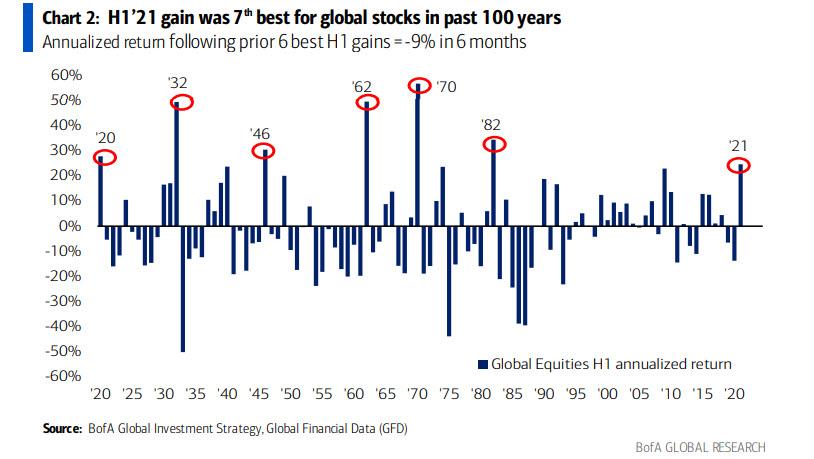
The result: the just completed first half of 2021 was the 7th best for global stocks in the past 100 years...
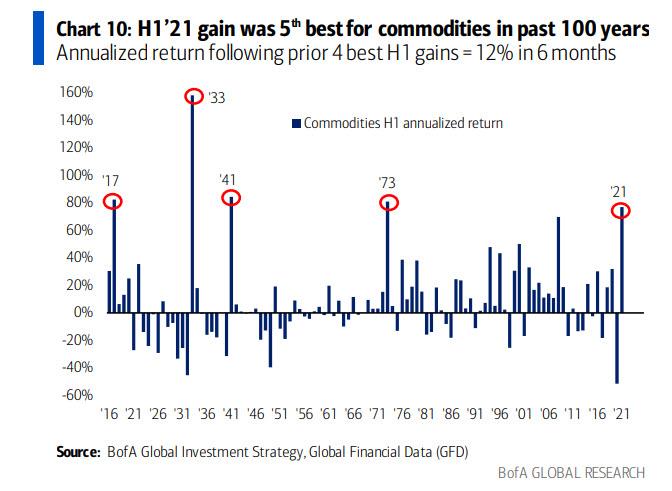
... although as BofA cautions, the annualized return following prior 6 best H1 gains was a 9% drop in the next 6 months. The first half of 2021 was also the 5th best start for commodities in past 100 years...
... and unlike stocks, returns in the subsequent 6 months far more solid, with BofA calculated that annualized return following prior 4 best H1 gains was 12% in 6 months.
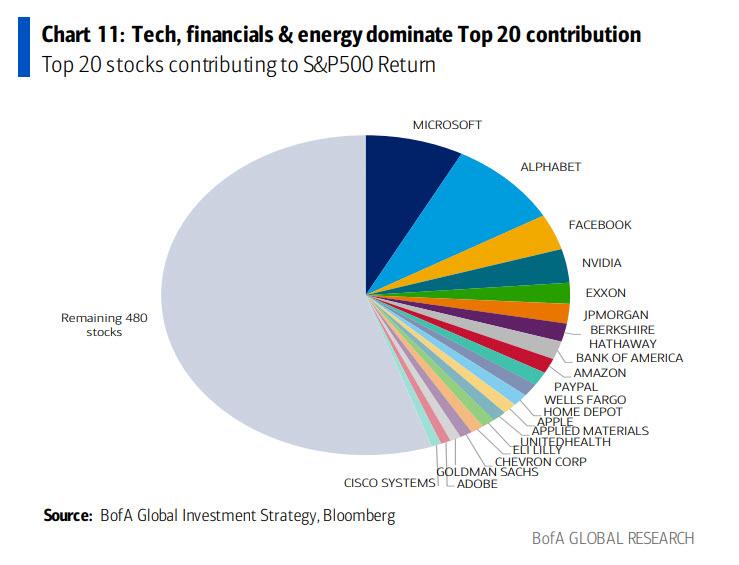
Some more details: 50% of the S&P500’s 15% YTD gain was generated by just 29 stocks (oh which, the top 20 are shown below).
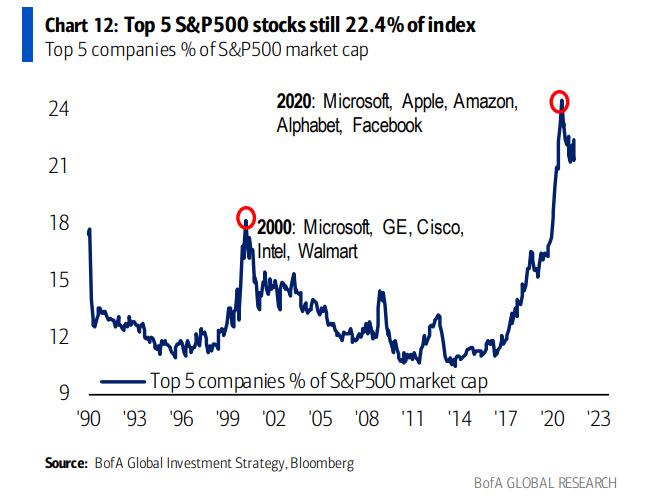
And while Hartnett mocks that everyone’s favorite H2 “contrarian” trade (an oxymoron) is long FAANG - because supposedly the reflation trade is now out of favor - the top 5 S&P500 stocks, the tech gigacap FAAMGs, still account for 22.4% of index (down from 24.5% peak in Aug’20 - Chart 12).

What about the economy: Well, during the past 6 months, global COVID-19 vaccinations surpassed 3 billion...
... which helped US GDP grow at the fastest pace in 70 years, while US CPI surged 8% annualized, the fastest pace since ’82; or as Hartnett correctly predicted about one year ago, "vaccine = boom."
But if H1 was a stellar "boom" quarter for markets and the economy, H2 will be far bumpier: here are the “known unknowns” according to BofA:
  • China eases (bullish),
  • US payrolls/labor market recovery weak (bullish + no taper + productivity “miracle” + “carry trades” carry-on);
  • bubble in stimulus = bubble in asset markets;
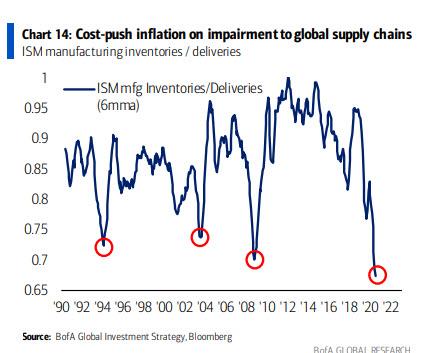
  • cost-push inflation (higher oil + huge impairment to global supply chains – see US manufacturing goods inventories vs deliveries, chart below) hits profit margins (bearish);
  • Biden infrastructure deal collapses (bearish);
  • New Fed Chair nominated Oct/Nov (bearish);
  • Inflation ends Fed’s “strategic ambiguity” on monetary tightening (bearish);
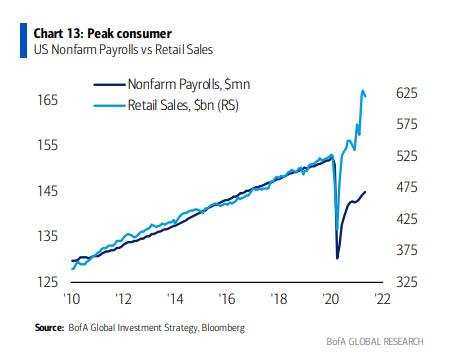
  • Peak US consumption as artificial supports end & labor/tax/health uncertainties + demographics keep US savings rate at high (Japanese/European) levels (bearish).
What does Hartnett think happens next? Looking at the second half, the BofA CIO sees:
  • inflation to stagflation,
  • QE to QT,
  • combo of rising Rates, Regulation, Redistribution (3Rs) & peak Positioning, Policy, Profits (3Ps) = low/negative stock/credit H2 returns;
  • optimal barbell long inflation & long quality;
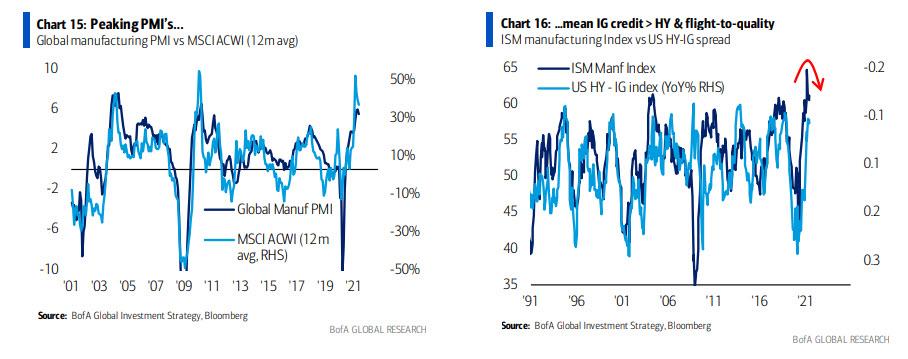
  • note June global PMI’s…1st time since Apr’20 more countries posted monthly declines than gains + US ISM prices paid index @ 92.1, highest since Jul’79; peaking PMI’s = IG credit > HY & flight-to-quality
In short, a stagflationary mess is about to unfold.