>>> Europe : Brokers Upgrades & downgrades - 5th of July 2021 V2(+)

>>> Up
* Brenntag PT Raised to 80 euros from 55 euros at UBS (+)
* Flutter Raised to Buy at Deutsche Bank; PT 16,257 pence
* Harbour Energy PLC Raised to Add at Peel Hunt; PT 472 pence
* Legrand Raised to Buy at Deutsche Bank; PT 102 euros
* Rexel Raised to Add at AlphaValue
* Stagecoach Raised to Hold at HSBC; PT 95 pence
* Workspace Raised to Neutral at Kempen & Co; PT 880 pence

>>> Down
* Argan Cut to Neutral at Kempen & Co; PT 110 euros
* IMI Cut to Neutral at Goldman; PT 1,700 pence
* Stillfront PT Cut to 110 kronor from 150 kronor at Berenberg
* TAG Immobilien Cut to Neutral at Kempen & Co; PT 27.20 euros

>>> Initiation
* Foresight Group Rated New Buy at Peel Hunt; PT 470 pence

>>> Call
* Equities Risk-Reward Remains Positive in 2H, JPMorgan Says (+)
* Harbour Energy Upgraded on Higher Crude Assumptions: Peel Hunt
* High Rates, Tax Reforms to Limit Upside for U.S. Stocks: Goldman (+)
* Legrand Upgraded on Organic Growth, Pricing Power: Deutsche Bank (+)
* MTG’s PlaySimple Deal Makes Strategic, Financial Sense: Citi (+)
* Wienerberger 2Q Earnings Ahead of Expectations: Commerzbank (+)
* Wm Morrison May Get Another Bid After Fortress Offer: Berenberg (+)

FT : Rapid break-up of Cobham fuels debate over private equity in UK

Rapid break-up of Cobham fuels debate over private equity in UK
Advent’s disposals shrink defence stalwart’s British footprint amid alarm over power of buyout groups

Two years ago the defence group Cobham became a cause célèbre in the debate about foreign takeovers of British companies as the outraged family of its illustrious founder and former executives warned its new American private equity owners would break up the company.

But investors still went on to back Advent International’s £4bn purchase and Boris Johnson’s government eventually waved through the deal with an official promise of tight scrutiny of the US private equity group. 

Today, 18 months after taking control, Advent has sold large parts of the business — more than half of what it bought by value.

While the operations have continued under their new owners, the disposals have left Cobham — one of Britain’s most historic aerospace groups and whose pioneering refuelling technology gave Royal Air Force planes the range they needed to carry out missions in the Falklands war of 1982 — without any UK manufacturing sites.

The buyout group’s ability to execute such a rapid restructuring, despite assurances made to the government, has raised alarm among the original opponents of the deal. 

“Just 18 months after Advent declared a long-term commitment to Cobham, it has largely dismantled the company and sold off the parts,” Nadine Cobham, whose late husband Michael Cobham ran the company and was the son of the founder Alan Cobham, told the Financial Times.

Seen through the unsentimental lens of an American investment firm, Cobham’s wide-ranging businesses were always likely to be worth more on their own than bundled together.


But the speed of the defence group’s dismantlement will fuel the debate about the role of private equity in the UK economy and the ownership of key technologies, at a time when buyout groups are announcing approaches to UK-listed companies at the fastest pace in two decades.

Some traditional fund managers complain that buyout groups are “raiding” the stock market for cheap deals. Cobham said last week that it was considering an offer for the FTSE 250 listed defence group Ultra Electronics. 

Private equity’s traditional financial model would require Advent to sell Cobham within about five years. The private equity firm calculated there would be few buyers for the company as a whole given its disparate operations, from training military pilots to air-to-air refuelling to antenna systems, people with knowledge of the matter said. 

Soon after taking control, it started to separate Cobham’s units so they would “operate effectively on a more independent basis”, it said in its annual report. While Advent plans to invest in the remaining Cobham units, including in research and development, they are also likely to be sold separately, the people said.

Cobham made its first disposal in June 2020, selling Axell Wireless, which supplies distributed antenna systems, to Rcapital, a turnround investor. Axell Wireless went into administration in December, but has since been bought out. Then, in September, Cobham sold the UK operations of its Aviation Services business, which trains military pilots, to Draken International.

The sales continued into the new year with its sale in January of Cobham Aerospace Connectivity, a provider of antennas and radios, to America’s TransDigm Group for $965m. And in February, it sold the company’s crown jewel, the air-to-air refuelling business Cobham Mission Systems, to Eaton Corporation for $2.83bn.

All of the businesses have continued to operate in the UK under their new owners. 

Advent, which agreed to a number of commitments when it bought Cobham, also said it had maintained “compliance with all undertakings given to the UK government”. 

The undertakings included honouring the terms of existing contracts, notifying the Ministry of Defence in advance if there was a material change to the company’s ability to supply key services and promising not to withdraw certain services for an agreed period. Finally, Advent had to give the MoD notice if it decided to sell all or part of Cobham. In addition, the undertakings would be independently audited.

The original agreement allowed for the sale of all or part of the Cobham business and did not transfer to new owners. 

Advent, however, is understood to have made it a condition of the sales that the new owners would give similar undertakings to the government for a limited time period. 

The Financial Times also understands that Kwasi Kwarteng, business secretary, has met with the new owners to discuss the economic considerations arising from the sale and received assurances from them on safeguarding UK jobs and investment.

Despite the assurances, the reality is that “all of the major technologies that Cobham had, no longer reside with us”, said Gordon Page, a former chief executive and chair at the company, who opposed the Advent takeover in 2019. 

“None of my original worries have gone away and for all this to happen in just two years’ time runs a coach and horses through what they said to the government,” he added. 

Supporters of the deal pointed out that, despite Cobham’s British heritage, less than a fifth of its workforce was based in the UK at the time of the takeover. More than half of its revenues were US-based. 

Nick Cunningham, analyst at Agency Partners, said the “key question is, should the government care about these technologies being under UK control or not? 

“When you have virtually free capital around for private equity and other leveraged buyout groups, how do you prevent these key UK assets being broken up and sold to overseas buyers? What is needed is a comprehensive industrial strategy.”

Advent has already taken back some of its investment. By December 2020 it had reclaimed $1.4bn in “preferred equity” that helped fund the buyout, corporate filings show.

The takeover left Cobham with $3bn in net debt, more than 5.5 times its earnings before interest, tax, depreciation and amortisation and a huge rise from just $72m when it was a publicly traded company, its accounts for the year to December show. That led to interest costs of $183m in the first year of Advent’s ownership. 

Advent said: “Cobham has performed strongly under Advent, despite the pandemic, with 6 per cent like-for-like revenue growth in 2020. 

“More than $350m has been spent on research and development and strategic investments. The business is now more focused on high-tech electronics and has won significant contracts in commercial satellites, government space programmes and next generation defence electronics.”

Under Advent’s ownership, Cobham has won some important contracts, including a $500m-plus deal to provide electronics to America’s Raytheon. Advent has also bought a business, Tods Aerospace, a manufacturer of composite aerospace structures, for an undisclosed sum. 

However, the buyout group’s ownership of Cobham will probably attract further scrutiny if the company does make an offer for Ultra. It told the market that a deal would create a “global defence electronics champion”. 

Sandy Morris, analyst at Jefferies, believes a move on Ultra would probably be even more controversial, given its role as a supplier of submarine hunting equipment to the MoD. 

It will also trigger renewed debate about the valuation of UK defence stocks. 

According to Morris, the UK equity market is “not very good at judging what defence businesses are worth to another company”. UK defence stocks trade between 10-20 per cent discounts to their US peers, he added, even though large parts of their businesses are in the US. 

However, the UK government stressed it had “worked with Advent to closely monitor the undertakings given in relation to the Cobham disposals. This includes advance notification of planned sales”.

It added: “The UK remains firmly open for business, and we are committed to protecting the livelihoods of British workers and investment in the UK.”

(ZH) South China Port Congestion Worsens As Traffic Jam Of Container Ships Build

South China Port Congestion Worsens As Traffic Jam Of Container Ships Builds

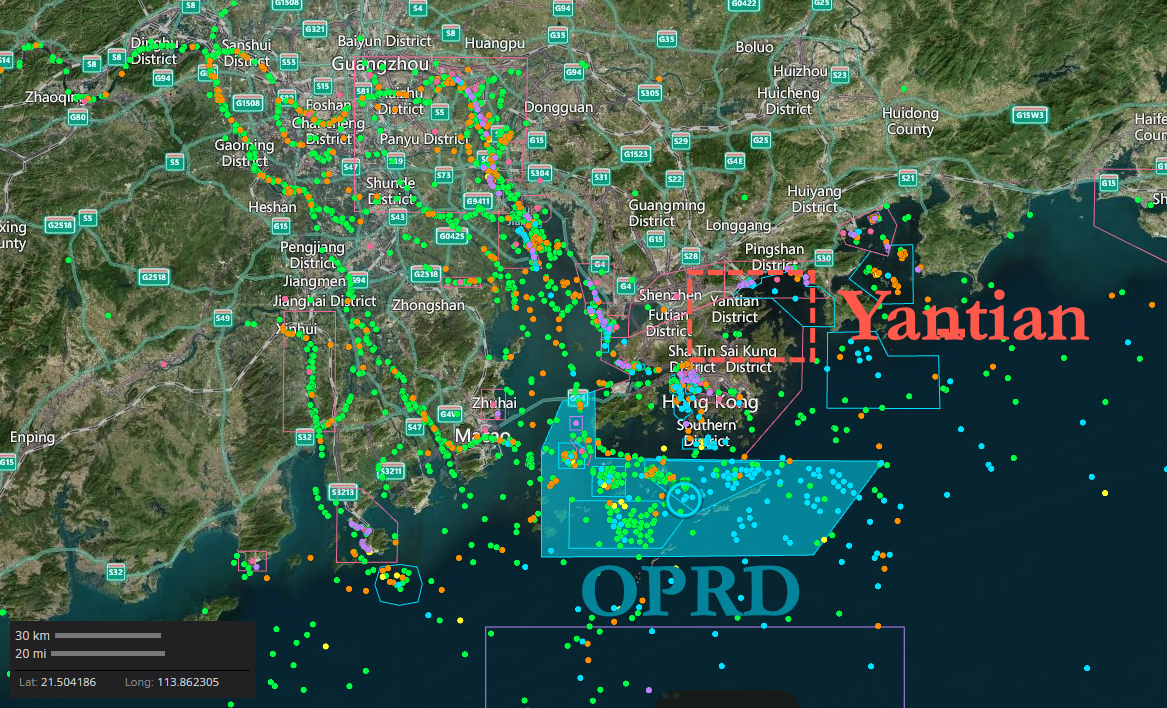
We have previewed for months that port congestion in southern China could be a more severe problem than the shutdown of the Suez Canal in March. Port congestion at Yantian International Container Terminal, a deepwater port in Shenzhen, Guangdong, is operating at 40% capacity and is seeing vessel delays of more than 16 days, significantly impacting exports to the US.
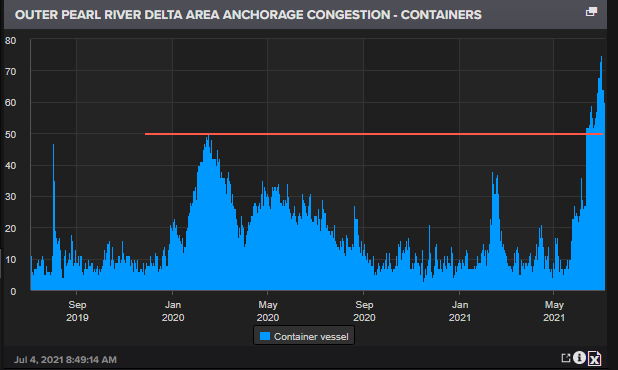
Just outside of Yantian is the Outer Pearl River Delta (OPRD) Area, where the number of container vessels is waiting to access ports on the mainland has hit multi-year highs.
At the end of June, 75 container ships were moored in OPRD, surpassing levels from early February of around 35 and about 50 in February 2020. These vessels are waiting for berths to open up at ports.
The congestion has surpassed March's Suez Canal blockage in terms of container disruption with median wait times around 18 days, according to data from project44.
"From port handling in Yantian alone, the sheer number of containers (not vessels) impacted now exceed the number of containers impacted in Suez," Lars Jensen, CEO of advisory Vespucci Maritime, said in a post on LinkedIn.
Jensen warned: "Add to this ripples such as problems in recent weeks getting new empty containers into South China. Then you will have a pile of cargo in backlog coming out of Yantian once everything re-opens given rise to a surge on the destination side with some timelag. You will have a pile of reefer cargo already on vessels inbound for Yantian but which is now being discharged in other ports increasing the risk that other ports will run out of reefer plugs (as we also saw in early 2020)."
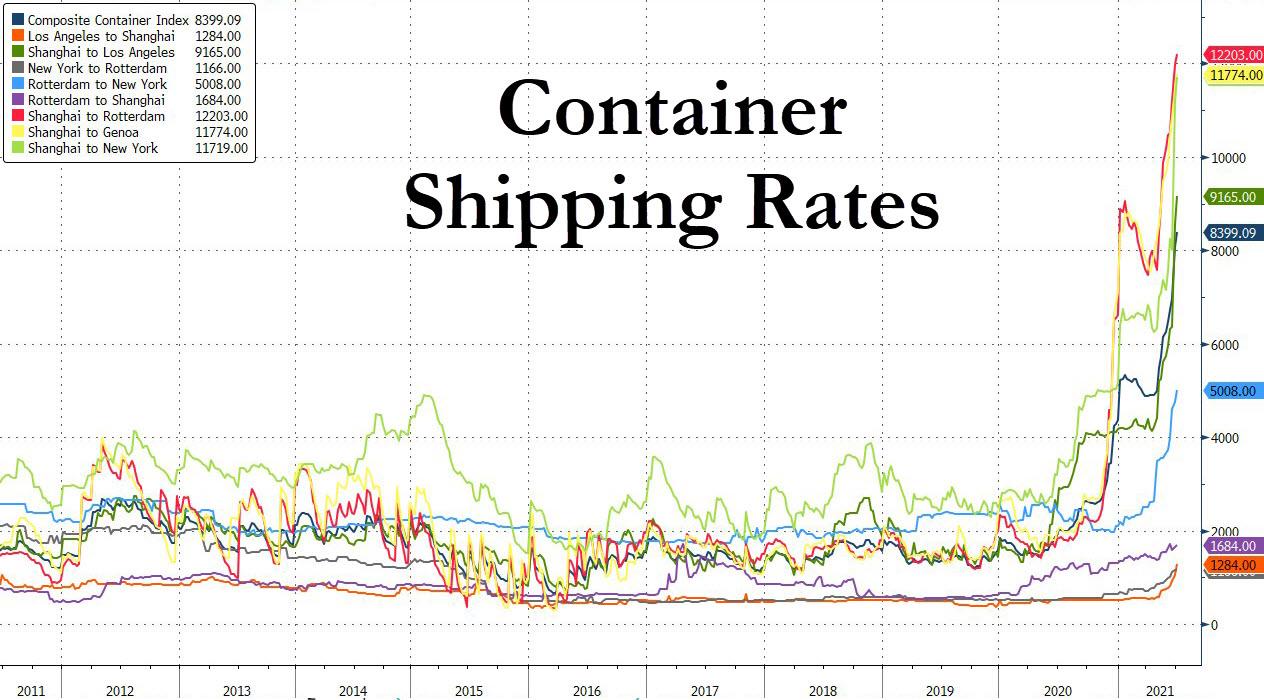
Meanwhile, international container shipping rates have hit never before seen levels amid a historic global scramble to secure goods and inventory...
Congestion and soaring shipping costs are more bad news for Walmart, Target, Amazon.com, and top retailers who are now placing holiday orders for Chinese-made merchandise weeks earlier this year, as a global shipping backlog threatens to leave many gift buyers empty-handed this Christmas shopping season.
The latest shipping data out of China suggest port congestion continues to worsen as supply chain woes are expected through the second half of this year.

FT : Apollo considers counterbid for Morrisons

Apollo considers counterbid for Morrisons
Private equity group mulls offer after rival investment group agreed £9.5bn deal with supermarket chain

Private equity group Apollo is examining a potential bid for Wm Morrison, the UK supermarket chain that has already agreed to a £9.5bn takeover led by Fortress, a rival investment group.

Apollo said in a statement on Monday that it was “in the preliminary stages of evaluating a possible offer” for the London-listed company.

It comes after Morrisons said over the weekend that it had struck a £9.5bn deal with SoftBank-owned Fortress along with the Canadian pension fund CPPIB and a unit of Koch Industries.

That deal was pitched at 252p a share along with a 2p special dividend, valuing the equity of Morrisons at £6.3bn before the inclusion of £3.2bn of net debt.

Apollo said it had not made an approach to the board. “There can be no certainty that any offer will be made, nor as to the terms on which any such offer might be made,” it added.

Business Of Fashion : The Payment Platforms Brands Need to Go Global

The Payment Platforms Brands Need to Go Global
Stripe and Klarna have transformed payments in the west, but fintech providers like PayU, M-Pesa and PhonePE can help drive e-commerce in rapidly growing emerging markets.

Like so many around the world, Urmi Bhattacheryya has cut back on her use of cash during the pandemic.

“I think I’ve switched to Google Pay and Paytm almost entirely over the last year in quarantine,” says the Delhi-based journalist who uses the apps for everything from buying sportswear online to purchasing food from vendors’ carts. So ubiquitous have these digital solutions become that she can even make mobile donations to some of the poorest members of the Dalit community, India’s lowest cast. “They all have these apps on their phone now too.”

By November 2020, 47 percent of Indians had already reported using less cash for purchases than before the Covid-19 outbreak, according to a YouGov survey of over 20 countries. The figure was even higher in emerging markets like Thailand, Malaysia, the United Arab Emirates, Vietnam, Indonesia and a few mature markets.

Though cash is still the only way that billions of people around the world make purchases for consumer goods like fashion, the uptake of alternative payment methods has leapt forward since the onset of the pandemic, progressing five years in less than 12 months, according to McKinsey’s 2020 Global Payments Report.

“We saw a huge increase in mobile penetration in the first year of the pandemic‚” said Marius Costin, head of EMEA (Europe, the Middle East and Africa) sales for PayU, which facilitates payments for most of the world’s largest 100 apparel brands.

Electronic forms of peer-to-peer and consumer-to-business payments have seen increased use across several of the fashion industry’s key geographies, benefiting global services such as Stripe and PayPal, China’s WeChat Pay and Alipay, Japan’s PayPay and Line Pay, along with a fast-growing list of buy-now-pay-later services like Klarna that have gained popularity among fashion consumers.

In a bid to get closer to the industry’s decision-makers, Afterpay has inked high-profile partnerships with Australian Fashion Week and New York Fashion Week while its UK service Clearpay has linked arms with London Fashion Week.

But change has been especially quick in regions like Africa, South Asia and South America where contactless payments, online banking and the use of mobile payment apps are historically low. Looking to capitalise on the opportunity, investors have poured over $23 billion into fintech start-ups in emerging markets in the past five years, according to a recent report by Catalyst Fund and Briter Bridges.

Lesser-known payment methods are now empowering consumers in increasingly important emerging markets to purchase the fashion they want from around the world, as long as brands are ready to meet them where they spend.

PhonePe, Google Pay and Paytm Battle for India

Ten years ago, only six non-cash transactions were made per person each year in India, according to the country’s reserve bank. That changed with the establishment of the Unified Payments Interface (UPI), which allows people to make payments instantly between over 200 banks nationwide using apps on their mobile phones.

Introduced in 2016, use of the UPI has grown at a ferocious pace. Both the number and value of monthly transactions more than tripled in the two years to April 2021. In that month alone, 2.6 billion transactions worth almost $70 billion were made using the UPI.

The vast majority of payments on the interface are made using apps such as Google Pay and Walmart-owned Indian firm PhonePE. India-based Paytm recently revealed plans to raise an additional $3 billion in a stock offering that would bring its valuation up to $29 billion, but it is still playing catch up.

PhonePe had over 100 million monthly active users in January 2021. The total value of payments through the app reached $300 billion last year, according to Walmart’s 2021 Annual Report. The service is already widespread, having partnered with 19 million stores, apps and websites, including Indian online fashion giant Myntra, which stocks global brands such as Nike, H&M and Marks & Spencer.

If ambition in the Indian market can be measured in cricketing sponsorships, PhonePe is going to be hard to beat. They’re sponsoring four franchises, as well as the TV broadcast on Star Sports and the digital broadcast on Disney+Hotstar.

M-Pesa and the Rise of Mobile Money in Africa

Mobile money is a service that allows people without bank accounts to make transactions using their phone number as their account number. There are now over 1.2 billion such SIM card-based accounts globally, according to a 2021 GSMA report, and transaction values are growing quickly, up 22 percent last year to $767 billion.

Mobile money began as a way for city earners to safely send money to family and friends in remote areas, but it has since evolved into one of the most popular and flexible payment methods in emerging markets. It is used not only to send money but to pay bills and make online purchases.

Of the estimated 310 mobile money services worldwide, 171 are in Africa. Examples include EcoCash in Zimbabwe, MoMo in South Africa, Paga in Nigeria and Tigo Pesa in Tanzania. One of the most popular is M-Pesa, which launched in Kenya in 2007 and now operates in 15 countries. The “M” stands for “mobile,” while “pesa” is Swahili for “money.”

Merchants who accept M-Pesa can now reach over 40 million customers, most of whom don’t have any other way to pay for online purchases. M-Pesa can be used to shop for fashion and accessories on Africa’s largest e-commerce platform, Jumia, which stocks brands like Adidas, as well as sites like Afrikrea, which helps thousands of “micro-retailers” sell African fashion to 170 countries worldwide.

M-Pesa and other mobile money services are well-positioned to take advantage of the African Continental Free Trade Agreement that came into effect on January 1 this year, eradicating 90 percent of tariffs and diminishing non-tariff barriers between signatories. The agreement will connect 1.3 billion people across 55 countries.

Admittedly, Africa currently accounts for just 2 percent of global trade, but payments provider eShopWorld expects to see significant growth in e-commerce across the MEA (Middle East and Africa) region, especially in countries such as Nigeria and South Africa and the United Arab Emirates.

Nubank and Oxxo Revolutionise Payments in Latin America

Latin America’s unbanked population is around 50 percent, and as high as 70 percent in some countries, excluding many from online shopping. But in the five months to October 2020, 40 million people in Latin America opened bank accounts for the first time, according to a study by Americas Market Intelligence and Mastercard.

Government subsidies helped drive the shift, with programmes in Brazil, Colombia and Argentina all requiring users to open an account to receive funds. Covid-related programmes like these are estimated to have reduced the unbanked population in Latin America by a whopping 25 percent.

Brazil’s branchless bank Nubank has been one of the beneficiaries, growing from 12 million customers in 2019 to 34 million in January 2021. Their services, which include a mobile banking app and credit cards that max out at as little as $10 per month, have helped them become the largest digital bank in the world by the number of customers and app downloads, according to TechCrunch. They’ve recently expanded into Colombia and Mexico, hoovering up venture capital along the way. Series G funding of $400 million brought their valuation to $25 billion.

In parallel to the increase in bank account ownership across Latin America, workarounds for those who don’t yet have them are becoming more powerful. The voucher system offered by Mexico’s Oxxo convenience stores is one hugely popular example.

Users order items online and receive an invoice, which they can pay in cash at one of over 20,000 Oxxo stores, to complete the transaction. Boleto in Brazil and Baloto in Colombia offer similar voucher systems.

“Every little village has an Oxxo store in Mexico,” says Scott Lindsay, who heads marketing in EMEA for eShop World, which works with fashion brands in 200 countries worldwide. It’s an option he recommends to clients looking for the quickest wins at the lowest costs.

“Offering as many payment methods as possible is not the way to do that,” he says. Instead, most brands should focus their energies on a group of high-performance platforms across high-priority emerging markets.

Oxxo is working hard to maintain its edge in Mexico. Its partners now include Amazon and Mercado Libre, Latin America’s largest e-tailer. Oxxo also announced a new payment app called Spin in March of this year, with the payments processed by Visa, opening up e-commerce to millions of people who don’t have bank accounts. All users need to sign up is a phone number.

Online fashion purchases in Latin America increased significantly since the pandemic began. According to PayU, online shopping in Colombia saw an increase of 70 percent from 2019 to 2020, while in Brazil the upsurge was 500 percent .

Notably, payment by instalments is the norm in much of the region, accounting for 60 percent of e-commerce purchases in Brazil, according to Ebanx.

The World’s Biggest Mobile Payments Prize?

Of all emerging market regions, Southeast Asia is primed to see the fastest growth in alternative payments. Digital payments are projected to double in value from $620 billion in 2020 to $1.2 trillion in 2025, according to the e-Conomy SEA 2020 report compiled by Google, Temasek and Bain.

This change is being propelled by a rapid increase in access to the internet. Forty million people in the region came online in 2020 alone, bringing the total number up to 400 million out of 538 million.

Most of the over 400 million unbanked individuals in the region still stand to benefit from access to mobile payment apps. Boston Consulting Group says such services are currently used by only 13 percent of Southeast Asia’s unbanked urban population, but that figure will surge to 58 percent by 2025.

It remains to be seen who will process all these payments. While mobile payments are dominated by PhonePE and Google Pay in India, and Alipay and WeChat Pay in China, the market is far more fragmented in Southeast Asia.

A snapshot of this fragmentation was demonstrated in 2019 by Reuters when the wire service counted 28 different e-wallets among two dozen stalls selling crab soup and banhmi sandwiches in Ho Chi Minh City, Vietnam. Moreover, there are over 40 licensed mobile payments services still fighting it out in Indonesia, Malaysia and the Philippines.

Consolidation will come eventually, with market leaders like Singapore’s Sea and Grab (who announced a partnership with Stripe last month) and Indonesia’s Gojek (who recently announced a merger with e-commerce giant Tokopedia to form GoTo) likely to prosper. That could help overcome one of consumers’ biggest gripes with e-wallets in the region, which is that they’re not accepted by enough merchants. Many would rather take cash on delivery than deal with the different requirements of dozens of payment providers.

Embracing new payment options can also be costly for brands, with McKinsey predicting the shift to digital will drive up merchants’ payments-acceptance costs by 6 to 10 percent. But PayU’s Costin says that expense is easy to justify when you know what you’re getting back in return.

“Seventy percent of payments are made through local payment methods,” he says. “If you want to capture a market you need to have them.”
>>> Stoxx 600 Pre-Market Indications

  • Morrison (MZP TH) +14%
    • Apollo Weighs Offer for Morrison, Heating Up Takeover Battle
  • Kerry Group (KRZ TH) +2.4%
  • BAT (BMT TH) +2%
  • Vodafone (VODI TH) +1.8
  • Coloplast (CBHD TH) +1.7%
  • Rio Tinto (RIO1 TH) +1.7%
    • Watch Miners With Iron Ore Up as Traders Weigh Chinese Demand
  • Glaxo (GS7 TH) +1.5%
  • Smurfit Kappa (SK3 TH) +1.4%
  • Nibe (NJB TH) +1.3%
  • Merck KGaA (MRK TH) -0.8%
  • AstraZeneca (ZEG TH) -0.8%
  • OMV (OMV TH) -0.9%
  • Tomra (TMR TH) -0.9%
  • Danone (BSN TH) -1.1%
  • H&M (HMSB TH) -1.3%
  • United Internet (UTDI TH) -1.3%
  • TUI (TUI1 TH) -1.8%
  • Prosus (1TY TH) -2.6%

FT : EU to develop investment initiative to counter Chinese influence

EU to develop investment initiative to counter Chinese influence
Draft statement seeks a “geostrategic approach” to investments abroad

The western response to China’s Belt and Road Initiative has to date consisted more of buzzwords and lofty ambitions than concrete projects.

This month, EU foreign ministers will attempt to change that narrative as they push for more tangible progress via the union’s “connectivity initiative”, writes Sam Fleming in Brussels. 

Draft council conclusions, seen by Europe Express, urge a “geostrategic approach to connectivity” and set the goal of identifying “high impact and visible projects and actions globally”. 

They followed a pledge by Joe Biden and his G7 partners in Cornwall last month to create a “Build Back Better” infrastructure partnership that could contribute to the estimated $40tn needed by developing nations by 2035. 

Beijing’s BRI has long been viewed with deep suspicion in G7 capitals. The initiative has been deployed as a strategic tool by Beijing since its launch in 2013, as dozens of countries agreed to China-backed projects such as ports, railways and bridges. 

Critics have warned that the scheme ends up lumbering recipient countries with onerous debt terms, as well as with projects that sometimes have a questionable business case or boast poor building and environmental standards. 

“As more and more of the negative consequences of Belt and Road become visible in countries like Montenegro, Pakistan or Sri Lanka, governments around the world are increasingly looking for a sustainable alternative,” said a senior EU diplomat. “The EU’s connectivity initiative can provide this.”

The ministerial conclusions, which are meant to be endorsed at a foreign affairs council meeting this month, call for a push by EU capitals and their development institutions, together with national multilateral development banks and the European Investment Bank and European Bank for Reconstruction and Development.

New “strategic connectivity” projects should be programmed into the current 2021-27 EU budget, ministers will conclude, to complement private investment. Public finance including loans and guarantees could also “crowd-in” private capital, ministers say, while calling for a “unifying narrative” to frame the EU’s activity in the area.

The question, of course, is how coherent and substantial the EU’s joint efforts will prove to be with powers including the US, Japan and India.

The draft council conclusions, which do not explicitly refer to China, lack specific target figures — as did last month’s G7 statement. Instead, they list the EU budget programmes that ministers want to draw upon as they seek greater action from Brussels. 

None of this amounts to a fully formed “rival” to the BRI. The EU and its allies lag far behind China, and it remains open to debate whether such an aspiration is even a realistic idea.

But the draft conclusions indicate that EU member states want to put more political weight and financial muscle behind their global connectivity ambitions. The conclusions are intended to serve as a particular wake-up call to the European Commission and its diplomatic wing, urging them to shift into a much higher gear.

>>> TradeGate Pre-Market Indications

DAX:
  • Siemens Energy (ENR TH) +0.8%
  • Henkel (HEN3 TH) +0.5%
  • Fresenius SE (FRE TH) -0.5%
  • Merck KGaA (MRK TH) -0.7%
MDAX:
  • Nordex (NDX1 TH) +1.4%
  • Evonik (EVK TH) +1.1%
  • Puma (PUM TH) +1.1%
  • Hochtief (HOT TH) +1.1%
  • Thyssenkrupp (TKA TH) +0.9%
  • Freenet (FNTN TH) -0.5%
SDAX:
  • Hensoldt AG (HAG TH) +1.4%
  • SMA Solar (S92 TH) +1.4%
  • Global Fashion Group (GFG TH) +1%
  • ADVA Optical (ADV TH) +1%
  • LPKF (LPK TH) +1%
  • 1&1 AG (DRI TH) -0.5%
  • Takkt (TTK TH) -0.6%
  • BayWa (BYW6 TH) -0.8%
  • Deutz (DEZ TH) -1.4%
  • SAF-Holland SE (SFQ TH) -1.9%