FT : Carlos Brito brews up second act after 30 years at AB InBev

Carlos Brito brews up second act after 30 years at AB InBev
Brazilian CEO transformed company through series of aggressive deals

Carlos Brito, who stepped down from Anheuser-Busch InBev this week aged 61, is already planning a long second act. “Brito 2.0” could involve another quarter-century of working, said the Brazilian businessman who spent three decades at the brewer.

“My dad . . . was a vascular surgeon until he turned 86 . . . I have 25 years ahead of me, at least 25 years,” he said.

Brito built AB InBev from a Latin American regional player into by far the world’s largest brewing company, with brands including Budweiser and Stella Artois.

But his final years were overshadowed by his largest, most contentious deal, the £79bn takeover of rival SABMiller in 2016. AB InBev’s share price is more than 45 per cent below where it was when that deal completed, and it is still saddled with $83bn of debt.

AB InBev’s aggressive dealmaking defined an era of consolidation that cemented the dominance of a handful of global beer makers. Brito leaves the company — and the industry — transformed from when he joined what was then Brahma in 1989.

Trevor Stirling, an analyst at Bernstein, called him “one of the three titans that have shaped the modern brewing industry,” alongside former Heineken chief Jean-François van Boxmeer and the late SABMiller leader, Graham Mackay.

In many respects, Wall Street’s view of Brito’s legacy accords with the former chief executive’s own. “We started from one country in Latin America, one country in Europe, and we built a global brewer . . . one of the top three CPG [consumer packaged goods] companies in the world and the highest by profitability”, he said.

“He has clearly created a lot of value for his shareholders,” Stirling concurred.

With AB InBev rallying from the worst of the pandemic — it reported far better than expected first-quarter results — Brito has handed the reins to Michel Doukeris, a 25-year company veteran known for building up brands and digital sales. 

“He’s very competent; he’s better than me,” said Brito, citing his successor’s achievements in Mexico, Brazil, China and the US.

Doukeris’s career path reflects AB InBev’s evolution into a truly global company, which Brito argued would not have happened without the SABMiller deal. “It was the right thing to do,” he said, for a brewer that thinks “not only about the next few years but the next 50, 100 years”.

But he admitted Covid-19 had set back AB InBev’s debt-cutting plans by about two years, and he preferred to highlight the 2008 hostile takeover of Anheuser-Busch.

That bid came just before the global financial crisis hit. “We needed 10 banks on the closing date to come up with a couple of billion dollars each and some banks were just disappearing every day,” he recalled. But once AB InBev got that financing, “we never looked back”.

The age of brewing megadeals is over, Brito acknowledged, though smaller-scale dealmaking continues. That, analysts said, put more pressure on AB InBev to build brands and grow organically, although its scale has not always helped its agility.

One example is hard seltzer, the flavoured alcoholic fizzy water that has taken the US drinks market by storm. In 2016 AB InBev acquired the pioneering brand, SpikedSeltzer, only to be overtaken by new rivals White Claw and Truly; it still lags behind those brands, despite gaining market share this year, according to Bernstein. 

“I think sometimes, maybe, we took longer to embrace some changes,” Brito admitted, because the company’s size made it wary of cannibalising its huge existing profit drivers. 

Without acknowledging that the US beer market is in decline, he predicted that non-beer products such as hard seltzer would grow in importance. “What people call the fourth category, which is the blurring of beer, wine and spirits . . . endanger[s] a section of existing categories, legacy categories.”

Expectations of chief executives evolved as fast as drinking habits during Brito’s reign but he said AB InBev would not be “an activist company”, campaigning on issues outside its core remit.

“The biggest challenge today [is] that people think CEOs and companies need to have an opinion about everything,” he lamented.

Investors’ new focus on environmental, social and governance, or ESG, concerns might appear an uneasy fit with AB InBev’s embrace of zero-based budgeting. Yet Brito painted the 3G Capital-backed system in which every cost must be justified anew in each budgeting period as making for a greener company.

“Everybody . . . wants companies to manage waste so we minimise the impact on the planet. So, all of a sudden, efficiency became a cool thing,” he said.

Companies now needed to understand that their communities “only allow you to exist if you’re part of the solution”, he said: “The moment you’re portrayed as part of the problem, they’re not going to kill you but they’re going to regulate you, tax you, restrict your business.” 

Brito urged governments not to raise taxes on companies such as his to pay for their Covid-19 outlays, but to impose the burden on those that profited in the pandemic. 

“When they raise taxes to pay for Covid incentives and stuff, they should go after the companies that need to share their wealth because they have consumers that were pushed towards them,” he said. Some businesses tripled or quadrupled their market value: “We didn’t.”

Brito has not yet settled on his next move, but did not rule out another chief executive role, or working again with his mentor, 3G co-founder Jorge Paulo Lemann, who funded his education and hired him into banking in his 20s. 

The calls Brito received after announcing his departure suggested he would have “many options”, he said, and he planned to spend July and August returning them.

But he voiced little doubt this was the right time to relinquish the company he shaped. “We have to pass on the baton to a new generation, otherwise they’ll go elsewhere,” he said. “If the CEO stays forever, the machine doesn’t work.”
(ZH) Spain's Proposed 'National Security Law' Would Allow Seizure Of Citizens' P

Spain's Proposed 'National Security Law' Would Allow Seizure Of Citizens' Property During Health "Crisis"

The prominent Spanish daily El País is reporting a hugely alarming scenario in which Spain's central government is mulling a national mobilization and "security law" which would compel citizens to "temporarily" give up their rights in instances of future public health crises or emergencies such as happened with the coronavirus pandemic.
The law is currently at the level of a mere proposal but worrisomely it would elevate matters of public health to the level of 'national security' - as El País spells out based on a translation of its reporting: "Any person of legal age shall be obliged to carry out the 'personal obligations' required by the competent authorities, following the guidelines of the National Security Council, when a state of crisis is declared in Spain. In this case, all citizens without exception must comply with the orders and instructions issued by the authorities."
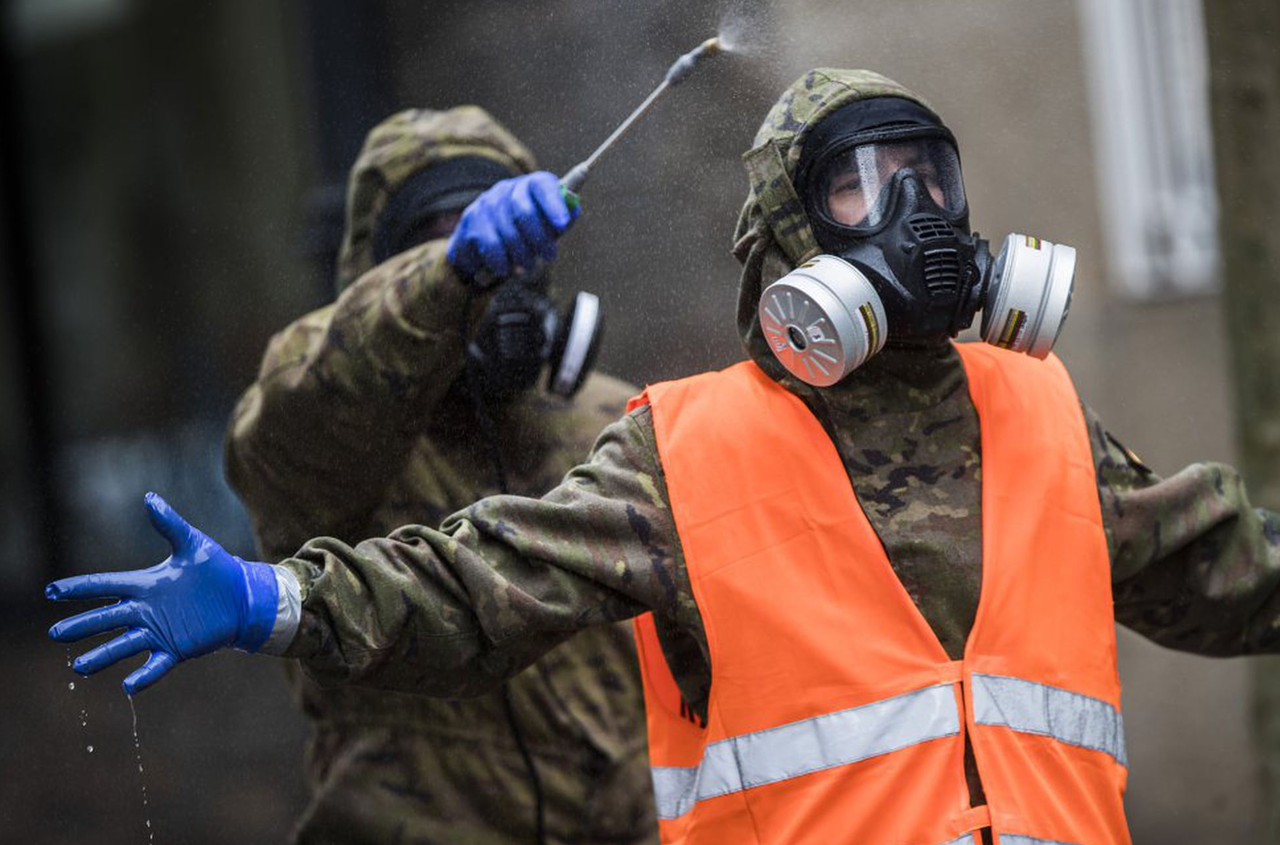
Members of Spain’s Emergency Military Unit disinfect one another, via El Pais.
This sounds vague enough to suggest literally nothing would be off-limits in terms of state authorities' massive legally enshrined reach into people's personal lives on the mere bases of a national crisis. And further there's little or nothing which establishes a clear threshold for what legally would constitute such a crisis.
Throughout the pandemic we've already seen a number of places in Europe, also especially Canada, where government officials already essentially claim such far-reaching powers to force the citizenry to conform. Now Spain is looking to permanently enshrine this scenario into law.
Consider just how far this Orwellian proposal goes, as reported on in El País:
In the event that a state of crisis is declared in Spain ('situation of interest to National Security' is the name given by law), the authorities may also proceed to the temporary requisition of all types of property, at the intervention or provisional occupation of those that are necessary or the suspension of all kinds of activities.
The backers of the future legislation are seeking to assure the public that "compensation" would eventually follow; however, it would clearly given permanent and endless powers to any ruling government which decided to enact it based on a real or manufactured "crisis".
Remember such insane recently enforced regulations like *outdoor* masks?...
Here's more on private citizenry being viewed as 'militarized' under the proposed legislation:
The duty concerns not only all citizens but also companies and legal entities to collaborate with the authorities to overcome the crisis, through a provision of a personal or material nature. The text is based on article 30 of the Constitution, according to which "Spaniards have the duty and right to defend Spain."
It is the same article that regulates compulsory military service (suspended in Spain since 2001), although it does not refer to its 2nd section, which establishes the "military obligations of the Spanish", but to the 4th, according to which, "by law, the duties of citizens may be regulated in cases of serious risk, catastrophe or public calamity", a constitutional provision whose development has remained unpublished until now.
Another crucial detail relates to the media, which would essential be 'temporarily' transformed to exclusively serve official state propaganda in order to "defend Spain" as if in a wartime situation:
Among other novelties, the draft includes the obligation of the media to collaborate with the competent authorities in the dissemination of information of a preventive or operational nature. The most important thing, however, is that it incorporates measures to avoid the recurrence of shortages of products and critical goods to face a crisis, such as the lack of masks, respirators and PPE that occurred when infections began to spread massively.
The draft law had first been unveiled in a Council of Ministers meeting on June 22, according to the report. There's little doubt that should Spain actually adopt this ultra-controversial expansion of state powers for the sake of a vague "crisis" - other European countries will follow suit and perhaps already are.
We've seen some officials and political pundits actually push similar measures in the US and Britain... this looks to unfortunately be the "what's next" waiting for us during the next "global health crisis" on the horizon - however it gets vaguely defined

(ZH) How Has The Flood Of Information Changed Wall Street Since 1990

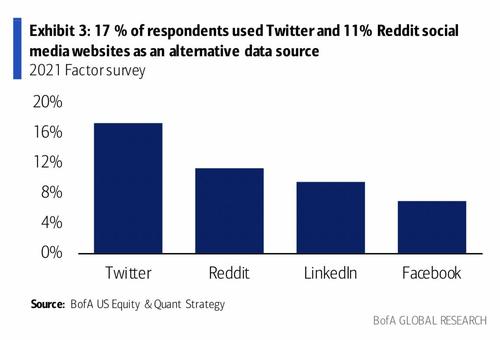
How Has The Flood Of Information Changed Wall Street Since 1990In a world where Wall Street admits that it increasingly gets its most precious commodity - information - from social networks such as Twitter, Reddit and Facebook...
... it got us thinking about the changing nature of information flow in finance and how it may be impacting markets.
Conveniently, in a recent note from DataTrek's Nick Colas, the former SAC portfolio manager takes a big picture look at just this topic, writing that when he started covering stocks in 1991 back at Credit Suisse, there was no Internet, no smartphones, no “Big Data”, no quarterly earnings conference calls, and no real regulation around how companies disseminated potentially market-moving information. All those things exist today, and according to Colas, the fact that the world's financial decision-makers are flooded with instant (and constant) information may well explain part of why US stocks trade at such premiums to prior cycles. But, as Colas also notes, more information can also make investors overconfident.
Below we excerpt from the DataTrek founder's latest note about the changing nature of information as it relates to the investment process over the last 30 years.
Too Much Information, by Nicholas Colas
We’ll start in late 1991 when these words first came out of a CFO’s mouth: “We should do a conference call after the quarter.” The speaker was Jerry York, then Chrysler’s chief financial officer. The company had just done a “save the firm” equity issuance to fund production of the then-new Grand Cherokee.
He felt that the institutional buyers of that deal should hear directly from the management team right after Q4 earnings were made public. They had taken a big risk buying Chrysler, which at the time was essentially insolvent. Keeping the lines of communication open with this group of investors was important. After all, the company might need to tap them again if the US economy didn’t continue to rebound.
I was at that first call, which was a hybrid in-person/teleconference held at the old Sky Club on top of what was then the Pan Am building in New York City. Some big investors in the deal traveled to New York to attend, and others dialed in. It did what Jerry wanted. Investors got to ask their questions directly and also hear management’s take on the business.
As effective as that form of shareholder communications was, quarterly earnings conference calls only slowly caught on through the 1990s. For many years, analysts more commonly waited for earnings reports to come through on PR Newswire. We would then print those out on a dot matrix printer and call the company’s CFO or investor relations person. We’d then wait for a call back and ask our questions about the numbers. Sometimes it would be the same day, sometimes the next. And if the company didn’t like you, that return call would simply never come.
Other differences between 1991 and now, as far as the investment process goes:
  • No Internet back then, at least as far as its utility to Wall Street. No Google, no Wikipedia, no “Big Data”.
  • No smartphones. If you were on the road and wanted a price quote or the latest news, you called your trading desk.
  • No email – analysts’ reports were printed and mailed/messengered to clients.
  • No Fed press conferences after FOMC meetings. Only Fed Chair Alan Greenspan spoke on policy, and infrequently at that.
  • No regulations requiring analysts to share their views with all clients at once.
  • No regulations requiring that companies disseminate market-moving information broadly. Most just used their favorite Wall Street analysts to update investors on earnings guidance.
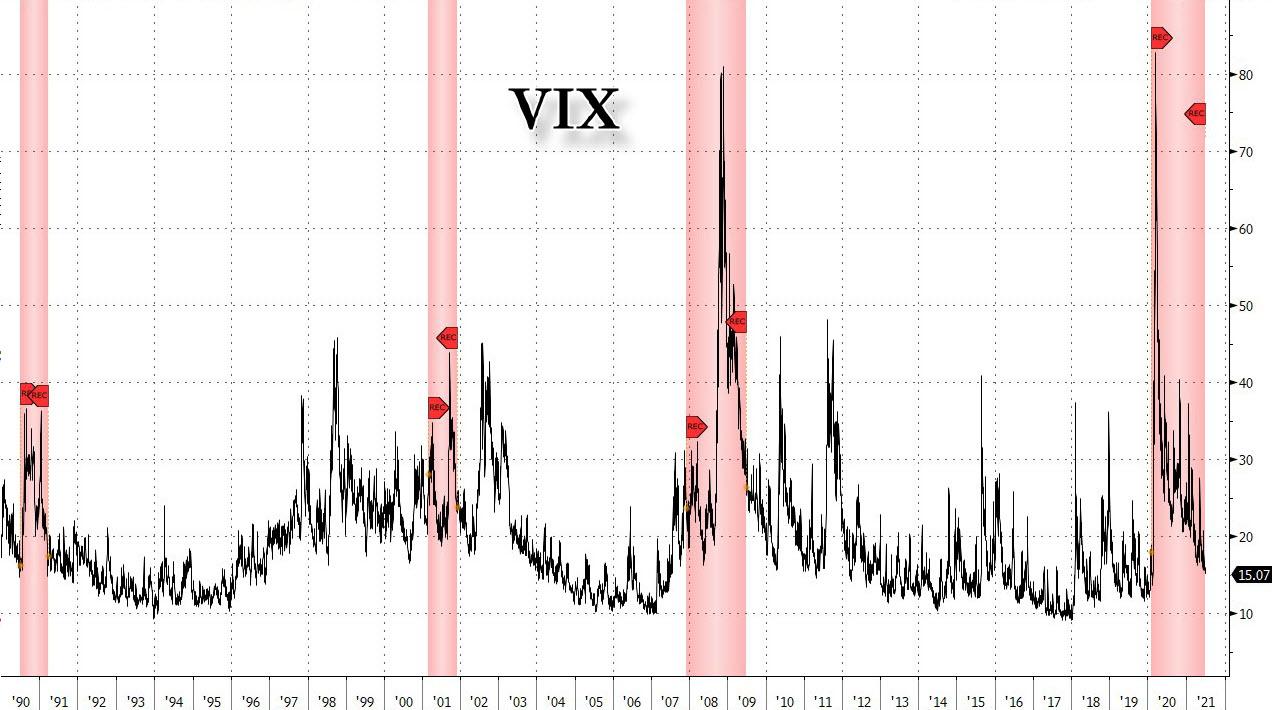
I think about all these differences every time I look at a 1990 – present history of the CBOE VIX Index. Has more, and more-widely available, information made US stocks less volatile? In theory, it should. Volatility is, first and foremost, a function of how much relevant fundamental information is embedded in stock prices.
Here’s that VIX history back to 1990, which shows that the period from 2012 to 2019 did see generally lower volatility than the prior 2 economic up cycles. There were other forces at work, certainly … A long expansion makes for more predictable corporate earnings, which should make for lower equity price volatility. But seeing a VIX that reliably traded below 19 (its long run average) for the better part of a decade is still notable. The truly “different” thing about this period versus the previous ones is the change in the quantity and speed of information flow.
What’s also striking about that chart is that volatility shocks (which always bring lower asset prices) still routinely occur despite the much greater amount of information available to markets and investors. Chalk that up to human nature. Prospect Theory says humans “feel/fear” loss about twice as much as equivalent gains. That asymmetry explains the old trader’s saying that “the market takes the stairs up, but the elevator down” when an unexpected event occurs.
Now, what does all this mean for current US equity market dynamics? Three thoughts:
  1. Everything else equal, more complete information about company/macro fundamentals should make for higher equity valuations now relative to prior cycles. It’s hard to prove statistically that this is the case, but it makes intuitive sense to me.
  2. More information now should also allow markets to reset more quickly after a shock than prior cycles. Imagine if we’d had the Pandemic Recession in pre-Internet 1990 instead of 2020. Would investors have as much confidence in a global economic recovery if they couldn’t see it forming through data from Google Trends, smartphone-enabled mobility tracking, and other 21st century sources of data? I doubt it.
  3. Greater levels of available information can, however, lead to investor overconfidence.
We’ll close out with a cautionary tale about “too much information” that relates to that last point:
  • Back in the 1970s, US researchers ran a study with 8 professional horse racing handicappers as their subjects.
  • They had the subjects list all the horse-specific datapoints they found most useful in predicting the outcome of a race, ranked from most to least important.
  • The handicappers received their top 10 data choices for the horses in an upcoming race and were asked to predict the winners.
  • For the next race, they saw their top 20 choices and made predictions based on that now-larger base of information.
  • Finally, they got their top 40 choices for relevant predictive data and forecast the outcome of the last race.
The surprising finding: while the handicappers’ confidence about their predictions increased with larger amounts of information, their accuracy in picking winners did not.
The lesson, profoundly relevant to investing: use the wealth of information available in a 21st century world with caution. More is not always better.

FT : Debenhams former chair blames Mike Ashley for scuppering rescue

Debenhams former chair blames Mike Ashley for scuppering rescue
Mark Gifford says lenders ‘lost patience’ with Frasers boss and ended up closing stores

Debenhams’ former chair claimed a rescue of the business that could have saved dozens of stores and thousands of jobs fell through because Frasers’ head Mike Ashley persisted in trying to drive the price down.

“I know Mike very well from other discussions,” Mark Gifford told the Financial Times. “He’s a great entrepreneur and his business plan was genuinely very, very well thought-out and I think had the best opportunity for success of anything I’d heard.”

“But he ultimately also wanted to pay the lowest possible price,” he added. “We had six weeks of negotiations. There was an alternative option in Boohoo that we were also negotiating and the lenders lost patience with Mike.”

Boohoo eventually bought the brand rights, website and customer data of Debenhams for £55m at the start of this year, leaving the administrators to liquidate its stock and close its remaining 124 stores with the loss of thousands of jobs.

US hedge funds Silver Point and GoldenTree, which along with Barclays acquired control of Debenhams through a prepack administration in 2019 and remained creditors, later also sold its Magasin du Nord business to Germany’s Peek & Cloppenburg, reducing the overall losses on their investment.

“[The agreement] was there, every revision,” Gifford said of the talks with Ashley. “Three hundred pages, it was done. All [Ashley] had to do was sign it . . . it was his judgment not to sign that agreement, ultimately.

“I don’t know for certain, but I believe he thought he could still do the deal at a lower price, and would seem to spend more time pushing us into accepting a better position price-wise.”

The negotiations with Ashley came after another proposal from JD Sports, which would also have preserved many of the stores, was withdrawn.

Gifford said Peter Cowgill, JD’s executive chair, “ran a very thorough and detailed process and got everything lined up”, including support from the group’s majority shareholder, Pentland Brands.

“There was a leak. His share price crashed and he got a lot of pressure from other shareholders not to proceed with the deal. And then by the Friday, Arcadia had gone into administration, which was our biggest concession partner.”

“Those two factors — losing almost a billion pounds of market cap and the challenge of turning [Debenhams] around becoming even more difficult — meant that although Peter had tried very hard . . . he just wouldn’t get the support from the shareholders.”

“But there was over £300m sitting in his lawyer’s bank account and there was a final sale and purchase agreement.”

Frasers did not dispute Gifford’s account, and remains in discussions with a number of Debenhams’ landlords over some of its former stores. “Given the way things have gone since then, it looks like we may have dodged a bullet,” said Chris Wootton, chief financial officer.

JD Sports declined to comment. Its shares have risen by a quarter since it withdrew its proposal for Debenhams.

NY Post : Economist Nouriel Roubini warns of ‘train wreck’ stock market crash an

The economist who correctly predicted the 2008 financial collapse is waving a red flag about another imminent disaster.

Nouriel Roubini, an economist at NYU Stern School of Business, writes in The Guardian that “the same loose policies that are feeding asset bubbles will continue to drive consumer price inflation” and that “conditions are right” for a double whammy of the stagnation of the 1970s and the stock market implosion of 2008.

“The warning signs are there for global economy, and central banks will be left in impossible position … today’s extremely loose monetary and fiscal policies, when combined with a number of negative supply shocks, could result in 1970s-style stagflation (high inflation alongside a recession),” Roubini wrote.

Economist Nouriel Roubini warns of ‘train wreck’ stock market crash and ‘stagflation’

Arguing that the debt ratios were much lower in the 1970s than they are now, Roubini says the upcoming crisis will be much worse.

“Debt ratios are much higher than in the 1970s, and a mix of loose economic policies and negative supply shocks threatens to fuel inflation rather than deflation, setting the stage for the mother of stagflationary debt crises over the next few years,” Roubini wrote.

“For now, loose monetary and fiscal policies will continue to fuel asset and credit bubbles, propelling a slow-motion train wreck,” Roubini continued. “The warning signs are already apparent in today’s high price-to-earnings ratios, low equity risk premia, inflated housing and tech assets, and the irrational exuberance surrounding special purpose acquisition companies, the crypto sector, high-yield corporate debt, collateralised loan obligations, private equity, meme stocks, and runaway retail day trading. At some point, this boom will culminate in a Minsky moment (a sudden loss of confidence), and tighter monetary policies will trigger a bust and crash.

“(At the same time) the same loose policies that are feeding asset bubbles will continue to drive consumer price inflation, creating the conditions for stagflation whenever the next negative supply shocks arrive.

“More broadly, the Sino-American decoupling threatens to fragment the global economy at a time when climate change and the Covid-19 pandemic are pushing national governments toward deeper self-reliance,” he continued. “Add to this the impact on production of increasingly frequent cyber-attacks on critical infrastructure, and the social and political backlash against inequality, and the recipe for macroeconomic disruption is complete.

“Making matters worse, central banks have effectively lost their independence because they have been given little choice but to monetize massive fiscal deficits to forestall a debt crisis,” Roubini wrote. “With both public and private debts having soared, they are in a debt trap. As inflation rises over the next few years, central banks will face a dilemma. If they start phasing out unconventional policies and raising policy rates to fight inflation, they will risk triggering a massive debt crisis and severe recession; but if they maintain a loose monetary policy, they will risk double-digit inflation – and deep stagflation when the next negative supply shocks emerge.”

Roubini continued to warn that due to an impending debt crisis, “many governments will be semi-insolvent and thus unable to bail out banks, corporations and households,” stating: “As matters stand, this slow-motion train wreck looks unavoidable…The stagflation of the 1970s will soon meet the debt crises of the post-2008 period. The question is not if but when.”

NY Post : Neiman Marcus weighs possible sale of Bergdorf Goodman

Neiman Marcus weighs possible sale of Bergdorf Goodman

Bergdorf Goodman is exploring a potential sale — and one possible outcome is that it moves to a surprising address nearby, The Post has learned.

Neiman Marcus, which has owned the storied Fifth Avenue luxury mecca since 1972, has been interviewing bankers, including for a possible sale, in a bid to raise cash after emerging from bankruptcy in September, sources told The Post.

In a surprise twist, insiders say that among the interested buyers in the 122-year-old department store is Ashkenazy Acquisition Corp. — the former landlord of Bergdorf’s now-deceased luxury rival Barneys. That’s because Ashkenazy is on the prowl for tenants at its 660 Madison Ave., which Barneys vacated when it liquidated its stores in December 2019.

Talks between Neiman and Ashkenazy have “recently heated up,” according to a source with knowledge of the situation.

Neiman denied a sale but declined to comment on whether the company has recently held discussions with bankers or prospective bidders.

“We have no intention nor are we looking to sell Bergdorf Goodman at this time,” a Neiman spokesperson said. “We are strategically investing in our business and our brands with the intention of growing and strengthening the company.”

A source close to the company added that Neiman is not in “active conversations regarding a sale.”

Of course, Ashkenazy could get outbid in any auction, which experts predict could fetch upwards of $1.5 billion. Insiders say Bergdorf would likely attract interest from other big names in luxury — foremost among them Bernard Arnault, the billionaire whose French luxury giant LVMH scooped up Tiffany & Co. earlier this year for $15.8 billion.

Arnault has “always been obsessed” with Bergdorf, according to a source close to Neiman Marcus. If LVMH made an offer, it would likely want to buy the real estate from the current landlord, the source added. That’s because the lease for the flagship women’s store expires in 2050 — setting it up for a future rent hike like the one that doomed Barneys.

A third prospective bidding bloc for Bergdorf, which according to sources already has expressed interest, consists of WeWork founder Adam Neumann and Sam Ben-Avraham, who had bid for Barneys in 2019.

Reps for Ashkenazy and LVMH didn’t return a request for comment. Ben-Avraham through a spokesperson denied that he has expressed interest in Bergdorf Goodman.

Neumann declined to comment.

Insiders said Bergdorf’s sales — which reached $650 million at their peak — plunged more than 50 percent during the pandemic. Profitability, meanwhile, has tumbled to $20 million in Ebitda, or earnings before interest, taxes and amortization, from a peak of $120 million.

“A buyer will be buying into the potential rather than the performance of the brand,” one source close to the company said. “Because the company is doing so poorly. It’s been a struggle.”

The goal has always been to make Bergdorf a $1 billion dollar business, a source said, but efforts to beef up digital sales have stalled.

One scenario being discussed would involve Ashkenazy Acquisition joining a group that purchases Bergdorf. An advantage of the old Barneys space, located at the corner of East 60th Street, is that it could house both the women’s and men’s departments in a single building, sources noted. Currently, Bergdorf does business on both sides of Fifth Avenue at East 58th Street, with the bigger women’s store on the west side opposite the men’s shop on the east.

In the meantime, Neiman has been raising cash and shoring up its balance sheet, exiting two major office leases near its Dallas headquarters and selling pricey artwork it owns, including original 1970s sketches by Halston, photos by late fashion photographer Bill Cunningham and a trove pieces collected by Stanley Marcus in the 1960s through the 1980s.

In December, Neiman reaped $18.2 million from the sale of a large mobile by Alexander Calder at a Sotheby’s auction. The Calder had been displayed inside the Hudson Yards store that closed permanently last year.

Neiman also refinanced debt in March, saying it had no borrowings on a $900 million credit line and had $200 million in cash.

Challenges : CyberAngel, la pépite française contre la fuite de données s'instal

CyberAngel, la pépite française contre la fuite de données s'installe aux USA

Experte en détection de fuite de données sur le dark Web, la start-up française s'est installée à New York. Objectif : lever des fonds et conquérir l'immense marché américain.

Les plans précis de futures agences bancaires ; les détails d'une campagne marketing du nouveau produit phare d'une marque de luxe ; la création de faux sites proposant des doses de vaccins bidon contre le Covid-19... La catastrophe industrielle a pu, à chaque fois, être évitée grâce à l'algorithme de Cybel-Angel, fondé en 2013 à Paris.

La grande force de cette start-up française ? Son outil d'indexation, qui scanne le dark Web tous les trois jours environ et détecte les anomalies qui peuvent impacter gravement une entreprise : vols de mots de passe ou de documents, attaques de fishing… Le dark Web constitue en effet la face cachée du réseau, où les moteurs classiques ne s'aventurent jamais, le refuge de tous les cybercriminels. Il s'y vend de la drogue, des armes ou les secrets des entreprises, dérobés par des hackers et revendus aux plus offrants.

Du CAC 40 au Nasdaq
" En plus de sa technologie, l'avantage de CybelAngel est d'avoir recruté d'excellents analystes, aux compétences techniques et géopolitiques qui peuvent détecter une fuite de données ainsi que son auteur", explique le consultant Bernard Barbier, créateur de BBCyber et ancien directeur technique de la DGSE. CybelAngel emploie plus de 150 personnes et réalise plusieurs dizaines de millions de chiffre d'affaires. Avec un business model bien établi : un abonnement de 150 000 euros par an en moyenne.

La plupart des groupes du CAC 40 sont ses clients, le centre de gravité de l'entreprise s'est déplacé vers les Etats-Unis. Erwan Keraudy, le cofondateur de CybelAngel avec son frère Stevan, s'est de fait installé à New York il y a trois ans avec un double objectif : conquérir l'immense marché américain et récolter l'argent nécessaire à ses ambitions.

En trois tours successifs, l'entreprise a levé 53 millions de dollars, qui lui ont permis de recruter quelques pointures du cyber, comme Todd Carroll, ancien numéro deux du bureau du FBI à Chicago. Il coordonne l'ensemble des équipes d'analystes qui, pour l'essentiel, restent basées en France.

"Ce recrutement leur donne une bonne visibilité commerciale », commente Bernard Barbier. Et l'équipe de CybelAngel commence à se sentir chez elle outre-Atlantique.

"Nous avions peur d'être mal vus parce que nous ne sommes pas Américains, confie Erwan Kerau-dy, mais si tu apportes de la valeur, ils achètent ton produit : nous avons ainsi délogé de gros acteurs américains."

Parrains expérimentés
L'entrepreneur s'est aussi assuré le soutien de parrains expérimentés dans la cybersécurité comme dans l'art de lever des fonds. Parmi ses précieux actionnaires, il peut ainsi compter sur Olivier Pomel et Alexis Lê-Quôc, fondateurs de Datadog, valorisé 30 milliards de dollars au Nasdaq. Ou encore Renaud Deraison, dont la société Tenable vaut plus de 5 milliards. Objectif d'Erwan Keraudy : créer un géant français du cyber coté au Nasdaq. « Pour cela, nous n'avons pas d'autre choix que de grandir le plus vite possible », martèle-t-il. Avec une arithmétique complexe : profiter de la rampe de lancement américaine, où les start-up sont quatre fois mieux valorisées qu'à Paris. Tout en préservant son identité française.