Business Of Fashion : Chanel Raises Bag Prices By Up to 15 Percent

Chanel Raises Bag Prices By Up to 15 Percent

The French luxury house has upped prices for some of its most iconic bag models by 10 to 15 percent in its third round of price adjustments since the pandemic began.

The price increases, which took effect on July 1, boosted price tags on models like Chanel’s Classic Maxi Flap by 15 percent.

Rumours of a price hike saw shoppers in Seoul, Korea, queue up outside Chanel’s boutique in Lotte Department Store earlier this week.

For decades, luxury prices have risen at over twice the rate of inflation and brands typically raise prices once or twice per year in accordance with factors like raw material and labour costs. Harmonising prices across markets — luxury price tags were, for years, significantly higher in key Asian markets like China and Japan — has also been cited as a motive to capture repatriated tourist spending. But in the wake of Covid-19, boosting prices is also helping top luxury players make up for revenues lost during lockdowns and as a result of travel restrictions.

“In line with the commitments made in terms of price harmonisation, these adjustments are made in such a way as to ensure that there are no excessive price differences between the different markets where the brand is present [or] available,” a Chanel spokesperson wrote in an email.

Business Of Fashion : What Kim Kardashian’s Olympics Coup Says About American Fa

What Kim Kardashian’s Olympics Coup Says About American Fashion
The mega-influencer’s digital-first shapewear brand Skims has not only succeeded in selling millions of units, but in quickly earning the sort of cultural credibility once reserved for the likes of Ralph Lauren.

It was a tale of two brands (and two business models) in American fashion this week.

On Monday evening, veteran designer Marc Jacobs thrilled fashion industry insiders with a show of striking silhouettes, staged IRL at the New York Public Library: a commitment to high design and the power of the runway. It was a crowd-pleasing comeback, however fragile, for a home-town hero who hadn’t shown since Covid-19 ripped through New York City early last year, for a business that has finally crossed back into profitability after five years of losses, and for the traditional American fashion system that underlies it.

Only hours earlier, however, another American fashion business made waves of its own when mega-influencer Kim Kardashian West announced in a flurry of social media posts that her Los Angeles-based shape-wear brand Skims would outfit Team USA’s female athletes with underwear, loungewear and pyjamas for this summer’s Tokyo Olympics and Paralympic Games.

The two businesses couldn’t be more different. Marc Jacobs, a designer ready-to-wear label founded by Jacobs and Robert Duffy in 1984, was born into a fashion system where success was built on glossy magazines and department stores. Meanwhile, Kardashian West’s Skims, a two-year-old shapewear brand developed with business partner Jens Grede, was conceived for a digital world with a strategy built on social media and e-commerce.

And though the fashion industry cheered for Jacobs, when Skims was named an official Olympics outfitter, the symbolism of the moment was unmistakable: a digital-first fashion business rooted in category-specific innovation had succeeded, not only in selling millions of units, but in earning the sort of cultural credibility once reserved for the likes of Ralph Lauren — all in the space of two years.

To be sure, Skims is still tiny compared to Ralph Lauren. In April, the shapewear brand raised $154 million in a new round of venture funding which lifted its valuation to $1.6 billion, a big number for a young label. But Ralph Lauren’s market capitalisation is more than five times that. Still, while Ralph Lauren took decades to become one of the most successful American fashion brands in history with a model largely based on wholesale and licensing, Skims has harnessed direct-to-consumer digital distribution to grow fast. The label reported $145 million in 2020 sales and is aiming to more than double that number this year.

It’s far easier to quickly scale a young brand online than in the physical world. Retail expansion brings friction and is expensive. And although building a direct-to-consumer e-commerce channel requires greater upfront investment than simply wholesaling to third-parties, it offers better margins and far greater control over everything from customer data to pricing, making it much easier to rapidly test and optimise a strategy. In a noisy market, going direct-to-consumer also allows young labels to send a much clearer brand signal.

Of course, you still need something to say. Skims has harnessed inclusivity and empowerment, offering a wide range of sizes and skin-tone shades, to not only target a broad customer base, but to stand for something that increasingly resonates with young consumers and imbues the brand with the kind of powerful story that can conceivably stand side-by-side on the world stage with American powerhouses like Ralph Lauren and Nike.

“Skims is size-inclusive and race-inclusive. It’s authentically consistent with the Olympics and that universalism [of sport],” said Nick Brown, co-founder of Imaginary Ventures, an early investor in Skims. “This can be a generationally-defining global brand that has real longevity.”

Of course, it helps to have the star power of Kim Kardashian.

FT : Wise co-founder Hinrikus to step down as chair within a year

Wise co-founder Hinrikus to step down as chair within a year
Money transfer fintech strengthens governance ahead of high-profile direct listing in London

Taavet Hinrikus, co-founder of fintech start-up Wise, will step down as chair within a year as the company looks to strengthen its governance ahead of a high-profile direct listing on the London market.

Hinrikus will be replaced by David Wells, the former chief financial officer of Netflix, who has been a non-executive director at the money transfer specialist since 2019.

Wise, formerly known as TransferWise, revealed the plans in a prospectus published on Friday ahead of a direct listing on Wednesday. A direct listing means the company will join the London Stock Exchange without selling any new shares, in what is set to be a landmark event for the bourse.

The UK’s corporate governance code recommends that at least half the board of directors of public companies, including the chair, are classed as independent.

Wise said in the prospectus that although it would not be legally required to comply with the code, it “places great emphasis on the importance of strong corporate governance”, and expects to be fully compliant with it “over the short to medium term”.

It added that it would hire another independent director within six months of going public.

Hinrikus, who was the first employee at Skype, set up Wise with fellow Estonian Kristo Kaarmann in 2010. He served as chief executive between 2015 and 2017 before swapping with Kaarmann to become chair. 

He has become progressively less involved in the day-to-day running of the business since becoming chair, and instead has put an increasing focus on investing in other technology start-ups. Hinrikus owns 11 per cent of Wise’s shares, and half his stock will carry enhanced voting rights for five years after the listing. 

Kaarmann, who owns 19 per cent of the company, remains chief executive, and is the only shareholder who will receive enhanced voting rights on his entire holding.

Wise, which was valued at $5bn in a secondary share sale last year, will be the first technology company to complete a direct listing in the UK. It said the structure offers “a fairer, cheaper and more transparent way for us to broaden our ownership”.

The company’s decision to list in London after considering alternatives such as New York and Amsterdam is a boost for the UK government, which has been working to attract more high-growth companies to the London market.

Its efforts suffered a setback in March with the disastrous reception of Deliveroo’s high-profile initial public offering. Many British fund managers raised concerns about Deliveroo’s dual-class share structure, but Wise is hoping its broader structure — which gives enhanced voting rights to all existing shareholders — will be less concerning to investors.

Wise’s largest shareholders after the co-founders are US venture capital groups Valar Ventures, IA Ventures and Andreessen Horowitz, followed by Baillie Gifford, the Scottish fund manager and backer of several well-known tech groups.

The prospectus also offered more detail on a previously reported legal dispute between Wise and MS Bank, a Brazilian lender it previously worked with. Wise has accused MS Bank of withholding £6m that was used to provide liquidity for Wise’s money transfer business. MS Bank, meanwhile, has accused Wise of breaching tax requirements and “violations of exchange controls”.

Wise took a £6.7m provision for the lost cash in its most recent financial results but is pursuing damages from the bank. It said the financial impact of its claims and any counterclaims by MS Bank were not yet known, and added that it intended to co-operate with Brazilian authorities.

FT : Oxford Nanopore to use ‘anti-takeover’ shares to remain British champion

Oxford Nanopore to use ‘anti-takeover’ shares to remain British champion
DNA sequencing start-up wants to avoid being bought by foreign competitor after IPO

Oxford Nanopore, one of Britain’s most highly valued tech start-ups, will use an “anti-takeover” structure in its upcoming IPO so it can fend off foreign bidders and become a national champion.

The company, which was spun out of Oxford university in 2005, has had a breakthrough year after its DNA sequencing technology became essential in tracking the spread of Covid-19 variants around the world. Its devices have been used in 85 countries, and about 18 per cent of all coronavirus genomes globally have been run on them.

In March it said it would list on the London market in the second half of this year, with analysts expecting it to reach a valuation of between £4bn and £7bn. Since then, it has raised a further £195m from investors including Singapore’s Temasek.

This week, the company filed for shareholder approval to give its chief executive, Gordon Sanghera, “limited anti-takeover shares” so that he can veto a hostile takeover. These shares expire after three years, and do not confer any other voting rights.

Sanghera said he was determined to avoid the fate of other high-flying British life sciences companies which had been bought by foreign rivals.

“Medisense was an Oxford spinout that was sold to Abbott in 1996 for $876m and Solexa was sold to Illumina ten years later for $600m,” he told the FT. The Solexa deal enabled Illumina, now worth $70bn, to become the world’s dominant sequencing company.

“Myself and our CTO Clive Brown [a former Solexa employee] don’t see these as great successes. We saw this as a sad ending of what could be a globally dominant tech, and no revenues really have come back to this country,” said Sanghera.

Sanghera said Oxford Nanopore chose to list in London because it sees itself as a British success story.

“What we set out to do at the outset is to build a global tech company that goes all the way from academic inception through to early commercialisation, which this country has a great track record of, but then usually companies like that get acquired,” he said.

“For us the next five years is to prove out the ability of UK tech companies to really go on and get to the next phase and become commercially dominant . . . to show strong commercial growth globally. And really take the company beyond the phase of getting acquired.”

The company hired Bank of America, JPMorgan and Citi to advise on the process.

Other UK listed companies, including The Hut Group and Deliveroo, have also tried to retain greater control for founders with dual-class share structures in recent months. Such structures have been common in Silicon Valley, but Deliveroo’s IPO was attacked by UK fund managers because of the control that its founder, Will Shu, retained.

Sanghera said: “A confluence of the pandemic which means people understand better what we do, and the government wanting to back tech companies [means] London has become far more attractive than a year ago. We think it . . . just takes a handful of companies to change that paradigm.”

(ZH) "We're Running Out Of New Money" - Burry Believes Meme Stocks Headed For Ma

"We're Running Out Of New Money" - Burry Believes Meme Stocks Headed For Massive Crash

Michael Burry caused a stir on twitter (and subsequently in the financial press) late last month when he tweeted (and quickly deleted) that he expected "the mother of all crashes" would soon "spell doom" for crypto.
While he's gone quiet again on Twitter, on Thursday, Barron's published an interview with the infamous Scion Asset Management founder (whose story was featured in "the Big Short") where Burry shared his skepticism of the "meme stock" craze, including GameStop, a company whose shares he correctly identified as undervalued back in 2019 (though he sold his position shortly after the price started trending higher in late 2020, missing out on the late-January surge in the company's shares).
Burry told Barron's he sees "shades of 1999 and 2007" in the meme stock world, and worries they could end up hurting regular investors. However, he can't say exactly when meme stocks will crash - he just knows they will.
"I don’t know when meme stocks such as this will crash, but we probably do not have to wait too long, as I believe the retail crowd is fully invested in this theme, and Wall Street has jumped on the coattails," Burry told Barron’s via email. "We’re running out of new money available to jump on the bandwagon."
Ultimately, retail traders might find themselves co-opted by institutions who have far more resources to spark "gamma squeezes" (when option buying forces dealers to hedge buy either buying or selling the underlying) that can manipulate the directionality of meme stocks. We've written (via SpotGamma) about the "gamma squeeze" dynamic playing out in shares of AMC.
"Momentum, social media are now part of the strategy for Wall Street, and they are in a better position than retail to participate, sniff out and start gamma squeezes in the options market," Burry added, the latter part referring to heightened demand for shares driven by market makers rushing to hedge call options they sold—a phenomenon that likely juiced meme stock trading.
As we mentioned above, not only did Burry correctly predict that GameStop's shares were undervalued, but Burry's analysis formed the basis of the bull case articulated by Keith Gill, aka "RoaringKitty" and "DeepF*ckingValue" credited with sparking the GameStop phenomenon on with his posts on Wall Street Bets.
Burry even warned about the risks posed by aggressive short-sellers (even back then GME was one of the most heavily shorted stocks in the US market).
All things considered, we suspect Burry was pretty happy with the results of his GameStop call based on a rubric he shared with Barron's.
“For me though, if I get within years on a thesis coming true, I’m happy," he says. "Most people are focused on days, weeks or months."
If nothing else, Burry managed to repeat the main accomplishment from his legendary housing-bubble call: he correctly ascertained that the general market sentiment surrounding GameStop was totally wrong.

WSJ : Cargo Plane Makes Emergency Water Landing Near Honolulu

Cargo Plane Makes Emergency Water Landing Near Honolulu
Two people on the Boeing 737 cargo aircraft were rescued

A cargo plane made an emergency water landing Friday morning in the ocean near Honolulu, federal officials said.

Transair flight 810, a Boeing Co. BA -0.64% 737-200 cargo aircraft en route to neighboring Kahului, Hawaii, had two crew members on board, both of whom were rescued, the Federal Aviation Administration said. The plane landed in the ocean around 1:30 a.m. local time, according to preliminary information from the agency.

“The pilots had reported engine trouble and were attempting to return to Honolulu when they were forced to land the aircraft in the water,” the FAA said. “According to preliminary information, the U.S. Coast Guard rescued both crew members. The FAA and National Transportation Safety Board will investigate.”

One person on board was taken to a hospital, a spokeswoman for the Hawaii Department of Transportation said. The flight had taken off from the Daniel K. Inouye International Airport, she added.

The Coast Guard deployed a helicopter, a plane and two boats after learning of the situation, a spokesman said. He said the maritime agency rescued one person on board the cargo plane, while the Honolulu fire department, which had also sent a boat to the scene, rescued another.

The National Transportation Safety Board said on Twitter it would send a team of seven people to investigate the crash.

Boeing shares fell sharply after reports of the incident emerged, recovering to recently trade 0.9% lower Friday. The airplane involved in the water landing in Hawaii wasn’t one of the company’s newer MAX planes, the plane maker’s latest 737 models. Two of those jets crashed in late 2018 and early 2019, leading to a nearly two-year grounding for those aircraft that has since been lifted.

The Pratt & Whitney-powered jet was manufactured in 1975, according to the FAA. Boeing and the engine maker said they were aware of the incident and in touch with the safety board.

Transair has operated all-cargo flights between the Hawaiian islands for almost 40 years and has a fleet of five 737 freighters, according to its website. Efforts to reach executives at the company weren’t immediately successful.

Successful water landings by large commercial jets are rare. The best-known example is the so-called “Miracle on the Hudson” in 2009 when a US Airways A320 was safely guided onto the Hudson River off Manhattan after both its engines were hit by a bird strike. All 155 passengers and crew were rescued.

TechCrunch : Dutch court will hear another Facebook privacy lawsuit

Dutch court will hear another Facebook privacy lawsuit

Privacy litigation that’s being brought against Facebook by two not-for-profits in the Netherlands can go ahead, an Amsterdam court has ruled. The case will be heard in October.

Since 2019, the Amsterdam-based Data Privacy Foundation (DPS) has been seeking to bring a case against Facebook over its rampant collection of Internet users’ data — arguing the company does not have a proper legal basis for the processing.

It has been joined in the action by the Dutch consumer protection not-for-profit, Consumentenbond.

The pair are seeking redress for Facebook users in the Netherlands for alleged violations of their privacy rights — both by suing for compensation for individuals; and calling for Facebook to end the privacy-hostile practices.

European Union law allows for collective redress across a number of areas, including data protection rights, enabling qualified entities to bring representative actions on behalf of rights holders. And the provision looks like an increasingly important tool for furthering privacy enforcement in the bloc, given how European data protection regulators’ have continued to lack uniform vigor in upholding rights set out in legislation such as the General Data Protection Regulation (which, despite coming into application in 2018, has yet to be seriously applied against platform giants like Facebook).

Returning to the Dutch litigation, Facebook denies any abuse and claims it respects user privacy and provides people with “meaningful control” over how their data gets exploited.

But it has fought the litigation by seeking to block it on procedural grounds — arguing for the suit to be tossed by claiming the DPS does not fit the criteria for bringing a privacy claim on behalf of others and that the Amsterdam court has no jurisdiction as its European business is subject to Irish, rather than Dutch, law.

However the Amsterdam District Court rejected its arguments, clearing the way for the litigation to proceed.

Contacted for comment on the ruling, a Facebook spokesperson told us:

“We are currently reviewing the Court’s decision. The ruling was about the procedural part of the case, not a finding on the merits of the action, and we will continue to defend our position in court. We care about our users in the Netherlands and protecting their privacy is important to us. We build products to help people connect with people and content they care about while honoring their privacy choices. Users have meaningful control over the data that they share on Facebook and we provide transparency around how their data is used. We also offer people tools to access, download, and delete their information and we are committed to the principles of GDPR.”

In a statement today, the Consumentenbond‘s director, Sandra Molenaar, described the ruling as “a big boost for the more than 10 million victims” of Facebook’s practices in the country.

“Facebook has tried to throw up all kinds of legal hurdles and to delay this case as much as possible but fortunately the company has not succeeded. Now we can really get to work and ensure that consumers get what they are entitled to,” she added in the written remarks (translated from Dutch with Google Translate).

In another supporting statement, Dick Bouma, chairman of DPS, added: “This is a nice and important first step for the court. The ruling shows that it pays to take a collective stand against tech giants that violate privacy rights.”

The two not-for-profits are urging Facebook users in the Netherlands to sign up to be part of the representative action (and potentially receive compensation) — saying more than 185,000 people have registered so far.

The suit argues that Facebook users are ‘paying’ for the ‘free’ service with their data — contending the tech giant does not have a valid legal basis to process people’s information because it has not provided users with comprehensive information about the data it is gathering from and on them, nor what it does with it.

So — in essence — the argument is that Facebook’s tracking and targeting is in breach of EU privacy law.

The legal challenge follows an earlier investigation (back in 2014) of Facebook’s business by the Dutch data protection authority which identified problems with its privacy policy and — in a 2017 report — found the company to be processing users’ data without their knowledge or consent.

However, since 2018, Europe’s GDPR has been in application and a ‘one-stop-shop’ mechanism baked into the regulation — to streamline the handling of cross-border cases — has meant complaints against Facebook have been funnelled through Ireland’s Data Protection Commission. The Irish DPC has yet to issue a single decision against Facebook despite receiving scores of complaints. (And it’s notable that ‘forced consent‘ complaints were filed against Facebook the day GDPR begun being applied — yet still remain undecided by Ireland.)

The GDPR’s enforcement bottleneck makes collective redress actions, such as this one in the Netherlands a potentially important route for Europeans to get rights relief against powerful platforms which seek to shrink the risk of regulatory enforcement via forum shopping.

Although national rules — and courts’ interpretations of them — can vary. So the chance of litigation succeeding is not uniform.

In this case, the Amsterdam court allowed the suit to proceed on the grounds that the Facebook data subjects in question reside in the Netherlands.

It also took the view that a local Facebook corporate entity in the Netherlands is an establishment of Facebook Ireland, among other reasons for rejecting Facebook’s arguments.

How Facebook will seek to press a case against the substance of the Dutch privacy litigation remains to be seen. It may well have other procedural strategies up its sleeve.

The tech giant has used similar stalling tactics against far longer-running privacy litigation in Austria, for example.

In that case, brought by privacy campaigner Max Schrems and his not-for-profit noyb, Facebook has sought to claim that the GDPR’s consent requirements do not apply to its advertising business because it now includes “personalized advertising” in its T&Cs — and therefore has a ‘duty’ to provide privacy-hostile ads to users — seeking to bypass the GDPR by claiming it must process users’ data because it’s “necessary for the performance of a contract”, as noyb explains here.

A court in Vienna accepted this “GDPR consent bypass” sleight-of-hand, dealing a blow to European privacy campaigners.

But an appeal reached the Austrian Supreme Court in March — and a referral could be made to Europe’s top court.

If that happens it would then be up to the CJEU to weigh in whether such a massive loophole in the EU’s flagship data protection framework should really be allowed to stand. But that process could still take over a year or longer.

In the short term, the result is yet more delay for Europeans trying to exercise their rights against platform giants and their in-house armies of lawyers.

In a more positive development for privacy rights, a recent ruling by the CJEU bolstered the case for data protection agencies across the EU to bring actions against tech giants if they see an urgent threat to users — and believe a lead supervisor is failing to act.

That ruling could help unblock some GDPR enforcement against the most powerful tech companies at the regulatory level, potentially reducing the blockages created by bottlenecks such as Ireland.

Facebook’s EU-to-US data flows are also now facing the possibility of a suspension order in a matter of months — related to another piece of litigation brought by Schrems which hinges on the conflict between EU fundamental rights and US surveillance law.

The CJEU weighed in on that last summer with a judgement that requires regulators like Ireland to act when user data is at risk. (And Germany’s federal data protection commissioner, for instance, has warned government bodies to shut their official Facebook pages ahead of planned enforcement action at the start of next year.)

So while Facebook has been spectacularly successful at kicking Europe’s privacy rights claims down the road, for well over a decade, its strategy of legal delay tactics to shield a privacy-hostile business model could finally hit a geopolitical brick wall.

The tech giant has sought to lobby against this threat to its business by suggesting it might switch off its service in Europe if the regulator follows through on a preliminary suspension order last year.

But it has also publicly denied it would actually follow through and close service in Europe.

How might Facebook actually comply if ordered to cut off EU data flows? Schrems has argued it may need to federate its service and store European users’ data inside the EU in order to comply with the eponymous Schrems II CJEU ruling.

Albeit, Facebook has certainly shown itself adept at exploiting the gaps between Europeans’ on-paper rights, national case law and the various EU and Member State institutions involved in oversight and enforcement as a tactic to defend its commercial priorities — playing different players and pushing agendas to further its business interests. So whether any single piece of EU privacy litigation will prove to be the silver bullet that forces a reboot of its privacy-hostile business model very much remains to be seen.

A perhaps more likely scenario is that each of these cases further erodes user trust in Facebook’s services — reducing people’s appetite to use its apps and expanding opportunities for rights-respecting competitors to poach custom by offering something better.


(ZH) June Auto Sales Plunge To SAAR Of 15.4 Million Due To Falling Dealer Invent

June Auto Sales Plunge To SAAR Of 15.4 Million Due To Falling Dealer Inventory
BY TYLER DURDEN
FRIDAY, JUL 02, 2021 - 12:40 PM
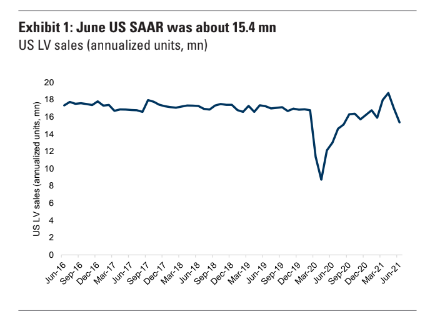
June's US seasonally adjusted annualized rate for light vehicle sales collapsed sequentially from May to June, falling to 15.4 million as low inventory levels at dealers constrained sales.
Despite the sequential drop from May, where the SAAR was about 17 million, June's number still marks a high teens percentage gain year-over-year, thanks to easy comps due to Covid.
Goldman Sachs said in a note out this week that June's SAAR was below their estimates of 15.5 million to 16 million. The number also fell below Bloomberg's 16.5 million estimate and StreetAccount's estimate of 16.1 million.
Vehicle sales were up 22% year over year in June, Goldman noted, while pickup and SUV sales were up about 16% and 15%, respectively. Analyst Mark Delaney told clients that "pickups and SUVs as a percent of total units remained at a similar mix from the year prior at 19% and 53%, respectively" and that Goldman believed "consumer demand for SUVs and pickups remains strong, and Ford and GM are prioritizing production of larger vehicles."
EV sales in June were up about 148% year over year and hybrid sales were up about 56%.
Delaney attributed the growth in EV sales to "the increasing popularity of electric and hybrid powertrains, as well as a soft yoy compare as some states where EVs are more popular had stringent shelter-in-place restrictions in June 2020."
Even as sales rose, incentive spending for vehicle was down 33% year over year and 11% sequentially, indicating that pricing could remain firm in coming months, leaving dealerships and automakers levers to pull to spur demand, if necessary.
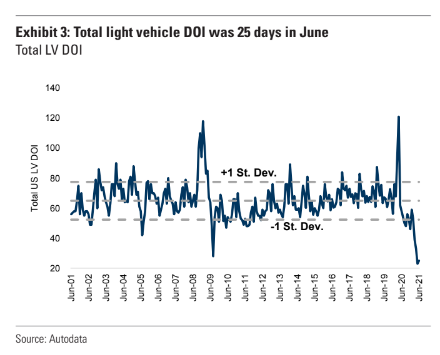
Most notably, inventory on a unit basis fell to 1.3 million in June from 1.4 million in May, Goldman noted. That number stood at 2.6 million in June 2020.
"Inventories remain at historically low levels, and we continue to believe it will take time for inventory at dealers to return to normalized levels given the strong demand for vehicles coupled with ongoing supply chain challenges (particularly with semiconductor chip shortages, but also due to shipping constraints)," Delaney concluded.