FT : Fracking groups fear Truss reforms fall short of industry’s revival

Fracking groups fear Truss reforms fall short of industry’s revival
Companies welcome lifting of moratorium but warn further rule changes needed for projects to be viable

Fracking companies have warned that Liz Truss’s lifting of a moratorium on the controversial method of shale gas extraction will not resurrect the industry in England without rapid reform of planning and seismicity rules.

The new UK prime minister on Thursday ended a ban on fracking in England that has been in place since 2019, as part of wide-ranging reforms to bolster Britain’s domestic energy supplies and address soaring bills for households and businesses.

Truss claimed the decision “could get gas flowing in as soon as six months”, although she acknowledged that the resumption of fracking in England would also be dependent on “where there is local support for it”.

While fracking companies, including Australian-owned Cuadrilla and Britain’s largest privately owned company Ineos, welcomed the reversal, industry insiders warned that other rules would also need to be tackled if the government wants to kick-start production.

Ross Glover, development director at Aim-listed fracking company IGas Energy, told the Financial Times that streamlining rules around planning and permitting would be crucial.

“Development of any form of infrastructure” in the UK faces a lengthy planning and permitting process, Glover argued. “We are not saying get rid of all the regulation, what we are saying is we need to have a proper discussion about how we accelerate the projects.”

IGas shares have surged more than 650 per cent this year, partly on the back of investor anticipation of a reversal of the fracking moratorium.


Shale gas companies have also long called for a review of seismicity regulations, known as the “traffic light system”, that require an immediate halt to work if fracking triggers earth tremors of magnitude 0.5 or above.

Charles McAllister, director of policy at UKOOG, a trade body that represents frackers, warned that if the industry does “not get the comprehensive policy support required, then some of the companies may not progress” their shale projects.

UKOOG is asking for the fracking industry to be subject to the same standards on surface vibrations that apply to other industries.

“We are asking to be treated fairly in terms of . . . earthquake regulations. We would want to be treated in line with construction, geothermal, quarrying and [the] coal mining industry,” McAllister said. “Our view is, the industry has been demonised in the context of wider regulation on seismicity and surface vibration.”

Brian Mullin, head of planning consultancy Marrons Planning, suggested community consent may also need to be removed from fracking consenting processes “as it demonstrably amounts to a moratorium for delivery”.

Ineos, which has offered to drill a shale gas test well to prove to the government that “we can do [fracking] safely and without harm to the environment”, has raised the prospect of payments to local communities to gain support.

“We have promised to invest the first 6 per cent of the value of the gas back into the local communities,” Ineos director Tom Crotty said on Thursday.


Hydraulic fracturing, or fracking, involves pumping water, sand and chemicals under the ground at high pressure to release gas from rock formations. It has transformed the US energy sector, but some leading academics have long argued Britain’s geology is ill suited to the process, even if community consent in such a densely populated country could be achieved.

“[The] geological history of the UK is complicated,” said Stuart Haszeldine, professor at the school of geosciences at the University of Edinburgh.

Truss’s energy reforms are also aimed at unleashing a new wave of exploration among UK North Sea companies, although sceptics argue that any increase in the region’s output is likely to have a minimal impact on sky-high oil and gas prices.

Truss will greenlight the first oil and gas licensing round since 2019-20 as the government seeks to arrest declines in UK oil and gas production.

The UK’s annual North Sea oil and gas output dropped 17 per cent last year. Although gas production has improved 27 per cent year on year in the first half of 2022, energy companies have cautioned that the reversal will prove “shortlived” unless there is a new wave of investment.

The new permits will be for mature areas of the UK North Sea, meaning any companies that successfully drill new wells can take advantage of existing infrastructure rather than installing costly new pipelines.

The UK oil and gas regulator, the North Sea Transition Authority, will prioritise an initial package of fast-track licences that contain existing discoveries, which companies could potentially exploit in less than a year, although the remaining permits could take between five and 10 years to yield any production.

Officials are also seeking to accelerate projects that are already in the development stages so they can reach production faster.

The government is particularly keen for Equinor to progress its Rosebank oil and gasfield 130 kilometres off the cost of the Shetland Islands, according to people familiar with officials’ thinking.

Rosebank is among the largest in a pipeline of projects slated to receive government and company approval in 2022 and 2023. Another of the biggest, Shell’s Jackdaw gas scheme, received a green light in June.

Equinor has so far said it will take a final investment decision on Rosebank in 2023.

Yvonne Telford, senior analyst for north-west Europe at the consultancy Westwood Global Energy Group, said exploration and production companies did have the “appetite” to proceed with developments.

But she warned that “production volumes from the larger developments such as Shell’s Jackdaw and Equinor’s Rosebank fields will not be seen until 2026 and 2027”.

FT : Netflix partners with Ubisoft to bolster fledgling gaming division

Netflix partners with Ubisoft to bolster fledgling gaming division
Streaming giant will launch three new mobile games next year based on French company’s popular hits

Netflix has teamed up with Ubisoft, one of Europe’s biggest video game companies, as the streaming giant seeks to bolster its fledgling gaming business.

The California-based streaming service will launch three new mobile games next year based on Ubisoft’s games, including its most successful title Assassin’s Creed.

The move comes as Netflix attempts to accelerate growth of its new gaming arm amid a slowdown in the company’s streaming business. The streaming group has lost more than half of its market value since April when it revealed its decade-long subscriber growth had ended.

The partnership will entail the French gaming group developing the mobile games for Netflix. This will also include a game based on Ubisoft’s Mighty Quest, a castle-building and monster-looting game, and the historical puzzle adventure game called Valiant Hearts.

The games will be made available exclusively to Netflix subscribers, with no ads or in-app purchases, allowing Ubisoft to tap into new audiences and experiment with fresh formats for existing titles. No details of the deal value have been announced.

Netflix entered the gaming sector last year, hiring a number of high-profile executives, as it joined the world’s largest technology companies in trying to grab a slice of the most valuable portion of the entertainment industry.

Big Tech groups including Amazon, Facebook-owner Meta, Google and Apple have all stepped up their investments in video games in recent years, vying to become the “Netflix of gaming”.

Netflix has launched 28 games and acquired three gaming studios, including Night School Studio, which makes the supernatural adventure game Oxenfree, and Texas-based Boss Fight Entertainment. In March, it bought Next Games, the Finnish developer behind mobile games based on its hit show Stranger Things.

However, the company has struggled to quickly convert a big chunk of its roughly 220mn subscribers into regular gamers. There are about 1.9mn daily active users of Netflix’s mobile games, according to market intelligence firm Apptopia, and they have been installed 28mn times. By contrast, King, a popular games publisher that makes Candy Crush, has roughly 30mn daily active users.

Leanne Loombe, head of external games at Netflix, said the streaming company is still “very committed to games” but is at an experimentation stage, working out which styles and genres resonate most with its subscribers.

“Whoever our members are we want to make sure there’s a game on there for them,” she said, adding that in the future “we are going to start to focus more on Netflix IP” as “that’s what we have a superpower in”.

The streaming giant plans to have a total of 50 games on its roster by the end of the year.

But its push comes during a wider slowdown in the gaming sector, with console producers, video game publishers and gaming chipmakers reporting weakening sales and engagement in recent months. Last week, US tech group Snap, which owns social media group Snapchat, said it was putting its gaming plans on hold.

Loombe said the company was not perturbed by a recent slide in gaming engagement, particularly in mobile, noting that “people are still playing games . . . so there’s still a huge opportunity for us”.

“You need a few hours to watch a TV series or films but you only need five minutes to play a game on your commute,” she added.

(ZH) Americans Love The NFL, But Change Is Looming

Americans Love The NFL, But Change Is Looming

While Baseball is often referred to as “America’s favorite pastime”, the NFL has long surpassed the MLB as the nation’s favorite professional sports league.
As Statista's Felix Richter notes, for several reasons, including first and foremost its better suitability for television, football flew by baseball as Americans’ favorite sport to watch in the 1960s and hasn’t looked back since. In recent years, baseball has even been surpassed by basketball, as younger audiences prefer the action-packed, star-studded NBA over what many young viewers consider the dragging affair of a three-hour baseball game.
You will find more infographics at Statista
According to findings from Statista's Global Consumer Survey, the NFL remains the number 1 among major professional sports leagues in the U.S., at least for now. While 52 percent of self-declared sports fans follow the National Football League, compared to 42 percent for the NBA and 31 percent who follow the MLB, looking at the youngest group of respondents reveals a worrying trend for NFL executives.
Among 16- to 25-year-olds, the NFL only plays second fiddle to the NBA, with just 33 percent of young sports fans following the league. The NBA reaches 40 percent of Gen X fans, who are overall less likely to follow any professional sports leagues than their older compatriots.

>>> Weekend Papers Summary

Weekend Papers Summary

NEW YORK TIMES
-First speech as King of Britain caps day of remembrance: King Charles III’s speech, coming one day after Queen Elizabeth II’s death, emphasized the continuity of governance in Britain’s constitutional monarchy.
-The UK now enters a mourning period that continues until after the queen’s funeral.
-New offensive seems to have caught Russian forces off guard. Sweeping south from positions in Ukraine’s northeast, Ukrainian forces have made their largest gains since routing Russia from Kyiv in April. Ukrainian and Western officials warned that the operations were in their early days and that the situation was fluid.
-Justice Dept. and Trump lawyers clash over special master’s qualifications. The two sides had diverging views of who could serve as an independent arbiter to sift through the files seized from former President Trump’s home.
-Navy orders high-level outside investigation of SEAL course. The punishing selection course for the Navy’s most elite force is under new scrutiny after a sailor’s death exposed physical abuse and other problems.
-Yeshiva University can bar LGBT Club for now, Justice rules: Sonia Sotomayor’s ruling will be in place pending a decision by the Supreme Court to take up the case.
-In New Hampshire, a MAGA rivalry is splitting House Republicans. Two young conservatives are battling for the mantle of Trumpism in a congressional primary that could help decide the House majority.
-First Kansas, Now Michigan and beyond as abortion ballot measures spread. Democrats are hoping ballot measures on abortion rights will drive up voter turnout. They’re looking to Michigan as a test run.
-Gov. Hochul declares polio state of emergency for New York. The virus has now been detected in a Nassau County wastewater sample, officials said.
-After legal fight, Oberlin says it will pay $36.59M to Gibson’s Bakery. The latter said the liberal arts college in Ohio had falsely accused it of racism after a Black student was caught shoplifting.
-Marc Lewitinn, Covid patient, dies after 850 days on a ventilator. While no definitive statistics exist, doctors say Mr. Lewitinn was likely the longest-surviving intubated Covid patient. He was 76.

THE FINANCIAL TIMES
-Charles III has addressed his nation for the first time, vowing to emulate his late mother Queen Elizabeth’s “life-long service”, ahead of his formal proclamation as king on Saturday.
-“We are at war,” Emmanuel Macron said on Monday as he outlined the emergency measures France was taking to shore up its energy supply and shelter its citizens and business from soaring costs. For months following Russia’s full-scale invasion of Ukraine, the president of France, aspired to act as intermediary and peacemaker between Kyiv and Moscow. This week he and fellow European leaders became belligerents in a sharply escalating energy conflict between Russia and the west. It was time, Macron said, for a “general mobilization”.
-The US is threatening to impose sanctions on buyers of Russian oil that rely on western services and fail to abide by the price cap proposed by G7 countries, as the Biden administration vows to strictly enforce the policy once it takes effect.
-Europe’s energy ministers have signaled support for a temporary cap on the price of gas imports including those from Russia and a windfall levy on energy producers to address “astronomical” costs for businesses and consumers.
-Josh Harris, the billionaire private equity executive who left Apollo Global Management last year after a messy succession battle, is returning to the investment industry with a firm that aims to be a contender in financial markets including private equity, credit and insurance.
-UK Prime Minister Liz Truss has been accused of carrying out an “ideological purge” of top civil servants after she approved the sacking of Sir Tom Scholar, the experienced permanent secretary at the Treasury, on her first day in the job. Whitehall insiders fear that Scholar’s dismissal on Tuesday will have a chilling effect on the civil service and make it less likely that officials will speak “truth to power”.
-FTX Ventures, the investment firm led by billionaire Sam Bankman-Fried, will buy a 30 per cent stake in the fund of ex-Trump aide Anthony Scaramucci, as he continues his mission to try to bolster the struggling cryptocurrency market.
-India imposed controls on exports of several varieties of rice on Friday, in a move likely to affect the global market for one of the most commonly eaten staple foods as commodity prices surge following Russia’s invasion of Ukraine. The country — the world’s leading exporter of rice, accounting for about 40% of the global trade — imposed a 20% duty on unmilled white rice, husked brown rice and semi-milled or wholly-milled rice. The restrictions do not apply to basmati rice, India’s best-known variety of the grain.
-Investors and analysts expect sterling and UK government bond prices to weaken further as the country issues billions of pounds in debt to fund Prime Minister Liz Truss’s new energy package.
-Solar power generation reached a new record in the EU over the summer months as supplies from gas, hydropower and nuclear were all squeezed during the energy crisis.
Sunny weather across the continent and a boost in solar installations contributed to the record generation, which was 28 per cent higher than the previous summer, according to research from Ember, the UK environmental think-tank.

NY POST
Tensions were too high for Meghan Markle to join the royal family at Balmoral after Queen Elizabeth II’s death, insiders say. Members of the family, including Prince William, the new heir to the throne, dashed to the monarch’s bedside Thursday.
-Gov. Kathy Hochul had New Yorkers pay twice as much for COVID tests from a company tied to nearly $300,000 in donations to her campaign compared to other state vendors, a new report details, raising fresh concerns of alleged pay-to-play behavior ahead of the Nov. 8 election.
-A suspected ransomware attack on Holiday Inn has crippled the hotel giant’s ability to book reservations online, resulting in sharp occupancy drops that have sparked legal threats from franchisees, The Post has learned. InterContinental Hotels Group, which owns Holiday Inn as well as 15 other brands including Crowne Plaza, said hackers breached its systems on Monday, forcing it to shut down its online reservation booking portal.

>>> Barron’s Weekend Summary

Barron’s Weekend Summary: For those who believe in Bitcoin, El Salvador looks like a crypto paradise.


Cover Story:
-For those who believe in Bitcoin, El Salvador looks like a crypto paradise. It’s one of the few places in the world where you can use Bitcoin to buy a Coke or cerveza on the beach. In theory, you can pay rent in Bitcoin, buy a house, pay off a credit card, or send a payment to a Mayan pottery vendor in the local market. Yet El Salvador is far from a crypto lover’s dream. Instead, it has turned into a cautionary tale of what happens when a country adopts a cryptocurrency, tries to weave it into its economy, and rebrands itself as a tech-friendly haven: It isn’t working as advertised.

Interview:
-Joseph Wang, a former trader on the Fed’s open-market desk and author of the Fed Guy blog and Central Banking 101 discusses the coming quantitative tightening. QT is as ambitious as its impact is uncertain. At full-throttle, the pace of balance-sheet tightening will be much more aggressive than in the past, and come at a time when interest rates are rising quickly. What could go wrong? Potentially, a lot, suggests Wang.

Tech Trader:
-Videogames have become the world’s most lucrative global entertainment medium, but the industry’s top players are unknown compared with film directors and TV show runners. Take Vince Zampella, who is responsible for the creation of three multibillion-dollar franchises, including the original Call of Duty and Modern Warfare, both of which are among the most successful games in history. Zampella also made Apex Legends as the head of Respawn, his independent studio that Electronic Arts EA +1.41% wisely acquired in 2017. Earlier this year, Electronic Arts announced that Apex had surpassed $2B in bookings.

The Trader:
-Traders prefer a volatile market, and they’ve gotten one in 2022. Stocks have declined, rallied, and dropped again, driven by ever-evolving expectations for interest rates and inflation, shifting recession odds, and the outlook for corporate earnings. About the only thing that has been reliable has been the technicals. This past week’s rally lifted the Dow Jones Industrial Average 2.7%, the Nasdaq Composite 4.1%, and the S&P 500 3.6%. That’s after all three saw declines of at least 3% during the prior week, their third straight losing week.
-IHS Holding is the new kid on the block in the cell-tower world—and its stock may be worth buying. Running a wireless network requires a multitude of antennas, cell towers, and the wires that connect them all. Profit margins are wide, recurring revenue is high, and future visibility is clear, given long-term contracts with annual escalators. In developed markets, recent growth has come from upgrading wireless networks to support 5G, which requires larger and heavier equipment that generates more rent, and more antennas to handle the wider range of wireless spectrum bands 5G requires.

Features:
-Queen Elizabeth II, who died Thursday at the age of 96, was Britain’s longest serving monarch. During her reign, British equities returned roughly 12% a year on average—in nominal terms—according to data from Credit Suisse. US stocks returned roughly 11% a year on average—again in nominal terms. (The US experienced lower inflation than the UK over the past 70 years.) The UK nominal numbers turn 100 pounds invested in the early 1950s into pounds worth roughly 300,000 today. That is quite a return that spans periods of war, currency devaluation, and labor unrest.
-The energy crunch in Europe escalated into a full-blown crisis this past week after Vladimir Putin cut off the pipeline that supplies a third of the natural gas that Russia sends to Europe. Natural-gas prices soared 30% at one point, and Goldman Sachs analysts projected that Europeans will see their monthly energy bills triple this winter to an average of EUR500, or almost $500, per family at the peak.

European Trader:
-Inflation is no problem for Evian. Evian, on sale since 1978 in the U.S., was one of the pioneers. Danone, its parent company, bottles it in the French Alps on the south shore of Lake Geneva and sends it all over the world. Sales of Danone’s water products rose 7.7% in the first half, just as inflation was accelerating to the fastest rate in 40 years. That was a big part of Danone’s overall increase of 7.4% in like-for-like sales. Danone also boasts a range of dairy and plant-based products, such as Activia and Actimel yogurts, Delight coffee creamer, and the Silk soy-milk line. It sells a range of baby foods, including Aptamil formula, where its biggest market is China.

Emerging Markets:
-Chile, with 19 million inhabitants, is the world’s dominant copper producer, boasting a third of global output, and No. 2 in lithium. The planet needs much more of both of these metals if EVs and renewable energy are going to save it. Demand for copper will double by 2035, S&P Global research predicts. Chileans’ landslide rejection of their new proposed constitution on Sep. 4 could make the race for supply easier.

Commodities:
Water has become a popular topic these days, given widespread drought conditions around the globe and the water crisis in Jackson, Miss. That doesn’t translate into an automatic win-win when it comes to investing in the sector. “While the megatrends of water continue to roil the headlines, the investment implications are more complicated,” says Deane Dray, managing director and multi-industry analyst at RBC Capital Markets.

Streetwise:
-Jack Hough presents the exciting topic of fertilizer arbitrage. Profits for North American fertilizer companies have exploded higher, and the reason has to do with the war in Ukraine, and a century-old manure workaround that today feeds the planet. Farming depends on reactive nitrogen compounds, like ammonia, made from nitrogen and hydrogen. Dung is filled with the stuff, luckily enough. But if we relied just on manure for fertilizer, the planet would only be able to support a population of maybe 4B, tops. On Nov. 15, we’re projected to hit 8B. Russia has shut off Europe’s natural-gas supply, and since gas isn’t easily shipped overseas, the price in Europe is many times the US price. Gas makes up about 75% of the cost of fertilizer, so European plants have simply shut down, leaving North American ones to supply the market.

The Epoch Times : US at Risk of Descent Into ‘Anarchy’ Amid Heightened Distrust

US at Risk of Descent Into ‘Anarchy’ Amid Heightened Distrust of DOJ, Law Enforcement, Expert Warns
By John Ransom

The United States is at risk of descending into “anarchy” amid escalating criticism of federal law enforcement entities in the wake of the FBI’s raid last month at former President Donald Trump’s Mar-a-Lago estate in Florida, a legal expert has warned.
The Department of Justice (DOJ), in response to claims of bias, on Aug. 30 banned all of its non-career political appointees from partisan events and other political activity.
“We must do all we can to maintain public trust and ensure that politics—both in fact and appearance—does not compromise or affect the integrity of our work,” Attorney General Merrick Garland said in a memo to DOJ employees.
Attorney Sandra Spurgeon, who has successfully litigated hundreds of state and federal cases, told The Epoch Times, “We are spiraling to anarchy, and we have to take the politics out of the positions by people of power within our legislative and executive branch.”
Spurgeon, who supports the DOJ ban, said that Garland had no choice but to do something to try to restore the public’s respect for law enforcement. She warned that the leadership of the DOJ and the FBI “live a very different life than you and I do.”
“They don’t think about the same things on the level that we would think of things because they have been elevated into a state where they have lost the appreciation of impartiality,” Spurgeon said about top government officials that are the focus of the ban.
“And quite frankly, they just don’t care.”
Public distrust of federal law enforcement agencies has trended to low levels, with 53 percent of voters agreeing with a statement that the FBI is “Joe Biden’s Gestapo,” according to an Aug. 15–16 survey by pollster Rasmussen. The survey of 1,000 U.S. likely voters also showed that 44 percent of respondents view the FBI less favorably since the Mar-a-Lago raid over documents the government alleges Trump doesn’t have permission to hold.
Overall, only 36 percent of likely voters disagree with the description of the FBI as a “Gestapo” that benefits President Joe Biden.
The DOJ directive also came a few days before a primetime TV speech in which Biden directed fiery political rhetoric against Trump-supporting Republicans. In the Sept. 1 speech given in the shadow of Philadelphia’s Liberty Hall, Biden warned against “MAGA Republicans” who “live not in the light of truth but in the shadow of lies.”
Out-of-Touch Behavior
Out-of-touch behavior by the so-called political class has led to the crisis that necessitated the DOJ ban, one former U.S. special agent told The Epoch Times.
One issue is that “a Biden appointee, the U.S. attorney for the state of Massachusetts [Rachael Rollins], showed up at a Joe Biden fundraising event where First Lady Jill Biden was appearing,” Eric Caron, who previously worked as an agent for the U.S. Treasury and for the Department of Homeland Security, said about the impetus for the attorney general’s directive.
“She even used a government vehicle” to get to the event, Caron added, all of which could be a violation of the Hatch Act ban on electioneering.
The electioneering claim is under investigation by the U.S. Office of Special Counsel, after the case was referred to the DOJ by Sen. Tom Cotton (R-Ark.) after Rollins, who was confirmed after a fractious process, showed up at the Biden fundraiser.
Politicization Claims
Others have wondered if the ban, as well as another DOJ memo issued on the same day reiterating a policy restricting communications with Congress, could be an attempt to intimidate so-called whistleblowers within the FBI and DOJ.
“Ever since we told you that FBI whistleblowers had begun contacting Members of Congress to report on political pressure from high-ranking FBI officials to falsely label some investigations and run interference on others to serve a political agenda,” noted former Trump attorney Jay Sekulow, the chief counsel at the American Center for Law and Justice. “Garland has been very busy trying to shut them down, and anyone else who might expose what’s going on.”
But even after discounting the possible partisan motives behind the moves, the gesture will be inadequate in regaining the trust and confidence of the American people, one critic says.
Under Garland, there have been a number of highly publicized cases that seem to indicate extreme politicization in the DOJ, Mike Davis of the Article III Project, which promotes constitutionalist judges and the rule of law, told The Epoch Times.
One such episode, according to Davis, involves an October 2021 memo by Garland foreshadowing “a series of measures designed to address the rise in criminal conduct directed toward school personnel.”
That memo came after the National School Boards Association, a key ally of the Democrats, wrote a letter to Biden, complaining that parents who showed up at school board meetings put school personnel “under an immediate threat” of violence. The association later apologized for the letter; Garland, later testifying at a House Judiciary Committee hearing, said that the DOJ hadn’t been told by the White House to issue the memo.
“Attorney General Garland’s ban on campaign activity for Justice Department political appointees is like placing a Band-Aid on a severed limb,” said Davis.
The move seemed desperate to Casey D. Thompson, assistant professor of legal studies at Tarleton State University.
“I will say that it could possibly be a last resort,” he told The Epoch Times in an email.
Spurgeon cautioned that the level of disrespect for our legal system and the damage that is being done daily to our court system, which is “vital to us as citizens to prevent a state of anarchy” is accelerating.
“I don’t believe we are in a state of anarchy yet, but the question must be, how do we ensure a level of transparency with our government, where ‘we the citizens’ have restored trust in those chosen to govern us in a bipartisan manner?” she said.
“I think American citizens will no longer accept being governed blindly and without accountability.”
Officials at DOJ didn’t respond by press time to a request by The Epoch Times for comment.

(ZH) Escobar: Germany's Energy Suicide - An Autopsy

Escobar: Germany's Energy Suicide - An Autopsy

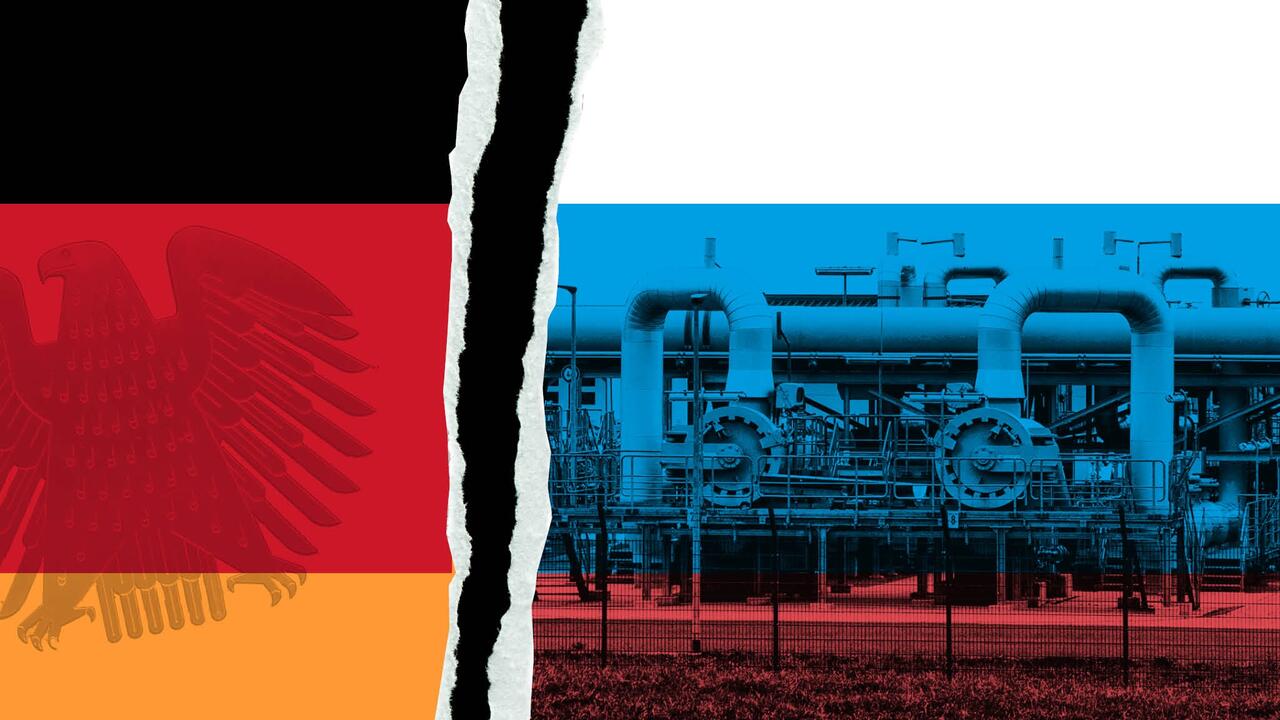
When Green fanatic Robert Habeck, posing as Germany’s Economy Minister, said earlier this week “we should expect the worst” in terms of energy security, he conveniently forgot to spell out how the whole farce is a Made in Germany cum Made in Brussels crisis.
Flickers of intelligence at least still glow in rare Western latitudes, as indispensable strategic analyst William Engdahl, author of A Century of Oil, released a sharp, concise summary revealing the skeletons in the glamour closet.
Everyone with a brain following the ghastly Eurocrat machinations in Brussels was aware of the main plot – yet hardly anyone among average EU citizens. Habeck, Chancellor “Liver Sausage” Scholz, the European Commission (EC) Green Energy VP Timmermans, EC dominatrix Ursula von der Leyen, they are all involved.
In a nutshell: as Engdahl describes it, this is about “the EU plan to de-industrialize one of the most energy-efficient industrial concentrations on the planet.”
That’s a practical translation of the UN Green Agenda 2030 – which happens to be metastasized into crypto Bond villain Klaus Schwab’s Great Reset – now renamed “Great Narrative”.
The whole scam started way back in the early 2000s: I remember it vividly, as Brussels used to be my European base in the early “war on terror” years.
At the time, the talk of the town was the “European energy policy”. The dirty secret of such policy is that the EC, “ advised” by JP MorganChase as well as the usual mega speculative hedge funds, went all out into what Engdahl describes as “a complete deregulation of the European market for natural gas.”
That was sold to the Lugenpresse (“lying media”) as “liberalization”. In practice, that’s savage, unregulated casino capitalism, with the “free” market fixing prices while dumping long-term contracts – such as the ones struck with Gazprom.
How to decarbonize and destabilize
The process was turbo-charged in 2016, when the last gasp of the Obama administration encouraged massive export of LNG out of the US’s huge shale gas production.
For that one needs to build LNG terminals. Each terminal takes as much as 5 years to build. Within the EU, Poland and Holland went for it from the start.
As much as Wall Street in the past invented a “ paper oil” speculative market, this time they went for a speculative “paper gas” market.
Engdahl details how “the EU Commission and their Green Deal agenda to ‘decarbonize’ the economy by 2050, eliminating oil, gas and coal fuels, provided the ideal trap that has led to the explosive spike in EU gas prices since 2021.”
The creation of this “single” market control implied forcing illegal rule changes on Gazprom. In practice, Big Finance and Big Energy – which totally control anything that passes for “EU policy” in Brussels – invented a new pricing system parallel to the long-term, stable prices of Russian pipeline gas.
By 2019, an avalanche of Eurocrat energy “ directives” by the EC – the only thing these people do – had established a totally deregulated gas market trading, setting the prices for natural gas in the EU even as Gazprom remained the largest supplier.
As lots of virtual trading hubs in gas futures contracts started popping up across the EU, enter the Dutch TTF (Title Transfer Facility). By 2020 the TTF was established as the real EU gas benchmark.
As Engdahl points out, “TTF is a virtual platform of trades in futures gas contracts between banks and other financial investors. Outside, of course, of any regulated exchange.
So LNG prices soon started to be set by futures trades in the TTF hub, which crucially happens to be owned by the Dutch government – “the same government destroying its farms for a fraudulent nitrogen pollution claim.”
By any means necessary Big Finance had to get rid of Gazprom as a reliable source to allow powerful financial interests behind the Green Deal racket to dominate the LNG market.
Engdahl evokes a case very few know about across Europe: “On May 12, 2022 although Gazprom deliveries to the Soyuz gas pipeline through Ukraine were uninterrupted for almost three months of conflict, despite Russia’s military operations in Ukraine, the NATO-controlled Zelensky regime in Kiev closed a major Russian pipeline through Lugansk, that was bringing Russian gas both to his Ukraine as well as EU states, declaring it would remain closed until Kiev gets full control of its pipeline system that runs through the two Donbass republics. That section of the Ukraine Soyuz line cut one-third of gas via Soyuz to the EU. It certainly did not help the EU economy at a time Kiev was begging for more weapons from those same NATO countries. Soyuz opened in 1980 under the Soviet Union bringing gas from the Orenburg gas field.”
Hybrid War, the energy chapter
On the interminable soap opera involving the Nord Stream 1 turbine, the crucial fact is that Canada deliberately refused to deliver the repaired turbine to Gazprom – its owner – but instead sent it to Siemens Germany, where it is now. Siemens Germany is essentially under American control. Both the German and Canadian governments refuse to grant a legally binding sanction exemption for the transfer to Russia.
That was the straw that broke the (Gazprom) camel’s back. Gazprom and the Kremlin concluded that if sabotage was the name of the game, they couldn’t care less whether Germany received zero gas via Nord Stream 1 (with brand new Nord Stream 2, ready to go, blocked by strictly political reasons).
Kremlin spokesman Dmity Peskov took pains to stress “problems in [gas] deliveries arose due to sanctions that have been imposed on our country and a number of companies by Western countries (…) There are no other reasons behind supply issues.”
Peskov had to remind anyone with a brain that it’s not Gazprom’s fault if “the Europeans (…) make a decision to refuse to service their equipment” which they are contractually obligated to do. The fact is the whole Nord Stream 1 operation hinges on “one piece of equipment that needs serious maintenance.”
Deputy Prime Minister Alexander Novak, who knows one or two things about the energy business, cleared up the technicalities:
“The entire problem lies precisely on [the EU’s] side, because all the conditions of the repair contract have been completely violated, along with the terms of shipping of the equipment.”
All that is inscribed into what Deputy Foreign Minister Sergey Ryabkov describes as “a total war declared against us”, which is “being waged in hybrid forms, in all areas”, with “the degree of animosity of our opponents – of our enemies” being “enormous, extraordinary.”
So none of this has anything to do with “Putin weaponizing energy”. It was Berlin and Brussels – mere messengers of Big Finance – which weaponized the supply of European energy on behalf of a financial racket, and against the interests of European industry and consumers.
Beware of the toxic trio
Engdahl has summarized how, “by systematically sanctioning or closing gas deliveries from long-term, low cost pipelines to the EU, gas speculators via the Dutch TTP have been able to use every hiccup or energy shock in the world, whether a record drought in China or the conflict in Ukraine, to export restrictions in the USA, to bid the EU wholesale gas prices through all bounds.”
Translation: casino capitalism at its finest.
And it gets worse, when it comes to electricity. There is a so-called EU Electricity Market Reform in progress. According to it, producers of electricity – from solar or wind – automatically receive “the same price for their ‘renewable’ electricity they sell to the power companies for the grid as the highest cost, i.e. natural gas.” No wonder the cost of electricity in Germany for 2022 increased by 860% – and rising.
Baerbock incessantly parrots that German energy independence cannot be secured until the country is “liberated from fossil fuels.”
According to Green fanaticism, to build the Green Agenda it’s imperative to completely eliminate gas, oil and nuclear power, which happen to be the only reliable energy sources as it stands.
And it’s here that we see the toxic trio Habeck/Baerbock/von der Leyen ready for their close up. They pose as saviors of Europe preaching that the only way out is to invest fortunes in – unreliable – wind and solar power: the “answer” from Providence to a gas price debacle manufactured by none other than Big Finance, Green fanaticism and Eurocrat “leadership”.
Now tell that to struggling pan-European households whose bills will surge to a whopping, collective $2 trillion as General Winter knocks on the door.

(ZH) The "Scariest Paper Of 2022" Reveals The Terrifying Fate Of

The "Scariest Paper Of 2022" Reveals The Terrifying Fate Of Biden's Economy: Millions Are About To Lose Their Job

For much of the past year (and certainly at the time, more than a year ago, when the so-called experts, central bankers and macrotourists were still yapping about "transitory inflation" and other things they were wrong about and do not understand), we were warning that at some point the Fed will realize that it is simply impossible to contain supply-driven inflation through stubborn rate hikes which instead would lead to a dire alternative - millions in mass layoffs and newly unemployed workers ...
... and will revise its 2% inflation target higher, a move which will send every risk asset - from high-beta trash and meme stonks, to blue-chip icons, to bitcoin and cryptos limit up.
To remind readers of this coming phase shift, we most recently warned in June that "at some point Fed will concede it has no control over supply. That's when we will start getting leaks of raising the inflation target"...
Well, it turns out that we were right, and not just about the coming mass layoffs, but also about the inflation target leaks. But first, lets back up a bit.
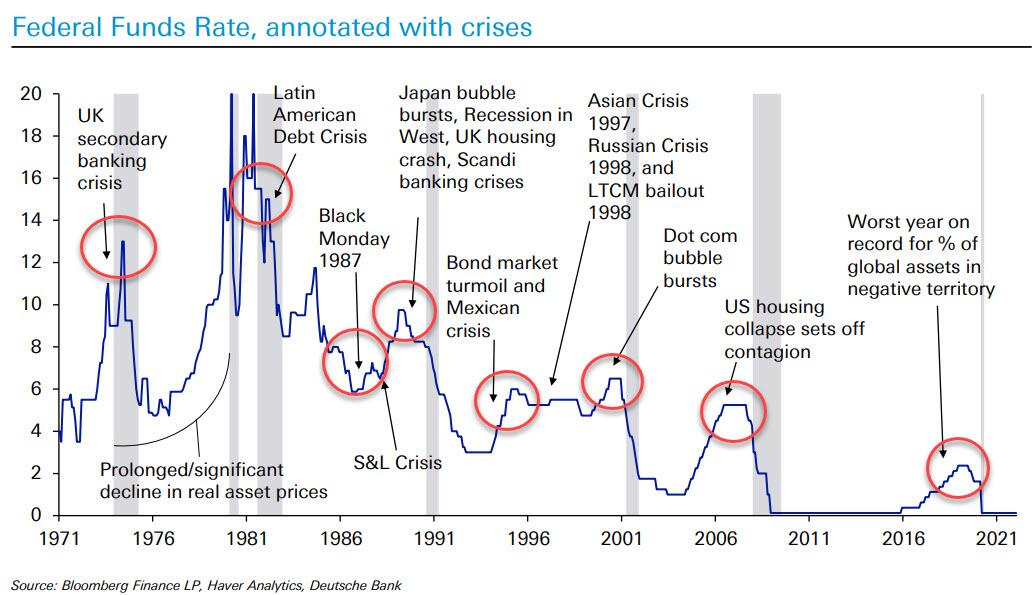
A little over one year after nobody expected the Fed would be hiking rates like a drunken sailor until some time in late 2023 or 2024, it has now become fashionable to not only predict that the Fed will keep hiking rates at every FOMC meeting and at the fastest pace since the near-hyperinflation of the 1980s, but that the central bank will somehow manage to avoid a hard landing (i.e., the hiking cycle won't end in a recession or depression), even though every single Fed tightening cycle since 1913 has ended in disaster.
An example of this was the statement by former Fed vice chair (and PIMCO's "twice-revolving door") Rich Clarida, who told CNBC that "failure is not an option for Jay Powell," adding that "I think they're going to 4% hell or high water. Until inflation comes down a lot, the Fed is really a single mandate central bank."
Of course, if one could hike rates in a vacuum that could work - after all, Clarida himself, who admits he got this year's soaring inflation dead wrong when he was still a daytrading god and part oft he Fed in 2021, said that the Fed may as well have just one mandate, namely to tame inflation. But what so few seem to recall is that the Fed is "hiking to spark a recession", or as CNBC's Steve Liesman put it, there is no such thing as "immaculate rate hikes" meaning that rate hikes have dire tradeoffs in other sectors of the economy. In other words, if the Fed's intention is to spark a recession, it will spark a recession... leading to millions of Americans losing their jobs, something which even Elizabeth Warren appears to have grasped.
Yet due to the recency bias of Biden's trillions in stimmies, and a world where workers - whether working form home or the office - have virtually all the leverage, few today can conceive of a world where inflation is zero or negative and is instead replaced with millions in unemployed workers, an outcome which one could (or rather should) say is even worse for the ruling democrats than roaring inflation. At least, with runaway prices, most people have a job and their wages are rising (at least nominally, if not in real terms).
However, the higher rates rise, the closer we get to that inevitable moment when the BLS - unable to kick the can any longer - admits what has been obvious to so many for months: the US is facing a labor crisis of epic proportions with millions and millions of mass layoffs. And for those to whom it is not yet obvious, we urge to read a WSJ op-ed published by none other than Jason Furman, who is not some crackpot republican but Obama's own top Economic Adviser from 2013-2017 and currently economic policy professor at Harvard.
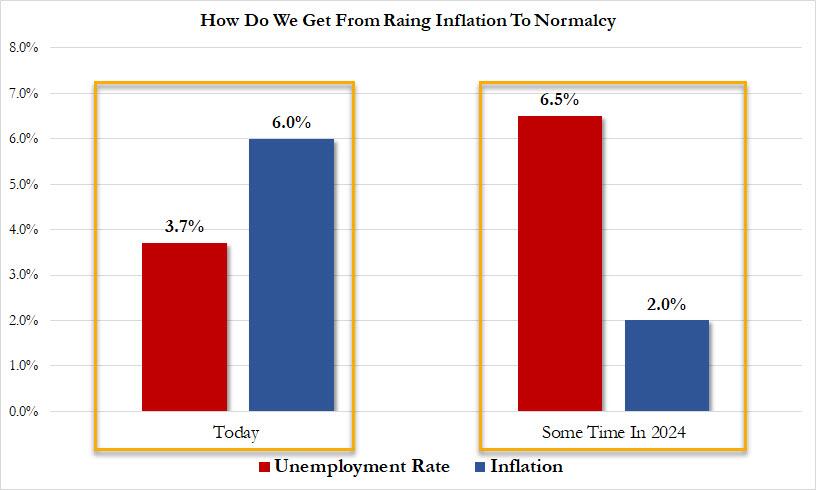
In "Inflation and the Scariest Economics Paper of 2022", Furman summarizes a paper written by Johns Hopkins macroeconomist Larry Ball with co-authors Daniel Leigh and Prachi Mishra of the International Monetary Fund released by the Brookings Papers on Economic Activity, whose conclusion is as follows: "To bring price increases down to 2%, we may need to tolerate unemployment of 6.5% for two years."
In other words, just as we said, inflation - much of which is supply-driven, which the Fed can do nothing about - will force the Fed to crush the economy by keeping rates for much longer, the result of which will be many millions in unemployed workers, or as Furman puts it, the paper "shows why the Federal Reserve will likely need to maintain its war on inflation, even if unemployment continues to rise."
What is more remarkable about Furman's read of the economist paper is that in addition to its primary theme (the lack of labor slack, or labor tightness, is responsible for some 3.4% of underlying inflation in July 2022), the paper admits precisely what we have been saying all along - that the Fed can't control supply-side variables:
The paper also argues, convincingly in my view, for a different measure of underlying inflation. Fluctuations in energy and food prices are generally due to factors outside the control of macroeconomic policy makers. Geopolitics and weather have elevated the inflation rate in recent years. Plunging gasoline prices are temporarily lowering the inflation rate now. That’s why economists since the 1970s have focused on “core” inflation, which excludes food and energy.
But food and energy aren’t the only things people buy that are subject to supply-side volatility. Prices of new and used cars, for example, have gyrated over the past two years for reasons that are mostly unrelated to the strength of the overall economy. Both regular and core inflation are based on taking averages of price increases and can be distorted by large changes in outlier categories. The median inflation rate calculated by the Federal Reserve Bank of Cleveland drops outliers to remove these distortions.
According to Furman, median inflation - which is a statistically better measure of the underlying inflation that policy makers can actually control - is well above the Fed’s preferred headline inflation print (which fell to zero in July on a sequential basis and has stabilize) and shows no sign of moderating and has run at a 6.6% annual rate in the last three months.
But the "scariest" part of the new paper, Furman reveals, is when the authors use their model to forecast the unemployment rate that would be needed to bring inflation down to the Fed’s 2% target. He explains why this is so scary:
The authors present a range of scenarios, so I ran their model using my own assumptions... Under these assumptions, which are more optimistic than the authors’ midpoint scenario, if the unemployment rate follows the Federal Open Market Committee’s median economic projection from June that the unemployment will rise to only 4.1%, then the inflation rate will still be about 4% at the end of 2025. To get the inflation rate to the Fed’s target of 2% by then would require an average unemployment rate of about 6.5% in 2023 and 2024.
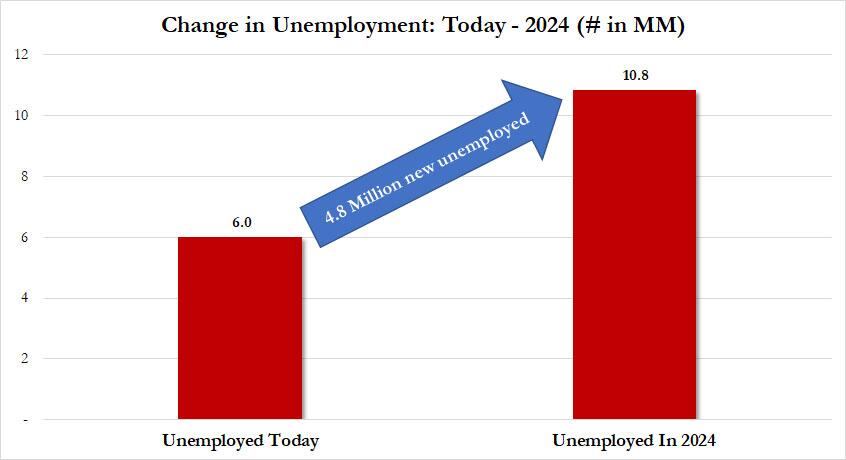
Where is unemployment now: it's 3.7% (6.014 million unemployed workers vs 164.746 million civilian labor force). This matters, because according to one of the most erudite economist Democrats, by the end of the Biden admin in 2024, the unemployment will have to soar to 6.5% for inflation to plunge to the Fed's historical target of 2.0%
What does this mean in absolute numbers? Assuming a modest increase in the US labor force, a 6.5% unemployment rate in 2024 would translate into no less than 10.8 million unemployed workers, an 80% increase from the 6 million today!
Still think that politicians - and especially Democrats - will sit quietly and blindly ignore how high the Fed is hiking rates if it means that to normalize inflation back to 2% it means nearly doubling the number of unemployed Americans (and a crushing recession to boot). Spoiler alert: no, they won't, and this may be one of the very rare occasions when Elizabeth Warren is actually right to worry about what the coming mass layoff wave means for Democrats... and the 2024 presidential election.
So what should the Fed do? Well, according to Furman, the Fed has four options:
  1. First, place more emphasis on the ratio of job openings to unemployment and median inflation as it assesses the tightness of labor markets and the underlying rate of inflation.
  2. Second, the new paper shows how much easier it will be to tackle inflation if expectations remain under control. The Fed should follow up on Chairman Jerome Powell’s tough talk at Jackson Hole with meaningful action such as a 75-basis-point increase at the next meeting.
  3. Third, be prepared to accept the unemployment rate rising above 5% if inflation is still out of control.
While we doubt #3 is actionable, what is more remarkable is Furman's final proposal: it's the one that, like the Dude's proverbial rug, ties the room together and sets the stage for what is coming:
Finally, stabilizing at a 3% inflation rate is probably healthier for the economy than stabilizing at 2%—so while fighting inflation should be the central bank’s only focus today, at some point the Fed should reassess the meaning of victory in that struggle.
And just in case his WSJ proves too complicated for some mainstream experts and economists, here it is in truncated, twitter format:
And there you have it: remember what we said on June 21: "At some point Fed will concede it has no control over supply. That's when we will start getting leaks of raising the inflation target." Well... there it is.
And while mainstream economists and the market may require quite a few months to grasp what is coming, it is the only way out of a crisis of commodities - as Zoltan has repeatedly and correctly put it - and which central banks have no control over, and thus will have to move not only the goalposts but the entire football field to avoid a social revolt or something even scarier.
While we wait, we can't help but snicker at what the 79-year-old figurehead in the White House tweeted today...
... because what Biden calls "the strongest economic recovery in recent history" is - even according to Democrats - about to be the biggest economic disaster in modern history.

Barrons : El Salvador’s Lonely Bitcoin Experiment: ‘It’s Either the Biggest Fail

El Salvador’s Lonely Bitcoin Experiment: ‘It’s Either the Biggest Failure or the Biggest Con.’

For those who believe in Bitcoin, El Salvador looks like a crypto paradise. It’s one of the few places in the world where you can use Bitcoin to buy a Coke or cerveza on the beach. In theory, you can pay rent in Bitcoin, buy a house, pay off a credit card, or send a payment to a Mayan pottery vendor in the local market.

Yet El Salvador is far from a crypto lover’s dream. Instead, it has turned into a cautionary tale of what happens when a country adopts a cryptocurrency, tries to weave it into its economy, and rebrands itself as a tech-friendly haven: It isn’t working as advertised.

Barron’s visited El Salvador to gauge BitcoinBTCUSD +0.14% ’s impact a year after the country passed a law that established the crypto as a legal currency. El Salvador made history when its 41-year-old president, Nayib Bukele, signed the Bitcoin Law last September, becoming the first country to fully legalize the crypto for domestic use. Banks, businesses, and merchants of all sizes have since been required to accept it, alongside the country’s other official currency, the U.S. dollar.

By almost all measures, Bitcoin appears to be doing more harm than good. The government has plowed scarce resources into the crypto and related projects, its fiscal health has deteriorated as Bitcoin crashed, and hardly anyone uses it outside a few pockets in the capital and crypto-friendly beach spot.

“The Bitcoin experiment is working as well as one might have expected—which is not too well,” says economist Eswar Prasad, professor of trade policy at Cornell University.

The crypto collapse hasn’t helped. Losing more than 70% since last November, Bitcoin has shed about $1.5 trillion in value, wiping out many investors and fueling a selloff in the broader crypto market. Along the way, it has drawn the wrath of governments, notably China, that have come to view it as a subversive threat to their monetary control and a profligate consumer of electricity due to the steep energy toll of crypto “mining.”

In El Salvador, the crypto still has its boosters, notably Bukele, a Twitter-loving millennial who heralded it as an economic savior. “We must break with the paradigms of the past,” he said when announcing the Bitcoin Law. “El Salvador has the right to move toward the first world.”

One year later, critics say, Bitcoin has been little more than a distraction from deep-seated economic problems and a mechanism for Bukele’s increasingly authoritarian rule. Indeed, it has been a divisive force, causing street protests and fear of reprisals to anyone who criticizes it—including residents of a fishing village who may be forcibly relocated by a government-backed “Bitcoin City.”

“It’s either the biggest failure or the biggest con,” said Claudia Ortiz, an opposition member of congress in El Salvador and one of the dwindling opponents of Bukele.

Bitcoin’s Bad Timing
On a macro level, the country’s embrace of Bitcoin has taken a toll. Bukele inherited a highly indebted nation when he won the presidency in 2019. The situation worsened as the pandemic hit and the government ramped up spending. Debt grew from 71% of gross domestic product in 2020 to 85% at the end of 2021.

As the debt load rose, Bukele started buying Bitcoin and legalized the crypto, complicating the country’s financial profile with creditors and pushing up its sovereign bond yields. A lack of hard currency is now raising alarms over two $800 million government bonds, maturing in January 2023 and 2025. The country had raised only $560 million to repay bondholders as of July, according to finance minister Alejandro Zelaya, who acknowledged that repaying the entire debt would be “almost impossible.”

The 2023 bond trades at 90 cents on the dollar with a 37% yield to maturity. The 2025 bond trades at 51 cents, yielding 39%. Both reflect market skepticism about the country’s debt profile and make it prohibitively expensive to issue more bonds.

Former government officials see more fiscal trouble ahead. “With international markets closed, I don’t see how it’s possible for the country to pay upcoming bonds with the resources of the domestic market,” says Carlos Acevedo, a former president of El Salvador’s Central Bank and now an independent consultant and economist.

Confidence in Bukele spending the government’s revenue wisely is also being undermined by his crypto plans. They have included doling out at least $250 million on “digital infrastructure,” according to estimates from opposition leaders. Those funds have gone to things like a government-backed digital wallet—distributed to adult citizens and preloaded with a $30 bonus in Bitcoin. The money also went to setting up more than 200 Bitcoin ATMs, and a $150 million “Bitcoin trust” to ensure convertibility between the crypto and the dollar.

Bukele widened the fiscal hole. While the government refuses to disclose its Bitcoin holdings or spending, Bukele’s tweets indicate that he bought 2,381 Bitcoins for the treasury, costing about $107 million. As prices slid, Bukele repeatedly tweeted that he “bought the dip.” The strategy appears to have lost tens of millions of dollars, based on falling prices for the crypto and Bukele’s tweets.

That isn’t fatal for a country with an $8 billion annual budget. But it has rankled opponents. “This is like gambling with the public money of a poor and indebted country,” said Ortiz. “A country that needs those resources now can’t afford to wait for them to gain value in an undetermined amount of time,” she said at her office, a small space tucked away in the congressional building, grouped with other Bukele opponents.

Turning El Salvador into a Bitcoin ATM has also rattled lenders like the International Monetary Fund. The government applied for a loan package from the IMF in 2020 and was negotiating a $1.3 billion agreement when Bukele signed the Bitcoin Law. Talks have broken down, partly due to the IMF’s concerns about the crypto’s destabilizing effect. “A program with the IMF would have to address all major economic vulnerabilities,” the fund said in a statement to Barron’s. “These include those related to the adoption of Bitcoin as legal tender.”

Bukele appears intent on turning the country into a global hub for Bitcoiners—from miners to crypto tourists. This past November—when the crypto was trading at peak prices around $68,000—he unveiled plans to issue Bitcoin-backed bonds, designed to fund the construction of an oceanside “Bitcoin City” nestled at the base of the Conchagua volcano. The city will be a tax haven for crypto investors, free of income, property, and procurement taxes, Bukele said. The country also aims to lure crypto miners—who use huge amounts of electricity to process transactions—by generating geothermal electricity from the volcano.

Yet the bonds, scheduled to be issued this past March, have been postponed. The country is doing some crypto mining—partially powered by geothermal energy from a pre-existing plant. But development of a volcano-powered Bitcoin City is nowhere in sight in the tropical forest. The volcano isn’t even a viable geothermal reservoir, says Carlos Martinez, an electrical engineer who works at the University of El Salvador.

Bukele’s promise of using Bitcoin to bank the unbanked and catapult the country into the digital era remains unfulfilled. Beyond a few pockets on the coast, a tiny sliver of people are using crypto—no surprise, perhaps, in a country where even apps like PayPal PYPL +0.06% ’s Venmo service aren’t widespread. More than four million people downloaded the wallet, called Chivo—Salvadoran slang for cool. A $30 bonus preloaded in Bitcoin was no doubt enticing in a country where the minimum wage is $13 a day.

Yet only 20% of Salvadorans used the app after spending the bonus, according to one recent study. Nearly 92% of small and medium-size businesses said Bitcoin has been immaterial for them. “Bitcoin is absolutely irrelevant for the country,” says Luis Membreño, a Salvadoran economist and critic of the Bitcoin Law, who lives in exile out of fear of government persecution.

The country continues to grapple with gangs, poverty, and rising unemployment. If Bitcoin is having an impact, critics say, it’s within a parallel world of crypto-tourists, techies, and well-connected elites.

Bukele declined interview requests, and a government spokesperson declined to make any officials available for this article.

A Bitcoin Surfer’s Paradise
To see Bitcoin in action, it helps to hit the beach. Specifically, El Zonte, an area that has been nicknamed “Bitcoin Beach” by crypto enthusiasts because it’s one of the few places where the crypto is readily accepted.

There, you might meet Wilfredo Urias, a 28-year-old surfer who started his own surfing school, in part thanks to profits he made from trading Bitcoin. Urias bought his first $100 of Bitcoin in 2020, promptly turned it into $500 as prices soared and then continued to trade and profit, eventually making enough to buy 12 surfboards and hire instructors—some who want to get paid in the crypto. Bitcoin has been “very beneficial” for El Zonte, he said, as an ocean breeze ruffled his hair and surfers dotted the black sand beach.

Urias’ story isn’t representative of much of the country. Few merchants or stores that Barron’s encountered were equipped with the QR code readers necessary to process a transaction. Nor do they see much reason to go through the hassle.

“Tourists don’t shop; they just come to sight-see,” said a vendor in a local market, explaining why she didn’t take Bitcoin as a payment.

Some vendors say they lost sales because of hacks in the digital wallets. A beach vendor selling baskets in El Zonte said he had been locked out of his wallet due to a hacking alert and couldn’t access the funds or take more Bitcoin payments. “It’s better to keep using cash than virtual money,” he said. “I’m not getting into that again.”

Bitcoin complicates even 1980s technology, like using an ATM. Bitcoin ATMs convert a traditional currency into Bitcoin, stored in a digital wallet. But they are slow; it took six hours for a $20 Bitcoin deposit to show up in our Chivo wallet. A government subsidy covered the transaction fee, usually steep at a Bitcoin ATM. When we tried to buy snacks, however, the money was nearly useless; only three merchants out of 10 that we met would accept payment in Bitcoin.

There is some crypto development in the capital. Companies that have set up shop include Strike, Bitrefill, and Binance. At a weekly meetup of Bitcoiners in a swanky bar, attendees swapped ideas for apps and exchanged tips for obtaining residency permits, buying property, or investing.

“If you’re somebody who has Bitcoin and fiat money, you’re in these worlds that don’t mix. Here, the two worlds have merged,” said Dallas Rushing, a California-based app developer, visiting as a crypto tourist.

Bitcoin investors are interested in buying property, said William Velasco, co-founder of a real estate brokerage. “We’ve noticed an influx of foreigners from nationalities that we never thought would invest here,” he said.

Nonprofits, meanwhile, are trying to teach students to use crypto. A nonprofit called My First Bitcoin holds classes across the country. Bitcoin could propel the country into the digital economy, said Napoleón Osorio, an instructor who had just returned from a class on Bitcoin at a school in Apaneca, a rural town in the coffee-bean-growing highlands. But foisting the crypto on the population was akin to a “technological coup,” he added, and it will take much education, time, and technological investment to catch on.

Outside of crypto circles, Bitcoin has scant discernible impact. On a recent Friday in the town of Conchagua, where the future “Bitcoin City” is planned, street vendors were setting up shop, milling around, and swatting flies while waiting for the shopping crowd. Few could conjecture what the future city would look like. Even fewer were familiar with how to use Bitcoin.

Local officials aren’t sure what to make of “Bitcoin City.” Oscar Parada, the mayor of the neighboring city of La Unión, said he doesn’t know when or where the development would start, adding that carving out the infrastructure would be a challenge. Parada, a member of Bukele’s New Ideas party, said he hasn’t been focused on Bitcoin. “Right now, I don’t think it’s necessary, but medium or long term, it will be,” he said.

One community feeling the impact is La Criba, a poor fishing village near the Conchagua volcano that has also been targeted for development of the “Bitcoin City.” More than 50 families live there, making a humble living through fishing and agriculture. Residents are under pressure to sell their land—often at a steep discount—as developers look to transform the region into a crypto destination.

“We live on standby,” said Hugo Guevara, 61, a resident and community leader of La Criba. Guevara gestures at the small, rundown cement houses with aluminum roofs nestled between the sand and lush mangrove trees. “We live like this because we can’t build anything better, out of fear that we’ll be evicted tomorrow.”

The Promise of Digital Money
One could argue that El Salvador was never a great proving ground for Bitcoin. Internet penetration is just 50%, and commerce is largely conducted in cash or credit cards backed by hard dollars.

Bitcoin might have a better shot in countries without a stable currency or financial system, where hyperinflation can be corrosive and people fear for access to their savings. El Salvador has none of that. It has used the dollar as official currency since 2001, posing steep hurdles to any rival, let alone something as baffling as Bitcoin—a 13-year-old set of software rules with no intrinsic value, existing solely as code on computers worldwide.

As for whether more countries follow in El Salvador’s path—the great hope of Bitcoin lovers—that is looking less likely. The Central African Republic made Bitcoin legal currency in April, but the country’s top court is putting up roadblocks to its use.

Opposition to Bitcoin from organizations such as the IMF, the World Bank, and international bond markets will likely deter other governments. Crypto also remains a conduit for money-laundering and evading government sanctions. And the environmental toll of mining—spewing out country-size carbon emissions each year—makes it controversial for any country, especially as other types of crypto have moved beyond Bitcoin’s energy-intensive system for processing transactions.

Even if Bitcoin were more stable, traceable, and eco-friendly, its technology wasn’t designed to scale up for an entire country. Its blockchain handles seven transactions per second, compared with 24,000 for Visa’s card network. An add-on “Lightning” network can process Bitcoin transactions faster, but that adds more complexity to the system, and it doesn’t address the high underlying fees and congestion on the original blockchain, where all transactions are recorded.

“There’s a cautionary tale here about the inability of Bitcoin to meet the needs of even a tiny country,” said David Yermack, a finance professor at New York University.

None of this should be viewed as an indictment of digital money or peer-to-peer transactions through apps. In Kenya, a mobile app allows people to deposit traditional currency on accounts stored on cellphones and transferred via text messages. For international remittances, or money transfers, a central bank digital currency, or CBDC, could cut fees compared with commercial services like Western Union. That would have big benefits in countries like El Salvador where a quarter of gross domestic product comes from remittances.

Indeed, the future of tokenized money is far more likely to be a CBDC or stablecoin—privately issued tokens backed, in most cases, by a hard currency like the dollar. China is well on its way to tokenizing its currency. In the Bahamas, the “sand dollar,” a digital version of its currency, can be loaded on a smartphone app and used at resorts or anywhere cash is taken. The U.S. is studying CBDCs, along with dozens of other countries.

Perhaps the best outcome of El Salvador’s Bitcoin experiment may be its failure. “If the law had been successful, Bitcoin’s drop would have been a catastrophe,” said Acevedo, the former central banker. “The Bitcoin Law’s failure has saved us.”