(ZH) Greek Coast Guard Fired On Ship Off Turkish Coast, Turkey Says

Greek Coast Guard Fired On Ship Off Turkish Coast, Turkey Says

A mere days ago on Wednesday, Greece issued formal letters to NATO HQ, the EU, and UN warning that a Ukraine-style war is looming with Turkey. The two have long been locked in disputes over maritime rights, the status of Greece's Aegean islands, and repeat airspace violations.
On Saturday a dangerous live fire incident in the eastern Mediterranean has served to inflame tensions further, and displays how on the brink the two countries could be to entering an active conflict, which would be the second afflicting Europe. "Turkey said the Greek Coast Guard fired on a ship in international waters in the northern Aegean Sea, marking another potential escalation of tension between the NATO countries Saturday," Bloomberg reports.
Illustrative image: Hellenic Coast Guard
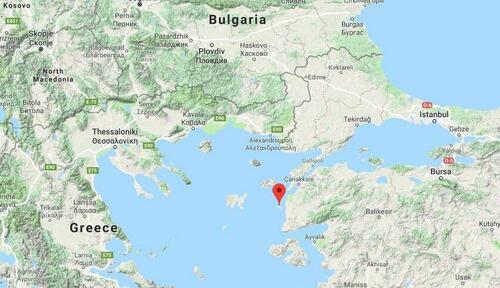
Turkish media is describing "harassment fire" which is alleged to have occurred a mere 11 nautical miles off Turkey’s southwestern island of Bozcaada, and 20km from the Turkish mainland. While the vessel was not a Turkey-flagged ship (if so, it likely would have triggered a Turkish military response), but has been identified as the Comoros-flagged vessel the Anatolian, Turkey's government is alarmed given it happened so close its coast.
While some initial reports have called the Anatolian vessel a cargo ship, some Turkish media reports are identifying it as a ro-ro ship, which ferries cars and passengers among islands - though in this case there haven't been reports that any passengers were on board other than the crew.
What's more is that Turkey's coast guard is claiming to have chased the Greek ships out of the area after the international vessel was "attacked":
The ship named "Anatolian,” which has a crew of 18 – six Egyptian, four Somalian, five Azerbaijani and three Turkish nationals – was attacked while sailing in international waters, Turkish Coast Guard Command further said in the statement.
After learning about the incident, the Turkish coast guard dispatched two boats and the Greek boats left the area.
None of the foreign ship's 18 international crew (again, which included Turkish nationals) have been reported injured. Athens is meanwhile describing the incident as a matter of exercising its territorial sovereignty and that the gunfire was only a "warning" - saying it won't bow to threats from Turkey.
Turkey state sources quickly published video purporting to show the moment the ship was fired upon:

The incident comes at a sensitive moment regarding ongoing Greece-Turkey disputes over islands near the coast, given Turkish President Recep Tayyip Erdogan has this month threatened his forces will intervene if Greece keeps "militarizing" islands which are under historic treaties.
But here is the Greek government's explanation of the Saturday live fire incident, according to Bloomberg:
The vessel wasn’t emitting a signal, according to a Greek shipping ministry official, so the Greek Coast Guard requested it stop to be boarded. The captain refused the control and sped off, prompting the Coast Guard to fire warning shots in the air and not at the vessel, said the official, requesting anonymity as details have not yet been made public.
The incident serves as a reminder that tensions continue to percolate in the region. Ahead of next year’s elections, Turkish President Recep Tayyip Erdogan has stepped up criticism of what Turkey calls a growing Greek military buildup on islands close to its coastline as well as Western military support to Athens, with which Ankara has long-running territorial disputes.
Greek Prime Minister Kyriakos Mitsotakis generally addressed the latest tensions at the Thessaloniki International Fair in northern Greece later on Saturday, saying Greece would not bow to threats.
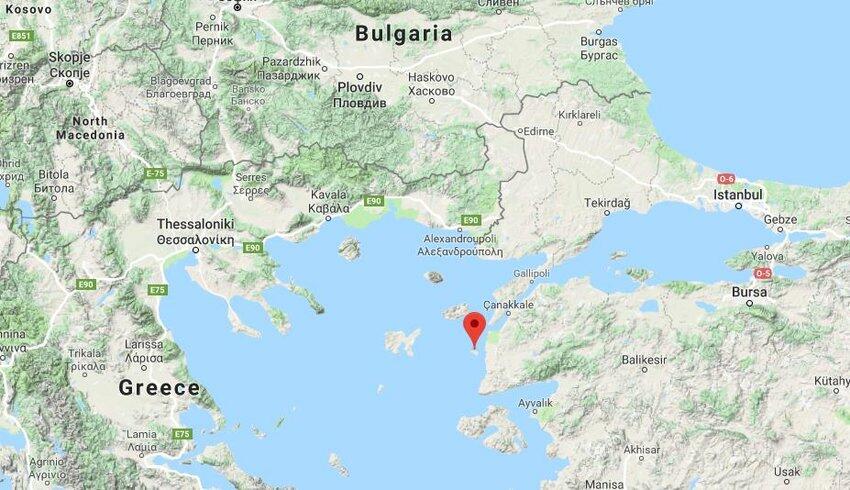
Location of Turkey's island of Bozcaada
Mitsotakis suggested this fresh incident is part of a broader narrative of Turkey concocting accusations of an unlawful interference, and as the latest in Ankara's "bullying" rhetoric.
Things really escalated starting a week ago when Erdogan warned Greece in a public speech, "We may come down suddenly one night," adding: "Look at history, if you go further, the price will be heavy."

>>> China plans three missions to the Moon after discovering a new lunar mineral

China plans three missions to the Moon after discovering a new lunar mineral that may be a future energy source

China aims to launch three moon missions over the next decade as part of its Chang'e lunar program.
China's National Space Administration won approval for the missions after it found a new mineral.
The mineral, Changesite-(Y), could be a future source of energy and was found in lunar samples.

China is aiming to launch three unmanned missions to the moon after discovering a new lunar mineral that could be an energy source in the future.

The space race between China and the US is accelerating after Beijing's National Space Administration got the go-ahead to launch three orbiters to the moon over the next 10 years, it announced on Saturday. The news was first reported by Bloomberg.

It comes a day after China became the third country to discover a new lunar mineral, which it called Changesite-(Y), according to Chinese state-controlled newspaper the Global Times.

China's Chang'e-5 mission retrieved samples from the moon in 2020 and it has been described by Global Times as a "phosphate mineral in columnar crystal" found in lunar rock particles. The mineral contains helium-3, which could be a future source of energy.

The discovery may put more pressure on the US to ramp up its efforts after its Artemis I moon mission was postponed for a second time.

Moon mining could be the next source of tension between the countries as NASA is also probing the moon's south pole where China plans to build a research station in conjunction with Russia.

China has accelerated its efforts in space exploration of late by building a space station, launching a number of missions to collect moon samples and putting a rover called Zhurong on Mars earlier this year to rival NASA.

The US remains the only country to put astronauts on the moon, with the last landing almost 50 years ago in the Apollo 17 mission, according to NASA's website.

The US Apollo 11 mission was the first to bring samples from another planet back to Earth in July 1969, with about 49 pounds (22 kilograms) of material from the moon's surface.

China's National Space Administration was contacted for comment.

Crunch Base : The Week’s 10 Biggest Funding Rounds: Verily Raises $1B; Web3’s My

The Week’s 10 Biggest Funding Rounds: Verily Raises $1B; Web3’s Mysten Labs Locks Up Huge Round
August was slow, but if the first full week of September is a harbinger, things may be picking up. Several U.S.-based startups saw large rounds this week, with the top nine companies on the list raising $100 million or more.
1. Verily, $1B, health care: Google and its parent, Alphabet, have been active health care investors—especially recently. This week continued that trend as Alphabet led a $1 billion investment in its former life sciences unit, Verily. Alphabet spun out what would become Verily as its own independent subsidiary in 2015. The South San Francisco-based firm—which introduced a Covid-19 testing program in 2020—has now raised more than $3.5 billion in capital, according to Crunchbase.

2. Mysten Labs, $300M, blockchain: In July, Palo Alto, California-based Web3 Layer 1 startup Aptos Labs closed a $150 million Series A led by FTX Ventures and Jump Crypto at a $2 billion valuation and made this list. Fast-forward to this week, and Palo Alto-based Web3 Layer 1 startup Mysten Labs closed a $300 million Series B at a more than $2 billion valuation led by FTX Ventures with Jump Crypto participating. Looks like it pays to be a Palo Alto, California-based Web3 Layer 1 company. Layer 1 system blockchain build their own blockchain—meaning it will not sit on Ethereum or another network, but be its own decentralized network. Mysten Labs has now raised $336 million, per Crunchbase data.

3. ArsenalBio, $220M, biotech: Battling cancer is big business. San Francisco-based ArsenalBio helped illustrate that with its $220 million Series B. The biotech startup specializes in cell therapy—where healthy, engineered human cells are transplanted into a patient whose body is too weak to fight disease—and is using the technique to battle a variety of cancers. The new round—the second-largest funding among cell therapy startups in 2022, per Crunchbase data—included investments by pharmaceutical company Bristol Meyers Squibb, along with biotech-focused Westlake Village BioPartners and SoftBank Vision Fund 2. Founded in 2019, ArsenalBio has raised $305 million, according to Crunchbase.

4. Muck Rack, $180M, public relations: I never knew my information was worth so much. Miami-based Muck Rack, which has put together a large database of info on journalists, closed a $180 million funding round—the company’s first since being founded in 2009. With the new round, Susquehanna Growth Equity is taking a minority stake in the company. In addition to distributing media information to marketers and public relations, Muck Rack offers other tools around media monitoring and reporting for PR pros.

5. Battle Motors, $150M, electric vehicles: New Philadelphia, Ohio-based commercial vehicle electrification startup Battle Motors raised a $150 million Series B from an unnamed “cornerstone global institutional investor.” The company, formerly Crane Carrier Co., provides electrified and natural gas trucks for the refuse and recycling markets. Battle Motors now has 750 municipal customers across the United States and Canada. Founded in 2021, the company previously closed a $120 million Series A last December.

6. VTS, $125M, real estate: New York-based real estate tech firm VTS closed a Series E of more than $125 million led by commercial real estate giant CBRE Group. The company, which started out as a leasing agent, now has a platform to help clients manage return-to-work operations after the pandemic. Founded in 2012, VTS has raised $462 million—per Crunchbase—including $150 million in debt financing in March.

7. (tied) Bitwarden, $100M, cybersecurity: Santa Barbara, California-based password manager Bitwarden announced a new $100 million growth round led by PSG. Founded in 2015, it’s the company’s first outside funding, per Crunchbase.

7. (tied) Cap Hill Brands, $100M, e-commerce: Seattle-based e-commerce aggregator Cap Hill Brands raised more than $100 million in a Series B round led by BlackRock. Founded in 2020, this is the company’s first disclosed amount of funding, according to Crunchbase.

7. (tied) True Food Kitchen, $100M, restaurant: Phoenix-based restaurant brand True Food Kitchen closed a funding round of more than $100 million, which included an investment from HumanCo.

10. Photys Therapeutics, $75M, biotech: Boston-based biotech firm Photys Therapeutics closed a $75 million Series A led by MPM Capital. It was the company’s first outside raise, per Crunchbase.


Big global deals
U.S. startups saw some big rounds, but the largest of the week went to a China-based space startup.
  • Satellite internet startup GalaxySpace raised approximately $1.59 billion in a huge Series D.

FT : European heavy industry steps up measures to deal with energy crisis

European heavy industry steps up measures to deal with energy crisis
Manufacturers idle output and look for alternative power supplies after Russia cuts off gas provision to the bloc

Some of Europe’s biggest energy users, from steel to chemical companies, are stepping up production cuts amid warnings that soaring prices and weak demand are rapidly eroding competitiveness.

Several steelmakers, including Europe’s largest, ArcelorMittal, have in recent days announced plans to idle some of their blast furnaces from the end of this month. ArcelorMittal’s German operations warned that the high costs were putting a “heavy strain” on its competitiveness. In Spain, Ferroglobe has temporarily shut two furnaces.

Miles Roberts, chief executive of FTSE 100 packaging company DS Smith, said businesses had to be prepared for energy to be rationed this winter.

“We are expecting there to be rationing across Europe, that’s what we’re preparing for. It may not happen, but we have to plan for that now,” he told the Financial Times.

The company, which relies on gas for up to 70 per cent of its energy usage, is combating high prices through hedging, diversifying its energy use and reducing consumption.

Russia’s decision this month to indefinitely cut off supplies through the critical Nord Stream 1 gas pipeline has intensified worries for manufacturers across Europe about an energy shortage this winter. At the same time, companies face lower demand from customers that are themselves struggling with higher operating costs. Russian gas supplies to the EU have been cut by approximately 80 per cent since the start of Russia’s invasion of Ukraine.

EU energy ministers on Friday backed a windfall tax on energy producers to help address costs for households and businesses.

Christian Kullmann, chief executive of Germany’s Evonik, a speciality chemicals company headquartered in Essen, said the country needed to keep its remaining nuclear power stations running.

“I am worried about a sharp recession in the winter . . . It will be necessary to keep running the three nuclear power plants,” he said. Manufacturers, he added, faced “an acute price crisis”. “We don’t yet have a supply crisis but there are warning signs”.

Evonik is substituting up to 40 per cent of natural gas at its domestic sites with liquefied petroleum gas. It is also continuing to operate a coal-fired power plant.

Chemicals group BASF said it had already reduced its gas demand since March, including by switching to alternative fuels such as oil where possible. The company said in a statement that it could continue to operate its large Ludwigshafen site with a reduced capacity if natural gas supply did not fall below “around 50 per cent of our maximum natural gas demand”.

Stefan Borgas, chief executive of RHI Magnesita, a FTSE 250 listed maker of refractory products — heat resistant materials used in linings typically found in steel mills — that operates four plants in Germany, said Europe had a “structural disadvantage in energy costs” compared with the rest of the world because of the Ukraine war as well as a “structural lack of investment in energy over the past 25 years”.

In the UK, where the government last week announced plans to subsidise energy supply, concerns about the scope and cost of support remain. Steve Hammell, chief financial officer of Sheffield Forgemasters, said he was worried about rationing.

“Rationing is a risk to us that we have to be mindful of,” he said, despite the company having been nationalised by the government last year. Sheffield, which makes forgings and casting for Britain’s nuclear submarines, had applied for an exemption from electricity rationing as a precaution given its work in defence, said Hammell. The company has implemented energy efficiency measures at its site in Yorkshire.

DS Smith’s Roberts said the company was looking to reduce energy consumption at its plants in the UK by 15 per cent — to match the EU’s reduction target.

“That’s purely a company issue, we’re saying we think it’s right that every part of our business works to reduce energy consumption. The fact the UK government isn’t asking for it is a bit irrelevant.”

FT : Richard Buxton says UK equities will struggle to attract investors back

Richard Buxton says UK equities will struggle to attract investors back
Fund manager is pessimistic that a tumbling pound and a renaissance for fossil fuels will reverse sell-off trend

A tumbling pound and a renaissance for the fossil fuel industry will not be enough to reverse a long-term trend and draw investors back to the UK stock market, according to a leading British fund manager.

Richard Buxton, an investment manager in UK equities at London-based Jupiter, said in an interview: “What could bring people back to major investing in the UK? I can’t hand on heart provide a heap of compelling answers.”

Investors have pulled £6.6bn from UK equities strategies this year, making 2022 already the biggest year of outflows in a decade, according to data from the Investment Association, a trade body. This outstrips the £4.8bn withdrawn in 2016, the year of the Brexit referendum. UK-focused funds have recorded net outflows every year since then.

Meanwhile UK government bonds and the pound have dropped on estimates that inflation could reach 20 per cent next year if energy prices remain high, and investors and analysts expect them to weaken further as the country issues billions of pounds in debt to fund prime minister Liz Truss’s £150bn energy package.

Buxton pointed to several long-term structural trends that have also turned investors off UK equities.

“The multiyear trend of let’s go global — which is a sneaky way of getting lots of US exposure, because the US has been so all-powerful — you don’t reverse that overnight,” he said.

He also highlighted the UK market’s bias towards cheap “value” stocks in sectors such as mining and energy, and the absence of fast-growing technology companies.

Until the Federal Reserve’s change of direction in November, growth stocks had been on the up for more than a decade, a prime beneficiary of central bank action to shore up the world economy against the financial crisis in 2008 and then the pandemic.

“The perception is that we’re a dull, boring stock market with no exciting go-go growth companies on ludicrous valuations,” said Buxton.

But this could stand UK investors in good stead in the current environment, he added, given that sectors like oil and mining tend to fare better than high growth stocks during periods of inflation.

An investment company managed by fund manager Ruffer said on Friday that its position in oil major BP, which rose 10 per cent during August, helped its equity exposure to outperform the wider indices that month.

“I actually think oil and mining is a wonderful place to hide in a commodities bull market and an equities bear market,” said Buxton. “It will take a three-year bear market crushing the Nasdaq before people say the trend of going global maybe wasn’t such a good idea.”

The FTSE 100 is one of the best-performing national stock indices this year, down just 2 per cent, while the S&P 500 in the US is down 15 per cent. The bulk of companies in the FTSE 100 earn revenues in dollars and other currencies that have gained against sterling, helping their bottom lines.

The Harvard Gazette : Dramatic rise in cancer in people under 50

Dramatic rise in cancer in people under 50

Altered microbiome, sleep deprivation, increase in alcohol consumption among possible culprits in 30-year global trend

Astudy by researchers from Brigham and Women’s Hospital reveals that the incidence of early onset cancers — including breast, colon, esophagus, kidney, liver, and pancreas — has dramatically increased around the world, with the rise beginning around 1990. In an effort to understand why many more people under 50 are being diagnosed with cancer, scientists conducted extensive analyses of available data, including information on early life exposures that might have contributed to the trend. Results are published in Nature Reviews Clinical Oncology.

“From our data, we observed something called the birth cohort effect. This effect shows that each successive group of people born at a later time — e.g., a decade later — have a higher risk of developing cancer later in life, likely due to risk factors they were exposed to at a young age,” said Shuji Ogino, a professor at Harvard Chan School and Harvard Medical School and a physician-scientist in the Department of Pathology at the Brigham. “We found that this risk is increasing with each generation. For instance, people born in 1960 experienced higher cancer risk before they turn 50 than people born in 1950, and we predict that this risk level will continue to climb in successive generations.”

Ogino worked with lead author Tomotaka Ugai and colleagues from 2000 to 2012 to analyze global data on 14 cancer types that showed increased incidence in adults before age 50. Then the team searched for available studies that examined trends of possible risk factors, including early life exposures in the general populations. Finally, the researchers examined the literature describing clinical and biological tumor characteristics of early onset cancers compared with cancers diagnosed after age 50.

In an extensive review, the team found that the early life “exposome,” which encompasses an individual’s diet, lifestyle, weight, environmental exposures, and microbiome, has changed substantially in the last several decades. They hypothesize that factors like the Western diet and lifestyle may be contributing to the rise in early onset cancer. The team acknowledged that this increased incidence of certain cancer types is, in part, due to early detection through cancer screening programs. They couldn’t precisely measure what proportion of this growing prevalence could solely be attributed to screening and early detection. However, they noted that increased incidence of many of the 14 cancer types is unlikely due to enhanced screening alone.

Possible risk factors for early onset cancer included alcohol consumption, sleep deprivation, smoking, obesity, and eating highly processed foods. Surprisingly, researchers found that while adult sleep duration hasn’t drastically changed over the several decades, children are getting far less sleep today than they were decades ago. Risk factors such as highly processed foods, sugary beverages, obesity, Type 2 diabetes, sedentary lifestyle, and alcohol consumption have all significantly increased since the 1950s.

“Among the 14 cancer types on the rise that we studied, eight were related to the digestive system. The food we eat feeds the microorganisms in our gut,” said Ugai. “Diet directly affects microbiome composition and eventually these changes can influence disease risk and outcomes.”

One limitation of this study is that researchers did not have an adequate amount of data from low- and middle-income countries to identify trends in cancer incidence over the decades. Going forward, Ogino and Ugai hope to continue this research by collecting more data and collaborating with international research institutes to better monitor global trends. They also explained the importance of conducting longitudinal cohort studies with parental consent to include young children who may be followed up for several decades.

“Without such studies, it’s difficult to identify what someone having cancer now did decades ago or when one was a child,” said Ugai. “Because of this challenge, we aim to run more longitudinal cohort studies in the future where we follow the same cohort of participants over the course of their lives, collecting health data, potentially from electronic health records, and biospecimens at set time points. This is not only more cost effective considering the many cancer types needed to be studied, but I believe it will yield us more accurate insights into cancer risk for generations to come.”

Ogino’s work is supported in part by the U.S. National Institutes of Health grants and the Cancer Research UK’s Cancer Grand Challenge Award. Ugai’s work is supported by grants from the Prevent Cancer Foundation, Japan Society for the Promotion of Science, and Mishima Kaiun Memorial Foundation.

FT : Electric vehicles will have to wait for the solid-state battery ‘game-chang

Electric vehicles will have to wait for the solid-state battery ‘game-changer’
Liquid-based lithium-ion will dominate for the next decade, says Prime Planet chief

Solid-state batteries, which have long carried hopes for turbocharging electric vehicle sales, will not be the “game-changer” the market expected, according to the head of one of the world’s largest car battery manufacturers.

Hiroaki Koda, who heads a joint battery venture between Toyota and Panasonic, told the Financial Times in an interview that new liquid-based lithium-ion batteries would be dominant for the next 10 years.

Prime Planet currently makes square lithium-ion batteries, half of which are used in Toyota’s hybrid and plug-in hybrid vehicles, while Panasonic supplies smaller cylindrical batteries to power Tesla’s electric vehicles.

“Solid-state batteries becoming a game-changer is still far away,” said Koda, president of Prime Planet Energy & Solutions and a former Toyota executive. “One reason is the difficulty in developing [solid-state batteries], and the other is the expanded potential of liquid lithium-ion batteries.”

In recent years, the development of solid-state batteries was heralded as the most promising technology to solve EV battery problems including charging time, capacity and the risk of catching fire and explosions.

Carmakers have poured money into developing solid-state batteries, which are lighter and safer than current electric vehicle batteries. Solid-state batteries replace a liquid electrolyte with a solid one and use lithium metal at the anode, instead of graphite as is standard in current lithium-ion batteries.

Honda will spend ¥43bn ($301mn) in 2024 at one of its research centres to operate a pilot production line, while Nissan says it plans to mass-produce the batteries by 2028. Volkswagen and Ford have invested in solid-state battery start-ups QuantumScape and Solid Power, respectively.

But they remain expensive and difficult to produce, forcing carmakers to push back their launch. Research company Strategy Analytics predicts that the deployment of solid-state batteries in electric vehicles will be delayed to 2030.

Toyota, which has more than 1,000 registered patents involving solid-state batteries, revealed a year ago that it wanted to start selling cars with the batteries before 2025 in hybrid models, but not electric ones.

Koda said Prime Planet had started developing the next generation of liquid-based lithium-ion batteries with Toyota and Panasonic. Prime Planet hopes to roll out the technology by as soon as 2025.

The Japanese joint venture, which launched in 2020, makes most of the batteries for hybrid vehicles but has a smaller presence for electric vehicles.

To better compete with bigger rivals like China’s CATL and South Korea’s LG Energy Solution, Koda has cut the cost of producing batteries by employing the manufacturing techniques he learned at Toyota.

“The key is shortening the processes leading up to the development and production of batteries,” Koda said, adding that this would allow the company to respond quicker to carmakers’ needs.

The cost savings are critical for battery makers to remain competitive because of the high cost of metals. Materials make up as much as 60 per cent of an EV battery’s cost and about half of that comes from natural resources such as lithium, according to Koda.

In April, the government said Japan would work to control 20 per cent of the global market for rechargeable batteries by increasing global output capacity at Japanese companies nearly 10-fold by 2030.

With the rise of Chinese and South Korean rivals, Japan’s global share for automotive lithium-ion batteries has halved to 20 per cent in 2020 from 40 per cent in 2015, according to the trade ministry.

To achieve that target, Koda said Prime Planet was working with Mitsubishi, Mitsui and other Japanese trading houses to secure lithium and other resources needed for batteries. It has also signed deals with companies such as Australia’s Ioneer and BHP.

FT : Disney boss rejects Dan Loeb’s calls to spin off ESPN

Disney boss rejects Dan Loeb’s calls to spin off ESPN
Bob Chapek vows to restore sports network to growth as media company previews coming attractions at D23 expo

Bob Chapek, Walt Disney chief executive, has rejected calls by activist investor Dan Loeb to sell or spin off the ESPN sports television network, vowing to restore the business to its onetime status as a growth engine of the company.

Loeb, whose Third Point hedge fund revealed in August that it had bought a $1bn stake in the company, called for ESPN to be spun off to reduce Disney’s debtload — just one element of a sweeping plan to shake up the media company.

In an interview with the FT, Chapek said Disney had been “deluged” with interest from companies seeking to buy ESPN earlier this year amid rumours that the company was weighing a sale of the cable network.

“If everyone wants to come in and buy it . . . I think that says something about its potential,” Chapek said. “I think its potential is within the Disney company.”

ESPN broadcasts live sports in the US, including games of the National Football League, National Basketball Association and Major League Baseball.

“We have a plan for it that will restore ESPN to its growth trajectory,” Chapek said. “When the rest of the world knows what our plans are they will be as confident about that proposition as we are.”

Chapek said he has “regular conversations” with Loeb, who also took a stake in Disney in 2020 that he sold early this year. He characterised the conversations as “very collaborative, non-antagonistic and collegial”, including around Loeb’s recommendations to change the composition of the Disney board.

He defended the board, saying that the average tenure is four years and has a broad “range of skillsets”.

But he added: “We’re so consistent with Dan’s thinking that everything he’s talked about are either things we have considered in the past or are considering for the future.”

Loeb has also called on Disney to purchase Comcast’s 33 per cent stake in the Hulu streaming service earlier than January 2024, when Disney has the option to purchase the remaining stake. Some analysts on Wall Street are also calling for Disney to settle the Hulu ownership soon.

Chapek said he would “love” to settle the matter sooner but that Comcast has seemed reluctant.

“We have talked to them numerous times over the past year-plus,” he said. “If that were in the cards we would love to do that, but it takes two to tango.” He noted that market sentiment has changed significantly since the agreement was struck, when investors were more bullish on streaming.

Chapek spoke on the sidelines of the annual D23 conference in Anaheim, California, where the company revealed its streaming and theatrical slate to thousands of Disney fans. Disney showed off trailers of two highly anticipated films coming this autumn, the Black Panther sequel Wakanda Forever and Avatar: The Way of Water.

It also previewed a run of original series on Disney Plus, including the Star Wars prequel Andor and the Marvel series Secret Invasion.

Chapek said the new slate represented the end of a Covid-induced production bottleneck. “This is our new steady state (of production),” he said, saying that both the pace of production and the size of its content budget — currently about $30bn — would remain level.

Disney has continued to add new customers to its streaming services this year, and by some measures its overall streaming operations have surpassed Netflix in subscribers. But Netflix’s revelation that it has lost more than 1mn subscribers this year has cast a pall over the entire streaming business, with investors growing concerned over high content spending and clamouring for a clear path to profitability.

Disney’s theme park business is also recovering strongly despite the closure of parks in China, analysts said. But shares are down 26.5 per cent this year, compared to a decline of 15.2 per cent for the S&P 500.

Chapek said Disney has “commercial momentum that is enviable” both in its content and theme parks businesses, but was suffering from investor “malaise” around streaming due to Netflix’s problems.

“For a long time we benefited from being just like Netflix because we were a streaming company,” he said. “It’s not unexpected that we would get painted with the same brush [but] we’re not the same company.”

FT : China makes more than $30bn in emergency loans

China makes more than $30bn in emergency loans
New data show Beijing emerging as formidable competitor of western-led IMF

China has doled out tens of billions of dollars in secretive “emergency loans” to countries at risk of financial crises in recent years, turning Beijing into a formidable competitor of the western-led IMF.

The bailouts represent a pivot from the huge infrastructure loans China has extended over nearly a decade as part of its $838bn Belt and Road Initiative, a programme that saw it eclipse the World Bank as the world’s biggest financer of public works.

Three of the largest recipients of China’s rescue lending have been Pakistan, Sri Lanka and Argentina, which together have received as much as $32.83bn since 2017, according to data compiled by AidData, a research lab at William & Mary, a university in the US. 

Other countries receiving rescue lending from Chinese state institutions included Kenya, Venezuela, Ecuador, Angola, Laos, Suriname, Belarus, Egypt, Mongolia and Ukraine, according to AidData, which did not provide details for these countries.

Such credit is aimed at enabling countries to keep up payments on foreign debt and to continue buying imports, warding off balance of payments (BoP) distress that can develop into full-blown storms such as the 1997 Asian crisis and the Latin American crisis of the 1980s. The IMF’s austere prescriptions in the aftermath of the Asian crisis were deeply unpopular, reinforcing a backlash against it that persists to this day.

Unlike the IMF, which announces the details of its credit lines, debt relief and restructuring programmes to debtor countries, China operates largely in secret. China’s financial institutions publish scant details of the credit it issues and Beijing does not predicate its lending on debt restructuring or economic reforms in recipient countries, analysts said. In most cases, the objective of China’s emergency lending is to prevent defaults on infrastructure loans extended under the Belt and Road Initiative, analysts said.

“Beijing has tried to keep these countries afloat by providing emergency loan after emergency loan without asking its borrowers to restore economic policy discipline or pursue debt relief through a co-ordinated restructuring process with all major creditors,” said Bradley Parks, executive director of AidData.

The AidData research lab maintains the world’s most comprehensive database on China’s global financing activities mostly by compiling data from countries that receive Chinese loans. The data set captures thousands of loans from more than 300 Chinese government institutions and state-owned entities across 165 low- and middle-income countries.

Parks added that China’s approach often “postpones the day of reckoning”. 

“When Beijing acts as an alternative lender of last resort and bails out a distressed sovereign without requiring economic policy discipline or pursuing a co-ordinated debt rescheduling with major creditors, it effectively kicks the can down the road and leaves it to others to solve the underlying solvency problem,” Parks said.

A study of the individual loans provided by Chinese financial institutions since 2017 to Pakistan, a key participant in the Belt and Road Initiative, shows a drip-feed of support in the form of loans from state-owned banks and SAFE, the agency that controls Beijing’s $3tn stash of foreign exchange reserves. 

The terms on such loans are far from concessionary, often building in a margin of about 3 per cent above benchmark funding costs. In addition to these loans, the People’s Bank of China, the central bank, has a currency swap agreement with its Pakistan counterpart that allows Islamabad to draw down funds when it needs them, the AidData records show. The PBoC has declined to comment.

Commentators said China’s rescue lending risked prolonging and exacerbating debt distress and the crises that often follow in debtor nations. “I see these as a major impediment to crisis resolution,” said Gabriel Sterne, head of EM macro at Oxford Economics and a former senior economist at the IMF.

As Sri Lanka’s current financial meltdown demonstrates, Beijing’s support is sometimes insufficient, analysts said. “The suspicion is that countries seek out the loan to avoid going to the IMF, which demands painful reform,” Sterne added. “There may be circumstances in which the gamble for redemption works, but generally — as in the Sri Lankan case — it just makes the adjustment more painful when it actually happens.”

Sean Cairncross, former chief executive of the Millennium Challenge Corporation, a US government foreign aid agency that provides grant funding on condition of democratic governance and economic transparency, said China’s loans were provided in pursuit of long-term aims in competition with rival powers.

“This isn’t about any particular loan or country . . . They want to have the ear of governments where raw materials are located, or large markets, or strategic ports, or where there is access to shipping lanes,” he said. “It is a way to narrow the strategic options for the US and for the west, in terms of access and influence globally.”