FT : Airlines/social distancing: flights of fancy

Airlines/social distancing: flights of fancy
In order to square restrictions with profitability, airlines would need to jack up ticket prices threefold

Michael O’Leary, Ryanair’s mouthy boss, put it best: social distancing on planes is idiotic.

That is of little consequence to frustrated holidaymakers and business travellers desperate to visit their villas in the south of France for the same cost as their trips last year.

Biomedically and financially, keeping middle seats empty in planes is up there with chocolate teapots. Suppose — wildly — that social distancing worked in a confined space and that rampant toddlers kept to their seats and everyone wiped down overhead luggage after every use. The two-metre restriction would mean losing more than middle seats; passengers could no longer be close to those behind or in front of them either. On some industry estimates that means emptying seven seats per passenger. 

Take a Boeing 747 with 345 seats. Assume it can keep all its first-class and half its business-class seats; slice six-sevenths of the remainder (14 + 26 + 40 = 80) and you get a plane that is three-quarters empty. Applying similar maths to one of Ryanair’s 189-seaters would fill say 35 seats, or one-fifth of the plane.


These numbers are far below the 70-75 per cent load factor Iata, the industry’s trade body, reckons airlines need to break even. Slashing payroll bills — even with the thousands of job cuts being announced almost daily — will not begin to cover a shortfall that wide. Six European airlines, including Virgin Atlantic and Lufthansa, have under five months of liquidity left, according to according to analysts at Redburn.

In order to square on-board social distancing with profitability, airlines would need to jack up ticket prices threefold. Thus a London-Dublin hop, now advertised at €23.46 on Ryanair, would need to rise to a far from discount €70; a British Airways London-Hong Kong return currently advertised at £551 would need to tip £1,600. Of course, the more prices rise, the fewer the passengers.

Horrid economics for airlines have always been with us. Warren Buffett, conceding his penchant for airline investments was misplaced, is a lagging indicator. When BA listed in 1987, after a torrid period fraught with losses and litigation, UK institutional investors were “unenthusiastic”. A government postmortem at the time sourly pointed the finger at “the tone of press comment which portrayed airlines as a riskier form of investment”.

As then, another round of severe restructuring is required. Some painful steps, such as mass job cuts and bankruptcies, have already begun. That will set the stage for a slow recovery — at least until the next crisis strikes.

Le Matin : LA CRISE VA PESER LONGTEMPS, SELON LE CHEF DE LA BNS

LA CRISE VA PESER LONGTEMPS, SELON LE CHEF DE LA BNS
Selon Thomas Jordan, le président de la Banque nationale suisse, l'économie suisse se trouve actuellement à 70-80% du niveau normal.

Les coûts de la crise liée au nouveau coronavirus vont peser sur la Suisse pendant des années, estime le président de la Banque nationale suisse (BNS). L'activité de l'économie suisse se trouve actuellement à 70-80% du niveau normal, rappelle-t-il.

«Il faut remonter à la crise pétrolière des années 1970 pour retrouver un tel effondrement de la croissance», précise Thomas Jordan dans un entretien diffusé par plusieurs médias du groupe de presse Tamedia. Le blocage du pays dû au confinement entraîne des coûts économiques «énormes», «qui sont de l'ordre de 11 à 17 milliards par mois», souligne-t-il.

La dette publique va augmenter et les coûts liés à l'assurance chômage et aux crédits accordés par le Conseil fédéral aux entreprises vont générer d'importants déficits publics en 2020, ajoute-t-il. «Il faudra s'assurer que l'activité économique pour maîtriser la dette».

Un déconfinement fait sens

Les mesures d'assouplissement du confinement sont très importantes dans ce contexte, selon lui. «Cela fait sens que ce déconfinement progressif débute maintenant». «On ne peut faire fi des coûts économiques dans l'équation du déconfinement, car nos systèmes éducatifs, de santé ou de retraite reposent sur la stabilité de notre économie». Il juge en outre que limiter le chômage est aussi «un élément essentiel pour le pays».

Thomas Jordan note aussi que l'offre de crédit aux entreprises est importante dans la situation actuelle. «C'est dans ce cadre-là que s'inscrit» l'action de la BNS dans la relance de l'économie.

Le patron de la banque centrale suisse rejette en revanche l'idée des Verts, qui veulent que la BNS reverse aux collectivités publiques jusqu'à 40 milliards de francs pour lutter contre la baisse des rentrées fiscales provoquée par le coronavirus.

Payer une telle somme «impliquerait que nous vendions une partie de nos positions en actions et obligations détenues en monnaies étrangères», souligne-t-il. «Pour transférer l'argent à la Confédération, nous devrions ensuite racheter du franc, qui se raffermirait alors, ce que veut justement éviter notre stratégie».

Interventions sur le marché

Les interventions de la BNS se sont accrues sur le marché des changes depuis le début de la pandémie, le franc suisse étant considéré comme une valeur refuge. «Nous avons acheté des montants substantiels de devises étrangères», précise Thomas Jordan.

Il ne considère toutefois pas une baisse des taux d'intérêt comme le meilleur outil actuellement. «Nous avons encore de la marge de manœuvre si nécessaire [...] nous nous concentrons aujourd'hui sur les interventions sur le marché des changes».

Thomas Jordan ne voit aucune alternative à la politique monétaire actuelle. «Ce n'est pas que nous soyons heureux des taux d'intérêt négatifs», mais «nous les relèverons dès que les circonstances le permettront». Pour l'instant, poursuit-il, le taux d'intérêt de -0,75% est nécessaire pour éviter des effets négatifs plus importants sur l'économie suisse.

Wash.Post : In the early days of the pandemic, the U.S. government turned down a

In the early days of the pandemic, the U.S. government turned down an offer to manufacture millions of N95 masks in America

It was Jan. 22, a day after the first case of covid-19 was detected in the United States, and orders were pouring into Michael Bowen’s company outside Fort Worth, some from as far away as Hong Kong.

Bowen’s medical supply company, Prestige Ameritech, could ramp up production to make an additional 1.7 million N95 masks a week. He viewed the shrinking domestic production of medical masks as a national security issue, though, and he wanted to give the federal government first dibs.

“We still have four like-new N95 manufacturing lines,” Bowen wrote that day in an email to top administrators in the Department of Health and Human Services. “Reactivating these machines would be very difficult and very expensive but could be achieved in a dire situation.”

But communications over several days with senior agency officials — including Robert Kadlec, the assistant secretary for preparedness and emergency response — left Bowen with the clear impression that there was little immediate interest in his offer.

“I don’t believe we as an government are anywhere near answering those questions for you yet,” Laura Wolf, director of the agency’s Division of Critical Infrastructure Protection, responded that same day.

Bowen persisted.

“We are the last major domestic mask company,” he wrote on Jan. 23. “My phones are ringing now, so I don’t ‘need’ government business. I’m just letting you know that I can help you preserve our infrastructure if things ever get really bad. I’m a patriot first, businessman second.”

In the end, the government did not take Bowen up on his offer. Even today, production lines that could be making more than 7 million masks a month sit dormant.

Bowen’s overture was described briefly in an 89-page whistleblower complaint filed this week by Rick Bright, former director of the Biomedical Advanced Research and Development Authority. Bright alleges he was retaliated against by Kadlec and other officials — including being reassigned to a lesser post — because he tried to “prioritize science and safety over political expediency.” HHS has disputed his allegations.

Emails show Bright pressed Kadlec and other agency leaders on the issue of mask shortages — and Bowen’s proposal specifically — to no avail. On Jan. 26, Bright wrote to a deputy that Bowen’s warnings “seem to be falling on deaf ears.”

That day, Bowen sent Bright a more direct warning.

“U.S. mask supply is at imminent risk,” he wrote. “Rick, I think we’re in deep s---,” he wrote a day later.

The story of Bowen’s offer illustrates a missed opportunity in the early days of the pandemic, one laid out in Bright’s whistleblower complaint, interviews with Bowen and emails provided by both men.

Within weeks, a shortage of masks was endangering health-care workers in hard-hit areas across the country, and the Trump administration was scrambling to buy more masks — sometimes placing bulk orders with third-party distributors for many times the standard price. President Trump came under pressure to use extraordinary government powers to force private industry to ramp up production.

In a statement, White House economic adviser and coronavirus task force member Peter Navarro said: “The company was just extremely difficult to work and communicate with. This was in sharp contrast to groups like the National Council of Textile Organizations and companies like Honeywell and Parkdale Mills, which have helped America very rapidly build up cost effective domestic mask capacity measuring in the hundreds of millions.”

Carol Danko, an HHS spokeswoman, declined to comment on the offer by Bowen and other allegations raised in the whistleblower complaint. Wolf also declined to comment on the whistleblower complaint.

A senior U.S. government official with knowledge of the offer said Bowen, 62, has a “legitimate beef.”

“He was prescient, really,” the official said, speaking on the condition of anonymity to describe internal deliberations. “But the reality is [HHS] didn’t have the money to do it at that time.”

Another HHS official, also speaking on the condition of anonymity, said: “There is a process for putting out contracts. It wasn’t as fast as anyone wanted it to be.”

A voice in the wilderness
Two decades ago, the low-slung factory in Texas was part of a supply conglomerate that produced almost 9 in 10 medical and surgical masks used in the United States.

Bowen was a new product specialist at the plant back then, and he watched as industry consolidations and outsourcing shifted control of the plant from Tecnol Medical Products to Kimberly-Clark and then shuttered it altogether. In less than a decade, almost 90 percent of all U.S. mask production had moved out of the country, according to government reports at the time.

Bowen and Dan Reese, a former executive at Tecnol, went into business together in 2005 and eventually bought the plant, believing a market remained for a dedicated domestic manufacturer of protective gear.

In the wake of the terrorist attacks of Sept. 11, 2001, Congress appropriated $6 billion to buy antidotes to bioweapons and the medical supplies the country would need in public health disasters. An obscure new government organization called the Biomedical Advanced Research and Development Authority, or BARDA, was among the agencies purchasing material for what would become the Strategic National Stockpile.

Bowen began studying BARDA, attending its industry conferences and searching for a way in to press his case.

In the parlance of BARDA, Bowen was seeking a “warm base” contract. The government would pay a premium to have masks manufactured domestically, but his company would keep its extra factory lines in working order, meaning production could be ramped up in an emergency.

Bowen said he soon concluded that BARDA’s focus was trained elsewhere, on billion-dollar deals to induce manufacturing of vaccines for the most exotic disasters, such as weaponized attacks with anthrax or smallpox.

Still, as Bowen moved down the supply chain, appealing directly to hospitals to buy his domestic-made masks, his sales pitch often ended with a plea to call BARDA.

Bowen often carried PowerPoint slides from a 2007 presentation by BARDA and its parent division at HHS, the Office of the Assistant Secretary for Preparedness and Response. One had a table showing that, in the event of a pandemic, the country would need 5.3 billion N95 respirator masks, 50 times more than the number in the stockpile. The presentation concluded: “Industrial surge capacity of [respiratory protection devices] will not be able to meet need and supplies will be short during a pandemic.”

Bowen said he felt like a voice in the wilderness.

“The world just looked at me as a mask salesman who was saying the sky was falling,” he said, “and they would say, ‘Your competitors aren’t saying that in China.’ ”

After Trump’s election, Bowen hoped the new president’s America-first mentality might trickle down to operations like his. He wrote a letter to Trump and addressed it to 1600 Pennsylvania Avenue: “90% of the United States protective mask supply is currently FOREIGN MADE!” it began.

“I didn’t think Trump would read it, but I thought someone would and take note,” Bowen said.

He also called Bright, who had been appointed to lead BARDA just before Trump took office. “In 14 years of doing this, there have been maybe four people in government who I felt like really understood this issue,” Bowen said. “Rick was one of them.”

In Trump’s first year, however, Bowen grew newly disillusioned. During a week that the White House touted its “Buy American, Hire American” initiative, Bowen lost a military contract worth up to $1 million, to a supplier that would make many of the masks in Mexico, he said.

“Shame on the Department of Defense! One of these days the US military will need America’s manufacturers to help win another war or fight another pandemic — and they will not exist,” Bowen wrote on Aug. 17, 2017, to Maj. Gen. Jeffrey Clark, a senior official with the Pentagon’s Defense Health Agency.

Clark, who retired last year, did not respond to a message seeking comment.

Proposal to produce goes nowhere
For Bowen, the first signs of trouble came in mid-January. Online orders through his company’s website, typically totaling maybe $2,000 a year and accounting for only a fraction of his business, suddenly skyrocketed to almost $700,000 in a few days.

On Jan. 20, Bowen also fielded a call from the Department of Homeland Security, urgently seeking masks for airport screeners. Bowen said he did not have masks in stock to fill the order, but the call led him to contact Bright to tell him about the surge in demand for masks. “Is this virus going to be problematic?” Bowen wrote.

Inside HHS, Bright quickly passed Bowen’s on-the-ground observations to a group that included Wolf, the director of the agency’s Division of Critical Infrastructure Protection.

“Can you please reach out to Mike Bowen below? He is a great partner and a really good source for helpful information,” Bright wrote on Jan. 21.

“Thanks Rick,” she replied. “We are tracking and have begun to coordinate with fda, niosh, and manufacturers today. More to follow tomorrow. Thinking about masks, gowns (inc those in shortage), gloves, and eye protection.”

Within a day, Bowen sent an email to Wolf laying out what Prestige could do. The company’s four mothballed manufacturing lines could be restarted with large noncancelable orders, he wrote.

“This is NOT something we would ever wish to do and have NO plans to do it on our own,” he wrote. “I’m simply letting you know that in a dire situation, it could be done.”

Over the next three days, Bowen kept HHS officials informed as orders for a million masks came in from intermediaries for buyers in China and Hong Kong. On Jan. 26, he sent the email warning that the U.S. mask supply was at “imminent risk.”

Bright forwarded it that day to Kadlec and others, urging action: “We have been watching and receiving warnings on this for over a week,” he wrote.

The next day, Bright wrote to his deputy asking him to explore whether BARDA could divert money earmarked for vaccines and other biodefense measures to instead buy masks.

From his end, Bowen said his proposal seemed to be going nowhere. “No one at HHS ever did get back to me in a substantive way,” Bowen said.

The senior U.S. official said Bowen’s idea was considered, but funding could not easily be obtained without diverting it from other projects.

Bowen started talking to reporters about the mask shortage in general terms. He was soon invited to appear on former Trump adviser Stephen K. Bannon’s podcast: “War Room: Pandemic.”

On the Feb. 12 podcast, the two commiserated over the beleaguered state of U.S. manufacturing. “What I’ve been saying since 2007 is, ‘Guys, I’m warning you, here’s what is going to happen, let’s prepare,’ ” Bowen said on the program. “Because if you call me after it starts, I can’t help everybody.”

Bowen said Bannon put him in touch with Navarro, the White House economic adviser.

Navarro was quick to see the problem, Bowen said. After talking with Navarro, Bowen wrote to Bright that he should soon expect a call from the White House, “I’m pretty sure that my mask supply message will be heard by President Trump this week,” Bowen wrote. “Trump insider reading yesterday’s Wired.com article, the ball is screaming toward your court.”

According to Bright’s complaint, he soon began attending White House meetings and helping Navarro write memos describing the supply of masks as a top issue. Emails and memos attached to the complaint show Bright reporting back to Kadlec and others about his work with Navarro.

None of it turned the tide for Bowen.

Nearly a month after his emailed offer, Bowen received his first formal communication about possibly helping to bolster the U.S. supply. The five-page form letter from the Food and Drug Administration — one Bowen said he suspected was sent to many manufacturers — asked how his company could help with what was by then a “national emergency response” to the shortage of protective gear.

Bowen responded on Feb. 16, by firing off a terse email to FDA and HHS officials. He directed the agencies to a U.S. government website listing approved foreign manufacturers of medical masks. “There you’ll find a long list of . . . approved Chinese respirator companies,” he wrote. “Please send your long list of questions to them.”

In March, Bowen submitted a bid to supply masks to the Federal Emergency Management Agency, which by then had taken over purchasing.

The government soon spent over $600 million on contracts involving masks. Big companies like Honeywell and 3M were each awarded contracts totaling for over $170 million for protective gear. One distributor of tactical gear — a company with no history of procuring medical equipment — was awarded a $55 million deal to provide masks for as much as $5.50 a piece, eight times what the government was paying months earlier.

On April 7, FEMA awarded Prestige a $9.5 million contract to provide a million N95 masks a month for one year, an order the company could fulfill without activating its dormant manufacturing lines. For the masks, Prestige charged the government 79 cents a piece.

(ZH) Something Odd Is Going On In Parking Lots Around The US

Something Odd Is Going On In Parking Lots Around The US

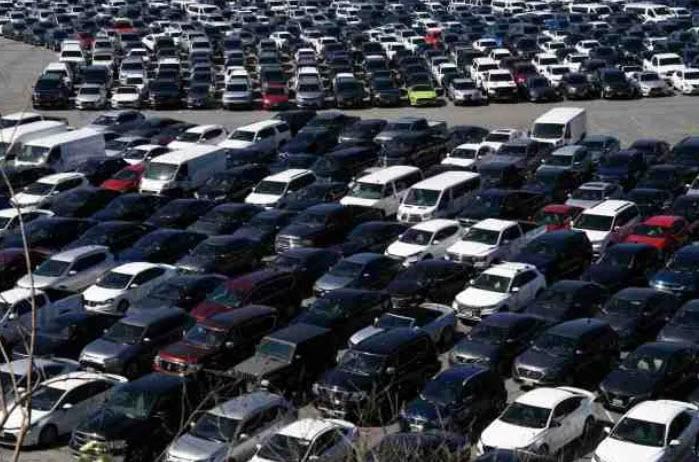
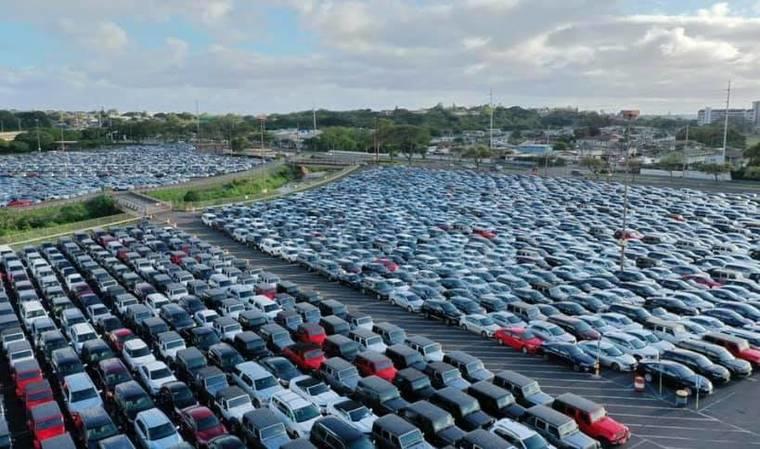
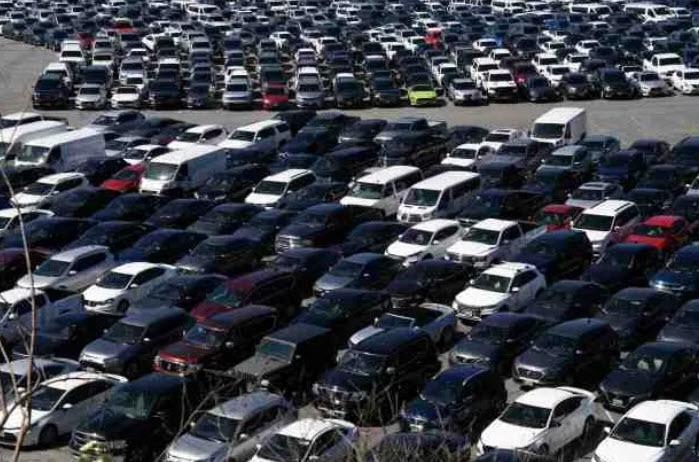
Over the last few weeks, we have been keeping a close eye on the growing glut of automobile inventory, exacerbated by demand falling off a cliff, plunging used car prices and rental car companies suffering from an unprecedented collapse in business (or, like Hertz, simply going bankrupt). To wit, just hours ago, we documented how declining fleet sales was having a profoundly negative impact on automakers. Previously, we pointed out how a crash in used car prices could be putting significant pressure on the rental car industry. And most notably, several days ago we also wrote that automakers were having so much trouble finding space for their unsellable inventory that ships bearing auto cargo from overseas were denied entry at US ports and sent back out into the ocean.
Now, we are seeing firsthand what buildups of inventory look like in major cities.
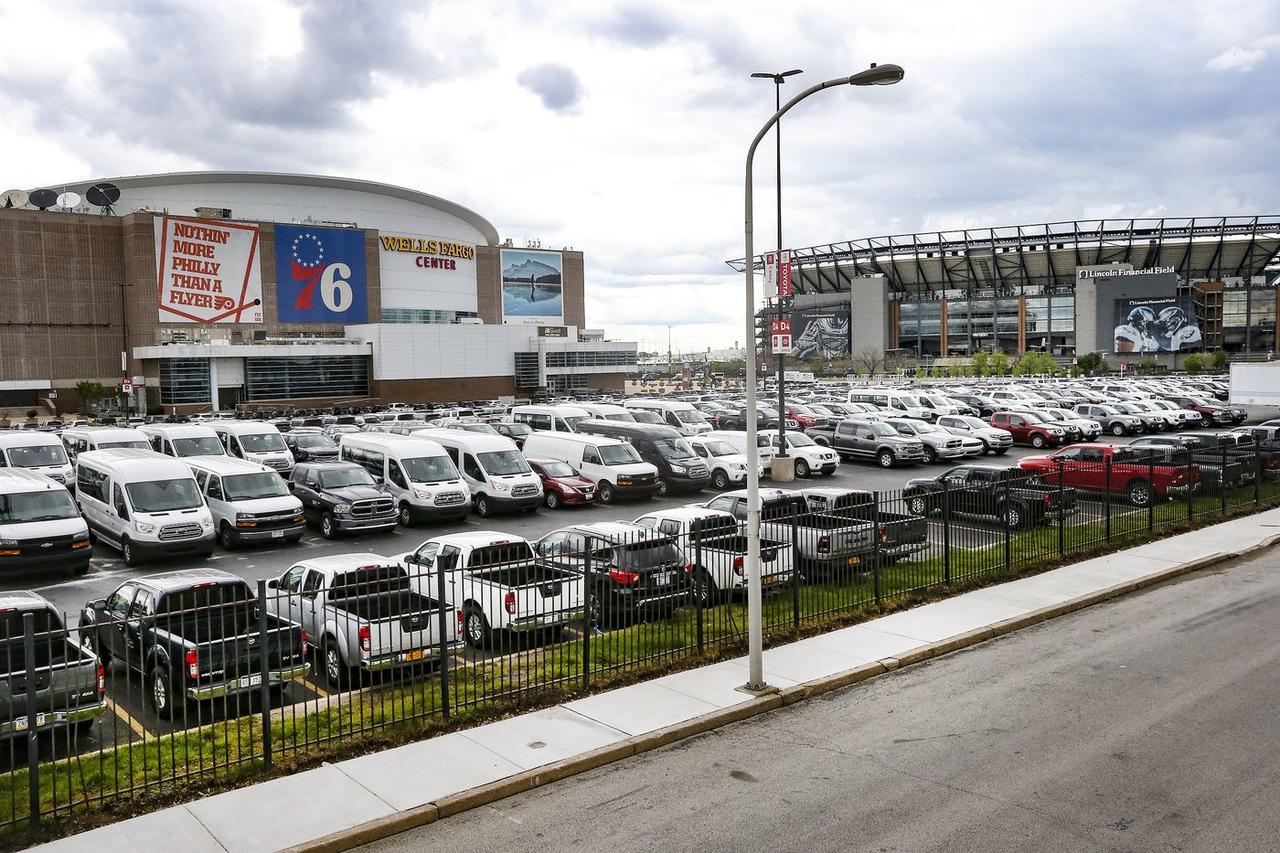
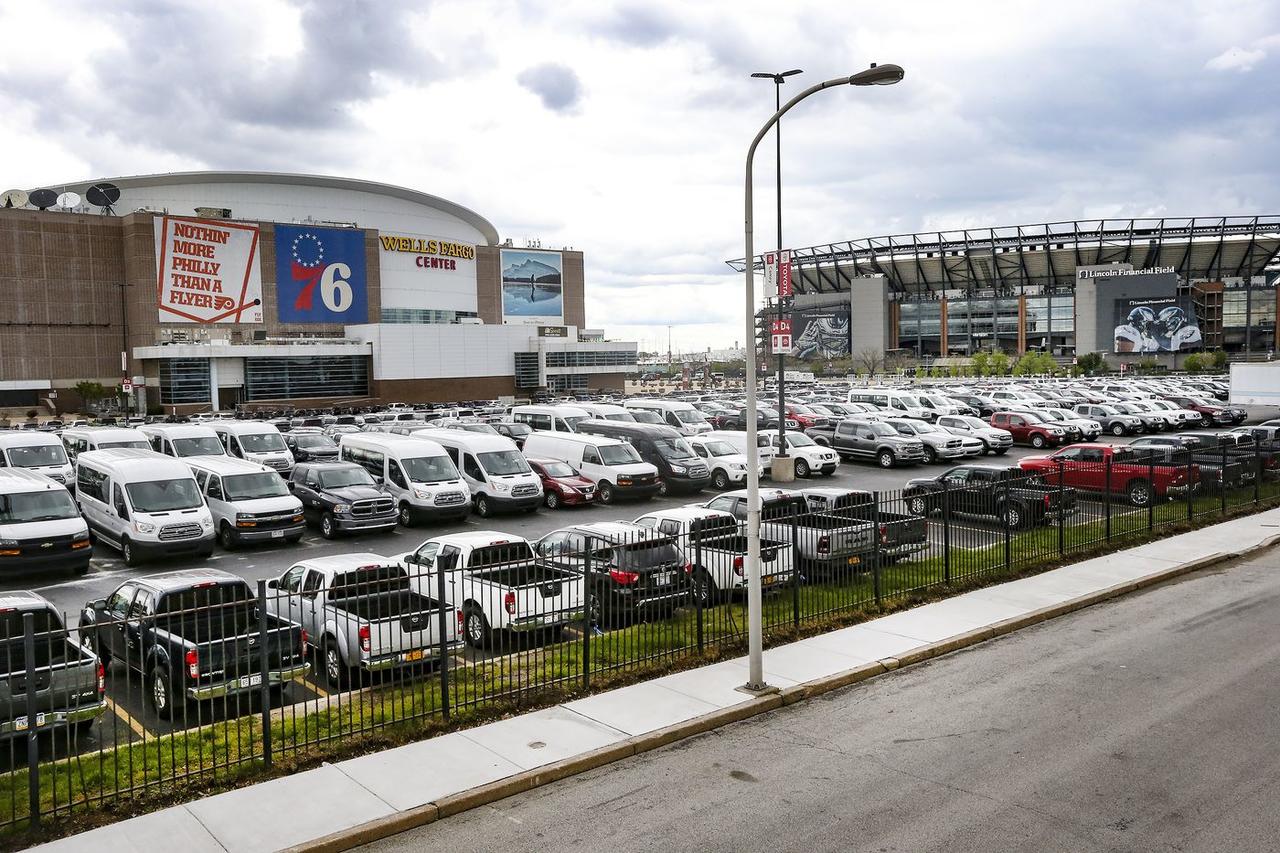
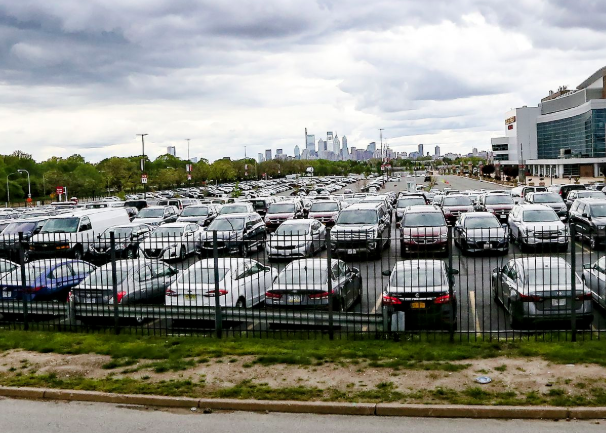
Philadelphia is rapidly becoming the case study which other cities will follow, because as Inquirer reports, the city's sports complex parking lots are now being used as lots for rental car companies based at the Philadelphia Airport. In other words, there are so many cars available, not even airport parking lots can hold them anymore.

About 2,200 Enterprise rental cars are parked at the Wells Fargo Center in South Philadelphia
In an effort to deal with the drop in air traffic, "rental cars are being stored at off-site locations, including the Wells Fargo Center parking lots," the Inquirer reported.
Phil Weinberg, executive vice president and general counsel for Comcast Spectacor, which owns the Wells Fargo Center, said: "Enterprise is a corporate partner of the Flyers and the Wells Fargo Center, and it is the only company with rental vehicles parked at the stadium. They approached us shortly after the stay-at-home orders became effective and asked if we could assist them in parking their cars, which are clearly not in service right now."
According to the Inquirer, the Wells Fargo Center is letting Enterprise park more than 2,000 vehicles free of charge, with no fixed end date in sight.
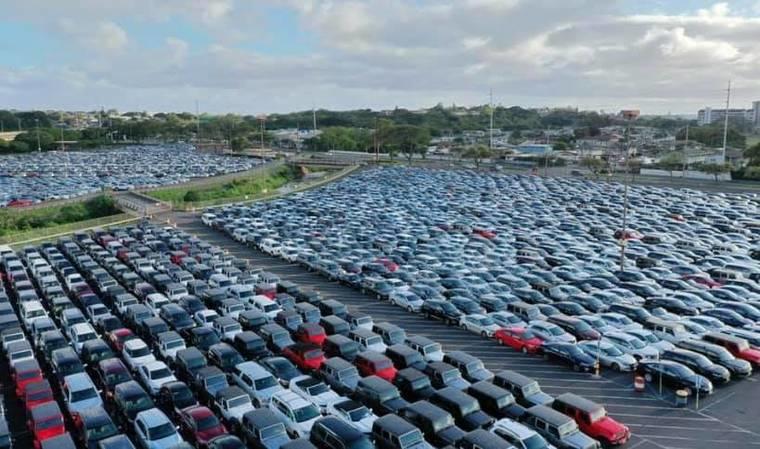
The Wells Fargo Center isn’t the only sports venue in the country housing overflow rental vehicles. According to the Honolulu Star-Advertiser, Aloha Stadium has up to 1,500 rental cars from five companies parked in its lots.
Aloha Stadium’s parking lot has become the temporary home to 1,000 to 1,500 rental vehicles on Oahu that have become idle because of the novel coronavirus pandemic.

And in Southern California, thousands of rental cars fill the parking lots at Dodger Stadium in Los Angeles and Angel Stadium in Anaheim, according to the Southern California News Group.
Hundreds of rental cars are being temporarily parked at Dodger Stadium as travel continues to constrict amid the coronavirus pandemic.
Lisa Martini, a spokeswoman with Enterprise Holdings, which owns the Enterprise, National and Alamo brands, said her company is working with Santa Anita to stage many of its cars there while the vehicles are being prepared and processed for rental, lease or sale. Business, she said, has fallen sharply in the face of the COVID-19 health crisis.
“Like others across the travel industry – and countless other companies large and small – we have witnessed an impact to our business,” Martini said via email. “This includes a significant decrease in reservations and customer demand as both corporate business and leisure travel have come to a virtual standstill.”
Pete Siberell, Santa Anita’s director of community services and special projects, said the parking arrangement makes sense.
“With Santa Anita not being able to race and having postponed many of our events, much of our parking lot space was available for us to help and we were glad to do so,” he said.
* * *
Incidentally, earlier today we reported that Hertz and Avis had put stops on purchases and, in some cases, re-directed purchases they've already made to additional parking lots. These companies have cancelled "all orders of GM vehicles for May, June and into July".
This has left GM and Hyundai taking back cars that it had agreed to sell to Hertz, Avis and Enterprise. Last month, Fiat underwent efforts to try and redirect almost 30,000 vehicles these companies had purchased, but was unable to transfer them.
The chaos has continued this month when Avis had to sell $500 million in junk bonds and Hertz was granted a last-minute concession from its lenders to narrowly avoid bankruptcy. Meanwhile, rental car sales fell 77% in April.
Most recently, Bloomberg reported this morning that rental icon Hertz hired advisors to consider a bankruptcy and the auto industry has placed a major bet on incentives to try and move inventory off of their lots.
Based on what we're seeing in parking lots around the nation, it isn't working.

(ZH)As Markets Crashed, The Swiss National Bank Went On A FAAMG Buying Spree

As Markets Crashed, The Swiss National Bank Went On A FAAMG Buying Spree

It used to be a running joke among traders that when markets crash, central banks step in - either directly or in the case of the Fed indirectly via Citadel - and buy stocks to prop up the market and short up confidence. That joke is now the truth.
Now that the Fed is openly buying corporate bonds and fallen angels, what was once absurd humor has become sad reality. And while we wait for the Fed to admit it too will be buying stocks soon - we just need that pesky next crash before Powell commits - other central banks have no such qualms.
Take the SNB.
We previously reported that the hedge fund that is not only publicly traded but also moonlights as the Swiss central bank, which allows it to print money and effectively purchase any security it wishes with a zero cost basis suffered its biggest loss in history, reporting a loss of $32.7 billion on its massive equity portfolio. Yes, the SNB along with the BOJ, is unique in that it does not pretend to not buy stocks, and does so quite openly.

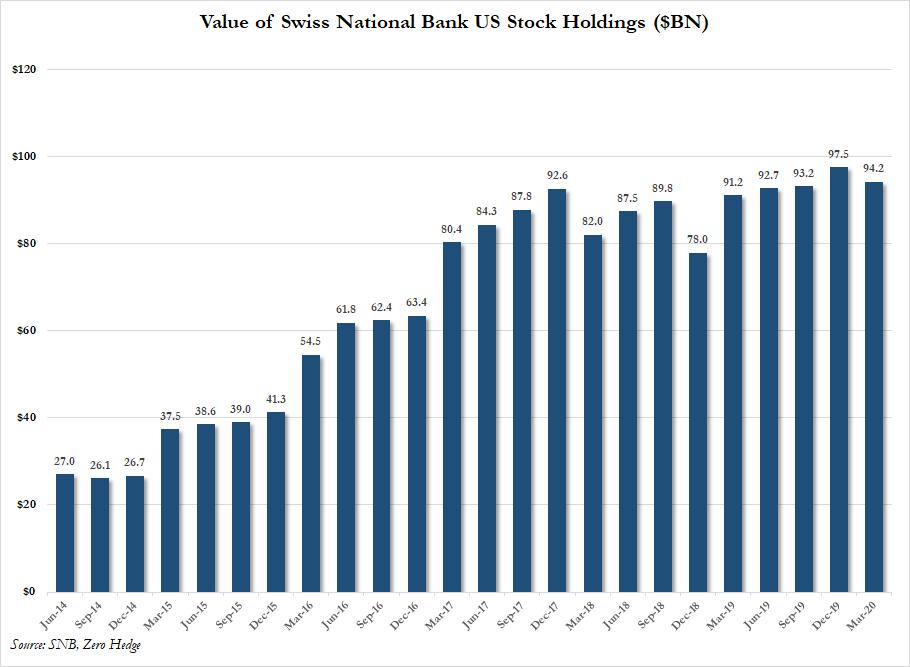
So openly, in fact, that in the past 5 years, the value of its US equity holdings increased more than threefold, from $26.7 billion in Dec 2014 to $97.5 billion in Dec 2019.
What about in the first quarter of 2020 when after hitting an all time high, stocks crashed in March?
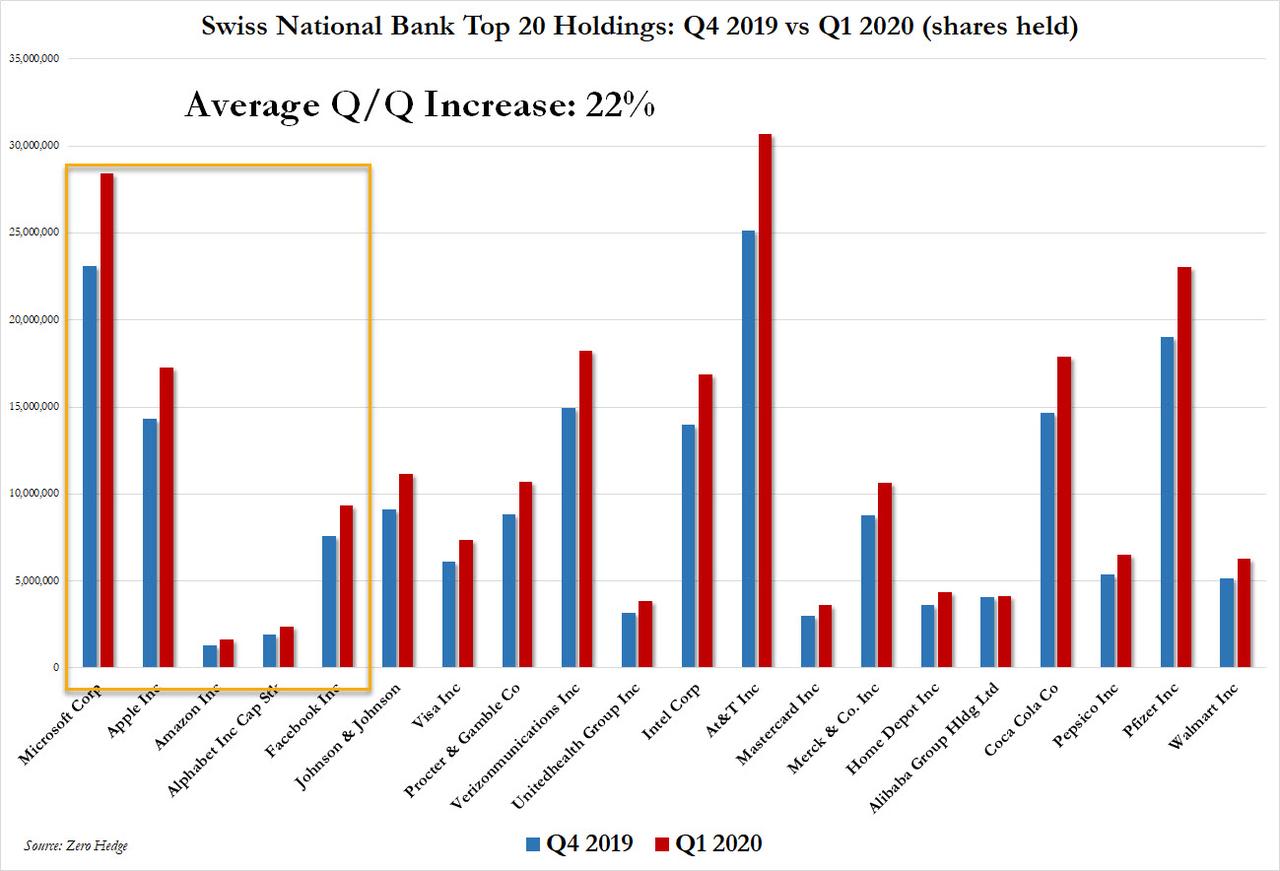
As one can see in the chart above, the total value of SNB stock holdings barely budged from Q4 2019 to Q1 2020 despite the 30% crash in the market in March.
How is that possible? Simple: after the SNB kept its total holdings relatively flat for the past year, conserving its dry powder for just the right occasion, said occasion materialized in March, and the Swiss National Bank went on a buying spree as markets crashed, adding roughly 22% (on average) to its top positions.

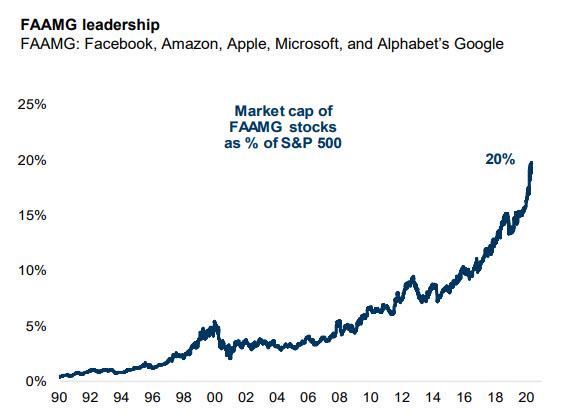
Also according to the SNB's latest 13F, as of March 31, the central bank owned $4.5 billion in Microsoft shares, $4.4 billion in Apple, $3.2 billion in Amazon, $2.7 billion in Google and $1.6 billion in Facebook, also known as the FAAMG stocks which as everyone knows by now, have become the market leaders, accounting for over 20% of the S&P's market cap.
And the punchline: the SNB added approximately 22% to its holdings of each of the FAAMGs in Q1 as follows:
  • MSFT: +23%
  • AAPL: +21%
  • AMZN: +23%
  • GOOGL: +22%
  • FB: +23%
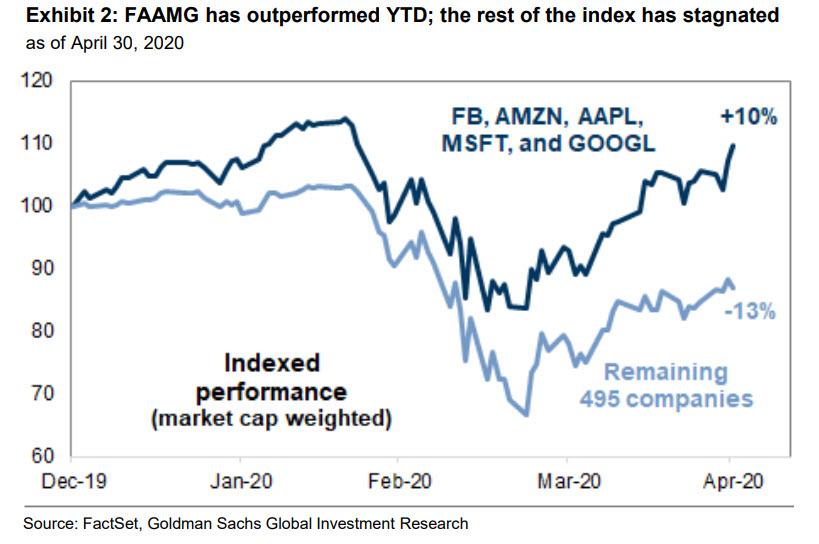
So for all those wondering who was going crazy bidding up all the megatech names, which are now up more than 10% YTD while the rest of the market is down 13%...
... even as even Warren Buffett sat on the sidelines waiting for the other shoe to drop, now you know and all you need to replicate the SNB's performance and buy FAAMGs without a care in the world, is your own (legal) printing press to print digital money out of ones and zero and buy anything and everything in the name of preventing the system from collapsing.
Source: SNB

The New Yorker : The Most Alarming Thing About the Worst Jobs Report in History

The Most Alarming Thing About the Worst Jobs Report in History

There has never been a monthly employment report like the one, for April, that the Labor Department released on Friday morning. The figures in the report are based on two surveys: a survey of households, which the Census Bureau carries out, and a survey of businesses, which the Bureau of Labor Statistics carries out. “The household survey is generally collected through in-person and telephone interviews, but personal interviews were not conducted for the safety of interviewers and respondents,” the report noted. The regional call centers that conduct the business survey were closed last month, but some of the interviewers worked from home, and the department encouraged firms to file their payroll reports electronically. As a result of these efforts, the amount of data that the business survey collected was “essentially unchanged from collection rates prior to the pandemic,” the report said.

In other words, the B.L.S. did yeoman’s work in tough circumstances, and its report provided the most comprehensive picture yet of how the coronavirus shutdowns have affected the economy. The headline figures were that the unemployment rate jumped from 4.4 per cent to 14.7 per cent in April, and the number of employees on firms’ payrolls fell by 20.5 million. Both of these jumps were unprecedented in scale. In October, 2009, following the great financial crisis, the unemployment rate peaked at ten per cent. In November and December, 1982, a year and a half after then Fed chairman Paul Volcker raised interest rates sharply to bring down inflation, it peaked at 10.8 per cent. We haven’t seen a jobless rate as high as the current one since the nineteen-thirties.

The New Yorker’s coronavirus news coverage and analysis are free for all readers.
Moreover, the 14.7 per cent figure substantially underestimates the actual jobless rate for a couple of reasons. One is a technicality. Based on the answers they give the officials carrying out the household survey, individuals get counted as employed, unemployed, or out of the workforce completely. The Employment Report explained that people who had been laid off in virus-related shutdowns should have been classified as “unemployed on temporary layoffs,” but many of them got categorized as “employed but absent from work.” If these absentees had been included in the temporary-layoff count, “the overall unemployment rate would have been almost 5 percentage points higher than reported.”

Making that adjustment takes the unemployment rate close to twenty per cent. But even that figure is already out of date, because the reference week for the household survey, which is where the jobless rate comes from, was April 12th to the 18th. Since then, at least another seven million Americans have filed for unemployment benefits. Today, the real jobless rate is probably somewhere in the low twenties, which would put it on a par with the peak rates seen during the Great Depression.

Friday’s report confirmed that layoffs and furloughs have affected virtually every part of the economy—manufacturing, government, and services—with the latter sector hit hardest. Restaurants and bars alone shed almost 5.5 million workers last month. Retailers laid off more than two million. About a million people who had been working in amusement parks, casinos, and other recreation businesses joined the ranks of the unemployed. So did a similar number of people who had been working in the offices of doctors, dentists, and other health practitioners. About eight hundred thousand people working in launderettes or dry cleaners were let go. So were about eight hundred thousand hotel workers.

In many of the hardest-hit industries, employees weren’t paid very much to begin with. An analysis of the employment report from the Center on Budget and Policy Priorities estimates that “more than half of all job losses come from the low-paid group of industries.” Taken together, these low-pay industries have cut their workforces by close to thirty per cent since February, the analysis concluded. By comparison, industries in the middle third of the pay distribution have cut twelve per cent of their workforce, and industries in the top third have shed just eight per cent of their employees. These figures confirm the emergence of two distinct coronavirus economies. In the economy of well-paid professionals, most people keep their jobs and work from home. In sectors where pay is low and workers tend to have fewer educational qualifications, the shutdowns often equate to being unemployed.

Since they are low-paid to begin with, many of the newly jobless don’t have the financial resources to survive independently. Congress should extend its recent expansion of unemployment benefits until the jobless rate returns to a much lower level. Other emergency programs may also need to be extended, and more financial aid should be provided to the states. The jobs report showed that state and local governments cut their payrolls by about a million last month. If states and municipalities are forced to cut their budgets as their tax revenues fall, this figure will only increase.

How soon will the jobless rate start to fall appreciably? Friday’s report doesn’t answer this question. In recording what has already happened, it is what economists refer to as “a lagging indicator.” On Wall Street, which looks forward, investors are betting on a rapid rebound in employment, output, and profits. After the jobs report came out, the Dow Jones Industrial Average rose by nearly two per cent. Since stocks bottomed out in late March, the index has risen by more than thirty per cent. The tech-heavy Nasdaq has risen even further.

Time will tell whether this is a shrewd wager or another instance of the madness of crowds. According to Jared Bernstein, a senior fellow at the Center on Budget and Policy Priorities, who was also an economic adviser to Vice-President Joe Biden, “the closest thing to a hopeful number” in the employment report is the fact that, of the total of twenty-three million jobless Americans, eighteen million of them were classed as being on temporary layoff rather than being permanently out of work.

In all likelihood, many of these people will get called back. Over the next few months, lots of retail stores, dental practices, construction sites, fast-food joints, and suspended flights will surely reopen, preferably with proper social-distancing protocols in place. But how much revenue will businesses that reopen generate? The lesson from other countries, such as China, is that, with many people still fearful of the virus, the rebound from the shutdowns tends to be slow and partial. And in some places, such as parts of Japan, a resurgence in cases of infection has prompted a second wave of lockdowns.

If that pattern is repeated here, many temporary layoffs may turn into permanent ones. MGM Resorts International, which operates thirteen properties in Las Vegas, has furloughed sixty-three thousand workers. Earlier this week, the firm indicated that at least some of these workers are unlikely to be rehired. Given “the continued uncertainty facing our industry, we simply don’t know just how many employees will return to work within the coming months,” MGM’s acting C.E.O., Bill Hornbuckle, said. He was only referring to one industry, of course, but his statement could just as well be applied to the economy as a whole. On a day when the worst jobs report in history was released, that pervasive and ineluctable uncertainty about what the future holds is the most alarming thing.

Daily Best : After Five Bloody Years in Syria, Russia Is Turning Against Iran—an

After Five Bloody Years in Syria, Russia Is Turning Against Iran—and Assad
BYE BYE BASHAR?
Vladimir Putin wants a stable Syria, with billions from abroad for his oligarch cronies to rebuild the country. But Assad's infamy and the ayatollahs stand in the way.

GAZIANTEP, Turkey—After five years fighting to preserve Bashar al-Assad’s regime in Syria, Russia now appears inclined to dispose of its infamous client. Assad’s persistent brutality and corruption, and his inability to establish even the semblance of a functioning state, has grown to be a burden Moscow would prefer not to bear.

And then there’s the problem of Iran. Assad, members of his family, and his Alawite clansmen enjoy close, perhaps unbreakable, bonds to the regime in Tehran and to Iranian-backed militias in Syria. All of which undermines Moscow’s primary mission there: to rehabilitate the Assad regime as a symbol of stability capable of attracting hundreds of billions of dollars of foreign investment for reconstruction, which Russian firms would then be poised to receive.

As long as Assad’s relatives continue to function as a mafia and give free rein to Iranian troops using Syria as base of operations to threaten Israel and plan attacks against U.S. troops in Iraq, those countries likely to foot the bill for Syrian reconstruction—the nations of Europe and the Gulf—are unlikely to come up with the cash.

NYT ; As Job Losses Mount, Lawmakers Face a Make-or-Break Moment

As Job Losses Mount, Lawmakers Face a Make-or-Break Moment
The United States just lost 20 million jobs. The wrong federal response could make those layoffs a permanent fixture of the U.S. economy and sentence thousands of companies to bankruptcy.

WASHINGTON — As the nation confronts unemployment levels not seen since the Great Depression, Congress and the Trump administration face a pivotal choice: Continue spending trillions trying to shore up businesses and workers, or bet that state reopenings will jump-start the United States economy.

At least 20 million Americans are unemployed and a large share of the nation’s small businesses are shut and facing possible insolvency. Policy errors in the coming weeks could turn the 18 million temporary layoffs recorded in April into permanent job losses that could plunge the United States into a deep and protracted recession unrivaled in recent history.

Yet the federal government is lurching away from the strategy that has thus far helped slow the spread of the coronavirus and sustain people and companies struggling during the self-inflicted economic shutdown.

Over the past two months, as consumers and workers retreated and state officials imposed limits on economic activity, President Trump and bipartisan coalitions in the House and Senate have approved $3 trillion in federal spending to help companies, workers and the unemployed. The Federal Reserve has taken extraordinary steps to keep the financial system functioning, buying up government-backed securities and embarking on plans to purchase corporate and municipal debt to keep credit flowing. Governors have embraced stay-at-home orders in an effort to slow the virus’s spread.

Economists and policy experts, including some in the administration, have likened those efforts to building a bridge through the pandemic recession — one that will carry as many people and companies to the other side of the crisis as possible.

But as the virus threatens to haunt the nation and its economy longer than some officials had anticipated, Mr. Trump and many Republicans in Congress have grown weary of federal spending to support workers and businesses and have begun urging states to get back to what was considered normal.

Even some allies of the president, though, acknowledge that may be an unrealistic gamble and more wishful thinking than an actual plan. With confirmed infections and deaths projected to continue rising, and limited capacity to test for the virus, many states are expected to keep businesses closed into the summer or longer. And even once things reopen, simply allowing people to walk into a barber shop or a movie theater does not mean they will do so during a pandemic until a vaccine or effective treatments are available.

Economists, including liberals and many conservatives, warn that prematurely ending efforts to aid businesses and workers without enacting a new strategy could force the economy into a summer of partial recoveries, rising infection rates and insufficient support for struggling businesses and those out of work.

In that case, the experts warn, today’s government-financed bridge through the crisis will have become, for vulnerable people and companies, a bridge to nowhere.

“We’re at the choose-your-own-adventure part of the book,” said Claudia Sahm, a former Federal Reserve economist who is now the director of macroeconomic policy at the Washington Center for Equitable Growth, a liberal think tank focused on inequality.

“It is unconscionable to wait for the economy to reopen,” she said. “For a lot of American workers, there will not be a job to go back to. Those temporary layoffs will not be temporary.”

Parts of the country are beginning to emerge from the deep freeze that has characterized the first months of a pandemic that has killed more than 75,000 Americans. Those efforts are happening in uneven fashion and often without the kind of precautions that health experts say will be needed to prevent another wave of infections that requires another lockdown.

Democrats and Republicans, eyeing a rapidly approaching election, are pushing opposing plans for what lawmakers should do next, with no quick agreement in sight. Democrats want to continue to spend trillions of dollars in additional aid to people, companies and local governments, and to keep the assistance flowing until economic data shows the country is well into recovery. Liberal voices like Ms. Sahm and Senator Elizabeth Warren of Massachusetts say they are determined to avoid the mistakes of the last crisis and prevent lawmakers from cutting off assistance too early, dooming the economy to years of slow growth.

Mr. Trump and Republicans want to shift government efforts toward relaxing restrictions and financing efforts they say would invigorate a reopened economy, like tax cuts and new business deductions. The White House and Republicans in Congress have hit pause on more stimulus efforts, as they push states to reopen and voice renewed concerns about the ballooning federal deficit, which is now projected to hit $3.7 trillion for this fiscal year.

“We put all this money in, which is fine,” the director of the National Economic Council, Larry Kudlow, told reporters on Friday at the White House. “It’s well worth it. Let’s see what happens. As we move into the reopening phase this month, maybe spillover to June, let’s have a look at it before we decide who, what, where, when.”

Behind the scenes, White House officials are privately bracing for additional economic damage in the coming months and for the economy to take several quarters to return to its precrisis levels, even if growth resumes this summer. Yet they are divided over how quickly and aggressively to shift the government from more spending and for now are watching how the economy reacts as states lift restrictions.

As the virus spread rapidly in the United States in March, large portions of the American economy shut down almost overnight. Congress and the Fed took swift action to support companies that were forced to close and workers who lost jobs or pay, offering aid to businesses, expanded unemployment benefits and one-time stimulus checks.

But those efforts were time-limited and did not reach everyone who needed aid. The most prominent effort to help small businesses, the Paycheck Protection Program, had just $349 billion at the start and quickly ran out of money, requiring an infusion of $310 billion. The money covers only eight weeks of employee payroll, meaning many companies will see their aid run dry as early as May 29.

Expanded unemployment benefits, which provided an extra $600 a week, are set to expire at the end of July. Checks that were sent to low- and middle-income Americans, of up to $1,200 an adult, were a one-time payment.

While some economists, including those at the Congressional Budget Office, expect economic growth to return this summer after a devastating spring contraction, no one expects the job market to reach the same lofty levels any time soon. Moody’s Analytics said Friday it did not expect the country to make up all the jobs it had currently lost until 2023.

Economists warn that reopening efforts will not remove the need for additional assistance since consumer traffic will be slow to come back until Americans are confident they can venture out with a degree of certainty they will not contract the virus.

A variety of real-time measures show that even in states that have recently eased restrictions, like Georgia and South Carolina, business activity has been slow to recover.

A prolonged recovery could effectively kill a wide range of businesses across the country and sideline millions of American workers. Data from the human resources company Homebase suggests 40 percent of the businesses that use its software have closed their doors since the crisis began. Economists from the ADP Research Institute, the University of Chicago and the Federal Reserve, using data from the private payroll firm ADP, reported this week that 40 percent of the nation’s lost jobs so far are in companies that appear to have stopped operating amid the crisis.

If there was any good news in the employment report released Friday, it is that nearly 80 percent of newly laid-off workers described their layoffs as temporary. That suggests the potential for a quick rebound but could portend danger if policymakers allow firms that have only briefly closed their doors to fold for good instead.

Democrats have pushed to tie continued help for laid-off workers to economic conditions, leaving enhanced benefits in place until the unemployment rate falls. Republican lawmakers have criticized the extra $600 a week as a disincentive for workers who might otherwise go back to work, suggesting they will not approve another round.

“There is so much uncertainty about how things will unfold that an arbitrary end date doesn’t make any sense at all right now,” said Heidi Shierholz, a former chief Labor Department economist now at the liberal Economic Policy Institute in Washington. “Lawmakers must be willing to provide fiscal support until the unemployment rate is at a manageable level.”

While the economic pain is nowhere close to ending, Republicans seem disinclined to renew huge spending programs, particularly as November looms. Activist groups that have led marches on state capitals pushing for economic restrictions to be lifted are poised to refocus on calling for an end to government spending, said Stephen Moore, an informal adviser to Mr. Trump who has been a vocal proponent of reopening states.

“All government can do right now is make things worse, not better,” Mr. Moore said.

Still, some Republicans on Capitol Hill have expressed openness to continued spending, particularly on small business assistance, despite pressure over the deficit.

Michael R. Strain, an economist at the conservative American Enterprise Institute who has advised congressional Republicans on economic policy, acknowledged that there was “real bailout fatigue among Senate Republicans.” But he added, “The economy is going to need support from fiscal policy for a long time. So I just can’t imagine a scenario where they don’t pass something else.”

Inside the White House, some officials are hopeful that the Fed, rather than Congress, can take up the work of helping companies through the crisis. But many economists warn that is asking too much of the central bank, and the Fed chair, Jerome H. Powell, has warned that its tools are limited to lending, not spending, and that more fiscal support is likely to be needed.

“Quickly, we have to pivot to think about how to support businesses and workers in what could be the lengthy period of the economy reopening,” said R. Glenn Hubbard, a Columbia University economist who was a top economic adviser to President George W. Bush. “You can’t just let the Fed handle it.”

Wired : The 5G Coronavirus Conspiracy Theory Has Taken a Dark Tu

The 5G Coronavirus Conspiracy Theory Has Taken a Dark Turn
Though social networks have pledged to take more concerted action against it, the theory has continued to spread, inspiring a surge of attacks.

MOBILE PHONE MASTS in the UK are still being attacked by arsonists on a daily basis because of a conspiracy theory linking 5G to the spread of coronavirus. New data seen by WIRED UK reveals that dozens of attacks have taken place in the last fortnight, with conspiracy theorists targeting both infrastructure and key workers in the misguided belief that they are somehow spreading coronavirus. In one incident, a broadband engineer was spat at in the face by an enraged member of the public. The engineer is now ill with suspected coronavirus.

Since March 30, there have been 77 arson attacks on mobile phone masts across the UK, with staff working on mobile infrastructure also reporting 180 incidents of abuse. There have been 13 additional incidents of sabotage reported, ranging from failed arson attacks to attempts to damage mobile network infrastructure in other ways. From April 20 through May 5, more than a week after the supposed peak of attacks in early April, there were 16 arson or sabotage attacks on mobile phone masts. When failed or attempted attacks are added to the tally, that number increases to 74.

The figures from the mobile phone sector are mirrored by Openreach, which is responsible for maintaining much of the UK’s broadband infrastructure. The company has recorded 63 incidents of abuse directed towards its staff while out working since April 1, with conspiracy theorists often filming such encounters while shouting and swearing at terrified key workers. Footage of these confrontations is then shared on social media. In the last two weeks of April, Openreach recorded 20 incidents of this nature.

The conspiracy theory linking 5G to coronavirus has spread rapidly through Facebook and YouTube in recent weeks. It was given further prominence when a number of celebrities—including TV star Amanda Holden, Hollywood actor Woody Harrelson, and boxer Amir Khan—shared it on social media. Despite social networks pledging to take more concerted action against it, the conspiracy theory has continued to spread in recent weeks.

The online spread of the conspiracy theory is still having dangerous real-world consequences. Openreach engineers, none of whom are even involved in installing 5G infrastructure, have been exposed to a barrage of abuse. One person threatened to throw a brick at an Openreach engineer’s head, returning several minutes later shouting and wielding a bottle. In another incident, an engineer was told they would be in “f-ucking trouble” if it turned out they were installing 5G, with the abuser then punching their van door and walking off. Elsewhere, a woman shouted that 5G was “more dangerous than Covid-19,” called an Openreach engineer “f-ucking mental” and said she would get her brother and six friends over to “do him in.”

While angry shouting and threats typify many of these incidents, some have resulted in physical acts of violence. Michael, an apprentice network engineer working for Openreach in London, was spat at in the face by an angry member of the public. Michael has since had to self-isolate after becoming ill with suspected coronavirus. He was too unwell to be interviewed for this story. Another Openreach engineer has been stabbed and put in hospital.

Dylan, an engineer working for Openreach in Leicester, who was verbally abused while driving his van, describes the incident as “quite intimidating.” In Dylan’s case, a man got out of his car while at a red light on a dual carriageway and started shouting abuse and banging on his van.

“He put his head against my window, he’s saying, ‘Don't you ignore me, stop trying to cover up what you're doing, 5G is killing us all, you’ve got no morals,’” Dylan says. “You’ve got someone right there and you’re on your own. You wonder if he’s going to smash the window, what’s he going to do if he does get in, is he going to attack me? I seized up and just waited for the light to go green.” While this was happening, another individual remained in the parked car and filmed everything. Dylan says the incident has left him shaken. “When I’m on my own I feel a bit cautious, a bit on edge. And I can't fully focus on the task at hand because I'm always keeping an eye on what’s happening.”

Tiffany, another Openreach engineer, experienced similar intimidation from a member of the public who went on a “power trip,” lecturing her about the apparent dangers of 5G while she was trying to fix broadband infrastructure on a residential street. “He was saying, ‘I’m a reporter, I'm going to be putting this everywhere.’ He was going to put out this thing saying I was spreading coronavirus when I was just doing my job. I felt really vulnerable while it was happening and really intimidated by him. I was shaking all day after.” Tiffany later found the video on Facebook and YouTube, though it has since been removed.

The continued abuse of key workers and attacks on critical infrastructure hint at how widely this conspiracy theory continues to circulate online. In the last seven days alone, more than 54,000 posts referencing 5G and coronavirus have appeared on Facebook, generating over two million interactions. The most popular of these posts, featuring an image of Bill Gates with devil horns, has received more than 4,600 shares, comments and interactions. Two posts protesting the removal of conspiracy theorist David Icke's Facebook page have together generated more than 7,000 shares, comments and other interactions.

The response from social networks has been spasmodic at best. While figures such as Icke have been banned, other Facebook groups with huge followings that peddle similar conspiracy theories are still active. Earlier this week, Twitter introduced a feature that prompts people posting about the conspiracy theory to read fact-checked advice. At the same time, David Icke’s Twitter profile is still active. On YouTube, conspiracy theory videos revealing “the truth” about 5G and coronavirus are still getting tens of thousands of views.

The worry for industry figures is that despite a widespread and concerted effort to debunk the dangerous 5G coronavirus conspiracy theory, it continues to thrive both online and in the real world. “It’s deeply frustrating and saddening that our engineers are facing abuse of this kind,” says Catherine Colloms, managing director of corporate affairs and brand at Openreach. “We’ve seen a worrying surge in incidents where our engineers are being subjected to mindless verbal abuse or intimidation linked to the bogus 5G theory. It really needs to stop.”