(ZH) For Albert Edwards This Is The One Chart Proving Just How Insane The Market

For Albert Edwards This Is The One Chart Proving Just How Insane The Market Has Become

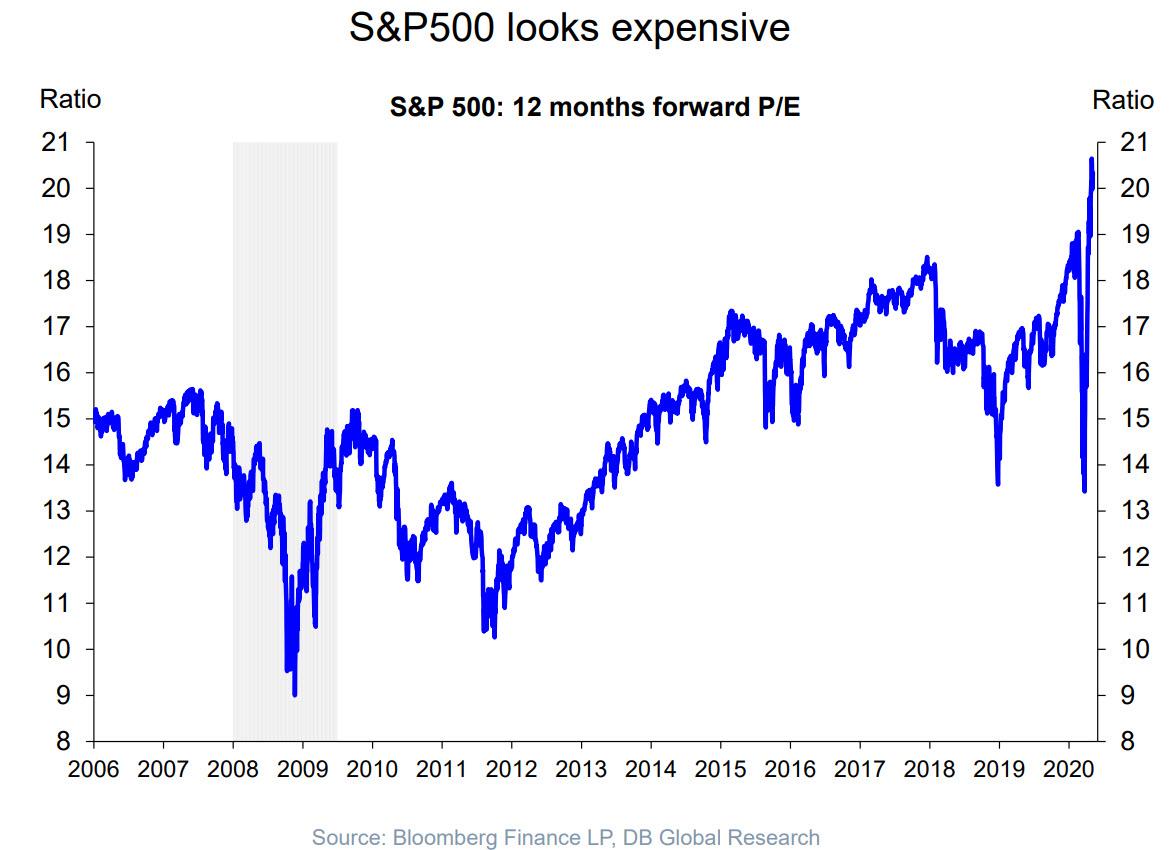
By now everyone has seen some version of this chart which we first presented a month ago and updated yesterday, demonstrating just how disconnected stocks are from reality.
SocGen's resident permabear (... for stocks, and permabull for bonds) Albert Edwards has seen it too, and he too is stunned by the ludicrous gap between reality and expectation, which he has been tracking for decades but never has it gotten as wide as it is now, because as he writes in his latest global strategy weekly:
We are in the midst of a monetary and fiscal ideological revolution. Nose-bleed equity valuations are being supported by nothing more than a belief that a new ideology can deliver. Meanwhile the gap between the reality on the ground and expectations grows wider.

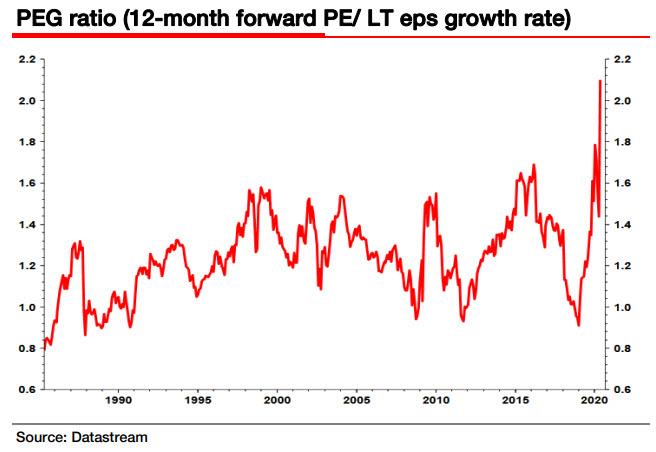
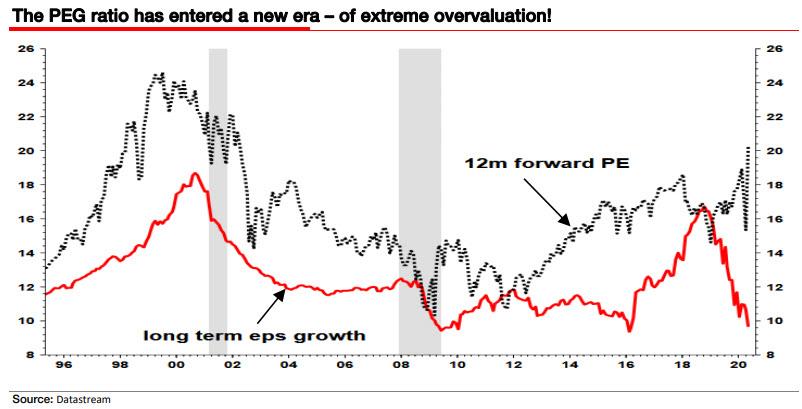
While Edwards admits that there are many ways to show "how ludicrous current equity valuations have become and by implication how vulnerable equities are to a collapse", the SocGen strategist avoids focusing on the "ubiquitous chart" shown above which shows the rise in the S&P500 12m forward PE above 20x driven by the ongoing profits collapse - after all we did that just yesterday highlighting the "Idiotic Disconnect Between Markets And Reality" - to Edwards the real show-stopper is a different chart, one which shows on one hand the continued Ice Age slump in analysts’ collective expectations for long-term eps growth, and on the other the soaring PE ratio. The combination of the two is what is also known as the PEG, or Price to Earnings Growth, ratio.
Looking at the first component, long-term, EPS growth, Edwards notes that it "has now slid below 10%, a trend only likely to accelerate during the current profits slump." This is shown in the chart below.
Looking at the chart above, Edwards urges readers to compare the current LT EPS situation with the late 1990s tech bubble, when - like now - "the S&P forward PE rose above 20x, but at least back then the cycle was still intact, and as technology stocks increasingly dominated the index, the market’s LT eps was also surging higher in tandem with the rising PE." As he further explains, at least back in the tech bubble, the market had a LT eps leg to stand on "albeit a wooden leg, riddled with woodworm." By contrast, this time around, despite technology stocks once again dominating the index, something Goldman warned two weeks ago always ends in pain, "the 20x PE is based on nothing more than an ideological dream." The dream he is referring to, is one spawned by the destructive ideology of MMT (i.e., the Magic Money Tree), where the merger of the Treasury and Fed, and the joint issuance and monetization of debt, magically creates an economic perpetual engine and social utopia... for at least a short while before the currency collapse. No wonder this ideological dream is that anchor pillar of socialists who wish to pass off as financial gurus.
In any event, going back to the chart above, when one combines the two data sets, one gets a snapshot of the so-called PEG ratio (the ratio of the P/E to Long-Term eps growth) which as Edwards notes, has risen above 2x for the first time ever, which prompts the stunned strategist to exclaim that "this is even more shocking than a 20x PE!"

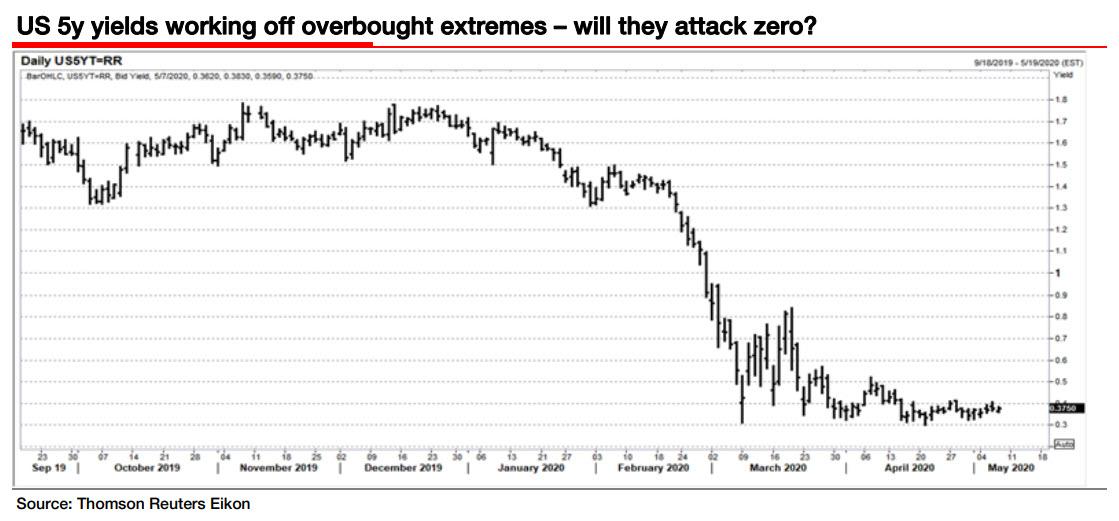
While not nearly as dramatic, Edwards also highlights a few charts from the far more rational world of bonds - at least until the Fed locks it down too, when it launches BOJ-style Yield Curve Control in a few months. The first one is of 5Y yields which as Edwards points out, have not bought into the latest risk rally and yields remain close to rock bottom. "Watch the 5y yield particularly closely as a break below the recent 0.3% floor would likely see an attempt to attack zero."
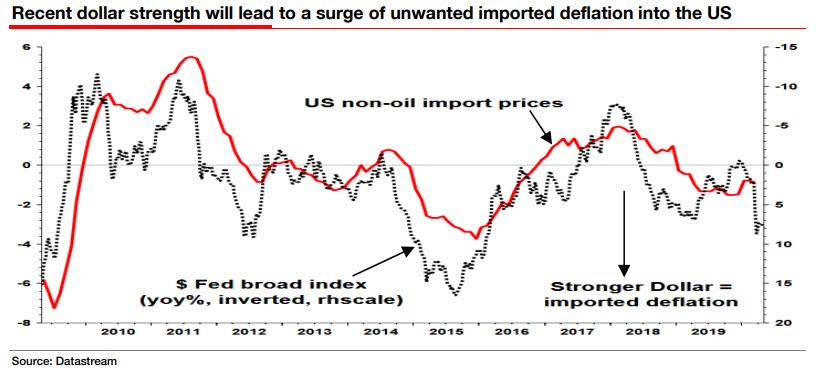
And speaking of zero rates, Edwards concludes with a quick take on the dollar, which as we first showed two months ago exploded to an all time high due to an ongoing and systemic $12 trillion US dollar margin call as countless offshore issuers of dollar-denominated debt suddenly find themselves cut off from cashflows as a result of the global economic stop, which in turn means that there is a shortage of up to $12 trillion in synthetically created dollars, which is precisely what the Fed has been struggling to flood the entire globe with thanks to its expanded FX swaps.
So far it is failing, however, and as Edwards concludes, "the dollar is already too strong in an environment where fighting deflation is becoming the number one priority. The recent surge in the broad dollar index is already sufficient to import another dose of unwanted deflation."
Which brings us to Edwards conclusion:
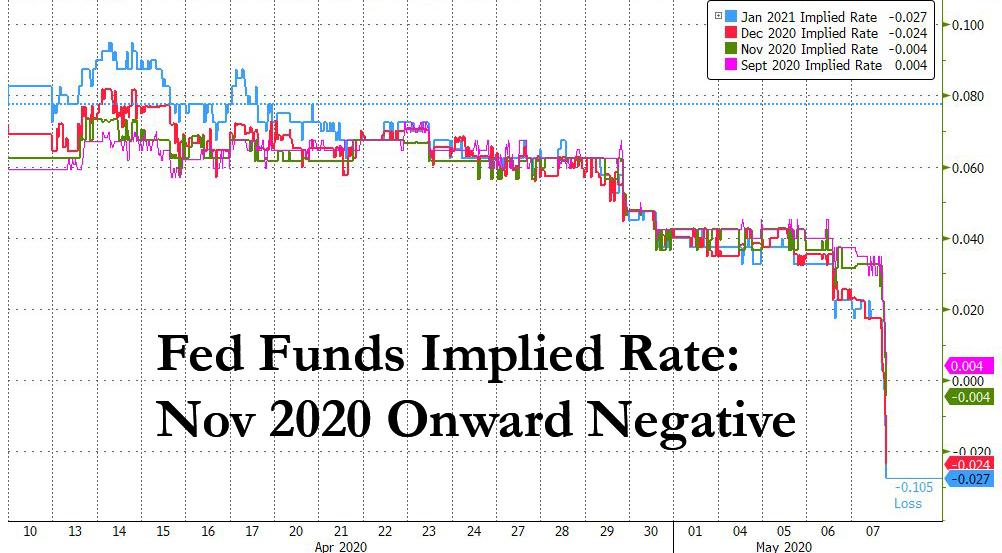
That is why I still believe we will see negative Fed Funds soon a topic now debated hotly on Twitter and elsewhere (see here for Ken Rogoff arguing the case for deeply negative interest rates).
Considering that Albert wrote this just hours before we got the first ever fed funds futures pricing above par, implying a negative interest rate as soon as Nov 2020...
... means the SocGen strategist is entitled to a victory lap. In fact, he will be making many of those in the coming months as the entire system, which central banks have kept alive with duct tape and superglue, finally starts to fall apart.

FT : Louis Bacon’s Moore Capital makes big gains after going it alone

Louis Bacon’s Moore Capital makes big gains after going it alone
Billionaire investor hits winning bets in global macro after closing to external money

Billionaire investor Louis Bacon’s Moore Capital is enjoying some of its best performance in years, barely six months after announcing it would return money to outside investors and strike out alone.

Mr Bacon’s New York-based hedge fund firm told investors in November it would shut its flagship funds to external clients and focus on running internal money. It has gained 17 per cent so far this year, according to people familiar with the figures, which would rank it among the world’s best-performing hedge funds.

Gains have come in all areas of the firm — a so-called global macro specialist that trades assets such as bonds and currencies, said one of the people. Among the biggest winning positions this year for such macro traders has been holding government bonds, which have soared as investors have sought havens in the coronavirus-driven market turmoil, while owning gold has also been profitable for some. Such funds tend to have less exposure than many investors to equities, which have been hard hit in the crisis.

The performance has echoes of the huge profits made by Mike Platt’s BlueCrest Capital, the hedge fund firm that announced in late 2015 it would become a family office. At the time Mr Platt said his bets had been constrained by risk-averse institutional investors. Since then BlueCrest has made annual gains of around 50 per cent in three of the past four years.

Returning external money can be a way of lifting returns for hedge fund managers, allowing them to take on more leverage or hold more concentrated positions. Such moves could be blocked by institutional investors such as pension funds and endowments that are often less tolerant of volatility, and that have come to dominate the hedge fund industry since the global financial crisis.

Handing back external money also frees managers from having to meet investors or disclose profits or positions in monthly updates. The lack of reporting requirements tends to make these funds more opaque.

Moore declined to comment.

Moore’s gains, which would rank among its biggest annual returns over the past decade, come as macro hedge funds enjoy a long-awaited revival. Most have struggled for years as central bank stimulus in the wake of the 2008/09 financial crisis dominated market movements and suppressed the volatility that such funds depend on.

However, this year many, including Brevan Howard, Caxton Associates and Dymon Asia, are enjoying double-digit gains. Mr Bacon’s one-time protégé Greg Coffey, who retired from Moore in 2012, is also profiting at his New York-based Kirkoswald hedge fund.

Moore, which was founded in 1989 and is one of the world’s oldest hedge funds, made $19bn in investor profits over the life of its three flagship funds, but had suffered lacklustre performance in recent years.

It told clients in November that “intense competition for trading talent coupled with client pressure on fees has led to a challenging business model for multi-manager funds such as ours”. Returning outside money would let the firm be “more opportunistic in acquiring investment talent” and more competitive with some other big, successful funds.

The firm has now returned almost all of the money it was managing for third parties, leaving two smaller funds that still manage some external capital.

Mr Bacon, a prominent conservationist, also said in November he would be less involved in fund management and would focus more on “personal time for a large family,” “philanthropic pursuits” and developing “a number of sports-oriented properties”.

>>> Europe : Brokers Upgrades & Downgrades - 8th of May 2020

>>> Up
* Aker BP Raised to Buy at Norne Securities; PT 210 kroner (+)
* DNO Raised to Buy at ABG; PT 6 kroner
* Jenoptik PT Raised to 30 euros at Bankhaus Metzler (+)

>>> Down
* Arnoldo Mondadori Editore Cut to Neutral at Intermonte
* Hufvudstaden Cut to Sell at ABG; PT 125 kronor
* Linde PT Cut But Buy Rating Kept on Resilience: Deutsche Bank (+)
* Maire Tecnimont Cut to Neutral at Banca Akros (ESN); PT 2 euros (+)
* Scout24 Cut to Hold at Commerzbank; PT 60 euros
* Sparebanken Vest Cut to Hold at Arctic Securities; PT 60 kroner
* Zalando Cut to Hold at Hauck & Aufhaeuser; PT 52 euros (+)

>>> Initiation


>>> Call
* Cucinelli Recovery Focus Positive Despite Challenges: Jefferies (+)
* ING’s 1Q Result Solid, Good Quality in Loan Book: Jefferies (+)
* Meyer Burger Order Pact Termination May Not Be Such a Blow: ZKB (+)

>>> TradeGate Pre-Market Indications

  • DAX:
    • Wirecard (WDI TH) +2.8%
    • BMW (BMW TH) +1.9%
    • Allianz (ALV TH) +1.8%
    • Siemens (SIE TH) +1.7%
      • Siemens Scraps 2020 Guidance With Industrial Downturn At Bottom
    • Adidas (ADS TH) +1.7%
    • Lufthansa (LHA TH) +0.2%
      • Lufthansa Confirms Talks to Hand Germany 25% Stake in Rescue
    MDAX:
    • HelloFresh (HFG TH) +2.8%
    • Zalando (ZAL TH) +2.8%
    • Bechtle (BC8 TH) +2.2%
      • Bechtle 1Q Pretax Profit EU51.1 Mln, +13% Y/y, Est. EU49.1 Mln
    • ProSieben (PSM TH) +2.2%
    • RTL (RRTL TH) +2.1%
    SDAX:
    • Stroeer (SAX TH) +3.4%
    • LPKF (LPK TH) +3%
    • Koenig & Bauer (SKB TH) +2.1%
    • Nordex (NDX1 TH) +1.9%
    • Ceconomy (MEO TH) +1.8%
    • Steinhoff (SNH TH) -1.8%

WSJ : Coronavirus Hijacks the Body From Head to Toe, Perplexing Doctors

Coronavirus Hijacks the Body From Head to Toe, Perplexing Doctors
More than a respiratory infection, Covid-19 wreaks havoc on many organs; inflammation and abnormal blood clotting are likely culprits

arvon Russell was having trouble breathing when he arrived sick with Covid-19 at a New York City emergency room. By the time he left the hospital two weeks later, he had battled the new coronavirus all over his body.

His lungs were inflamed, their tiny air sacs filled with fluid that made it hard for oxygen to get into his bloodstream. His kidneys failed with Mr. Russell in septic shock from his infection.

Then, when it looked like he had turned the corner, his bedside nurse noticed his left leg was swollen. Doctors found a blood clot in a deep vein.

Mr. Russell, a 67-year-old retiree, said he feels lucky to have survived: “It’s nothing to play with.”

As the number of Covid-19 patients grows, doctors are learning its damage can extend well beyond the lungs, where infection can lead to pneumonia and acute respiratory distress syndrome, the sometimes fatal condition Mr. Russell had. The disease can also affect the brain, kidneys, heart, vascular and digestive system. Some patients have sudden strokes, pulmonary embolisms or heart-attack symptoms. Others have kidney failure or inflammation of the gut.

Infection can affect the nervous system, causing seizures, hallucinations or a loss of smell and taste. It may affect pregnancies, though the science is nascent: The placenta of a patient who miscarried during her second trimester tested positive for the virus and showed signs of inflammation, according to a paper published April 30 in the Journal of the American Medical Association.

The virus’s strange effects go beyond anything doctors say they usually see with other viral infections. “It seems to strike so many systems,” said Maya Rao, a nephrologist at New York-Presbyterian/Columbia University Irving Medical Center in New York who is treating Covid-19 patients with acute kidney failure. “We don’t understand who gets it.”

Doctors are trying to understand what about the infection predisposes patients to so many complications. The number of confirmed Covid-19 cases world-wide topped 3.7 million as of Thursday morning with roughly 260,000 deaths, according to data compiled by Johns Hopkins University. The U.S. accounted for more than 1.2 million cases and over 73,000 deaths.

“Sometimes with very severe infections you can see things similar to this,” said Magdy Selim, a neurologist at Beth Israel Deaconess Medical Center in Boston, who is treating Covid-19 patients who have had strokes. “But not all this combination of things in one patient. These are really sick patients.”

Some patients are young and otherwise healthy. Some children, who generally don’t get very sick with Covid-19, have been hospitalized with symptoms similar to Kawasaki disease—an inflammatory condition typically affecting young children—with acute inflammation in their hearts and intestines.

The extreme inflammation that is a hallmark of the most severe Covid-19 cases is likely at play, doctors said. Inflammation can also cause blood clots, which doctors believe may be a common denominator spanning several complications. Physicians describe stunningly extensive and swift clotting leading to the strokes and pulmonary embolisms seen in even otherwise young, healthy patients.

The complications add to the mysteries of a virus that makes an estimated 10% to 20% of those who are infected severely ill, though more population-wide testing and studies are needed to know the true percentage. Most people who develop Covid-19 experience relatively mild symptoms—fevers, coughs, chills, fatigue, nausea, diarrhea, pinkeye—but for a minority, ailments can quickly escalate to a more serious stage.

Figuring out how to treat patients with Covid-19 is difficult because the virus is new, identified just at the beginning of this year, and its effects differ from those of other coronaviruses that infect humans. Patients are often admitted to the hospital when already very sick, significantly narrowing the window to save them, and there aren’t any medications approved to specifically treat infection with the new coronavirus. Some of these complications ultimately will be considered rare but appear more common now because so many people have gotten sick at once, doctors say.

Scientists are combing through piles of studies, and doctors are sharing experiences in real-time on Facebook and WhatsApp groups.

The inflammation at play in many complications is starting to come into focus. Immune-system cells rush in to kill infected cells. They also release molecules known as cytokines and chemokines that promote inflammation. The inflammation’s goal is to cordon off infected tissue, but too much can promote extra damage and create a “cytokine storm.”

Inflammation in the lungs can starve the blood of oxygen, depriving other organs, as it did with Mr. Russell, who spent eight days on a ventilator. Inflammation of the heart muscle, called myocarditis, can cause chest pain, shortness of breath and heart-rhythm disorders and scar the heart tissue.

Mark Gorelik, a pediatric rheumatologist and immunologist at New York-Presbyterian/Columbia University Irving Medical Center, has treated children and young adults with a condition resembling Kawasaki disease. While that condition involves artery inflammation, Dr. Gorelik said, these young patients have fevers, “a lot of cardiac inflammation” and sometimes a condition in their guts resembling colitis.

Genetic sequencing showed some patients have gene variants associated with a hyperactive immune response to viral infections, he said, yielding one possible clue into why some people develop serious complications, though such evidence is preliminary.

Researchers are also studying complications possibly caused by a direct attack by the virus. A recent study in the journal The Lancet found evidence the virus attacks endothelial cells, which form a layer lining blood vessels and the heart. That makes Covid-19 a vascular disease as well as a lung disease, said Mandeep Mehra, executive director of the Center for Advanced Heart Disease at Brigham and Women’s Hospital in Boston, an author of the study.

“It might be that this is a disease that requires a combination of therapy that attacks the virus and that also stabilizes the vasculature,” he said.

Strange complication
Among the strangest and most worrisome complications is how prone to clotting the blood of some Covid-19 patients seems to be. “Every time you have hyper-inflammation, you’re more prone to clotting,” said Andre Goy, a hematology oncologist and chair of the John Theurer Cancer Center at Hackensack University Medical Center. “This is not new…but what’s amazing is the extent of it.”

A study in the Netherlands found 49% of patients in intensive-care units developed clotting complications, mostly pulmonary embolisms but also some strokes. The risk of death for these patients with these complications was 5.4 times the risk for those without those complications, according to the study, published in the journal Thrombosis Research. “We were very much surprised by what we saw,” said Erik Klok, an internist and vascular-medicine specialist at Leiden University Medical Center, and lead author of the study. “We’re not used to this in patients with the normal flu.”

Doctors have seen some patients’ blood clot during dialysis, or while circulating in life-support machines, clogging the circuits. “They’re clotting off things that don’t usually clot,” said Lee Schwamm, executive vice chairman of neurology at Massachusetts General Hospital in Boston. “It’s as if you had sludge in your garden hose.”

At Mount Sinai Hospital in New York, a 44-year-old stroke patient’s blood started visibly clotting while surgeons were trying to remove a clot from his brain despite infusion with clot-busting drugs, according to Thomas Oxley, the interventional neurologist who treated the patient. The patient can’t speak or move his right side, he said.

Strokes happen when large clots in large blood vessels make their way to the brain, cutting off vital oxygen. About 5% of Covid-19 patients develop them, according to a study of 221 patients in China.

Patients are presenting not just with the more-common large clots that can lead to strokes and pulmonary embolisms, but also a constellation of small clots that block blood flow through the tiny blood vessels, known as capillaries, that deliver blood to all organs throughout the body. Some suffer from “Covid toe,” a painful, purplish swelling caused by clots in small blood vessels.

The International Society on Thrombosis and Haemostasis now recommends that any patient admitted to the hospital be evaluated for the risk of clotting and be given anticoagulants like heparin, according to Jeffrey Weitz, the organization’s president-elect. Thrombosis is the medical term for blood clots that form in blood vessels.

How Covid-19 infection makes blood more clot-prone isn’t entirely understood. But a growing body of studies suggests some patients have elevated levels of d-dimer, a protein produced when the body breaks down clots. D-dimer levels are a reliable indicator of Covid-19 severity, several doctors said. A study published by Chinese researchers in March in The Lancet found patients who died had higher d-dimer levels than survivors.

Clinicians think clots may be forming along walls of tiny and major blood vessels due to damage caused by inflammation or the virus itself. When the SARS-CoV-2 virus, as the new coronavirus is officially called, reaches the lung, it replicates rapidly, damaging cells of tiny air sacs called alveoli. That damage triggers inflammation, which leads the blood to coagulate, clinicians say. The damaged cells also release substances that activate coagulation.

study of three patients who died from Covid-19 published in The Lancet showed evidence the virus can infect walls of capillaries that feed several organs, including the kidneys and small intestine. Pro-clotting proteins flood in to patch up the damage in a process similar to what happens when a scab forms—except the wounding persists internally, promoting more clotting.

“The high levels of d-dimer indicate the body is trying its darndest to break down the clot,” said Dr. Weitz. But “the forces to generate clots are overwhelming the capacity of the body to get rid of them.”

This runaway process wreaks havoc on the entire body. When micro-clots form in tiny blood vessels, they create a traffic jam. Blood can’t flow through the lungs’ alveoli, where blood picks up oxygen.

Clots can lead to heart problems, including reduced blood flow in coronary arteries. Some patients show signs of heart problems a week or so after developing blood clots that start in the lung, said Gian Paolo Rossi, chair of internal medicine at the University of Padua in Italy. The heart damage develops slowly, he said. “They do very badly.”

Clots are also one suspect in acute kidney failure, which is caused by inadequate blood flow and oxygen. Blood clots in capillaries may prevent blood from getting to the kidneys, said Dr. Rao, of Columbia. Other possible causes of acute kidney injury are shock or a direct attack by the virus, because the kidneys have the ACE2 receptor to which the SARS-CoV-2 virus binds to enter cells, she said. Patients include people who had healthy kidneys, she said.

As many as 30% of Covid-19 patients in the intensive-care unit at her hospital have required dialysis or consultation from a nephrologist, Dr. Rao said. That doesn’t include patients with kidney injuries that aren’t severe, she said. “We have seen an enormous amount of this in patients who are in the ICU with Covid-19,” she said.

Some people will fully recover. Others will need dialysis the rest of their lives, she said. “We’re not seeing a lot of recovery in the kidneys,” she said, “but we hope in the longer term people will get better.”

Mr. Russell’s clot
Other patients develop deep vein thrombosis, a life-threatening condition usually occurring deep in a leg vein. Mr. Russell, who has diabetes and high blood pressure, was improving in late March when doctors found the blood clot in his left leg. He had been on a prophylactic dose of a blood thinner, but it wasn’t enough, said Neha Dangayach, a neurocritical care specialist at Mount Sinai Hospital, where Mr. Russell was cared for.

He was put on a stronger dose of anticoagulants, Dr. Dangayach said. Given Mr. Russell’s health and the number of complications he suffered, she said, “he could have died.”

He is now at home in the Bronx. His kidneys recovered, but he is on blood thinners to prevent more clots.

A study published Wednesday by Mount Sinai researchers in the Journal of the American College of Cardiology found that treating hospitalized patients with blood-thinning drugs improved their chances of survival.

In a span of two weeks, Mount Sinai treated five Covid-19 patients under age 50 who had experienced a major stroke. None had clotting disorders, though one had a previous history of stroke. Normally, the hospital sees less than one such patient on average during that same period, according to a paper published in the New England Journal of Medicine in April.

Patients are often unsure when to call for help when they start experiencing symptoms such as numbness on one side of the body and trouble speaking, neurologists said. Some are waiting more than a day to call. The reason: Patients are being advised to call for help only if fevers or shortness of breath worsen.

Sagine Alexandre, 33, one of the patients described in the paper, had no history of stroke. She said she is slowly regaining movement in her left arm and learning how to walk again. She hasn’t seen her family in person since she went into the hospital on April 1.

“It’s hard to be going through something like this and not have any family or friends around,” she said. “I thank God for FaceTime. That’s all I have.”
FT : Too much cash is chasing too few desirable assets

Too much cash is chasing too few desirable assets
With no productive use of liquidity, money is going into market speculation driving recovery in asset prices

Portfolio managers and asset allocators in the post-Covid-19, post-crash, post-central bank intervention moment have a problem deciding what to do with their money.

While institutions and markets have been kept from imploding by the wall of money the Fed and other central banks have thrown at the economy, they still do not have clear long-term prospects. Financial people, their slide packs in disarray, do not have plans that fit the circumstances.

Are we in a long-term deflation or disinflation? There’s a slide for that, which requires buying bonds and leveraging up the paltry returns. Inflation? Could be less depressing, but more scary. The old slides would tell us to buy gold (if there were any physical gold available) as well as companies that have quick inventory turns, so prices can be changed quickly.

Of all the scenarios under consideration in virtual offices, the most popular is a relatively quick return to “normalcy”. That means a rapidly developing V-shaped recovery under which one could go back to considering algo-generated combinations of stock and bond indices for the clients, so their long and comfortable retirements will be comfortably paid for. That will not be possible. There is too much risk, too little return, too many people fighting over profits that are too small to support all the middle class beneficiaries or would-be rich.

Our political and central bank leaders do not want us to be so unhappy that we want to change governments too quickly. So the fiscal and monetary authorities have told the public in most advanced countries that we have a short-term liquidity problem. Not enough cash right now, but when the economy restarts, these trillions of dollars of short-term government backed loans can be repaid.

Unfortunately, demand for goods the money can be spent on has disappeared, as businesses, rationally, can see no reason for new capital spending to meet market demand that does not exist. And nobody is taking first-class trips to New Zealand or Disney World. The supply of more modest goods and services that can be bought with the cash made available by central banks and government grants is also in short supply. They are rationing burgers at Wendy’s fast food stores in America, and you cannot buy a new mobile device at Apple stores in Europe affected by closure orders.

This helps explain the “recovery” in asset prices over the past month and a half or so. There is no productive use for the liquidity injection, and not much supply of desirable goods available, so money has gone into speculation in securities markets. This has raised the prices of shares and bonds above reasonable levels, so what do you do when you next sit down in front of your personal-account trading screen? Or propose to the investment committee at your institution?

We can begin by selling the 30-year US Treasury bonds I recommended back in January as an optimum portfolio asset. Back then, they had a 3.86 per cent yield, and now have rallied to a 3.12 yield. So about a point of interest income, and decent capital gain, with apparent safety.

That is now over. Treasuries will not disappear or instantly crash. They are too much needed as collateral for other transactions. But the rally is finished. Over time, their principal and interest payments will be eroded by inflation, as all that liquidity finds its way into the prices of goods and services.

So gold, right? Gold sounds like a great hedge for uncertain times. If you can carry it from one place to another. It is physically very heavy and in short supply as it moves from its incarnation as jewellery and transient art through several forms of gold bullion. Until you have a safe guarded by a trusted thug, you are better off with an ETF.

Then we have Chinese government bonds. At this point, gasps from all centrist western opinion, because the Chinese are now under suspicion. For everything.

But as Louis-Vincent Gave of Gavekal Research pointed out to me, China has the second-largest government bond market in the world, with an American-scale $10tn-plus in issuance across the curve. So far, its fiscal and monetary management has been among the most conservative of major countries in the post-Covid-19, post-recession world.

Assuming any of these insightful investment concepts work, and you realise large dollar, sterling or euro-denominated profits, you can sell your positions and reap your reward: more cash when there is not much to buy.

FT : A £31bn merger and a master dealmaker in action

A £31bn merger and a master dealmaker in action
John Malone shows his adroitness in deal between Liberty Global and Telefónica


One Scoop to start: Mukesh Ambani has sold a stake in his Indian digital services group Reliance Jio for a third time in three weeks, agreeing to a $1.5bn deal with US buyout group Vista Equity Partners. More here. 

It’s day two of the new look and feel DD newsletter. Share your thoughts with us by dropping a line to Due.Diligence@FT.com. If you would like to sign up to receive the DD briefing in your inbox daily go here. 

John Malone and the art of optionality in dealmaking
Earlier this week, we gave you a short but important refresher on a legendary dealmaker: John Malone, the US billionaire known as the “Cable Cowboy”. 

We listed some of the reasons that have made him stand out in the telecoms and M&A industry ever since he first started wrangling together deals in the 1970s. 

That list includes things for which he is well known for, such as avoiding tax payments wherever possible, and the incredibly resourceful use of debt, that would impress even the most experienced private equity investors. 

But the thing that is often overlooked about Malone’s craft is actually a far more obvious observation. It is something he has yet again achieved with Thursday’s announcement that Liberty Global, the US-listed, European cable company he controls, would combine its Virgin Media business in the UK with O2, the mobile provider owned by Spain’s Telefónica. 

And that is the ability to create optionality with every move you make. Before we explain, here’s our news story on the £31bn combination and here’s the FT tick-tock on how the megadeal came together. It starts off at the five star Boca Raton Resort & Club in January. 

That was where Malone’s top team had gathered to plot their next move in the UK market during daytime meetings, which were topped off by night-time yoga sessions and a private concert by rock singer Lenny Kravitz.


Back to the point about optionality and this transaction. We’ve already explained this week that the transaction creates a 50/50 venture with Telefónica. So one obvious outcome is that in time the venture will seek a stock market listing, which will give Malone’s Liberty Global a possible route for an exit, and those plans are built into the agreement. 

But there is another intriguing possibility: that is whether the deal has pushed Vodafone, a UK competitor to O2 in mobile services, against a wall.

As Nic Fildes reports in his tick-tock: “One Liberty Global insider argued that ‘plan A’ in the past had always been a sale of Virgin Media to Vodafone and that the O2 deal could smoke out a rival bid . . . In the UK, Virgin Media signed a deal last year to use Vodafone’s network for its mobile customer base for 5G.”


Without a partner to converge services in the market, that means it now faces a situation where Virgin Media has been valued at £18.7bn including debt. That number becomes a baseline that will need to be surpassed if any counter-strike is made by Vodafone. Oh, and of course, it will need to remember Malone’s views on paying any taxes on a deal.