Wash. Post : Rockefeller heirs to Big Oil find dumping fossil fuels improved bot

Five years ago, members of the Rockefeller family walked away from the fossil fuels that made them rich, alarmed that burning oil and gas was causing climate change. Now it also seems like a smart financial move. The $1.1 billion Rockefeller Brothers Fund — largely free of oil and gas — has outpaced financial benchmarks, defying predictions of money managers.

Stephen B. Heintz, president of the fund, said the financial performance should bolster those trying to stop investment in industries linked to climate change. “This has become not a symbolic gesture, as might have been viewed at the time we announced,” Heintz said. “It’s become a movement.”

No other name reverberates in the oil industry quite like Rockefeller. John D. Rockefeller Sr. built the Standard Oil empire 150 years ago and became one of the richest Americans in history. An antitrust case in 1911 resulted in the breakup of the trust into the companies that became Exxon, Mobil, Amoco and Chevron, among others.

The Rockefeller Brothers Fund, founded in 1940 by five sons of John D. Rockefeller Jr., became interested in global warming in 1986 but sharpened its focus on sustainable development and climate change starting in 2005. The fund spends about $15 million each year on grants to support climate change solutions globally.

Several years ago the leaders of the Rockefeller Brothers Fund decided they wanted to match their programs’ priorities with their investment strategy.

“We were extremely uncomfortable with the moral ambivalence of funding programs around the climate catastrophe while still being invested in the fossil fuels that were bringing us closer to that catastrophe,” Heintz said.

Since changing its strategy, the Rockefeller Brothers Fund has cut its endowment’s exposure to fossil fuel companies from about 7 percent in 2014 to less than 1 percent of its holdings today. It had ramped up investments consistent with the fund’s mission — including renewable energy in Africa, workforce housing in the United States, services for the poor in India and Latin America, and pollution control in Europe — to $178.2 million by March.

At the same time, the fund’s assets grew at an annual average rate of 7.76 percent over the five-year period that ended Dec. 31, 2019. The fund’s benchmark investment portfolio, made up of 70 percent stocks and 30 percent bonds, would have returned only 6.71 percent annually over the same time frame.

Valerie Rockefeller, a great-great-granddaughter of John D. Rockefeller Sr. and chair of the Rockefeller Brothers Fund board of trustees, believes he would approve. He gave lavishly to education, medical research, public health and charity. And his son John D. Jr., a conservationist, bought and protected tens of thousands of acres he later gave to the National Park Service. But, Valerie Rockefeller said, “climate change doesn’t respect those boundaries.” She said her great-great-grandfather would be investing in renewable energy today.

In 2014, the Rockefeller Brothers Fund’s decision to divest from fossil fuels grabbed attention because of the fund’s historic name and the family’s connection to the oil business. In the five years since, however, many other philanthropic organizations have followed suit, and the volume of investments subject to similar restrictions has mushroomed.

Pavel Molchanov, an analyst at the investment firm Raymond James, said that the change “is underappreciated.” He said that 26 percent of all U.S. professionally managed assets worth $12 trillion are covered by some kind of investing limitations, or screens, triple the amount in 2012. Within that $12 trillion, the largest slice, $3 trillion, is centered on climate, he said.

The Rockefeller Brothers Fund hired an outside firm, Agility, to manage its endowment as a separate account. Its instructions were to divest from fossil fuel stocks without hurting the fund’s returns or contributing to volatility.

The Rockefeller Brothers Fund is also using a portion of the endowment for “impact investing,” directing money to projects consistent with the mission of the organization without compromising on returns. Valerie Rockefeller said that about 15 percent of the endowment is devoted to projects such as clean energy technology and sustainable water use.

To some extent, Agility benefited from changes in oil markets. In February 2014, when Agility took over management of the endowment, the price of crude oil was above $100 a barrel. Prices plunged and ended that year at half that level. Several coal companies, including the giant Peabody, have gone bankrupt; those that have reemerged have come out much smaller. In the coronavirus pandemic, the price of crude tumbled further.

But the fund directors believe there’s more than good luck involved. Christopher L. Bittman, a partner at Agility, said that three-quarters of the endowment’s outperformance against its benchmark came from smart choices, while only a quarter resulted from fossil fuel divestments. “It’s been very good timing on the part of the Rockefeller Brothers Fund, but that is only part of the story,” Bittman said.

Increasing attention to climate change has spread the idea that many of the assets or reserves on the books of big oil and coal companies might never be tapped but rather would be left in the ground and “stranded.”

CNBC television investment guru Jim Cramer this year declared big oil companies to be bad investments. “I’m done with fossil fuels,” he said Jan. 31. Later, Cramer compared fossil fuel companies to tobacco stocks that many investors, including pension funds, are unwilling to buy. Big oil companies, Cramer said, “may just be on the wrong side of history.”

Also in January, BlackRock, the world’s largest investment management firm, overseeing about $7 trillion, announced it would exit some investments related to coal production and make sustainability a central part of its portfolio. “I believe we are on the edge of a fundamental reshaping of finance,” BlackRock chief executive Larry Fink wrote.

Many endowments, including those of most leading universities, remain unwilling to divest from fossil fuel stocks, saying that it would be the beginning of a slippery slope. Some activists have demanded the selling off of Puerto Rico bonds or gun manufacturer stocks. Others want to cut off academic exchanges with Israel.

“The endowment is a resource, not an instrument to impel social or political change,” Harvard President Drew Faust declared in 2013.

That is one reason the Rockefeller Brothers Fund is highlighting its returns over the past five years. “I think universities and other nonprofits respond not only to moral but economic arguments,” Bittman said.

The upheaval in markets since the coronavirus pandemic has taken hold only makes the case for divestment stronger, Bittman said. Crude oil demand has collapsed, and storage tanks are being flooded. Prices have dropped sharply. “The energy market has changed fundamentally over the last month or so,” he said. “Markets are really struggling with how to price the future.”

Heintz said that in 2014, many people called the divestment “a symbolic gesture.” He said, “Yes, but don’t underestimate the value of symbols to motivate people, inspire change and tell a story that can be very compelling.”
Wash. Post : The job numbers are horrible. But there’s more to this story.

The job numbers are horrible. But there’s more to this story.

The scale of job losses over the past two months has been unimaginable, and the data probably understate the bleak reality that many are currently facing. At the same time, there is some small basis for optimism. The latest numbers don’t yet represent permanent job loss. We still have time to make choices to ensure that as many people as possible have jobs to return to once it’s safe for them to do so.

To see why this moment is so unusual, consider a typical recession. Job losses in those circumstances accumulate over many months as businesses slowly realize that demand for their products is waning. Peak unemployment happens long after a recession has begun. In the 2008 recession, total non-farm payrolls declined each month for two years, hitting a low point in February 2010, when nearly 9 million jobs had been lost. Most of those jobs had been permanently destroyed. The recovery that followed was driven by existing businesses hiring new workers and new businesses getting off the ground. This is a time-consuming process, and non-farm payrolls grew slowly, only returning to pre-recession highs in 2014.

Our current situation is different. States ordered all but essential businesses to send employees home for their own safety. The businesses that closed did so with the intention of bringing their workers back. The result? The Bureau of Labor Statistics reported on Friday that 18.1 million people said that they were on temporary layoff and another 11.5 million were employed, but absent from work. Those jobs were lost for a time, but not necessarily destroyed. The destruction of jobs will only happen as employers realize that they won’t need some of those workers to return and as some businesses fail to stay afloat.

The next employment report will capture how many people are on employers’ payrolls next week. It may show that we have started to recover. States have started relaxing rules, and while many businesses are staying closed for now, furloughs have likely slowed. If more workers are brought back from furlough by next week than were laid off in the second half of April and early May, then non-farm payrolls could even start to climb. This shouldn’t be surprising: Workers such as dental hygienists, nurses, hairdressers, and even some restaurant and hotel workers may not be essential to fighting a pandemic in the short term, but the demand for their old jobs has not vanished and the business model behind them has not failed.

But we shouldn’t over-interpret any short-term improvements, either, just as we shouldn’t assume the horrible jobs numbers of the last few months are permanent. Job reports will show non-farm jobs growing at first as workers are recalled to their old jobs, but these recalls will eventually slow. And they will slow long before the 21.4 million people who have been dropped from employer payrolls since February are added back.

The first few months in which the data show job growth, we’ll simply be learning which jobs were never really lost in the first place. It’s then that we’ll be able to see which industries have shrunk, which businesses reduced their output or shuttered entirely, and which workers need to find new employers or a different kind of work.

We still have time to minimize the permanent job destruction wrought by covid-19. How many jobs ultimately survive will depend on how we help support incomes and businesses and how we handle the pandemic.

States that force an opening now despite public health warnings to the contrary may stem the measured job loss in May and June, but ultimately lead to a rise in permanent job loss. Surveys show that many are worried that states are reopening too soon or that proper safety precautions are not being taken. Those who are worried will be less inclined to venture back into businesses even as they open. If businesses that open see only a handful of customers return then they will likely conclude that they need fewer employees, ultimately leading to more permanent job destruction.

If, instead, states wait to reopen until they have built better public health plans that inspire more confidence, businesses will likely see a sharper increase in demand when they ultimately reopen.

Managing job loss in the pandemic requires three things: supporting people’s incomes, helping businesses stay afloat and a public-health plan that people believe means that they can safely return to normal economic activity. We must continue on these three fronts to prevent our staggering job losses from becoming permanent.

WSJ : South Korea’s Early Coronavirus Wins Dim After Rash of New Cases

South Korea’s Early Coronavirus Wins Dim After Rash of New Cases
More than 50 cases have been linked to Seoul’s nightclubs and bars, which have now been ordered closed

SEOUL—South Korea, which largely succeeded in quelling the spread of the coronavirus, is back on the defensive, with Seoul’s bars and clubs ordered closed, as the country reported its biggest one-day increase in new infections in a month.

More than 50 cases have been linked to a 29-year-old man who, in a single night last weekend, visited five clubs and bars in a popular Seoul neighborhood, health officials said. He tested positive on Wednesday—the same day the South Korean government rolled out relaxed social-distancing measures.

The fresh virus cases, following days of no reported local infections, show how difficult it might be to return to normalcy. The country of roughly 51 million people hadn’t resorted to a lockdown like the U.S. and Europe. Instead, South Korea relied on aggressive testing, tech-heavy contact tracing and a willingness by many to stay indoors. The use of face masks remains widespread.

On Sunday, South Korean officials said 54 cases had been linked to Seoul’s night clubs and bars. President Moon Jae-in, in a national address, pointed to the new cluster of cases and warned a second wave of infections could arise anytime and anywhere.

“It will be a long time before the Covid-19 outbreak has ended completely,” Mr. Moon said Sunday. “It’s not over until it’s over.”

South Korea was an early victim in the pandemic. Lauded for a quick response to its outbreak, the Seoul government spent weeks contemplating a new playbook for managing life with coronavirus. Late last month, it released guidelines advising against high-fives at sporting events and for zigzag seating at restaurants as well as outlining how close visitors may stand to each other at zoos.

But before those measures could take effect, new infections had begun to spread in Seoul’s Itaewon neighborhood. Health officials, poring over security-camera footage and credit-card statements, have expanded their investigation to more than 5,000 individuals. Some of the clubbers have infected family members.

On Saturday, Seoul Mayor Park Won-soon issued an administrative order, lasting at least a month, banning large crowds at clubs, bars and other entertainment venues. Violators are subject to severe punishment, he added, including fines. “Carelessness can lead to an explosion in infections,” Mr. Park said. “The effort made by the citizens and medical staff could turn to dust in a moment.”

Wendell Louie, who owns multiple establishments, including a cocktail bar in the Itaewon area, requires customers to have their temperatures checked and provide their name and phone number. He suspects the closure might affect only bars with dancing, rather than his venues, which also operate as restaurants. He plans to stay open.

But the new cluster of infections has pushed back expectations among local business owners that there could be a return to normal in May.

“I think that’s been pushed back a month,” Mr. Louie said. “Now everybody is hoping it’ll be June.”

The Itaewon venues had also taken down phone numbers, though health officials have been unable to reach more than a third of the roughly 5,000 people. They suspect clubbers had provided inaccurate information.

When the 29-year-old man’s case was made public, South Korean media reported the establishments he visited were some of Seoul’s most popular gay clubs, which could explain why some clubbers provided inaccurate contact information.

Same-sex marriage isn’t legal in South Korea, which ranked fourth lowest for gay and transgender inclusiveness among 35 countries surveyed for a 2017 report published by the Organization for Economic Cooperation and Development.

South Korea’s contact-tracing allowed investigators to pinpoint the 29-year-old man’s whereabouts from the evening of May 1 until the early hours of the following day. A report published on the local district’s website provided his travel details, the company he works for and other sensitive information.

While authorities didn’t release the man’s name, some people believe his identity could be determined from the information they did disclose.

In the days following, the phrases “Itaewon Coronavirus” and “gay” ranked among South Korea’s most-searched queries. Some online commenters suggested anyone attending those clubs should leave the country.

Seoul-based LGBT rights organizations issued statements asking citizens to stop criticizing and mocking sexual minorities, saying it did little to aid preventive measures. They were also critical of the publication of the 29-year-old man’s sensitive information.

“It violates one’s privacy and it is a grave human-rights violation exposing one’s identity and outing them to the public,” the Seoul-based Solidarity for LGBT Human Rights of Korea said Thursday.

The same day, a 26-year-old uploaded a petition to South Korea’s presidential Blue House, asking the government to mediate “anti-human rights and biased media reports” relating to the first reported Itaewon case. “Please stop the media from using terms such as ‘gay club’ and ‘gay bar,’ which forcefully outs sexual minorities who were at the club, and could prompt people to hide and avoid testing or quarantine,” wrote the petitioner, who claims to be part of a sexual minority.

Some South Korean media outlets, after a backlash, changed headlines that had referred to gay clubs, describing them instead as popular clubs. At least one provincial government has allowed individuals to be tested without divulging to the public if they had visited Itaewon clubs or bars—though they are ordered to avoid contact with others for two weeks.

Jung Eun-kyeong, the head of South Korea’s Centers for Disease Control and Prevention, said personal information would be protected as much as possible. But Ms. Jung said people who had been to the Itaewon clubs recently should get tested to protect their own health, as well as the health of their families and colleagues. People should be tested whether they have shown symptoms or not, she added.

“This is a fight against time,” Ms. Jung said at a Sunday briefing.

FT : Johnson unveils plan to get UK back to work

Johnson unveils plan to get UK back to work
‘Stay at home’ message abandoned in England but most restrictions remain

Boris Johnson has set out a three-stage plan to get Britain back to work, abandoning his “stay at home” message and holding out the prospect that schools and parts of the economy could start to reopen before the summer.

In a sharp change of tone, Mr Johnson said in a televised address that, while people should continue to work at home if possible, he wanted those in jobs such as construction and manufacturing to go back to work this week.

Mr Johnson’s shift to a new slogan “stay alert” was strongly criticised by leaders in Scotland and Wales, who complained they had not been consulted. Nicola Sturgeon, Scotland’s first minister, said she did not know what the slogan meant.

Keir Starmer, Labour party leader, said: “This statement raises more questions than it answers, and we see the prospect of England, Scotland, Wales and Northern Ireland pulling in different directions.

 “The prime minister appears to be effectively telling millions of people to go back to work without a clear plan for safety or clear guidance as to how to get there without using public transport.

“What the country wanted tonight was clarity and consensus, but we haven’t got either of those.”

Frances O’Grady, general secretary of the Trades Union Congress, tweeted: “The government still hasn’t published guidance on how workers will be kept safe. So how can the PM — with 12-hours' notice — tell people to go back to sites and factories? It’s a recipe for chaos.” 

But while Scotland and Wales will persist with a tough “stay at home” message, Mr Johnson told the cabinet that he wanted to start easing the lockdown this week, with two further phases of liberalisation to follow if Covid-19 remained under tight control. 

“There is an important underlying message that those that can go to work now should, provided they can maintain social distancing,” said one cabinet minister, arguing that a conditional timetable for lifting the lockdown would help business plan ahead.

Mr Johnson said most restrictions would remain in place for now, but that from this Wednesday there would be some modest relaxation of the rules in what he said was the first stage of an easing of restrictions, linked to progress in fighting the virus.

“We want to encourage people to take more and even unlimited amounts of outdoor exercise,” he said. “You can sit in the sun in your local park, you can drive to other destinations, you can even play sports but only with members of your own household.”

These rules applied only in England; government officials said people could drive to national parks or the beach, provided they maintained 2m distance.

“In step two — at the earliest by June 1 — after half term — we believe we may be in a position to begin the phased reopening of shops and to get primary pupils back into schools, in stages, beginning with reception, Year 1 and Year 6,” the prime minister said.

Mr Johnson said that the “ambition” was that Year 10 or Year 12 pupils facing exams next year should have at least some time with their teachers before the summer holidays.

He said a third step would happen in July at the earliest — if scientific advice suggested it was safe. “We will hope to reopen at least some of the hospitality industry and other public places, provided they are safe and enforce social distancing,” he said.

Government officials said that cafés in parks or restaurants with open terraces might be able to open if they could maintain distancing measures, but one added: “I’m afraid that pubs will have to wait a little bit longer.”

Mr Johnson used his address to urge people working in industries that had not been closed to return to work immediately: “We now need to stress that anyone who can’t work from home, for instance those in construction or manufacturing, should be actively encouraged to go to work.”

New guidelines on workplace safety — the subject of fierce negotiation between unions and business leaders — are expected to be published this week to explain how work can continue in an era of social distancing.

Mr Johnson said public transport use would be limited by social distancing.

To assess whether it was appropriate to lift the lockdown at any given moment, a new “Covid alert system” run by a joint biosecurity centre would assess the state of the virus at any given point, with a warning system from one to five.

“That Covid alert level will tell us how tough we have to be in our social distancing measures — the lower the level the fewer the measures,” Mr Johnson said.

“Level one means the disease is no longer present in the UK and level five is the most critical — the kind of situation we could have had if the NHS had been overwhelmed.

“Over the period of the lockdown we have been in level four, and it is thanks to your sacrifice we are now in a position to begin to move in steps to level three.”

Mr Johnson said Britain would need a “world-beating system for testing potential victims” to keep a track of the disease, but admitted more work needed to be done to get daily testing up to the “hundreds of thousands” level.

Meanwhile, in a blow to the aviation sector, Mr Johnson said: “To prevent reinfection from abroad, I am serving notice that it will soon be the time — with transmission significantly lower — to impose quarantine on people coming into this country by air.”

FT : WeWork’s woes cause mortgage-backed bonds to tumble

WeWork’s woes cause mortgage-backed bonds to tumble
Office provider’s move to skip rent payments and renegotiate leases knocks CMBS market

WeWork’s move to skip rent payments and renegotiate hundreds of its leases is rippling into the commercial mortgage market, sending the price of bonds backed by the company’s payments tumbling. 

The provider of shared office space has moved aggressively to cut costs as swaths of its tenants have sought rent relief or to terminate their contracts since the coronavirus pandemic brought business activity to a standstill. 

That has knocked the commercial mortgage-backed securities that count on WeWork’s rent to pay investors. CMBS deals bundle together commercial mortgages to back issuance of new bonds with different levels of exposure to the potential default of the underlying borrowers. 

Roughly $5.5bn worth of CMBS includes properties where WeWork is a tenant, according to data provider Trepp, including some of the office provider’s flagship locations in New York and San Francisco.


The pandemic has exposed investors to the short-term nature of WeWork’s leases, more at risk of rising vacancies than traditional office buildings that tend to have much longer-term tenants, putting pressure on the company’s own ability to keep up with rental payments. 

“It’s an untested business model,” said Jennifer Ripper, head of CMBS at Penn Mutual Asset Management. The “question mark”, she added, is whether WeWork’s tenants will return once lockdown measures have been lifted.

When rating one WeWork-backed deal, S&P Global warned about the “sustainability of the co-working business model in an economic downturn, during which tenants may rapidly cancel their memberships as employment dynamics shift.”

That CMBS, structured by Goldman Sachs and Citigroup, is backed by a single office in San Francisco’s financial district, boasting a roof deck and fitness centre. WeWork rents more than half of the building at 600 California Street as well as owning a large proportion of the building through related entities — a concentration that Morningstar analysts raised as a concern last year. The lowest rated tranche of that $240m deal has sunk to 73 cents on the dollar, from over 100 cents in March, according to Bloomberg data. 

A $410m loan on WeWork’s Wilshere Courtyard office in Los Angeles — around the corner from the Miracle Mile museum district — is the largest in any CMBS, according to Trepp’s data, underpinning a deal sold by French bank Natixis last year. The triple-B rated tranche, which carries the coveted classification of being “investment-grade”, has fallen from just shy of 100 cents on the dollar in March to 82 cents.

The declines in the CMBS market come as WeWork tenants complain of difficulty cancelling leases or freezing rent payments. Michelle Orman, who rents space in a WeWork office in Brooklyn, New York for her boutique public relations and communications firm, told the Financial Times that she will not renew her lease after May.

Ms Orman said she had tried to cancel sooner, as she is unable to go to the office in the current environment. In the end, she said she negotiated a reduced rent bill for May. Ms Orman said she had “no intention of going back to [WeWork] after this experience . . . I can’t support a business that turns its back on entrepreneurs and small businesses.”

WeWork declined to comment on Ms Orman’s lease.

Shelter-in-place orders have meant most of WeWork’s offices in urban areas across the US and Europe are sparsely populated and will need to be overhauled to space tenants out if and when they return.

“WeWork believes in the long-term prospects of our locations and our relationships with landlords across the world,” the company said, adding that it was engaging in “good faith” negotiations with its more than 600 landlords to “benefit all parties involved.”

The company last year began evaluating properties for closure after it aborted its initial public offering and co-founder Adam Neumann stepped down as chief executive. While Japanese group SoftBank has injected cash into the group and helped WeWork secure new debt, analysts have warned that the company may face cash shortfalls in the year ahead. 

(ZH) One Bank Explains Why QE No Longer Stimulates The Economy And Only Leads To

One Bank Explains Why QE No Longer Stimulates The Economy And Only Leads To Higher Stock Prices

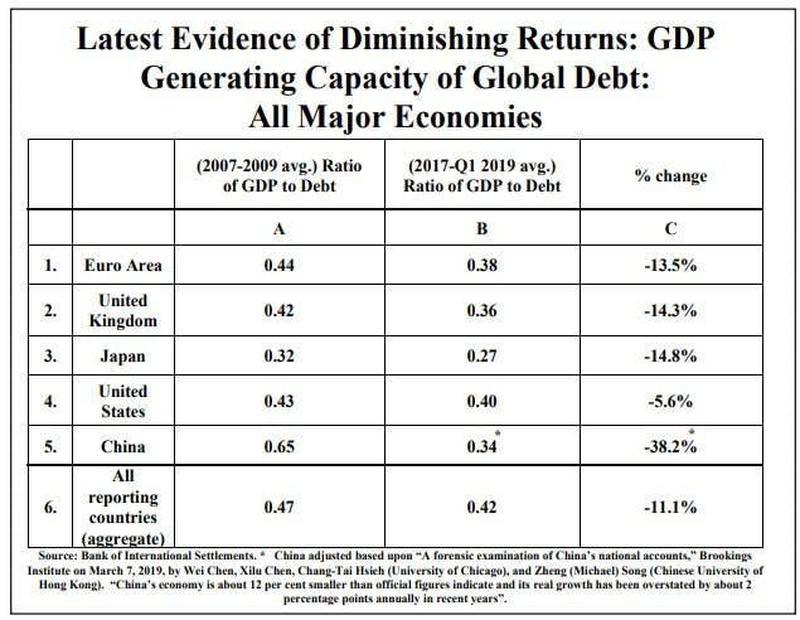
Even some of the most ardent supporters of the fraud that is Keynesian economics now admit the entire modern economic system is on the verge of collapse for one main reason: the marginal utility of debt is collapsing, with ever more debt required to generate an increase in underlying GDP.
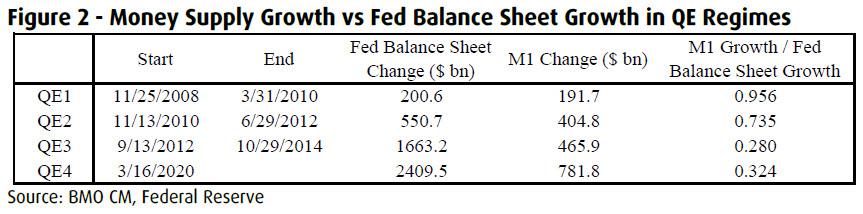
And tied to that, is another reason why any day now the current system may be the last: the marginal utility of every new QE is now declining to the point where soon virtually none of the money created by the Fed out of thin air will enter the economy and instead will be stuck in capital markets, resulting in hyperinflation for asset prices even as the broader economy collapses. Or, as BMO's Daniel Krieter writes, "QE has fed through to the real economy in a slower manner than previous QE campaigns" and for each dollar the Fed's balance sheet has grown, M1 money supply has increased about $0.32, compared to $0.96 and $0.74 in QE1 and QE2. "The expansionary policy thus far has mostly resulted in increased asset prices", BMO writes concluding what had been obvious to us and our readers since 2009. Only now we are ten years closer to what is the inevitable endgame, one where the Fed has no impact on M1, which will also be known as the "game over" phase.
But let's back up.

Traditionally, as BMO explains, we analyze the business cycle from a classical economic perspective where monetary authorities are more passive and “the invisible hand” guides economies (this used to be the case before the Fed went all Politburo on the USSA and decided to nationalize capital markets, crushing any "signal" the bond market may have; the final step will be the launch of Yield Curve Control which will be game over for the market). In this context, we look at interest rates, which can theoretically be defined as the rate that makes the consumer indifferent between consumption today and consumption tomorrow. R* is the (unknowable) natural rate of interest that supports full employment and stable interest rates. In theory, if r<r*, then consumption today is preferable and the economy is expanding. If r>r*, consumption saving is preferable and the economy is contracting.
In an expansionary phase, prices and consumption are increasing. Because prices and investment opportunities are high, demand for money among consumers/businesses is high, and interest rates (r) increase alongside borrowing. When r rises to the rate of r*, consumption slows, earnings fall, and a recession ensues. R* falls as uncertainty and risk aversion grow. This is a “business cycle” recession (and as long as the Fed is around, we will never have one of those again as the Fed has now also killed the business cycle... just as the USSR tried to do).
However, a recession can also be caused by some external shock to the economy that produced further declines in r*. This is because r* is reactive to uncertainty with a strong negative correlation. The greater the uncertainty, the lower r* falls.
In recession, r falls as consumption remains low as long as it is greater than r*. Defaults accelerate the drop in r. With the passage of time, r* rises slowly as the uncertainty/risk aversion surrounding the shock and/or end of business cycle fades. However the longer firms go without earnings due to low consumption, the more defaults are realized and the more r drops. At some point, the combination of falling r and rising r* results in r <= r*. Once this happens, consumption/ investment picks up and the economy enters recovery.
In addition to accelerating declines in r, defaults experienced during recession also lower the cost of labor and capital goods as the resources of failed companies are returned to the economy. In addition, barriers to entry in certain industries fall as “old guard” firms go out of business. Thus, as the economy enters recovery, this combination of cheaper labor/capital goods and lower barriers to entry leads to strong business investment and increases growth potential during the ensuing expansion.
This is how the world works in theory. Unfortunately, since 1913, theory has not worked due to the intervention of the Fed. So now let’s look at how all this works in reality, and introduce an active central bank with a wider range of monetary policy tools at its disposal.

As the economy cools, the central bank lowers r in an attempt to spur consumption by forcing r<r*. Consumption increases in response, and recession/defaults are avoided. But business resources aren’t returned to the economy. Recovery will be less robust due to fewer relative attractive investment opportunities. As Krieter argues, this was the experience of 2001.
Now in 2008, a shock in the form of subprime mortgages hits the economy and uncertainty skyrockets. R* moves into negative territory as shown in a recent San Francisco Fed study. The Fed moves rates lower, but is constrained by the zero bound. In order to further “lower r", the Fed embarks on asset purchases during QE and is successful in spurring consumption, as evidenced by the strong correlation between increases in excess reserves and increases in M1. M1 is the most basic measure of money supply and includes essentially only cash and checking/demand bank accounts.
The theory is that for a good or service to be consumed, it must be paid for out of M1. Therefore, the increase in M1
following QE is a measure of the degree to which QE results in actual consumption.
Note "lower r" in quotation marks in the previous bullet because r is at the zero bound and cannot (at least in the United States) be lowered further. Therefore QE increases money supply which is meant to spur consumption, which is the same desired effect of lower interest rates. In a sense, money supply increases are synthetic interest rate decreases (and synthetic capital market increases).
The combination of QE-driven consumption (r falling) and fading uncertainty after a trillion dollar fiscal stimulus package (r* rising) ultimately pulls the economy out of recession. However, the pace of response in 08/09 was slower. QE was not announced until late November 2008, after large defaults were already experienced. Fiscal stimulus in the form of the ARRA package didn’t arrive until February 2009 with an additional lag in implementation that featured incremental defaults. In the end, almost a trillion dollars’ worth of debt was affected by default in 2008/09, but QE certainly prevented actual defaults from being likely exponentially greater. BMO notes however that defaults avoided were once again economic resources that were not returned to the economy and barriers to entry that are not lowered. This argues that attractive investment opportunities following the financial crisis were not as abundant as the depth of recession would suggest.
As a result, the recovery was slow, ultimately prompting the Fed to embark on additional rounds of quantitative easing in an attempt to spur increased consumption.
Which brings us to the seeds of the Fed's own demise: the problem is that QE appears to be experiencing diminishing returns, as evidenced by a falling correlation between excess reserves and M1 in successive episodes of QE following the financial crisis. As QE leads to a direct increase in bank reserves, only a fraction is translated into money supply growth, and thus potentially consumption and investment. QE1 was highly effective and an important factor behind pulling the economy out of recession. QE2 had a marginally lower, but still high, follow through of .735 indicating that on average, $0.74 of each dollar of QE translated to increased money supply. We observe elevated inflation and personal consumption rates during the period of QE2 as evidence of its effectiveness. However, during Q3, the correlation fell to just $0.28 and resulted in very little inflation of GDP growth. Through this lens, the impact of QE on the real economy has diminished over time.
How does BMO explain the diminishing impact of QE?
  • Diminishing marginal utility of consumption: QE (and monetary policy) is often referred to as "borrowing from the future". However, there is only a limited amount of future consumption that can be pulled into the current period via monetary policy. This could apply to consumption of durable goods: as rates have been relatively low for a long period of time, demand for credit no longer increases at the same rate with incrementally lower interest rates. At some point, consumption does not bring sufficient to utility no matter how long prices or interest rates are.
  • Wealth disparity: Wealth disparity exacerbates the impact of diminishing marginal utility of consumption. For reasons discussed in further detail below, QE tends to inflate the price of financial assets, making those who own the assets more wealthy. A large percentage of QE money ends up in the hands of the wealthy, whose consumption patterns are unlikely to change in response to a near term increase in wealth.
  • Inflation expectations: Finally, the crux of monetary policy plays on expectations. Inflation is self reinforcing as demonstrated by a very high correlation between inflation and inflation expectations. Around the introduction of QE, there was an expectation that it could spawn runaway inflation. Having been through multiple rounds of QE without a large increase in inflation, people have likely generally come to understand that QE is not likely to result inflation, therefore there is marginally less impetus to consume now.
Following five years of no QE in the United States, it appears the utility of current QE has increased modestly in comparison to QE3. However, the follow through to consumption still remains well below levels experienced between Q1 and Q2. It is likely then that current QE is unlikely spurring much consumption as r isn’t influenced lower (via money supply increase) as much as in the past and likely remains well above r*.
Worse, as we discussed last week, one can argue that r* is likely lower now than potentially any point in history, and according to Deutsche Bank it is at an all time low of -1%.
Not only is uncertainty extremely high, but the impact of COVID-19 arguably directly lowers r*. Recall r can be defined as the rate of interest that makes consumption today indifferent to consumption in the future. In all economic models, r is assumed to be positive. But when people are afraid to their leave their house for fear of infection, future consumption actually is more attractive than current consumption. So r* is arguably negative for fundamental reasons for the first time. Greatly heightened uncertainty only pushes it even further negative.
When money supply goes up, but consumption fails to be generated (because r remains well above r*), then savings rates mathematically increase. Therefore, the prices of financial assets increase generally.
During times of risk aversion, bond prices increase first, but supply of safe assets is limited, especially as the Fed buys a substantial portion of the Treasury market. Investors are therefore pushed into riskier assets. But as long as r remains below r*, the more savings go up, the greater the mechanical move in financial asset prices relative to real economic activity.
This, according to BMO, is what’s driving the paradoxical relationship between bond and equity prices in recent weeks, and explains why stocks are performing so well despite the outlook for the greater economy. Money supply that doesn't translate into consumption must result in higher financial asset prices until defaults result in wealth destruction. What does this mean for the recovery? The central bank is displaying reduced capacity to further generate real economic activity as a result of accommodative policy over the past twenty years. This means that recovery is unlikely until r* increases significantly, which only happens alongside fading virus uncertainty. This will take a long time.
During that time, one of two things will happen. Either the government will continue to assist companies in avoiding
bankruptcy, or it will not. If it does, confidence (and r*) will likely return relatively more quickly at a huge cost to the government. However, there will not be a large return of economic resources at the end of this recession and the ensuing recovery will be disappointing given the degree of economic pain currently being felt.
If it does not, defaults could potentially reach historic proportions, and the recession will be long and painful. However, using the "ripping the bandaid" analogy, this scenario would result in likely the largest return of economic resources in the history of the country and lead to a very powerful economic expansion in the wake of the current recession.
Ultimately, the truth likely lies in the middle. The government will continue to provide relief, though not likely in scale large enough to save all businesses. Defaults and downgrades will be staggering, but this will increase the capacity of growth in the ensuing economic recovery.
What does this mean for risk assets? It means that risk assets are being technically supported by stimulus measures so far, particularly QE that is no longer as effective as it was. However, a large wave of defaults is unavoidable without an unlikely near-term (and complete) solution to COVID-19. Heavy defaults, the kinds described in "Biblical" Wave Of Bankruptcies Is About To Flood The US, will likely bring about another wave of risk asset price weakness as wealth is destroyed and technical upward pressure on financial asset prices and a higher percentage of savings demand is met with safe haven assets (Figure 3).
This also explains why the Fed was compelled to enter the bond market, as absent a direct intervention in the secondary market, bond prices would crater and trigger a self-fulfilling doom-loop, where lower bond prices lead to higher defaults, lead to even lower prices and so on. For now, the Fed has managed to delay this process but there is only so much Powell can do to offset the collapse in fundamentals which will lead to continued ratings erosion, and the eventual defaults of countless companies, many of which the Fed will be directly invested in. At that point, the Fed's action in the "market" will become the topic of non-stop Congressional hearings, and will culminate with doubts emerging about the viability of the dollar as a reserve currency.
Until this trigger level is reached, however, QE will continues to pose a technical tailwind, influencing financial asset prices higher. This can be sustained until default rates increase, which is likely not until June or later as government stimulus money starts to run dry, and which point assets will likely take another nosedive lower, just as reports of a second coronavirus pandemic result in (most Democratic) states shuttering again ahead of the presidential election.
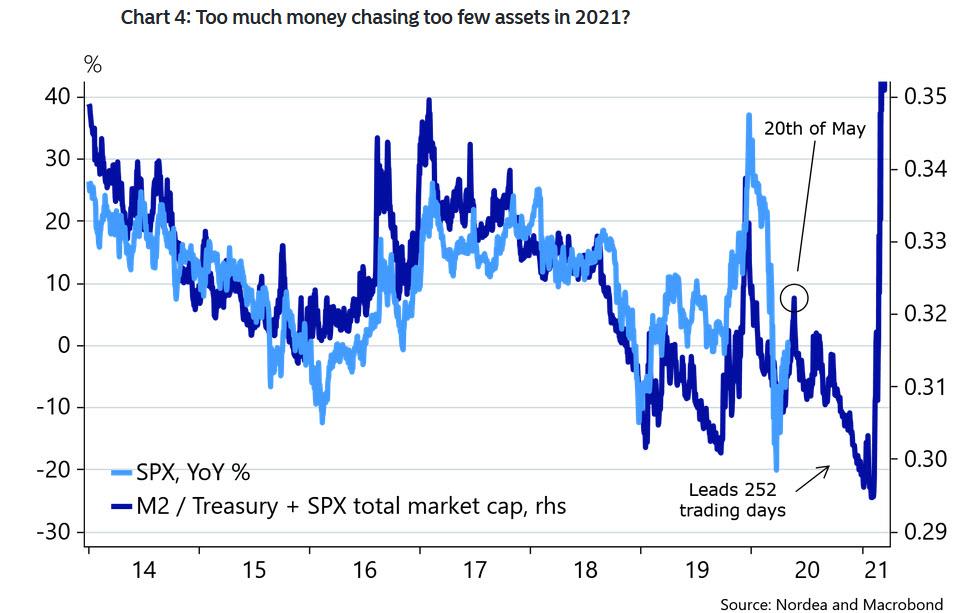
What happens then? Risk assets will continue to slide into the election and into 2021, at which point as Nordea showed last week, we will hit a point where the lagged effect of the flood central bank liquidity will finally hit into the S&P500, and result in one final explosion in risk assets, sending stocks over 40% higher...
... although not of a benign nature but more of what one would expect to see in the Caracas or Weimar stock market.

(ZH) China Asked WHO To Delay Pandemic Announcement, Deny Human-To-Human Transmi

China Asked WHO To Delay Pandemic Announcement, Deny Human-To-Human Transmission: German Intelligence

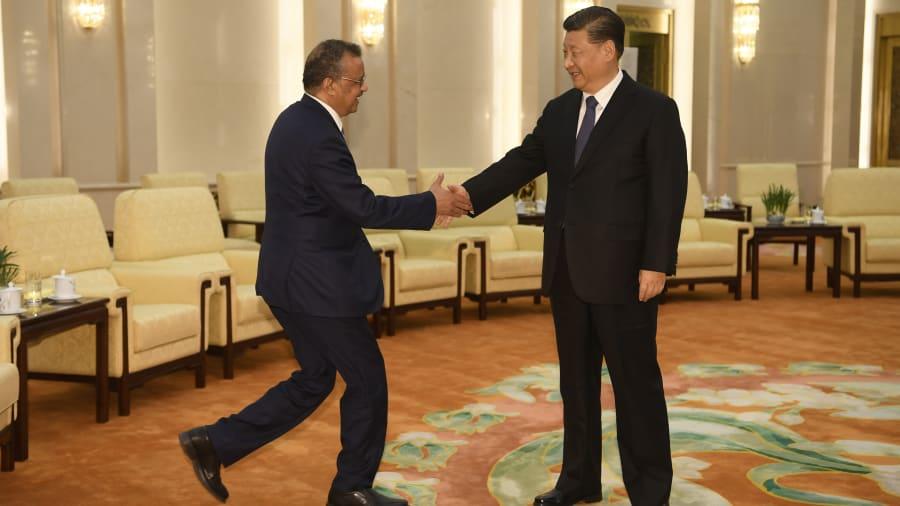
German intelligence has revealed that Chinese President Xi Jinping asked World Health Organization (WHO) Director-General Tedros Adhanom Thebreyesus to cover up the severity of the coronavirus pandemic in January, according to Der Spiegel.
During a January 21 conversation - one week after the WHO assured the world there was 'no clear evidence of human-to-human transmission' - Xi reportedly asked Tedros not to reveal that the virus was in fact transmissible between humans, and to delay declaring that the coronavirus had become a pandemic - despite the virus qualifying as one by the WHO's own former guidelines.
And while the WHO announced on the 22nd that data collected through their own investigation "suggests that human-to-human transmission is taking place in Wuhan," which they said more analysis was required "to understand the full extent," they waited all the way until March 11 to declare the virus a pandemic.

It is now widely recognized that China’s political culture of secrecy helped to turn a local viral outbreak into the greatest global disaster of our time. Far from sounding the alarm when the new coronavirus was detected in Wuhan, the Communist Party of China (CPC) concealed the outbreak, allowing it to spread far and wide. Months later, China continues to sow doubt about the pandemic’s origins and withhold potentially life-saving data.
In mid-January, the body tweeted that investigations by Chinese authorities had found no clear evidence of human-to-human transmission of the virus. Taiwan’s December 31 warning that such transmission was likely happening in Wuhan was ignored by the WHO, even though the information had been enough to convince the Taiwanese authorities – which may have better intelligence on China than anyone else – to institute preventive measures at home before any other country, including China.
The WHO’s persistent publicizing of China’s narrative lulled other countries into a dangerous complacency, delaying their responses by weeks. In fact, the WHO actively discouraged action. On January 10, with Wuhan gripped by the outbreak, the WHO said that it did “not recommend any specific health measures for travelers to and from Wuhan,” adding that “entry screening offers little benefit.” It also advised “against the application of any travel or trade restrictions on China.”
Even after China’s most famous pulmonologist, Zhong Nanshan, confirmed human-to-human transmission on January 20, the WHO continued to undermine effective responses by downplaying the risks of asymptomatic transmission and discouraging widespread testing. Meanwhile, China was hoarding personal protective equipment – scaling back exports of Chinese-made PPE and other medical gear and importing the rest of the world’s supply. In the final week of January, the country imported 56 million respirators and masks, according to official data.

* * *
It's no secret that China engaged in a massive cover-up as the Wuhan coronavirus spiraled out of control. At the same time, the CCP allowed tens of thousands of people to travel for the Chinese Lunar New Year.
As the situation continues to evolve and narratives are shaped, take a close look and remember who's defending who.

Wash. Post : White House aides rattled after positive coronavirus tests and offi

White House aides rattled after positive coronavirus tests and officials send mixed messages on how to respond

The White House on Saturday scrambled to deal with the fallout from two aides testing positive for the coronavirus, as officials who were potentially exposed responded differently, with some senior members of the pandemic task force self-quarantining while others planned to continue to go to work.

Food and Drug Administration Commissioner Stephen Hahn and Centers for Disease Control and Prevention Director Robert Redfield, both task force members, said they are self-quarantining or teleworking for two weeks after exposure to a coronavirus case at the White House. On Saturday night, a spokeswoman for Anthony S. Fauci, the government’s top infectious diseases official, acknowledged that working from home sometimes will be among the precautions he is taking.

But several administration officials said White House staffers were encouraged to come into the office by their supervisors, and that aides who travel with President Trump and Vice President Pence would not stay out for 14 days, the recommended time frame to quarantine once exposed to the virus.

The conflicting ways in which officials and aides are responding after two staff members were diagnosed with the coronavirus this past week — Pence spokeswoman Katie Miller and a military valet to the president — continued to raise questions about how the White House is responding to the challenge of maintaining a safe work environment for Trump, Pence and their staff.

The White House press office declined to comment Saturday on whether employees beyond Miller and the military aide have been told to self-quarantine.

“The president’s physician and White House operations continue to work closely to ensure every precaution is taken to keep the president, first family and the entire White House complex safe and healthy at all times,” White House spokesman Judd Deere said. “In addition to social distancing, daily temperature checks and symptom histories, hand sanitizer, and regular deep cleaning of all work spaces, every staff member in proximity to the president and vice president is being tested daily for covid-19 as well as any guests.”

Sign up for our Coronavirus Updates newsletter to track the outbreak. All stories linked in the newsletter are free to access.

But the nervousness and concern among White House staffers became more palpable on Saturday, according to people familiar with the matter who, like others, spoke on the condition of anonymity to discuss the tensions. Now that Redfield and Hahn are staying away, some officials said they don’t know if they should keep going to work at the White House. Staffers who had potentially been in contact with Miller were still getting calls on Saturday from officials trying to gauge their exposure to the virus, according to one person who received a call.

All White House staffers received a memo from the White House management office on Friday, which encouraged employees to “practice maximum telework” and to “work remotely if at all possible.”

The White House will receive “heightened levels of daily cleaning,” according to the memo. It also told employees they must quarantine for 14 days if they leave the Washington region and must report all of their travel. The memo did not suggest that employees wear masks, as the CDC has suggested for all Americans in public spaces. Masks generally protect other people from the person wearing the face covering, rather than preventing the individual from contracting the virus.

“We are exercising daily caution by testing [Executive Office of the President] staff who have high proximity to the president and Vice President for covid-19,” the memo says. “For any presumptive positive covid-19 results, the White House medical Unit conducts immediate contact tracing and notifies any affected individuals.”

On Thursday, aides began to close the door to the outer Oval Office, and Secret Service and White House officials began to limit who was in the Oval Office, even as Trump continued not to wear a mask and evoked no concern.

Elsewhere in the administration, senior officials were taking varied levels of precaution in response to the positive cases at the White House.

The FDA said late Friday that Hahn began to self-quarantine for two weeks after being exposed to an individual who tested positive. A senior administration official, who spoke on the condition of anonymity because the person was not authorized to discuss the matter, said the individual in question was Miller, who was present at task force meetings attended by Hahn and other health officials.

Redfield “will be teleworking for the next two weeks,” according to a CDC spokesman, who said Redfield “has been determined to have had a low-risk exposure” on Wednesday to “a person at the White House who has covid-19.”

The spokesman, Benjamin Haynes, did not identify the infected person. Haynes said Redfield was last tested on April 27 and had a negative result.

“He is feeling fine and has no symptoms,” said Haynes, who added that, if Redfield needs to go to the White House during his teleworking time, he will have his temperature taken, be screened for symptoms and keep at a distance from others.

Both Redfield and Hahn had been scheduled to testify before the Senate Health, Education, Labor and Pensions Committee on Tuesday, but will now do so by videoconference, Sen. Lamar Alexander (R-Tenn.), the panel’s chairman, said Saturday night.

Health and Human Services Secretary Alex Azar has been tested “multiple times,” most recently on Friday, according to a department spokeswoman. He has tested negative each time and is following the advice of his physicians at the White House Medical Unit, the spokeswoman said.

Asked about a potential quarantine, the spokeswoman said Azar, a member of the task force, is continuing to consult with his doctors about whether that could be necessary.

Fauci, director of the National Institute of Allergy and Infectious Diseases and another task force member, “has tested negative for covid-19 as recently as yesterday,” an institute spokeswoman said Saturday. “He will continue to be tested regularly and is actively monitoring his temperature and other health indicators.”

At first on Saturday afternoon, the spokeswoman said Fauci, one of the administration’s most recognizable figures in the pandemic response, “is considered to be at relatively low risk based on the degree of his exposure. Nevertheless, he is taking appropriate precautions to mitigate risk to any of his personal contacts while still allowing him to carry out his responsibilities in this public health crisis.”

Then, hours later, the spokeswoman said Saturday night that the precautions include “a mix of teleworking and wearing a mask during in-person meetings.”

Brett Giroir, the HHS assistant secretary for health who is in charge of coronavirus testing, has not been at the White House since Tuesday, participating in meetings since then remotely, according to a spokeswoman. He previously tested negative for the virus, the spokeswoman said.

It remains unclear whether some White House officials and other members of the coronavirus task force have been in closer proximity to the infected aides than others and therefore would be at greater risk of contracting the virus.

But concerns were evident at the White House, where there is worry that if Miller and the unidentified personal valet to Trump are infected, then multiple officials may be at risk.

After news of Miller’s diagnosis, aides were going through seating charts, looking at her schedule to discern where she had been and trying to question anyone who may have been close to her in a room. Emails were sent about possible exposure, and staffers were called.

“Any place she spent extensive time was immediately sanitized,” one official said.

Miller was regularly in the Oval Office and around Trump when the daily coronavirus task force news briefings were ongoing, but has not been since the briefings ended a couple of weeks ago. She was in the task force meeting in the Situation Room on Thursday, sitting in the back row facing Pence on the far right side, closer to the door, according to a person familiar with the situation.

Miller, who had told other colleagues that she did not have symptoms, attended a senior staff meeting on the coronavirus at 8 a.m. on Friday and was near other aides, rattling some of her White House colleagues. Neither Trump nor Pence was in the meeting.

A number of aides from Pence’s office were sent home on Friday after the contact tracing was complete. Miller is married to top White House aide Stephen Miller, who is expected to quarantine at home for the time being.

Friday was “totally nuts,” a senior administration official said.

A White House official said all visitors and employees now will be questioned by doctors about a list of symptoms before they enter the complex. The East Wing staff is wearing masks.

Agents on the president’s detail — who work in three rotating shifts — typically huddle in a small “down room” a floor below the Oval Office when Trump is there. Those agents have been wearing face masks for several days, according to one administration official, due to concerns they cannot appropriately distance in this confined space.

But other Secret Service agents are not wearing masks on campus, according to two senior administration officials who interact with Trump.

The concerns are spreading to the Trump campaign, where a senior official said there was no plan to hold a large-scale campaign event with the president until at least August.

“It’s just not practical right now,” the official said, “to even try.”

FT : Forensic auditor to review every transaction at Lebanon’s central bank

Forensic auditor to review every transaction at Lebanon’s central bank
Economy minister says comprehensive inspection is part of measures needed to save economy

A forensic auditor will review every transaction at Lebanon’s central bank, the economy minister said, in an exercise set to increase pressure on the long-serving head of the Banque du Liban as the government seeks a way out of its most severe economic crisis in decades.

The independent auditing firm, one of three appointed last month, “will look into all the transactions” to understand what has been done and the “validity” of each arrangement, Raoul Nehme, economy minister, told the Financial Times. “Whatever bailouts and so on. Everything that was done.”

When the audit was announced in April, it was pitched by Prime Minister Hassan Diab as a measure to improve transparency for creditors after the government defaulted on its foreign borrowing for the first time and asked to restructure $90bn of debt.

But tensions between Mr Diab and Riad Salame, governor of the central bank, came to a head last week after the prime minister criticised his handling of the country’s monetary crisis. Mr Salame, who has run the bank since 1993, responded by saying that the Banque du Liban had often propped up the government and alleged there was a targeted campaign against him.

In 2016, Mr Salame launched the bank’s first so-called “financial engineering” operations with local lenders, combining a complex series of swaps involving government debt, and local currency and dollar deposits at Banque du Liban. The costly scheme attracted foreign reserves and helped the bank shore up the country’s dollar-pegged currency, but also helped boost profits at Beirut-based lenders, some of whom were in financial difficulty.

Mr Nehme, who was the executive general manager of Lebanese lender Bank Med from 2018, said the audit would go back as far “as needed” but would focus on the most recent of the financial engineering operations.

The international firms KPMG, Kroll and Oliver Wyman, which the government named last month to run the audit as part of a plan to restructure the banking sector, did not respond to requests for comment. Mr Nehme said he could not yet officially confirm which of the three companies would run the forensic audit. Mr Salame was not immediately available to comment.

Lebanon’s new government estimates that the financial sector is sitting on about $80bn worth of losses, which it says must be tackled for the import-dependent economy to recover from its intertwined fiscal, economic and banking crises.

The government, central bank and political parties could turn things round if “we all work hand in hand and forget the political bickering”, Mr Nehme said in the interview this week. “We’re all in the same boat. So if one of us is going to make a hole in the boat, we will all sink.”

On the parallel market, the value of the Lebanese pound against the dollar has fallen about 60 per cent since late January and food prices have more than doubled year on year. Protests have reignited and last month rioters torched dozens of banks.

An economic recovery plan approved by cabinet last week had a “menu” of options for sharing bank losses between shareholders, the state and large depositors, Mr Nehme said.

The plan also sketches out a route to reducing Lebanon’s 175 per cent debt to gross domestic product ratio and gradually unpegging its rapidly depreciating currency from the dollar. It has paved the way for intervention by the IMF, to which Beirut has turned for budgetary support.

While Lebanon was focused on securing multilateral support for the economy, Mr Nehme said the government would also seek to renegotiate its trade agreements with the EU and Arab states, which contained clauses that “are unfair to Lebanon”, he said.

But with the government so strapped for cash, he said he was relying on unpaid advisers and economists for help. “I have economists working for free, and, hopefully soon, I will have other big name advisers,” he said.