>>> TradeGate Pre-Market Indications

DAX:
  • Deutsche Telekom (DTE TH) +1.5%
    • ESG Could Bring Interest to ‘Unloved’ Telecoms Sector: Berenberg
  • Bayer (BAYN TH) +1.3%
  • Vonovia (VNA TH) +1.2%
    • Vonovia to Join Euro Stoxx 50 Benchmark
  • BMW (BMW TH) +1.2%
  • SAP (SAP TH) +1.1%
MDAX:
  • Siltronic (WAF TH) +2.1%
    • Siltronic Recovery Potential Not Fully Priced In: Jefferies
  • Evotec SE (EVT TH) +1.8%
  • Commerzbank (CBK TH) +1.7%
    • Commerzbank Considering Dropping EY as Auditor: Sueddeutsche
  • Hugo Boss (BOSS TH) +1.4%
  • Siemens Healthineers (SHL TH) +1.3%
SDAX:
  • DIC Asset (DIC TH) +1.6%
  • Jenoptik (JEN TH) +1.1%

>>> What to look a today - 2nd of September 2020

U.S. and European stock-index futures rose Wednesday, while Asian equity markets were mixed as investors assessed valuations with global shares at a record high. Emerging-market currencies weakened.
Stocks in Japan and South Korea posted modest gains, while China, Hong Kong and India edged lower. S&P 500 futures rose after a climb in Apple Inc. again pulled the benchmark to an all-time high. Euro Stoxx 50 contracts also advanced.
The dollar was steady, having erased overnight losses as data showed U.S. manufacturing expanded last month at the fastest pace since 2018. The euro edged further down from $1.20, a level it breached for the first time in over two years Tuesday. Treasury yields ticked up. The Aussie dropped after a worse-than-expected reading on second-quarter growth.
US After Hours HOME -14.9%, SCVL -12.5% are weak on earnings; AMC +9.6% jumps as more theaters open; 

Nikkei +0.45% Hang Seng -0.15% CSI +0.20% Shanghai -0.10% Shenzen +0.54%

Eur$ 1.1906 CNH 6.8297 CNY 6.8289 JPY 106.03 GBP 1.3377 CHF 0.9113 RUB 73.6415 WTI$ 43.17 +0.96%

S&P +0.43% Nasdaq +0.69% EuroStoxx +0.76% Dax +0.92% SMI +0.61%

Macro :
- Draghi Says Stimulus Must Create New Jobs, Not Save Old Ones
- Fed’s Brainard Says Economy Still Needs Fiscal, Monetary Support
- Pentagon Says China Nears Milestone in Nuclear Arms Buildup
- Copper Rises to Two-Year High on China Data, Dollar Weakness
- Euro Stoxx 50 Drops SocGen, Orange, Telefonica, Adds Adyen (2)

Keep an eye on :
- ADP FP : ADP Plans as Many as 1,400 Voluntary Job Cuts, Unsa Union Says
- AIR FP : Airbus Jet Use Shows Fragile Recovery Propped Up by China
- ATL IM : Italy, Benettons Consider Two-Step Plan for Autostrade Sale
- BIG FP : Bigben Lifts FY 2020-21 Targets, Sees Sales of EU270M to EU290M
- BIM FP : BioMerieux First Half Adjusted Operating Income EU253 Mln
- EN FP : Bouygues Unit Colas Wins Bangkok Airport Extension Contract
- CINE LN : Watch Cineworld After AMC Says 70% of U.S. Theaters to Be Open
- CBK GY : Commerzbank Considering Dropping EY as Auditor: Sueddeutsche
- CSGN SW : Credit Suisse Spying Probe Escalated by Swiss Regulator Finma
- DANSKE DC : Danske to Be Probed by Danish FSA After Debt System Errors
- ALDEL FP : Delfingen Buys Schlemmer’s Activities in Europe and Africa
- FERG LN : Ferguson Raised to Buy at HSBC; PT 8,450 pence
- MS IM : Dutch Court Prohibits Mediaset’s Spanish-Italian Merger
- NEOEN FP : Tesla’s Outback Big Battery Fails to Retake Crown After Upgrade
- HNSA SS : Hansa Biopharma Sees Delay in U.S. Patient Enrollment for Study
- RI FP : Pernod Earnings Decline Less Than Expected on At-Home Shift
- PSH NA : Pershing Square Holdings Aug. Net Performance +8%
- ROG SW : Roche to Unveil Rapid Covid-19 Test in Nations Accepting CE Mark
- TSLA US : Tesla’s Possible Addition to S&P 500 May Come Soon, Analyst Says
- UNA NA : Unilever Will Spend $1 Billion to Rid Cleaning Products of Oil
- VK FP : Vallourec to Seek Banks’ Consent for Fin. Restructuring Talks
- VOW3 GY : Portugal Jan.-Aug. Light Vehicle Sales Fall 41.3%, Acap Says

>>> Europe : Brokers Upgrades & Downgrades - 2nd of September 20

>>> Up
* CompuGroup Medical SE & PT Raised to 90 euros at Deutsche Bank
* Eiffage Raised to Neutral at Goldman; PT 83 euros
* Siemens Gamesa Raised to Buy at Goldman; PT 25.40 euros
* Zillow Raised to Buy at Deutsche Bank; PT $106

>>> Down
* Bankinter Cut to Underweight at JPMorgan; PT 3.85 euros
* Codemasters Cut to Add at Peel Hunt; PT 420 pence
* Encavis Cut to Hold at Berenberg; PT 15 euros
* Ferguson Cut to Neutral at JPMorgan; PT 7,900 pence
* Flughafen Wien Cut to Hold at Erste Group; PT 27.30 euros
* Kingspan Cut to Neutral at JPMorgan; PT 68 euros
* Securitas Cut to Neutral at JPMorgan; PT 135 kronor
* UnipolSai Cut to Hold at SocGen; PT 2.55 euros

>>> Initiation
* AJ Bell Rated New Hold at Panmure Gordon; PT 451 pence
* Brewin Dolphin Rated New Hold at Panmure Gordon; PT 280 pence
* Brooks Macdonald Rated New Buy at Panmure Gordon
* IntegraFin Rated New Hold at Panmure Gordon; PT 569 pence
* PVA TePla Rated New Buy at Jefferies; PT 18 euros
* Quilter Rated New Buy at Panmure Gordon; PT 199 pence
* Rathbone Brothers Rated New Hold at Panmure Gordon
* Siltronic Rated New Buy at Jefferies; PT 105 euros
* TOMRA Reinstated Sell at Arctic Securities; PT 250 kroner

>>> Call
* Aggreko Could Face Further Valuation Pressure: Morgan Stanley
* Encavis Shares Now Reflect Good Outlook, Berenberg Cuts to Hold
* ESG Could Bring Interest to ‘Unloved’ Telecoms Sector: Berenberg
* Siltronic Recovery Potential Not Fully Priced In: Jefferies

>>> US After Hours Summary: HOME -14.9%, SCVL -12.5% are weak on earnings; AMC +9.6% jumps as more theaters open;

After Hours Summary: HOME -14.9%, SCVL -12.5% are weak on earnings; AMC +9.6% jumps as more theaters open;

After Hours Gainers:

Companies trading higher in after hours in reaction to earnings/guidance: CAL +6.9%, CDMO +5.6%

Companies trading higher in after hours in reaction to news: OSH +12.9% (announces collaboration with WMT to offer clinics at Dallas area locations), AMC +9.6% (expects to reopen at approx 140 additional theatres this week), TGI +2.2% (extends partnership with Airbus), RPM +1.4% (to acquire abrasives manufacturer Ali Industries), GOGO +1.1% (S&P CreditWatch revised to positive from negative), AMRN +0.4% (presents data evaluating VASCEPA), AMGN +0.2% (data showing humoral immune response to SARS-CoV-2), VHC +0.2% (Apple's motion for relief from judgment gets denied by court, according to Scribd.com), HL +0.2% (increases dividend), GM +0.2% (to meet with Ivanka Trump on Wed, according to CNBC), FLWS +0.1% (Founder and his Family Trusts recently sold 2% of holdings for tax and estate planning), V +0.1% (provides August operating metrics)

After Hours Losers:

Companies trading lower in after hours in reaction to earnings/guidance: HOME -14.9%, SCVL -12.5%, JAMF -9.2%, HRB -2.7%

Companies trading lower in after hours in reaction to news: HLNE -4% (stock offering), AIR -2.2% (signs new services agreement with Frontier Airlines), CBZ -1.5% (acquires ARC Consulting and ARC Placement Group), NKLA -0.6% (WOR says in August its WI Ventures unit sold 6.5 mln shares of Nikola), TBPH -0.5% (stock offering), DHR -0.2% (new CEO), T -0.1% (Bloomberg says co will abandon sale of its Warner Bros. video game business)

>>> US Close Dow +0.76% S&P +0.75% Nasdaq +1.39% Russell +1.07%

Closing Stock Market Summary

The S&P 500 (+0.8%) and Nasdaq Composite (+1.4%) rallied to fresh record highs on Tuesday, with the Nasdaq getting an added boost from the momentum in the mega-caps and growth stocks. The wealth spread around to the Russell 2000 (+1.1%) and Dow Jones Industrial Average (+0.8%), too. 

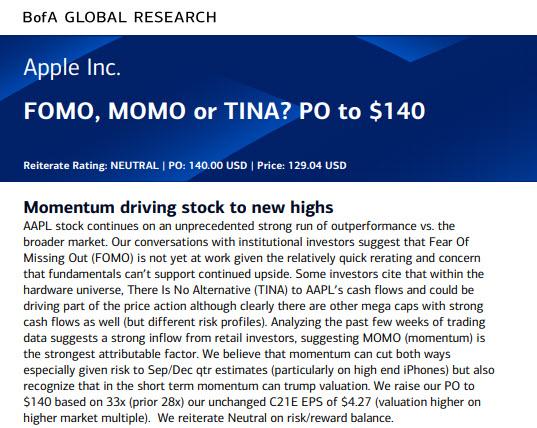
Today's key moves were Apple (AAPL 134.18, +5.14, +4.0%) rising 4% after JPMorgan raised its price target on the stock to $150 from $115, and Zoom Video (ZM 457.69, +132.59, +40.8%) surging 40% after it crushed Q2 earnings expectations.

Apple was a major factor in today's index gains given its 7.3% weight in the S&P 500, while Zoom provided the fuel for other growth stocks like Netflix (NFLX 556.55, +26.99, +5.1%) and DocuSign (DOCU 268.80, +45.80, +20.5%). Another supporting factor was the ISM Manufacturing Index for August increasing to 56.0% (Briefing.com consensus 54.5%) from 54.2% in July.

The manufacturing data helped lift the S&P 500 materials (+2.8%) and industrials (+1.0%) sectors into positive territory with the information technology (+1.9%), communication services (+1.0%), and consumer discretionary (+1.1%) sectors. Each advanced at least 1.0%. 

Conversely, the utilities (-1.1%), health care (-1.0%), and utilities (-0.9%) sectors underperformed and declined around 1.0%. 

Recapping some other mega-cap moves, Walmart (WMT 147.59, +8.74, +6.3%) climbed 6% after officially introducing its Walmart+ membership program. Tesla (TSLA 475.05, -23.27, -4.7%), however, was a notable holdout after the company disclosed plans to sell up to $5 billion in stock. 

U.S. Treasuries ended the day higher after reclaiming overnight losses. The 2-yr yield declined two basis points to 0.11%, and the 10-yr yield declined two basis points to 0.67%. The U.S. Dollar Index increased 0.2% to 92.34 after being down 0.4% in the morning. WTI crude futures increased 0.3%, or $0.14, to $42.76/bbl.

Reviewing Tuesday's economic data:

  • The ISM Manufacturing Index for August increased to 56.0% (consensus 54.5%) from 54.2% in July. The dividing line between expansion and contraction is 50.0%. The August reading is the highest level for the index since January 2019.
    • The key takeaway from the report is that it is a reflection of an encouraging rebound in manufacturing activity following the sharp contraction seen in April and May.
  • Total construction spending increased 0.1% m/m in July (consensus +1.0%) on the heels of an upwardly revised 0.5% decline (from -0.7%) in June. Total private construction spending rose 0.6% and total public construction spending fell 1.3%.

Looking ahead, investors will receive the ADP Employment Change Report for August, the Fed's Beige Book, Factory Orders for July, and the weekly MBA Mortgage Applications Index, and auto and truck sales for August on Wednesday.

  • Nasdaq Composite +33.1% YTD
  • S&P 500 +9.2% YTD
  • Dow Jones Industrial Average +0.4% YTD
  • Russell 2000 -5.4% YTD

(ZH) Apple's Market Cap Surpasses The Entire Russell 2000 Due To "Option Insanit

Apple's Market Cap Surpasses The Entire Russell 2000 Due To "Option Insanity"

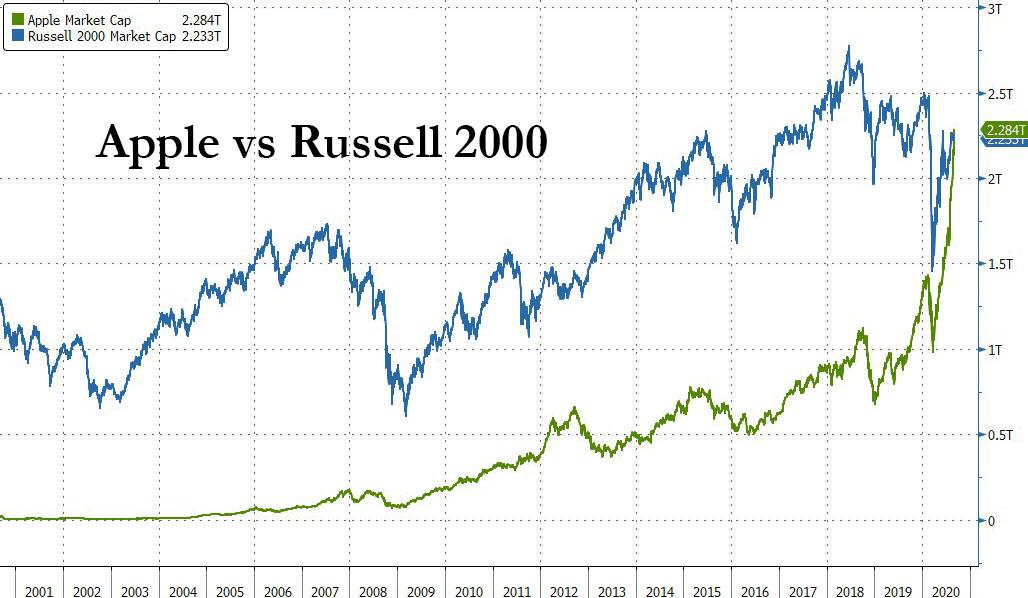
On Monday, in a tweet that went viral, we showed that the market cap of Apple was on the verge of overtaking the entire Russell 2000 index of small-cap companies.
Well it's now official, and as of Tuesday's 4.3% jump in AAPL stock price largely on the back of the latest upgrade from Bank of America, which raised its price target to $140 post-split citing an even greater multiple expansion as the catalyst (because there is nothing else really)...

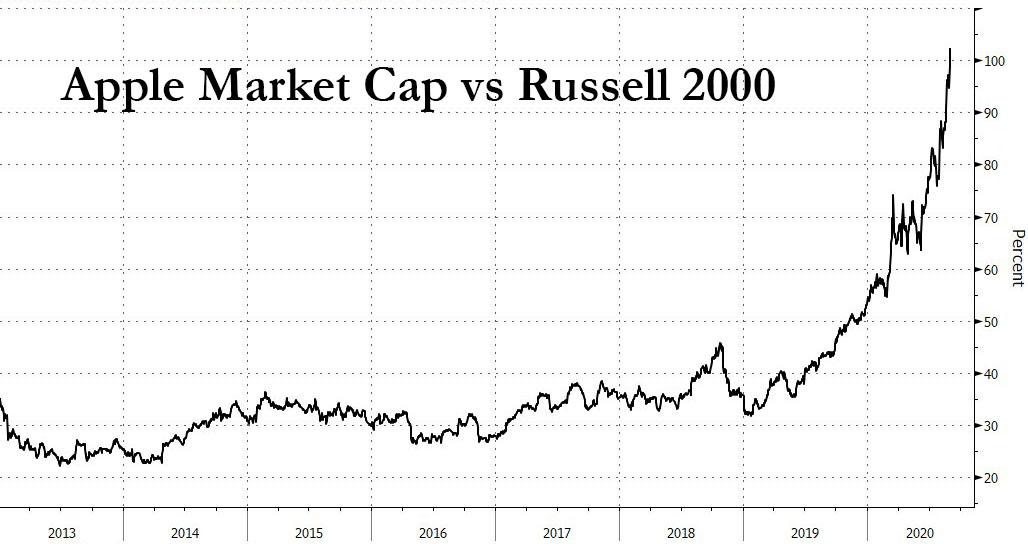
... which helped propel Apple's market cap to $2.3 trillion, Apple's market cap is now greater than the entire Russell 2000 for the first time ever.
The next chart shows the historical transformation of Apple as not only the biggest company in the world, but also the one company which now has the biggest impact on pretty much anything market-related.
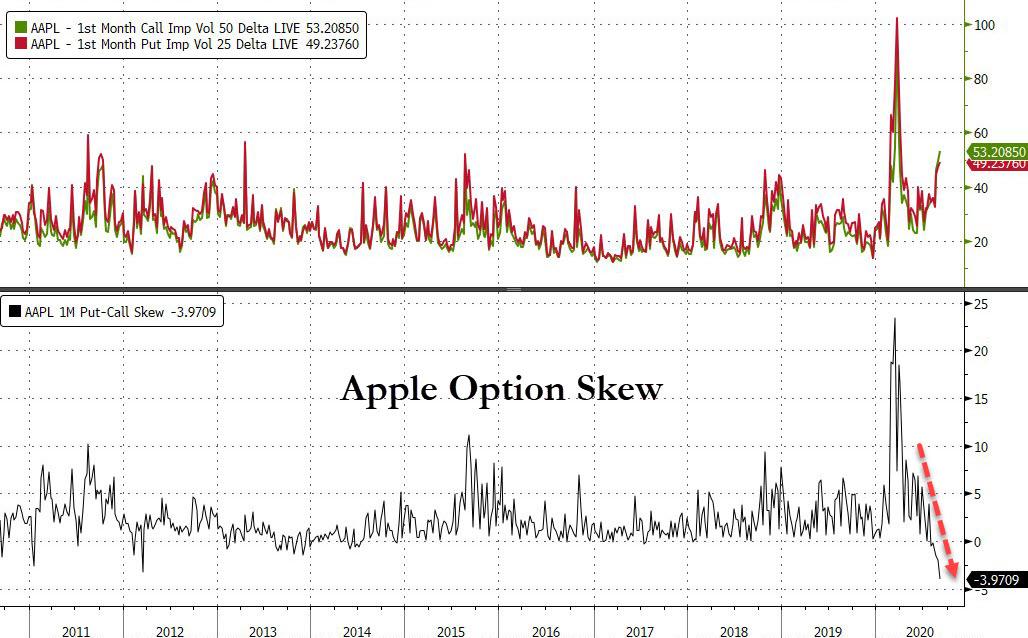
We previously discussed the unprecedented negative put-call skew, which we said will keep pushing AAPL even higher due to the layered gamma which is creating an upward feedback loop, and sure enough this is still the case.

And since nothing else has changed and we already showed what is going on from a delta- and gamma-hedging perspective...
... we will give the last word to the Bear-Traps report which describes the "Insanity" in Apple Options:
The convexity skew picture on big-name equities like Apple $AAPL has gone parabolically stupid. Let’s keep this simple and draw a conclusion.
  • Apple $AAPL Stock near $130
  • Jan $180 Strike Calls costs $4
  • Jan $80 Strike Puts costs $1
*Both options are $50 out of the money, approx data, BUT it is nearly 3x more expensive to buy upside risk in AAPL equity. What does this mean?
Apple closed near $130, while the cost of speculative upside calls is weighted heavily against the buyer. Someone must have reached out to Buffett today because he can make a fortune in selling $AAPL upside calls. Let us explain.
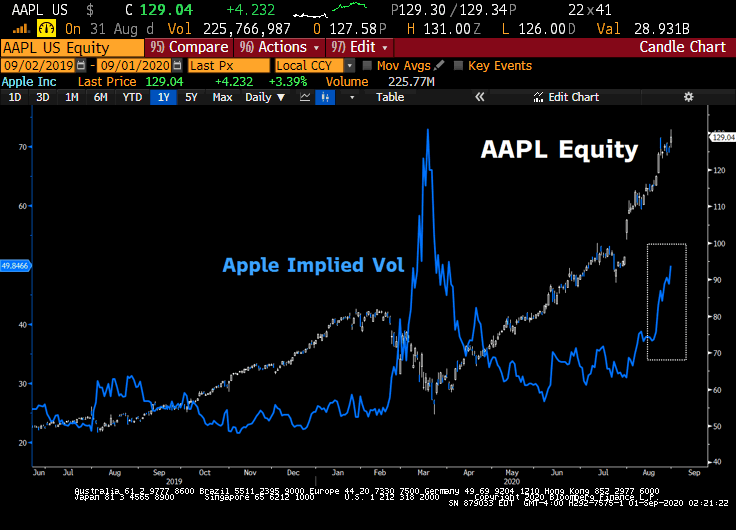
Highly unusual activity, we have a higher stock price in Apple AAPL with a much higher cost of equity upside. Equity vol usually explodes higher in market crashes, NOT bull markets. As you can see above, in normal Apple equity bull markets – see all of 2019 – AAPL implied vol has been CHEAP!
In our institutional client chat on Bloomberg, a hedge fund put on this trade and we are sharing it with permission.
Think of the January 2021 expiration. The client bought the $200 call and sold the $250 call, 1 x 4, and got paid $3.50 to put the trade on.
Apple was worth $1.5T at the end of July and today she stands tall at $2.2T. In order for the client to lose money* at January expiration, the stock has to breach $270 ($129 today), which would put the company’s market capitalization very close to $5T, by January 2021, that is a little over four months away.
*The mark to market in the short run can be extremely painful though – if Apple equity soars another 10-20% (Apple is up 50% since late July), that is indeed the catch. AAPL is trading nearly 65% above its 200-day moving average vs. 42% in February’s great bull run.
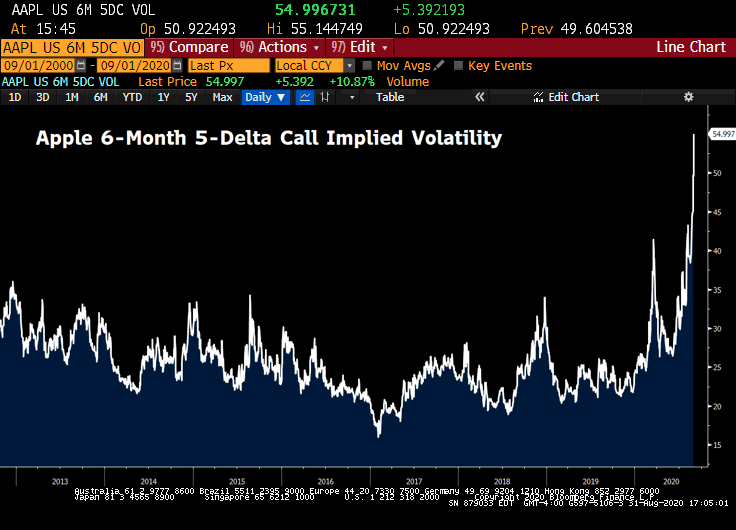
There are a handful of quant funds pushing around a few stocks (with high impact on QQQ, NDX, SPY) in the options markets. The dealers are getting very nervous. Last 15 days – Imaging being a large market maker in Apple and Tesla equity options. You make a market, bid – offer, you get lifted and lifted over and over again by buyers to the point where you have raised the price of calls vs puts to multi-year extremes. How short is the Street gamma? VERY.
When call vs. put skew gets this extreme it can be a solid leading risk indicator.

(ZH) The True Costs Of Zombie Companies And Easy Money

The True Costs Of Zombie Companies And Easy Money

Recent data published by Yardeni Research Inc., Bank for International Settlements (BIS), the Institute of International Finance (IIF), and in the Federal Reserve Bank of St. Louis Economic Data (FRED) database offers an insight into the true extent of central banking practices before and during the covid-19 pandemic.
The wide-ranging implications of this can be seen through several critical dimensions. But first we must understand the destructive nature of central banking.
If we accept the main premise of central banking, that the central bank is the lender of last resort, it follows that in this last resort event the central bank must have a pool of wealth to lend from. After all, in order to lend to someone, you have to own something of value. In this situation, the central bank prints money, which, to that extent, is where it derives its pool of assets for lending from, taking from people via inflation. Paradoxically, the central bank therefore lends to banks by stealing from the people, whereas the banks are then expected to loan that money back to people. This theft is, however, subtle, not seen as a direct tax or immediate confiscation, but through the destruction of real savings and purchasing power.

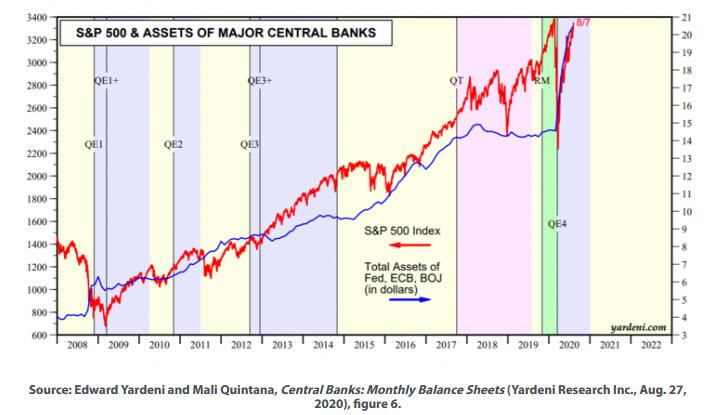
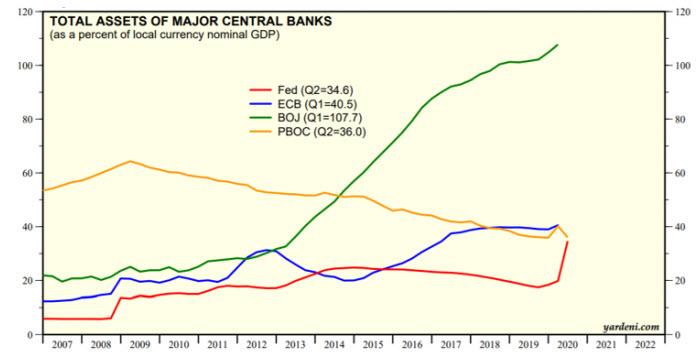
From the beginning of this year to June, the total assets of major central banks (the Fed, ECB, BOJ, PBOC) have jumped by a near $6 trillion. This rapid ascent is likely going to continue as the year progresses. Similarly, in Q1 of this year, global debt rose to $258 trillion, representing an all-time high of 392 percent of GDP. Households, businesses, and governments are taking on more debt in hopes of offsetting the acute economic pains of the crisis. But the false sedative of debt will soon dissipate, revealing the true pain behind all these distractions. Make no mistake, what is being done by governments and enabled by central banks is akin to paying credit card debt with more credit cards.
This data should alarm you and the immediate question should be, Who’s going to pay for it, and who benefits? In the bizarre world of negative interest rates, however, that question becomes all the more complicated.
Artificially low interest rates have enabled the longest bull run in US history (2009–20). Cheap borrowing has propped up unprofitable zombie corporations which rely on loans to pay back loans. In conjunction with quantitative easing efforts, the S&P 500 has not only recovered since the covid March meltdown but surpassed its all-time high.
Low interest rates have historically made it cheaper to mortgage a house, finance a car, and pay for student debt—in the long term, however, it has made all of these more expensive. By enabling cheap borrowing to finance spending, particularly on assets such as housing and in the equities market, central banks have infused those markets with artificial demand which in turn causes prices to skyrocket.
By indirectly monetizing and devaluing the real value of debt, central banks have cut the brake wires off government spending.

Its no coincidence that the moment the Fed started to unwind its balance sheet in 2018 markets went berserk. When the Fed shrank its assets by just around 6 percent between early 2018 and February 2019, the market plummeted by twice that.
The most recent market faltering in March was a very real indicator of upcoming economic trouble. It was all covered up by the Fed, however, which bought $500 billion in Treasury securities and $200 billion in mortgage-backed securities to provide so called “emergency liquidity.”
In effect, the Fed’s actions diverted scarce resources from productive sectors to monetize government debt, inflate a chaotic asset bubble, and send the bill to everyone else. Importantly, this has created an environment of haves and have-nots. So, although so-called conservative politicians are scratching their heads about the popular rise of socialism, should we really be that surprised?
The true mark of economic recovery should not be measured nominally in dollars and cents, but in terms real interest rates. When markets, not bureaucrats and central bankers, set interest rates, markets equilibrate, allowing for productive and allocative efficiency. The true sign of a growing and healthy economy should instead be a positive real interest rate set by market forces.
Positive real interest rates indicate that investments/savings are yielding positive returns and thus creating wealth. This means that people, businesses, and governments are rewarded for saving. In the world of negative interest rates, the opposite is true.
When real interest rates are negative, they create distortions in markets. Consider that between March 23 and the day I write this (August 8), nearly every popular US asset has inflated. Equities such as the NASDAQ and S&P 500 have risen by 61 percent and 50 percent respectively, bitcoin by 81 percent, and gold by 36 percent. Through the manipulation and debasement of currency, however, this asset inflation should be a warning signal to everyone not that their assets are necessarily worth more, but their dollars worth less.
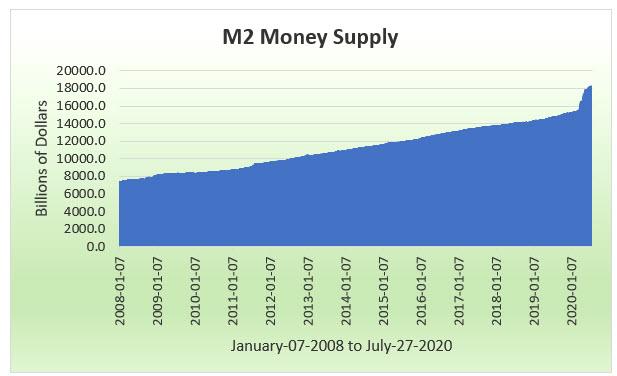
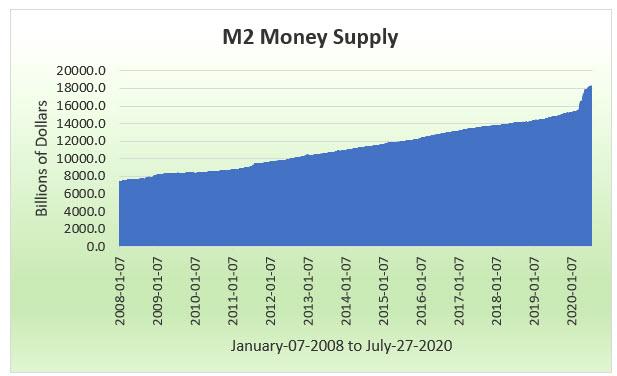
This asset inflation coincided with a sharp M2 money supply increase (roughly 20 percent year over year).
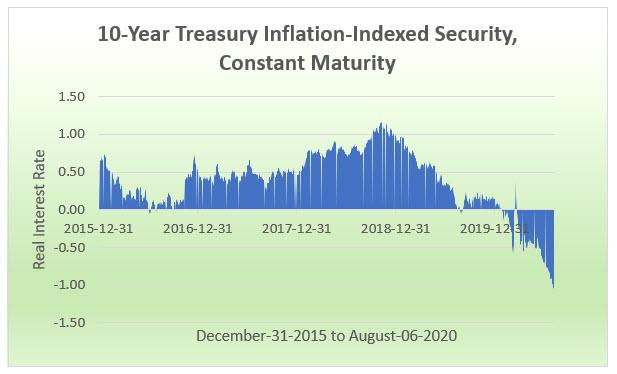
Nonetheless, when real interest rates are negative, bubbles are to be expected. Since the covid crisis, ten-year inflation-indexed bond yields have crashed, falling even below –1 percent.
Unsurprisingly, these rates have dropped so low not particularly because their yield is negative (although they did dip below that level slightly in March), but because inflation is higher than the yields.
This is something that the traditional CPI (Consumer Price Index) will fail to capture. Using irrelevant baskets of consumer goods such as air travel, nightclubs, and hotels among other things paints a false picture. Of course, now more than ever there is more money chasing fewer goods, with many businesses being closed and stimulus checks coming in. The recent sharp increase in the money supply will therefore drive real inflation even higher and real interest rates lower.
Real negative rates serve to accelerate global indebtedness and solidify zombification. As the balance sheets of central banks grow, so does the indirect subsidization of inefficient corporations. By taking out corporate loans at a real interest rate of below zero, zombie corporations manage to have their lender of circumstance actually pay them for taking on debt. By keeping inefficient players in the marketplace, innovative entrepreneurs are blocked from creating wealth and market barriers to entry are raised through a slow and steady engulfment of scarce resources, furthering an unprecedented inequality of wealth via central bank–induced monopolization.
In 2019 the BIS determined that over 10 percent of the publicly traded firms of fourteen developed countries were zombies. My assessment is that by the end of this crisis that statistic will be much higher. In the US, the number is nearly 20 percent according to Deutsche Bank Securities.
When borrowing money is so cheap (in fact, they pay you!) zombification is an inevitable process. Analyzing quarterly data from 1998 to 2020, 8 percent of the variance of corporate debt levels as a percentage of equity can be directly attributed to changes in M2 levels. Utilizing regression analysis, the null hypothesis of this relationship (that the variables are unrelated) has a p-value of 0.0000 and a t-score of 588, or in other words there is an almost 100 percent chance that the relationship between these two variables is statistically significant.1
Japan is the historical home of zombies and is still suffering from the peak of its crisis in the eighties. As of 2018, Japanese corporations had taken out $4.59 trillion in loans, the highest amount since 1997. Japan’s myriad economic problems not only include the zombification of its companies but also of its people, as they face the challenges of an aging population. As its balance sheet surpasses 100 percent of GDP, the BOJ is essentially doubling down on past failed policies.
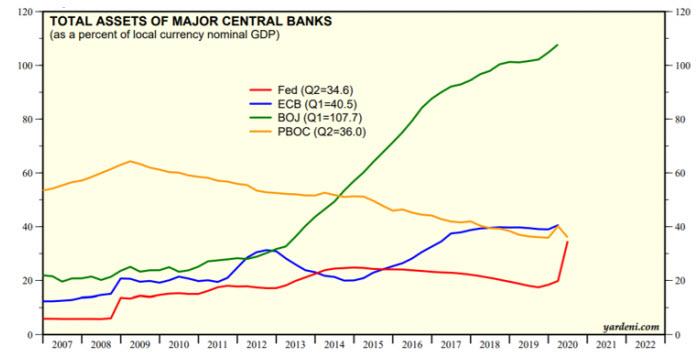
Source: Edward Yardeni and Mali Quintana, Central Banks: Monthly Balance Sheets (Yardeni Research Inc., Aug. 27, 2020), figure 5.
Keeping inefficient zombie corporations may boost short-term employment by avoiding the general turnover of firm market share; however, in the long term they massively drain resources and block future employers out of the marketplace. The BIS writes:
Specifically, the estimation results suggest that a 1 percentage point increase in the narrow zombie share in a sector lowers the capital expenditure (capex) rate of non-zombie firms by around 1 percentage point, a 17% reduction relative to the mean investment rate. Similarly, employment growth is 0.26 percentage points lower, an 8% reduction. However, under both definitions we find that non-zombie companies invest more and have higher employment growth.
Following the 2008 crisis a radical experiment of depressed and even negative interest rates was employed by the Fed, BOC (Bank of Canada), ECB (European Central Bank), and other central banks. Now, however, the resources that were previously available to fight recessions have been totally depleted combating the last recession. Fighting debt with debt is irresponsible and unfair to future generations—clearly fiscal and monetary restraint is needed.
The interplay between rising debt levels, negative real interest rates, and zombification should concern us all—especially in the context of global lockdowns. But it should not be capitalism which we blame for this crisis. Quite the contrary, in fact; we should blame central banking and its destructive economic capabilities.
(ZH) Bill De Blasio Says NYC Indoor Dining May Not Happen Until June 2021

Bill De Blasio Says NYC Indoor Dining May Not Happen Until June 2021

Not satisfied with watching from the sidelines as his city descends into a war zone, Mayor Bill de Blasio seems to be doing everything he can to drive citizens and business owners out of the city. His latest idea came on Monday, when de Blasio said he may not open indoor dining in the city until a vaccine for Covid is released. This means that indoor dining in the nation's most popular city may not happen during 2020, despite the fact that outdoor dining is going to be far more difficult to continue heading into the winter months.

We're sure this will be the most "popular" idea with restaurant owners since Philadelphia's Mayor was spotted dining indoors in Maryland while keeping Philadelphia-area restaurants shut down for indoor dining. The news, obviously, could be crippling to business owners.

de Blasio has backed a June 1, 2021 re-open date, despite many other major U.S. cities all setting up to re-open heading into the fall. He said Monday: “We do expect — and pray for and expect — a vaccine in the spring that will allow us to get more back to normal, but I will absolutely tell you, we’re going to keep looking for that situation where we can push down the virus enough where we would have more ability to address indoor dining.”

Meanwhile, the city is posting its lowest infection rate in months at 0.59%. Across the river in New Jersey, restaurants are setting up to reopen for indoor dining at 25% capacity starting Friday (in addition to open outdoor seating). Almost every other region in New York has also reopened for some type of indoor dining.

But de Blasio isn't convinced: "Is there a way where we can do something safely with indoor dining? So far we have not had that moment, honestly. It’s going to take a huge step forward to get to that point and that’s the truth."

Meanwhile, NYC residents are also taking "giant steps" as they flee the city in droves.