WWD : 3 Strategies That Could Save the 2020 Holiday Season

3 Strategies That Could Save the 2020 Holiday Season
Sanjeev Sularia of Intelligence Node discusses how retailers can succeed in the upcoming season.

In November 2019, my company, Intelligence Node, asked consumers if they were planning to cut back on spending during the upcoming holiday season, in part due to tariff and recession fears. While almost half (49 percent) said they were, holiday sales actually grew by 3.4 percent due to a century-low unemployment rate and a sharp increase in online shopping.
But this holiday season will see a 180-degree turn as we experience an all-time high unemployment rate.
Fast-forward to the summer of 2020 and data shows that consumers are planning to spend less on holiday shopping this season than they did last year. While the threat might sound similar on the surface, it’s very different. This year, it’s no longer hypothetical.

Rather than fear of a recession, we are in a recession. Rather than tit-for-tat trade tariffs on certain consumer products, the U.S. is in an all-out trade war with China that continues to escalate. Not to mention, millions of Americans are feeling the pain of unemployment and are unsure where their next paycheck will come from — all factors that are due to the long-lasting impacts of the coronavirus.
Consumers Are More Cautious Than Ever
We’ll see the consequences of COVID-19 on consumer spending patterns even before the holiday season rolls around.
Back-to-school, normally a reliable shopping event and a massive opportunity for retailers to capture revenue, will be dramatically different this year. According to 2020 data from the survey linked above, nearly one-third of consumers plan to spend less on school supplies this year than last year and only 17 percent have started to save for the occasion.
All things considered, consumers have never been more cautious when it comes to spending their hard-earned money — a hard truth that we will continue to see materialize in the second half of 2020. Where does this leave retailers? With the need to be more thoughtful and strategic than ever.
Strategies for Retailers to Grab Market Share
This significant shift in consumer sentiment and purchasing habits will cause a ripple effect for retailers, who will need to work harder than years past to gain their share of revenue.
To make the most of the upcoming holiday shopping season, retailers must execute the following strategies:
• Enhance online experiences. When retail stores closed in March due to COVID-19, online spending accelerated exponentially. According to Adobe, the pandemic accelerated e-commerce growth by four to six years. And, even as stores slowly reopen, our data suggests that 82 percent of consumers plan to continue shopping online. Add to this the news that many of the largest retailers in the U.S. — including Target Corp., Walmart Inc. and Best Buy Inc. — will be closed on Thanksgiving Day and it becomes clear just how important digital channels are to retail success.
As Intelligence Node’s Consumer Buying Report highlights, today’s modern online consumer references multiple digital touch points before making a purchase decision. Therefore, retailers must implement unified and omnichannel strategies that align with this and engage potential customers at every stage of the journey — from discovery to decision.
Optimize pricing and shipping costs. While price is always a critical factor in the path to purchase for consumers, it’s even more so now. Data shows that 87 percent of consumers regularly compare prices of products while shopping online and one out of three shoppers make purchasing decisions based solely on who offers the lowest price.
This holiday, retailers must employ technology that allows them to closely monitor prices that other brands are offering to ensure they are presenting a price that is not only competitive but enticing.
In addition to price, shipping costs will significantly influence the buying decision. More than half of consumers say they will revisit online stores that provide fast, easy, and affordable — or free — delivery. To succeed this holiday season, retailers must upgrade their logistics and supply chain to offer fast and affordable delivery options.
• Represent social causes. Finally, today’s consumers expect brands to endorse social causes and voice their support against injustices. This will be a major factor for shoppers when deciding which brands to invest in this holiday season.
Nine out of 10 Gen Z consumers believe companies have a responsibility to address social and environmental issues. And, 30 percent of adult U.S. shoppers are willing to pay more for a product from a brand whose corporate values align to their own. Considering this evolving consumer ethos, brands can no longer stay neutral on social causes; they must embrace them and weave them into their corporate narrative as a way to stand out to potential customers.
• Overcome external forces. While there was a veiled threat of slowed consumer spending around the 2019 holiday, this year is wholly different and poses a new, tangible threat to retailers.
Consumers are reeling from the economic impacts of the pandemic and retail brands have much larger external forces working against them than ever before. During the 2020 holiday shopping season (and beyond), brands that simplify the online shopping experience, optimize pricing and appeal to consumers’ larger belief systems are more likely to gain in the hard-fought market share war.
Sanjeev Sularia is the cofounder and chief executive officer at Intelligence Node.
WWD : Victoria’s Secret’s Next Move

Victoria’s Secret’s Next Move
The lingerie brand’s parent company is soaring on Wall Street. But will consumers embrace the new Angels?

Victoria’s Secret is down, but definitely not out. In fact, recent changes — such as eliminating 15 percent of its staff, closing more than 200 stores Stateside, refinancing the U.K. division of the business and planning to spin off Victoria’s Secret into a private firm — have led to 52-week highs for shares in the parent company L Brands. But will consumers follow suit?

Victoria’s Secret has fallen out of favor among many shoppers in the last few years. Critics argue that the innerwear giant was too late to adjust its marketing materials to reflect a more diverse array of models. (Victoria’s Secret is known for its super-skinny, airbrushed Angels.) It was also late to jump on the bralette trend in favor of its signature push-up styles.

That could be why the once-fashionable Victoria’s Secret Fashion Show was canceled in 2019. (Viewership had been waning in recent years leading up to the decision to axe the spectacle.) There is also competition from a number of entrants — such as Rihanna’s Savage x Fenty, American Eagle Outfitters’ Aerie, ThirdLove and even more established names, like Wacoal, Natori and Chico’s FAS’s Soma that have refreshed their looks as of late — all circling around, eager to take market share.

But Victoria’s Secret, still the market-share leader in the U.S. women’s intimate apparel category, has made some meaningful changes in the last 12 months that have turned heads. To start with, the company has toned down its overtly sexy image and made way for a more diverse set of models, including hiring Ali Tate Cutler, the brand’s first plus-size model, in addition to transgender models. Even the web site seems to have embraced a softer vibe, with more natural hues and an emphasis on comfortable attire.

“Since 2016, Victoria’s Secret has made several strategic changes intended to strengthen the business that have yet to show positive results, while their younger subbrand Pink began to struggle more recently in 2018,” Ike Boruchow, senior retail analyst at Wells Fargo, wrote in a note. “As a result, [operating] income at the business has decreased approximately 90 percent since 2015. However, things may be beginning to shift now that new leadership and ownership is in place at both VS and Pink. While brand health has been damaged, it does not appear to be irreparable given that VS remains the share leader in women’s intimates.”

Whether or not the adjustments will sway a new cohort of wannabe Angels is uncertain. But, at least for now, there have been some signs of improvement. E-commerce sales surged 65 percent last quarter year-over-year while the majority of Victoria’s Secret stores were closed, reflecting continued consumer demand.

Merchandise margins were also up in the most recent quarter at Victoria’s Secret — which includes the lingerie, beauty and Pink divisions — and the Bath & Body Works brand, driven by fewer promotions. Now the company has its sights set on the upcoming holiday season.

“Some of the changes one might argue are subtle so far,” Stuart Burgdoerfer, executive vice president and chief financial officer of L Brands Inc., as well as interim chief executive officer of Victoria’s Secret, said on L Brands’ most recent conference call. “We’re not in any way out of touch with reality about where we are.…But we have indication that the consumer is noticing those changes, [and] those are important changes. And there’s more to come.”

>>> Europe : Brokers Upgrades & Downgrades - 2nd of September 2020 - V2(+)

>>> Up
* Carl Zeiss Meditec Raised to Buy at Hauck & Aufhaeuser (+)
* CompuGroup Medical SE & PT Raised to 90 euros at Deutsche Bank
* Deutsche Telekom Raised to Buy at AlphaValue (+)
* Eiffage Raised to Neutral at Goldman; PT 83 euros
* Eurazeo SE Raised to Buy at BofA; PT 57 euros (+)
* Neste Raised to Buy at BofA; PT 60 euros (+)
* Siemens Gamesa Raised to Buy at Goldman; PT 25.40 euros
* Zillow Raised to Buy at Deutsche Bank; PT $106

>>> Down
* Bankinter Cut to Underweight at JPMorgan; PT 3.85 euros
* Codemasters Cut to Add at Peel Hunt; PT 420 pence
* Encavis Cut to Hold at Berenberg; PT 15 euros
* Ferguson Cut to Neutral at JPMorgan; PT 7,900 pence
* Flughafen Wien Cut to Hold at Erste Group; PT 27.30 euros
* Kingspan Cut to Neutral at JPMorgan; PT 68 euros
* Securitas Cut to Neutral at JPMorgan; PT 135 kronor
* UnipolSai Cut to Hold at SocGen; PT 2.55 euros
* Varta Cut to Reduce at Kepler Cheuvreux; PT 88 euros (+)

>>> Initiation
* AJ Bell Rated New Hold at Panmure Gordon; PT 451 pence
* Brewin Dolphin Rated New Hold at Panmure Gordon; PT 280 pence
* Brooks Macdonald Rated New Buy at Panmure Gordon
* IntegraFin Rated New Hold at Panmure Gordon; PT 569 pence
* PVA TePla Rated New Buy at Jefferies; PT 18 euros
* Quilter Rated New Buy at Panmure Gordon; PT 199 pence
* Rathbone Brothers Rated New Hold at Panmure Gordon
* Siltronic Rated New Buy at Jefferies; PT 105 euros
* TOMRA Reinstated Sell at Arctic Securities; PT 250 kroner

>>> Call
* Aggreko Could Face Further Valuation Pressure: Morgan Stanley
* BioMerieux 1H Beat, But Lack of Guidance Disappoints: Jefferies (+)
* CompuGroup an Indirect Winner from Covid, Deutsche Bank Hikes PT (+)
* Encavis Shares Now Reflect Good Outlook, Berenberg Cuts to Hold
* ESG Could Bring Interest to ‘Unloved’ Telecoms Sector: Berenberg
* Eurazeo Up to Buy at BofA After Fundraising, Improving Portfolio (+)
* IAG Will Never Return to Former Peak Profit or Glory, Citi Says (+)
* Pernod’s Lack of Guidance Likely to Weigh on Shares: Jefferies (+)
* Roche Rapid Covid Test to Speed-Up Diagnostics Growth: Vontobel (+)
* Siltronic Recovery Potential Not Fully Priced In: Jefferies

FT : Alibaba doubles stake in Chinese courier in bid to fend off PDD

Alibaba doubles stake in Chinese courier in bid to fend off PDD
Ecommerce giant pays nearly $1bn to boost holding in YTO as it tries to speed up delivery

Alibaba is stepping up efforts to tighten control over its logistics network to fend off stiffening competition in its core ecommerce business, paying nearly $1bn to double its stake in Chinese courier group YTO Express.

Hangzhou-based Alibaba remains China’s largest ecommerce platform, but has reported slowing growth for its Taobao and Tmall marketplaces even as competitors such as JD.com have experienced a pandemic-driven boost. 

A particular challenge for Alibaba is its reliance on partners to ferry its 29.5bn annual packages to shoppers. During China’s lockdown early this year as authorities sought to curb the spread of coronavirus, that meant many of its goods went undelivered by courier companies lacking manpower.

Alibaba, like Amazon, has been moving to establish its own delivery platform to achieve a goal of delivery anywhere in China within 24 hours. The Chinese company also aims to be capable of reaching anywhere in the world in three days.

It has acquired stakes in five of China’s leading courier companies in recent years while building out a network of warehouses and parcel lockers to speed up delivery, and holds board seats on several of them. 

It has also increased its holdings in logistics arm Cainiao to a controlling stake, and pledged to spend Rmb100bn ($14.6bn) in the five years to 2022 to beef up its operations. 

Faster delivery would give Alibaba an edge over fast-rising competitor Pinduoduo, which is quickly gaining users attracted by its cheaper prices. Both ecommerce companies rely largely on the same set of courier groups to ship packages.

In contrast, JD.com has built out its own logistics network that allows for same-day or next-day delivery in many major cities across China. 

Alibaba is paying Rmb6.6bn to increase its 10.5 per cent stake in YTO Express to 22.5 per cent. YTO’s founding couple, Zhang Xiaojuan and Yu Huijiao, will remain its controlling shareholders. 

The aim, said Li Chengdong at ecommerce think-tank Haitun, was to expand its influence over strategy and planning. With its current small stake in YTO, Alibaba’s “control over the company was too weak to influence the company’s decision-making,” said Mr Li.

Alibaba said the deal would strengthen its YTO partnership “focused on digitisation and globalisation”. 

Shanghai-listed YTO, which has a market value of about Rmb56bn, said the two companies would push forward with co-operation on logistics, air cargo, and international expansion.

(ZH) Lancet Study Finds US Has, By Far, The World’s Most Overpriced Medical Care

Lancet Study Finds US Has, By Far, The World’s Most Overpriced Medical Care
originally posted at Strategic Culture
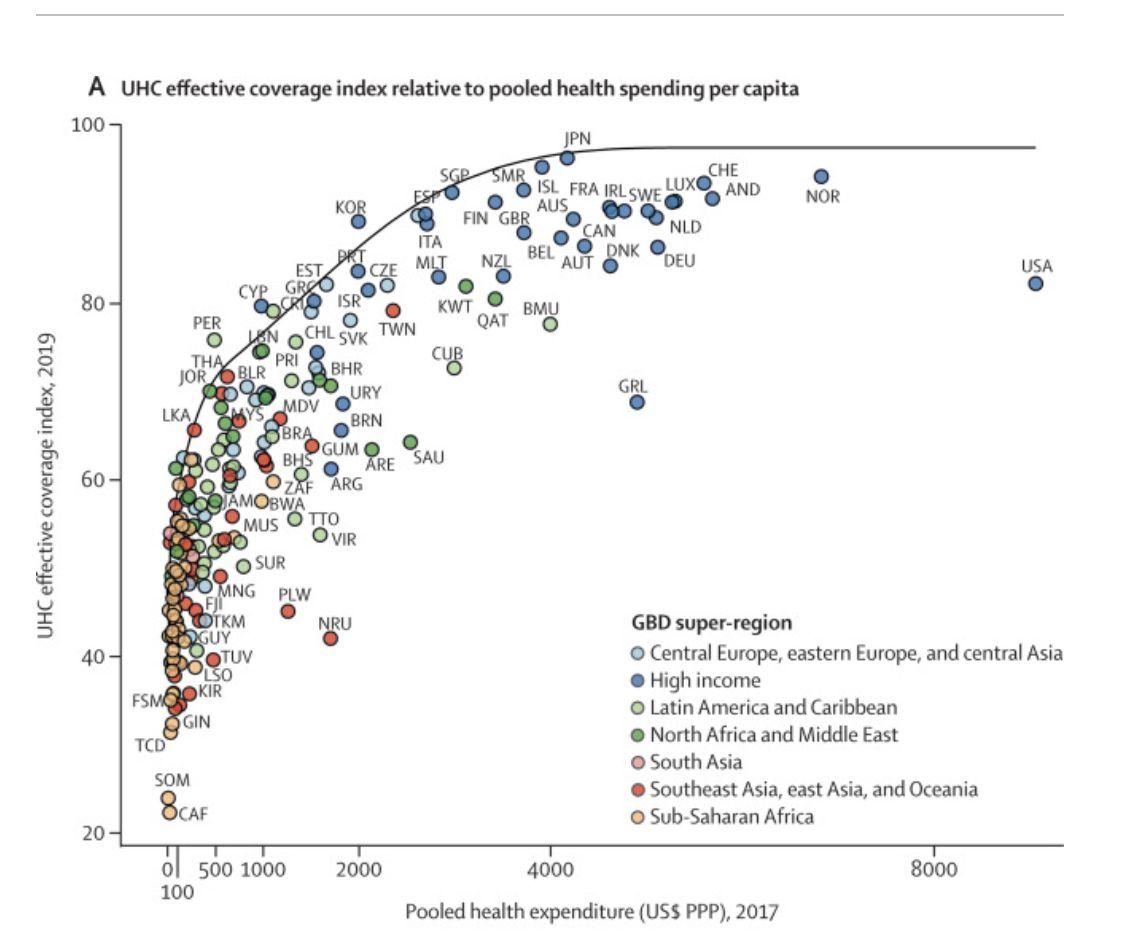
The medical journal, The Lancet, is one of the world’s Big Three scientific journals of medicine; that’s the triumvirate of authorities for physicians worldwide, and the other two are the Journal of the American Medical Association, and the New England Journal of Medicine. On August 27th The Lancet published “Measuring universal health coverage based on an index of effective coverage of health services in 204 countries and territories”. Here is the visual that’s in it, which shows the United States as having, by far, the world’s costliest medical care, at around $9,000 per person per year, and yet as having lower quality of health care than virtually all other industrialized nations do:
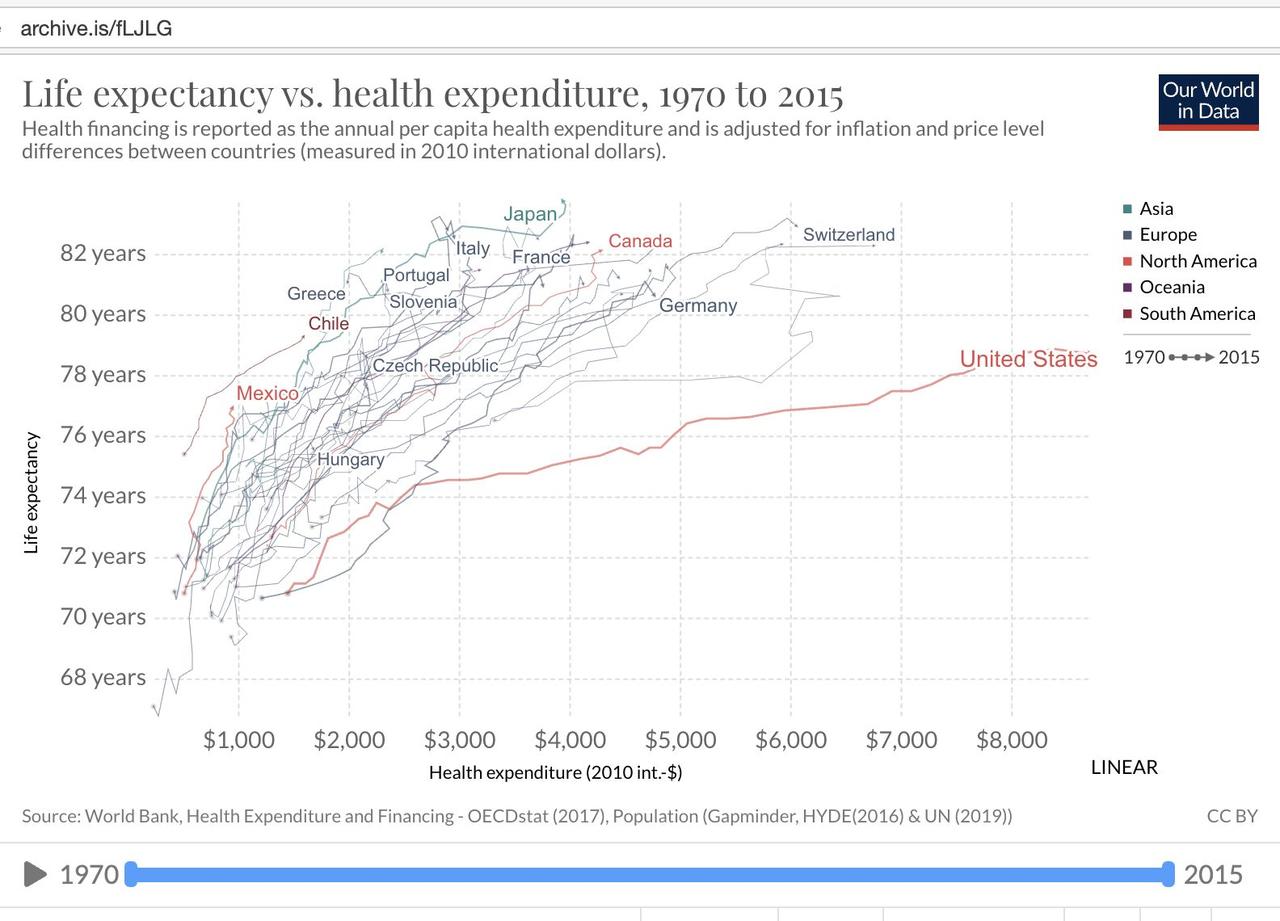
Here is another such study, showing the same thing, and calculating it more simply:

What explains this?
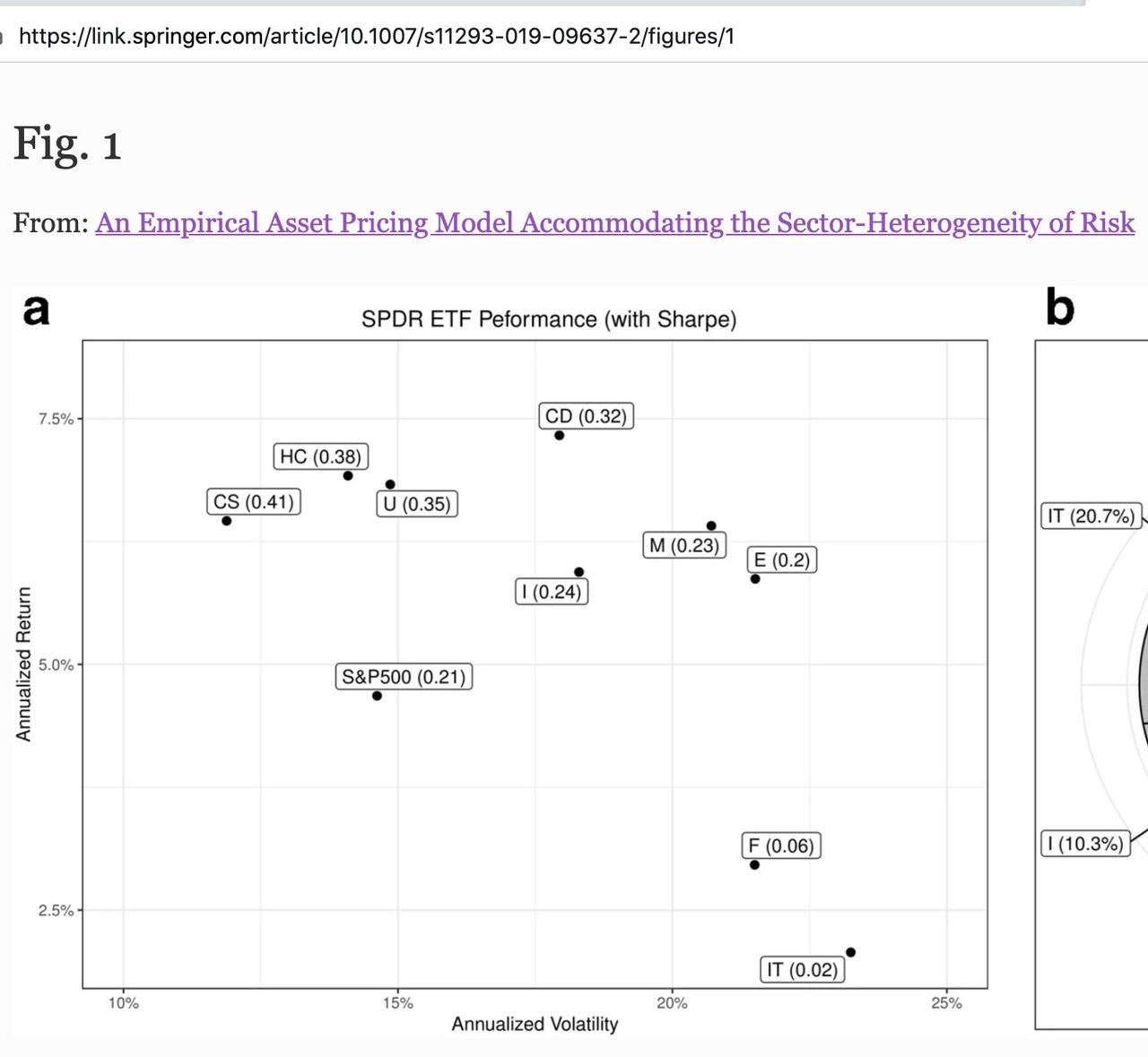
Quite simply, the United States is the world’s most corrupt nation, and medical care is such an extreme necessity when a citizen needs it, so that they’ll pay whatever the system charges them for it — and investing in healthcare products and services is therefore enormously profitable in the United States. Actually, the only other market-sector that competes with it for providing simultaneously high returns and low risk (the combination that offers the best of both worlds to investors) is consumer staples, such as foods, which likewise are necessities of life. When people are desperate, they’ll pay, whatever the cost, because these are things they don’t just want — they need. Here, from Maksim Papenkov’s award-winning 6 February 2020 paper, “An Empirical Asset Pricing Model Accommodating the Sector-Heterogeneity of Risk”, is his sector-specific calculation of stock-market profitability during 2000-2018, showing that “HC” Health Care, and “CS” Consumer Staples, were the best at combining low risk with high returns, during that 19-year period:
(“CD” there is Consumer Discretionary and includes Automobiles and Hotels. It’s the only sector that has higher returns than Health Care, but those returns are twice as risky. The S&P500 have lower returns than Health Care and slightly higher riskiness. At the opposite end, “IT” Information Technology is both the riskiest and the least profitable; and “F” Financials are the second-worst sector for investors. The most-profitable sectors are the necessities, the sectors that take the most from the most-desperate.)
In May 2017, Axene Health Partners published their actuary, Chris Slaybaugh’s, study, “International Healthcare Systems: The US Versus the World”, which stated:

The United States is the only industrialized country in the world that does not have Universal Health Coverage for all citizens. … Rather than one system, United States citizens and residents are insured under a variety of sometimes overlapping systems. The United States is also the only developed country where a significant number of citizens are permitted to be uninsured and where a person’s employment can determine whether they have insurance and what insurance they have. … The extent to which medical bills contribute to bankruptcy is hard to tease out from other factors, but even those who are skeptical of the claim that medical costs cause the majority of bankruptcies concede that they are a significant contributor.13
In the rest of the developed world, by contrast, medical costs are rarely or never cited as a driver behind personal bankruptcy.
In fact, CNBC headlined on 11 February 2019, “This is the real reason most Americans file for bankruptcy” and reported that,
Two-thirds of people who file for bankruptcy cite medical issues as a key contributor to their financial downfall.
While the high cost of health care has historically been a trigger for bankruptcy filings, the research shows that the implementation of the Affordable Care Act [“Obamacare”] has not improved things.
What most people do not realize, according to one researcher, is that their health insurance may not be enough to protect them.
While Barack Obama was running for President in 2008, he was promising to provide Americans with a “public option” in order to reduce profits for health insurance companies and thus lower costs, but he dropped that proposal immediately when he won the 2008 election, and he never pushed for it (not even to use as a bargaining chip with the Republicans in shaping his Obamacare). (In fact, Obama chose the conservative head of the Senate Finance Committee, Democratic Senator Max Baucus, to draft his Obamacare, because Baucus was against there being a public option, and because the progressive Democratic Senator Ted Kennedy’s Health, Education & Labor Committee had just drafted an Obamacare with a public option — Obama refused to have Kennedy draft his healthcare legislation. Obama was actually against there being a public option; only his public rhetoric was for it. Joe Biden is apparently now following the same tactic, of lying promises to the public, and true promises to his billionaire backers, to win the White House.) Obama promised the public “universal coverage”, which means 100% of the population covered, like in all other advanced economies, and his Obamacare increased the percentage insured from 84.5% when he came into office in 2009, to 87.7% two years after Obamacare started in 2013 — around 3%, by 2015 (which was after two years). That was still far short of the promised 100%. He was lying through his teeth in order to win election, and the ‘news’-media still hide (instead of expose) the fact that he did, and that he was actually an agent of the billionaires. He’s now the big hero among Democrats, because maybe Trump is even worse. Trump is up-front about his fascism. And Trump’s opponent now is another hypocrite (after Obama), Obama’s V.P., Joe Biden, who was the U.S. Senate’s leading Democratic Party segregationist and won his nomination by claiming to have been instead a civil-rights champion. Everything in U.S. politics is bait-and-switch. That’s the reality in America’s ‘democracy’: a bait-and-switch ‘democracy’, which serves actually only the wealthiest few. The politicians who are elected serve only the wealthy and well-connected.
America is the most libertarian, or “neo-liberal,” of the advanced industrial nations, and this is why it has the world’s most overpriced medical care. It provides the most liberty for the billionaires.
One of the few extremely bold Americans who rose high in the U.S. healthcare system and tried to tell the public how intensely corrupt it is, has been Marcia Angell, M.D, who held numerous prestigious posts in the U.S. medical system, and she was for a while the Editor-in-Chief of the New England Journal of Medicine. On 15 January 2009, Dr. Angell headlined “Drug Companies & Doctors: A Story of Corruption”, and wrote:
Conflicts of interest pervade medicine. … It is simply no longer possible to believe much of the clinical research that is published, or to rely on the judgment of trusted physicians or authoritative medical guidelines. I take no pleasure in this conclusion, which I reached slowly and reluctantly over my two decades as an editor of The New England Journal of Medicine. … So many reforms would be necessary to restore integrity to clinical research and medical practice that they cannot be summarized briefly. Many would involve congressional legislation and changes in the FDA, including its drug approval process. But there is clearly also a need for the medical profession to wean itself from industry money almost entirely. … Breaking the dependence of the medical profession on the pharmaceutical industry will take more than appointing committees and other gestures. It will take a sharp break from an extremely lucrative pattern of behavior. But if the medical profession does not put an end to this corruption voluntarily, it will lose the confidence of the public. …
If we had set out to design the worst system that we could imagine, we couldn’t have imagined one as bad as we have. … Our health care system is based on the premise that health care is a commodity like VCRs or computers and that it should be distributed according to the ability to pay. … That market ideology is what has made the health care system so dreadful, so bad at what it does. … That is a fundamental mistake in the way this country, and only this country, looks at health care. … The only way to both reduce cost and increase access and quality is to change the system, to scrap it and start over. … I would pay for health care in a single payer system, and what goes into that pot can vary. In Germany, employers have to contribute to that pot. I don’t think that’s a good idea. I would rather see it come straight out of tax revenues.
Experts who are that public-spirited and knowledgeable about the system should be appointed by U.S. Presidents to lead the FDA and the Department of Health and Human Services, but the billionaires prevent that (of course).
On June 27th, NPR headlined “After Pushing Lies, Former Cigna Executive Praises Canada’s Health Care System”, and interviewed a retired PR executive for America’s health insurance companies, who said that maybe the work that he had done smearing Canada’s socialized health insurance — “to spread misinformation about Canada or use cherry-picked data and anecdotes” so as to deceive Americans to accept America’s existing medical system — was partly to blame for America’s having performed significantly worse than Canada had done on the coronavirus crisis. (As of 29 August 2020, Canada had 3,378 cases per million and was the 76th worst out of 215 countries, whereas U.S. had 18,522 cases per million and was the 9th-worst. On deaths, Canada was the 27th-worst at 241, whereas U.S. was the 11th-worst at 564.)
America’s billionaires derive the vast majority of their net worth from stocks (capital gains and dividends), and from interest that’s paid to them; and, since nothing does this for them better than healthcare investments, the current for-profit system in health care is terrific for them; and these few hundred people, billionaires, extract this wealth from the hundreds of millions of Americans, the general public, and want to continue doing so, and they consequently finance politicians such as Joe Biden and Donald Trump (and their predecessors, such as Bush and Clinton), and they also set up ‘charitable’ foundations, and donate to medical schools, so as to inculcate this libertarian belief, not just into the public, but especially into the students and professors, who receive that trickle-down from them, as employees and future employees. While many in academe are against it, they’re not the ones who get advanced to the prestigious and high-paid positions. “He that pays the piper calls the tune.” It’s top-down (aristocracy), and it only pretends to be bottom-up (democracy). And, so, the corruption continues, and Americans die younger, and poorer, because of this aristocratically controlled system. It’s the American way. It’s the American system. Of corruption. Americans call it “capitalism.”
Of course, another area in which the U.S. Government is extraordinarily corrupt is its Military-Industrial Complex; and, on August 28th, a former top official of the NSA, Bill Binney, provided, online, an in-depth description of what he personally knows about that. His personal knowledge is enormous concerning within the Government itself, but not outside it — i.e., not regarding the corporations and billionaires who control the economic rewards system that the top public officials, who typically are agents of the “Deep State” (the billionaires), are serving. However, what he says there is informative and highly reliable regarding the way that the Government’s bureaucracy itself functions, and he is extraordinarily honest about the intense corruption within the official Government. He makes clear that the U.S. Constitution is being systematically and routinely violated by top U.S. officials; so, the U.S. Government routinely violates the U.S. Constitution, in this ‘democracy’, where the system functions like clockwork, for the billionaires.

WSJ : Mnuchin Urges Congress to Pass More Stimulus Funding

Mnuchin Urges Congress to Pass More Stimulus Funding
Treasury secretary says he would call Speaker Pelosi to press for more talks on coronavirus-relief bill

WASHINGTON—Treasury Secretary Steven Mnuchin urged Congress to appropriate more money to combat the effects of the coronavirus pandemic, saying at a hearing Tuesday that he was ready to sit down with Democratic leaders to resume negotiations at any time.

For more than a month since key provisions of the landmark Cares Act expired, Democrats and Republicans have been at loggerheads over the size and content of another relief package. House Democrats in May proposed an additional $3.5 trillion of relief, while Senate Republicans rolled out a $1 trillion bill in July. Without a new agreement, jobless workers have gone without a $600 federal supplement to weekly unemployment insurance since July 31, and a federal eviction moratorium expired on July 25, leaving millions of tenants at risk of losing their homes.

The Trump administration is moving to halt evictions through the end of the year in an effort to slow the spread of Covid-19, senior administration officials said Tuesday, adding that it was relying on the authority of the Centers for Disease Control and Prevention to take measures deemed necessary to mitigate the spread of communicable diseases.

In Tuesday’s hearing before a congressional panel, Mr. Mnuchin suggested the gap between the two sides may be narrowing and mentioned a new, higher number for the administration’s proposed ceiling for a follow-on bill: $1.5 trillion. The secretary also indicated that the Trump administration has softened its opposition to a Democratic proposal to apportion more money for state and local governments.

“Whether it’s one trillion or one-and-a-half trillion, again, let’s not get caught on a number,” Mr. Mnuchin said. He added that Democrats and Republicans agree that more money is needed for grants for small businesses, enhanced unemployment insurance and direct payments to households.

Mr. Mnuchin said he and White House chief of staff Mark Meadows “conceded…in an effort to get a deal done” to put more money on the table for cities and states.

House Speaker Nancy Pelosi said last week Democrats wouldn’t be willing to accept anything less than a $2.2 trillion package. Asked by Rep. Maxine Waters (D., Calif.) whether he would support a deal of that size, Mr. Mnuchin said, “I do not support $2.2 trillion.”

The last known discussion between the sides—a 25-minute phone call between Mrs. Pelosi and Mr. Meadows last week—didn’t loosen the stalemate. In response to prodding by Ms. Waters, Mr. Mnuchin said he would call Mrs. Pelosi after Tuesday’s hearing.

Mrs. Pelosi later said in a statement that a 36-minute phone call followed, during which she raised a series of concerns that Democrats have about the Trump administration’s positions on the next coronavirus relief package. She also blamed Republicans for being unwilling to compromise to reach a deal.

“Sadly this phone call made clear that Democrats and the White House continue to have serious differences understanding the gravity of the situation that America’s working families are facing,” Mrs. Pelosi said.

As the monthslong impasse has worn on, the White House has sought to use executive power to soften the blow to families and workers from expiring protections.

Under the antieviction measures laid out by the White House officials Tuesday, tenants are eligible for relief from eviction for not paying their rent if they earn less than $99,000 a year, or $198,000 for a couple filing jointly. Tenants must show they have taken all possible steps to seek government assistance and declare that Covid-19-related financial hardships are the reason they aren’t able to pay rent. They must also declare that they would become homeless or would be forced to move into congregate housing facilities if evicted.

“President Trump is committed to helping hardworking Americans stay in their homes and combating the spread of the coronavirus,” White House spokesman Brian Morgenstern said in a statement.

Tenants will still be asked to pay as much rent as they can afford. A senior administration official said the move is “not an invitation to stop paying rent.” The rent a tenant owes won’t be forgiven.

Enforcement of the CDC order will be adjudicated at the local level, another senior administration official said.

Housing advocates criticized the administration’s approach, saying the process is confusing and could be difficult for tenants to navigate. They reiterated calls for Congress and the White House to work out a deal on rental assistance.

“We could still have millions of evictions in January, in the middle of winter, and all we will have accomplished is evicting people in colder weather,” said David Dworkin, president and CEO of the National Housing Conference, a nonprofit group that advocates for affordable housing.

Without “a critically needed compromise” on rental assistance, he added, building owners will also miss out on rental payments for five more months.

Mr. Mnuchin said during Tuesday’s hearing that he would prefer offering rental assistance to an eviction moratorium. But he said the amount of aid would need to factor in enhanced unemployment insurance.

Mr. Mnuchin also released a new estimate that the so-called Main Street Lending Program, created by the Treasury Department and Federal Reserve, will make between $25 billion and $50 billion of loans to midsize businesses in coming months. The program, plagued by a slow start and what many lenders and borrowers say are unattractive terms, has the capacity to lend up to $600 billion.

>>> Stoxx 600 Pre-Market Indications

  • Rolls-Royce (RRU TH) +3.4%
  • BT (BTQ TH) +2.4%
  • AstraZeneca (ZEG TH) +1.8%
  • Vodafone (VODI TH) +1.3%
  • Deutsche Telekom (DTE TH) +1.3%
    • ESG Could Bring Interest to ‘Unloved’ Telecoms Sector: Berenberg
    • Deutsche Telekom Raised to Buy at AlphaValue
  • Renault (RNL TH) +1.2%
  • Linde (LIN TH) +1.1%
  • Evotec SE (EVT TH) +1.1%
  • Deutsche Bank (DBK TH) +1.1%
  • Air Liquide (AIL TH) +1%

FT : Ex-Blackstone trader balks at ‘grubby’ terms of Codere debt deal

FBI investigates deaths of mining executives in UK corruption probe
James Bethel and Gerrit Strydom were seen as witnesses in SFO inquiry into ENRC

The FBI is investigating the deaths of two former mining executives who British prosecutors saw as potential witnesses in one of the UK’s biggest corruption probes.

James Bethel, 44, and Gerrit Strydom, 45, were found dead at a motel in Springfield, Missouri, in May 2015, when the two were on a road trip across the US.

Until shortly before their deaths, the men had held senior positions in the African division of Eurasian Natural Resources Corporation, a mining group that is at the centre of a seven-year bribery and fraud investigation by the UK’s Serious Fraud Office.

Springfield police announced at the time that the cause of death was cerebral malaria, citing tests by the Centers for Disease Control and Prevention, the national agency that handles such cases.

But as revealed in the forthcoming book Kleptopia: How dirty money is conquering the world, autopsy reports and CDC records show that the chances the two men died of malaria are “almost certainly nil”, according to a leading expert who analysed them.

For reasons a spokesperson refused to reveal, the Springfield police never formally closed the case. In May this year a police spokesperson referred further inquiries to the FBI, “as they have taken over the investigation of this case”. FBI agents had already been looking into the case, according to two people briefed on it, including taking away some of the men’s personal effects.

Founded by three Central Asian oligarchs who took control of valuable mines in Kazakhstan during the rush of privatisations that followed the collapse of the Soviet Union, ENRC floated on the London Stock Exchange in 2007. The miner joined the FTSE 100 index of blue-chip companies, making it one of the most valuable in the UK, at one stage worth almost £20bn.

After the listing, ENRC bought mines in Congo, Zimbabwe and elsewhere in Africa — acquisitions that would become the focus of bribery allegations.

The SFO launched a criminal corruption investigation in 2013. Later that year, the oligarchs — Alexander Mashkevitch, Patokh Chodiev and Alijan Ibragimov — took the company private again and shifted its base to Luxembourg.

Bethel and Strydom, South African citizens with long experience in the mining industry, were among the most senior ENRC officials running the African operation. In 2015, they decided to leave the company.

The SFO’s investigators were keen to learn what they knew. They had made contact with Bethel by the time the men departed for a holiday in the US, according to three people with knowledge of the matter. One of those people said the SFO was also interested in Strydom, though it does not appear to have contacted him before his death.

The men began to feel unwell during the flight from Johannesburg via Amsterdam to Chicago but set off along Route 66 on hired Harley-Davidsons, according to messages they sent that were later passed to the coroner.

On Saturday May 9 2015, staff at La Quinta Inn in Springfield opened the doors to their rooms to find both men dead, with nothing to show what had killed them.

The local medical examiner sent samples for toxicology tests to a laboratory but received only partial results. Lacking the equipment to make a full assessment himself, he sent blood and tissue samples to the CDC, which detected malaria, CDC records show.

According to emails released in response to a freedom of information request, analysts at the CDC suggested the pair might have become infected on a fishing trip they had taken together in malarial Zambia two weeks before they started to feel sick. 

But when the cause of death was announced, colleagues of the dead men were immediately sceptical that two men could die of malaria on the same night in the same motel. Five years on, their doubts are reinforced.

Sam Wassmer, a malaria expert at the London School of Hygiene & Tropical Medicine who has reviewed the documents obtained by the Financial Times, said that because of the multitude of factors that determine the speed at which the disease develops over many days, “the likelihood of two separate people developing the disease at the exact same time and dying the same night is almost certainly nil”.

The only remotely plausible scenario would be if both men had been bitten by the same mosquito, Mr Wassmer said, but the CDC’s genetic analysis of the samples it received ruled that out.

Investigators at the SFO fear the samples may not have been reliable, according to a person familiar with the investigation. Neither the local medical examiner nor a private coroner whom ENRC sent to attend the autopsy could say whether any chain of custody procedure designed to safeguard evidence had been followed. The CDC did not respond to questions from the Financial Times. The FBI did not comment. The SFO declined to comment. 

ENRC denies any wrongdoing. In 2019 it sued the SFO, accusing it of cooking up a scandal with the corruption investigation in league with the company’s former lawyers, a Kazakh dissident and private investigators. All those accused deny the allegations.

FT : Ex-Blackstone trader balks at ‘grubby’ terms of Codere debt deal

Ex-Blackstone trader balks at ‘grubby’ terms of Codere debt deal
Hedge fund manager battles over restructuring of Spanish casino operator

Akshay Shah, the former Blackstone executive who once raked in large profits by persuading Spanish company Codere to default on its debts, is challenging a new restructuring at the casino operator that he says will award “grubby fees” to select creditors.

The legal fight represents a role reversal for Mr Shah, who was one of the most senior managers of distressed debt at the credit arm of the $560bn-in-assets private equity firm. He now manages a $28m hedge fund he set up after leaving Blackstone in 2017.

In 2013, Mr Shah engineered what some described as a “manufactured default” involving Codere, when the company accepted funds from Blackstone in exchange for briefly reneging on its debt. That guaranteed a profit on the credit default swaps held by the US firm.

Critics said that the agreement amounted to an abuse of power by Blackstone to influence restructurings for its own benefit. Jon Stewart, the US comedian and talk show host, compared the deal to a scene in Goodfellas in which mobsters burn down a restaurant to collect the insurance. At the time, Blackstone pointed out such deals were “wholly compliant” with market rules.

Now, Mr Shah has cast himself on the opposite side of a new struggle over Codere, saying it is once again favouring larger creditors at the expense of other bondholders, such as his firm Kyma Capital. It is the latest in a string of disputes among creditors over the restructuring of companies caught in the Covid-19 downturn.

Codere, which had to shut many of the gaming halls, betting shops and racetracks it operates across Europe and Latin America in response to coronavirus, cut a deal with some of the largest holders of its €750m of bonds for a new funding lifeline in July.

Under the plan, a so-called ad hoc committee of these creditors will provide €250m of new funding that ranks ahead of its existing debt. Codere needs approval from an English court for the deal, and the backing of creditors representing 75 per cent of its debt.

However, Kyma argues that because the investors on the committee — whose identities are not public — are receiving fees and other benefits worth €22m, they should count as a separate class of creditor in the English court. 

Codere already has approval for the deal from bondholders representing over 80 per cent of its debt. But if the court were to agree with Kyma it would mean the restructuring deal would need separate support from three-quarters of its bondholders who are not on the committee.

Kyma has further argued that this major creditor group’s advisers are earning substantial additional fees that have not yet been disclosed. 

Last week, Codere offered all bondholders an additional fee to back the deal. Kyma has said this is a bid to get above a 90 per cent threshold, which would allow the deal to pass without the need for court hearings.

“If the company and ad hoc committee can avoid the English court route, I suspect they will want to, to avoid scrutiny of all the grubby fees,” Mr Shah said.

Codere said that it strongly disagreed with the hedge fund’s characterisation of its plan.

“Kyma's arguments are wrong in both fact and law, and Codere does not believe they have any real prospects of success in court,” the Madrid-based company said.

An initial High Court hearing is due on 3 September. A judge is then expected to rule on whether to approve the restructuring at the end of the month.