- Sartorius (SRT3 TH) +1.5%
- Stock fell 6.8% yesterday
- Polymetal (PM6 TH) +1.1%
-
Nokia (NOA3 TH) +0.6%
- Finnish State’s Solidium Exceeds 5% Threshold in Nokia Shares
- Dialog Semi (DLG TH) +0.6%
-
Adyen (1N8 TH) +0.5%
- Adyen Rated New Buy at HSBC; PT 1,700 euros
- Gerresheimer (GXI TH) -1.1%
- Gerresheimer Raised to Buy at Bankhaus Metzler; PT 122 euros
- Zalando (ZAL TH) -1.1%
- Orsted (D2G TH) -1.2%
- Qiagen (QIA TH) -1.2%
- Engie (GZF TH) -1.5%
- Deutsche Wohnen (DWNI TH) -1.7%
- TUI (TUI1 TH) -2.1%
- U.K. to Announce Decision on Travel Restrictions Friday: Hancock
- Vestas (VWS TH) -2.1%
- Stock hit record high yesterday
- Vonovia (VNA TH) -3.6%
- Vonovia Offering Prices 17m Shares at EU59/Share
- Vonovia, Ryanair to Raise Fresh Capital on Red Day for Stocks
DAX:
- Covestro (1COV TH) +0.7%
- Covestro Raised to Buy at Commerzbank; PT 50 euros
- Vonovia (VNA TH) -3.3%
- Vonovia Offering Prices 17m Shares at EU59/Share
MDAX:
- Varta (VAR1 TH) +2.6%
- Sartorius (SRT3 TH) +2.3%
- Qiagen (QIA TH) -1.2%
- Aixtron (AIXA TH) -1.7%
SDAX:
- Shop Apotheke (SAE TH) +3.5%
- Germany’s DAX Index to Leave Constituents Unchanged (1)
- Steinhoff (SNH TH) +3%
- ADVA Optical (ADV TH) +2%
- Encavis (CAP TH) +2%
- LPKF (LPK TH) +1.7%
- Eckert & Ziegler Strahlen- und Medizintechnik AG (EUZ TH) -2.3%
- Hornbach Baumarkt (HBM TH) -4.7%
U.S. equity futures fell Friday along with stocks in Asia as a rotation away from high-flying tech stocks gained steam amid question marks over the sustainability of lofty valuations. European stock futures ticked up.
Losses in Tokyo, Shanghai and Hong Kong were smaller than those seen in the U.S. overnight, as trader focus turned to the non-farm payrolls report later Friday. S&P 500 futures slipped after the benchmark fell 3.5% Thursday. Nasdaq contracts slid over 1% after the tech-heavy gauge’s 5% overnight slump, its largest since March. That suggests the U.S. retreat could extend for a second day ahead of a holiday weekend there. Treasuries and the dollar were steady, with moves into haven assets muted despite the pronounced drop in equities. Gold ticked higher.
US After Hours Chip stocks weak after hours; DOMO +8.4%, OXM +3.9%, COO +3.4% strong on earnings while DOCU -5.6% shows weakness
Nikkei -1.13% Hang Seng -1.51% CSI -1.38% Shanghai -1.24% Shenzen -0.96%
Eur$ 1.1850 CNH 6.8439 CNY 6.8403 JPY 106.17 GBP 1.3274 CHF 0.9096 RUB 75.2377 WTI$ 41.01 -0.77%
S&P -0.30% Nasdaq -1% EuroStoxx +0.24% FTSE -0.40% Dax +0.08% SMI +0.07%
Macro :
- ECB Decides Rates, Lagarde Holds Briefing: Week Ahead Sept. 5-11
- European Airlines, Airports Issue Call for Slot-Waiver Extension
- Germany’s DAX Index to Leave Constituents Unchanged
- Muted Haven Reaction Suggests Risk-Off a Stocks Issue for Now
- Fund Flows Exit U.S and EM Equities, Head for Bonds, Citi Says
Keep an eye on :
- ANA SM : Acciona-Led Consortium Wins C$1.7B Vancouver Subway Contract
- ATL IM : Benettons May Get 11%-12% in New Autostrade After Spinoff: Sole
- ASML NA : How China Made the Netherlands Question the Free Market (1)
- AZN LN : Five DOD Sites Picked for AstraZeneca Phase 3 Vaccine Trial
- BKIA SM : Spain’s Bankia, CaixaBank Confirm They Are Weighing Merger
- CABK SM : Spain’s Bankia, CaixaBank Confirm They Are Weighing Merger
- COLR BB : Colruyt Increases Stake in Zeb Owner Fraluc to >96%; No Terms
- EDP PL : EDP First Half Net Income Beats Estimates
- EL FP : EssilorLuxottica To File Appeal Against GrandVision Judgment
- EXO IM : Exor Reports 1H Loss of EU1.3B
- ERF FP : Eurofins Buys Sundream Group; Deal To Be Immediately Accretive
- FLS DC : FLSmidth CEO Seeks Takeover Targets in Cement, Borsen Says
- GSF NO : Grieg Seafood Gets 5 New Farming Licenses in Newfoundland
- ILD FP : Iliad CEO Sees French 5G Spectrum Auction End Sept., Early Oct.
- JDEP NA : JAB Prepares to Name Fabien Simon as JDE Peet’s CEO: FT
- LHA GY : Eurowings Plans to Have About 80 Aircraft Flying in Summer 2021
- NELES FH : Valmet Represented on Neles Nomination Board, Alfa Laval Is Not
- NOKIA FH : Finnish State’s Solidium Exceeds 5% Threshold in Nokia Shares
- PSTH/U US : Ackman Says He Held Early Talks to Take Airbnb, Stripe Public
- REP SM : Repsol to Buy Back Up To 23.6m Shrs, or 1.45%, for Max EU227.2m
- ROG SW : Roche Gets FDA EUA for Cobas SARS-Cov-2 & Influenza A/B Test
- RYA ID : Ryanair EU400M Placing Order Book Said to Be Covered
- SEV FP : Suez Should Seek Alternatives to Veolia’s Offer, Chairman Says
- SOF BB : Sofina 1H Net Loss EU210.7 Mln Vs. Profit EU566.7 Mln Y/y
- TIT IM : Telecom Italia May Not Hold Grid Majority: Patuanelli to Stampa
- VNA GY : Vonovia Offering Prices 17m Shares at EU59/Share
- VOW3 GY : VW Unit Said to Plan to Resume Navistar Takeover Push This Month
- VOW3 GY : VW Seeks One-Time Remedy Pay for ~50,000 Diesel Customers: DPA
- WEW GY : Westwing Boosts Full Year Revenue Forecast
>>> Up
* Amplifon Raised to Buy at Jefferies; PT 34 euros
* Avance Gas Raised to Buy at Cleaves Securities
* Covestro Raised to Buy at Commerzbank; PT 50 euros
* Gerresheimer Raised to Buy at Bankhaus Metzler; PT 122 euros
* Hikma Raised to Overweight at Barclays; PT 2,800 pence
* Ontex Raised to Buy at KBC Securities; PT 18 euros
* Sampo Raised to Buy at HSBC; PT 40 euros
>>> Down
* Hypoport SE Cut to Sell at Bankhaus Metzler; PT 415 euros
* Pernod Ricard Cut to Neutral at Citi; PT 150 euros
>>> Initiation
* Cellnex Resumed Overweight at Morgan Stanley; PT 70 euros
* Corestate Rated New Hold at MainFirst; PT 19 euros
* Knorr-Bremse Rated New Buy at SocGen; PT 125 euros
* Quantafuel Rated New Buy at Arctic Securities; PT 125 kroner
>>> Call
* Hearing Aid Margin Upside Underrated, Amplifon to Buy: Jefferies
* Hikma Up to Overweight After Positive Vascepa Ruling: Barclays
* Cellnex Has M&A Firepower, Resume Overweight: Morgan Stanley
* Covestro Rating Up as Volume, Margins Recover, Commerzbank Says
* Hikma Up to Overweight After Positive Vascepa Ruling: Barclays
* Ontex Holder Activism Provides ‘Electroshock’: KBC Securities
* Pernod Vulnerable to Earnings Downgrades, De-Rating, Citi Says
After Hours Summary: Chip stocks weak after hours; DOMO +8.4%, OXM +3.9%, COO +3.4% strong on earnings while DOCU -5.6% shows weaknessAfter Hours Gainers:
Companies trading higher in after hours in reaction to earnings/guidance: DOMO +8.4%, NX +5.5%, AOUT +4.4%, OXM +3.9%, COO +3.4%, SWBI +2.6%, YEXT +1.5%
Companies trading higher in after hours in reaction to news: LMPX +16.3% (acquires two dealerships), OSUR +4.2% (ORAcollect RNA collection device included in FDA's EUA granted to MiraDx), INCY +3.2% (CALA opts out of co-development agreement with INCY), HONE +2.9% (adopts share repurchase program), PBI +2.1% (announces pricing adjustments ahead of 2020 peak season), OBSV +1.9% (announces $20 mln equity offering), PLUG +1.6% (DE Shaw discloses 5% stake), RLAY +0.9% (doses first patient in clinical trial of RLY-4008), LLY +0.7% (FDA approves additional doses of Trulicity), KMB +0.6% (to acquire Softext Indonesia for approx. $1.2 bln), VICI +0.4% (CZR and VICI sell Harrah's Louisiana Downs), PFE +0.3% (CEO expects co will know in Oct if vaccine works, according to Reuters), CZR +0.2% (CZR and VICI sell Harrah's Louisiana Downs), NBIX +0.2% (to present new data from its movement disorder programs)
After Hours Losers:
Companies trading lower in after hours in reaction to earnings/guidance: DOCU -5.6% (also names new CFO), MDLA -0.6% (also to acquire Stella Connect)
Companies trading lower in after hours in reaction to news: TSLA -3.8% (follows 9% drop on Thurs), LUV -1.4% (to provide service to Miami and Palm Springs later this year), SMH -1.4% (chip stocks weak on Bloomberg report that China is planning to develop its domestic chip industry to counter US restrictions), QDEL -1.2% (Pac-12 Conference announces deal with QDEL for daily COVID testing, according to website), MTCH -1.2% (DOJ closes investigation), JWN -0.6% (S&P downgrades To 'BB+' From 'BBB-'), HA -0.5% (eliminates change fees), AMX -0.1% (AMX and TEF terminate deal to purchase Telefonica Moviles El Salvador)
Some chip stocks are weak apparently on Bloomberg article that China is planning to develop its domestic semiconductor industry (see 17:49 comment): NVDA -4.8%, MRVL -3.4%, AMD -2.9%, SMH -1.5%, QCOM -1.2%
Justice Dept. Plans to File Antitrust Charges Against Google in Coming Weeks
The attorney general is said to have set a deadline over the objections of career lawyers who say they need more time to build the case.
WASHINGTON — The Justice Department plans to bring an antitrust case against Google as soon as this month, after Attorney General William P. Barr overruled career lawyers who said they needed more time to build a strong case against one of the world’s wealthiest, most formidable technology companies, according to five people briefed on internal department conversations.
Justice Department officials told lawyers involved in the antitrust inquiry into Alphabet, the parent company of Google and YouTube, to wrap up their work by the end of September, according to three of the people. Most of the 40-odd lawyers who had been working on the investigation opposed the deadline. Some said they would not sign the complaint, and several of them left the case this summer.
Some argued this summer in a memo that ran hundreds of pages that they could bring a strong case but needed more time, according to people who described the document. Disagreement persisted among the team over how broad the complaint should be and what Google could do to resolve the problems the government uncovered. The lawyers viewed the deadline as arbitrary.
While there were disagreements about tactics, career lawyers also expressed concerns that Mr. Barr wanted to announce the case in September to take credit for action against a powerful tech company under the Trump administration.
But Mr. Barr felt that the department had moved too slowly and that the deadline was not unreasonable, according to a senior Justice Department official.
A former telecom industry executive who argued an antitrust matter before the Supreme Court, Mr. Barr has shown a deep interest in the Google investigation. He has requested regular briefings on the department’s case, taking thick binders of information about it on trips and vacations and returning with ideas and notes.
When Mr. Barr imposed a deadline on the investigation, some lawyers feared that the move was in keeping with his willingness to override the recommendations of career lawyers in cases that are of keen interest to President Trump, who has accused Google of bias against him.
The Google case could also give Mr. Trump and Mr. Barr an election-season achievement on an issue that both Democrats and Republicans see as a major problem: the influence of the biggest tech companies over consumers and the possibility that their business practices have stifled new competitors and hobbled legacy industries like telecom and media.
A coalition of 50 states and territories support antitrust action against Google, a reflection of the broad bipartisan support that a Justice Department case might have. But state attorneys general conducting their own investigations into the company are split on how to move forward, with Democrats perceived by Republicans as slow-walking the work so that cases can be brought under a potential Biden administration, and Democrats accusing Republicans of rushing it out under Mr. Trump. That disagreement could limit the number of states that join a Justice Department lawsuit and imperil the bipartisan nature of the investigation.
Editors’ Picks
Virtual Tours Are Here to Stay. This Is How to Do Them Right.
Mr. Smith Went to Washington … With Dimmers
Pull Out of the Kentucky Derby? Pressure on a Black Owner Mounts
Continue reading the main story
Some lawyers in the department worry that Mr. Barr’s determination to bring a complaint this month could weaken their case and ultimately strengthen Google’s hand, according to interviews with 15 lawyers who worked on the case or were briefed on the department’s strategy. They asked not to be named for fear of retribution.
Brianna Herlihy, a Justice Department spokeswoman, declined to comment on the continuing investigation. Jose Castaneda, a spokesman for Google, said that the company would “continue to engage with ongoing investigations” and that its business practices enabled “increased choice and competition.”
When the Justice Department opened its inquiry into Alphabet in June 2019, career lawyers in the antitrust division were eager to take part. Some within the division described it as the case of the century, on par with the breakup of Standard Oil after the Gilded Age. It also offered a chance for the United States to catch up to European regulators who had been aggressive watchdogs of the technology sector.
Alphabet was an obvious antitrust target. Through YouTube, Google search, Google Maps and a suite of online advertising products, consumers interact with the company nearly every time they search for information, watch a video, hail a ride, order delivery in an app or see an ad online. Alphabet then improves its products based on the information it gleans from every user interaction, making its technology even more dominant.
For nearly a year, dozens of Justice Department lawyers and other staff members worked in two groups, each overseeing a separate line of inquiry: Google’s dominance in search and its control over many aspects of the ecosystem for online advertising.
Google controls about 90 percent of web searches globally, and rivals have complained that the company extended its dominance by making its search and browsing tools defaults on phones with its Android operating system. Google also captures about one-third of every dollar spent on online advertising, and its ad tools are used to supply and auction ads that appear across the internet.
The Justice Department amassed powerful evidence of anticompetitive practices, three people said.
But the lawyers also described internal politics that at times slowed down the department’s work or drove a wedge among members of the team.
Makan Delrahim, the head of the Justice Department’s antitrust division, had pushed the department to investigate Google but was recused from the case because he represented the company in a 2007 acquisition that helped it to dominate the online advertising market.
In an unusual move, Mr. Barr placed the investigation under Jeffrey A. Rosen, the deputy attorney general, whose office would not typically oversee an antitrust case. Mr. Barr and Mr. Delrahim also disagreed on how to approach the investigation, and Mr. Barr had told aides that the antitrust division had been asleep at the switch for decades, particularly in scrutinizing the technology industry.
Mr. Rosen does have a tech background: He was the lead counsel for Netscape Communications when it filed an antitrust complaint against Microsoft in 2002.
In October, Mr. Rosen hired Ryan Shores, a veteran antitrust lawyer, to lead the review and vowed to “vigorously seek to remedy any violations of law, if any are found.”
Mr. Barr also had a counselor from his own office, Lauren Willard, join the team as his liaison. She met with staff members and requested information about the investigation. She also issued directives and made proposals about next steps.
The case seemed to have two leaders who were not always in sync about who was in charge, and one of them sat in the office of the attorney general.
As debates among the team arose over how best to move forward against Google — primarily over whether to file a complaint that included both the search and advertising elements, or to focus on one line of attack — lawyers wondered who would have the last word. Mr. Barr stepped in this spring to clarify that Mr. Shores was in charge. Ms. Willard still had a hand in Google, but she stepped back from the case to focus on other assignments.
State attorneys general also disagreed on whether to bring a narrow case that could be filed during Mr. Trump’s presidency or to take more time to file a broader complaint. Attorney General Phil Weiser of Colorado, a Democrat who worked in the Obama Justice Department, drove the effort to bring a broad lawsuit, three people with knowledge of his plans said. But Attorney General Ken Paxton of Texas, a Republican, was in the advanced stages of a case focused on Google’s advertising technology and felt that it could be brought quickly.
A spokesman for Mr. Weiser declined to comment. A spokeswoman for Mr. Paxton did not immediately respond to a request for comment.
When the Justice Department this summer shared a potential approach to the case, several state attorneys general viewed it as too narrow for them to support, said one person who was familiar with the presentation.
Google’s lawyers hope to seize on Mr. Trump’s politicization of the matter should the Justice Department sue the company. Republican lawmakers like Senator Ted Cruz of Texas and Representative Jim Jordan of Ohio, the top Republican on the House Judiciary Committee, have accused platforms like YouTube and Facebook of censoring conservative voices.
Data from the companies undermine their claims, showing that Republicans are among the most visible figures on their services. And few figures have as much reach on social media as Mr. Trump himself.
But the president had made the accusations personal. In 2018, he said that when searching for “Trump News,” Google’s search engine turned up only reports from news organizations that he said were biased against him.
“Google search results for ‘Trump News’ shows only the viewing/reporting of Fake News Media,” he said on Twitter. “In other words, they have it RIGGED, for me & others.” He also said Google had potentially violated the law.
Mr. Barr recently echoed the president’s criticism and said that antitrust laws could be used to keep companies from restricting the spread of conservative views.
Many career staff members in the antitrust division, including more than a dozen who were hired during the Trump administration, considered the evidence solid that Google’s search and advertising businesses violated antitrust law. But some told associates that Mr. Barr was forcing them to come up with “half-baked” cases so he could unveil a complaint by Sept. 30, according to three people with knowledge of the discussions.
Some lawyers who felt they needed more time laid out their concerns in the memo and left the case; about 20 lawyers remain on the team. Department lawyers said that Mr. Shores planned to slim down the team this summer. Some people also left because the coronavirus pandemic had made it hard for them to dedicate time to the case. A lawyer in the department’s civil division joined the remaining members of Mr. Shores’s team.
The department approached litigators from at least three outside law firms to take on a potential case, according to two people with knowledge of the talks. But they all declined, citing conflicts of interest and other logistical obstacles created by the pandemic.
Closing Stock Market SummaryThe S&P 500 dropped 3.5% on Thursday in an orderly retreat led by the mega-caps and growth stocks. The Nasdaq Composite underperformed with a 5.0% decline due to its greater exposure to these names, while the Dow Jones Industrial Average (-2.8%) and Russell 2000 (-3.0%) declined about 3%.
There were no macro catalysts attributed to today's steep decline, suggesting that profit taking and price exhaustion were likely factors in cooling off the market that many investors had described as overheated. Losses were broad, evident by all 11 S&P 500 sectors closing in negative territory, but there was a relative divergence between the losers.
A bulk of the losses were found in the high-momentum stocks within the information technology (-5.8%) and consumer discretionary (-3.6%) sectors, which were the only sectors that declined more than the S&P 500. The Philadelphia Semiconductor Index fell 5.7%.
The value-oriented spaces, like the energy sector (-0.7%), declined the least. To better illustrate this relative outperformance, the Russell 1000 Value Index declined 2.1% versus a 4.9% decline for the Russell 1000 Growth index. Not much consolation for investors, though, given growth and value both declined noticeably.
Whether these losses materialize into a steeper correction in the coming days is uncertain, but the absence of a buy-the-dip mentality likely exacerbated fears of further weakness in equities. The CBOE Volatility Index, which is widely seen as a fear gauge and representation of hedging activity, spiked 26.5% to 33.60.
Separately, Chicago Fed President Evans (FOMC voter in 2021) was the latest Fed official to subtly urge lawmakers for more fiscal relief. Mr. Evans also suggested that economic activity might not return to pre-pandemic levels until late-2022 and doesn't expect inflation to pick up in the near future.
U.S. Treasuries ended the day on a higher note, as investors assumed some safety amid the weakness in stocks and lingering growth concerns. The 2-yr yield declined one basis point to 0.12%, and the 10-yr yield declined three basis points to 0.62%. The U.S. Dollar Index declined 0.1% to 92.73. WTI crude futures declined 0.5%, or $0.20, to $41.34/bbl.
Reviewing Thursday's economic data:
- Initial claims for the week ending August 29 decreased by 130,000 to 881,000 (consensus 915,000), which is the lowest they have been since the week ending March 14. Continuing claims for the week ending August 22 decreased by 1,238,000 to 13.254 million.
- The key takeaway from the report is that initial claims were the lowest they have been since the COVID pandemic hit the U.S. economy in force in mid-March. That has fostered some confidence in the view that, even with initial claims still alarmingly high, the economy continues to heal from that impact.
- The ISM Non-Manufacturing index for August slipped to 56.9% (consensus 56.7%) from 58.1% in July.
- The key takeaway from the report is that it featured a notable slowing in the New Orders Index (56.8% from 67.7%) and a notable pickup in the Prices Index (64.2% from 57.6%).
- Q2 Productivity growth was revised to an annualized 10.1% (Briefing.com consensus 7.0%) from the advance estimate of 7.3%. Unit labor costs were up 9.0% (consensus 12.6%) versus the advance estimate of 12.2%.
- The key takeaway from the report is that the huge productivity gain (largest since Q1 1971) is only formulaic as opposed to a true picture of strength. To wit, output declined 37.1% (largest on record) while hours worked fell 42.9% (largest on record).
- The July trade deficit widened to $63.6 billion (consensus -$58.6 billion) from a downwardly revised $53.5 billion (from -$50.7 billion) in June. Exports were up $12.6 billion from June while imports were up $22.7 billion.
- The key takeaway from the report is that exports and imports both rose, which is consistent with a global economy in recovery mode.
Looking ahead, investors will receive the Employment Situation Report for August on Friday.
- Nasdaq Composite +27.7% YTD
- S&P 500 +6.9% YTD
- Dow Jones Industrial Average -0.9% YTD
- Russell 2000 -7.4% YTD
Nomura Warns "Broken" Equity Vol Complex "Feels Like An Accident Waiting To Happen"
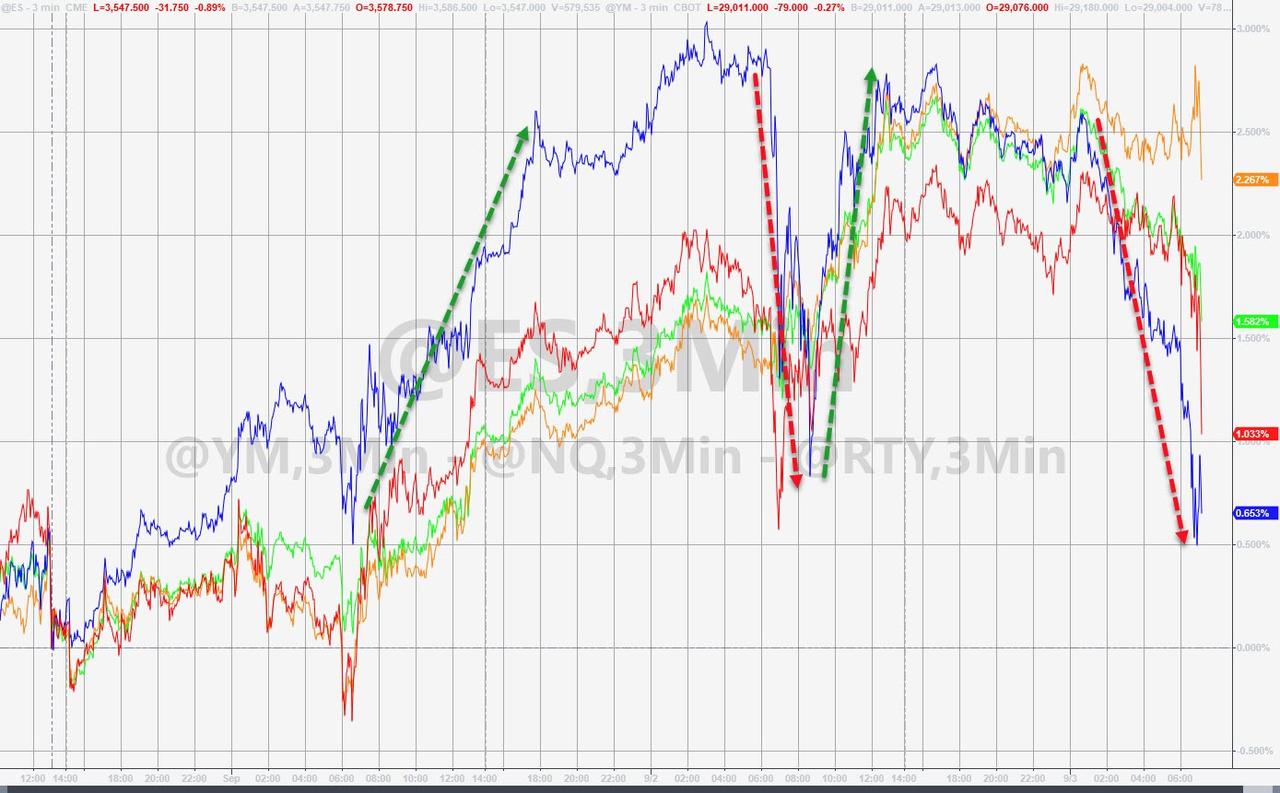
US equity markets have been trading like penny stocks for a while and the last two days are perfect examples as they swing schizophrenically and violently on now news from one sentiment extreme to another...
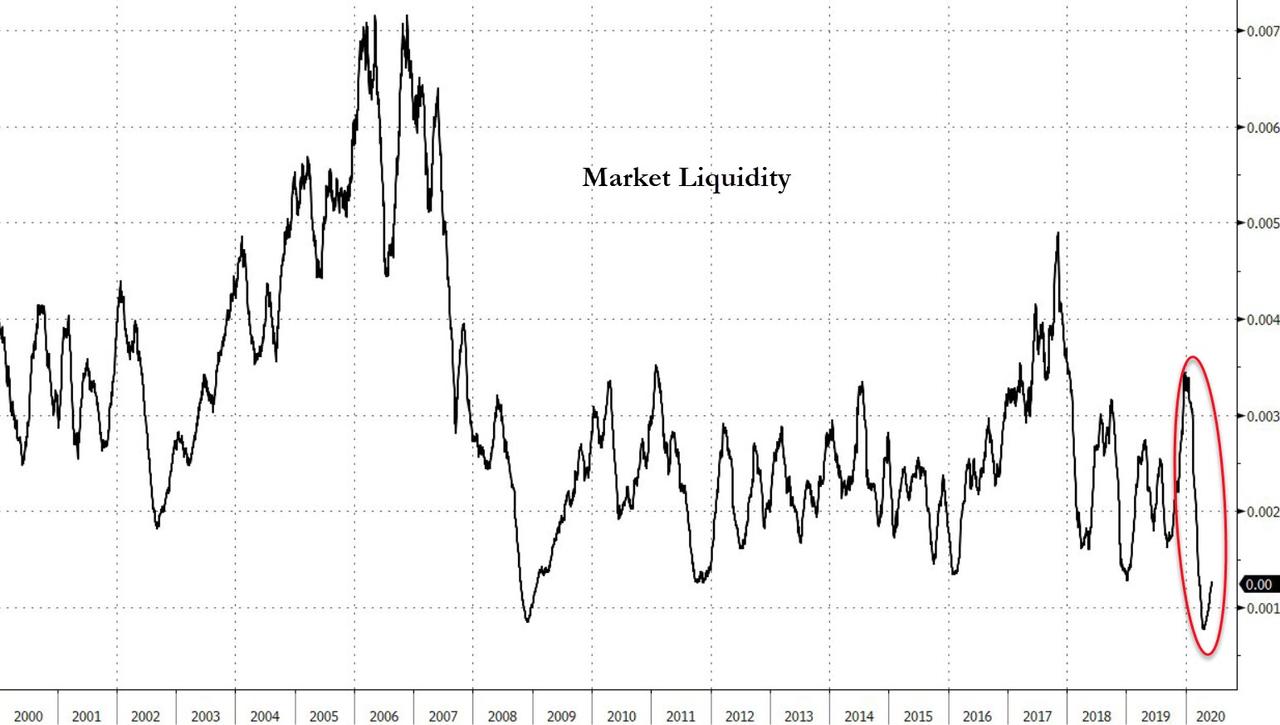
The fact that liquidity in these markets is at or near record lows is not helping...
And an avalanche of "this is easy" retail muppetry is bidding levered long positions suggests none of this ends well.

With VIX at a record high for any S&P 500 all-time high in history...

And that is the message - loud and clear - from Nomura MD Charlie McElligott:
The Eq Vol complex is acting “broken” and indicative that “something’s gotta give,” in-light of the aforementioned “(vol market) tail wagging the (equities market) dog” dynamic which sits at the core of this recent and mechanical “negative convexity” / “short gamma”-driven grab into market upside.
As McElligott's note headline proclaimed:
"FEELS LIKE AN ACCIDENT IS COMING...BUT MARKET CRUSHING YOU IN THE MEANTIME"
It all adds-up to feel like a recipe for tears, i.e. “real” potential for a Nasdaq / SPX -6% to -8% single day in the next 1m-2m timeframe in my eyes as it all then turns the other way to the downside.
- Spread btwn UX1 and UX2 at record highs (steep contango) while conversely, there is an enormous backwardation in mid- to long- end curve.
- Ratio of 10d / 25d Put (Skew) hitting a new 2020 high, where even at prior all-time mkt highs in Feb, we didn’t see “downside” acting like this.
- Massive premium of implied vol over realized (thx to the Tech upside premium buyer flows and concurrent Dealer “short gamma” hedging spillover), with QQQ 60d implied-realized spread still around ~ 99th %ile (10Y rel) and UX1 / SPX 30d realized vol spread currently ~2.5 SD’s over its 10 year mean (h/t AK)

“Spot up, Vol up” continued again yesterday with both SPX and NDX again meaningfully higher-est (lol), but term structure again higher across both as well:

And then there's the building election risk...

The Nomura strategist explains that in addition to the very high likelihood that large Street vol dealer desks will almost certainly be clamped down upon with regard to risk deployment (thus, poor mkt liquidity) around the event and protection of their strong year PnLs - combines to make it very difficult to imagine that the market is going to have the ability to “place” ongoing demand for “tails”
And this dynamic - though somewhat “far” away now - will likely keep vol of vol “sticky” (as we currently see VVIX back north of the finger-in-air 120 “tension” level), because the demand for wingy stuff (crash UP or crash DOWN) only builds the longer this “broken-ness” agitates under the surface... and that in itself is a sign that an accident could happen.
The big question McElligott says he gets from every client in the world it seems:
“when and how does this end?”
It certainly could be a “trade up into, trade down out of” an options expiration “trigger” (fwiw, the Tech flows have been Oct-Feb expiries).
Obviously, this September is a “Serial Expiry” (qtrly) and is suiting-up to be substantial, so in conjunction with something idiosyncratic (a macro “risk-off” catalyst, or perhaps even something innocuous like a stock sale or split from one of the Tech “high flyers”) which then is the “butterfly flapping its wings” event to start something more ominous.
Looking currently at the options-positioning “extremes,” we see some stuff:
- SPX net $Delta at 99.1%ile
- QQQ net $Delta at 100.0%ile, $Gamma 82.4%ile

But for now, it ain’t happenin’... because outside of the negative gamma knock-on buying in market, we also continue to see the US Equities market bot in SIZE by the “Vol Control” universe - as again, realized vols just continue to collapse under the weight of the prior trailing 1m or 3m periods.