>>> US Gapping down

Gapping down
In reaction to earnings/guidance
:

  • CDK -8.6%, PLCE -8.5%, CREE -5.4% (also expands silicon carbide wafer supply agreement with STM), VTEX -5.2%, CRMT -2.6%, ADI -2.6%, TGT -1.8%, JKHY -1.1%, AMCR -0.8%, EAT -0.8%

Other news:

  • PFMT -10% (prices offering of 10.525 mln shares of common stock at $3.80 per share)
  • MRNS -3.4% (receives orphan drug designation from FDA; reports top-line results from Phase 2 trial of ganaxolone in tuberous sclerosis complex)

Analyst comments:

  • ORTX -4.9% (downgraded to Neutral from Overweight at JP Morgan)
  • FCPT -1.1% (downgraded to Outperform from Strong Buy at Raymond James)
  • STOR -1% (downgraded to Mkt Perform from Outperform at Raymond James)
  • AMCR -0.8% (downgraded to Sell from Neutral at Goldman)

>>> US Gapping up

Gapping up
In reaction to earnings/guidance
:

  • ALC +9.9%, INST +7.2%, LOW +4.8%, WB +4.7%, DNUT +2.6%, A +1.7%, LITE +1.7%, TJX +0.8%, TUYA +0.7%

Other news:

  • BWAY +21.2% (FDA gives 510(k) clearance for the company's Deep Transcranial Magnetic Stimulation System to treat symptoms of depression)
  • TLRY +9.1% (acquires majority position in senior convertible notes of MedMen)
  • JKS +6% (signs long-term supply agreement with Wacker Chemie for over 70,000 metric tons of Polysilicon)
  • ANAB +5.2% (FDA grants accelerated approval for JEMPERLI)
  • STRO +4.4% (FDA grants Fast Track designation for STRO-002 for treatment of ovarian cancer)
  • FUV +4% (issues correction, increases the number of manufactured vehicles in Q1 and Q2)
  • CABA +3.1% (reports clinical data from the second dose cohort in DesCAARTes trial in patients with mPV)
  • TS +2.6% (CEO acquitted by Argentine court in Notebooks Case),
  • MRTN +2.5% (declares special cash dividend of $0.50/sh)
  • XPEV +2.2% (signs agreement with Zhaoqing Smart EV Manufacturing Base Phase Two expansion project; capacity for Zhaoqing Base to reach 200,000 units)
  • REGN +1.9% (Regeneron Pharma and Eli Lilly (LLY) COVID treatments are being used to keep patients out of hospital, according to WSJ)
  • VAL +1.4% (awarded one-well contracts with estimated duration of 60 days each)

Analyst comments:

  • VIAC +3% (upgraded to Overweight from Equal Weight at Wells Fargo)
  • ACVA +2.4% (upgraded to Overweight from Neutral at Piper Sandler)
  • BB +1.8% (upgraded to Hold from Sell at Canaccord Genuity)
  • SHEN +1.5% (upgraded to Buy from Neutral at B. Riley Securities)

FT : Just Eat Takeaway.com Gets Lost in Translation

Just Eat Takeaway.com Gets Lost in Translation
The European food-delivery company faces integrational challenges ahead. Confusing its investors won’t help.

Shares of Amsterdam-based Just Eat Takeaway.com, also known as “Jet,” have significantly underperformed U.S.-based food delivery peers over the past year. The irony of that shortfall is the company’s dominance in a fast-growing industry. A June presentation shows more than 95% of Jet’s European gross merchandise value comes from countries where the company has the leading market position.

But the contrast between geographic market leads and stock-market losses doesn’t make the shares an automatic buy. Miscommunication between the company and its investors could make things even less appetizing.

As one of Jet’s top shareholders, Cat Rock Capital, argued in a July presentation, the company’s current problems have less to do with execution than with what the firm calls a history of “broken” communication with investors. In the presentation, Cat Rock shows how the company seems to have flip-flopped on issues such as handling deliveries for restaurants and getting into grocery, belittling such investments only to appear to be pursuing them later.

Jet closed its acquisition of Chicago-based Grubhub in June, but the company says most of its shareholders are still based outside the U.S. Because of that dynamic, clear communication is arguably more important than ever. Fresh company metrics show the U.S. would have accounted for more than 30% of Jet’s total gross transaction value in the first half of the year on a combined basis.

But communication doesn’t seem to have improved. Last month, the company said in a trading update that its adjusted losses before interest, taxes, depreciation and amortization had peaked as of the first half of the year, expecting its margin on that basis to improve going forward, driven in part by “the removal of significant fee caps in the U.S. and Canada.” It reiterated that guidance Tuesday when reporting results for the first half of the year.

In late July, the New York City Council voted to extend caps on commissions that food delivery platforms can charge restaurants in its jurisdiction through at least mid-February. But on Tuesday, Jet only alluded vaguely to that vote in its earnings release, noting that “fee caps in some regions have been prolonged despite a previously announced time frame linked to the end of the state of emergency or restaurants being able to operate at full capacity again.”

The council now says it will be scheduling a vote imminently on a potential permanent commission cap, something investors outside the U.S. might not be watching closely, and which Jet didn’t directly address in its release.

In a conference call for analysts on Tuesday, the company quantified the total impact of fee caps in Canada and the U.S. on adjusted Ebitda as €110 million, equivalent to nearly $129 million, for the first half of the year. It didn’t break out the impact of fee caps in New York alone, even though that city has historically represented Grubhub’s largest market.

A spokesperson for Jet said that because the company operates in more than 20 markets, it doesn’t make sense to go into the details of all the fee caps in every area of every market. Jet’s adjusted Ebitda losses for the first half of the year totaled €190 million, or around $222 million, suggesting that prolonged fee caps in New York City could be meaningful.

U.S.-based delivery companies have been clear that commission caps can weigh on order volume because they lead to higher fees for diners. Jet also reiterated its expectations Tuesday for full-year order growth of above 45% year-over-year, but that guidance excludes Grubhub, whose business has been growing more slowly than Jet’s global business. In the first half of the year, the company’s orders grew 61%, excluding the U.S., from a year earlier, while U.S. orders rose just 27%.

U.S.-based communication from the company includes its own shades of gray. Also on Tuesday’s conference call, Grubhub founder Matt Maloney told investors “we are the clear number-one leader in New York City.”

While not entirely apples to apples, fresh Bloomberg Second Measure data published the same day show DoorDash had pulled ahead of Grubhub in the New York City metro area, with the top market position in terms of sales as of July. The data also show Uber Eats was a mere 5 percentage points behind Grubhub in the third-place spot, not including Postmates, which it bought last year.

The European delivery giant risks winding up with egg on its face.

>>> US Early premarket gappers

Early premarket gappers

  • Gapping up:
    • ALC +10.1%, INST +7.2%, TLRY +6.7%, JKS +6%, WB +5.7%, ANAB +3.3%, TUYA +2.7%, FUV +2.6%, TS +2.6%, XPEV +2.4%, VIPS +2.4%, OPEN +1.7%, VAL +1.4%, A +1.3%, LOW +1.2%, LSTR +0.9%, AGIO +0.8%
  • Gapping down:
    • PFMT -11%, CDK -9.8%, CREE -6.4%, VTEX -5.2%, MRNS -2%, AMCR -1.9%, JKHY -0.9%, LZB -0.8%, CRMT -0.5%
FT : Europe’s big secret is its small cap superstars

Europe’s big secret is its small cap superstars
Contrary to popular belief, not all of the world’s fastest-growing companies are American

Conventional wisdom has it that Europe is a perennial laggard in building exciting companies that can rival the global success stories of the United States.

While venture capital investing has grown significantly in the continent over the past decade, the European start-up sector remains minuscule compared to the might on show in North America.

The malaise also extends to Europe’s listed companies. For more than a decade, European stock indices have significantly lagged behind the US. A quick glance across the European members of the Fortune 500 show the vast majority were founded before the second world war — think solid, boring, and slow growth.

With so much focus on trying to discover racy European private start-ups many observers have failed to spot that some of the fastest-growing and best-performing small companies in the world have in fact been surging ahead right under their noses — and not all of them are new.

Alta Fox, a fund management group based in Texas, last year published an analysis of the best performing small listed companies in the developed world over the five years from 2015-20.

The stock-screen covered companies in North America, western Europe and Australia that started with a market capitalisation between $150m and $10bn, and had generated a total shareholder return of at least 350 per cent over the five year period (35 per cent a year compounded).

Alta Fox excluded all companies in the energy, materials and financials sectors, and as a final check, required companies to have positive revenue growth and earnings before taxation, interest and depreciation for the previous 12 months.

Its findings of the study run against significant amounts of received wisdom about the dire lack of fast-growing companies in Europe compared to the US.

Of the 104 companies to make the final cut, those in western Europe made up 55.7 per cent of the total compared to 32.7 per cent in North America, with Australia accounting for the rest.

Some of these once tiny European listed companies — many of which you may never have heard of — generated annual returns that would trounce top venture capital funds. Xilam, a French-listed animation studio that produces content for Netflix and Amazon was up 1,678 per cent over the period, and Vow ASA, a Norwegian company that purifies waste for cruise ships rose by 1,244 per cent.

Others were microcap shares with no investment bank analyst coverage that were probably worth less than a banker’s house at the start of the study.

Endor, a Bavarian gaming accessory company that makes high end racing simulation racing gear, had a market cap of €1.85m in 2015 but generated a total shareholder return (TSR) of 8,217 per cent over five years. Today, it is worth €352m.

Others will be better known to readers. Some are not new at all, such as the UK miniature war-games company Games Workshop, founded 46 years ago, which grew from £160m to £2.5bn in the period, making returns of more than 2,000 per cent for its investors.

Online fashion retailer Boohoo generated a TSR of 1,320 per cent. Other UK Aim-quoted companies on the list included Bioventix, a biotechnology company based in Surrey, Ideagen, which produces compliance software, and UK polling company YouGov.

Given the obsession with tech as the only source of growth, it’s striking that many of these small companies had little to do with anything that would immediately interest most VC investors.

While companies in the technology sector made up 34 per cent of the total, about a fifth were classed as consumer discretionary companies, and 13 per cent were in the industrial sector. AB Dynamics, listed in the UK and based in Bradford-on-Avon, makes automotive testing equipment. In 2015 it was worth £40m, yet has raced up to £418m today.

As for the country breakdown, the US made up 28.8 per cent of the set Alta Fox studies, with the UK in second place with 15.4 per cent and Sweden in third place with 12.5 per cent. Germany, France, Norway, Denmark, Austria and Ireland all had entrants. However no companies were featured from Italy, Spain or Switzerland.

There should be some lessons in this. By fetishising venture capital and start-ups, both investors and policymakers risk missing that Europe already has an extremely healthy record for small, profitable companies that grow into much larger successful ones. To find them, however, requires looking a little bit harder.

(ZH) Emerging Market ETF Outflows Hit 11-Month High On Brazil Troubles

Emerging Market ETF Outflows Hit 11-Month High On Brazil Troubles

"I think that the rotation from emerging markets to Western markets could continue in the near-term," David Chao, Global Market Strategist, at Invesco, recently said.
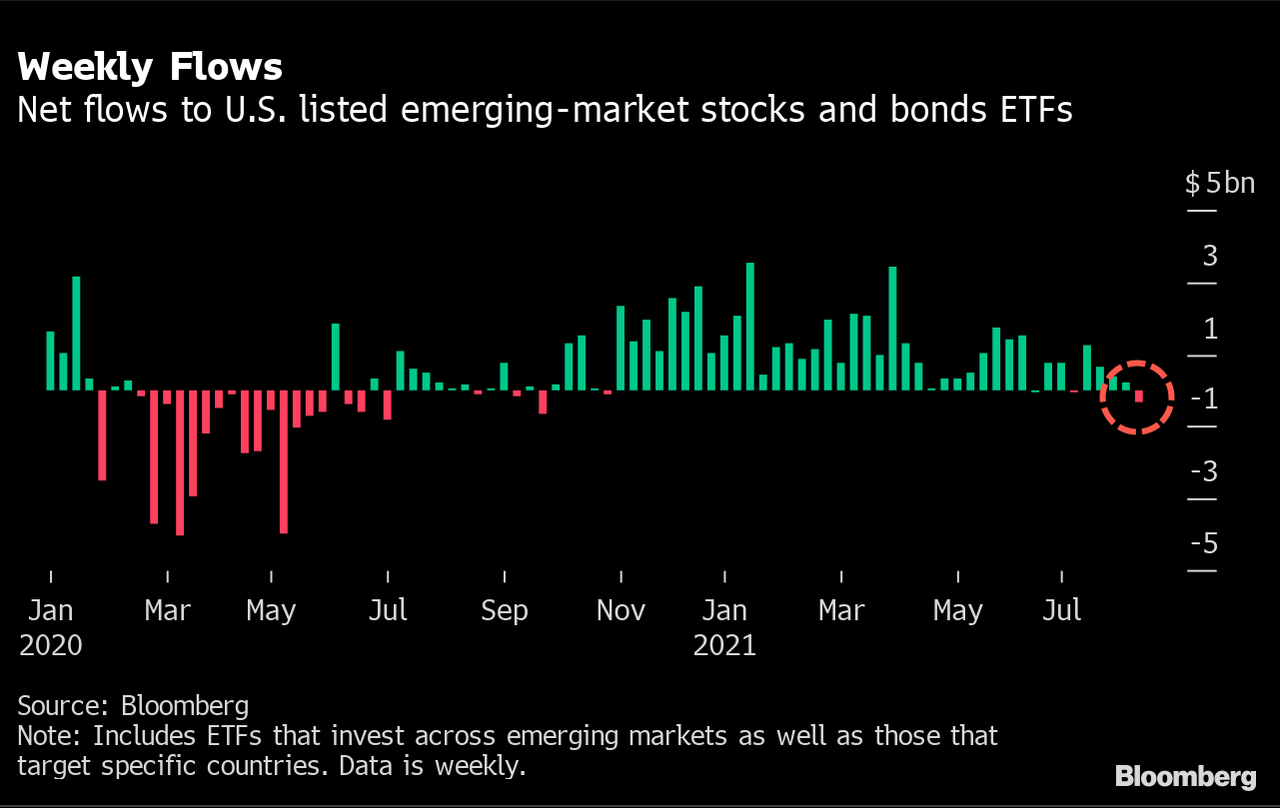
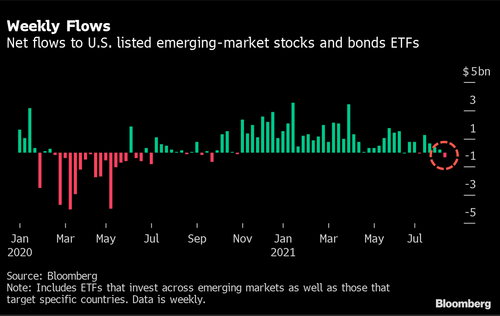
With Chao's EM to DM rotation in mind, Bloomberg data shows EM exchange-traded funds had the most money pulled out last week in 11 months, thanks to mounting Brazilian political and economic risks.
Increasing political tensions in Latin American's biggest economy forced money managers to pull $158.2 million out of Brazilian equity ETFs in the week ended Aug. 13. As a result, U.S.-listed EM ETFs saw their largest weekly outflow since last September.
Source: Bloomberg
Bloomberg data also showed withdraws from funds that invest in EM stocks and bonds were about $345.4 million last week, compared with a gain of $189.7 million the previous week.
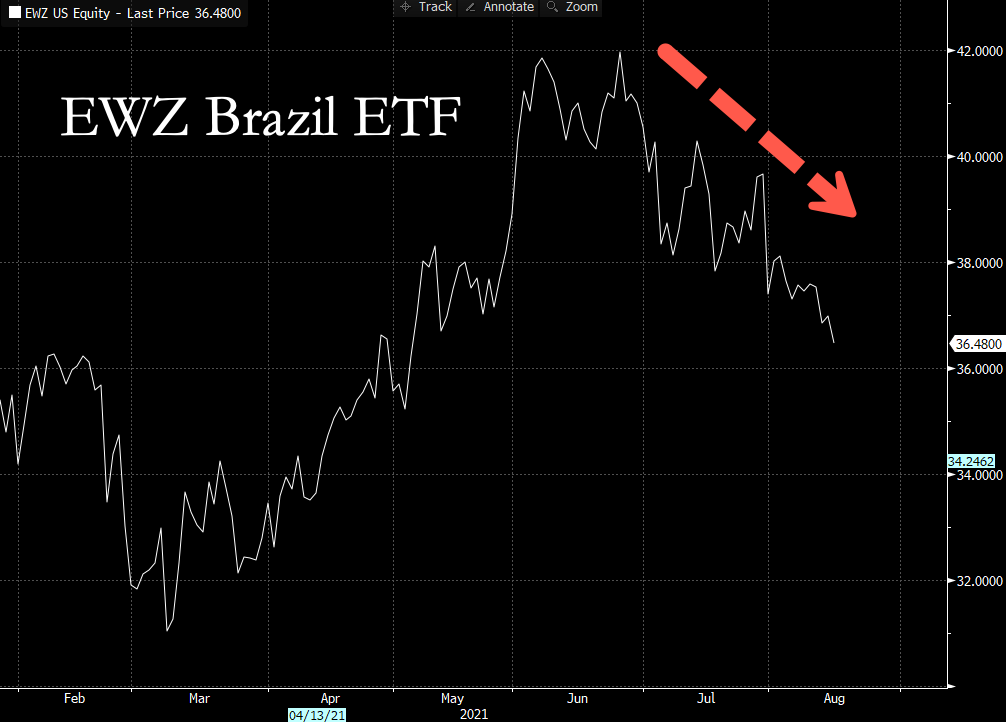
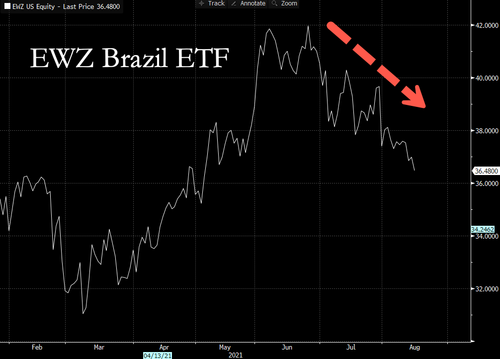
iShares MSCI Brazil, or EWZ, may experience the third month of outflow after investors withdrew $131.8 million last week. Shares of the ETF have tumbled into a correction since peaking in late June, down 13% to $36.49 on Monday, hitting levels not seen since May.
Source: Bloomberg
Besides a political firestorm, investors are also concerned about the country's central bank's full percentage point rate hike next month that could damage sentiment in the local markets.
Some investors, such as Carlos Botelho, chief investment officer at Limiar Capital Management in Arlington, Virginia, said rate hikes are leading to a fixed-income rotation. He said investors are bracing for "a bout of risk-off ahead of the start of Fed taper."
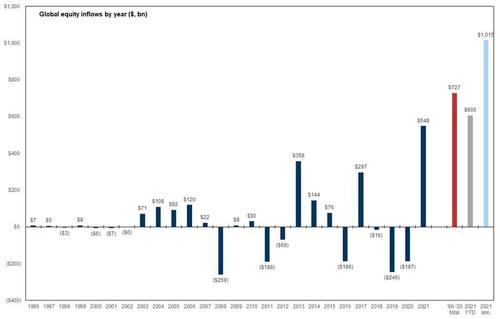
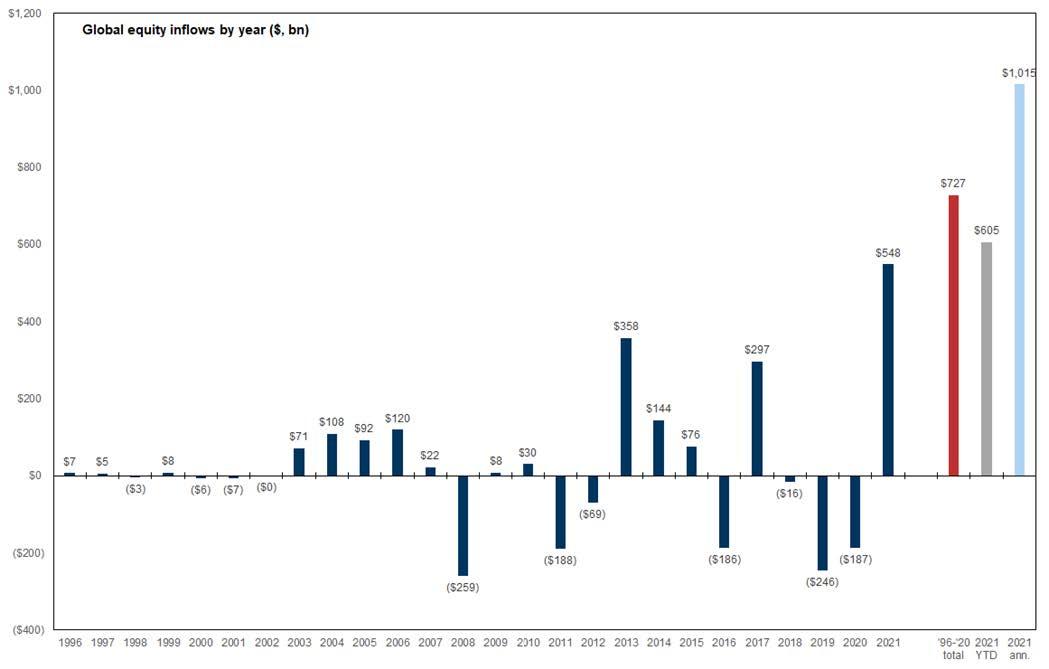
Meanwhile, Goldman Sachs flow trader Scott Rubner released his latest Tactical Flow of Funds report showing global equities have seen more than $605 billion worth of inflows YTD.
Source: Goldman Sachs
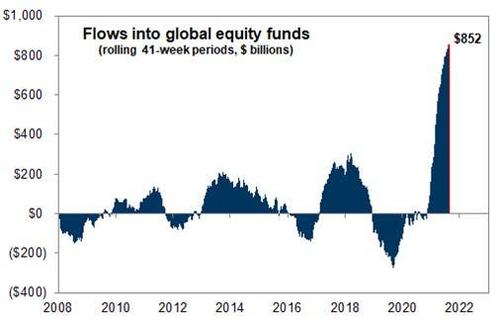
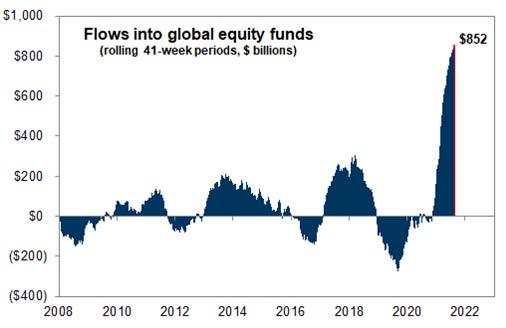
...and $852B in the last 41 weeks since positive vaccine developments.
Source: Goldman Sachs
Meanwhile, EM ETF EEM is negatively diverging the rest of the world.
Could emerging market outflows be the first warning sign that the global rally in stocks is beginning to lose momentum?