WWD : Beyoncé and Jay-Z Meet a Blue Basquiat in Tiffany’s New Campaign: EXCLUSIV

Beyoncé and Jay-Z Meet a Blue Basquiat in Tiffany’s New Campaign: EXCLUSIVE
The spots are to run for one year, and feature the famous Tiffany Diamond.


While no one could ever upstage Beyoncé and Jay-Z, together for the first time in an ad campaign for Tiffany & Co., it’s fair to say there is a third star in the spots: a never-before-seen painting by Jean-Michel Basquiat in the jeweler’s signature robin egg blue.
Tiffany recently acquired the spectacular artwork, which had been in the possession of a private collector since the early 1980s, adding another surprise and layer of storytelling to a vast, yet nuanced advertising effort, which is to break in print next month.
Now controlled by LVMH Moët Hennessy Louis Vuitton, Tiffany is putting major firepower behind the yearlong campaign featuring the Carters, which includes a short film that depicts Beyoncé singing “Moon River” to her husband. It’s destined for major exposure in the coming months, including a takeover of all the digital billboards in New York’s Times Square.

Unveiling the first campaign image exclusively to WWD, Alexandre Arnault, Tiffany’s executive vice president of products and communications, also told the back story of the project in his first sit-down interview since joining the historic New York jeweler last January.
Jay-Z and Beyoncé in the new Tiffany campaign.
MASON POOLE
The ads mark the first time the two music superstars will appear together in a campaign and the first time the famous Tiffany Diamond — with its 128.54 carats and 82 facets — will feature in one. Only three other women — Mary Whitehouse, Audrey Hepburn and Lady Gaga — have ever worn the famous gemstone, which was unearthed in South Africa in 1877.
It’s also tantamount to a record release, with Beyoncé debuting her own interpretation and arrangement of the famous song from the 1961 movie “Breakfast at Tiffany’s” as Jay-Z filmed her with a Super 8 camera. For the film, or call it a music video, she conscripted director Emmanuel Adjei, the co-director and creative collaborator of Beyoncé’s acclaimed musical film “Black Is King.”
Meanwhile, the Basquiat painting, dating from 1982 and titled “Equals Pi,” ties a neat ribbon around a spectacular talent package, being a legendary New York artist that the Carters also admire, relate to — and collect.
“We don’t have any literature that says he made the painting for Tiffany,” Arnault related over Zoom. “But we know a little bit about Basquiat. We know his family. We did an exhibition of his work at the Louis Vuitton Foundation a few years back. We know he loved New York, and that he loved luxury and he loved jewelry. My guess is that the [blue painting] is not by chance. The color is so specific that it has to be some kind of homage.
“As you can see, there is zero Tiffany blue in the campaign other than the painting,” he added, noting that the artwork will ultimately take up permanent residence in Tiffany’s flagship boutique on New York City’s Fifth Avenue, currently undergoing renovation. “It’s a way to modernize Tiffany blue.”
The campaign featuring the Carters is also serving to further renovate Tiffany’s image, with Arnault touting modernity and inclusivity among the overarching ideas he’s introducing — along with daring. It reflects LVMH’s renowned expertise in supercharging heritage brands by blending history and the zeitgeist.


Since Tiffany joined the French luxury conglomerate, also the parent of Dior, Louis Vuitton, Fendi, Givenchy and Celine, the brand has been speaking more frequently — and outside of the moments one expects jewelers to communicate, like Mother’s Day and Valentine’s Day. It’s even garnered some rancor with its divisive “Not Your Mother’s Tiffany” spots.
While acknowledging that Tiffany is a large brand that speaks to many different audiences, and markets a diverse array of products priced anywhere from $300 to $3 million, Arnault said the Carter campaign reclaims the company’s roots as a high jeweler, while giving more hints about where LVMH plans to take the company.
To be sure, the young executive aimed high, describing the trifecta of power players in the campaign as follows: “She’s the best singer in the world, and he’s the best rapper in the world, hands down. And we’re the best jewelry company in the world, right? So we kind of had to marry ourselves together to produce this.”
And what sparks this triangle produced.
“We’ve shared the film with a few people in the company, and they had tears in their eyes. They work for Tiffany’s so it’s biased, but still,” he mused.
The Tiffany Diamond is worn by Beyoncé in the campaign.
Arnault said he pitched the idea to Jay-Z at the top of the year, reckoning that the campaign would surface as the world emerges from the worst of the coronavirus pandemic, providing a message of hope and a story built around New York, Basquiat and his marriage with Beyoncé.
“We at Tiffany stand for many things, love being at the forefront…. And they embody modern love, in my opinion,” Arnault said, mentioning their nearly two decades together, their sometimes public “ups and downs” — and their prolific, unprecedented careers, ranging from Beyoncé’s Ivy Park activewear line with Adidas to Jay-Z’s recent partnership with LVMH to market Ace of Spades Champagne. “If you think about iconic power couples in the world, they are number one, at least in my mind. It’s a really proud moment for everyone at Tiffany.
“We wanted them to be seen as no one has ever seen them before. We wanted to go behind the scenes and try to capture those intimate moments that are so difficult to see and find,” he continued. “You’ll see the magic of them loving each other. It’s quite incredible. Also, their daughter was on set and she appears in one of the videos. You see the special bond that they all have together, which is amazing.”


The couple certainly sprung into action for the creative project, which explores themes of connection and vulnerability. “They believe in the brand, and together, we thought had an amazing story to tell. We’re really honored to have them as part of the family for sure,” Arnault said.
Called “About Love,” the print campaign, photographed by Mason Poole, is to break on Sept. 2 in Harper’s Bazaar U.K. before appearing in other global publications. The accompanying video is to debut on Sept. 15 on tiffany.com as well as key outdoor locations, digital platforms and broadcast outlets. Major takeovers including Times Square and Grand Central in New York City, plus iconic locations in Paris, Tokyo, Shanghai and London, are to unfurl through the fourth quarter.
Arnault declined to say how much Tiffany is investing in the campaign around the Carters.
“The investment will be pretty impressive,” he demurred. “It’s our biggest campaign for the year. It’s the most enduring campaign. Also, it’s the only year-long campaign that we have. It marks a clear evolution of what we’ve been doing from a creative standpoint.”
As part of the partnership with the couple, Tiffany is committing $2 million for scholarship and internship programs for Historically Black Colleges and Universities. “This commitment reflects Tiffany’s continued support toward the advancement of underrepresented communities,” Arnault said. “The Carters have already done incredible work in this space. Together, we are excited to embark upon this journey.”
The video and print campaign were realized at the Orum House — an ultramodern, glass-clad home in Los Angeles — with dreamlike, nostalgic flashbacks interwoven.
Arnault said the shoot went off without a hitch, lauding the professionalism and endurance of the couple, who showed up before call time, stayed after hours, and “gave 150 percent.” He marveled that Beyoncé remained at the piano for four hours, without breaks or refreshments.
The executive also discovered just how knowledgeable both are about jewelry, far beyond what one might glean from Jay-Z’s past penchant for gold chains.
“They both have a real understanding of jewelry. They were asking so many questions that you could see they knew exactly what they were talking about, what they had in their hands,” he said. “They were very, very interested in it.”


Besides the Tiffany Diamond, which cemented the brand’s reputation as a diamond authority, the campaign also features midcentury designs by Jean Schlumberger, including his iconic Bird on a Rock brooch from 1956, reconfigured for the shoot as a pair of one-of-a-kind cuff links for Jay-Z, who also wears a Tiffany engagement ring on his pinkie finger. Some items from the Tiffany T collection are featured, though the eye goes to all the big rocks.
“We wanted this campaign to showcase the highest jewelry that we have, in order to set in people’s minds that this is who we are at our heart,” Arnault said. “We are a high jewelry company. We have extraordinary pieces that are handcrafted by artisans around the world, using the most incredible stones. And putting those products in this campaign is a way for us to remind the public that this is who we are. Putting those products on the Carters is also a way for us to say that we partner with the best, by giving them the best that we have.”
June Ambrose and Marni Senofonte were the wardrobe stylists, dressing Beyoncé and Jay-Z in Givenchy in the images released for this WWD exclusive.
Since taking on the role at Tiffany after four years as chief executive officer of elite luggage firm Rimona, Arnault has certainly demonstrated that he believes in the power of celebrity, first tapping Blackpink member Rosé and Chinese singer Jackson Yee as new global ambassadors, and then adding Tracee Ellis Ross, Eileen Gu and Anya Taylor-Joy. The latter three women first appeared in ads for the T1 jewelry collection, called “Give Me the T.”
Alexandre Arnault
KARL LAGERFELD
According to him, some campaigns have been “more niche,” others “much more edgy” and some more “baroque and opulent.” But overall, the response to Tiffany’s new and varied messaging has been “massively positive.”
Its Pride Month campaign boosted traffic to tiffany.com by 150 percent, according to Adobe Analytics. Meanwhile, its Mother’s Day campaign garnered 75 percent positive sentiment on social platforms, with “Give Me the T” scoring north of 90 percent, according to data from ListenFirst.
“‘Not Your Mother’s Tiffany’ has been met with quite a bit of adversity, which we anticipated, but we’ve seen great growth from the product categories in it,” Arnault said, acknowledging the blowback the ads received on social media. “And we obviously welcome the dialogue, whether it’s positive or negative. We were spoken about by people who had never spoken about Tiffany before, which was great.”


Its current “Knot Your Typical City” campaign, mostly in black in white, is also somewhat unconventional, featuring model Alton Mason in a tuxedo and Taylor-Joy in a bustier jumpsuit cavorting around a bustling Manhattan in daylight.
“You see $50,000 golden and diamond necklaces in the middle of the streets of New York, or on a basketball court with skaters and bikers — which is today’s reality of New York City, and that’s what we try to express.
“We tried to be as inclusive as we could in everything we did. And our intention was meant to speak to the broadest audience possible, which I believe we’ve reached,” he continued. “We want to speak to multiple generations, men and women, a broader audience than we have in the past. We want our brand to be as relevant as it can be.”
In reporting second-quarter results, LVMH cited strong momentum in the first-half of the year and noted that Tiffany “has performed extremely well since its acquisition” and “benefited from the new team’s focus on its iconic products.”
The group’s watches and jewelry division, which includes Bulgari, Chaumet, Fred, Tag Heuer, Zenith and Hublot, reported revenues combed 5 percent in the first half versus 2019.
Arnault declined to talk numbers, but noted the Tiffany brand is already attracting younger clients — and ones with a bigger propensity to spend. Some 62 percent of new clients in the U.S. are younger than 40 years old, and spend around $2,000, which is “massive growth versus 2019.” During Mother’s Day, new U.S. clients under 40 years old grew to represent almost 50 percent of total new clients in 2021, a 25 percent increase versus 2019.
He demurred when asked about the next strategic moves for the brand, while giving a few hints.
“We’ll continue elevating the brand as much as we can from both product and marketing standpoints, without forgetting the entry-price categories at Tiffany, which are very important and core to who we are,” he said. “We’re going to try to connect with the new audience as much as we can and appeal to them, and make ensure that every brand experience meets our potential.”

NY Post : Endeavor staffers fume over IPO, saying it mainly enriched boss Ari Em

Endeavor staffers fume over IPO, saying it mainly enriched boss Ari Emanuel
Talent agents and executives at entertainment conglomerate Endeavor are fuming at their boss, the Hollywood super agent Ari Emanuel, claiming they got shortchanged in the company’s IPO this spring while he made out like a bandit.
Some 300 top players at Endeavor — which owns Ultimate Fighting Championship and the Miss Universe Pageant, in addition to the powerful WME and IMG talent agencies — were told just before Endeavor’s initial public offering in April that their stock options were worthless, sources told The Post.
The shocking news came on a conference call with company president Mark Shapiro, who told the agents and executives that their Endeavor options were severely “underwater,” according to a source with direct knowledge of the call.
According to sources, Shapiro left out the fact that employees’ options had been diluted well below the company’s stock price not only because of the pandemic that hammered Endeavor’s business, but also a massive trove of stock awards that had been granted to Emanuel, the fast-talking Hollywood dealmaker whose brash style was the inspiration for the Ari Gold character on HBO’s “Entourage.”
Emanuel with Mark Shapiro and UFC president Dana White before Endeavor’s public listing on the NYSE on April 29, 2021.
REUTERS
Adding insult to outrage, Shapiro claimed that while Endeavor could have chosen to make employees’ options obsolete, he and the firm’s other top executives had devised a plan to make them whole since they were “good guys,” the source bitterly recalled.
Stunned staffers then received entirely new stock options that they learned, through an online portal, came with harder-to-reach strike prices and longer vesting periods, sources said. Indeed, some said stock that had already vested got replaced with unvested options.
Endeavor declined to comment.
“Nobody is happy. There’s a lot of complaining,” one employee told The Post. “They cut my equity from what I was told when I got it, but it doesn’t look like Ari was cut.”
In order to go public this year, Endeavor bought out the remaining stake in the more lucrative UFC, which diluted Endeavor shareholders.
Zuffa LLC via Getty Images
Adding to the upheaval, employees who raised a fuss walked away with better terms, sources said — pointing to an agent who allegedly bragged about having finagled a one-time bonus of over $200,000 after complaining to management about his new stock terms.
“Everything here is bespoke,” said a source, adding that it’s the company’s culture to reward people for “making noise.”
“Whoever yells the loudest and whoever they’re most worried about leaving that day or that month will likely get something,” the source said.
The company behind the WME talent agency, which represents A-list clients like Christian Bale, Gal Gadot and Matt Damon, moved forward with its IPO plans this year after a failed attempt in 2019. The April launch came despite the company having been left weakened by the pandemic, which slammed the brakes on Hollywood production and live events.
Ari Emanuel (left) with Endeavor president Mark Shapiro, who told stockholding employees that their shares were “under water.”
Getty Images for NBCUniversal
Emanuel and his partners, Patrick Whitesell and Shapiro, pulled off the IPO by cutting a deal at the same time to buy 100 percent of mixed martial arts company UFC, of which Endeavor already owned half, and whose business has boomed through the pandemic. Endeavor sold 21 million shares to investors at $24 each on April 29, raising $511 million.
Since the debut, Endeavor’s stock has since hovered mostly in the $25 range, hitting a high of $31.95 in May and a low of $23.17 in June. On Friday, it closed at $24.99.
According to a source close to the situation, Emanuel owns roughly 30 million Endeavor shares — a cache worth $735 million at current market prices. Emanuel’s only barriers to selling include an IPO lockup period that expires at the end of this year, as well as the vesting of 4.1 million stock options he received in the year or so leading up to the IPO, according to sources and regulatory filings.
Endeavor, which owns the Miss Universe Pageant, issued stockholding employees new stock with harder-to-reach strike prices and longer vesting periods.
AP
Those 4.1 million options alone, slated to vest in three tranches by the end of 2023, will make Emanuel eligible to reap a $100 million windfall if Endeavor’s stock keeps its value until then. Meanwhile, roughly 80 percent of his total holdings carry no such restrictions, enabling him to cash in when he likes.
“Ari basically made himself whole by issuing himself a ton of UFC equity in the last 12 months when no one else was getting much stock and then those units converted to a huge amount of Endeavor equity,” a source said. “No one else’s slice of the pie got bigger.”
While some 150 Endeavor executives who joined the company before 2014 appear to be getting bonuses in line with what they were promised in dollars, some groused they were half what they should have been given the company’s growth. Meanwhile, another 150 executives hired after 2014 saw their bonuses slashed to as little as a quarter of what they’d been promised,
“The stock has to go up a lot before I get what was agreed when I signed on,” one insider kvetched.
Employees complained that Emanuel (far left) and Whitesell (center left) were responsible for some Endeavor stock dilution over the years.
Getty
It’s unusual for a company to IPO with underwater shares. But when it does, particularly through a complex merger, it results in “tricky” calculations that can upset and confuse people, said compensation expert James Reda.
“What the company has to be really concerned about is making sure everybody is getting treated the same”… and that the “top people” are not “bending the rules” to benefit themselves, he said.
Questions surfaced in 2017 when Emanuel and Whitesell sold $165 million in closely held Endeavor stock — and were later rewarded with $100 million each in replacement stock at the company’s expense, diluting other shareholders, according to securities filings.
As Endeavor announced a restructuring in March 2020 that resulted in more than 1,000 layoffs during the pandemic, Emanuel said he would not take a salary that year. Nevertheless, he collected a $1.2 million bonus for the first three months of the year and managed to grab his full bonus of $5.8 million for what Endeavor’s S-1 filing called “his leadership and contributions through the COVID-19 disruption.”
Whitesell got a $2 million bonus, while Shapiro scooped up a $1.6 million bonus, Chief Financial Officer Jason Lublin grabbed a $1.4 million bonus and Chief Legal Officer Seth Krauss raked in $2.4 million.
By contrast, sources said most of Endeavor’s roughly 5,700 employees without stock options — who weathered layoffs, furloughs and pay cuts, with many of them working overtime ahead of the company’s IPO — were given $500 Visa gift cards after the launch.

NY Post : Bill Ackman calls it quits on his giant SPAC days after shareholder la

Bill Ackman calls it quits on his giant SPAC days after shareholder lawsuit
Billionaire investor Bill Ackman said he’s throwing in the towel on his giant blank-check company — just days after he was slapped with a shareholder lawsuit that claims it was set up illegally.
In a Thursday letter to shareholders of his $4 billion special-purpose acquisition company, or SPAC called Pershing Square Tontine Holdings, Ackman told investors he plans to return their money and blames the lawsuit for ruining his chances of closing a deal to buy a 10-percent stake in Universal Music Group.
“Our ability to complete a transaction in the required time frame has been impaired by the lawsuit,” Ackman wrote in the letter. While his firm Pershing Square Capital believes the suit is “meritless,” he added that it “may have a chilling effect on the ability of other SPACs to consummate merger transactions or to engage in IPOs.”
The lawyers who brought the suit, former SEC commissioner Robert Jackson and Yale Law professor John Morley, allege Ackman’s SPAC has been illegally acting as an investment company instead of an operating company, also alleging that Ackman has improperly positioned himself to reap hundreds of millions of dollars in fees.
“We are gratified to see that just two days after we filed our lawsuit, the world’s largest SPAC is now offering to mail back over $4 billion worth of checks to investors,” Jackson and Morely said in a statement.
Ackman, however, said “all is not lost,” noting that Pershing is “working on obtaining approval” from the Securities and Exchange Commission for an entirely new kind of blank check company — a SPARC or special purpose acquisition rights company, which only asks investors for cash if it finds a deal.
Ackman, who has just 11 more months to find a target before he will be forced to return money to shareholders, said the vehicle could be approved by the SEC “shortly.” If the SPARC is approved, Ackman will return investors the $20 per share they spent and give them a warrant to buy into the SPARC when it closes a deal.
Some investors took to a Pershing Square Reddit board to air their grievances — and posted comments like “f***” Bill Ackman” and “Bill Ackman should be charged with securities fraud.”
Early Friday morning Ackman posted on Twitter how a SPARC would preserve optionality for shareholders by letting them by into the deal when the timing made sense. He added that in some cases its better to create a new entity than reform an existing one.

In June, Ackman announced he’d use his SPAC to buy the UMG stake after nearly a year of searching for a target. After pushback from the SEC, which among other issues questioned whether the deal met the New York Stock Exchange’s listing requirements, he announced he would be purchasing a stake through his hedge fund instead of a SPAC.

SPACs are shell companies that raise money in the public markets and then use that money to merge with a private company and take it public. Pershing Square Tontine shares ended the day down 1.3 percent, to $19.73.

(ZH) Japan Emerges As Biggest Driver Behind Recent Plunge In Yields

Japan Emerges As Biggest Driver Behind Recent Plunge In Yields

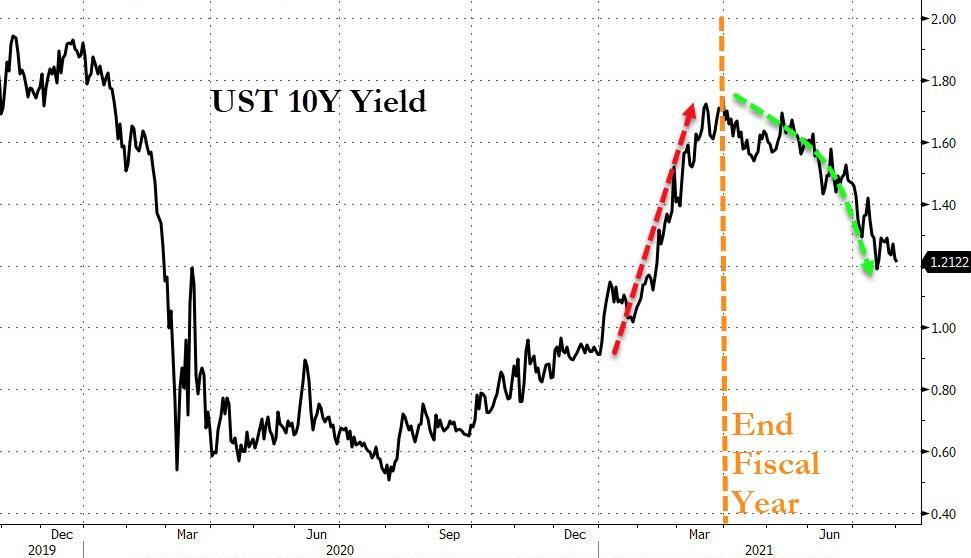
As frequent readers will recall, one of the catalysts behind the forceful emergence of the reflation trade in the first quarter was the powerful move higher in yields which many interpreted as markets pricing in higher long-term inflation. In reality, we have since learned that this move - which coincided perfectly with the end of Japan's fiscal year on March 31 - was largely, if not exclusively, a byproduct of Japan's giant pension fund, the GPIF, drastically shifting out of treasuries as it slashed its US Treasury exposure by a record amount.
Furthermore, as Morgan Stanley said earlier this month when news of the GPIF's asset reallocation first emerged, "it is important to avoid the trap of forcibly goalseeking a narrative to lower yields, a trap investors dealt with merely four months ago":
Treasury yields rose sharply in March, largely due to selling from Japanese investors, based on their fiscal year-end considerations.
Yet, most investors mistook the rise in yields as validation for a super-hot economy, and the consensus bought into the idea that 10-year yields were headed above 2%. We cautioned investors that yields had overshot relative to the economic reality. Over the coming weeks, economic data in the US couldn’t keep up with unrealistic expectations, and 10-year yields started grinding lower.
In other words, GPIF's decision to dump US Treasuries fooled the world into believing the recovery was accelerating, but now that yields are collapsing again, the asset gatherers and commission-rakers conveniently brush it off as "QE-driven distortion."
Fast forward to today when we may be experiencing a remarkable reversal of events from the first quarter.
As most know, in recent weeks the market has been obsessed with the ongoing plunge in yields with most interpreting this development as spelling the end of any reflationary hopes and signaling perhaps outright deflation. Yet as Morgan Stanley again points out, it could very well be that the recent sharp move lower in yields is again merely the result of country-specific asset reallocation. The country in question? Again Japan.
As Morgan Stanley's rates strategist Matthew Hornbach writes in his latest weekly Global Macro Strategist note, global macro markets continue to grapple with the fallout from rising Covid cases driven by the Delta variant, albeit to different extents. With higher vaccination rates, booster vaccines, and stronger fiscal support, most developed economies have some scope for mitigating the economic damage from the rise in cases. As Fed chair Powell noted earlier this week, he doesn't see "important effects" for the US economy just yet.
Powell, on August 18: I would say it's not yet clear whether the delta strain will have important effects on the economy. We'll have to see about that.
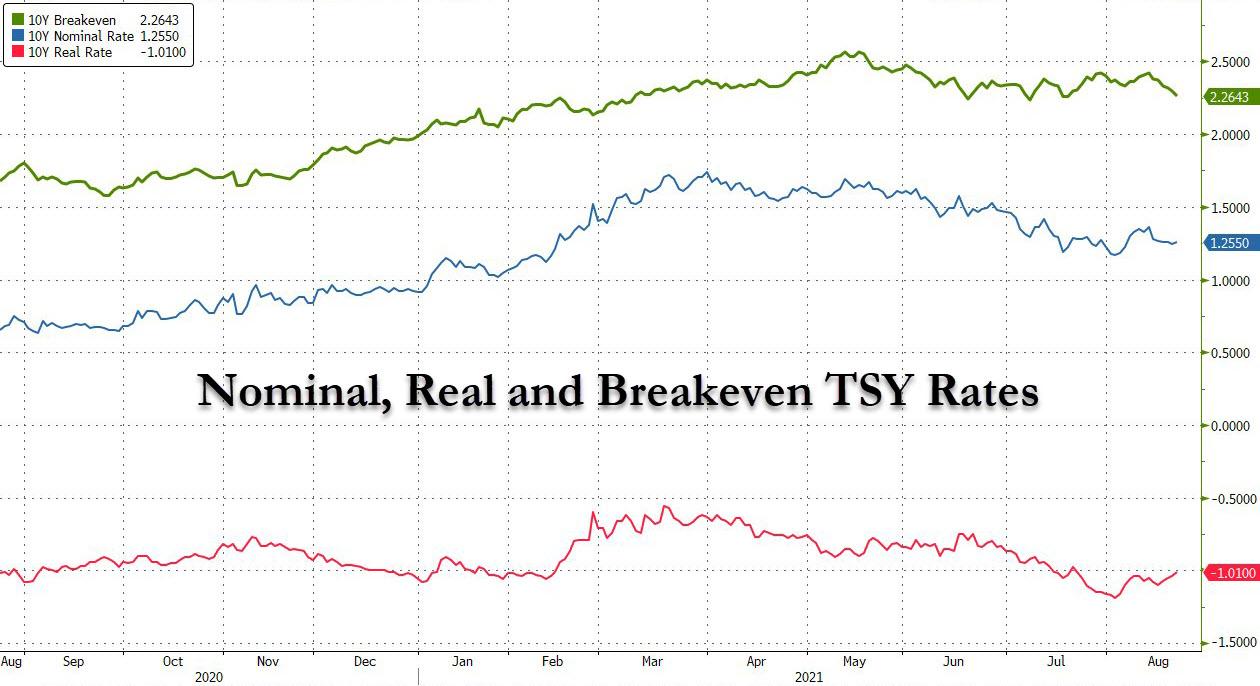
But while Powell may not have changed his view for the economy based on rising Covid cases yet, markets are grappling with the risk case that the rise in the Delta variant will have a negative effect on the economy. Nowhere is this more obvious than in the recent plunge in 10Y nominal yields to 1.15% and the crash in real yields to all time lows.
Of course, there is nothing revolutionary in arguing that the move lower in yields is a direct result of economic slowdown fears arising from the wide spread of the covid Delta variant which has already prompted fresh lockdowns in various countries such as Australia, Japan and New Zealand... but how much is too much? According to Morgan Stanley, "the decline in Treasury yields in the last two months, coincident with a rise of the Delta variant globally, already prices in that downside risk to a sizeable degree."
But a far more actionable observation courtesy of Morgan Stanley's Matthew Horbnach, is that the buying of Treasurys (i.e., reducing yields) is hardly a uniform event. In fact, as shown in the chart below, the decline in yields has been coming exclusively from overnight buyers, particularly from Asian buyers - i.e., Japan, the same Japan which in Q1 was busy dumping Treasurys - while US investors as well as European investors seem relatively bullish.
As shown in the chart below, yields have declined in August only in the Tokyo session, while rising in London and NY sessions.
Furthermore, as Hornbach notes, the lack of follow-through in Treasury yields after the sharp decline in the University of Michigan consumer sentiment - which curiously saw yields rise despite the most bearish economic signal in the survey's recent history - "is encouraging in that regard."
Paradoxically, this bizarre dump out of Japan may also explain a strange observation in equities: as we noted last week, in the past month the S&P is down 4% in the overnight session and it is up 3.5% from 930am to 4pm. This is a stark reversal of the familiar "overnight futures ramp" which has led to most of the market's gains in the past decade.
So is the recent slide in yields the result of aggressive Japanese hedging and/or outright buying of Treasurys? After GPIF's Q1 stunner, when yields blew out as the pension fund was dumping its Treasury exposure, it certainly is conceivable that Japan's skittish bond managers have once again taken the entire bond market for the proverbial ride. Throw in the fact that Japan would be wrongfooting the entire market for the second time in six months, and the irony of all those rates experts being confounded by one nation's bond flow would be complete.
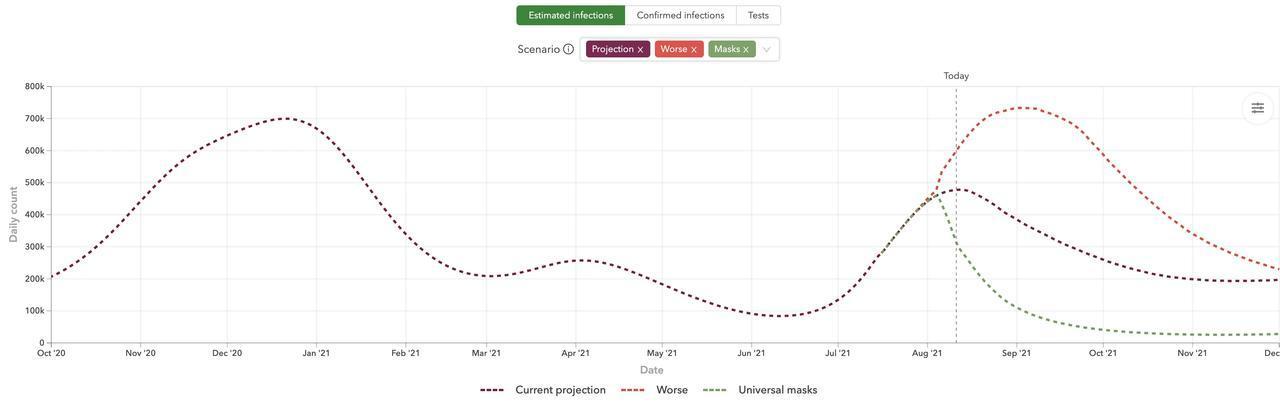
There's more: even if the move in rates is more than just "Japan", the bond market has now taken its downbeat view of the Delta variant too far. Just yesterday, we reported that according to the CDC, the Delta wave has "likely peaked across the Northeast." This confirms what Morgan Stanley said 10 days ago when it predicted that the Delta wave "will peak in 1-2 weeks." It's now almost two weeks later.
Also two weeks ago JPMorgan's Marko Kolanovic said that Delta cases are about to turn lower, an inflection point which prompted the quant to call for a bottom in yields and cyclicals.
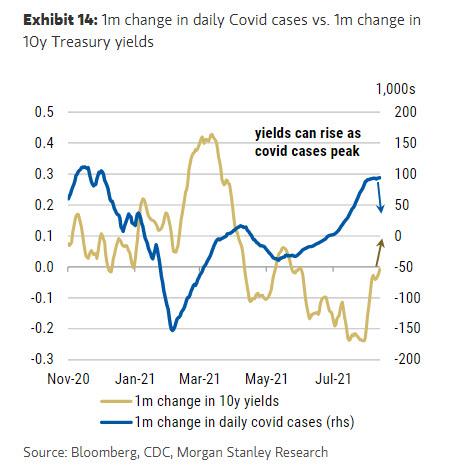
Picking up on this, Hornbach writes that the "second derivative of daily cases in the US is peaking, which is in line with our biotechnology analysts' view that daily Covid case in the US could be peaking in late August/early September." As shown in the next chart, the rise and fall in Treasury yields over the last few months has a degree of inverse relationship with the rate of change of daily Covid cases (2nd derivative of total cases). In other words, "If Covid cases indeed peak, we would expect Treasury yields to rise."
And finally, Hornbach who was broken with Wall Street's dovish trend and expects 10Y yields to hit 1.80% by year end, notes that there may actually be long-term positive effects from the current wave of Covid cases in that it allows the US population to move faster toward herd immunity. This is because (1) more people have been vaccinated after the recent rise in cases, and (2) given the fast spread of the Delta variant in the unvaccinated population, more people gain immunity by developing antibodies after infection.
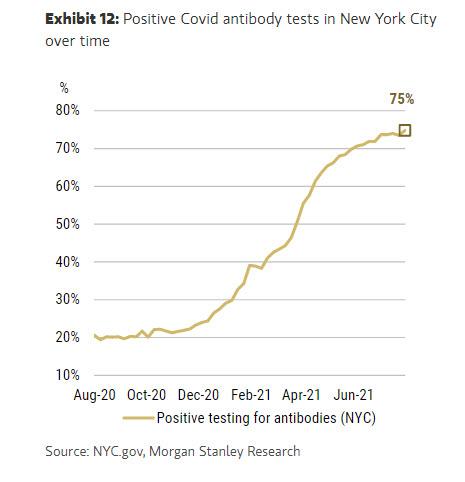
On that note, it is remarkable that the latest serological testing in New York City shows that 75% of the population has some form of antibody immunity vs. Covid - immunity whether due to vaccination or actually having defeated the virus - and thus the US is getting ever closer to "herd immunity".

(ZH) Beijing Considers Making US Listed Companies Hand Over Data Control To Chin

Beijing Considers Making US Listed Companies Hand Over Data Control To Chinese State Firms

On Friday, Chinese tech stocks swooned for the nth time, sending the Hang Seng index into bear market territory, after Beijing approved a new privacy law to prevent data collection by domestic technology companies. As we reported then, China's most powerful legislative body, the Standing Committee of the National People's Congress, passed the Personal Information Protection Law that will go into effect on Nov.1. The move sent tech stocks plunging and leaving investors bewildered over the intensity of Beijing's regulatory crackdown that has slammed countless sectors.
It turns out that when it comes to control over data, Beijing is nowhere near done and late on Friday Reuters reported that as part of Beijing's unprecedented scrutiny of private sector firms, Chinese regulators are considering pressing data-rich companies "to hand over management and supervision of their data to third-party firms" if they want to list in the U.S.
The regulators believe bringing in third-party information security firms - ideally state-backed - to manage and monitor IPO hopefuls' data could effectively limit their ability to transfer Chinese onshore data overseas. That, Reuters notes, would help ease Beijing's growing concerns that "a foreign listing might force such Chinese companies to hand over some of their data to foreign entities and undermine national security" a increasingly sensitive topic for public Chinese firms such as Didi whose stock price plunged amid an ongoing feud with Beijing over who gets to control the company's data trove.
The plan is one of several proposals under consideration by Chinese regulators as Beijing has tightened its grip on the country's internet platforms in recent months, including looking to sharpen scrutiny of overseas listings.
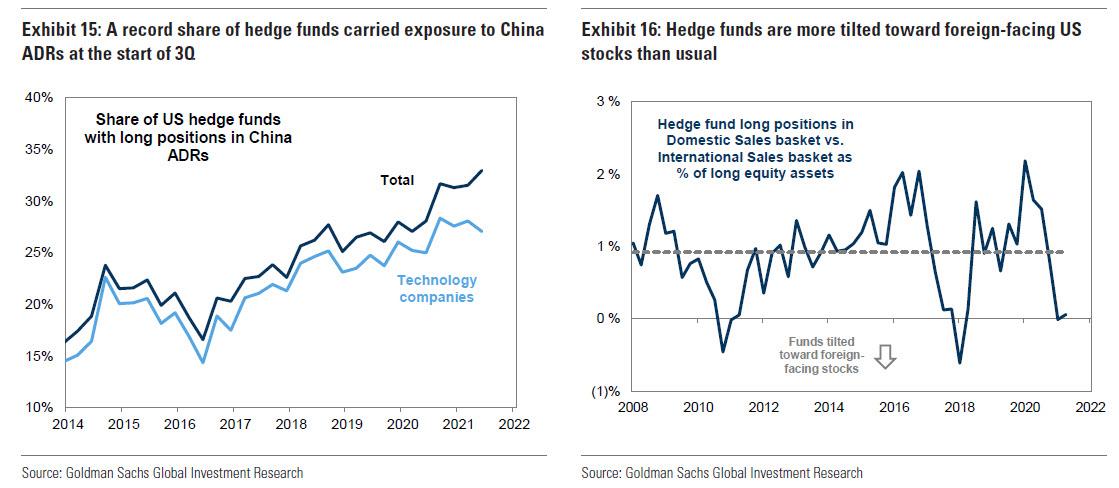
The crackdown, which has smashed stocks and badly dented investor sentiment, in the process hammering US hedge funds who as we noted on Friday have been especially exposed to Chinese stocks...
... has targeted unfair competition and internet companies' handling of an enormous cache of consumer data, after years of a more laissez-faire approach. A final decision on the IPO-bound companies' data handover plan is yet to be made, said the Reuters sources.
The regulatory officials have discussed the plan with capital market participants, said one of the sources, as part of moves to strengthen supervision of all Chinese firms listed offshore.
IPO advisers are hopeful a formal framework on the data handover issue could be delivered in September, said the source.
Chinese regulators have recently put companies' overseas listing plans, particularly in the United States, on hold pending new rules on data security. Last month, the CAC proposed draft rules calling for companies with over 1 million users to undergo security reviews before listing overseas .
With US policymakers already worried that Chinese firms are flouting U.S. rules requiring public companies to disclose a range of potential risks to their financial performance, Beijing's data handover plan sparked renewed calls for caution.
"This is one more piece of evidence that private companies do not actually exist in the People’s Republic of China – they are all under the control of the Chinese Communist Party," U.S. Representative Michael McCaul, the top Republican on the House Foreign Affairs committee, said in a statement.
"Any company that does business in the PRC must answer to the CCP, threatening investor transparency, consumer privacy, and national security," he added, according to Reuters.
Senator Bill Hagerty, who sits on the Senate Banking Committee, echoed this statement to Reuters: "The Biden Administration and the SEC must continue to take action to ensure that Americans are aware of all the risks of investing in companies that are in anyway subjected to the Chinese Communist Party’s rule, including the CCP’s management of key data."
The plans to step up supervision of Chinese companies going public overseas came days after Beijing launched a cybersecurity investigation into ride-hailing giant Didi Global on the heels of its $4.4 billion U.S. stock market listing. Didi is now in talks with state-owned Westone Information Industry Inc to handle its data management and monitoring activities, Reuters reported earlier this month. The proposed restrictions on Didi could become a possible template for other data-rich Chinese companies that look to go public in the United States.
As noted above, Beijing's increasing sensitivity about the collection and usage of onshore data comes as the top legislative body on Friday passed a new law designed to protect online user data privacy. It will implement the policy starting on Nov. 1. In September, China is also set to implement its Data Security Law, which requires companies that process "critical data" to conduct risk assessments and submit reports to authorities.
The government has in recent years increasingly seen user data as key to the country's financial and social stability and pushed tech giants including Ant Group, Tencent and JD.com to share consumer loan data to prevent excess borrowing and fraud, Reuters reported in January. read more Ant is also in the process of spinning off its consumer-credit data operations, as part of the business revamp to revive its public share sale.

FT : TPG $5.4bn climate fund backs long-duration battery start-up

TPG $5.4bn climate fund backs long-duration battery start-up
Form Energy’s technology will help grids manage fluctuating amounts of wind and sun

TPG’s $5.4bn climate fund has made its first investment into clean energy, joining investors including Bill Gates with a bet on a start-up developing a cheap battery that enables electricity grids to better integrate renewable energy.

The TPG Rise Climate, which launched last month, has joined Massachusetts-based Form Energy’s $240m fundraising alongside steelmaker ArcelorMittal, the firm said. The sum was undisclosed.

The investment is part of a growing push by private equity into clean energy. Brookfield Asset Management last month launched a $7.5bn fund focused on climate change, while General Atlantic also established a venture focusing on the sector led by John Browne, former BP chief executive.

“Private capital has a vital role to play in supporting the creation and growth of innovative climate-focused solutions like Form Energy’s,” said Marc Mezvinsky, a member of the climate investing team for TPG Rise.

Former US Treasury secretary Hank Paulson serves as TPG Rise Climate’s executive chair alongside TPG’s co-founder, James Coulter.

Form Energy has developed a battery that uses iron and air to store energy for days rather than hours as lithium-ion batteries currently do. The company says cheaper energy storage will enable the use of intermittent renewable energy all year round, similar to a coal-fired or gas-fired power plant.

“What we are betting on is a mega-trend that is not going away,” said Mateo Jaramillo, a former Tesla executive who co-founded Form Energy in 2017.

The company says its iron battery can deliver electricity for 100 hours at a cost that is competitive with conventional power plants and less than a tenth of the cost of lithium-ion batteries.

That would enable the provision of energy during periods of extreme weather, grid outages, or when there is little wind or sun. The battery costs less than $20 a kilowatt-hour but Jaramillo says the company aims to get that down to $10/KWh by the end of the decade.

The type of iron the battery needs is already produced by the steel industry on a large scale, according to Jaramillo. “Iron is extremely abundant,” he said. “We don’t have to go from scratch and create this globally scaled production process to get the iron that we need.”

The company has a deal to provide 150 MWh of storage to Great River Energy utility in Minnesota and is finalising “lots of other” projects with other utilities who are using more renewables or replacing coal-fired power plants, he added.

“There is still lots of coal generation in the power sector and that is all coming out of the system, it’s not economic any longer,” he said. “A big question is what do you replace it with? Increasingly the trade that has been made for the last 20 years, natural gas, is not really the trade going forward.”

The fundraising brings the total amount raised by Form Energy to more than $360m.

Also joining the funding round were private equity firm Perry Creek Capital, as well as existing investors including Singapore’s Temasek, Bill Gates-backed Breakthrough Energy Ventures, Prelude Ventures, NGP Energy Technology Partners III, Coatue, MIT’s The Engine, Capricorn Investment Group, Eni Next and Macquarie Capital.

The company will manufacture the batteries in the markets where they are deployed, but will continue to make its proprietary air-electrode, which is like a thick piece of rubber, at its headquarters, Jaramillo said.

FT : Asset managers rush to file applications for bitcoin futures ETFs

Asset managers rush to file applications for bitcoin futures ETFs
SEC chair says such funds could win regulatory approval but analysts think investors might stay away

At least four asset managers have filed for ETFs that invest in bitcoin futures after Securities and Exchange Commission chair Gary Gensler earlier this month indicated that he could approve such funds. But investors may not want them in lieu of physically backed bitcoin ETFs, analysts have said.

Valkyrie Investments is the latest fund shop to throw its hat into the ring with the futures-focused Valkyrie Bitcoin Strategy ETF, which it disclosed plans for last week.

The ETF will not directly invest in bitcoin but will instead purchase bitcoin futures contracts. As the contracts approach expiration, they will be replaced by similar ones that have later expiration dates, according to the filing.

VanEck, meanwhile, has just disclosed plans to launch a bitcoin futures ETF that resembles a similar fund it had filed for in 2017. The prior version never launched.

In addition to investing in bitcoin futures, the VanEck Bitcoin Strategy ETF will also invest in ETFs listed in Canada that provide exposure to the underlying digital asset, the filing said.

Neither fund divulged an expense ratio or launch date.

Invesco and ProShares earlier this month filed to launch bitcoin-tracking ETFs that would invest in futures.

But such ETFs, even if they are approved as Gensler indicated, may not satisfy investor appetite for bitcoin ETFs that track the physical asset, analysts said.

Investors were more drawn to ETFs that invest in physically backed bitcoin, said Neena Mishra, director of ETF research at Zacks Investment Research. She compared ETFs that track gold, such as the $57bn SPDR Gold Trust and the $27.6bn iShares Gold Trust, to those that buy gold futures, including the $83m Invesco DB Gold Fund.

The SPDR Gold Trust bled $11.8bn over the year ended July 31, while the iShares Gold Trust garnered $872m, according to FactSet. The former launched in 2004, and the latter debuted in 2005, according to ETF.com. The Invesco DB Gold Fund, meanwhile, bled $61.6m over a one-year period ended July 31. The fund was born in 2007.

“While investor education is important, I think investors understand the difference between a bitcoin futures ETF and one that actually tracks bitcoin,” Mishra said. “Many crypto investors really looking for a bitcoin ETF will wait for the latter.”

However, most retail investors looking for bitcoin exposure may not be able to understand the nuances and complexities of futures-based ETFs, said Nathan Geraci, president at The ETF Store, a registered investment adviser that managed $162m in client assets as of March 25. Retail investors also probably did not understand the available options that could give them bitcoin exposure, such as the $30bn Grayscale Bitcoin Trust, he said.

“I can’t tell you how many people I’ve interacted with who think GBTC is an ETF — it’s alarming,” he said. “ETF issuers must continue leading with education, but this ultimately comes down to investors’ ensuring they understand what they’re buying.”

Most retail investors did not understand the premium they were paying when they bought the Grayscale Bitcoin Trust, Mishra added. The fund charges a 2 per cent annual fee.

While bitcoin futures ETFs could be expensive, they are unlikely to be more expensive than the crypto funds and vehicles already available to investors, said Dave Nadig, chief investment officer and director of research at ETF Trends. He estimated that a bitcoin futures ETF could cost 90 basis points on average, in line with what the Ark 21Shares Bitcoin ETF, a physically backed fund awaiting approval, said it would charge.

Investors may also prefer to steer clear of bitcoin futures ETFs because the futures market could run the risk of a contango if the contracts that expired at a later date became more expensive than the ones nearing their end dates, Mishra said. In those cases, the performance of the ETF could suffer, and investors could lose money, she explained.

A “super contango” in the oil market last year was sparked by a price war between Saudi Arabia and Russia, and was exacerbated by pandemic lockdown conditions. It left investors nursing losses and led to lawsuits and regulatory scrutiny of fund sponsors and trading apps.

Additionally, bitcoin futures ETFs that seek to invest in Canadian bitcoin ETFs — such as VanEck’s product — could change their strategy or suddenly become funds of funds if regulators gave the green light to a physically backed bitcoin ETF, Mishra noted, adding that this could confuse investors.

WSJ : Economy Week Ahead: Housing, Inflation and the Fed

Economy Week Ahead: Housing, Inflation and the Fed
Also on tap, August surveys of purchasing managers in some of the world’s largest economies

Federal Reserve Chairman Jerome Powell’s remarks at the central bank’s Jackson Hole economic symposium on Friday cap off a full week of economic data.

Monday
August surveys of purchasing managers in some of the world’s largest economies—including the U.S.—will offer the freshest indication of how the rapid spread of the Delta variant of Covid-19 is affecting economic activity. Economists expect to see a modest slowdown in the expansion of the services sector in both the U.S. and Europe and declines in activity in both Japan and Australia.

U.S. home prices hit a record in June amid a housing boom that is pitting low mortgage rates and strong demand against limited supplies of homes for sale. Economists are forecasting a small drop in existing-home sales in July, to an annual pace of 5.83 million from 5.86 million a month earlier, as price and supply constraints lock more would-be buyers out of the market.

Thursday
U.S. jobless claims fell to a new pandemic low in the second week of August, a sign the labor market continues to improve despite rising Covid-19 cases and hospitalizations. Economists are forecasting little change in applications for unemployment benefits during the week ended Aug. 21, an outcome that would suggest layoffs are holding fairly steady as the summer unfolds.

Friday
The Commerce Department releases key measures of consumer spending and inflation for July. Data on household outlays could show the continuing shift toward spending on in-person services and away from goods amid the latest Covid-19 disruptions. The Fed’s preferred inflation gauge, the personal-consumption expenditures price index, will be closely watched to see if price pressures are easing as the economy adjusts to a misalignment of supply and demand caused by the pandemic.

Mr. Powell speaks on the economic outlook at the central bank’s Jackson Hole economic symposium. Fed officials appear on track to begin reversing their easy-money policies later this year, though there are several wild cards that could alter the timing of their plans. Those include higher-than-expected inflation and rapidly rising Covid-19 cases associated with the spread of the Delta variant.

FT : Future of petrol pumps fuels Morrisons bid battle

Future of petrol pumps fuels Morrisons bid battle
Rival consortiums consider tie-ups or sales for UK forecourts controlled by supermarket group

While the outcome of the bidding war for Wm Morrison remains uncertain, one aspect is clear: fuel retail features heavily in both bidders’ plans for the supermarket group.

Clayton, Dubilier and Rice, whose £9.7bn offer on Thursday secured a recommendation from the Morrisons board, envisages some form of tie-up between the supermarket’s wholesale arm and the 900 UK filling stations it controls via its ownership of Motor Fuel Group.

The rival consortium led by Fortress, which is considering its response to the CD&R offer, has said it would look at selling the 330 petrol stations attached to Morrisons stores.

These would be offloaded into an increasingly competitive UK market as Asda, now owned by TDR Capital and the Issa brothers, is already in the process of selling its 300 forecourts to EG Group, a petrol station operator also controlled by TDR and the Issas.

Analysts said Fortress’s likely plan to sell the fuel stations was driven by a need to raise cash to improve the overall return on its acquisition.

William Woods, an analyst at Bernstein, said that even at the 252p-a-share level of Fortress’s initial bid for Morrisons, he “struggled to see the returns of the current offer without significant asset sales”.

“If the offer price were to be raised, this will put further pressure on potential new owners to sell off additional assets,” he wrote in a note to clients.

The rival bidders’ plans highlight how the role of fuel has changed in recent years and continues to do so as drivers begin to switch to electric vehicles.

When supermarkets first started to open filling stations at large stores in the late 1980s and early 1990s, the main objective was to lure more shoppers into their stores.

“It was part of the hypermarket revolution,” said Simon Laffin, who was finance director at Safeway in the late 1990s. “The petrol station basically paid for itself but it also increased takings at the store by about 2 per cent.”

The pricing of fuel, often in conjunction with in-store promotions, was key to the offering.

“If you believed that petrol was determining your customers’ choice of supermarket then it had to be cheap,” said another former executive with decades of experience in fuel retail.

“We used to watch rivals’ pricing like hawks while also watching the Platt’s [wholesale] price of the actual fuel.”

But as discounters Aldi and Lidl grabbed market share in the aftermath of the financial crisis, forcing big supermarket chains to cut food prices, the calculus changed.

“As margins in the grocery business tightened, fuel had to stand in its own right . . . supermarkets could no longer justify subsidising fuel,” he added.

At the same time, groups such as EG emerged, buying up groups of filling stations and running them better. Both trends narrowed the price gap between supermarkets and other operators.

But even if it no longer drives footfall in the way it once did, fuel has another important role for supermarkets.

“Supermarket fuel is highly cash flow positive,” added the former executive. “They buy on very good terms and hardly any fuel is stored under the forecourt for more than a few days.”

Selling fuel for cash while paying suppliers for it on credit terms amounts to significant free working capital, which supermarkets missed when the pandemic hit.

At Morrisons, the sharp fall in fuel sales during the UK’s first national lockdown drove a cash outflow of more than £200m in its first half compared with a similar-sized inflow the previous year, and a £400m increase in net debt.

Away from their own forecourts, supermarkets have worked with major oil companies and independent operators to introduce convenience stores to filling stations, giving them another route to consumers.

This has the potential to be particularly valuable for Asda and Morrisons, which unlike Tesco and Sainsbury do not have a convenience format of their own.

EG will soon start introducing “Asda on the Move” stores at its UK filling stations. Morrisons already supplies petrol stations operated by Harvest Energy and Rontec with groceries, though both are considerably smaller than Motor Fuel Group.

Supermarkets and independent operators alike are also starting to ponder the impact of electric vehicles; the UK is due to ban the sale of all new petrol and diesel cars by 2030.

For the independents, the transition reinforces the need for forecourts to be about more than just fuel.

“It is still early days, but increased dwell times driven by motorists having to wait for their car to charge reinforces the non-fuel investment undertaken to date,” said Ilyas Munshi, group commercial director at EG.

“We believe demand for great food and drink, along with a strong grocery and merchandise proposition, will only accelerate with the transition to alternative fuels.”

For supermarkets, whose car parks often have a surplus of spaces, electrification presents an interesting opportunity.

The typical 30-40 minute timeframe for a rapid charge is ideal for a shopping trip, and the big four UK grocers along with Aldi, Lidl and Waitrose have installed thousands of charging points at stores over the past few years.

With petrol and diesel volumes likely to shrink gradually over time, the former fuel retail executive predicts supermarkets will spend more time thinking about whether forecourts are becoming a distraction they can live without.

“There’s going to be quite a debate over the next five years or so,” he said.