FT : Ithaca: the island of many happy returns

Ithaca: the island of many happy returns
Three millennia after Odysseus’s homecoming, the tiny, serene, Ionian island is still drawing people back

I arrived on Ithaca having decided, out of some writerly cliché-avoiding vanity, to write about the island without mentioning the Odyssey. Already from the boat taxi, we could see the place was beautiful: wooded hills, emerald shores, secluded bays. This island, I thought, might attract tourists thanks to its legendary name, but in substance it will have moved on from that. I expected the Odyssey to be no more than a faded film poster peeling off the back wall of a fast-ferry ticket office. 

Ithaca is very green, rugged and hilly. It is also bizarrely shaped: imagine a dumbbell painted by Salvador Dalí. Because of the way it’s often possible to look from its shores across the water and see another part of Ithaca in the distance, I found the island’s geography confusing.

The beautiful place we stayed at, for instance, has the feel of a house perched on the shores of a mountain lake. Without a map, you are never quite sure if you are looking at the mainland, at the much larger neighbouring island of Kefalonia, at Lefkada or back at Ithaca itself.

Our host, Vassilis Lazaris, an enterprising thirtysomething with a kind and infectious smile, dispels the first of my assumptions. Compared to its neighbours, the island has very little tourist activity. For a long time there was only one hotel on Ithaca (boldly called “Hotel”); now there are a couple, some guesthouses, and restaurants and tavernas that, outside the peak summer months, mainly cater to the 3,000-strong local population.

One of the island’s villages, Kioni, boasts a postcard-pretty harbour and is popular with sailing boats, but much of the rest of the island is tourist-innocent. Vassilis tells us that when he and his family recently decided to return to Ithaca, after many years in Prague and then Athens, and to invest in tourism, they felt like pioneers. He speaks of trying to corral local stakeholders into committing to schedules, to having regular opening hours; he finds it amusing rather than maddening. During our stay, we overhear him several times good-naturedly trying to lure someone over from a taverna to open the doors of their own establishment for us.

On the first day, we are supposed to go on a tour of the island. We meet our guide, Spyros Couvaras, at breakfast, an affable, mild-mannered man, as interested in where we are from as we are in his island. When asked about the day’s programme he mentions some villages, which sounds innocent enough. But it’s a trap: no sooner are we off than Spyros pulls out ancient maps and printouts with vertigo-inducing timelines (the “recent” end is the Byzantine empire).


The hilltop villages, I realise, are mostly an excuse to reach a high enough vantage point from which to speculate about the possible location of a certain travel-prone busybody’s palace. I ostentatiously turn to taking photos of flowers and butterflies; it’s my friends who ask questions.

I suppose the reason I expected the Odyssey to be irrelevant to Ithaca today was that I assumed historical matters were more or less settled. What I didn’t know was that even after Frank Calvert and Heinrich Schliemann’s discovery of Troy in the late 19th century, there’s still no evidence any of the Homeric characters existed. The only thing archaeologists agree on is that there was a place called Troy that matches the Homeric location and chronology, and it was destroyed by war. That’s the full extent of what has been reasonably proved.

Spyros, who does believe there was an Ithacan king called Odysseus, is fair-minded enough to inform us that there’s no full agreement even about the location of Ithaca, that some historians believe the name, as used by the ancients, refers to another island. That pesky topography, again: at any one point on the island, the view mimics that of other islands. 

We interrupt our tour of archaeological sites for late lunch in the sleepy hilltop village of Anogi. The old kafeneion we enter is interesting enough to shift attention from pre-antiquity to pre-tourism. Fat pickled artichokes sit in jars on the counter, and food is served on metal plates. There is a TV and a 1950s fridge, family photos on the walls, books lying about, shelves with bags of flour, sugar and salt for sale, crates of tomatoes with handwritten price tags: I can’t decide if it’s someone’s living room or a grocer’s.

Sofia Moraiti, the owner and cook, has an air of humble nobility. We have the best mezedes I’ve ever had (simple: artichokes, fresh local cheese, grilled peppers, salami, olives, a cucumber-less tzatziki, and excellent tsipouro), while my photographer friends go absolutely bananas taking photos of the place.

I take the chance to ask Spyros about his background and interest in local history and he tells us he has lived in Athens for most of his life, working as an editor and proofreader, and only returned to Ithaca a decade ago. He supports himself by private tutoring and the guided tours.

He seems happy in a calm, serene way, and unintentionally deadpan: after asking us if we have cigarettes, he concludes ruefully that “everyone I might have borrowed a smoke from is dead”. Spyros is obviously and sweetly a history geek: at any given time, the geography that is at the fore of his mind is the Homeric one. I get the feeling that if someone were to shout “Phrygian invasion!”, he’d know which way to look.

The following day we are due to go on a boat tour (we all note Vassilis’s relief when our boat shows up). We’ve had glimpses of the beaches from the hilltops we visited the previous day, and what seemed suspect from a distance is outright unbelievable from close range. The waters off Ithaca defy anyone’s colour vocabulary: turquoise, ice-blue, emerald, baby-blue, indigo; I could already anticipate having to explain that no, I’ve not messed about with the photo settings. At times we were tantalisingly close even to Homer’s famous “wine-dark” sea.

Our skipper, George Lilas, explains that the diving is excellent here, and the range and intensity of colour has to do with the cleanliness of the water and the colour and texture of the sea floor. He is rightfully proud at having recently helped clean a beach left full of debris near an abandoned fish farm; we visit the cleaned beach and he shows us the sinister “before” photos. George, too, has returned to the island after years abroad, including working in Florida and doing a masters in renewable energy engineering in Edinburgh.

At the next archaeological site we visit, just outside the northern village of Stavros, Spyros tells us of the attempts at finding Odysseus’s palace, starting with Schliemann, who came to Ithaca emboldened by his Trojan success, and ending with the most recent efforts. The latter unearthed a Mycenaean structure that fits the relevant timeline but which, according to some experts, lacks the grandeur of a royal abode.

We wander among large, pockmarked building blocks that to my eye are almost indistinguishable from boulders. The remains of an arch is the most visibly man-made entity. Odysseus’s palace, if that’s what we’re looking at, is very nearly dust.

For the duration of the trip, I’m too embarrassed to confess to our hosts that I was not going to mention Homer. Instead, I keep my mouth shut and remember Christopher Hitchens’ cautionary anecdote of his trip to communist Prague, his ambition not to mention what every writer knows about Prague: that it used to be Kafka’s home, and that dictatorships are Kafkaesque.

On that trip, Hitchens went on to be arrested for no obvious reason, and was refused an explanation by the Czech authorities: supremely Kafkaesque by anyone’s standards. On Ithaca, listening to Spyros, it feels stupid and naive to have believed that a place’s history would somehow just peel off its present.

I start seeing signs to that effect everywhere. At some point, one of us makes the offhand remark that many shops and tavernas are called Odysseus or Telemachus but none are called Penelope. Vassilis’s earnest answer is that Ithacans suspect Penelope wasn’t entirely faithful to Odysseus, and therefore are less inclined to honour her. This bizarre telescoping of history: imagine still gossiping about Penelope!

The last day we’re at the top of a hill, again with a view of the sea and unidentifiable landmasses, when Spyros starts quoting Homer. Specifically, the parts that reference the surrounding views from Odysseus’s palace. It’s more than a little thrilling to realise that the ancient description fits the landscape before us.

Apart from the poetic frisson, this is what makes the hunt for the palace so enticing, even for an amateur: most of the clues are there for all to see and speculate on, in nature and in Homer’s poems. And the clues might really work, given that they once helped unearth Troy. It should feel hopeless to look for the house of someone who may or may not have lived 3,000 years ago, yet here I am, tempted to make off with poor unsuspecting Spyros’s laminated maps and Homeric quotes and embark on a life of scrutinising the Ionian horizon.

We return to Sofia’s for dinner. She has made a traditional dish, chicken and kid slow-cooked in clay pots. It is delicious, Sofia is a little tipsy, and we tourists are again tipsily amazed that this kafeneion exists. It is rare to feel so at ease and present in a place, without ulterior anythings: you really go there to be there.

And, because by now I expect a certain answer, I ask Sofia whether she has ever left the island. Now and then sneakily tugging at her mask to puff on a cigarette, Sofia delivers the expected answer: she has lived in Italy, France, Canada and is from the tiny village we’re in, Anogi. But when I ask her why she returned, she surprises me: what a question! She was always going to return. Sofia makes her life in other countries and on other continents sound as though she merely popped out for cigarettes.

So: go to this island that the locals love, that they were dying to return to. They’ve seen the world, and they like it here the most. There’s the parallel with Odysseus’s obsessive journey home, of course, but the other thing that struck me about the Ithacans we met is that they seemed genuinely at peace, in a serene, uncomplicated way.

In a travelling context it’s usually the tourist who is the vulnerable one — there is something childlike about being new in a place, being ignorant of the language and the customs. You are exposed. But on Ithaca, it was we tourists who were left feeling intensely protective of the locals. I would love for others to visit this beautiful island and meet these people, but I also found myself wanting to urge future visitors to be kind to them.

(ZH) Feds Offer Cryptocurrency Rewards On Dark Web For Information On Hackers An

Feds Offer Cryptocurrency Rewards On Dark Web For Information On Hackers And Terrorists

The US State Department has launched a new initiative to pay anonymous informants in cryptocurrency for information on enemy state-backed hackers or suspected terrorists, according to CNN.
The agency, for the first time, via its "Rewards for Justice" (RFJ) program, will be paying informants cryptocurrency on a secure portal on the Dark Web for information about enemy state-backed hackers involved in attacking US infrastructure or businesses and or terrorists who want to harm other American interests.
On RFJ's website, the State Department is offering "rewards of up to $10 million for information leading to the identification or location of any person who, while acting at the direction or under the control of a foreign government, participates in malicious cyber activities against US critical infrastructure." Informants who provide credible information will remain anonymous and elect to receive compensation in the form of crypto assets.
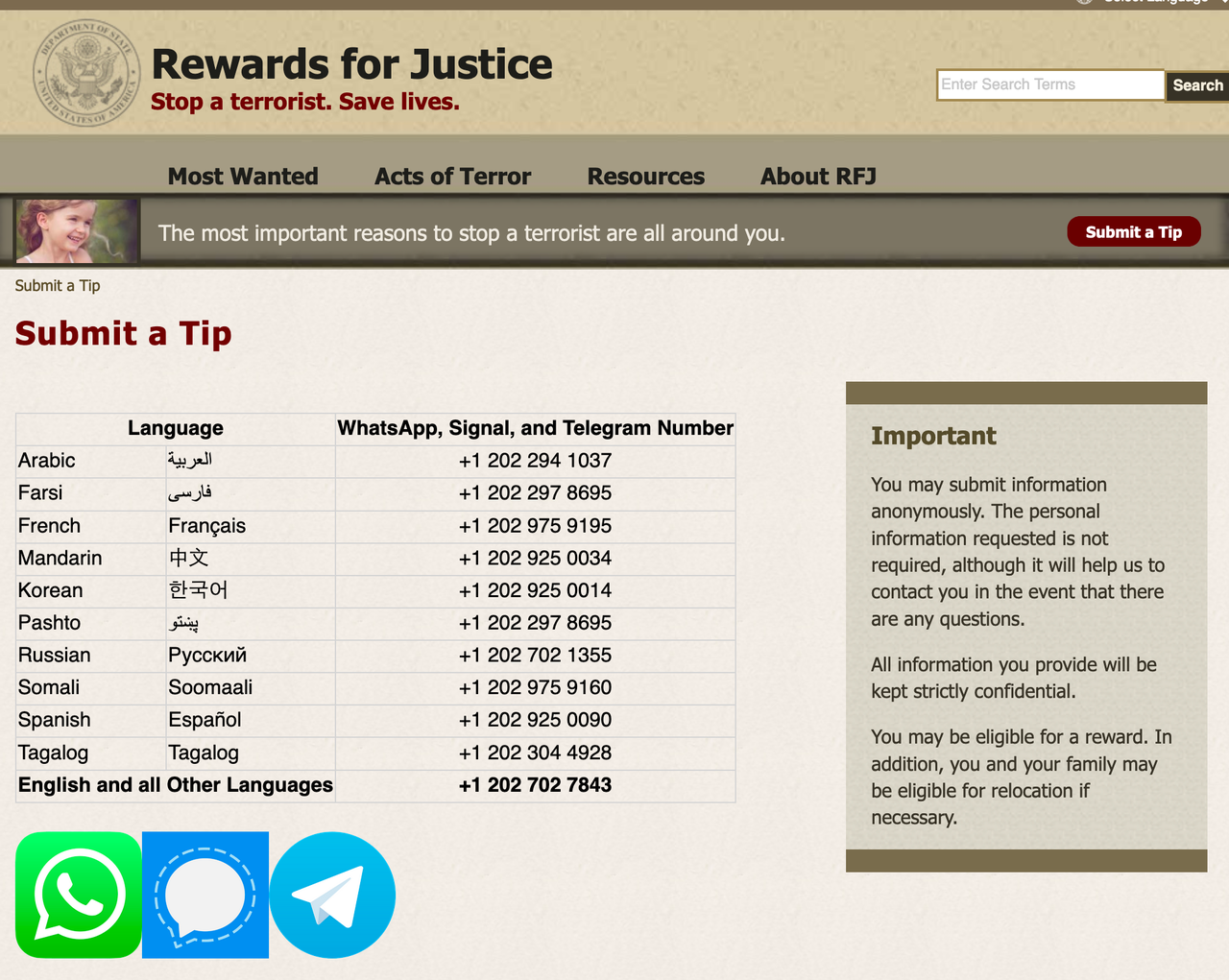
Here's RFJ's website.
RFJ's submit a tip section.
The RFJ platform can be accessed using Tor, one of the most common browsers for the Dark Web that protects a user's privacy. Officials told CNN they have begun receiving tips.
"Within our program, there's a tremendous amount of enthusiasm because we're really pushing the envelope every chance we get to try and reach audiences, sources, people who may have information that helps improve our national security," a State Department source told CNN. "It's been edgy for some government agencies, perhaps, but we're going to keep pushing forward in many different ways."
The source declined to elaborate on the tips already received through the Dark Web due to the sensitive nature of the information and sources.
"Something on the Dark Web that allows total anonymity and an initial level of security is probably more appropriate for those folks," a second State Department source said. "So just finding people where they are and reaching them with the technology on which they are most comfortable, I think, is the name of the game for Rewards for Justice."
Bill Evanina, CEO of The Evanina Group, who recently retired as Director of the National Counterintelligence and Security Center at the FBI and CIA, said this initiative is the federal government's most public use of crypto assets so far.
Contrary to the State Department's use-case, Minneapolis Federal Reserve President Neel Kashkari said Tuesday at an event in Montana that crypto is trash and hasn't "seen any use case that Bitcoin solves other than funding illicit activities like drugs and prostitution."
Kashkari's poisonous remarks about crypto are more of the same from the central banker who also said crypto "is 95% fraud, hype, noise, and confusion."
While the State Department is using crypto and the dark web to catch bad guys, Kashkari is living in an alternate reality and should realize that real uses of crypto are already observed in parts of the federal government.
But again, Kashkari has to defend the dollar, so naturally, any alternative form of payment he is against.

>>> US After Hours Summary: DLO +20%, BBWI +4.1%, SNPS +3.2%, NVDA +2.4% higher

After Hours Summary: DLO +20%, BBWI +4.1%, SNPS +3.2%, NVDA +2.4% higher on earnings; HOOD -8.4%, RRGB -8.4%, VSCO -7.6%, CSCO -1.2% fall on earnings

After Hours Gainers:

Companies trading higher in after hours in reaction to earnings/guidance: DLO +20%, BBWI +4.1%, SNPS +3.2%, NVDA +2.4%

Companies trading higher in after hours in reaction to news: LQDA +8.9% (FDA completes on-site Pre-Approval Inspection of NC facility), PRTK +4% (FDA grants Orphan Drug designation to NUZYRA), FHI +1.8% (to acquire remaining interest in Hermes Investment for $161.5 mln), WGO +1.7% (increases dividend; to move HQ), WDAY +1.5% (acheives Ready status for FedRAMP at Moderate impact level), CFMS +1.4% (announces first procedure using knee replacement system), MNR +1% (STWD raises offer to acquire MNR to $19.20/sh)

After Hours Losers:

Companies trading lower in after hours in reaction to earnings/guidance: HOOD -8.4%, RRGB -8.4%, VSCO -7.6%, CSCO -1.2% (on call, says it expects supply challenges to continue through at least the first half of FY22), KEYS -1.1%, SPTN -0.6%

Companies trading lower in after hours in reaction to news: VRRM -3.1% (stock offering), TRN -0.3% (forms joine venture with Wafra), EQR -0.2% (STWD raises offer to acquire MNR to $19.20/sh), CCI -0.1% (names new COO for Towers unit), WFC -0.1% (reverses decision to shutter personal lines of credit, according to CNBC)

>>> NVIDIA beats by $0.02, beats on revs; guides Q3 revs above consensus (190.4

NVIDIA beats by $0.02, beats on revs; guides Q3 revs above consensus (190.40 -4.18)
  • Reports Q2 (Jul) earnings of $1.04 per share, excluding non-recurring items, $0.02 better than the S&P Capital IQ Consensus of $1.02; revenues rose 68.3% year/year to $6.51 bln vs the $6.34 bln S&P Capital IQ Consensus.
  • Co issues upside guidance for Q3 (Oct), sees Q3 revs of $6.66-$6.94 bln vs. $6.53 bln S&P Capital IQ Consensus

>>> Robinhood Markets reports Q2 (Jun) results, revs in-line, MAUs up 109%, expe

Robinhood Markets reports Q2 (Jun) results, revs in-line, MAUs up 109%, expects seasonal headwinds and lower trading activity across the industry in Q3 (49.80 +3.13)
  • Reports Q2 (Jun) loss of $2.16 per share, may not be comparable to the two analyst estimate of ($0.26); revenues rose 131.6% year/year to $565 mln vs the $559.55 mln two analyst estimate.
  • Transaction-based revenues increased 141% to $451 million in the second quarter of 2021, compared with $187 million in the second quarter of 2020.
    • Options increased 48% to $165 million in the second quarter of 2021, compared with $111 million in the second quarter of 2020.
    • Cryptocurrencies increased to $233 million in the second quarter of 2021, compared to $5 million in the second quarter of 2020.
    • Equities transaction-based revenue decreased 26% to $52 million in the second quarter of 2021, compared with $71 million in the second quarter of 2020.
  • Monthly Active Users (MAUs) increased 109% to 21.3 million in the second quarter of 2021, compared with 10.2 million in the second quarter of 2020.
  • Assets Under Custody increased 205% to $102 billion in the second quarter of 2021, compared with $33 billion in the second quarter of 2020.
  • Outlook: "... For the three months ended September 30, 2021, we expect seasonal headwinds and lower trading activity across the industry to result in lower revenues and considerably fewer new funded accounts than in the prior quarter. For operating expenses, we will continue to invest in key areas to enhance platform capabilities, drive product innovation and improve customer support, as well as building upon our regulatory and compliance functions. We will also record a one-time cumulative charge of $1.0 billion in stock-based compensation for restricted stock units related to our IPO in the third quarter... "

>>> Cisco beats by $0.01, reports revs in-line; guides OctQ EPS in-line, revs ab

Cisco beats by $0.01, reports revs in-line; guides OctQ EPS in-line, revs above consensus; guides FY22 EPS in-line, revs above consensus; JulQ marked highest product order growth in over a decade (55.15 -0.86)
  • Reports Q4 (Jul) earnings of $0.84 per share, excluding non-recurring items, $0.01 better than the S&P Capital IQ Consensus of $0.83; revenues rose 8.0% year/year to $13.13 bln vs the $13.04 bln S&P Capital IQ Consensus.
    • Co reports Q4 non-GAAP operating margin of 33.5% vs 32-33% prior guidance.
    • "The demand for Cisco technology is strong with our Q4 performance marking the highest product order growth in over a decade. With the power of our portfolio, we are well positioned to help our customers accelerate their digital transformation and thrive in a hybrid world."
  • Co issues guidance for Q1 (Oct), sees EPS of $0.79-0.81, excluding non-recurring items, vs. $0.81 S&P Capital IQ Consensus; sees Q1 revs of $12.82-13.06 bln vs. $12.81 bln S&P Capital IQ Consensus. Co guides to Q1 non-GAAP op margin of 31.5-32.5%.
  • Co issues guidance for FY22, sees EPS of $3.38-3.45, excluding non-recurring items, vs. $3.41 S&P Capital IQ Consensus; sees FY22 revs of $52309-53305 vs. $51.89 bln S&P Capital IQ Consensus.

>>> US Close Dow -1.08% S&P -1.07% Nasdaq -0.89% Russell -0.84%

Closing Stock Market Summary

The S&P 500 fell 1.1% on Wednesday amid a flush of selling interest into the close on no specific news. The market traded relatively flat for most of the day, as investors digested earnings news from retailers, mixed economic data, and a July FOMC Minutes report that was largely in-line with expectations. 

The Nasdaq Composite (-0.9%), Dow Jones Industrial Average (-1.1%), and Russell 2000 (-0.8%) declined between 0.8-1.1%. 

Eight of the 11 S&P 500 sectors declined at least 1.0%, including energy (-2.4%), which fell more than 2.0%. The consumer discretionary sector (+0.2%) was the lone holdout amid some relief in retail stocks and Tesla (TSLA 688.99, +23.28, +3.5%). 

Retail stocks drew support from better-than-expected earnings reports from Lowe's (LOW 199.70, +17.44, +9.6%), Target (TGT 247.95, -7.10, -2.8%), and TJX Cos. (TJX 73.31, +4.36, +6.0%). In addition, Lowe's raised its FY22 revenue guidance above consensus, and Target's CEO said he hasn't seen any slowdown due to the Delta variant. TGT shares closed lower, though. 

The broader market didn't really react to the earnings news or to mixed housing starts and building permits data for July. Briefly, total housing starts were weaker than expected at 1.534 million units (Briefing.com consensus 1.610 million) while building permits were better than expected at 1.635 million (Briefing.com consensus 1.610 million). Both figures are seasonally adjusted annual rates.

Instead, there was a slight overreaction to the FOMC Minutes from the July meeting, which indicated that several Fed members thought tapering should begin later this year after substantial further progress has been met. This was in-line with recent Fed commentary when the market was hitting all-time highs. 

The major indices briefly pushed toward session highs immediately following the minutes at 2:00 p.m. ET, then quickly turned around. The bulk of the selling interest happened well after the minutes were released. It's worth mentioning that trading volume at the NYSE was on the lighter side, which might have contributed to the weak price action.  

The Treasury market was well behaved throughout the session. The 10-yr yield increased two basis points to 1.27%, and the 2-yr yield was unchanged at 0.21%. The U.S. Dollar Index was little changed at 93.15. WTI crude futures fell 1.7%, or $1.16, to $65.44/bbl, which reflecting lingering growth concerns. 

Reviewing Wednesday's economic data:

  • Total housing starts declined 7.0% month-over-month to a seasonally adjusted annual rate of 1.534 million units (consensus 1.610 million) while building permits increased 2.6% month-over-month to a seasonally adjusted annual rate of 1.635 million (Briefing.com consensus 1.610 million).
    • The key takeaway from the report is that permits and starts for single-family units both declined, which speaks to some of the resistance of prospective buyers to high prices and some of the hesitancy to build new homes due to the high costs for materials, land, and labor.
  • The weekly MBA Mortgage Applications Index decreased 3.9% following a 2.8% increase in the prior week.
  • Weekly crude oil inventories decreased by 3.23 mln barrels after decreasing by 447,000 barrels during the previous week.

Looking ahead, investors will receive the weekly Initial and Continuing Claims report, the Conference Board's Leading Economic Index for August, and the Philadelphia Fed Index for August on Thursday.  

  • S&P 500 +17.2% YTD
  • Dow Jones Industrial Average +14.2% YTD
  • Nasdaq Composite +12.7% YTD
  • Russell 2000 +9.3% YTD

(ZH) Perfect Storm Of Factors Signal 100% Stock Market Rally Could Be Due For Co

Perfect Storm Of Factors Signal 100% Stock Market Rally Could Be Due For Correction

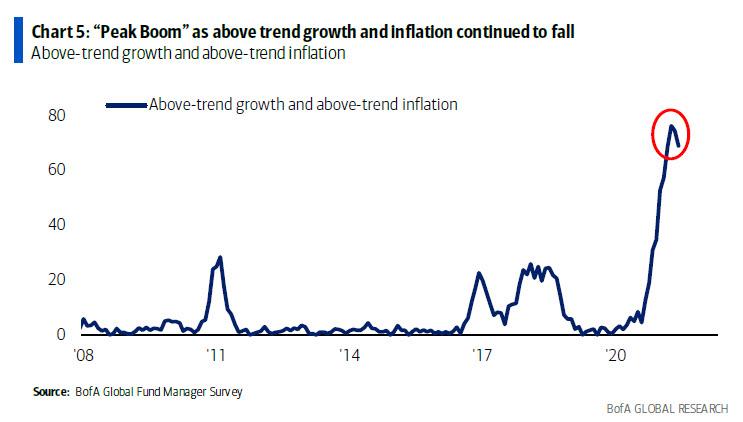
BofA's latest Fund Manager Survey serves up a dose of reality for those who are overly optimistic about the future as "peak economic boom" is here. With that being said, if history is any guide, the stock market could be nearing a correction.
Let's first start with BofA's Michael Hartnett fund manager survey in which 257 panelists with $749bn in AUM, indicated that growth, profit, and inflation expectations are crashing as a result of what Hartnett dubs the "Peak Boom."
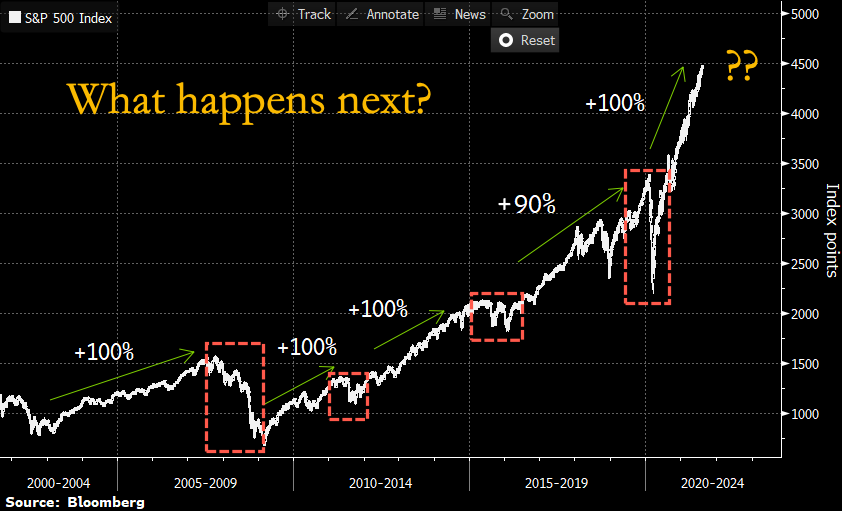
So with Wall Street sentiment turning dire as growth, profits, and inflation plunge, the S&P500 has soared 100% from 2020 COVID lows.
According to Bloomberg, when the S&P500 rises about 100% over the past two decades, the main equity benchmark has usually "fallen at least 10% from its peak in the months or years that followed."
We pointed out yesterday that under the market surface, anxiety is building:
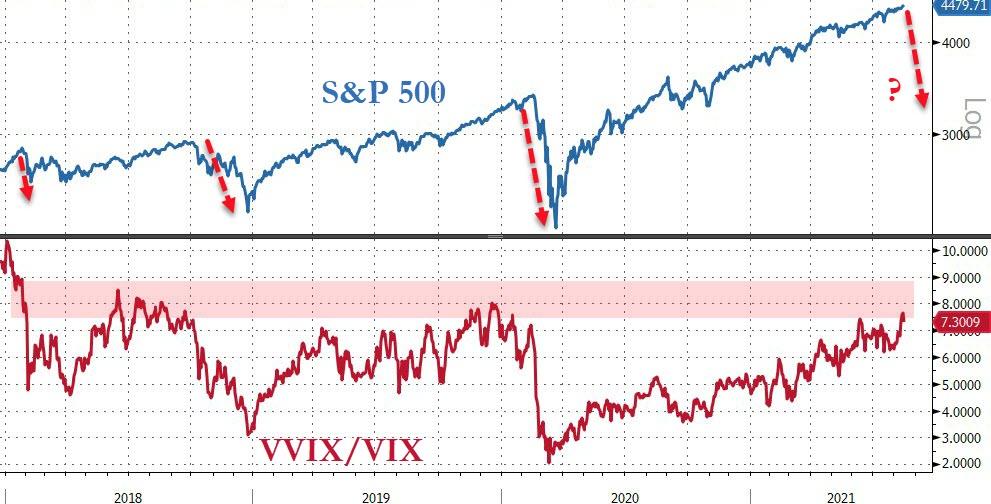
The implied volatility in VIX options continues to advance for five out of seven weeks even though VIX has sunk. This has put the ratio VVIX/VIX at a mind-numbing level of 7.5 on Monday, a reading that has preceded market crashes in the last several years.
Going back to 2017, when VVIX/VIX broke above 8, or near today's current level, it didn't end well for stocks.
So peak economic boom, S&P500 rally signals a warning, and VVIX/VIX at levels that warn of a correction - this means Federal Reserve Chairman Jerome Powell at Jackson Hole next week better keep his mouth shut about tapering if he doesn't want to trigger a market turmoil.