Closing Stock Market SummaryThe stock market struggled on Tuesday, with the S&P 500 (-0.7%) and Dow Jones Industrial Average (-0.8%) snapping five-session winning streaks. The Nasdaq Composite (-0.9%) and Russell 2000 (-1.2%) underperformed and declined closer to 1.0%, but the major indices did close off session lows on no specific news.
The market had a lot to chew on, including a 1.1% m/m decline in total retail sales for July (Briefing.com consensus -0.2%), a disappointing earnings reaction in Home Depot (HD 320.75, -14.30, -4.3%), another day of discouraging reports on the Delta variant, and a step taken from China to crack down on unfair Internet competition.
These were clear headwinds for shares of retailers and Chinese companies (China's Shanghai Composite fell 2.0% on Tuesday) while the broader market was caught up in growth concerns and expectations for a pullback. Weaker prices for oil ($66.61/bbl, -0.73, -1.1%) and copper ($4.21/lb, -0.12, -2.8%) corroborated growth concerns.
Despite the late comeback effort, the consumer discretionary sector (-2.3%) was still held back by Home Depot and its mega-cap components, while the materials (-1.2%) and industrials (-1.1%) sectors declined about 1%. The health care sector (+1.1%) was impressive with its 1.1% gain.
Homebuilding stocks were additionally pressured by a relatively disappointing NAHB Housing Market Index for August, which decreased to 75 (Briefing.com consensus 80.0) from 80 in July. The iShares US Home Construction ETF (ITB 71.19, -2.61, -3.5%) dropped 3.5%.
Strikingly, the Treasury market didn't seem too concerned about growth, and longer-dated yields even bounced off lows after the weaker-than-expected retail sales report. A better-than-expected industrial production report for July might have been a supportive factor.
The 10-yr yield settled unchanged 1.26% after trading at 1.22% prior to the open. The 2-yr yield increased one basis point to 0.21%. The U.S. Dollar Index increased 0.5% to 93.12.
Walmart (WMT 150.70, -0.05, -0.03%) fared slightly better than the overall market after the company beat top and bottom-line estimates and issued upbeat FY22 EPS guidance. WMT shares closed fractionally lower despite the good news.
Reviewing Tuesday's economic data:
- Total retail sales declined 1.1% month-over-month (consensus -0.2%) following an upwardly revised 0.7% increase (from 0.6%) in June. Excluding autos, retail sales declined 0.4% month-over-month (consensus +0.2%) following an upwardly revised 1.6% increase (from +1.3%) in June.
- The key takeaway from the report is that there were declines in most retail categories. One notable exception was food services and drinking places (+1.7%), which just might be leading market participants to think that the impact of the Delta variant on the consumer's psyche isn't as bad as feared/reported and that there will be even more robust activity following any future data point that suggests Delta-related cases are peaking.
- Total industrial production increased 0.9% in July (consensus 0.5%) following a downwardly revised 0.2% increase in June (from 0.4%). The capacity utilization rate increased to 76.1% (consensus 75.7%) from an unrevised 75.4% in June.
- The key takeaway from the report is that it showed the potential for increased industrial production activity when the automobile semiconductor shortage issue can get worked out.
- Business Inventories increased 0.8% m/m in June (consensus 0.8%) following an upwardly revised 0.6% increase (from 0.5%) in May.
- The NAHB Housing Market Index for August decreased to 75 (consensus 80.0) from 80 in July.
Looking ahead, investors will receive Housing Starts and Building Permits for July, the FOMC Minutes from the July meeting, and the weekly MBA Mortgage Applications Index on Wednesday.
- S&P 500 +18.4% YTD
- Dow Jones Industrial Average +15.5% YTD
- Nasdaq Composite +13.7% YTD
- Russell 2000 +10.2% YTD
‘Big Short’ Investor Michael Burry, Other Hedge Funds Bet Against Cathie Wood’s ARK Innovation ETF
Filings show several hedge funds are wagering ARK will keep falling behind market
A legion of retail traders helped make stock picker Cathie Wood’s flagship fund one of the hottest investments in the past year. Now, some professional investors are betting on its demise.
Several hedge funds took out fresh positions in the second quarter betting against Ms. Wood’s actively managed ARK Innovation ARKK -0.93% exchange-traded fund, according to the most recent 13F filings with the Securities and Exchange Commission. The filings are a requirement for professional investors and are due 45 days after the end of the quarter.
Among the biggest naysayers was Michael Burry, the pathology-resident-turned-hedge-fund manager whose success in calling the housing market’s collapse was made famous by Christian Bale in the 2015 film “The Big Short.” As of the end of June, Mr. Burry’s Scion Asset Management held bearish put options worth nearly $31 million against 235,500 shares of the ARK Innovation ETF.
Put options, which give investors the right to sell shares at a certain price, typically deliver profits to investors when the stock or fund they are betting against declines in value.
Several other funds that previously hadn’t bet against the ARK fund took on new positions against it in the second quarter, filings show. Laurion Capital Management held roughly $171 million worth of put options against 1.3 million shares of the ARK Innovation ETF. GoldenTree Asset Management, Moore Capital Management and Cormorant Asset Management also held sizable bearish positions on Ms. Wood’s fund.
Ms. Wood’s ARK Innovation ETF raced higher in 2020 and at the start of 2021, boosted by big bets on companies like electric car maker Tesla Inc., Roku Inc. and Square Inc. Ms. Wood’s strategy, which can be best summed up as identifying and betting on companies that she believes are at the forefront of “disruptive innovation,” seemed unbeatable.
Retail investors clung to her every word on Twitter and television, giving her nicknames like “Mamma Cathie,” “Aunt Cathie” and, in the case of South Korean fans, “Money Tree.”
But as shares of technology and other fast-growing companies lost some of their luster over the following months, so, too, did Ms. Wood’s innovation fund. It is down 6.9% this year, while the S&P 500 has risen 18%.
Ms. Wood doesn’t seem fazed yet. She laid out her investment thesis in a series of Twitter posts Tuesday—then capped off her messages by throwing a jab at Mr. Burry’s latest call.
“To his credit, Michael Burry made a great call based on fundamentals and recognized the calamity brewing in the housing/mortgage market,” Ms. Wood said. “I do not believe that he understands the fundamentals that are creating explosive growth and investment opportunities in the innovation space.”
One Twitter user chimed in with a nod of respect to both investors.
“Mom and dad are fighting again,” the user wrote in response to Ms. Wood.
Neither Ms. Wood nor Mr. Burry were immediately available for comment.
The 13F filings, which firms managing more than $100 million are required to submit to the SEC, only reflect holdings through the end of the last quarter—so it’s possible that firms like Scion, Laurion and Goldentree have adjusted their bearish positions since then.
As for the accuracy of hedge funds’ calls, the industry has had a spotty record when it comes to beating the market. While equity hedge funds eked out a gain in July, they underperformed the S&P 500 for the fifth straight month, according to research from Bank of America.
Nevertheless, recent moves from money managers suggest there’s still a crowd betting Ms. Wood’s fund will fall.
In July, Greenwich, Conn.-based Tuttle Capital Management submitted an SEC filing seeking to launch an exchange-traded fund that would use swap agreements to wager against ARK. The value of Tuttle’s fund would rise when ARK falls.
6 Positive Market Months In A Row... What Happens Next?
In this past weekend’s newsletter, I discussed the rarity of 6-positive market months in a row. To wit:
“An additional ‘red flag’ is the S&P 500 has had positive returns for 6-straight months. As shown in the 10-year monthly chart below, such streaks are a rarity, and when they do occur, they are usually met by a month, or more, of negative returns.“

(It is also worth noting that when the 12-Month RSI is this overbought, larger corrective processes have occurred.)
As stated, I only went back 10-years in the chart above. Such generated several email questions asking about the number of historical occurrences over the long term.
6-Positive Market Months – Long Term
Using Dr. Robert Shiller’s long-term nominal stock market data, I calculated monthly positive returns and then highlighted periods of 6-positive market months or more.

There are several important takeaways from the chart above.
- All periods of consecutive performance eventually end. (While such seems obvious, it is something investors tend to forget about during long bullish stretches.)
- Given the extremely long-period of market history, such long-stretches of bullish performance are somewhat rare.
- Such periods of performance often, but not always, precede fairly decent market corrections or bear markets.
The table below shows all periods where there were 2-months or more of consecutive positive returns.

What the table shows is that nearly 40% of the time, a two-month stretch of positive performance is followed by at least one month of negative performance. Three consecutive positive months occur 23% of the time, and only 14% of occurrences stretch to 4-months.
Since 1871, there have only been 12 occurrences of 6-month or greater stretches of positive returns before a negative month appeared. In total there are just 40 occurrences, out of 245 periods of 2-months or more, the market ran 6-months or longer without a correction.
However, in every period, the run ended in at least a negative return month, but the vast majority ended with much deeper corrections.
This Time Is Different
At the current time, there is no concern about “risk” in the financial markets as the “bullish bias” remains unfettered. With the Fed still applying $120 billion a month in liquidity, investors learned the meaning of “the beatings will continue until morale improves.”
It is certainly possible the market advance can continue unabated into one of the historically lengthier stretches. The only question is when will it end, and how big of a correction will it be?
What will cause the correction is unknown? The reason is that if the market becomes aware of an issue, participants “price” that “risk” into markets. Such is why, particularly when investors are aggressively positioned in the market when an unexpected, exogenous, event occurs prices decline rapidly as “risk” gets reduced.
Such is why the market was holding up fairly well in the face of the “Pandemic” in February of 2020. However, what market participants were not prepared for, the “exogenous” event, was the complete “shutdown” of the economy.
So, whatever event causes a rush of investors to the “exits,” is not something we are currently discussing or worried about in the financial media.
Size Of The Correction
The magnitude of the correction is an easier question to answer.
Currently, the market is extremely deviated above its 2-year (24-month) moving average. Such extreme deviations are a historical rarity and have often resulted in corrections of 20% or more.

As we showed in “Past Performance Is No Guarantee,”
“This is also where investors should be paying attention to the ‘risk’ they are taking on. As shown, there are few points in history where the index, monthly, is this extended, deviated, and bullish.”
There have only been 6-previous points in history where markets were simultaneously this extended, bullish, and overbought. Each of those periods marked more historical performance peaks – 1929, 1937, 1946, 1957, 1987, 1999.
Importantly, the 72-month moving average has acted as long-term running support for the market going back to 1925. Violations of that moving average are rare and only occur during “mean-reverting” bear markets. Currently, a correction to the 72-month moving average would require a 36.5% decline.

Currently, such a correction seems unlikely given the current “bullish sentiment.” However, the same sentiment abounded in February 2020 just before the market tested that support.
Given the massive deviations from long-term means, our suspicion is that at some point we will likely again test that support in the future.
Into The Belly Of The Beast
The market is currently priced for perfection. Investors continue to disregard warnings of slowing economic growth on hopes that monetary interventions will continue indefinitely. While such could indeed be the case, that does not preclude the market from having a correction or worse.
Interest rates continue to decline sharply suggesting that economic growth is weakening rapidly. Such will lead to earnings disappointment in the months ahead at a time when valuations remain excessive on many levels.
August and September historically sport weak performance for the market for a variety of reasons. However, given 6-positive market months already, the risk of a correction has risen markedly.

The first year of a new-President also sports weak performance during the August-September period. With the “debt ceiling” approaching, the Fed potentially discussing “tapering” asset purchases, and the potential for disappointment in economic reports, there are plenty of things to “spook” markets.
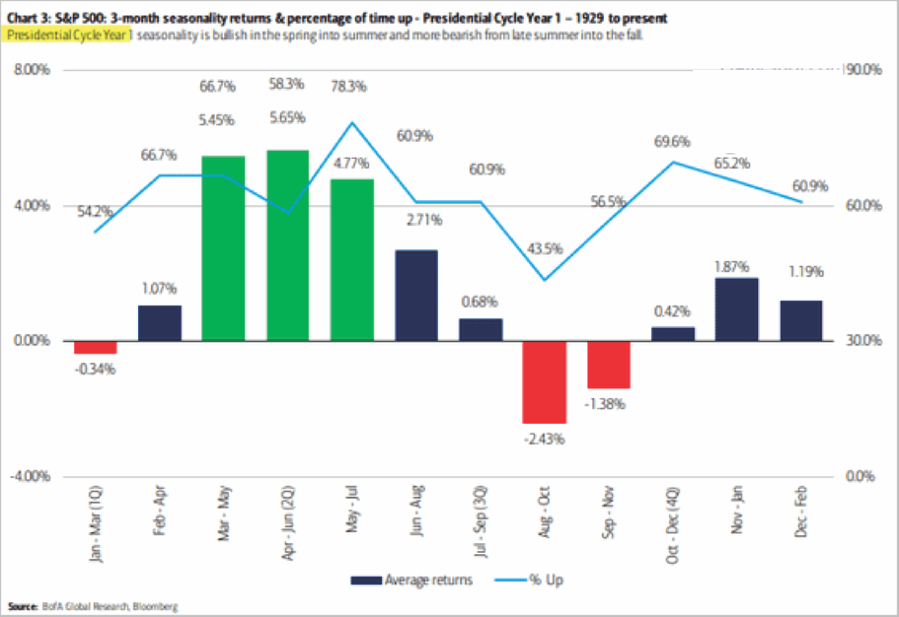
The point is simply that the “risk” of a correction is now elevated.
What This Means And Doesn’t Mean
Let me repeat the following just so there is no confusion.
“What this analysis DOES NOT mean is that you should ‘sell everything’ and ‘hide in cash.’”
As always, long-term portfolio management is about managing “risk” by “tweaking” things over time.
If you have a “so so” hand at a poker table, you bet less or fold.
It doesn’t mean you get up and leave the table altogether.
What this analysis does suppest is that we should use rallies to rebalance portfolios.
- Trim Winning Positions back to their original portfolio weightings. (ie. Take profits)
- Sell Those Positions That Aren’t Working. If they don’t rally with the market during a bounce, they will decline more when the market sells off again.
- Move Trailing Stop Losses Up to new levels.
- Review Your Portfolio Allocation Relative To Your Risk Tolerance. If you have an aggressive allocation to equities at this point of the market cycle, you may want to try and recall how you felt during 2008. Raise cash levels and increase fixed income accordingly to reduce relative market exposure.
Could I be wrong? Absolutely.
But what if the indicators are warning us of something more significant?
What’s worse:
- Missing out temporarily on the initial stages of a longer-term advance, or;
- Spending time getting back to even, which is not the same as making money.
US Treasury Freezes Billions In Afghan Reserves, Depriving Taliban Of Cash
After handing the Taliban US-supplied military hardware on a silver platter thanks to the botched Afghanistan withdrawal, the Biden administration scrambled to deprive the terrorist organization of funding - freezing Afghan government reserves held in US bank accounts, and blocking the Taliban from accessing billions of dollars held in US institutions, according to the Washington Post, citing two people familiar with the matter.
The decision was made by Treasury Secretary Janet Yellen and officials in Treasury’s Office of Foreign Assets Control, the people said. The State Department was also involved in discussions this weekend, with officials in the White House monitoring the developments. An administration official said in a statement, “Any Central Bank assets the Afghan government have in the United States will not be made available to the Taliban.” The officials spoke on the condition of anonymity to discuss government policy not yet made public.
As of April, the Afghan central bank held $9.4 billion reserve assets according to the International Monetary Fund - roughly one third of the country's annual economic output. The vast majority are held outside of the country, according to the Post, billions of which are in the United States.
According to the report, the freeze took effect on Sunday. As the situation was rapidly deteriorating over the weekend, Afghani Central Bank governor Ajmal Ahmady tweeted that they were told they wouldn't receive any more dollar shipments.
As the Post notes, Afghanistan is already one of the poorest countries in the world, and has been highly dependent on US assistance. What's more, the Biden administration will also likely face difficult decisions over how to manage existing sanctions on the Taliban - while dealing with trying to deliver humanitarian aid to a population in dire need.
According to Adam M. Smith, who served on the National Security Council and as senior adviser to the director of the Department of Treasury’s Office of Foreign Assets Control during the Obama administration, the Biden administration didn't need any new authority to freeze the reserves because the Taliban is already sanctioned under an executive order approved following the Sept. 11, 2001 attacks.
Meanwhile, the US sends roughly $3 billion per year in support for the Afghan military, which can only be sent if the Secretary of Defense "certifies to Congress that the Afghan forces are controlled by a civilian, representative government that is committed to protecting human rights and women’s right."
This funding is expected to stop flowing as well, along with smaller pots of money, such as $20 million for recruiting women to the Afghan National Security Forces. About 80 percent of Afghanistan’s budget is funded by the U.S. and other international donors, John Sopko, the special inspector general for Afghanistan reconstruction, told Reuters this spring. A spokesman for the White House Office of Management and Budget declined to comment on the status of Congressionally-approved funding for Afghanistan.“Of course, it’s dangerous,” said Ian Bremmer, president and founder of Eurasia Group, a consulting firm, about restrictions on the Afghan economy, including the freezing of funds held in the U.S. “You’ll see a lot more refugees on the back of this, a lot more radicalism on the back of this. But, on the other hand, Afghanistan will not be able to control this country for a very long period of time. I can’t see us spending money on the Taliban." -WaPo
According to the UN Special Inspector General for Afghanistan Reconstruction, half of the country's total population has required humanitarian assistance this year, nearly double that from 2020, and a six-fold increase from four years ago.
Maybe China will kick in a few billion bucks to their new besties?
Fed’s Jerome Powell Says Pandemic Has Changed Outlook of America’s Youth
‘This is an extraordinary time, and I believe that it will result in an extraordinary generation,’ the Fed chief told students and educators
Federal Reserve Chairman Jerome Powell said the coronavirus pandemic has borne down particularly hard on the nation’s students and educators and will change how young people view the world and their place in it.
America’s schoolchildren “have been forced, sooner than most people, to consider what in life is truly important,” Mr. Powell said in the text of a speech prepared for delivery before a gathering of educators and students Tuesday. He didn’t comment on monetary policy or the economic outlook in his prepared remarks.
With the experience gained in the pandemic, “I hope this will cause you to think about how you want to make your mark, knowing that things do change, and sometimes they change quickly,” Mr. Powell said. “This is an extraordinary time, and I believe that it will result in an extraordinary generation,” he added.
Mr. Powell weighed in as he and his colleagues are preparing for a pullback in the support the central bank has been offering the economy as it has navigated the shock of the coronavirus pandemic. A swift recovery in the economy and declining levels of unemployment are bringing Fed officials closer to the time when they will start paring their $120 billion a month in bond buying. A number of officials have said slowing the pace of these purchases should happen soon.
Mr. Powell is scheduled to take questions from attendees at the Tuesday event.
Tech billionaires back north-east England as green electric hub
Californian developer backed by Bill Gates and Jeff Bezos funds transport innovation in former industrial region
When a California-based developer of sustainable technology, backed by billionaires Bill Gates and Jeff Bezos, searched the world for companies to turn its electric motors into a product that could power the green revolution, it found them a few miles apart in north-east England.
The £100m invested by Turntide Technologies into three businesses near Newcastle offers the prospect of thousands of new, skilled jobs in a region still struggling to recover from the demise of sectors such as coal mining, steel and shipbuilding, with their links to the industrial revolution powered by fossil fuels.
For Matt Boyle, a local entrepreneur who brokered the three deals, including the acquisition of BorgWarner Gateshead, which he used to run, the arrival of the US tech company represents a chance to cement the region’s place as a UK hub of green electrical innovation.
BorgWarner Gateshead, formerly Sevcon, makes control systems for electric drivetrains that began in the 1960s with milk floats. Boyle, now managing director of newly created Turntide Transport, said the UK subsidiary will bring together the three acquisitions and plans to target the “long tail of electrification” in areas of transport facing big technological challenges to going green.
The goal is to build a global business to supply Turntide’s efficient electric motor technology, already used to power heating and air-conditioning units in buildings, to the aerospace, shipping, rail and industrial vehicle sectors.
“All these need to be electrified or policymakers are never going to meet their goals,” said Boyle. “The market is going to be worth trillions.”
The region already has a head start on the rest of the UK in green electrical technology. In 2013, Nissan started building its Leaf, the first mass market electric car, at its factory in nearby Sunderland.
Then in July, the Japanese company announced plans to build a new electric model there along with the UK’s first large-scale battery factory in a deal with Envision, which already supplies the Leaf battery from a smaller site in Sunderland. The £1bn investment will create in total about 6,000 jobs to add to the 46,000 already supported by the car plant.
In December 2020, start-up Britishvolt unveiled plans for a third plant in the region: a £2.6bn factory in Blyth, 13 miles north of Newcastle, employing 3,000 workers.
“We have the controls, the batteries, the machines, the drive systems and the cars all in the region. No one else has got that within a few miles of each other,” said Professor Colin Herron of Newcastle University, a former Nissan executive who heads the Zero Carbon Futures consultancy.
One of the main reasons for battery manufacturers to choose north-east England is the plentiful supply of green power, according to Herron. Blyth is the landing point of a 1,400MW cable providing hydroelectric power from Norway. Battery production is energy intensive and companies need low carbon energy sources to comply with increasingly strict emissions standards.
Brexit has also played a role, he said. Rules of origin under the trade deal with the EU effectively means the battery and powertrain of any British electric vehicle sold to the trade bloc must be built in the UK.
With the UK banning petrol and diesel vehicle sales from 2030, the car industry is moving fast to electrify and other engineering sectors are following.
The government has so far backed the expansion of the Nissan plant in Sunderland with £100m of support but Boyle argued ministers should provide incentives to suppliers to ensure the technology developed in the UK is also manufactured here.
The US tech company has raised $400m to date from backers, including Gates’ Breakthrough Energy Ventures, Bezos’ Amazon, BMW and the Canadian Pension Plan Investment Board.
“There is not enough government support . . . The UK has the opportunity to manufacture what it develops,” Boyle said.
The government pointed to its support for the new Envision battery factory and said it had recently announced a £500m commitment to building an electric vehicle supply chain. “We are backing Britain’s automotive sector through a major investment programme to electrify our supply chain, create jobs and secure a competitive future for the sector,” it added.
Turntide’s focus so far has been its Smart Motor System, an electric motor that could ultimate cut energy consumed by existing rival designs by almost two-thirds. It also avoids the use of expensive rare earth minerals used in most electric drivetrains.
Its three acquisitions in north-east England are designed to expand its expertise in the transport sector. Sunderland-based Hyperdrive uses the same power cells fitted in the Leaf but assembles them into bigger battery-packs to power heavy lift machinery, running its proprietary software.
Chris Pennison, Hyperdrive’s chief executive, said Turntide’s ownership would further boost the business after turnover had doubled during the pandemic to hit £30m this year. “I have 20 engineers here, we now have 100 across the group I can call on.”
AVID Technology, Turntide’s most recent purchase in June, designs and manufactures electric powertrain systems for trucks, buses and high-performance vehicles. It is based in Cramlington, between Newcastle and Blyth.
The three companies supply a range of customers, including Hitachi Rail, Aston Martin and Volkswagen’s MAN trucks division.
Success will in part depend on whether the region can transition from its heavy industrial past to the green technologies of the future. Helen Golightly, chief executive of the North East Local Enterprise Partnership, the regional economic development body, said it was gearing up to provide a trained workforce.
“There is a great skills base. We need to ensure that the offshore oil worker can retrain to work in low carbon industries. And we are working with colleges to ensure they are providing the right courses for young people.”
BT Group/Adam Crozier: this operator will need more than smoothness
Incoming chair must reconcile demands of key shareholders with those of minorities and regulators
Tim Höttges, of Deutsche Telekom, sent a cryptic message to Adam Crozier, BT Group’s chair-elect recently. He noted his company’s kingmaker role — it has a 12 per cent stake — on an earnings call. The finance director name-checked the other key shareholder of the UK’s biggest telecoms group, Patrick Drahi. Crozier will need all his confident charm to reconcile their demands with those of minorities and the UK’s demanding telecoms regulator.
The Scot triumphed in a global hiring contest for good reasons. He turned round struggling television network ITV after running the Football Association. His familiarity with technology at fast fashion group Asos will also have clicked with BT’s nominations committee. His personality should mesh well with that of ambitious chief executive Philip Jansen.
Fathoming the aims of Drahi should be close to the top of Crozier’s to-do list when he starts in December. The Altice Capital boss known for his slash-and-burn tactics took a stake in June. The French tycoon has not requested board membership, which means he is keeping his powder dry.
Drahi can hardly be pleased with the drop in BT’s share price. The enterprise value is about five times estimated ebitda. He could generate some excitement by purchasing part or all of DT’s stake. A partial sale of broadband network Openreach would have the same effect.
BT, like ITV, looks very much like a legacy business struggling to generate steady growth. G-network, City Fibre and Virgin Media are among broadband rivals enumerated by James Ratzer at New Street Research.
Crozier will have to validate his time management skills with stakeholders, as well as BT’s strategy. He has agreed to give up the chair at Asos and a directorship at Sony. But he will continue to chair hotels group Whitbread and Kantar, the market research company owned by Bain.
The argument for plural chairs is that it gives them better contacts and comparative knowledge of other sectors. Arguments against them include suggestions they may limit opportunities for UK business to hire from a wider talent pool. Chairs of big UK companies remain predominantly able-bodied, male, middle-class, heterosexual and Caucasian.
None of these characteristics will matter so much to Crozier’s tenure as his diplomacy. These days, running big UK-focused corporations, like war, is simply politics by other means.
Poly Network tries to persuade hacker to return stolen assets
Alleged thief dubbed Mr White Hat has yet to make good on vow to return millions in crypto tokens
Poly Network has launched a charm offensive focused on the mystery hacker who stole more than $600m in cryptocurrencies in a bid to persuade the alleged thief dubbed Mr White Hat to relinquish control over the outstanding assets.
The overture by Poly on Tuesday is the latest twist in a saga that began about a week ago and which has captivated the world of digital assets. Mr White Hat absconded with the digital tokens after exploiting a vulnerability in Poly’s system and later vowed to return them.
Days later, however, the hacker, who has still not been publicly identified, has declined to relinquish full control over $235m of crypto assets.
Poly on Tuesday called on Mr White Hat to transfer the “keys” — alphanumeric strings — to the account holding the other tokens “as soon as possible”. It offered a handful of sweeteners, including the opportunity for the hacker to become its chief security adviser and renewed an offer to provide a bounty totalling half a million dollars.
The hacker has claimed to be an ethical attacker — a so-called “white hat” who looks for weaknesses in computer networks to improve them, rather than being motivated by money.
Mr White Hat moved some of the virtual loot to a joint account last week, but has yet to hand over the key that would give Poly control of around $235m of coins so it can hand them back to their owners. Poly is in control of around $330m of the stolen assets, while stablecoin operator Tether has frozen $33m of them pending a legal process.
“We are grateful for Mr White Hat’s outstanding contribution to Poly Network’s security enhancements,” Poly said on Tuesday. However, it said the return of funds was still its priority. “Thus, we sincerely hope Mr White Hat can understand our appeal and continue to actively co-operate with us,” it added.
Poly claimed it “has no intention of holding Mr White Hat legally responsible” for the hack — a climbdown from its initial response after the attack in which it said it would take legal action.
The network also said it would donate a $500,000 bounty to a crypto wallet approved by Mr White Hat. It had originally offered the sum in return for discovering the flaw in the system, but the hacker said they would not accept it. “We truly hope that no future projects and industry successors have to experience any similar incidents,” Poly said.
The hacker and Poly have been communicating through messages accompanying transactions executed on the Ethereum blockchain. The messages can be seen in public by anyone with basic software.
Developers who are building automated networks that can bypass institutions like banks and exchanges have argued this type of decentralised finance can make transactions faster, safer and easier. However, the Poly incident has also illustrated the difficulty for hacked networks in retrieving their assets because the computer code on which the networks rely has no legal status.
“It means there is little law enforcement can do ‘post-hack’ to disrupt operations. Once a token or currency has been stolen, there is no way to recover it, it’s gone,” said Andrew Tsonchev, director of technology at Darktrace, the cyber security company.