FT : Rating agencies caution on corporate debt after US borrowing frenzy

Rating agencies caution on corporate debt after US borrowing frenzy
Analysts anticipate wave of fragile companies facing future defaults after ‘clear signs of risk taking’

A boom in US corporate borrowing has laid the foundation for a wave of defaults at financially risky companies, according to leading debt rating agencies that assess and rank bonds and loans. 

Sales of low-rated, “speculative-grade” debt have already reached $650bn this year, according to S&P Global Ratings, putting them on track to surpass all-time borrowing records with more than four months left to go in 2021. Companies of all types had already borrowed record amounts of cash in 2020 in an effort to ride out the coronavirus downturn.

Senior analysts at both Moody’s and S&P said that furious demand from investors on the hunt for higher-yielding assets at a time of low interest rates had given less creditworthy companies access to financing with loose lending terms. 

While they expect debt defaults and bankruptcies to remain low for the foreseeable future, the analysts said the current easy access to corporate financing might be laying the foundation for a future debt crisis. 

“It might not come home to roost in the next year or even longer,” said Gregg Lemos-Stein, chief analytical officer for corporate ratings at S&P. “But there are clear signs of risk taking and a lot of lower-rated issuance. We think this will lead to elevated levels of defaults down the road.”

The warnings stand in contrast to the current bullish mood in corporate credit markets, with the US economy mostly shrugging off the threat of the highly contagious Delta coronavirus variant and even highly indebted companies being able to pay lenders back from their increasing profits.

Following a severe sell-off at the start of the pandemic in March of last year, the Federal Reserve stepped in to backstop corporate bond markets. The central bank’s actions assuaged investors’ concerns and opened the floodgates to an unprecedented wave of corporate fundraising that has yet to abate. 

“It averted a much worse downturn for corporates but the trade-off is that it leads to an increase in risk and the possible creation of asset bubbles,” Lemos-Stein said.

Companies on the brink of collapse found financing to survive. Slowly, investor demand for riskier debt brought borrowing costs down. The added confidence in an economic recovery provided by the announcement of successful vaccines in November spurred further lending as investors bet on companies’ fortunes turning around. 

Christina Padgett, head of leveraged finance research and analytics at Moody’s, said the hopes for recovery leave debt markets open to disappointment. 

Furthermore, the potential for sustained higher inflation to push up interest rates makes companies with floating-rate debt vulnerable to a jump in borrowing costs, a threat also potentially faced by issuers with fixed-rate debt due to be refinanced.

“If you take a forward view, there are many more companies that are fragile,” she said. “They have layered on a lot of debt. What if growth slows beyond what was anticipated when that balance sheet was structured? What if real rates rise or inflation remains higher for longer than we think?

“What may be manageable given today’s outlook could be unsustainable in a higher-cost or lower-growth environment,” Padgett said.
FT : TransDigm signals readiness to pursue Meggitt takeover

TransDigm signals readiness to pursue Meggitt takeover
US engineer made unsolicited bid after UK group had agreed deal with rival Parker Hannifin

TransDigm has given the strongest indication yet that it intends to make a formal bid for UK aerospace and defence group Meggitt, which has already agreed a deal with a rival US engineer.

Kevin Stein, chief executive of the Ohio-based aircraft parts group, said that while he could not comment in detail on the company’s plans, it was interested in buying “good solid assets in the aerospace world”. 

“We don’t do things of a frivolous nature. We are serious about aerospace and about turning good businesses into great ones,” he said. 

The comments are the first time that Stein has spoken publicly since it was revealed by Meggitt last week that TransDigm had made an unsolicited preliminary offer of 900p, 100p more than an agreed bid from rival US group Parker Hannifin.

The UK Takeover Panel on Monday set a deadline of September 14 for TransDigm to make a formal bid or walk away.

TransDigm’s interest has triggered concerns in some quarters that the US group, which talks unapologetically about its ambition to offer “private-equity style returns” to its investors, could break up Meggitt.

Its business practices have also been scrutinised in the US, after a report in 2019 by the US Department of Defense’s inspector general found that the company had overcharged taxpayers on a number of contracts between January 2015 and January 2017. 

The UK government is known to be looking at the current spate of takeover bids in the defence sector, including the bid for Ultra Electronics by private-equity owned Cobham.

Meggitt, which has pushed ahead with the sale to Parker Hannifin, setting a date of September 21 for a shareholder vote, has demanded a series of commitments from the US company on protecting local jobs and investment. 

Stein defended TransDigm’s business model, insisting that the company was a long-term owner of aerospace businesses. He declined to comment on whether TransDigm was prepared to make comparable commitments if it did bid for Meggitt but stressed that the company was a “long-term investor in the UK . . .[that] understands what it takes to be successful”. 

Shares in Meggitt have traded above 800p since TransDigm’s interest emerged, suggesting that the market believes that the US group will make a firm offer. They closed at just under 820p on Tuesday.

TransDigm has been operating in Britain since 2012 and has 2,000 staff at nine sites. In January, it bought Cobham’s radios and antennas business for just under $1bn. Stein said TransDigm intended to “triple the capital investment” in the business. 

He said he had spoken to Kwasi Kwarteng, Britain’s business secretary, at the time of the Cobham purchase, telling him that “we would give him a letter, we would make whatever commitments are necessary”. 

Stein conceded, however, that the commitments in the letter were not legally binding but added: “I understand the governments in these requests. We are long-term buyers in the UK market and we understand the need to continue to invest in MoD, Home Office programmes and projects to maintain a defence capability in the nation.” 

Stein also defended TransDigm’s relationship with the US government. The company paid the government $16.1m in the wake of the report by the defence department’s inspector general, but noted that it had followed all the laws.

“You don’t want one of your largest customers upset with you. It was voluntary. We wanted to show the government that we wanted to help,” Stein said.

(ZH) "Everything Ready To Burn" - High Winds Stoke California Wildfires Burning

"Everything Ready To Burn" - High Winds Stoke California Wildfires Burning At Record Pace

Northern California is battling one of the worst blazes in years as the wildfire threat across the state continues to increase.
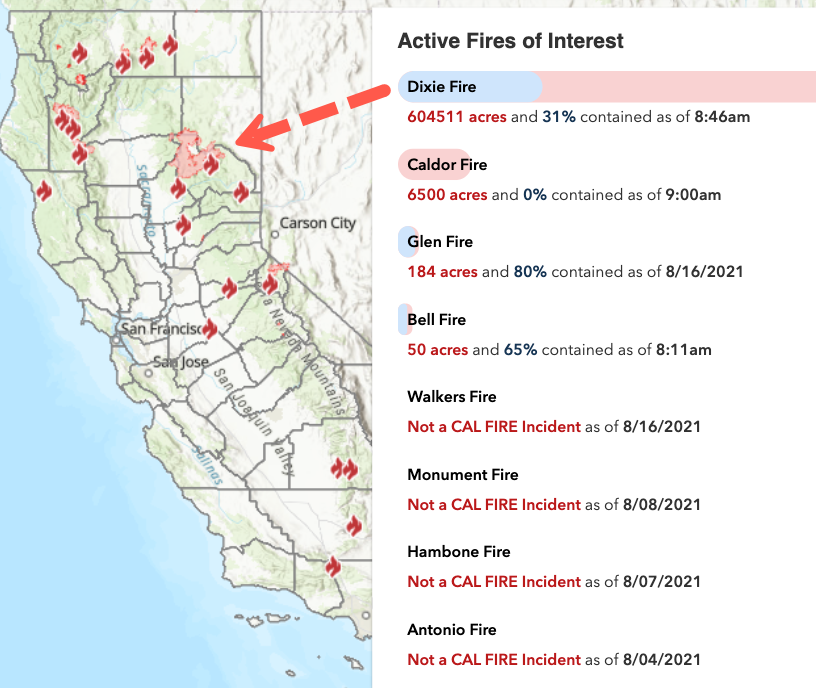
As of Tuesday morning, California broke the 1 million acres burned mark, the earliest in a fire season on record. The largest wildfire is Dixie Fire, which already burned 604,000 acres, and is the state's largest blaze to date. The fire is only 31% contained as of 0846 local time.
A National Weather Service meteorologist in Sacramento, Emily Heller, said low humidity and high winds would help fuel wildfires through late Wednesday.
"Everything is just ready to burn," Heller said. "We have a trough passing to the northeast, and when that happens, we get northerly winds which tend to dry out portions of our area even more."
Utility operator California Public Utilities Commission, PG&E, warned Monday it might have to cut power to nearly 50,000 customers to prevent additional wildfires. In July, PG&E filed documents that their equipment may have started the Dixie Fire.
Dixie has been burning for well over a month, and nearly 6,000 firefighters are battling the blaze. Damage reports already indicate 1,000 homes, businesses, and other structures have been destroyed. The damage might strain the state's fire fund.
Across the state, firefighters are battling ten large blazes, including the Dixie Fire.
Nationally, 104 large fires have been reported in 12 states, burning more than 2.2 million acres, the National Interagency Fire Center said Tuesday.
California's fire season may be a record-setting year as the megadrought and constant heatwaves continue to fuel fires.

(ZH) China's Top Port Shuttered For Seventh Day As Congestion Crisis Spreads

China's Top Port Shuttered For Seventh Day As Congestion Crisis Spreads

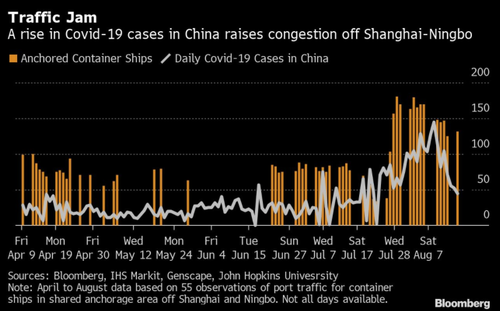
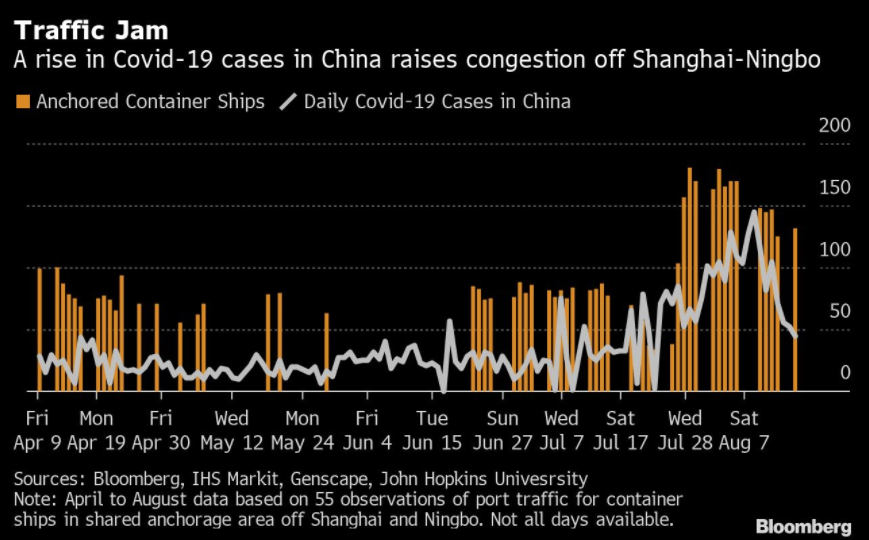
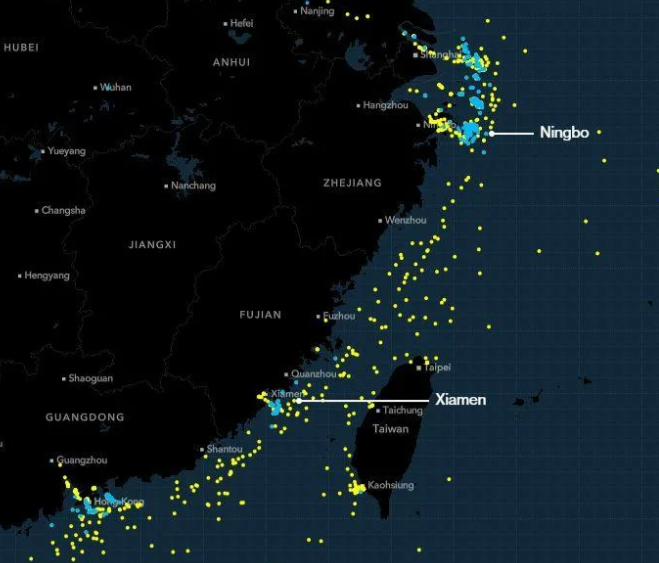
Massive port backlogs continued to build for the seventh day in China at the world's third-busiest container port. Vessels are being diverted away from Ningbo Meishan Container Terminal due to suspended operations following the COVID-19 Delta variant outbreak. This is having a profound impact on nearby ports in Shanghai and Hong Kong, according to Bloomberg.
Port congestion in nearby Shanghai and Hong Kong is increasing once again due to the closure of the Meishan terminal at Ningbo port, a major port and industrial hub in east China's Zhejiang province, which lies south of Shanghai. Last week, a dock worker at the port became infected with the virus and forced the Meishan terminal closure.
Source: Bloomberg
At least a quarter of the port's capacity has been brought offline, forcing some of the world's biggest shipping lines to divert vessels to other surrounding ports.
Simon Heaney, senior manager of container research at Drewry Shipping Consultants Ltd., said Moller-Maersk A/S and CMA CGM SA, the world's largest shipping line, is skipping Ningbo port after the closure has stretched into the seventh day.
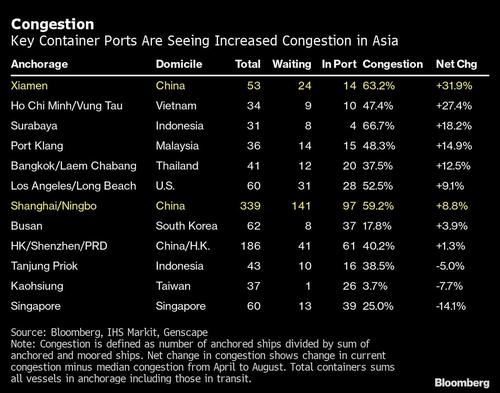
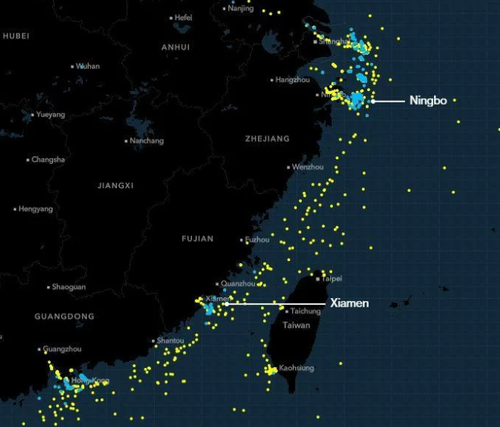
The average count of container ships anchored off Xiamen, a port city on China's southeast coast, across a strait from Taiwan, was 24 on Tuesday, up from 6 at the beginning of the month. Ships anchored off Shanghai and Ningbo ports were more than 141, 60 more than the average from April to August.
Source: Bloomberg
Ningbo is the third-largest container port globally after Shanghai and Singapore, but the busiest container port in the world by volume.
Source: Bloomberg
The consequences of limiting capacity at Ningbo are already apparent and are rippling through surrounding ports, causing massive congestion.
The week closure of the terminal results in cargo diversion to other ports, putting a strain on their operations and exacerbating capacity challenges that have led to record shipping rates ten times greater than normal for specific routes.
Michael Every, Head of Asia-Pacific Financial Markets Research at Rabobank, recently said Delta leads to further disruption to shipping at China's busiest ports. The virus is impacting even Vietnamese and Thai production. In short, shipping snarls are going to get worse. Anecdotes are of shippers telling clients they will not deliver except at a premium; of smaller firms, and countries, being pushed down the priority list; of ships refusing to pick up goods exports from some locations; and of a structural supply-demand mismatch of sought-after shipping containers.
"Most ports are already experiencing congestion or delays, so any additional and uncatered for volumes will heap on more pressure," said Drewry's Heaney.
Goldman Sachs has explicitly warned that "port closures or stricter control measures at ports could also put further upward pressure on shipping costs, which are already very high."
Increasing port congestions in China is bad news for US importers who may experience longer shipping times and incur higher shipping costs on products that will be passed onto consumers. There's also the risk of product shortages developing.

WSJ : Dispute Over Agency in Foreign Bribery Case Gets Second Hearing

Dispute Over Agency in Foreign Bribery Case Gets Second Hearing
A decision by an appeals court could affect future prosecutions of foreign executives under the Foreign Corrupt Practices Act

The long-running prosecution of a former Alstom SA executive came before the Second Circuit Court of Appeals for a second time on Tuesday, with a three-judge panel hearing arguments on a legal question that could affect the government’s enforcement of a widely used antibribery law.

Lawrence Hoskins was found guilty by a jury in late 2019 of helping to bribe Indonesian officials. But soon after, a district court judge partly overturned the conviction, ruling that federal prosecutors hadn’t shown sufficient evidence that Mr. Hoskins, a British citizen who worked for Alstom in the suburbs of Paris, fell under the reach of U.S. law.

The judge’s acquittal gave new life to a legal dispute that has plagued the case nearly since its inception in 2013. Depending on which side prevails, the government could find it more difficult to prosecute foreign nationals like Mr. Hoskins who allegedly play a role in arranging bribes for U.S.-linked companies without ever setting foot in the U.S.

The question before the Second Circuit concerns how broadly prosecutors can apply the U.S. Foreign Corrupt Practices Act, a law that prohibits companies with certain ties to the U.S. from paying bribes to foreign public officials to gain a business advantage. The law applies to a company’s shareholders, directors, employees and agents.

In Mr. Hoskins’s case, prosecutors alleged that he acted as an agent of a former Alstom subsidiary based in Windsor, Conn., while technically working as an employee of the parent company in Paris. Lawyers for Mr. Hoskins disputed that view, saying the subsidiary, Alstom Power Inc., didn’t have sufficient authority over him.

The matter was ultimately a factual question that had to be decided by a jury, Judge Janet Bond Arterton, who oversaw Mr. Hoskins’s case, ruled during pretrial litigation.

Judge Arterton blocked prosecutors from separately prosecuting Mr. Hoskins for aiding and abetting in the Indonesian bribery scheme, unless they could prove he was an agent. The matter came before the Second Circuit, with another three-judge panel ruling in 2018 in Mr. Hoskins’s favor.

The ruling placed prosecutors in a position where proving that Mr. Hoskins had acted as an agent of the Alstom subsidiary was a crucial step to securing his conviction on bribery charges.

The dispute was complicated by the fact that the FCPA doesn’t provide a definition of what constitutes an agent. Leading up to trial, Mr. Hoskins and prosecutors argued over what jurors should be instructed about a common law definition that has emerged from legal precedent.

When Mr. Hoskins’s trial finally occurred in New Haven, Conn., in late 2019, prosecutors presented what they said was evidence that Mr. Hoskins had acted as an agent of the Alstom subsidiary. That included emails and testimony that appeared to show that Mr. Hoskins helped recruit the third-party consultants who would be instrumental in securing a $118 million power contract for Alstom Power in Indonesia.

Jurors ultimately decided to convict Mr. Hoskins on the strength of that evidence. After the trial, Judge Arterton overruled them, throwing out his conviction on charges of violating the FCPA, while letting separate money-laundering charges stand.

Mr. Hoskins was sentenced to 15 months in prison for the money-laundering charges, and is serving his sentence.

The U.S. Justice Department appealed Judge Arterton’s acquittal of Mr. Hoskins on the FCPA charges last year. Mr. Hoskins, in response, appealed several other aspects of the judge’s handling of the case, including her decision to let the money-laundering charges stand.

Appearing before the Second Circuit on Tuesday, David Novick, a prosecutor from the U.S. attorney’s office for Connecticut, argued that Judge Arterton shouldn’t have overruled the jury’s conviction.

Returning to evidence presented at trial, he emphasized interactions between Mr. Hoskins and Alstom Power that suggested the subsidiary had some degree of control over the executive’s actions.

“The common thread…is the constant need to check for approval with API [Alstom Power] before Mr. Hoskins could do anything on [the subsidiary’s] behalf,” Mr. Novick said. “One can glean from what happened on the ground here, evidence that API had the right to control Mr. Hoskins because in fact they did repeatedly.”

A lawyer for Mr. Hoskins, Christopher Morvillo, argued that it was Mr. Hoskins who exercised control over the Alstom subsidiary—not the other way around.

“The evidence showed conclusively that API could not fire Mr. Hoskins, could not reassign him, could not demote him, could not affect his compensation,” he said. “What agency relationship exists when the principal cannot do any of those three things?”

FT : Chinese start-ups caught in US listings limbo

Chinese start-ups caught in US listings limbo
Wall Street bankers rush to identify alternative options as regulatory crackdown halts IPOs

Some of China’s most valuable start-ups are scrambling to find a way out of listings purgatory in the US as their top advisers on Wall Street admit they have been stymied by new demands from regulators in Beijing and Washington.

More than 50 Chinese companies that filed their intention to list on US markets this year are “in limbo”, several of their advisers said. Initial public offerings by Chinese groups in the US have ground to a halt after the $4.4bn listing of ride-hailing app Didi Chuxing in June, which was followed by a flurry of regulatory moves in China and the US.

Bankers have been forced to freeze deals that were near completion as they weigh up how to comply with new requirements from US financial regulators to explain how they will be affected by new Chinese rules that do not yet exist in their final form.

The proposed regulations would require nearly all companies that list in foreign countries to submit to a cyber security review that would dramatically heighten Beijing’s oversight.

In the first half of the year, 34 Chinese companies raised $12.4bn in New York IPOs, a record high on both counts. About 20 Chinese companies had publicly disclosed plans to raise $1.4bn from share sales in New York this year, Dealogic data showed, with many more filed confidentially. 


The Securities and Exchange Commission has also stopped signing off on Chinese issuers to price their deals amid the uncertainty from Beijing and turbulent markets as global investors have rushed to sell out of companies affected by a widening clampdown on Chinese technology groups.

Companies that had prepared to list “are in a catch 22”, said a senior IPO lawyer at a US firm in Hong Kong. “The US disclosure requirements are about Chinese regulations, but that’s a billion dollar question. No one knows what the final rules will look like so they cannot craft disclosure.”

Thomas Gatley, an analyst at research firm Gavekal in Beijing, said: “The only options are to stay in the queue and wait for the finalised regulations [from China] or withdraw and attempt to list onshore or in Hong Kong.”

The incentives for listing in the US — particularly for companies in sectors such as tech that have been hit hardest by the regulations — are still “very large”, Gatley said. Those companies “are thinking the US is our last opportunity to cash out” and so would likely “hold on” for a New York listing, he added.

“The IPO window is firmly shut for now and so bankers are rushing to discuss what the options are,” said the chief executive of a large private equity firm in Hong Kong that owns a number of Chinese tech companies that were nearing IPOs in New York.

Alternatives being pitched by bankers include redirecting listings to Hong Kong, exploring a merger with special purpose acquisition vehicles, and backdoor listings, through which a company would inject its assets into a listed vehicle, according to several bankers and lawyers involved in talks.


“This is a golden opportunity for Spacs to hunt for targets in China,” said the private equity boss. However, he said issuers would be cautious as it was not yet clear whether the new Chinese regulations would apply to Spac deals.

“Companies that had got to the finish line in the US have had to just take a pause and wait,” said a second lawyer at a US firm. “Certainly they are very anxious.” The lawyer added that Hong Kong was “not a viable option” for every issuer blocked from a US IPO due to its strict listing requirements.

Several high-profile companies in China have already publicly withdrawn their planned New York listings. Toyota-backed autonomous driving start-up Pony.ai suspended plans to go public through a merger with a Spac at a $12bn valuation, while Hellobike, a bike-sharing platform backed by Alibaba, also pulled its IPO late last month.

“These sudden regulatory changes have had a chilling effect on capital markets,” said the partner at a US law firm in Hong Kong who has worked on some of the largest overseas IPOs by Chinese companies. “China has shown that drastic policy shifts can happen overnight, it is becoming too unpredictable.”

If Chinese issuers do move ahead with US listings this year, investors are likely to be cautious after a recent sell-off in Chinese shares. Cloud Village, a music streaming service, cancelled plans for a $1bn IPO in Hong Kong this month following a disappointing response from investors.

There has not been a Chinese IPO outside of the mainland since Didi. Chinese electric vehicle maker Li Auto, which listed on Nasdaq last year, carried out a secondary listing in Hong Kong last month, but its shares have since dropped 3 per cent.

Li Auto is the latest Chinese group to create a back-up listing in case they are forced off US markets. The US is preparing regulations that would de-list companies that do not comply with its audit disclosure requirements, which Chinese authorities have long resisted.

FT : Evergrande’s legal woes pile up as financial stress grows

Evergrande’s legal woes pile up as financial stress grows
Heavily indebted Chinese developer faces hundreds of court cases from contractors

Evergrande is on course to face a record number of legal challenges in Chinese courts this year as disputes with contractors pile pressure on the under-stress developer’s attempts to reduce its more than $100bn in debts.

Figures from Tianyancha, a data provider, showed that Evergrande has been involved in 427 legal cases this year, compared with 436 over the whole of 2020. In the past week, 18 cases have arisen — more than the developer’s total in 2014.

Legal cases involving the developer, which have increased significantly over the past few years, have been thrust into the spotlight in recent weeks as fears mounted over Evergrande’s financial health.

Shares in the group, whose chair Hui Ka Yan was once China’s richest man, have plunged 64 per cent this year as Beijing has tightened restrictions on leverage in the property market. Its dollar bonds maturing in 2022 were trading at 56 cents on the dollar, up from a nadir of 53 earlier this month.

Among those to file legal challenges was China’s Huaibei Mining Group, which said in late July that it was suing Evergrande in Anhui province over claims the developer owed Rmb401m ($61.9m) to one of its subsidiaries. Huaibei has asked the court that several construction contracts be terminated. 

Advertising company Leo Group this month said it was applying to a Shenzhen court to freeze Evergrande assets. Leo Group claimed the developer owed Rmb132m in advertising fees to one of its subsidiaries. Separately, a court in Jiangsu province in July froze Rmb132m of deposits at the request of Guangfa Bank related to a dispute over early repayment terms on a loan.

The number of legal cases involving Evergrande dwarfed those of other big developers. Country Garden, an industry peer, has been involved in 39 cases in 2021, according to Tianyancha data.

Many of Evergrande’s legal cases have been related to contractor disputes. The developer relies on commercial bills that it issues to companies it works with in advance of an eventual cash payment.

S&P Global Ratings downgraded Evergrande this month to triple C, deeper into speculative grade territory, as it noted a recent rise in contractor disputes. The rating agency estimated that the company has Rmb240bn of commercial bills and trade payables coming due over the next 12 months, of which Rmb100bn was due this year. 

“Based on market information, Evergrande might be persuading its suppliers and contractors to accept physical properties . . . as payments for services and goods,” S&P said. It added that it was a “possible approach” for preserving cash for loan repayments, but that would still reflect a “deterioration” in its liquidity position.

LETs, an architecture group based in the southern Chinese city of Xiamen, said last month that on June 9 it had stopped accepting commercial bills from Evergrande. As of its announcement, LETs said it held Rmb33m of overdue and unpaid Evergrande bills.

According to Chinese publication Caixin, civil lawsuits against Evergrande will be centralised at the Intermediate People’s Court of Guangzhou, the city where the company is headquartered. One expert working in the restructuring sector in China said this practice was becoming “increasingly common” and could give the company time to address its issues.

Evergrande had Rmb674bn of debt as of March and has pledged to reduce that figure Rmb350bn by June 2023. The company has pursued asset sales in a bid to raise cash.

Hui on Tuesday stepped down as chair of Hengda, the company’s mainland Chinese subsidiary, though he remains chair of the overall group.

Evergrande did not respond to a request for comment.

>>> US After Hours Summary: ALC +4%, DNUT +2.9%, A +1.7% higher on earnings; CRE

After Hours Summary: ALC +4%, DNUT +2.9%, A +1.7% higher on earnings; CREE -3.8% falls on earnings; ANAB jumps +10% as FDA grants accelerated approval

After Hours Gainers:

Companies trading higher in after hours in reaction to earnings/guidance: INST +11.4%, ALC +4%, DNUT +2.9%, VTEX +2.1%, A +1.7%, CRMT +0.5%, LSTR +0.2% (raises Q3 EPS and revenue guidance), LZB +0.1% (also increases share buyback auth by 6.5 mln shares)

Companies trading higher in after hours in reaction to news: ANAB +10% (FDA grants accelerated approval for JEMPERLI), TLRY +5.3% (acquires majority position in senior convertible notes of MedMen), FUV +1% (issues correction, increases the number of manufactured vehicles in Q1 and Q2), AGIO +0.8% (FDA accepts NDA for mitapivat for pyruvate kinase deficiency), MRNS +0.2% (receives orphan drug designation from FDA; reports top-line results from Phase 2 trial of ganaxolone in tuberous sclerosis complex), GPI +0.2% (increases dividend), VAL +0.2% (awarded one-well contracts with estimated duration of 60 days each)

After Hours Losers:

Companies trading lower in after hours in reaction to earnings/guidance: CDK -7.3%, CREE -3.8% (also expands silicon carbide wafer supply agreement with STM), JKHY -0.5%, AMCR -0.2%

Companies trading lower in after hours in reaction to news: PFMT -9.6% (stock offering), COIN -0.7% (Bill Miller adds stake in Coinbase Global, according to CNBC), STM -0.1% (expands silicon carbide wafer supply agreement with CREE)