FT : Investors shun Chinese high-yield debt after Evergrande shock

Investors shun Chinese high-yield debt after Evergrande shock
Bailout of Huarong Asset Management fails to calm bond market nerves

A string of stresses at indebted property developer China Evergrande has left a mark on investor confidence for the country’s riskiest borrowers in the international bond markets.

Interest rates on Chinese high-yield bonds issued offshore were 13.3 per cent last week, according to an index from ICE and Bank of America, up from less than 10 per cent in June and close to levels when the onset of the coronavirus pandemic dragged down bond prices at the start of 2020. The recent peak in late July was more than 14 per cent.

The higher yields indicate that Evergrande’s woes have sparked broader concerns about the health of the property sector, which is responsible for about half of China’s offshore bond issuance but is under pressure from Beijing to reduce leverage.

“I would think that most of the weakness is contributed by the property developers,” said Edmund Goh, investment director at Aberdeen Standard Investments, of China’s high-yield bond market. “If Evergrande moves then it will have a pretty sizeable impact.”

Evergrande had $104bn of interest-bearing liabilities outstanding in March and is one of China’s biggest borrowers on international markets. But shares have dropped 70 per cent this year and bonds have also tumbled, stung by woes including local bans on apartment sales and legal challenges from its contractors. New rules also limit the leverage of China’s big developers.

Last week, the company warned its interim profits would drop by as much as 39 per cent as it battles deepening financial distress.

Evergrande’s bonds maturing in 2022 are trading at 48 cents on the dollar, about half the value they held in late May. S&P Global Ratings cut the company’s rating by two notches to triple C this month.

“[Developers] will continue to face liquidity drains in the near term,” said Bruce Pang, head of research at investment bank China Renaissance, who also pointed to restrictions on “land auctions and fundraising opportunities”.

A state bailout earlier this month for China Huarong Asset Management, the country’s biggest bad debt manager, has also not fully eased the strain on the broader market.

On Sunday, Huarong revealed its leverage rose to 1,333 times at the end of last year as losses wiped out most of its equity. After a five-month delay marked by volatile trading in its bonds, it also released its financial report for 2020.

Huarong’s perpetual bonds, which are rated below investment grade, have recovered to trade close to their par value after falling as low as 49 cents in April.

Rating agency Fitch, which rates the Huarong group as investment grade, updated its outlook to “positive” last week, saying the bailout was a form of “extraordinary support” given most of the companies involved were under the direct control of China’s Ministry of Finance.

As well as higher yields on dollar bonds issued offshore, Chinese developers are also facing tighter liquidity in the renminbi-denominated domestic market. Growth in credit issued onshore has been “surprisingly low”, said Mansoor Mohi-uddin, chief economist at Bank of Singapore.

Mohi-uddin said the high cost of borrowing in China’s onshore, renminbi-denominated credit market was also reflected in local governments’ reluctance to issue bonds to fund new projects as they face pressure from Beijing to get their finances in order.

According to Michelle Lam, senior China economist at Société Générale, Beijing’s deleveraging initiatives were “visibly increasing the credit spread for risky lenders”.

Credit Suisse estimates that local governments have issued less than 40 per cent of their annual quota for so-called special purpose bonds, which are meant to fund infrastructure and other projects, reflecting far slower spending than in either of the previous two years.
>>> US Early premarket gappers

Early premarket gappers

  • Gapping up:
    • AFRM +37%, SPRT +34.5%, NCTY +11.6%, IDEX +10%, NEGG +5.9%, LI +2.8%, DOYU +2.4%, REGN +1%, ERF +1%, BIP +0.9%, NGMS +0.9%
  • Gapping down:
    • ASTR -23%, DLPN -1.4%, VXX -0.7%, USO -0.5%

>>> Europe : Brokers Upgrades & Downgrades - 30th of August 2021 V2(+)

>>> Up
* Salmar Raised to Buy at Arctic Securities; PT 670 kroner

>>> Down
* Atlantic Sapphire ASA Cut to Hold at Arctic Securities
* Atlantic Sapphire ASA Cut to Hold at Kepler Cheuvreux (+)
* Gurit Cut to Market Perform at ZKB; PT 1,900 Swiss francs (+)
* GNP Energy Cut to Hold at Norne Securities; PT 30 kroner

>>> Initiation
* Allgeier Rated New Buy at LBBW; PT 31 euros
* GVOLT PL Rated New Buy at JB Capital Markets; PT 6.40 euros

>>> Call
* Amadeus IT Ebitda Views Downgraded at Citi; Retains Buy, PT (+)

9to5 : Kuo: iPhone 13 to support LEO satellite communication, allowing users to

Kuo: iPhone 13 to support LEO satellite communication, allowing users to make phone calls and send texts without cell signal

The iPhone 12 has been a massive sales hit for Apple thanks to the launch of 5G. It seems Apple wants to keep the momentum by adding another new radio technology to the iPhone this year. In an investor note, Ming-Chi Kuo today said that he expects the upcoming iPhone 13 models to feature a low-earth-orbit (LEO) satellite communication mode. This would allow an iPhone 13 user to send messages and make phone calls, even when they are not within standard 4G/5G cell tower coverage.

Bloomberg first reported Apple’s investigations into using satellite technology to beam data to iPhones in a story from 2019. However, this is the first time we have heard that the feature is coming as part of the 2021 iPhone 13 lineup.

In the future, Kuo speculates that LEO satellite communication may also be used by the upcoming Apple AR headset, the Apple Car and other Internet-of-Things accessories.

Kuo says that the iPhone 13 will use a customized version of the Qualcomm X60 baseband modem chip. This chip will support communications over satellite.

It is unclear if sending messages and making calls over satellite would only work with Apple services like iMessage and FaceTime, or if Apple could proxy satellite communications to standard cell towers on the other end. It is also unclear if satellite features would be free, like GPS, or would come with associated usage charges.

We currently expect Apple to announce the iPhone 13 lineup in September. The phones will largely resemble the existing iPhone 12 lineup in screen size and form factor. Expected new features include upgrades to the camera systems, a high-refresh rate display for the Pro models, and a smaller display notch. Today’s news about satellite features is certainly the most exciting thing to come out of the rumor model for this year’s phones.

9to5 :You can partially enable Universal Control in macOS Monterey beta 5; here’

You can partially enable Universal Control in macOS Monterey beta 5; here’s how

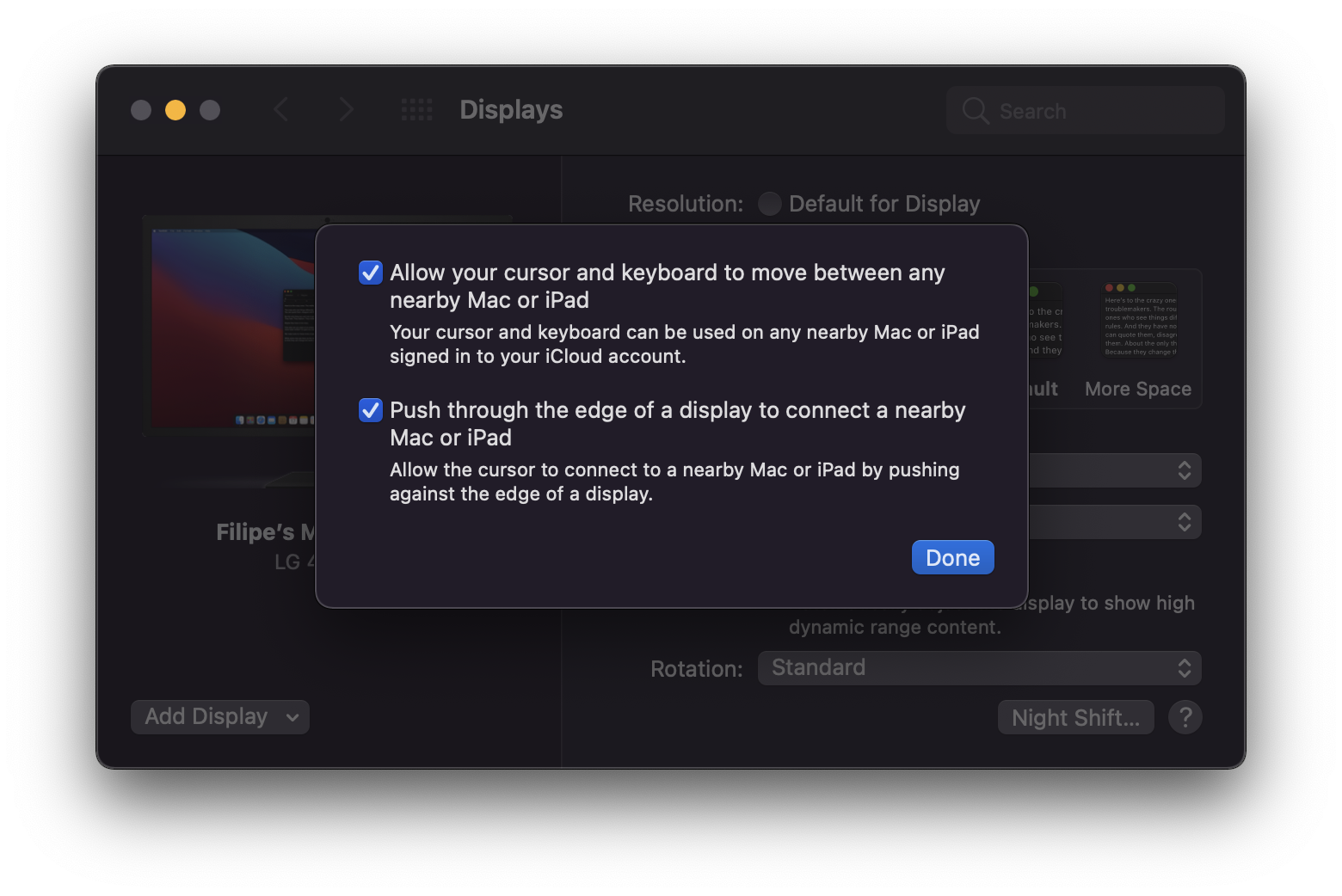
macOS Monterey was announced in June at WWDC 2021 with a new feature called Universal Control, which will let users control an iPad or even another Mac using the keyboard and mouse of their main computer. Unfortunately, this feature was never made available to beta users, but a developer has now found a way to partially enable Universal Control in macOS Monterey beta 5.


The feature can be enabled by changing some internal files in the operating system, similar to how users could revert to the old Safari in the first beta of macOS Monterey. The process is not exactly difficult, but modifying system files can always result in other issues, so be aware of this before you try.


Developer Zhuowei Zhang (via MacRumors) has shared on GitHub the codes you need to enable Universal Control on a supported Mac. To make things easier, you can download the file from GitHub to simply move it to the right folder on your Mac.


After downloading the file containing the right codes, move it to the following folder: /Library/Preferences/FeatureFlags/Domain/ — if the folder doesn’t exist, you can create it manually. Since this is an internal macOS folder, you may need to disable System Integrity Protection on your Mac before modifying it. You can read more about how to disable SIP in this article on Apple’s website.


After moving the file to the right folder, a simple reboot should enable Universal Control on your Mac. It’s worth noting that the feature requires a 2016 Mac or later with iCloud and Handoff enabled.


How does it work?


One thing to keep in mind is that Universal Control can only be used with another Mac by following this method. Since there’s no way to modify the iPadOS 15 internal files without jailbreak, Universal Control won’t work with an iPad at this time.


In my tests with two Macs (an Intel MacBook Pro and an M1 MacBook Air), Universal Control worked just as promised. I was able to move the cursor from one Mac to the other, as well as reproduce gestures and type on both Macs using the same keyboard. The delay is barely noticeable, and I was also able to move files between Macs using just the mouse.


At this point, it’s unclear why Universal Control is not officially available in the macOS Monterey beta. Perhaps this could be due to some problem on the iPadOS side, or Apple is planning to delay the feature for a future release.


Of course, this method was tested only with macOS Monterey beta 5 and may not work with upcoming betas.

>>> TradeGate Pre-Market Indications

DAX:
  • No major moves
MDAX:
  • MorphoSys (MOR TH) +1.7%
  • ProSieben (PSM TH) +1.2%
  • Fuchs Petrolub (FPE3 TH) +1.2%
  • Cancom (COK TH) -0.8%
  • Gerresheimer (GXI TH) -0.8%
  • Shop Apotheke (SAE TH) -0.8%
SDAX:
  • Home24 (H24 TH) +2.8%
  • ElringKlinger (ZIL2 TH) +1.1%
  • VERBIO Vereinigte (VBK TH) +1.1%
  • DWS (DWS TH) +1%
  • Metro (B4B TH) -1.2%

>>> Stoxx 600 Pre-Market Indications

  • SEB (GRB TH) +1.4%
  • Novozymes (NZM2 TH) +1.1%
  • Pernod Ricard (PER TH) +1%
  • Telenor (TEQ TH) -0.8%
  • Gerresheimer (GXI TH) -0.8%
  • Siemens Gamesa (GTQ1 TH) -0.8%
  • Aegon (AEND TH) -0.9%
    • Aegon Bank publishes its first half 2021 report
  • EssilorLuxottica (ESL TH) -0.9%
  • BNP Paribas (BNP TH) -1.1%
  • Orsted (D2G TH) -1.2%
  • Ericsson (ERCB TH) -1.2%
  • Mowi (PND TH) -1.3%