Stock Suspended in HK (2799 HK)
Decoding the New Tiffany
This week, a Tiffany campaign featuring Beyoncé, Jay-Z, a Basquiat painting and a 128.54-carat diamond offered a window into how LVMH is bringing its playbook to its largest-ever acquisition and the advantages and challenges of marketing brands rooted in the 19th century in today’s world.
After a leadership reshuffle that put Anthony Ledru, Alexandre Arnault and Michael Burke in the driver’s seat, Tiffany hit the market last month with advertising that screamed “Not Your Mother’s Tiffany.” The rebranding accelerated this week, when the jeweller launched a campaign featuring superstar couple Beyoncé and Jay-Z, a Jean-Michel Basquiat painting and the 128.54-carat Tiffany Diamond, one of the largest yellow diamonds ever discovered.
Internet mentions spiked, but sentiment was divided.
In the US, Tiffany’s largest market, some saw the bejeweled Black power couple, photographed alongside a painting by Basquiat, whose work often addresses racism and class struggle, as a celebration of a New American Dream, no less defined by material wealth but freshly attainable to those long relegated to the bottom of the country’s socio-economic hierarchy. In this reading, Beyoncé becoming the fourth woman in the world (and the first Black woman) to ever wear the $30-million Tiffany Diamond was a symbol of empowerment.
Others saw a troubling depiction of Black Aristocracy defined by adjacency to whiteness spiked with the troubled history of colonialism, pointing primarily to the spectacle of Beyoncé refashioned as Audrey Hepburn in the film “Breakfast at Tiffany’s” while wearing a gemstone unearthed in South Africa in 1877. “Her brown skin reflects the light instead of Hepburn’s ivory complexion. The enormous diamond, freighted with the history of colonialism, hangs around a Black woman’s neck,” wrote Robin Givhan in the Washington Post.
Seen through a business lens, the Tiffany campaign was most interesting as a window into how LVMH is bringing its playbook for rebooting heritage labels to its largest-ever acquisition and the advantages and challenges of marketing brands rooted in the 19th century in today’s world.
Heritage is undoubtedly a powerful brand asset, especially when combined with a modern sensibility. LVMH has developed one of the most successful playbooks in the luxury sector with a strategy focused on modernising dusty labels, most notably with its high fashion revamp of luggage-maker Louis Vuitton, now the group’s cash cow, under designer Marc Jacobs.
Per the approach, the strongest luxury brands are both timeless and contemporary, able to lean on a unique backstory, often with alluring Old World associations from artisanal craftsmanship to aristocratic clients, while simultaneously tapping the current zeitgeist. In short, they are both classy and cool, a combination that gives them powerful sociocultural value and serves to differentiate them in the market beyond quality materials and design, with price tags to match.
Tiffany has a powerful history, but in recent decades the brand has been neither classy nor cool in the eyes of consumers. It needs to simultaneously reassert its heritage and connect with today’s cultural moment. Enter a campaign that features no saleable product, but where each element has a vital part to play in rescripting Tiffany’s brand story to do just that.
The 128.54-carat Tiffany Diamond plays a star role, its provenance and size underscoring Tiffany’s 184-year-old heritage as a high-jewellery house. Meanwhile, the Basquiat painting, a rarely seen work from 1982 whose dominant colour closely resembles Tiffany’s signature robin’s-egg blue, serves as a kind of cultural bridge between the past and the present.
So do Beyoncé and Jay-Z, whose hair style resembles Basquiat’s dreadlocks. They are the archetypical contemporary power couple — strong and equally successful, but by no means immune to the ups and downs of relationships — whose appearance in the campaign helps to modernise the concepts of love and marriage to which the Tiffany brand is so closely associated. But they may also be the closest thing America has to royalty and appear in black evening wear that, in the case of Beyoncé, is a direct reference to Golden Age actress Hepburn.
The mix of history and the current zeitgeist is potent.
But what happens when heritage brands, often rooted in the 19th century, come with historical associations that may be uncomfortable for 21st century eyes and ears? As critics have pointed out, the diamond that stars in Tiffany’s campaign was mined in colonial Africa.
It’s hard to hold companies responsible for what happened in past centuries. But it’s in their own interests for brands to be careful with how they deploy their heritage stories today, when politics is so deeply embedded in the daily conversation and winning over social media commentators, whose posts can powerfully shape consumer perception, is not always easy.
The issue is by no means unique to Tiffany. In today’s politically charged, social media-driven landscape, it’s increasingly clear that brand heritage can come with liabilities as well as advantages.
Chanel Buys Up More Jasmine Fields to Safeguard Famous No. 5
The luxury group said it had bought up an extra 10 hectares (100,000 square metres) of land, adding to the 20 hectares it already exploits in partnership with a local family near the town of Grasse, known for its surrounding flower fields.
On a sunny late August morning before the heat reached a peak in nearby Pegomas, dozens of workers were busy with this year’s jasmine harvest, the key ingredient for Chanel’s 100-year-old No.5 perfume, created by late designer Coco Chanel.
Chanel struck a deal with the Mul family in the late 1980s to anchor its production of five flowers in the region. Some local producers began selling their land at the time, drawn in part by property deals in the region close to Nice and the French Riviera.
“There was a time when there was a threat because jasmine production was starting to move to other countries,” said Olivier Polge, who followed in his father’s footsteps to become Chanel’s head perfumer in 2013.
The jasmine grown in Grasse has a specific scent. The region became a flower and fragrance hub in the 17th century, when local leather tanners began to perfume their wares.
Fabrice Bianchi, who runs the Mul family’s production, said operations were not overly affected by the COVID-19 pandemic, with pickers able to work outside. The virus causes some sufferers to lose their sense of taste and smell - a particular problem for perfumers, known as “noses” in the business.
“For sure, it was a pretty peculiar year,” Polge told Reuters. “But in many ways it was the same for me as for everyone, even though I’m a nose - we all tried not to get it.”
COVID Bailouts Have Nothing To Do With COVID
Below, we ask a simple question: Is the 'war on COVID' the needed pretext for even more centralized market “performance?”
After all, who needs free markets when central bank liquidity determines price forces via endless COVID bailouts?
The trend toward centralized controls and centralized markets was in play long before COVID, but has the pandemic given the powers-that-be even more power?
As we discuss below, COVID may just be the final nail in the coffin of free market capitalism.
In this murky light, do traditional market indicators and forces even matter anymore?
Consumer Sentiment: Who Cares?
As stocks reached all-time highs in U.S. markets, consumer confidence recently saw its 7th greatest collapse in history.

Needless to say, cadres of Wall Street spin-sellers (propaganda specialists?) are already hard at work explaining why such a disconnect between sentiment and equity valuations (i.e., price bubbles) doesn’t matter.
After all, when buckets of QE liquidity pour daily into the financial system in a COVID-induced era of unlimited-QE, today’s central-bank driven markets don’t need consumer confidence or even healthy balance sheets (from free-cash-flows to profits & earnings) to make their zombie-like climb toward 34.6 PE levels on the S&P.
In short, who needs consumer confidence (or even consumers at all), when a central bank airbag sits permanently beneath the S&P, NASDAQ and DOW?
Words Replacing Math & Facts
Over a decade ago, when the first controversial bucket of QE1 began, Bernanke promised it would be a “temporary” measure.
But bear or bull, we are fairly clear by now that words like “temporary” and “transitory” coming out of D.C. are as empty as Nixon’s promise in 1971 that decoupling from the gold standard would be equally short-lived:

And when it comes to words vs. reality, it doesn’t take a Sherlock Holmes or even an Inspector Clouseau to see the lighthouse of true motives amidst a fog of false narratives.
Enter COVID—The Ultimate Bailout
Whatever one’s view of the COVID pandemic or its toll on human health and global GDP, one can no longer deny that a virus whose survivability percentage is greater than 99% has been the perfect setting (ruse?) to justify, inter alia, yet another tsunami of Wall-Street bailouts under the guise of a global health crisis.
In short, if Bear Sterns, Lehman Brothers, Morgan Stanley and other TBTF banks playing with MBS fire justified the 2008 bailout, certainly the optics of a “global health crisis” made trillions worth of more market “accommodation” easier to swallow (or sneak in).
Toward this end, as the needed and all-too important debates continue to rage (despite open censorship) about health passports, nation-wide shutdowns, case fatality rates, vaccine safety/efficiency facts and health ministry fictions in a backdrop of dying civil liberties, free-market forces and governmental trust, one thing is becoming clear…
COVID (and more specifically COVID bailouts) saved the global financial markets.
That is, despite the competing fear-porn vs. “we care for you” narratives from NYC to Sydney, COVID has been Wall Street’s greatest ally since the Geithner-Bernanke-Paulson era of 2008.
Stated even more simply, while millions wonder when they can travel, work or save money again, the markets got another bail-out at the expense of the real economy.
And COVID, whether man-made or bat-made, came just in time to bailout a credit market that was near death’s door by late 2019.
Coincidence? Deliberate? We’ll never find those answers in a carefully/privately censored Google search or YouTube video.
Meanwhile, policy makers (like bees buzzing galvanically around a pot of honey) continue exploiting the COVID narrative to justify an unprecedented era of centralized control over public free markets and individual free choice with a sanctimonious carte blanche the likes (and dishonesty?) of which history has never seen before.
Playing along or following along, companies like Amazon, the NY Times, BlackRock and Wells Fargo continue to push back their return-to-office dates as individual states debate whether mask mandates make sense, despite censored science which suggest that masks stop the spread of viral microbes about as well as chain-link fences stop mosquitos…
Has the world gone mad as a gullible herd following fork-tongued shepherds, or does Big Brother just care a lot about your health?
That’s for each of us to decide, but when it comes to what we can expect from central bankers, my view is clear: COVID will continue to be exploited to justify more liquidity and hence more market “support.”
The Taper or No-Taper Debate
This means investors can expect more market bubbles, volatility, and distortion alongside more inflationary tailwinds, currency debasements and policy double-speak as the taper vs no-taper debate takes on a prominence in the public discourse similar to the mask or no-mask comedy de jour.
That is, as Wall Street continues to debate whether the Fed will begin tapering its magical money printing, the growing volume of Delta variant headlines pouring from the global Ministries of Truth leads me to believe that a narrative is already being telegraphed to justify more rather than less monetary expansion in the near-term.
This may explain why BTC and gold, despite bumpy rides of late, have been recovering rather than hiding in a corner, as more and more investors see the currency debasement writing on the wall, despite such realities never making the headlines or FOMC meeting notes.
We’ve also written elsewhere that the “taper debate” is ultimately (and realistically) a non-debate, as any significant form of tapering means less sovereign bond support, and less sovereign bond support means bond-decay followed by immediate yield (and hence interest rate) climbs.
If interest rates climb in a $280T backdrop of global debt, the market party (i.e., artificial “recovery”) enjoyed since 2009 comes to an immediate end. Period, full stop.
Central bankers and politicos, of course, know this, which explains why more rather than less QE is all that keeps the current risk asset bubble (from stocks to real estate) alive.
In this sad yet seductive light, policy makers—and investors—have two choices: 1) keep the QE going and send inflation to the moon, or 2) taper and send the global markets to the basement of time.
At some point, of course, even unlimited QE becomes unsustainable and the entire house of cards collapses under its own grotesque weight.
When that moment (planned or natural) occurs, the very policy makers who caused this inevitable catastrophe will have the convenient excuse to blame the financial rubble on COVID rather than their bathroom mirrors.
Again, COVID is a very convenient narrative, no?
Near term, the cynical yet realist take on the taper ahead is that it will be postponed rather than embraced. That’s our view.
The Case for Tapering—Michael Burry’s Next Big Short
In fairness to open debate, however, it’s worth noting that far smarter folks have taken other views.
For example, Michael Burry of Scion Capital, the misunderstood genius behind the “Big Short” during the Great Financial Crisis of 2008, has been shorting US Treasuries to the tune of $280 million in put options against the iShares 20+ Year Treasury Bond ETF (ticker TLT), which makes him money if bond prices fall rather than rise.
Michael Burry, it seems, is expecting less rather than more FED bond support, and hence rising rather than “repressed” yields on long-term Treasuries.
And Burry, I’ll confess, may be right.
Even the Fed can’t print forever to keep yields and rates artificially suppressed. Hence, they may actually signal actual rather than semantic tapering, which is why all eyes will be on Jackson Hole to look for further signs of Fed tightening by year end.
This brings us back to COVID and the deliberate fear campaign from on high, as Powell has confidence that stoking the COVID narrative will force more investors into buying “safe” bonds, thus taking some of the onus off the Fed to buy the bulk of Uncle Sam’s debt via extreme QE.
If the Fed taper becomes a reality rather than debate, bond prices will fall, which means bond yields could easily and rapidly rise from the current 1.2% range to 1.8% or higher mark.
Rising bond yields, of course, mean rising interest rates, and rising interest rates means a rising cost of debt, which ultimately means that the debt-driven “party” which markets have been enjoying for years will see a genuine “hangover” moment worse in scope to what the rising rate window of late 2018 witnessed.
In short, should the Fed indeed turn naively hawkish and “taper,” this would be a disaster for just about every asset class but the dollar, and would likely be a short-lived and immediately reversed policy, akin to the 2019 reversal after the 2018 Q4 rate hike. We may even get a new variant and COVID bailout to mark the occasion!
Tapering & Gold
As for gold investing, rising rates would send gold lower and the dollar higher if inflation doesn’t rise measurably faster or higher than potentially rising bond yields.
Given the Fed’s primal fear of that anti-dollar known as gold, we can expect more fictionally downplayed badCPI inflation reporting from DC in the near-term, especially if a dollar-surging taper were to occur.
Longer term, however, the damage created by years of expansionary monetary and fiscal policy will continue to be an inflationary tailwind for precious metals whose patience in the face of drunken fiscal policy is historically confirmed crisis after crisis after crisis…
Real Rates: Deeper Down Seems Inevitable
As all precious metal investors know, gold price moves inversely to real (i.e., inflation-adjusted) rates. That is, as real rates plunge, gold prices rise.
This would explain why gold bought from Switzerland is moving to patient gold investors in zip codes like China and India.

Despite genuine arguments in favor of tapering and the genuine intelligence of traders like Michael Burry, the realists play the long-game. They know, in short, that tapering is a self-inflicted bullet wound to risk assets.
Furthermore, they understand that the massive mountains of debt upon which countries in the West now sit would make rising rates impossible for countries like the U.S. to re-pay.
For this reason alone, I see more rather than less QE ahead, as the only real buyers of government debt needed to keep rates repressed come from central banks, not natural market demand.
As U.S. debt to GDP skyrockets past 100% and now 130% for the twin-deficit USA, the only solution/option available to such a debt-soaked nation is lower rather than higher real rates.
In such a light, tapering, again, is a dangerous option.
Since 2014, when the U.S. lost its external finance base (i.e., when global central banks stopped buying Uncle Sam’s debt on net), the Fed has had no choice but to be the buyer of last resort for its own IOUs.
This means Uncle Sam has a vested interest in keeping rates low while inflating away its debt with higher (albeit mis-reported) inflation rates—the perfect backdrop for falling rather than rising real rates—and hence a clear tailwind for gold.
Despite such realism, many are arguing that the negative 1.1 real rate figure seen last August represents a floor.
Hmmm?
A New War, a New Excuse to Print Money
Returning to that all-too-convenient COVID narrative (scapegoat?), I am of the strong opinion that the “war on COVID” will be the dominant and continued narrative moving forward, as wars are historically confirmed (as well as historically convenient) justifications for further rate repression and even lower real rates.
That’s good for gold.
Be reminded, for example, that the U.S. is no stranger to seeing real rates fall as low as -14%, as was seen in the Civil War, as well as World Wars I and II. In the post-Vietnam 70’s, real rates sank to -7%.
My cynical realism suggests therefore that the -1.1% real rates observed last August were anything but a “floor” and that the War on COVID will be deliberately exaggerated, promulgated, extended and alas conveniently exploited to justify even greater negative real rates ahead—all very good conditions for gold and silver.
As hard as it may be for modern investors lulled into thinking the Fed has actual intelligence and choices when it comes to tapering or managing inflation like a home thermostat, the only means they have for keeping the tragi-comical levels of U.S. debt sustainable is to see real rates closer to -15% not -1.1%.
To achieve this, they will need more COVID bailouts and QE, and hence more liquidity, and hence more dollar-debasing policies to pay their debts cheaply. Again, a very nice setting for precious metals.
But -15% real rates? No way? Crazy, right?
Growing Rather Printing Our Way Out of Debt?
Optimists, of course, will call me crazy, and pundits will say we can “grow our way out of debt.”
Fair enough.
But to “grow” our way out of debt in a normal rather than increasingly more negative real-rate environment would require GDP growth rates of 20% or higher for the next 5 years.

Does anyone actually believe that will happen?
We don’t either.
Taper or no taper, real war or a politically-contrived “COVID war,” pandemic altruism or pandemic scapegoat, the debt reality facing the world in general or the U.S. in particular suggests that COVID will be the politically-correct pretext for more rather than less “accommodation” from the Eccles Building.
Longer term, this means an already grossly debased dollar will become even more so, and that negative real rates can go far lower than expected, thereby ushering in a new yet all-too familiar era for gold.
Let’s wait and see.
Fed Says Taper Is Coming. Bulls Hear "No Taper Now"
Market Rallies As Bullish Trend Remains
As discussed last week, the bullish bias remains as “dip buyers” jumped into the markets. As discussed in our Daily Market Commentary Friday morning:
“While the market continues its bullish advance (why not with $120b in QE), the divergences between price and other internal indicators continue to diverge. Another trip to the 50-dma would be a near 3% crash, and a decline in the 200-dma (which hasn’t happened for one of the longest spans in 40-years) would be a 10% disaster. (While I am sarcastic, the low volatility market experienced this year will make even normal corrections seem much worse than they are.)For now, the ‘stair-step’ process continues with bounces off the 50-dma to slightly new highs before the next decline. At some point, investors will slip and fall down the stairs.”

The lack of a definite timeline on tapering from the Fed on Friday gave the “bulls” the boost of confidence they needed. As long as monetary policy and accommodative policy remain intact, there is a greater fear of “missing out” than of “losing money.”
Nonetheless, the rally on Friday set the 52nd new high this year and the market is well on pace to set an all-time record of new highs this year. (Charts courtesy of Zerohedge.)

Interestingly though, while the markets are hitting new highs, a large number of stocks are not as volume continues to drop.

Of course, none of that is important as long as the “bullish bias” remains intact.
The only mistake investors make is believing the current trend will extend indefinitely. It can’t.
First Half Of The Full-Market Cycle
When you look at the long-term market cycles, there are oscillations between secular (long-term) bull and bear markets over time. Using long-term trendlines, we can make the case the first half of the current secular bull market began in 1980 following the crash of 1974. If we plot out the first half of the cycle, it currently intersects at 4500 on the S&P index (although 5000 is well within the margin of error.)

Whether or not you agree with cycle theory is mainly irrelevant. What is important is to note several things in the chart above.
- Previously weekly 2-standard deviation extensions above the 200-week moving average resulted in signficant corrections.
- The current 3-standard deviation above the 200-week moving average is a historical anomaly.
- A correction back to the long-term bullish trendline would require a 68% decline.
- A 50% correction would take you back to the March 2020 lows.
- A 38.2% correction wipes out all the gains back to January 2018.
That information is not meant to be “bearish” or to scare you into selling into cash. However, not acknowledging that such a correction WILL eventually occur leaves you at risk of impairing a large chunk of your investment capital.
Without acknowledging risk, you are essentially driving a car blindfolded. It will work for a while. But, eventually, it won’t.
However, as noted above, as long as the Fed is engaged in QE, investors believe there is “no risk.“
But is that about to change?
Taper Is Coming, Bulls Hear “No Taper Now.”
On Thursday, Esther George, Robert Kaplan, and Jim Bullard suggested the Fed start tapering its balance sheet expansion and prepare for hiking rates. To wit:
“It would continue to be my view that when we get to the September meeting, we would be well served to announce a plan for adjusting purchases and begin to execute that plan in October or shortly thereafter.” – Robert Kaplan, CNBC“We did say that we would allow inflation to run above target for some time, but not this much above target. So for that reason, I think we want to get going on tapering and get it finished by the end of the first quarter next year.” – Jim Bullard, CNBC“When you look at the job gains we saw last month, the month before, you look at the level of inflation right now, I think it would suggest that the level of accommodation we’re providing right now is probably not needed in this scenario. So I would be ready to talk about taper sooner rather than later.” – Esther George, CNBC
While investors fretted the Jackson Hole symposium would result in a firm timetable for an aggressive tightening campaign beginning as early as September, such was not the case. As Powell’s comments show, the message delivered was a perfect combination of ambiguity, vagueness, and misdirection on timing and amounts of an eventual taper.
After Powell’s speech, Fed Governor Harker continued with vagueness around the taper, stating:
“The Fed has reached an agreement that tapering will begin this year.”
All the market heard was “No taper now,” which immediately translated into a panic bid to buy stocks.

Powell Emulates Greenspan
During the runup to the Dot.com crash, then-Fed Chairman Alan Greenspan became famous for “Greenspeak.” Such was his unique gift of saying much while saying nothing.
Chairman Powell’s speech, while greeted with market optimism, was his rendition of Greenspeak. While Powell said much, he said very little. As noted byZerohedge this morning:
“The bottom line, and the reason for the market’s dovish eruption: Powell provided no explicit taper signal, as he likely wants to see more jobs reports for accumulated evidence that ‘substantial further progress’ on the labor market is being made, while dismissing soaring inflation as transitory.”
As we noted for our RIAPro Subscribersthis morning:
“In particular, the following line is assuring investors the Fed will not be aggressive with tapering QE. In regards to premature tightening Powell said: ‘Today, with substantial slack remaining in the labor market and the pandemic continuing, such a mistake could be particularly harmful.‘”
Below are two critical segments from his speech:
- We have said that we would continue our asset purchases at the current pace until we see substantial further progress toward our maximum employment and price stability goals, measured since last December, when we first articulated this guidance. My view is that the “substantial further progress” test has been met for inflation. There has also been clear progress toward maximum employment. At the FOMC’s recent July meeting, I was of the view, as were most participants, that if the economy evolved broadly as anticipated, it could be appropriate to start reducing the pace of asset purchases this year.
- The timing and pace of the coming reduction in asset purchases will not be intended to carry a direct signal regarding the timing of interest rate liftoff, for which we have articulated a different and substantially more stringent test.
Keeping The Faith
Don’t be mistaken; the Fed is going to start tapering this year. So while the bullish bias remains currently, with liquidity continuing, that will change. As shown last week, asset prices do not do well when balance sheet reductions begin.

For now, however, there is still plenty of monetary accommodation combined with “faith in the Fed.”
That “faith” and near-record levels of stock buybacks keep a continuous bid beneath stock prices. But, as we noted in our daily market commentary on Thursday:
“In the years before the COVID-19 pandemic, one of the biggest sources of buying power in the stock market were the companies themselves. As the economy has improved, the stock market has rallied, and corporate buyers returned as a force in the stock market. Via BofA:‘Buybacks by corporate clients accelerated from the prior week to the highest level since mid-March, driven by Financials. Financials has now overtaken Tech as the sector with the largest dollar amount buybacks so far this year.’” – Yahoo

As discussed previously, the correlation between the Fed’s monetary interventions and the stock market is evident. The increase in the Fed’s balance sheet remains in near lockstep with the stock market’s climb.

To repeat from above, as long as investors “believe” monetary accommodation will remain, there is no reason to reduce speculative “risk-taking” endeavors.
Taper Timeline Announced
Interestingly, while the market surged on news of “no immediate taper,” such was already widely expected by the markets. It was also expected the Fed would “cautiously affirm” a tapering announcement for later this year.
What spurred the bulls was Powell’s affirmation that any tapering would be contingent upon economic outcomes continuing to meet expectations. In other words, any deviation from the baseline data could delay any potential action.
Furthermore, there was a clear distinction between tapering the current balance sheet expansion and hiking rates. Rate hikes will get predicated on inflationary pressures remaining above the 2% target longer than anticipated. This all sounds copasetic until you understand the Fed runs a high risk of getting caught in a stagflationary environment. Such an outcome will greatly reduce policy effectiveness. Via our daily market commentary:
“The graph below from Arbor Research provides a clue for the recent decline in consumer confidence. Based on Google search data, the term stagflation is now the leading the “inflation” search word. Stagflation entails weak economic activity coupled with inflation. Stagflation results in higher unemployment and negative real wage growth.“

The most significant risk for the Fed is getting trapped between fighting rising inflation and keeping consumer confidence elevated through higher asset prices in such an environment. If they choose to hike rates, they will crash the stock market. However, a decision to try and support higher asset prices and the economy gets crushed by higher inflation.
It’s a “no-win” outcome and remains the most significant risk to investors betting on monetary policy.
The Problem Of Liquidity
On the “Real Investment Show,” I have spoken a few times about the collapse of liquidity in the market. The problem with the lack of liquidity is that when sellers show up in earnest, there will be a significant gap between the current price and the next buyer.
The chart below shows that the short-term sell-offs to the 50-dma saw sharp spikes in volume over the last several months. However, the subsequent rally of “buying” saw a collapse in volume.

That lack of “buying” volume leads to more significant negative divergences in the advance-decline volume indicator.

The critical thing to understand about liquidity, or lack thereof, is how it will manifest itself during the subsequent correction.
The Next Big One
There are two prevailing myths investors must be aware of concerning chasing markets in the current environment. The first is the “cash on the sidelines” meme, and the second is the “the greater fool” syndrome.
There is no “cash on the sidelines” as there is a buyer for every seller. The only thing that determines the underlying security price is the price at which the transaction occurs. Currently, given the extremely high levels of equity allocations, few investors are willing to “sell” at current prices for “fear of missing out” on further gains. Therefore, “buyers” must pay increasingly higher prices to get the transaction completed.
Such is also where the “greater fool syndrome” resides. The buyers who must pay higher prices to complete a transaction assume there will be someone willing to pay an even higher price in the future. Such may seem to be the case until it isn’t.
Much like an overly crowded theatre, eventually, someone will yell “fire.” It is at the point the few “buyers” that currently exist will disappear entirely. Sellers will be rushing towards a very narrow exit in the market only to find the price where they wished to sell has wholly vanished.
Such is precisely what happened in March of 2020 and why the market was dropping by double-digits between brief reflex rally attempts.

There is a straightforward truth to markets, always.
“Sellers live higher. Buyers live lower.”
Always make sure you are on the right side of the trade.
Portfolio Update
Heading into the Jackson Hole Summit meeting and not knowing how the market would react, we made some adjustments to our portfolios on Thursday. As we discussed with our RIAPRO subscribers, our goal is to reduce the “volatility” of the portfolio, thereby reducing risk without significantly sacrificing performance. So even though we took profits in stocks like WOOF and replaced FANG with XOM, we held equity allocations essentially flat at 50%.

We still hold a slightly higher cash balance in the equity sleeve (~10%) and the fixed income sleeve (~10%). W use the cash as a risk hedge against an equity draw and “shorten duration” in the bond allocation. While we were previously increasing the duration of our bond portfolio to capture the decline in rates, we are holding cash to add longer-duration bonds on upticks in rates.
Why Bonds?
If there is a risk-off event in the market, yields will drop to 1% or less providing a nice bump in appreciation in our bond portfolio. In the meantime, we are collecting a bit of income while holding the hedge.
The distortions in the markets from excess accommodation continue to mount. Nowhere is this more clearly shown than in the spread between the market and CCC-rate junk bond yields.

Add to that, the collapse in consumer confidence will create a feedback look into weaker economic growth and eventually a disappointment of extremely lofty corporate earnings.

Such is highly problematic in a market that has become grossly detached from corporate profitability.

As you will note, we are indeed a tad bit more risk-averse currently, given a historically long market advance without a 5-10% correction.
While we would certainly like to be even more cautious, we still have a mandate to generate returns for clients to meet their financial goals. We realize that when the correction comes will give back some of our outperformance over our benchmark this year. However, given the current level of “irrational exuberance,” we will remain at the “back of theatre” to ensure we can get through the exit door when the time comes.
Lawyers Suing Bill Ackman's Pershing Square Tontine Could Sue Up To 50 More SPACs
First came Bill Ackman's Pershing Square Tontine Holdings. Now, the lawyers suing Ackman for his SPAC's less-than-ceremonious launch are going after other SPAC targets, too.
Lawyers including former U.S. Securities and Exchange Commissioner Robert Jackson filed lawsuits against two other blank-check companies last week, including GO Acquisition Corp. and E.Merge Technology Acquisition. The lawsuits are similar to the one against Ackman's SPAC in that they accuse the entities of "operating illegally by not registering as investment companies," Reuters reported this week.
The group of lawyers includes law firms Susman Godfrey LLP and Bernstein Litowitz Berger & Grossmann LLP. They continue to "actively monitor" the SPAC space for "potential issues", the report says.
We had previously noted that the suit against Ackman's SPAC could wind up setting a precedent against other SPAC vehicles. Now, sources are telling Reuters that up to 50 lawsuits could wind up being filed.
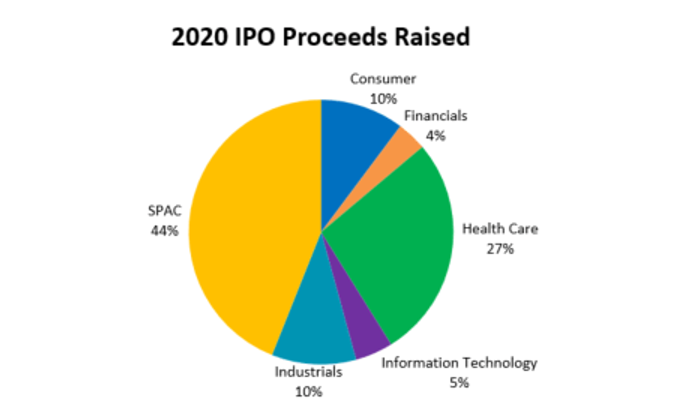
Douglas Ellenoff, a corporate and securities partner at law firm Ellenoff Grossman & Schole LLP, told Reuters the suits may wind up stopping some companies from moving forward with SPAC plans. He commented: "It has a very chilling effect on all responsible capital markets, participants who are trying their best to do things in compliance with the securities laws."
It was no sooner we mentioned how spectacularly the blowup of Pershing Square's Tontine Holdings SPAC was for some retail investors, than the entity was being sued.
The lawsuit seeks to prove that Pershing Square's SPAC was an investment company and not a SPAC. As we noted days ago, this is the exact reason the SPAC got pushback from the SEC when it announced its intention to make an investment in Universal Music, leaving cash left over to acquire, invest and/or merge with other companies.
In response to the suit, Bill Ackman told Bloomberg last week: “PSTH has never held investment securities that would require it to be registered under the Act, and does not intend to do so in the future. We believe this litigation is totally without merit.”
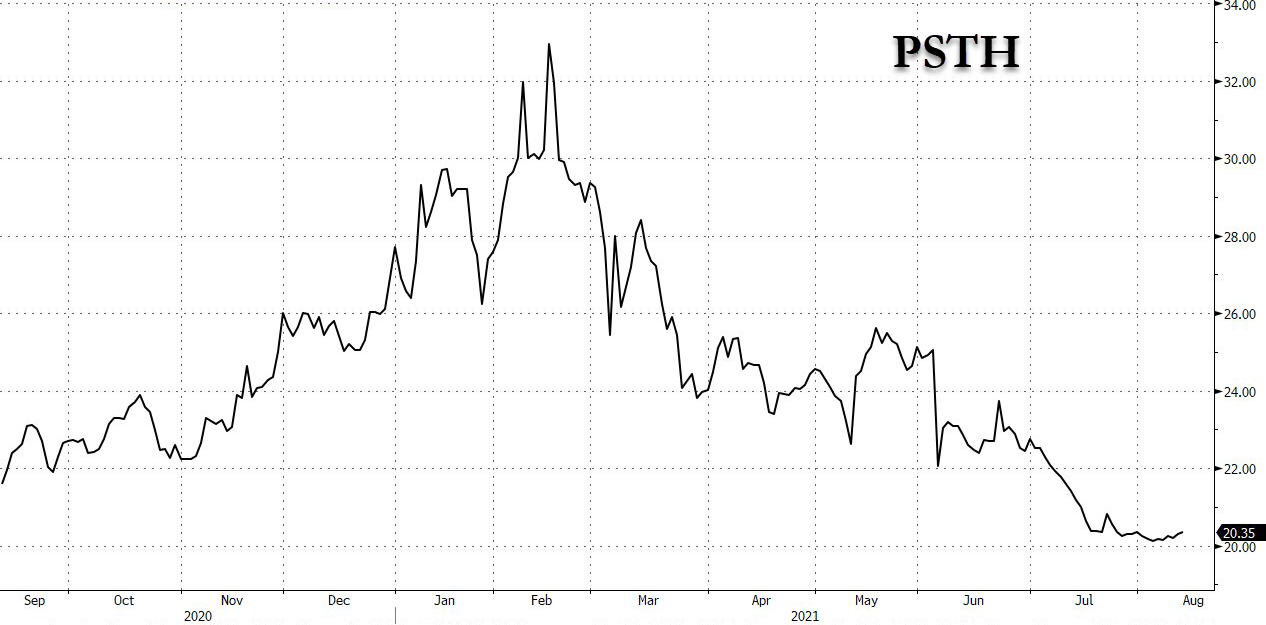
Recall, earlier this month we wrote that Ackman wound up torching retail investors when Pershing Square Tontine Holdings failed to find a merger partner after months of bluster from Ackman and blind faith from investors.
The failure of PSTH to get off the ground resulted in large losses for retail investors, like one 35-year-old unmarried Chicago psychiatrist who lost nearly $1 million "investing" in call options on the pre-merger entity, a new profile by Institutional Investor pointed out several days ago.
PSTH had been touted by Ackman to be an "investor friendly" SPAC. Ackman even "tweeted a rap video about SPACs minting money" in February 2021. Ackman even joked about “marrying a unicorn” when talking about his SPAC's launch last July.
“That video literally single-handedly caused the stock to rise 10 percent,” the investor told II. “It was like, okay, this is coming very soon. If you don’t get in now, you’re going to miss it.”
“Just because I have specialized training doesn’t mean I can’t be just as much of a fool as the guy next door,” the investor said. “Whatever money I had, I pretty much was putting it all into buying more of it," he said of his purchases of June 18, 2021 $25 strike call options. The stock traded at $23 at the time, leaving the options to be a total loss.
But reality hit on June 4 when PSTH announced a deal to take a 10% stake in Universal Music Group. It was a small slice of an investment that left money over for other deals. Then, "hell came" when the SEC told Ackman that the deal didn't meet NYSE's requirements for a SPAC, all but killing the deal.
In fact, II talked to 16 other people who invested in PSTH and though it was a "safe, calculated bet". "Nine of the 17 men II contacted were either immigrants or first-generation Americans," the report noted.
One 31 year old German college student put about $294,000 in savings into the SPAC. He had lost about $100,000 on the investment. “I looked up to Ackman,” he said, noting that he was impressed by Ackman's SPAC doing away with free sponsor shares and encouraging holding shares post-merger through special warrants. “It was clear to me that this was a new kind of vehicle. To me, the warrants were the unique selling point of PSTH,” he said.
Another investor who lost $600,000 on PSTH options told II: “The gambler’s fallacy is always the high end. You think you’re invincible until you’re not, and that’s generally what happened to me.”
The biggest loss came from a 39 year old software engineer, who saved $1.6 million over 20 years. He set up an account at Fidelity last year and, behind the back of his parents whom he was helping support, put the entire $1.6 million into PSTH.
“Ackman just sounded very confident. I trusted the guy. I thought he knew what he was doing,” the engineer said.
It was then that he transferred his shares into in the money call options with a strike price of $22. The stock was trading at $30 at the time. His account hit $2 million at one point before his options expired worthless on July 16.
He said of the resulting depression he is suffering from: “I’m not mentally there. I’ve got to pick myself up or this is going to ruin my life even further.”
Water Is Getting More Expensive. That’s an Opportunity.
A drought in California has led to a spike in the state’s water prices, nearly doubling the value of futures contracts for the essential commodity this year and creating opportunities in water-related investments.
As of Aug. 24, the Nasdaq Veles California Water Index, which represents the weighted average price of water-rights transactions across five major markets in California and is published weekly, has climbed by roughly 87% year to date to $923.54 per one-acre foot.
The unit of measure represents the amount of water needed to submerge one acre of land in one foot of water, or about 325,851 gallons of water. On the CME, water futures based on that index have climbed 90% this year to $942 per one-acre foot.
It’s a “perfect storm of conditions” for California’s water, with “worsening supply/demand imbalances, telltale signs of climate change, and a hesitancy by state officials to step up permanent solutions like conservation, water reuse, and desalination,” says Deane Dray, a managing director and multi-industry analyst at RBC Capital Markets.
The Department of Water Resources reported that storage in major California reservoirs stood at just 53% of their historical average as of July 31.

Droughts like the one in California can “no longer be considered rare, unexpected, or even abnormal,” said Kirsten James, program director, water at Ceres, a sustainability nonprofit organization. “The climate crisis is acting as a threat multiplier, accelerating the already daunting pressures” on the state’s freshwater resources.
At least 50% of the stocks listed in each of the four major U.S. stock indexes are in industries with medium-to-high water risk, according to an analysis by Ceres, says James. Even so, companies often “do not realize they will be significantly impacted if they fail to be an active player in smart water management.” Opportunities for water-related investment exist in areas such as water treatment and conservation that can help California manage drought, she says.
There are about 65 water funds globally, according to Morningstar. The Invesco Global Water exchange-traded fund (ticker: PIO) is up 22% this year.
Water futures were launched less than a year ago and are still in the early stages of development. But market interest and participation has expanded as people “start to look at next year and position themselves to ride out a competitive market” and rising water prices, says Clay Landry, managing director at consulting firm WestWater Research, which provides data used to calculate the Nasdaq water index.
Since the Dec. 7 launch, 1,019 water futures contracts representing 10,190 acre feet of water have traded at CME Group, with the second-highest monthly volume in April.
California Gov. Gavin Newsom declared a drought emergency in April, and in July called on Californians to cut water use by 15%. “The path of least resistance for water prices is higher, as water scarcity is already a concern in certain areas around the world, and we believe that water as a commodity is gaining more traction,” says RBC Capital’s Dray.
He believes that water futures are a “proverbial ‘toe-dip into the water’ in providing some market-driven insight into California’s water pricing,” but volume of trading needs to ramp up significantly before they can “advance past this novelty state.”
RBC’s investment framework for water focuses on the names at the “higher end” of what it calls the “water valuation continuum.” Those include firms that have “more embedded water technology” such as Xylem (XYL), Evoqua Water Technologies ( AQUA ), Danaher (DHR), and Mueller Water Products (MWA), Dray says.
In order to raise water supplies, California, and the rest of world, need to focus on conservation efforts, water reuse, and more desalination, he says.
This Stock Has Surged Because of Covid. Why the Gains Can Continue.
Synthomer, a British-based chemical manufacturer that makes latex for medical gloves, has excelled during the pandemic as demand for personal protective equipment has soared.
The company’s U.K.-listed stock (ticker: SYNT.UK) has surged more than 70% over the past 12 months, far ahead of the gains of rival BASF of Germany, up 22%, and U.K.-based Croda International, up 53%.
The gains could well continue, with Synthomer poised to grab significantly more market share. The Essex-based company, with a market value of 2.29 billion pounds sterling ($3.14 billion), operates in 21 countries. In addition to latex, it makes such products as flooring adhesives and materials used in paint, packaging tape, and mattress foam. But latex has been the big growth engine.
Demand for protective gloves, masks, and gowns continued to outpace supply during the first half of 2021. Prices increased, helping Synthomer’s earnings before interest, taxes, depreciation, and amortization, or Ebidta, more than triple to £323 million. The strong results were further helped by better profit margins for nitrile latex, a material used for PPE.
Sebastian Bray, an analyst at broker Berenberg, estimates that this accounted for more than half of Synthomer’s earnings for the first half of 2021, with reported earnings more than quadrupling over the same period compared with the previous year.
Even with vaccine campaigns now mitigating the impact of pandemic, Covid-19 isn’t going away. The overall market for glove and PPE raw materials, including natural rubber and latex, is around five million tons annually worldwide; Synthomer produces just 440,000 tons.
The company will increase capacity, producing an additional 200,000 tons a year by 2024, says Bray. But even then, it will only control about 4% of the total market, so there is much business to win.
Jolyon Wellington, an analyst at broker Peel Hunt, estimates that a 200,000-ton increase in production will lift Ebitda by £53 million, increasing Synthomer’s total earnings to £428 million by 2025, from £259 million in 2020. He figures this could lift the shares by 30% to £7.
At a recent price of £5.40, the stock fetches a low multiple of 9.2 times this year’s expected earnings, or a healthy 60% discount to its peers.
The dynamics of the latex market are clearly helping the shares. “[The] nitrile latex market is sold out,” says Jaroslaw Pominkiewicz, an analyst at Jefferies. “Although several nitrile latex expansions are scheduled for completion in the coming years, we expect the incremental volumes will be absorbed with ease.” The only caveat is that profit margins are unlikely to remain as hearty, as rivals also ramp up production.
Caroline Johnstone, the company’s chairwoman, told Barron’s in a statement: “Synthomer has a proven strategy and a robust balance sheet, which underpin our confidence in being able to continue the group’s excellent momentum and deliver long-term growth and strong returns for our shareholders.”
The company has good prospects in its other divisions, too. Its construction products, such as waterproofing, could get a boost from increased urbanization, while materials it makes to keep diapers feeling dry could see stronger demand from the aging population.
Synthomer is also growing through acquisitions. It bought U.S. rival Omnova Solutions in 2020, and has a substantial war chest at its disposal. Pominkiewicz, for his part, looks for a “transformational acquisition” later this year.
Hertz Stock Looks Appealing. The Warrants Might Be Even Better.
Hertz Global Holdings (ticker: HTZZ) emerged from bankruptcy on June 30. The shares in the reorganized company, now trading around $16, look appealing. But the better bet is the company’s warrants (HTZZW), trading at $7. The 30-year warrants, a call option with an exercise price of $13.80, are statistically supercheap.
The rental-car company, valued at $7.5 billion, is coming off a successful second quarter, and the current quarter could be even better thanks to strong pricing that reflects robust demand and scarce vehicles.
Hertz has a great balance sheet, with net cash of $300 million, excluding asset-backed debt secured by its fleet. The U.S. rental-car business is an oligopoly with three dominant players: Hertz, Avis Budget Group (CAR), and the private Enterprise. That bodes well for pricing even after the companies build up their vehicle fleets next year.
Hertz has a low valuation based on its earnings before interest, taxes, depreciation, and amortization, or Ebitda. The company could be in position to return cash to shareholders by 2022.
Hertz has little in the way of analyst coverage, but its profile should rise by year end. The stock’s listing is expected to move from the Pink Sheets to either the New York Stock Exchange or Nasdaq by then, and the company plans to do what it calls a “re-IPO,” which could involve the sale of stock by institutional holders who got shares in the bankruptcy reorganization as well as newly listed shares.
How to Buy Chinese Stocks Now That U.S.-Listed Shares Have Become Risky
Owning U.S.-listed Chinese stocks is increasingly risky, thanks to regulatory uncertainties from both countries. Investors who are wary of such risks, but are still bullish on the Chinese economy and markets, can buy Chinese stocks listed on domestic exchanges instead.
Most Chinese stocks available in the U.S. are traded as American depositary receipts. In most cases, ADRs entitle investors to foreign shares being held on their behalf at a bank. But that is not the case for some Chinese ADRs, which represent only an interest in a shell company—often called a variable interest entity, or VIE—designed to get around China’s ban on foreign ownership in certain industries and assets. That means U.S. investors in these stocks technically have no ownership stake in the underlying company itself.
For years, both Beijing and American investors have benefited from this arrangement and glossed over its inherent risks. Chinese companies can raise capital in the U.S. without giving up operational control; U.S. investors can participate in China’s economic gains without the hassles of buying foreign stocks. Today, there are roughly 250 Chinese companies listed in the U.S., whose shares are worth more than $1.3 trillion after the recent selloff.
But tensions between the two countries have escalated. Beijing has been tightening its regulatory scrutiny of Chinese companies listed overseas, while Washington demands that U.S.-listed Chinese firms adhere to American auditing standards or face potential delisting. China has resisted handing over the financial information of its companies to U.S. regulators for years.
To hedge against these risks, many companies have filed secondary listings in Hong Kong, though not all companies can meet Hong Kong’s stricter listing standards.
Institutional investors have largely shifted their Chinese holdings out of ADRs and into stocks listed in Hong Kong, the so-called H-shares, or those listed in the Shanghai and Shenzhen exchanges, known as the A-shares. This could put further pressure on ADRs.
Retail investors concerned about Chinese ADRs’ regulatory risks should follow suit. A handful of big brokerage firms allow direct access to foreign markets.
To trade stocks listed in Hong Kong, Interactive Brokers Group charges a commission ranging from 0.015% to 0.05% per trade value—the higher the monthly volume, the cheaper the commission rate—plus other fees and clearing costs. There is no minimum investment threshold, but there is a floor charge of four to 12 Hong Kong dollars ($0.51 to $1.54) per order. Fidelity charges a flat fee of HK$250 ($32) for every order regardless of trade size; Vanguard charges a $50 processing fee. To trade online, Charles Schwab users need to open a separate global account, which charges HK$250 ($32) per order. They can also trade by phone for a higher commission. E*Trade and Robinhood users cannot trade on foreign exchanges.
U.S. investors will need Hong Kong dollars to purchase H-shares. They have two options, says Steve Sanders, executive vice president of marketing and product development at Interactive Brokers. Investors can convert the U.S. dollars in their accounts to Hong Kong dollars or buy Hong Kong stocks on margin, borrowing Hong Kong dollars from a brokerage firm with U.S. investments as collateral.
Interactive Brokers users can also invest in China’s A-shares through Shanghai-Hong Kong Stock Connect and Shenzhen-Hong Kong Stock Connect, Sanders says. Both are cross-boundary channels that allow investors in each market to trade shares on the other market using local brokers and clearinghouses. Access to the mainland Chinese market is not available at Fidelity, Vanguard, or Schwab.
Investors who don’t want to directly own individual Chinese stocks can also access them through exchange-traded funds that mainly hold China A-shares or H-shares. The $2.1 billion Xtrackers Harvest CSI 300 China A-Shares ETF (ticker: ASHR), the $747 million KraneShares Bosera MSCI China A ETF (KBA), and the $649 million iShares MSCI China A (CNYA) all exclusively invest in stocks listed in Shanghai and Shenzhen. The $4.7 billion iShares China Large-Cap (FXI) holds Hong Kong–traded shares only; the $1.7 billion SPDR S&P China (GXC) offers a mixed bag of Chinese stocks, but with a heavy focus on H-shares.