Biogen’s New Alzheimer’s Drug Beyond Reach for Many Patients
Doctors say insurers’ reluctance to pay for the controversial medication, Aduhelm, results in patients being put on waiting lists
When Biogen Inc.’s Aduhelm was approved in June, patient advocates hailed the first new Alzheimer’s disease drug in nearly two decades. But health-policy analysts warned that the costly medication would add tens of billions of dollars to Medicare spending even if it were prescribed to just a fraction of people with the memory-loss disease.
Three months later, Aduhelm’s launch has made more of a whisper than a bang. Few patients are being treated with Aduhelm, doctors say, because health insurers are reluctant to pay for a medicine whose effectiveness is hotly disputed among doctors.
Many Alzheimer’s clinics are holding off on prescribing Aduhelm until federal officials decide next year if Medicare will pay for it. Hospitals that do provide the medication often require patients to cover its cost if their insurance refuses to pay; those who can’t are often put on waiting lists.
“Because of the uncertainty, it puts us in limbo,” said Stephen Salloway, director of Butler Hospital’s Memory and Aging Program in Providence, R.I. “The main issue right now is coverage.”
Patients from around the country have been referred to his clinic by doctors whose hospitals aren’t yet providing Aduhelm. Next week, Butler will treat its 10th patient with Aduhelm, Dr. Salloway said, but more than 100 patients have opted to be placed on a waiting list.
“That’s not the way I want to go about this, that only people with means can access the drug,” said Dr. Salloway, who has worked for Biogen as a paid consultant and speaker. “That’s not what the FDA intended. It isn’t equitable.”
Biogen has said the drug, which a doctor or nurse gives by infusion once a month, will cost about $56,000 annually for the average patient. Some estimates peg the price even higher.
Epic Systems Corp., an electronic health records provider, said in an email that fewer than 10 patients were recorded since June 1 as being treated with Aduhelm in its database of anonymized medical records. The database covers more than 116 million patients across 705 hospitals and more than 12,000 clinics.
Among 74 neurologists surveyed by Piper Sandler analyst Christopher Raymond, only two had prescribed Aduhelm as of August. About a third of the doctors said they expect to prescribe the drug within the next six months, and more than half said they expected to do so in the next year, Mr. Raymond said in a note to clients on Aug. 25. Roughly three in five of the neurologists said insurers greatly restrict access to Aduhelm.
A Biogen spokeswoman declined to comment. Last month, the company said Alzheimer’s specialists are eager to start prescribing the medication, though many are still working to create protocols and infrastructure to manage the treatment of patients.
Wider uptake of the drug hinges in large part on whether Medicare will pay for it and for which patients. The Centers for Medicare and Medicaid Services, or CMS, launched a payment review in July, and expects to issue a proposed policy by January 2022 and a final policy by April 2022.
Biogen has said it expects Medicare, the health insurance program for elderly and disabled people, to cover about 80% of the roughly one million to two million U.S. Alzheimer’s patients who could benefit from the drug.
Aduhelm is approved to treat early-stage Alzheimer’s by removing a sticky protein in the brain called amyloid.
The Food and Drug Administration’s approval of Aduhelm has been controversial because of uncertainty over whether it provides a meaningful benefit to patients and its potential side effects, which include bleeding in the brain. Two large studies of the drug yielded conflicting results, with one showing Aduhelm slowed cognitive decline and the other failing to do so.
Uncertainty about Medicare reimbursement had led some large health insurers, including UnitedHealth Group Inc. and Humana Inc., to hold off on their own coverage policies for commercially insured patients. Others, including the Department of Veterans Affairs and several regional Blue Cross Blue Shield companies, have excluded Aduhelm from their lists of regularly available treatments.
‘We still have concerns about the conflicting data on the safety and efficacy of the drug.’— A Humana spokesman
Humana is covering the drug for commercial and Medicare-insured patients whose doctors provide paperwork showing they meet the criteria Biogen used to recruit subjects for its clinical trials, a company spokesman said.
“Like many physicians and healthcare delivery systems, we still have concerns about the conflicting data on the safety and efficacy of the drug,” the spokesman said. “Additional guidance from CMS on the coverage policy in the Medicare program is essential and will influence our final coverage determination.”
For now, regional Medicare administrators decide whether to pay for Aduhelm on a case-by-case basis, and so far have received a small number of claims, a CMS spokeswoman said.
Because of the way doctor-administered drugs are paid for, hospitals assume financial risk when they administer medicines like Aduhelm. Under a so-called “buy and bill” system, hospitals and infusion centers purchase drugs like Aduhelm up front from wholesalers and get paid back—along with a small profit—only after infusing a patient with the medication and submitting a reimbursement claim to their insurance plan. If the insurer refuses to pay, the hospital has to seek payment from the patient—or otherwise assume the cost.
“This is where a lot of the fear comes from…in the centers where they want to know, are we going to be reimbursed?” Alisha Alaimo, president of Biogen’s U.S. commercial operations, said in July on the company’s second-quarter earnings call. “And the answer to that is, you’re not going to know until you try.”
A few hospitals, including Cleveland Clinic and Mount Sinai in New York, have said they won’t provide Aduhelm.
Doctors with Montefiore Health System, based in Bronx, N.Y., haven’t begun prescribing Aduhelm yet. A committee of experts from different specialties are developing protocols for using the drug and waiting for clarity on Medicare reimbursement, said Jessica Zwerling, director of the Montefiore Hudson Valley Center of Excellence for Alzheimer’s disease.
“We have to wait to see what CMS has in store for us,” Dr. Zwerling said.
Michele Hall, a 54-year-old former attorney in Bradenton, Fla. who was diagnosed with Alzheimer’s late last year, said she was eager to start treatment with Aduhelm once it was approved.
Ms. Hall said her doctor at the Mayo Clinic in Jacksonville, Fla., told her she may be a good candidate for the drug but that he isn’t yet prescribing it.
A Mayo Clinic spokeswoman said its doctors aren’t prescribing Aduhelm because it is still “under review with our formulary committee, and no decisions have been made.” The process is independent of Medicare’s coverage decision, she said.
Ms. Hall said she can’t read or spell easily, and now uses a calculator to do math she used to do in her head. But she can still hold down a conversation with friends and do basic tasks—abilities she wants to retain for as long as she can.
“I said to my doctor, ‘How long is it going to take?’ Because time is ticking,” said Ms. Hall. “I look normal to everybody, but it won’t be too long from now that I can’t drive anymore and do things on my own. That’s coming for me and I know it, and I’d like to have this drug before then.”
SEC Launches Review of Online Strategies Used by Brokers, Advisers
Wall Street watchdog’s request for public comment may presage new rules
WASHINGTON—The Securities and Exchange Commission launched a wide-ranging review Friday of the online strategies used by brokers and investment advisers to interact with customers, aiming to determine whether tools like smartphone notifications are in the best interests of investors.
The SEC solicited public comments Friday on “digital engagement practices” in the financial industry. These include social-networking tools, investing and contests with prizes, digital badges, and leaderboards, notifications, celebrations for trading and chatbots.
Requests for public comment often represent a first step in the process of developing new rules to guide behavior in the industry.
“In the last few years, we’ve seen a proliferation of trading apps, wealth-management apps, and robo-advisers that use these practices to develop and provide investment advice to retail investors,” SEC Chairman Gary Gensler said in a statement. “In many cases, these features may encourage investors to trade more often, invest in different products, or change their investment strategy.”
Mr. Gensler said such behaviors may result in conflicts between an investment platform and a customer. A key question is whether certain outreach by platforms to customers constitutes an investment recommendation, which would trigger heightened standards of conduct.
Under a 2019 rule change, the SEC required brokers to avoid placing their own interests ahead of a client’s. Investment advisers, meanwhile, are held to a fiduciary standard that requires them to put their client’s interests ahead of their own.
Some brokerages, such as Robinhood Markets Inc., use push notifications, colorful graphics and lists of hot stocks to enhance their apps and remind users to check in on their accounts. Others, such as Public Holdings Inc. and eToro Group Ltd., incorporate social-networking features, such as the ability to follow other investors’ activity or the ability to copy a portfolio of another user.
The brokers say the tools aim to make the investing process less intimidating for novices, a group that many investing startups target. Robinhood has said that over half of the users who funded accounts on the platform hadn’t previously had another a brokerage account.
'This Ends The Debate' - Israeli Study Shows Natural Immunity 13x More Effective Than Vaccines At Stopping Delta
Dr. Anthony Fauci and the rest of President Biden's COVID advisors have been proven wrong about "the science" of COVID vaccines yet again. After telling Americans that vaccines offer better protection than natural infection, a new study out of Israel suggests the opposite is true: natural infection offers a much better shield against the delta variant than vaccines.

The study was described by Bloomberg as "the largest real-world analysis comparing natural immunity - gained from an earlier infection - to the protection provided by one of the most potent vaccines currently in use." A few days ago, we noted how remarkable it was that the mainstream press was finally giving voice to scientists to criticize President Biden's push to start doling out booster jabs. Well, this study further questions the credibility of relying on vaccines, given that the study showed that the vaccinated were ultimately 13x as likely to be infected as those who were infected previously, and 27x more likely to be symptomatic.
Alex Berenson, a science journalist who has repeatedly questioned the efficacy of vaccines and masks at preventing COVID, touted the study as enough to "end any debate over vaccines v natural immunity."
Here's an excerpt from a report by Science Magazine:
The new analysis relies on the database of Maccabi Healthcare Services, which enrolls about 2.5 million Israelis. The study, led by Tal Patalon and Sivan Gazit at KSM, the system’s research and innovation arm, found in two analyses that people who were vaccinated in January and February were, in June, July, and the first half of August, six to 13 times more likely to get infected than unvaccinated people who were previously infected with the coronavirus. In one analysis, comparing more than 32,000 people in the health system, the risk of developing symptomatic COVID-19 was 27 times higher among the vaccinated, and the risk of hospitalization eight times higher.
This time, the data leave little doubt that natural infection truly is the better option for protection against the delta variant, despite the fact that the US won't acknowledge the already infected as having antibodies protecting them from the virus.
As the first country to achieve widepsread coverage by the vaccine, Israel is now in an unthinkable situation: daily case numbers have reached new record levels as the delta variant penetrates the vaccines' protection like a hot knife slicing through butter.
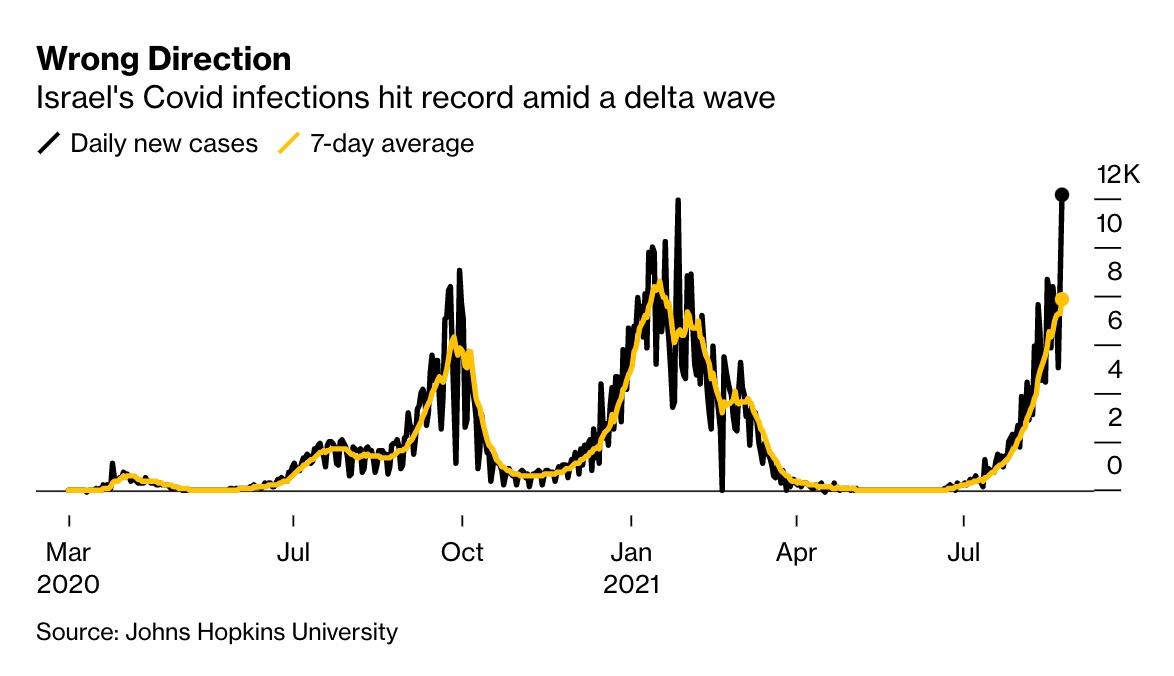
Source: Bloomberg
At the very least, the results of the study are good news for patients who have already successfully battled COVID but show the challenge of relying exclusively on immunizations to move past the pandemic.
"This analysis demonstrated that natural immunity affords longer lasting and stronger protection against infection, symptomatic disease and hospitalization due to the delta variant," the researchers said.
Unfortunately, the study also showed that any protection is time-limited. Protection offered by natural infection wanes over time, just like the protection afforded by vaccines: The risk of a vaccine-breakthrough delta case was 13x higher than the risk of developing a second infection when the original illness occurred during January or February 2021. That's significantly more than the risk for people who were ill earlier in the outbreak.
What's more, giving a single shot of the vaccine to those who had been previously infected also appeared to boost their protection. Still, the data don't tell us anything about the long-term benefits of booster doses.
This latest data showing the vaccines don't offer anywhere near the 90%+ protection that was originally advertised by the FDA after the emergency authorization. Other studies are finding harmful side effects caused by the mRNA jabs are also more prevalent than previously believed.
Andrea Pignataro’s Ion raises offer for Italy’s Cerved
Acquisitive fintech group increases bid for credit data and information provider by 7%
Ion, one of Europe’s most acquisitive fintech groups, has stepped up its pursuit of Cerved with a raised offer that values the Italian credit data and information provider at €2.54bn.
Dublin-registered Ion, which is run from London by Italian entrepreneur Andrea Pignataro, was rebuffed by Cerved in March with an initial bid of €9.50 a share, which valued Cerved at €2.4bn including debt.
On Friday Ion’s acquisition vehicle, Castor Bidco, increased its offer to €10.20 a share, a figure it said represented a premium of more than 50 per cent to Cerved’s share price over the previous 12 months.
Ion has been stalking Cerved since the Milan-based group said it was negotiating with private equity funds over the sale of its credit management division.
Cerved is Italy’s third-largest collector of non-performing loans, an area expected to grow on the back of rising piles of bad debt resulting from the pandemic. The deal would complement Ion’s purchase of Italian banking software provider Cedacri, which Ion won in an auction this year.
Privately held Ion has become known as one of Europe’s most acquisitive companies as it turned itself into a leading global provider of trading software and a key player in financial data.
Ion and Pignataro have kept a low profile for most of the company’s 20-year history but it has snapped up more than 20 businesses since 2005, including well known brands in financial markets such as data providers Fidessa and Dealogic, news service Mergermarket and bond trading venue Broadway Technologies.
Deals this year also include Dash Financial Technologies, a US options trading technology company.
Cerved has appointed UBS in London — a frequent adviser to Ion — as well as Mediobanca and Banca di Credito Finanziario as financial advisers on the approach.
Former Salomon Brothers bond trader Pignataro has sought to build a financial data empire to compete with the likes of Bloomberg, FIS and Intercontinental Exchange, attempting to exploit the fact that financial markets have become more international and electronic.
Pignataro’s debt-fuelled acquisitions have typically been followed up by aggressive private-equity style cost-cutting.
Castor Bidco said it had extended its tender offer period to September 9 and raised the minimum threshold condition from 50 per cent plus one share to 80 per cent.
Cerved’s share price rose 1 per cent on Friday morning to €10.05, having traded at €7 just before Ion’s first offer in March. Cerved did not respond to a request for comment.
Ion said in March that Italian antitrust authorities would not launch an in-depth investigation as a combination would not reduce competition in the local market.
Gapping down
In reaction to earnings/guidance:
- OLLI -13.8%, BIG -8.5%, PTON -7.6%, DOMO -6.9%, VMW -6.4%, HPQ -5.5%, MRVL -3.8%, DELL -2.1%
Other news:
- NMM -5.8% (NMM to combine with NNA)
- BOLT -1.3% (announces collaboration with Innovent Biologics)
Analyst comments:
- APLT -9.8% (downgraded to Sell from Neutral at Goldman; tgt lowered to $10)
- FIVE -1.7% (downgraded to Equal-Weight from Overweight at Morgan Stanley)
- EYE -1.5% (downgraded to Equal-Weight from Overweight at Morgan Stanley)
- AAP -0.9% (downgraded to Equal-Weight from Overweight at Morgan Stanley)
- ORLY -0.7% (downgraded to Equal-Weight from Overweight at Morgan Stanley
Gapping up
In reaction to earnings/guidance:
- BILL +15.1%, GPS +8.5%, RPID +7.1%, UI +6.8%, WDAY +6.6%, HIBB +3.3%, RCEL +1.2%, CUBI +0.9% (issues in-line guidance; also authorizes share repurchase plan for up to 10% of shares outstanding), PTR +0.5%
Other news:
- SPRT +63.4% (extends momentum from 41% move on Thursday)
- NNA +40.5% (NMM to combine with NNA)
- MPLN +8.2% (announces $250 mln share repurchase program)
- AKTS +3% (has received a volume commercial order for its patented WiFi 6 XBAW filters from its second WiFi 6 OEM customer)
- FFIE +2.9% (PLTR invested $25 mln in FFIE before it went public, according to The Verge)
- HEAR +1.5% (Donerail Group responds; remains hopeful that good faith negotiations are still possible)
- MOR +1.1% (MOR and INCY announce European Commission approval of Minjuvi)
- CZR +1% (purchases minority interest in Horseshoe Baltime from JV partner)
Analyst comments:
- PLAY +3.6% (upgraded to Buy from Hold at Truist)
- FTCH +2.5% (upgraded to Overweight from Equal Weight at Wells Fargo)
Early premarket gappers
- Gapping up:
- SPRT +47.7%, NNA +38.1%, BILL +14.4%, GPS +7.6%, RPID +7.1%, WDAY +6.1%, FFIE +2.8%, PLTR +1.3%, MOR +1.3%, CUBI +0.9%, NXPI +0.8%, LRCX +0.5%
- Gapping down:
- OLLI -13.8%, PTON -9.7%, DOMO -8.7%, NMM -8.4%, BIG -6.8%, VMW -5.7%, MRVL -3.5%, HPQ -3.3%, HITI -1.7%, DELL -1.6%, BOLT -1.3%
Tim Cook sells $750m of Apple stock after completing decade as chief
iPhone maker’s CEO sold shares after receiving final tranche of award granted in 2011
Tim Cook sold more than $750m worth of Apple shares this week, after receiving the final tranche of a stock award that he was granted a decade ago when he took over from Steve Jobs as the iPhone maker’s chief executive.
Apple’s stock has risen more than tenfold since Cook became chief executive in 2011, a record that entitled him to the maximum possible payout under the award.
After his remaining restricted stock awards vested on August 24, around 5m shares were sold at prices ranging between $148-$150, netting $752m, according to filings released on Thursday. Apple’s shares hit a new all-time high of $151.12 earlier this month, as the market capitalisation of the world’s most valuable company approaches a record $2.5tn.
Most of the trades were part of a pre-arranged stock sale plan adopted last August, through a scheme commonly used by US company executives to avoid any appearance of insider trading. Just over half of the sales, worth $397m, were withheld by Apple to cover Cook’s tax obligations when stock options vest.
Cook’s original stock award was estimated to be worth $378m in 2011 when it was first granted, at the time putting Cook among the most highly remunerated executives in America. The scheme was amended in mid-2013 to reflect Apple’s share-price performance relative to other US companies, after around a third of Apple’s shareholders lodged a protest vote on executive pay at the company’s annual meeting earlier that year.
Apple said in a filing on Thursday that its total shareholder return — which assumes all dividend payouts are reinvested — for the three years to August 24 was 192 per cent, ranking Apple 13th in the S&P 500.
Cook, whose net worth was estimated by Bloomberg to top $1bn for the first time last August, said in 2015 that he planned to give away the majority of his fortune before he dies. He donated just over $10m worth of Apple stock to charity a week ago.
Last September, Cook, who receives an annual salary of $3m, was granted his first new award of restricted stock units since his 2011 promotion. The stock award, which will vest after April 2023 and is partly dependent on total shareholder returns, could be worth almost $150m at today’s share price, if Apple hits the top end of its targets by 2025.
In January, Apple said that it would add an “environmental, social and governance modifier” to its executives’ annual bonus schemes, allowing the board to vary the cash payout by 10 per cent according to an assessment of “values-driven leadership”.