Barrons : Investors Are Running Scared From China’s Stocks. Where to Find Opport

Investors Are Running Scared From China’s Stocks. Where to Find Opportunities.

It has been a rough year for investors in China, especially those who forgot that it’s still a Communist nation with a government that can act unilaterally and change direction swiftly and ruthlessly. After some surprising, and very anticapitalist, moves in the past several months, Chinese stocks are plummeting. China’s market is down 20% in the past six months, while some of its biggest names have dropped more than 40%. Has China become uninvestible? No—but it has gotten a lot more complicated.

U.S. investors have largely focused on China’s tech giants, but given the situation today, there are better options. For years, the Chinese government allowed—even assisted—internet companies, enabling them to blossom with little intervention. This created lucrative returns for investors and helped the nation mint more billionaires—257—last year than any other country. Investors became less wary, even complacent, as the world’s second-largest economy seemed to be embracing capitalism.

That narrative has been unraveling. As President Xi Jinping makes an expected bid for a third term next year, he is trying to strengthen his grip on the Communist Party and address public discontent. That has led to a policy shift toward “common prosperity,” emphasizing social welfare and national security, and regulation that targets swaths of the economy, including the technology, education, property, and healthcare industries, and many of China’s most well-known and successful companies.


Illustration by Justin Metz
The moves have not been small: The Chinese government blocked the highly anticipated public offering of Alibaba Group Holding (ticker: BABA) affiliate Ant Group last fall, overhauled the fintech’s business model, and dealt a public rebuke to outspoken founder Jack Ma. Beijing also targeted soaring education costs by turning after-school tutoring firms into nonprofits. And it cooled a hot initial-public-offering market with an inquiry into the data practices of DiDi Global (DIDI) just days after it went ahead with its U.S. market debut—and chilled it further on Friday with plans to ban user data-heavy companies from seeking IPOs in the U.S., according to The Wall Street Journal. All served as a stark reminder of who is ultimately in control in China, and the risks to investors.

The pace, breadth, and uncoordinated nature of the measures coming from various regulators have been jarring, causing China enthusiasts like Stephen Roach, former chairman of Morgan Stanley Asia and a senior fellow at Yale University, to reassess his favorable view on China. “I stuck with it because fundamentals are impressive and strong,” he says. “This is a warning shot on that view.” His main concern: New regulations and increased scrutiny could stifle the “animal spirits” needed to help fuel innovation and keep China’s economy growing.

Investors are running scared. The KraneShares CSI China Internet exchange-traded fund (KWEB) has lost 45% in the past six months, with Alibaba down 30% and education companies like New Oriental Education & Technology (EDU) and Tal Education (TAL) down about 90% in the same period. In the first two weeks of August alone, investors yanked $3 billion out of China, according to EPFR Global.


Investors should be greedy when others are fearful, according to a Warren Buffett adage, and there is a lot of fear reflected in Chinese stock prices, even as some intrepid investors have gone back in. China is a $15 trillion economy, home to 1.4 billion people and myriad innovative companies—long-term investors cannot ignore it. But they shouldn’t ignore the multitude of risks, either.

So what’s an investor to do? First, understand the risks. Then, there are two ways to approach investing in China today—smaller companies, best owned through a mutual fund, and knowing when to go into some of the nation’s biggest names.

The Risks: What to Watch
When the two most powerful economies clash, the risks are plentiful. Let’s take the U.S. first: There’s bipartisan support for a tougher stance against human-rights abuses, and a broader desire for increased scrutiny of Chinese companies listed as American depositary receipts, or ADRs. The Securities and Exchange Commission is looking at ways to take steps that pave the way for delisting Chinese companies that don’t comply with U.S. auditing standards. SEC Chairman Gary Gensler has warned that many U.S. investors aren’t aware of the risks embedded in Chinese ADRs. This is because of a complex corporate structure called a variable interest entity, or VIE, that’s used to skirt China’s foreign ownership rules and results in U.S. investors owning shares in a shell company with a contract with the Chinese business operators. Even professional money managers have increasingly dumped Chinese ADRs in exchange for shares listed in Hong Kong; large-cap funds have half the exposure to Chinese ADRs today that they did two years ago, according to Bank of America.


Then there’s China. There are the “all bets are off”–type risks, like a conflict with Taiwan, that could destabilize global markets. More immediately, there are the risks that come with investing in an authoritarian government that is tightening control over business and society. Xi is clearly emphasizing a need to address the wealth inequality created by recent economic gains, even at the expense of corporate profitability. China has taken a heavy hand to regulation before, including an anticorruption drive that hit luxury and casino stocks hard in 2012 to 2014 and a crackdown on the online-gaming industry in 2017, but this drive is much broader and less coordinated—driven by different types of regulators, and it shows little signs of wrapping up. “The regulation doesn’t have a framework you can latch on to,” says Ruchir Sharma, chief global strategist at Morgan Stanley Investment Management. “It’s disorienting.”

China passed some of the world’s strictest data-privacy laws this month and is targeting anticompetitive behavior, like internet behemoths’ exclusivity agreements with small merchants and algorithms that can influence consumer behavior. Regulators have pushed e-commerce companies to raise compensation for gig workers and are exerting more control over content and entertainment. Also on the table: possibly eliminating the preferential tax treatment that internet companies have enjoyed and increasing pressure on businesses and the wealthy to give back more to society.

Over the long term, some of these regulations could mean more sustainable growth in the internet sector, which has been the scene of price wars, subsidies, and misdirected investments. But in the near term, “this marks a sea change, and is triggering a reassessment by investors of some of the big companies,” says Rajiv Jain, chief investment officer of GQG Partners, whose emerging markets strategy is underweight China. “ China Mobile used to trade at 40 times earnings, and every investor wanted to own it,” he says, “but as it got hit by regulatory pressure over the years, it dropped significantly—even before the implementation of regulatory sanctions” that led to its delisting.

A government-owned entity just took a stake in ByteDance, which owns TikTok, raising questions about how much political intervention investors should expect—and whether China should trade at a discount to other emerging markets, as Russia does. But China isn’t Russia; its size and breadth of market opportunities are far larger.

Plus, innovation is crucial to China’s ambitions to reduce its dependence on the U.S., which is why even those wary about the recent moves do not expect China to devastate its internet behemoths, which are a hotbed for emerging technologies like artificial intelligence. With the private sector accounting for almost 90% of urban employment and the digital economy accounting for 40% of China’s gross domestic product, most expect China to ease off or reverse course if its efforts begin to impinge on growth at a time when the economy is already slowing and as another round of Covid-19 restrictions hit. In fact, the People’s Bank of China has already been trying to ease strain on small and medium-size enterprises and said it would boost the amount of money flowing to smaller businesses and the economy.

As the Communist Party grapples with inequality, corporate profits may not be as juicy, but they won’t disappear. And China isn’t done with its experiment with capitalism. “In the long term, you can’t ignore China—and they do want foreign investment,” says Mark Mobius, a veteran emerging markets investor who now runs Mobius Capital Partners. He adds that the recent panic-fueled selloff has made China more attractive. “They want to become very powerful, and the only way to do that is by having a successful market economy.”

Underpinning all of this is a larger objective: to become more independent in a world turning increasingly hostile to China. That means China is intent on creating a deep and liquid capital market, one more accessible to domestic investors, who have not been able to access offshore companies like Alibaba and Tencent Holdings (700.Hong Kong).

“China is far from over,” says Justin Leverenz, manager of the $50 billion Invesco Developing Markets fund (ODMAX), which is underweight China’s megacap technology stocks and investing elsewhere in the country. “The bull case is very strong—and not incumbent on foreign investment. There will be a multiyear transformation of the asset allocation of the households in China that drive prices. Why would one not be part of this explosive opportunity?”

The Strategy: What to Buy
Beijing’s policy shifts and regulatory efforts are reshaping industries, which puts the behemoths—such as Alibaba, Tencent, and Yum China Holdings (9987.Hong Kong)—at risk of slower growth and crimped profitability in the near term, but opens up opportunities elsewhere, notably companies in areas like renewable energy, autonomous driving, hardware, and businesses helping to create a stronger middle-class.

These lesser-known companies—some big, just not giant, as well as smaller firms—are not as well represented in broad market indexes and are best owned through mutual funds with experienced managers who understand the changing dynamics. Investing with funds also allows individuals to sidestep logistical issues, like delistings, and is an easier way to access Hong Kong–traded shares and the vast onshore, or A-shares, Chinese market.


For a China-focused option, the $1.6 billion Matthews China (MCHFX), down 2% this year, has a strong long-term record, and lead manager Andrew Mattock sees opportunities not just in the internet platform companies but also in domestic software and hardware companies, consumer-oriented companies, and those that are part of the value chain for renewable energy and solar—two areas that the government is intently focused on bolstering.

Some of the best emerging markets funds have invested in China without overloading on its behemoths. The all-cap $147 million Wasatch Emerging Markets Select (WAESX), which has returned 19% this year to beat 97% of its peers, has been underweight China and veering toward smaller companies within the country, some of which could benefit as Beijing stresses social good over profits.

“Very large and very successful companies may have reached the limits [of profitability], so you may be better off in smaller companies that can go unnoticed,” says lead manager Ajay Krishnan, who owns Chailease Holding (5871.Taiwan), a Taiwanese company that provides financing to the small and medium enterprises that Beijing is trying to bolster, and chip maker Silergy (6415.Taiwan), since China is trying to reduce its dependence on the U.S. for the key input for advanced technologies.

The $2.1 billion Seafarer Overseas Growth and Income fund (SIGIX), which is up 4.8% this year, beating two-thirds of its peers, has been underweight China. But Andrew Foster, a longtime Asia investor, says the selloff has made China more investible than in the past five years because the market can no longer ignore the risk of investing in state-controlled companies. Foster has gravitated toward companies that are not against or aligned with China’s policy agenda, like drugmaker Jiangsu Hengrui Medicine (600276.China), which has a stable of oncology treatments, including one for liver cancer that’s up for U.S. Food and Drug Administration review and could help the company go global.

The Strategy: When to Buy
China’s most well-known companies are starting to look cheap to some U.S. investors, though the likelihood of volatility means there will be ample opportunity to buy. These three are among the ones to watch.

Alibaba
One of the world’s largest online retailer is also home to China’s dominant cloud computing business, and myriad others. Before the derailment of Ant’s IPO last fall, it traded at 30 times earnings; today, it’s closer to 15 times next year’s earnings, and has $73 billion in cash. That’s a fraction of what Amazon. com trades at, even though the two e-commerce giants both earned about $22 billion in fiscal 2020—and Alibaba’s sales are growing faster. Of course, Alibaba (9988.Hong Kong) operates in a country with an ambiguous rule of law, so some discount is warranted. But at less than a third of Amazon’s market value, the discount may be at an extreme—even if its profitability and growth prospects are lighter.

“Alibaba controls almost half of the e-commerce in the country and is at the center of making sure China has a vibrant economy moving from manufacturing to consumption,” says Victor Liu, senior research analyst at Causeway, who expects midteens earnings growth over the longer run. “This is still a company that has a lot of growth in front of it, just not as unbridled as before.”

There are company-specific risks that have nothing to do with China’s political efforts: Competitive pressure has been intensifying, and Alibaba’s aggressive investments to catch up with younger rivals like Meituan (3690.Hong Kong) and Pinduoduo (PDD) depressed near-term earnings growth prospects. The mean analyst estimate on FactSet for earnings per share in fiscal 2022 is now $9.50, down from $12.34 at the beginning of the year; analysts expect sales to rise 29%, to $143 billion, for the fiscal year ending next March.

Ironically, Beijing’s antimonopoly measures could force more discipline in Alibaba’s investments. The company also just increased its share buybacks to $15 billion from $10 billion. Alibaba’s stock is used as a proxy for China, and it has the most risk and the most issues with its business model—all of which will keep the stock volatile. But if it drops another 25%, where its price/earnings ratio is in the low teens, even wary money managers say they would bite.

Tencent
Tencent, which has fallen 30% in the past six months, is more appealing. The company’s core mobile-gaming business is under less competitive threat than Alibaba’s core business, and CEO Pony Ma has a better history of keeping a low profile and staying in the good graces of Beijing. Unlike Alibaba and other big internet companies, Tencent, whose WeChat app has more than a billion users, never listed in the U.S., and it has a record of being proactive in addressing government concerns. For example, it recently introduced a one-hour limit for children under the age of 12 on their games and limits in-game purchases. The impact of the crackdown aimed at younger gamers should be limited, since minors made up just 0.3% of gaming revenue in the second quarter.

There are risks, though: Its advertising business could be hurt if the economy slows, and as regulation dampens the cutthroat competitiveness that fueled some ad spending. Tencent is also a stealth venture capitalist, with successful investments in the likes of JD.com (JD) and Meituan, businesses whose valuations are also under pressure.

The risk of further intervention also persists, including losing its preferential tax treatment. If the tax rate increases to 21% in the second quarter from the 15.5% that Citigroup analyst Alicia Yap has modeled, she estimates a 3% hit to earnings. Yap has maintained her Buy rating, but cut her 12-month price target 12%, to 689 Hong Kong dollars—45% higher than recent prices—citing near-term pressure on the company’s business because of the fallout from regulation.

Tencent trades at 23 times 2022 earnings, near the trough for the company’s core online entertainment and advertising businesses over the past five years. That means there’s little value assigned to its fintech and cloud businesses or its investments, says Neuberger Berman Emerging Markets Equity manager Conrad Saldana. Despite the near-term risks, Saldana expects long-term earnings growth of 20% to 30% as the company makes money off its ecosystem and base of 1.25 billion monthly users.

Yum China
Even nontech companies have been swept up in the selloff. Shares of investor darling Yum China fell 5% in the past three months. Yum China has generated free cash flow every year since it was spun off from Yum! Brands (YUM) in 2016; it is extremely well run and has 7.5% of its market cap in net cash, providing a cushion amid the uncertainty, says Laura Geritz, who runs Rondure Global Advisors.

At 27 times forward earnings, the stock isn’t as cheap as the internet megacaps but also not as much in regulators’ crosshairs. Analysts, on average, expect earnings per share to grow 27% in fiscal 2021 to $1.95 a share, with revenue growing at about the same rate to $10.2 billion.

Yum’s price drop was amid another round of Covid lockdowns, but the company navigated last year’s lockdowns well, and its scale and experience should help it emerge as a survivor in a market filled with mom-and-pops, Leverenz says, adding that Yum could double its network in seven to eight years. Plus, China’s redistributive policies aimed at reducing housing, education, and healthcare costs should give lower-income consumers more money to spend on eating out. The average 12-month stock price target from analysts on FactSet sees Yum China’s stock 19% higher, at HK$570.

Ultimately, the message for investors is one of cautious optimism: China is still a major source of global growth, and home to diligent savers being encouraged to put more of their $75 trillion in household wealth into a stock market filled with companies well positioned for Beijing’s policy makers. That’s attractive terrain for long-term stockpickers, just one that requires a clear sense of the risks and careful footing.

WSJ : Ida Intensifies Into a Category 4 Hurricane Poised to Strike New Orleans

Ida Intensifies Into a Category 4 Hurricane Poised to Strike New Orleans
Storm with winds up to 125 miles an hour at landfall is expected to be fiercest to hit city since Hurricane Katrina caused mass destruction

NEW ORLEANS—New Orleans is bracing for Hurricane Ida to make landfall Sunday in what is expected to be the fiercest storm to strike the city since the mass destruction of Hurricane Katrina 16 years ago.

Normally busy streets were largely empty Sunday morning after many people in the hurricane’s path heeded evacuation orders, while those who stayed behind hunkered down for Ida’s arrival.

Ida intensified early Sunday to a Category 4 hurricane, with maximum sustained winds of 150 miles per hour, after crossing the warmest and deepest part of the Gulf of Mexico. The storm, now at the second-highest classification for hurricanes, was expected to make landfall in southeast Louisiana at about 1 p.m., the National Weather Service in New Orleans said.


The region could see rainfall of up to 20 inches or more, with winds up to 125 miles an hour at landfall, and dangerous storm surges, the weather service said. A surge of 12 to 16 feet is expected at Port Fourchon, La., south of New Orleans, to the mouth of the Mississippi River. Tornadoes were possible from Louisiana to the Florida panhandle. The weather service also issued an extreme wind warning for areas near New Orleans on Sunday.

“If you are under a mandatory evacuation…LEAVE NOW!” the weather service in New Orleans warned Saturday evening. “You do not want to play around with your life, and it is not worth it to stay if you have the means to leave.”

Louisiana Gov. John Bel Edwards had warned residents Saturday to complete their preparations and find a place to ride out the storm. “This will be one of the strongest hurricanes to hit anywhere in Louisiana since at least the 1850s,” the governor said.

The storm is likely to be the biggest test yet for New Orleans’s $14.5 billion flood-protection system, which was designed to prevent a repeat of the catastrophic flooding and destruction following Katrina. The hurricane, which made landfall exactly 16 years ago to the day, killed more than 1,800 people and caused more than $100 billion in property damage.

The new system includes flood walls, levees, canals and barriers constructed by the U.S. Army Corps of Engineers.

The Southeast Louisiana Flood Protection Authority said Saturday that it closed a series of floodgates in the federal levee system to prevent storm surge ahead of the hurricane. New Orleans’s police and fire departments staged boats and high-water vehicles in flood-prone areas.

In New Orleans, it was drizzling slightly Sunday morning with a few wind gusts as gray clouds swept over the city. Few cars passed as the city was on lockdown.

Restaurants, bars and other businesses in and around New Orleans had been closed since Saturday afternoon. Stores, bars and restaurants were boarded up and fortified with sandbags as early as Saturday. Even 24-7 dive bars such as Ms. Mae’s and Brothers 3 closed Saturday morning. Only a Walmart, a Winn-Dixie and a few other stores were open Saturday in the city’s uptown neighborhood.

Many people in low-lying areas had moved their cars to higher ground. By Saturday night, only a few people strolled down Bourbon Street in the normally packed French Quarter.

Austin Lane, 38 years old, who owns a Mexican restaurant called El Cucuy, planned to ride out the storm Sunday just to the north in Carriere, Miss. He drove out of New Orleans Saturday afternoon with his girlfriend, Meghan Ackerman, 40, their four dogs, two cats and two chickens.

Most of his 19 employees also evacuated, some to Houston and one to as far away as Missouri, he said.


To hunker down, the couple brought a generator, headlamps, candles, two crates of water, sausage, and a bottle of bourbon. If the winds pick up at the property they own, they plan to use two cat carriers to bring the chickens indoors.

“By no means is it a supersafe destination,” Mr. Lane said. “It’s still in the path of the hurricane. It’s just the best I could do after I got my people out and could lock the place up.”

Making landfall in Louisiana on Sunday, Ida is stirring up a sense of dread that reminded residents of the catastrophic damage and loss of life caused by Katrina 16 years ago.

“As it falls on the date of Katrina, people are pretty spooked and taking it serious and evacuating,” Mr. Lane said.

New Orleans ordered residents living outside the city’s levee system to evacuate. Electric utilities were mobilizing more than 10,000 workers across the state to address power outages, officials said.

The National Hurricane Center issued a hurricane warning for New Orleans, Lake Pontchartrain and Lake Maurepas in Louisiana, and along the Gulf Coast from Intracoastal City to the mouth of the Pearl River at the Louisiana-Mississippi border.

On Saturday, traffic leaving the city on Interstate 10 over Lake Pontchartrain had been bumper-to-bumper as people evacuated. But some stayed behind to ride out the storm.

In Houma, La., which is expected to get 10 feet of storm surge, Dr. Howard Russell, 65, said he was planning to stay home Sunday, even though his daughter Gabrielle Russell, a 23-year-old nursing student, evacuated from New Orleans to Kingwood, Texas.

Ms. Russell said she was worried about her father staying in the house where she grew up, because there is a lake beyond their backyard. “We’ll be experiencing quite a few feet of water. You just never know how much rain can build up," she said.

Her father, who will be in the house alone, boarded up its front door and planned to watch the news Sunday. He said he has enough gas to run his generator for a week and supplies to last a month. But he was still hoping that the storm would pass and that he would be able to drive to work Monday morning.

“It’s not my first rodeo,” Dr. Russell said. “My biggest fears are all my shingles coming off my roof.”

FT : Bitter brew for coffee roasters as Vietnam adds to Brazil woes

Bitter brew for coffee roasters as Vietnam adds to Brazil woes
Prices jump after strict lockdown rules cause problems getting beans out of the country

Leading coffee roasters have been dealt a blow as a strict lockdown in Vietnam, the world’s second-biggest grower, has led to higher bean prices on the back of worries about export supplies.

Vietnam is the leading exporter of robusta coffee, the bitter tasting bean used for instant coffee as well as for some espresso blends. The sharp rise in Covid-19 infections and a shortage of vaccines have caused the government to impose travel curbs in producing areas.

“There are big worries that you may not be able to transport your coffee out of the country,” said Carlos Mera, analyst at Rabobank.

The robusta futures benchmark hit a four-year high of $2,043 a tonne on Friday, up by almost 50 per cent since the start of the year. The rise follows arabica’s jump to seven-year highs in July after unseasonal frosts in Brazil hit trees already weakened by drought.

While many roasters have hedging agreements in place insulating them from coffee price fluctuations, analysts have started downgrading profit forecasts for some companies.


JM Smucker, the US food company behind Folgers and Dunkin’ coffee, last week reported a 17 per cent fall in quarterly profits for its coffee business from a year before. It also cut its full-year earnings guidance by 5 per cent, to $8.25-$8.65 per share, partly on the back of “multiple extreme weather events” which “have impacted key commodities important to our business”. 

Some companies, such as Starbucks, have long-term hedging contracts and will not feel the effects of the higher prices in the international commodity markets. At the end of July, Starbucks said it had locked in its coffee price for its business year to September 2021 as well as the following financial year.

However, other companies, including JM Smucker, have raised their retail prices in order to shore up margins squeezed by higher coffee costs. Germany’s Tchibo, a leading roaster and retailer, and Japan’s UCC Coffee have been forced to announce retail price increases. 

JDE Peet’s, the number two roaster after Nestlé and owner of coffee brands including Douwe Egberts and Stumptown, said earlier this month it had “pretty good hedging in place” and was negotiating with retailers on prices.

Nevertheless, some analysts expect the steep rise in bean prices to eat into the Amsterdam-listed group’s margins. “Given the rate of coffee inflation year-to-date, we think it’s unlikely JDE Peet’s will be able to recover the full effect of coffee price inflation in FY2022,” said analysts at Berenberg, who cut their earnings outlook. 

Coffee experts are now focused on Brazil. The rainy season is expected to start in early September, which will be crucial for the coffee trees that survived the drought and the frosts of the past year. “Rains will be incredibly important in order to wake up dormant trees and stimulate flowerings, replenish soil moisture, and reinitiate growth of foliage for trees that lost leaves due to the frost,” said Ilya Byzov at coffee trader Sucafina.

FT : Qiagen seeks to capitalise on consumer confidence in home testing

Qiagen seeks to capitalise on consumer confidence in home testing
Diagnostics group considers launching products that detect everyday infections without a visit to surgery or hospital

German diagnostics group Qiagen is aiming to capitalise on consumer confidence in home testing by launching products that detect everyday infections without a visit to a surgery or hospital.

The company, which is in the running to enter the blue-chip Dax index next month, has enjoyed rapid growth thanks to demand for its range of tests for coronavirus and its new variants.

“It completely changed the paradigm for a company like ours,” Thierry Bernard, chief executive, told the Financial Times.

Qiagen’s net profit of $250m in the first six months of the year was almost double that of the same period in 2020, when Covid-19 testing was still limited.

The business was now looking beyond the coronavirus, Bernard said, to direct-to-customer testing kits for everything from influenza to gastrointestinal, respiratory and urinary tract infections.

Funding flooded into the diagnostics industry in 2020 as demand for Covid tests stoked investor interest in the previously unloved corner of healthcare.

Diagnostics start-ups raised a record $4.8bn last year, according to Crunchbase, while shares in companies including market leaders Roche and Thermo Fisher, which tried to buy Qiagen last year, soared.

As well as bringing testing into the home, scientists are working on new technologies to expand diagnostic capabilities, including blood tests to detect early stage cancer. Others are using the gene-editing tool Crispr to create faster and more accurate tests.

Shares in Qiagen have risen 63 per cent since January 2020 but have oscillated in recent months amid uncertain demand for Covid tests.

The company in July cut its earnings and revenue guidance for the year, expecting that vaccination rollouts would cut demand for tests, but Bernard said “volumes of Covid testing [are] already going up once again” in the third quarter. “It seems more and more that this is here to stay at least beyond 2021,” he added.

Qiagen is focusing on collecting saliva or blood samples at home and then processing them in qualified labs in less than half a day, rather than rapid tests that deliver the result directly to the customer.

Bernard warned that there were “a lot of ethical issues” with tests that offer at-home readouts. “If you do a test without any medical control and you are not happy with the result, what do you do with this result?”

“For example, you are Covid-19 positive, but you are absolutely in need — for financial reasons — to work,” the French executive said. “Are you going to tell your employer?”

He added that the social stigma around other diseases could also prevent people from making their test results known to others.

In the near term, the company, based in Hilden, near Düsseldorf, is expanding its line-up of Covid products. It is adding tests that can detect the disease in wastewater, which has been particularly useful in monitoring the most recent outbreak in New Zealand.

It has also submitted for regulatory approval kits that can measure how long T-cell responses, that have been prompted by Covid vaccines, persist.

Initial research has suggested that protection from T-cells lasts longer than that given by antibodies and scientists believe some vaccines may generate more effective T-cell responses than others.

Given the importance of its products in fighting the pandemic, Bernard has called for compulsory vaccination of Qiagen’s 5,000 staff around the world. “We have some countries in Europe where it’s clearly impossible for us to ask someone whether she or he is vaccinated,” he said.

“I believe that companies like Qiagen . . . should be considered exactly as a hospital, as a healthcare provider, and therefore vaccination should be mandatory,” he told the FT.

He added: “I don’t want to go against personal freedom, but I believe that personal freedom stops at the border of collective safety.”

FT : Huarong finally releases report that stirred debate on financial failure

Huarong finally releases report that stirred debate on financial failure
China’s biggest bad debt manager confirms plans for bailout from state-backed groups

Huarong, China’s biggest bad debt manager, has released a long-awaited financial report that outlines a record Rmb103bn ($16bn) loss last year, ending a five-month delay that sparked a debate over Beijing’s approach to corporate failure.

The company, which earlier this month confirmed plans for a bailout from state-backed businesses including conglomerate Citic, said its leverage ratio leapt to 1,333 times by the end of 2020 as losses wiped out most of its equity.

The belated release of the results, which were initially due in April, comes after a chaotic period for a company that was launched in the late 1990s to help clean up the banking system, but saw its former chair Lai Xiaomin executed in January for accepting Rmb1.8bn in bribes after years of expansion.

Last year’s losses were driven primarily by impairments of Rmb108bn, the filings showed, which the state-owned company described as a “painful lesson”. In interim results, it separately unveiled a profit attributable to shareholders of Rmb158m in the first six months of the year.

Wang Zhanfeng, chair, said that Huarong had “badly deviated from its main responsibilities” owing to the “aggressive operation and disorderly expansion” of Lai, whose execution was seen as an unusually harsh punishment for financial crimes. The company also cited the impact of the coronavirus pandemic in 2020.

Huarong had in the past decade expanded significantly both within and outside of China to transform itself into a conglomerate with a range of financial businesses that extend beyond its core remit of managing distressed loans.

It was also a major issuer on dollar-denominated bond markets where investors and traders have assessed whether Beijing would support it. 

In April its perpetual bonds collapsed to levels of 49 cents on the dollar, but have since recovered to trade close to their face value after an announcement of the bailout plan in mid-August.

Fitch, the rating agency, changed its rating watch outlook for the company to “positive” last week, saying it saw the plan as “a step towards the company alleviating its financial stress amid its expected net loss”.

Huarong also said in its results that it would “dispose of subsidiaries with non-core business activities in the near future to increase internally generated fund inflows and to replenish capital”.

In June, S&P, the rating agency, said that Huarong would need to release its results by the end of August to avoid a technical default on a bond issued by Huarong International, one of its subsidiaries.

The company listed in Hong Kong in 2015 and counts Warburg Pincus, the US private equity firm, as one of its biggest investors. Trading in its shares was suspended in April and will remain suspended until further notice, the group said.

(ZH) The Bear Case In 12 "Charts Of Darkness"

The Bear Case In 12 "Charts Of Darkness"

While most sellside analysts and strategists are throwing in the towel as the market continues its relentless meltup (one which according to Goldman is becoming increasingly "painful" for the bank's institutional clients most of whom have taken the other side of the trade), there are still a handful of hold outs who refuse to chase the price action and instead have made a stand of sorts, predicting that it's just a matter of time before stocks reverse much of their 2021 gains.
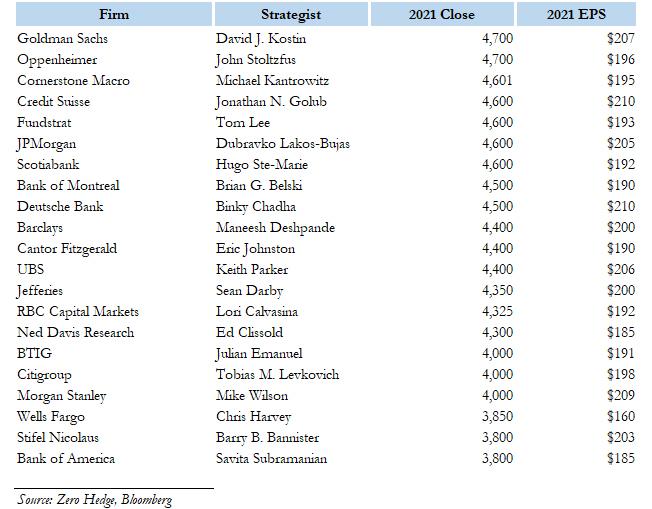
One such stubborn holdout is BofA whose Chief Investment Strategist, Michael Hartnett has for much of the past six months been warning that a stagflationary bust in the economy is coming, in keeping with BofA's year-end target of 3,800.
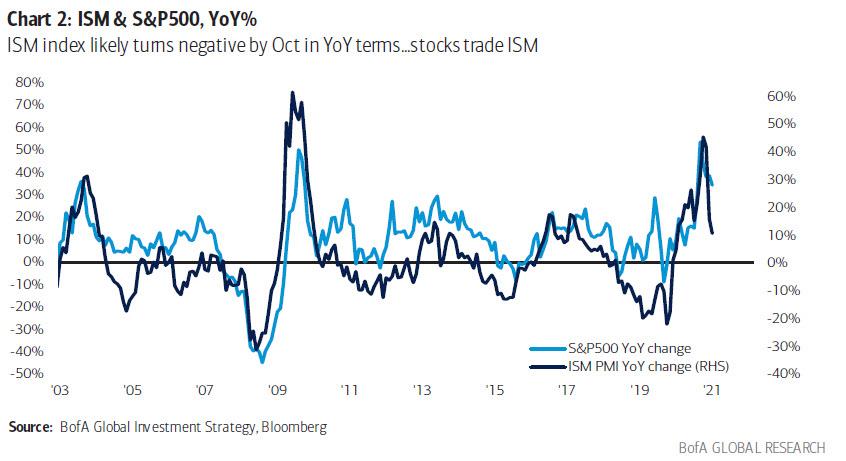
Last Friday, in his weekly Flow Show notes, Hartnett went so far as to put a tentative time for when he expects stocks to reverse. Pointing out that the annual change in stocks closely tracks that of the ISM/PMIs with a slight lag, Hartnett said that October is when the chickens will come home to roost as that's when the .average ISM PMI will turn negative, with stocks set to follow.
It's not just the correlation: in keeping with his favorite 3Ps - Policy, Prices and Profits - Hartnett lays out several other reasons why the 4th P, the party, can't keep going on forever. Here are some of his observations in the context of the 3Ps:
  • On policy: investors have zero fear of central banks…NZRB baulked at raising rates this week despite NZ house prices up 30%; Fed has bought $4tn bonds past 18 months (2X amount US spent on War in Afghanistan past 20 years), global central banks have spent $834mn every hour buying bonds since COVID, US government spending $875mn every hour in ’21…little wonder everyone believes in TINA & BTD.
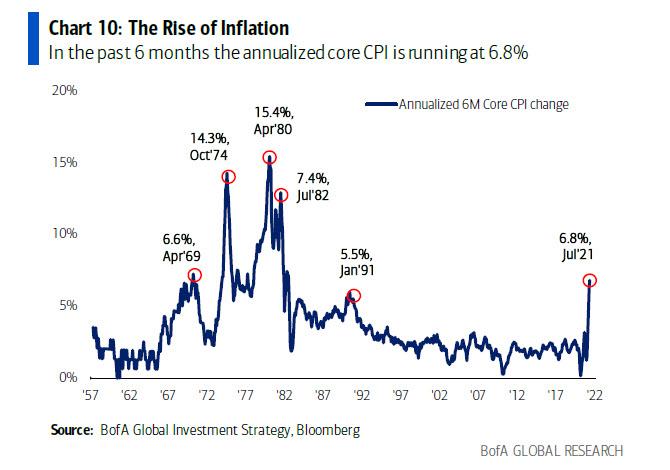
  • On prices: stimulus has caused immense inflation of Wall St assets; more recently inflation on Main St…July 6-month annualized US CPI 7.8%, core US CPI 6.8%, US house prices (May) 19.7%; Canada CPI @ 20-year high; UK/Canada/NZ/Australia real estate surging; "pipeline inflation" PPI's popping in US/China/Japan; secular themes of geopolitical risk and nationalism crushing globalization remain inflationary.
  • On profits: V-shape recovery was v strong but inflation now inducing stagflation; economic surprise indices -ve in US/China/Japan, auto production plummeting in US/Germany/Japan, US consumer confidence smacked to 10-year lows, US home sales - 13% from peak; China growth wobbling, US consumer has peaked, US fiscal optimism fading, Fed potential “policy mistake”…rising risk of autumn “flash recession” (likely revealed via sharp dip in global PMI’s).
Hartnett concluded by predicting "negative returns stocks & credit in H2", but one week later, both stocks and credit keep rising, with the S&P closing above 4,500 for the first time.
So fast forward one week when in his latest Friday Flow Show, Hartnett - getting more and more gloomy as a result of the meltup that just one stop - published a note titled Charts of Darkness, which recaps his pent-up disillusionment with the market in the form of a thematic “dirty dozen” charts on the pandemic, the macro dislocations, wealth inequality caused by the central bank liquidity supernova, coming stagflation & the H2 EPS risks from the US consumer, China & credit markets.
So without further ado, let's go down the list of charts starting with...
Pandemic: COVID-19 pandemic by the numbers…5.1 billion vaccinations, 214 million cases, 4.5 million deaths (Chart 3); the policy reaction…$32 trillion of monetary and fiscal stimulus; the Wall St reaction…global stock market capitalization up $57 trillion in 18 months; despite >5bn vaccines, societies & economies remain hostage to the pandemic, allowing Wall St to discount endless stimulus to the benefit of asset prices; the “end” of the pandemic will be very negative for Wall St, but few think it “ends” soon.
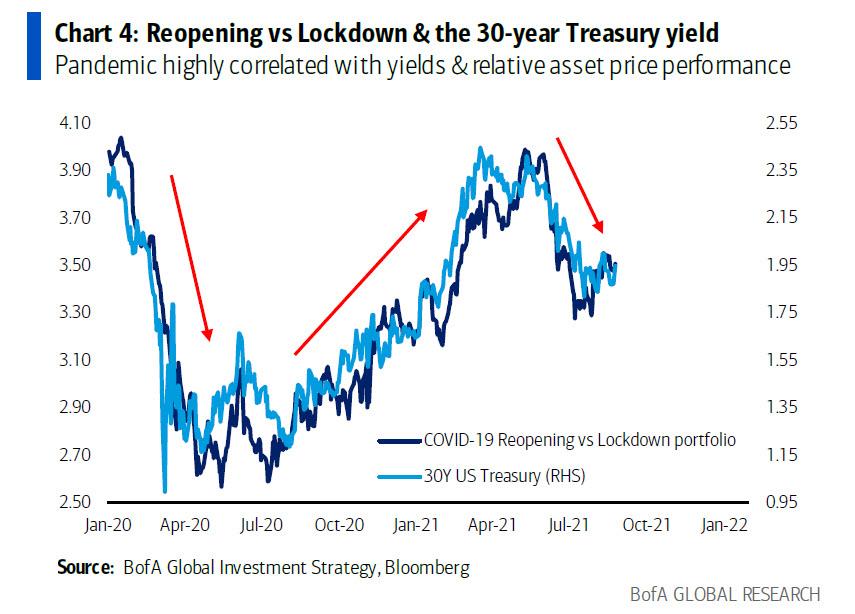
Pandemic & Wall St: the battle between lockdown & reopening battle has caused significant relative asset price movements; the performance of reopening vs lockdown baskets is highly correlated with bond yields (Chart 4) as well as the relative performance of HY bonds vs IG bonds, small cap stocks vs large cap, value vs growth and so on (see last week’s Flow Show); the Delta variant in the past two months has caused “lockdown” to outperform “reopening”.
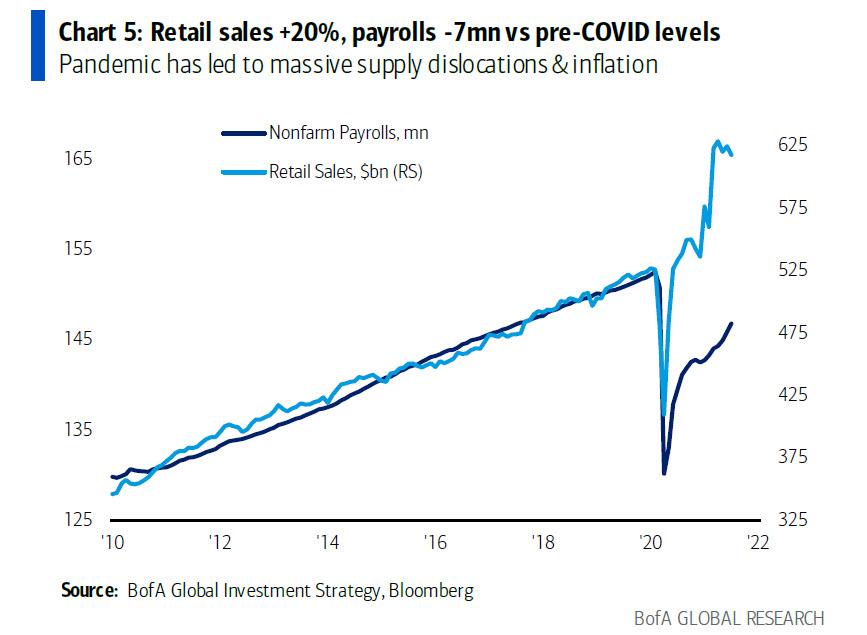
Pandemic & Main St: pandemic and emergency support for the economy has also led to massive dislocations in the economy, most evident in massive supply disruptions to goods, services & labor markets, which in combination with a “transitory” surge in consumer spending, has led to a significant inflation of goods, services & wages; note US retail sales (which have peaked) are roughly 20% above pre-COVID levels, while US payrolls are 7 million below their pre-COVID levels, despite record levels of job offers (see Chart 5); the pandemic has not only dislocated local labor markets, it is also accelerating the trend away from globalization toward isolationism; local and global supply chains are unlikely to mend anytime soon…stagflation the new investment backdrop to markets.
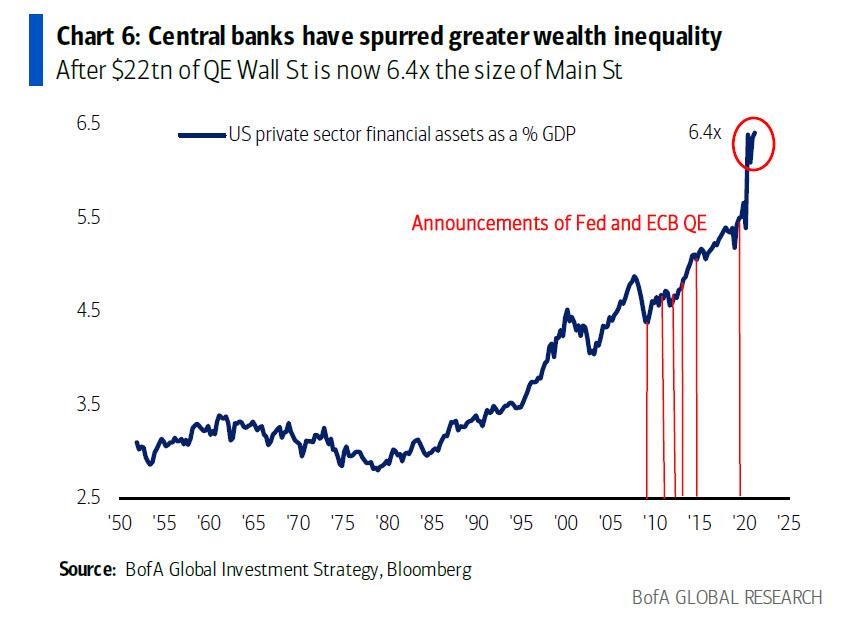
The Fed & Inequality: the central bank response to COVID-19 has “accelerated” inequality; between 1950 and the late-90s tech bubble, the ratio of US private sector financials assets (Wall Street proxy) vs the GDP of the US (Main Street proxy) oscillated between 2.5x and 3.5x; the radical interventionist policy of Quantitative Easing since the GFC has seen global central banks buy $22.4tn of financial assets (Fed & ECB have launched 7 QE programs – Chart 6), boosting the valuation of financial assets in the US to 6.4x the size of GDP.
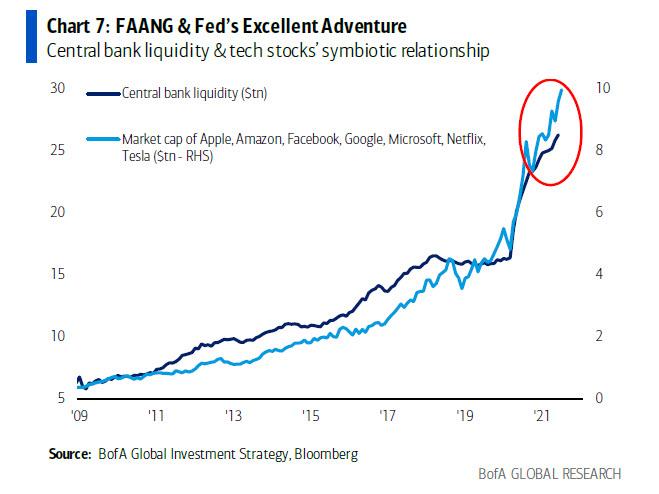
The Fed & Tech: Fed’s determination to stoke Wall St exuberance & Main St inequality has been particularly positive to the US tech sector; the market cap of FAAMG + Netflix & Tesla equates to the 3rd largest country in the world in GDP terms; the Fed has been tech’s best friend for the past 10 years (Chart 7)…it’s no coincidence that since the outbreak of COVID-19 global central banks have bought $834mn of financial assets every 60 minutes…and every 60 minutes the market cap of global tech stocks has risen $780mn.
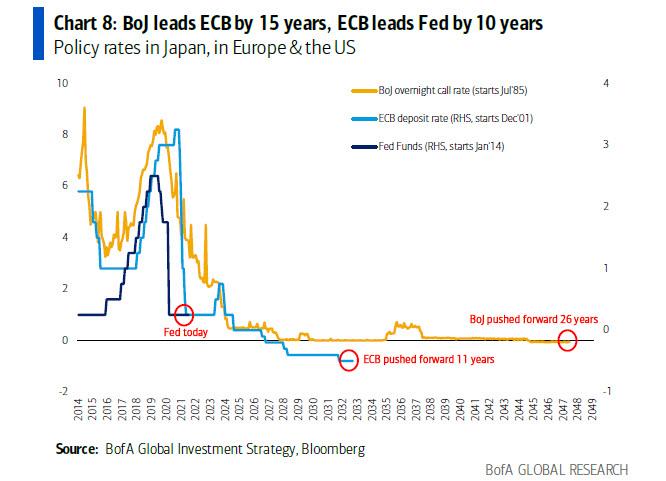
The Fed & the BoJ & the ECB: BoJ has operated a zero interest rate policy for over 20 years, the ECB for almost 10 years, neither have been able normalize monetary policy, and both remain the “cement in the Fed’s shoes” (Chart 8); note zero rates in Europe & Japan in recent decades have not been asset positive; the US is different with a housing market that still is rate-sensitive, and a behemoth tech sector within the domestic equity market.

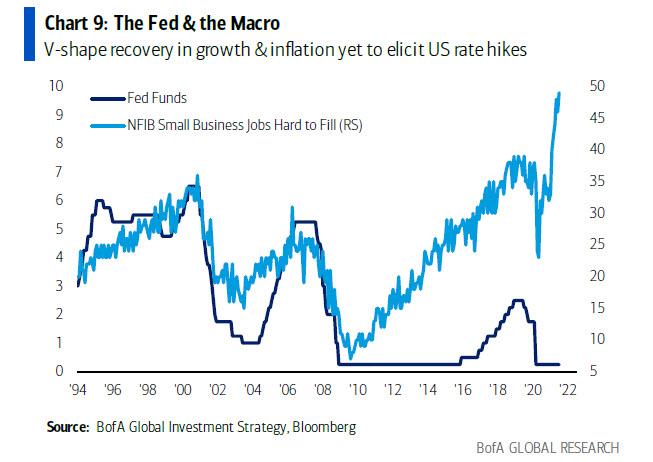
Monetary tightening: the V-shape economy recovery since Q1’20 (Chart 9) & the inflation of asset prices, housing prices, commodity prices, consumer prices, is causing a very slow & protracted turn in monetary policy; for example, in 2021 there have been 41 rate hikes and 11 cuts (c/o 5 rate hikes & 95 cuts in 2020); the most important central bank in the world, the Fed, has thus far remained steadfastly against a tightening of monetary policy; but the inflation of asset prices, housing prices, commodity prices, consumer prices means the Fed’s liquidity tailwind is likely to weaken dramatically in coming quarters.
Inflation: inflation has soared in 2021 and it is highly unlikely to vanish as quickly as it appeared given the structural changes (War against Inequality) and pandemic unintended consequences (supply chain dislocation); in the past 6 months the annualized rate of CPI inflation was 7.8%, of core inflation was 6.8% (Chart 10), US house prices was 19.7% (May) and "pipeline inflation" PPI's are popping higher in US/China/Japan.
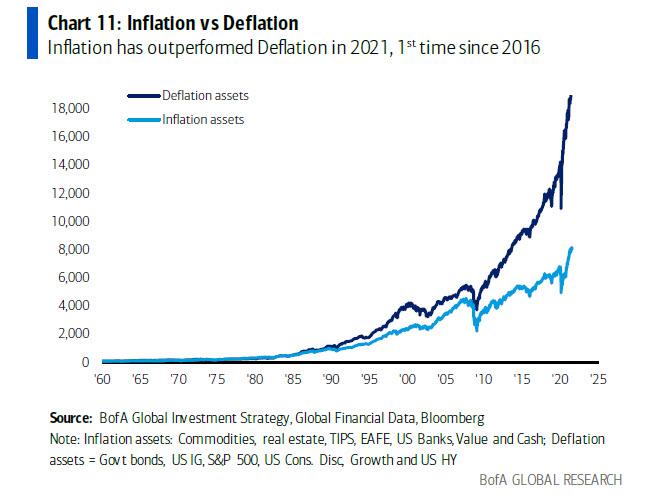
Inflation vs deflation: investors are structurally positioned for deflation; as cyclical bears we think H2’21 will see outperformance of high quality defensives; but we continue to argue that longer-term the inflation theme will win and the US dollar will lose; note YTD in 2021 inflation assets are outperforming deflation assets (see Chart 11 for definitions) for the 1st time since 2016.
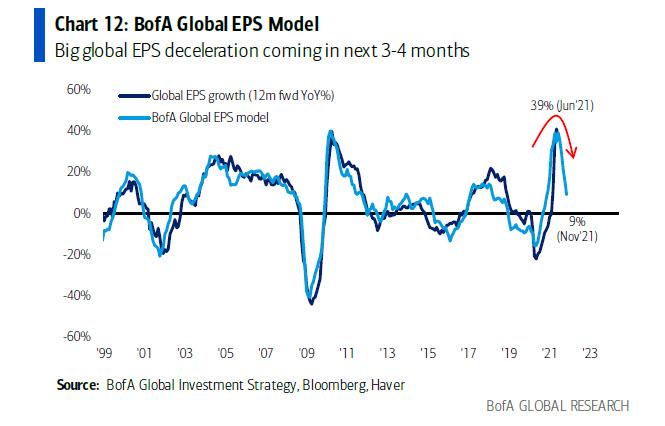
Peak profits: the BofA Global EPS model says global EPS peak was ≈ 40% in April (model driven by China FCI, Asia exports, global PMI, US yield curve); global EPS is projected to decelerate very sharply to 9% by November (Chart 12); this will be driven by inflation, supply bottlenecks, unwillingness of companies to increase inventories given Delta, peak US consumption, China economic weakness, fiscal cliffs and geopolitical risks; decelerating profit growth means quality>junk, defensives>cyclicals tactically.
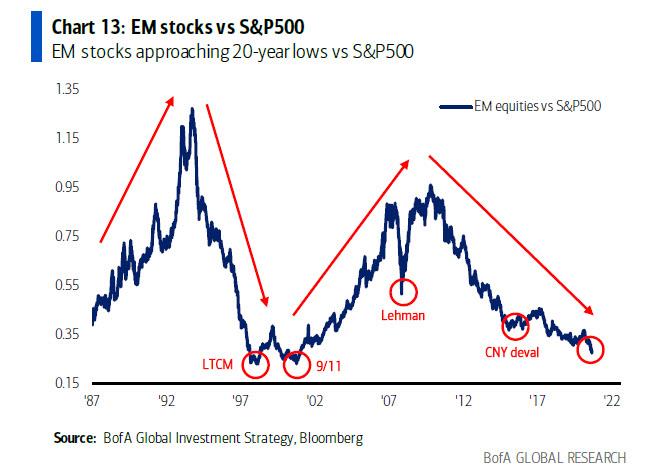
China: EM stocks are approaching 20-year low versus S&P500 (Chart 13); big lows in EM are normally triggered by cathartic events (LTCM, 9/11, Lehman) but EM unambiguously where the secular value is, e.g. EM bonds cheapest relative to US high yield in 20 years; China has been the lead indicator for the virus, the lockdown, the reopening, the tech boom, the tapering, the tightening; China HY spreads have risen sharply to 1277bps, as investors fret about a “credit event” in China.
Credit: credit leads stocks and financial repression continues to keep spreads low (excluding China); but note the relative underperformance of HY bonds vs IG bonds, not a good leading indicator for stocks (Chart 14).

WSJ : Taliban Move to Ban Opium Production in Afghanistan

Taliban Move to Ban Opium Production in Afghanistan
Prices of the raw material for heroin soar in anticipation; the group is seeking acceptance from the international community

Taliban leaders, seeking international acceptance after seizing power in Afghanistan, have told farmers to stop cultivating opium poppies, residents of some major poppy-growing areas say. This has caused raw opium prices to soar across the country.

In recent days, Taliban representatives began telling gatherings of villagers in the southern province of Kandahar, one of the country’s main opium-producing regions, that the crop—a crucial part of the local economy—would now be banned.

This followed a statement by Taliban spokesman Zabiullah Mujahid at an Aug. 18 news conference in Kabul that the country’s new rulers won’t permit the drug trade. Mr. Mujahid at the time didn’t offer details of how the Islamist group intends to enforce the ban.

Local farmers in Kandahar, Uruzgan and Helman provinces said raw opium prices have tripled, from about $70 to about $200 per kilogram, due to uncertainty about future production. In the northern city of Mazar-e-Sharif, the opium price has doubled, residents there said. Raw opium is processed into heroin.

The Taliban have long been one of the narcotics industry’s top beneficiaries, using taxation of the drug business to finance their 20-year insurgency, Western governments say. Afghanistan accounts for some 80% of the world’s illicit opiates exports, and the poppy-planting season starts in about a month.

Two decades of U.S. attempts to curb Afghanistan’s drug business have failed, partly due to the huge political cost of alienating Afghan farmers who depend on the poppy crops for their livelihoods.

Taliban attempts to do the same could undermine public support for the group and deprive its new administration of an important source of revenue at a time when Afghanistan is cut off from the global financial system and foreign aid.

An opium farmer in Kandahar, who attended a recent meeting between villagers and the Taliban, said in a phone interview that farmers were unhappy but would have no choice but to obey if the Taliban move to enforce the prohibition.

“We can’t oppose the Taliban’s decision,” he said. “They are the government.” The farmer said the Taliban have told people to grow other crops, such as saffron. “They’ve told us that when we ban poppies, we’ll make sure you have an alternative crop.”

With Afghanistan’s rutted roads, poor storage infrastructure and few export outlets, poppies are one of the few cash crops available to local farmers. Saffron—which used to be a key element of U.S. counternarcotics efforts in Afghanistan—is another, but it is nowhere near as lucrative or as easy to sell.

“If the Taliban prohibit the cultivation of poppy, people will die from starvation, especially when international aid stops,” a poppy farmer in the Chora district of Uruzgan said in a phone interview. “We still hope they will let us grow poppies. Nothing can compensate for the income we get from growing poppies.”

When the Taliban were in power before the 2001 U.S. invasion, they also initially banned opium production, but later punished only the consumption of drugs, not their cultivation and trading. The Taliban did, however, dramatically crack down on opium cultivation in 2000, when they sought international acceptance for their regime.

That prohibition drove down production by 90%, said Vanda Felhab-Brown, a senior fellow at the Brookings Institution who follows Afghanistan. Yet, it came at a huge political cost for the group.

By the spring of 2001, Afghan farmers were flouting the ban because they couldn’t cope, Ms. Felhab-Brown said. That move to curb opium crops, she added, turned into a key reason why “no one was lining up on the side of the Taliban during the U.S. invasion.”

After 2001, the U.S. spent some $9 billion over 20 years trying to prevent Afghanistan from supplying the world with heroin, to no avail. Led mostly by the State Department and the Drug Enforcement Administration, the U.S. efforts included paying farmers to destroy their poppies, a policy that ignited a poppy-growing fever among others trying to cash in.

The U.S. also funded Afghan eradication teams that turned impoverished farmers’ crops into mulch, enraging communities.

Washington gave up on eradication by 2010, partly because the effort pushed large parts of the rural population to join the Taliban. The U.S. Agency for International Development worked to persuade Afghan farmers to grow saffron, pistachios or pomegranates instead. But export opportunities for those products were scarce.

Last year, Afghan farmers grew poppies on land four times the size of what they did in 2002.

A new Taliban opium prohibition would be a political risk for the group. It could win them a degree of gratitude from foreign governments, particularly in Europe, Russia and Iran, the main markets for Afghan heroin.

Unlike the 1990s, when the Taliban had to contend with powerful, foreign-backed Northern Alliance militias that retained control of the country’s northeast, the Islamist movement today doesn’t face any serious military challenge to its rule. It does, however, need to contend with potential discontent caused by the country’s economic crisis.

With a U.S. freeze on central-bank assets and billions of dollars in foreign aid drying up, the new Taliban authorities in Kabul are hard pressed to stave off economic collapse. Prices of basic commodities like cooking oil have already surged, while imports are growing scarce.

As an insurgent movement, the Taliban profited heavily from the opium trade in the past two decades, according to Western governments and the United Nations. They established shadow governments across the country, building a parallel economy that was sustained in large part by the trafficking of drugs and smuggling of fuel and consumer goods.

It isn’t just opium and its derivatives anymore. Afghanistan has also seen the emergence of a large-scale methamphetamine production. In one district, Bakwa, in the southwestern province of Farah, crystal-meth production has become a cottage industry, according to David Mansfield, an independent socio-economist and Afghanistan expert.

His team of researchers documented more than 300 suspected labs there that can produce annually crystal meth worth some $240 million. Approximately $4 million of that amount went to the Taliban, primarily through taxes, Mr. Mansfield estimated.

Iranian authorities seized 17 tons of methamphetamine from March 2019 to March 2020, and another 10 tons from March 2020 to November 2020, the vast majority of which came from Afghanistan, according to Alexander Soderholm, an independent consultant researching illicit drug flows through Iran at the London School of Economics.

At the highest levels of the Taliban leadership, officials appeared to see the drug trade as a vital undertaking. During peace talks with the U.S. in 2020, Taliban negotiators asked for the release of Hajji Bashar Noorzai, a drug kingpin imprisoned in the U.S., which the now-toppled Afghan government said was an attempt to boost the insurgents’ drug-smuggling capabilities.

“He has no other skill,” said Khalid Mohid, who served as spokesman for the Afghan Counter Narcotics Justice Center, a counternarcotics investigative and prosecuting body of the deposed Afghan republic. Mr. Noorzai, sentenced by a U.S. federal judge in 2009 to life imprisonment on heroin trafficking charges, remains behind bars.

>>> Barron’s Weekend Summary

Barron’s Weekend Summary:US investors have largely focused on China’s tech giants, but given the situation today, there are better options.

* Cover Story
-US investors have largely focused on China’s tech giants, but given the situation today, there are better options. For years, the Chinese government allowed—even assisted—internet companies, enabling them to blossom with little intervention. This created lucrative returns for investors and helped the nation mint more billionaires—257—last year than any other country. Investors became less wary, even complacent, as the world’s second-largest economy seemed to be embracing capitalism. That narrative has been unraveling. As President Xi Jinping makes an expected bid for a third term next year, he is trying to strengthen his grip on the Communist Party and address public discontent, emphasizing social welfare and national security, and regulation that targets swaths of the economy.

* Tech Trader:
-One peculiar outcome of the pandemic has been a newfound appreciation for the personal computer. The humble PC had been out of the spotlight for years. Eclipsed by the rise of smartphones, the PC had become a stale, dull, largely underappreciated appliance—technology’s toaster. This revival has boosted the fortunes of Apple (AAPL), Dell Technologies (DELL), and HP Inc. (HPQ). Earlier this year, demand jumped into ludicrous mode: In its March quarter, Apple posted 70% growth in Mac sales. In their April quarters, consumer PC sales rocketed upward by 72% at HP and 42% at Dell.

* The Trader:
-Federal Reserve Chairman Jerome Powell’s masterful message was received loud and clear by an optimistic stock market—yes, a taper is coming, but don’t even think about rate hikes. The Kansas City Fed’s Jackson Hole Economic Symposium has a reputation for being the place where Fed chiefs drop bombshells on the market. It was where Ben Bernanke hinted at the coming of new Fed stimulus programs in 2010, 2011, and 2012, and where Jerome Powell laid out a backward-looking, rather than forecast-based, monetary policy in 2020. -

There’s no doubt that the housing boom has gone to extremes. New home prices, we learned this past week, rose 18.4% in July from the level a year earlier, and are now 18.5% higher than they were in December 2019, prior to the Covid-19 pandemic. Before a 10.9% jump in December, home prices hadn’t experienced a double-digit year-over-year gain since 2016. The iShares U.S. Home Construction exchange-traded fund (ITB) this year has returned more than 30%, including reinvested dividends, easily outpacing the S&P 500’s 20% return. But as sharp as the rise in home prices has been, they still have a way to go before reaching the level of the housing bubble.
-Lululemon Athletica’s (LULU) stock hasn’t gone very far since its six-month stay as a stay-at-home darling in the immediate aftermath of the pandemic bear market. Its second-quarter earnings might just be the catalyst it needs to get moving again. The drop began with a downgrade, one that cited its valuation—it traded at over 11 times 12-month forward sales estimates when it was cut on Sept. 4, 2020. Lululemon results, scheduled for release on Sept. 8, could change all that. The company is expected to report a profit of $1.18 a share on sales of $1.33 billion, while same-store sales are expected to have increased by 36.1%. And there’s a good chance that earnings will be even better than that.

* Interview:
-Former collegiate basketball player Doug Ramsey is constantly balancing this dynamic, only in a different arena. As chief investment officer of Minneapolis-based investment-research firm Leuthold Group, Ramsey oversees the firm’s extensive macroeconomic research, which it publishes in its widely followed Green Book. At the same time, he is a co-manager of two funds, the $614 million Leuthold Core Investment (ticker: LCORX) and the $29 million Leuthold Global (GLBLX). The former is a 25-year-old tactical allocation fund that aims to keep pace with the overall market but with less risk. Since its inception through the end of July, it has returned an average of 8.5% a year, versus 10.1% for the S&P 500 index, though with significantly less volatility.

* Features:
-Many people claim Social Security earlier than the age at which they would receive 100% of what they are entitled to receive. In fact, roughly 50% of all working men claim at age 62, and nearly 70% have claimed before full retirement age. And they do so for several reasons, according to Neha Bairoliya, an assistant professor at the University of Southern California and co-author of a recent paper that examined Social Security claiming decisions.
-Change has been constant for Berry Global Group. It’s changed its growth strategy, its capital structure, even its name. What it can’t change is what it does: make plastics. While that’s contributed to its underperformance recently, it also created a buying opportunity for investors. The fact that Berry (BERY) makes plastic containers hangs over the stock like a plastic bag on an ocean reef. But writing off Berry for plastics overlooks changing practices in the industry and ignores one of the sturdiest of materials stocks. Berry management recognized that things needed to change, so it started reducing debt and focusing on organic growth. Currently, Berry has $8.9 billion debt, net of cash, and has generated $2.3 billion in Ebitda over the past 12 months, for a debt to Ebitda ratio of 3.9 times. It also has committed to operating between three and four times debt to Ebitda, which isn’t far off packaging peers Sealed Air (SEE) and Amcor (AMCR)
-Even before the pandemic made some common senior living arrangements less desirable, a growing number of older Americans had been expressing a preference for remaining in their current home throughout retirement. The reasons given for this desire to age in place range from community ties to nearby family members to tax breaks such as property-tax exemptions. And it’s cheaper: If homeowners can stay in their dwellings, it may be possible to delay or forgo moving into assisted living that could cost tens or hundreds of thousands of dollars.

* Europe:
-Synthomer (SYNT.UK), a British-based chemical manufacturer that makes latex for medical gloves, has excelled during the pandemic as demand for personal protective equipment has soared. The company’s stock has surged more than 70% over the past 12 months, far ahead of the gains of rival BASF of Germany, up 22%, and U.K.-based Croda International, up 53%. The gains could well continue, with Synthomer poised to grab significantly more market share. The Essex-based company, with a market value of 2.29 billion pounds sterling ($3.14 billion), operates in 21 countries. In addition to latex, it makes such products as flooring adhesives and materials used in paint, packaging tape, and mattress foam. But latex has been the big growth engine.

* Emerging Markets:
-China’s consumer spending is weakening and helping slow overall economic growth, forecasts for which have been trimmed over the past few months. The entire economy is on edge. But consumer sales have been especially laggard. Retail sales rose 8.5% last month from a year ago, easily missing analysts’ forecasts of 11% to 12%. Vehicle sales were particularly discouraging, being the only retail subsector to actually fall in July—and that was for the third straight month, according to China’s National Bureau of Statistics. One of the drivers was the continuing shortage of global semiconductor chips, and the China Association of Automobile Manufacturers (CAAM) said it did not expect that to let up anytime soon. Yet all is not lost. While traditional auto sales plummeted, new energy vehicles are weathering the storm impressively, with sales doubling in July year-over-year, according to CAAM data. Sales of medicines and home electronics are stable as well.

The good news from Brazil is that Covid is receding and the economy is rebounding with surprising strength. Economists now predict 5% growth in 2021. The bad news is that V-shaped recovery has reignited Brazil’s traditional scourge, inflation, forcing the central bank to tighten interest rates from 2% to 5.5% since March. Investors expect at least 7% by the end of the year. Meanwhile, President Jair Bolsonaro continues to make expensive promises as he looks toward re-election next year.
The good news looks priced in after a 17% rise in the iShares MSCI Brazil exchange-traded fund (ticker: EWZ) from a March low. Investors are accentuating the negative. “The easy money has been made,” says Pablo Riveroll, head of Latin American equities at Schroders.

* Commodities:
-Commodity producers look appealing after a pullback from May highs. While prices for industrial metals like copper and iron ore have been weaker, Chris LaFemina, a mining analyst at Jefferies, is upbeat on the sector. “The soft patch will end,” he says. “There won’t be a massive acceleration in demand, but things will start to pick up, and there are supply constraints in commodities like copper that will result in demand growing faster than supply.” Among diversified miners, BHP (BHP), at $66, is down 20% from its peak; Rio Tinto (RIO) is off 19%, to $75; Anglo American (NGLOY) is off 13%, to $21; and Freeport-McMoRan (FCX), a global copper producer, is down 21% from its peak to $36.

* Streetwise:
-Jack Hough discusses “NFTs and the Million-Dollar Rock.” In this edition of his podcast Jack tackles bored apes and CryptoPunks to explain what's behind the mania in non-fungible tokens.