(ZH) The Best Offense Is A Good Defense Company

The Best Offense Is A Good Defense Company

In this week’s Dirty Dozen [CHART PACK] we look at mean reversion and record hedging driving the indices higher, we pair this bullishness with some concerning cyclical action and a downright bearish indicator, before then taking a look at global defense spend, a defense contractor, and big whales getting out of big tech, plus more…
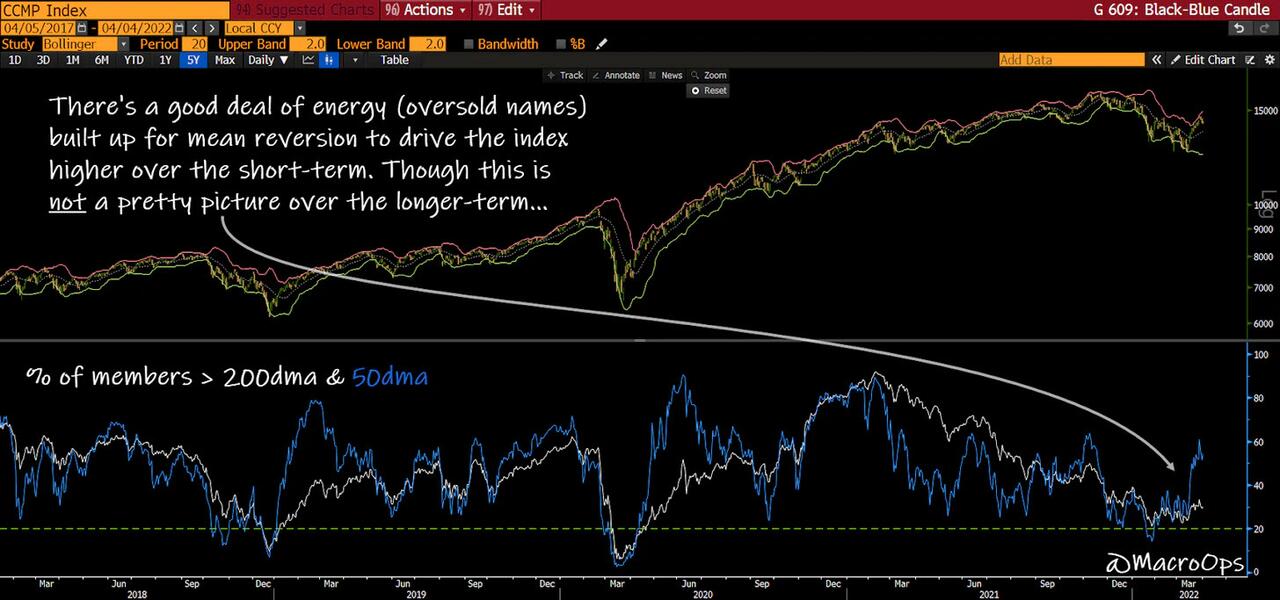
1. Sometimes breadth gets so bad it’s good. This is due to the power of mean reversion. One of the three driving factors of market technicals, the other two being trend, and momentum. This is the case for the Qs right now where the percent of members trading above their 50 and 200 day moving averages fell to the 20% level two weeks ago. The market bottomed soon after. Short-term this is bullish. Longer-term these weak breadth trends are bearish…
2. Sentiment and positioning have also been a tailwind to the bulls as of late. Here’s a chart of the aggregate commercial hedger positioning amongst the major indices, showing near record longs (implying very short specs).
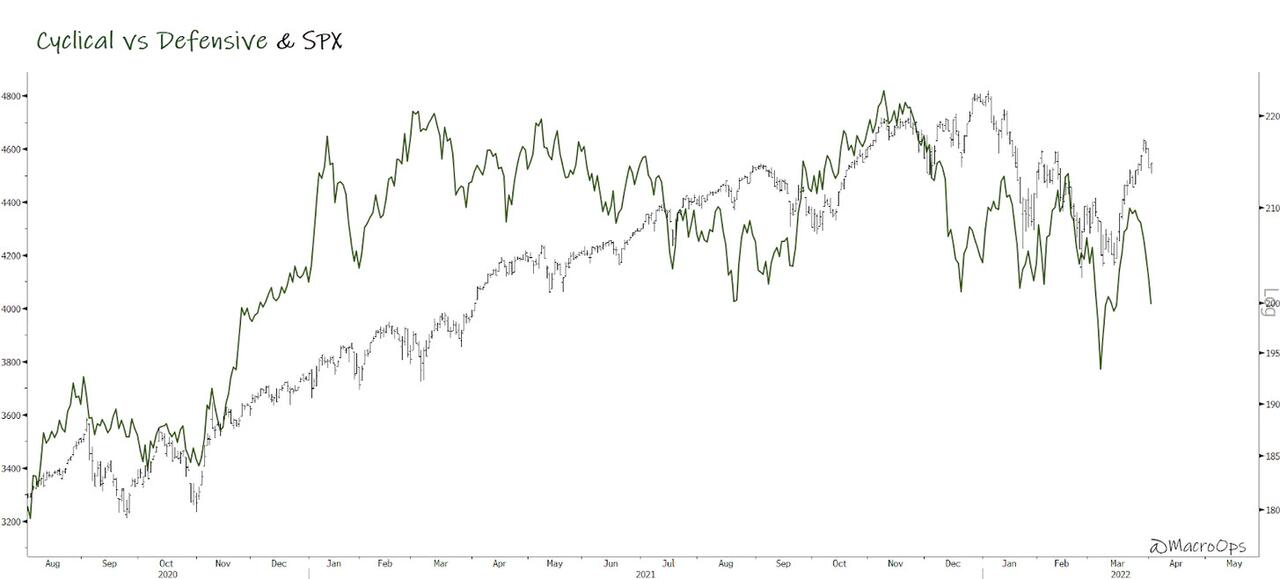
3. Not all is rosy though and one thing you should be tracking is Cyclical vs. Defensives, which led the market weakness at the turn of the year.
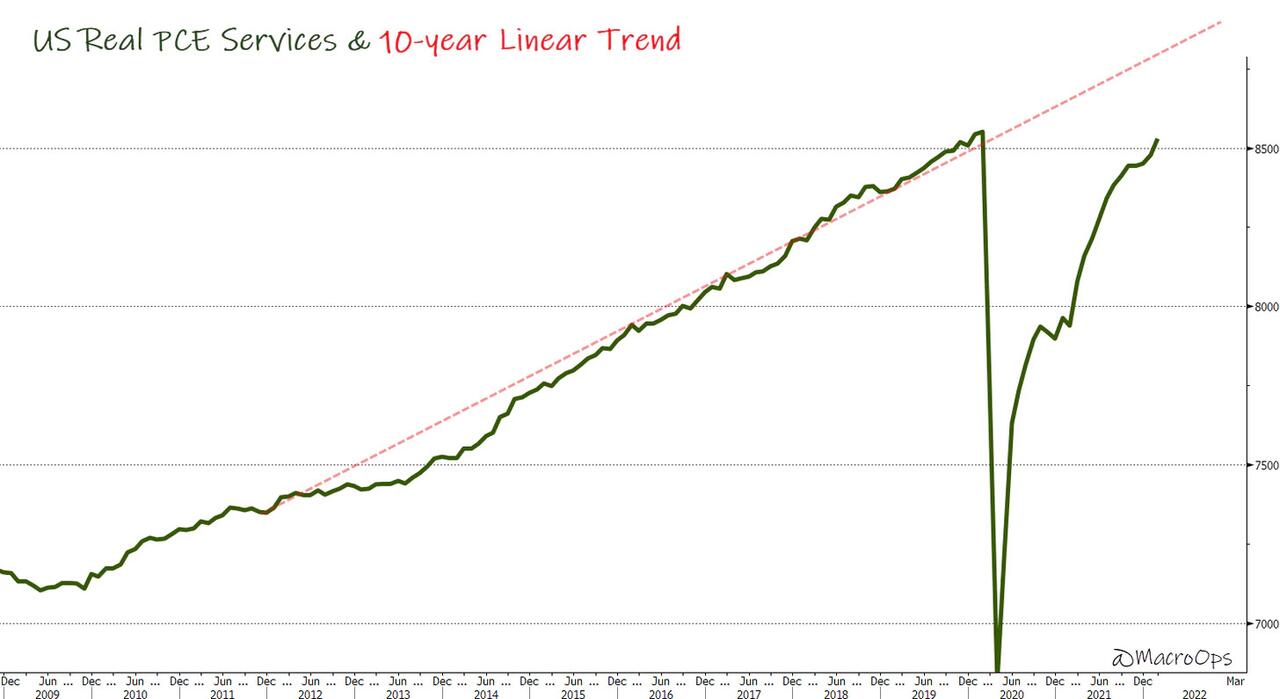
4. We are witnessing the great convergence between services and durable goods. Expect a continued pickup in consumer demand for services and experiences…
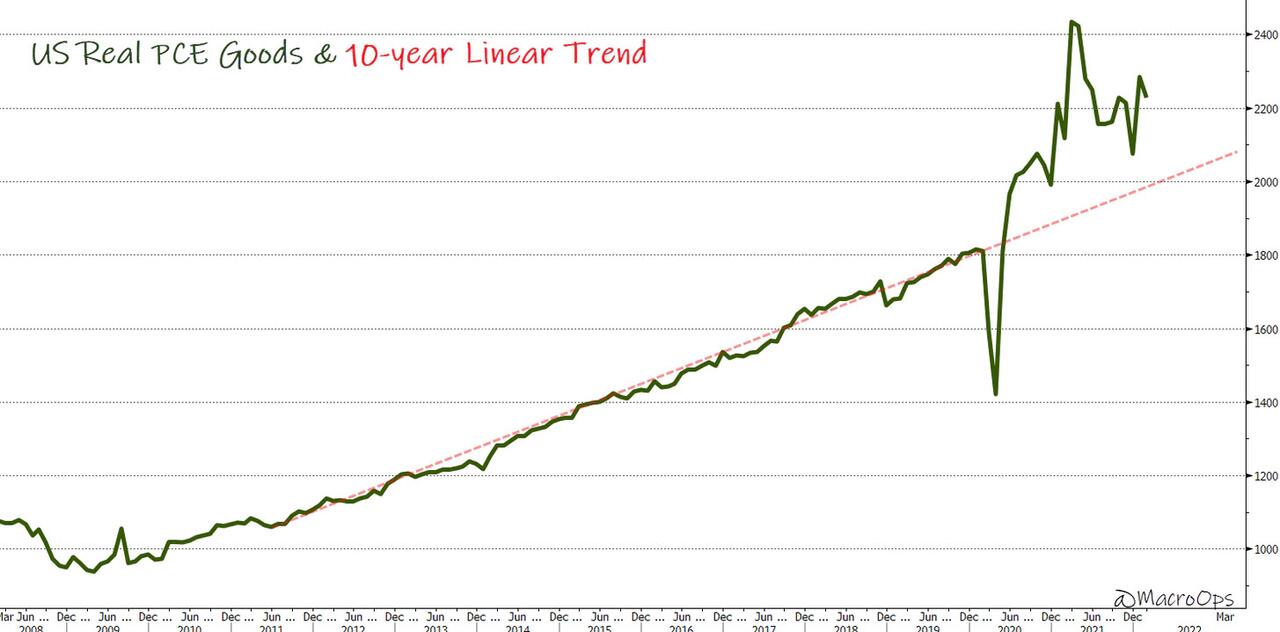
5. And a slowdown in goods which should ease up pressure on supply chains as well as inflation.
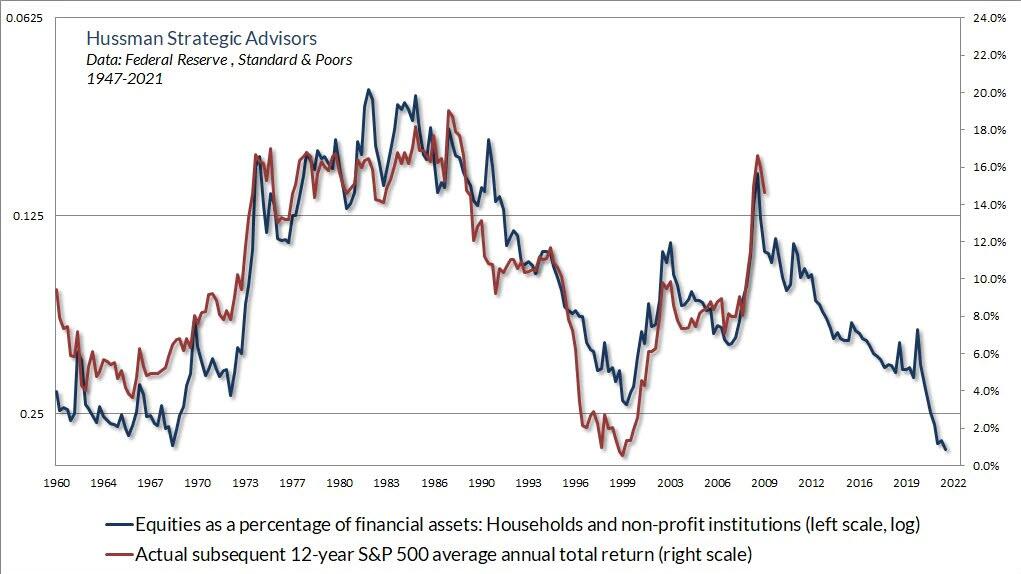
6. US equities are a bit rich… @hussmanjp tweeted the following last week:
So this is fun. The share of household financial assets invested in stocks ended 2021 at the highest extreme in history (and our most reliable measures are even worse). The last two times we got close, the S&P 500 lagged T-bills for the next 13-18 years.
This is the perfect long-term backdrop for precious metals though (link here)…
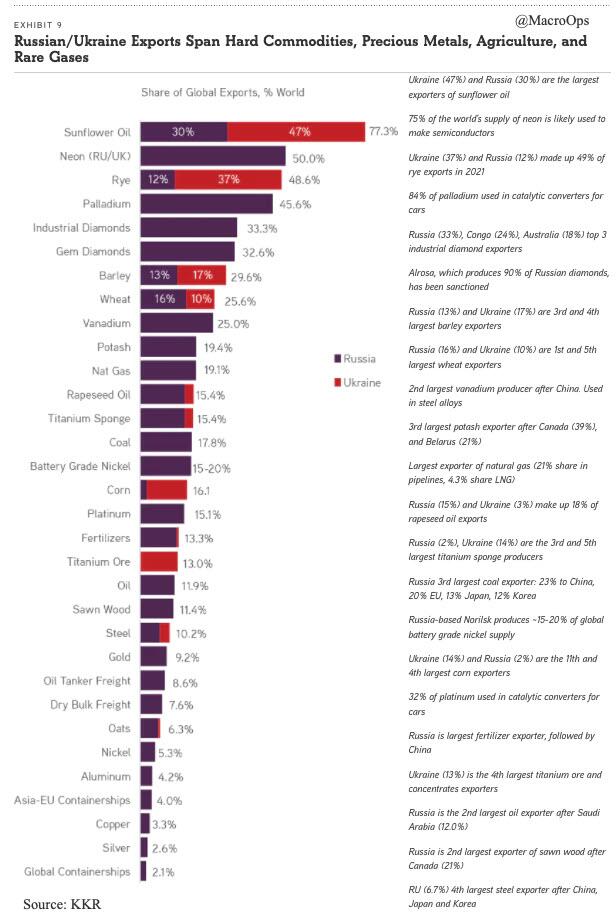
7. Russia/Ukraine Commodity exports as a % of world total via KKR.
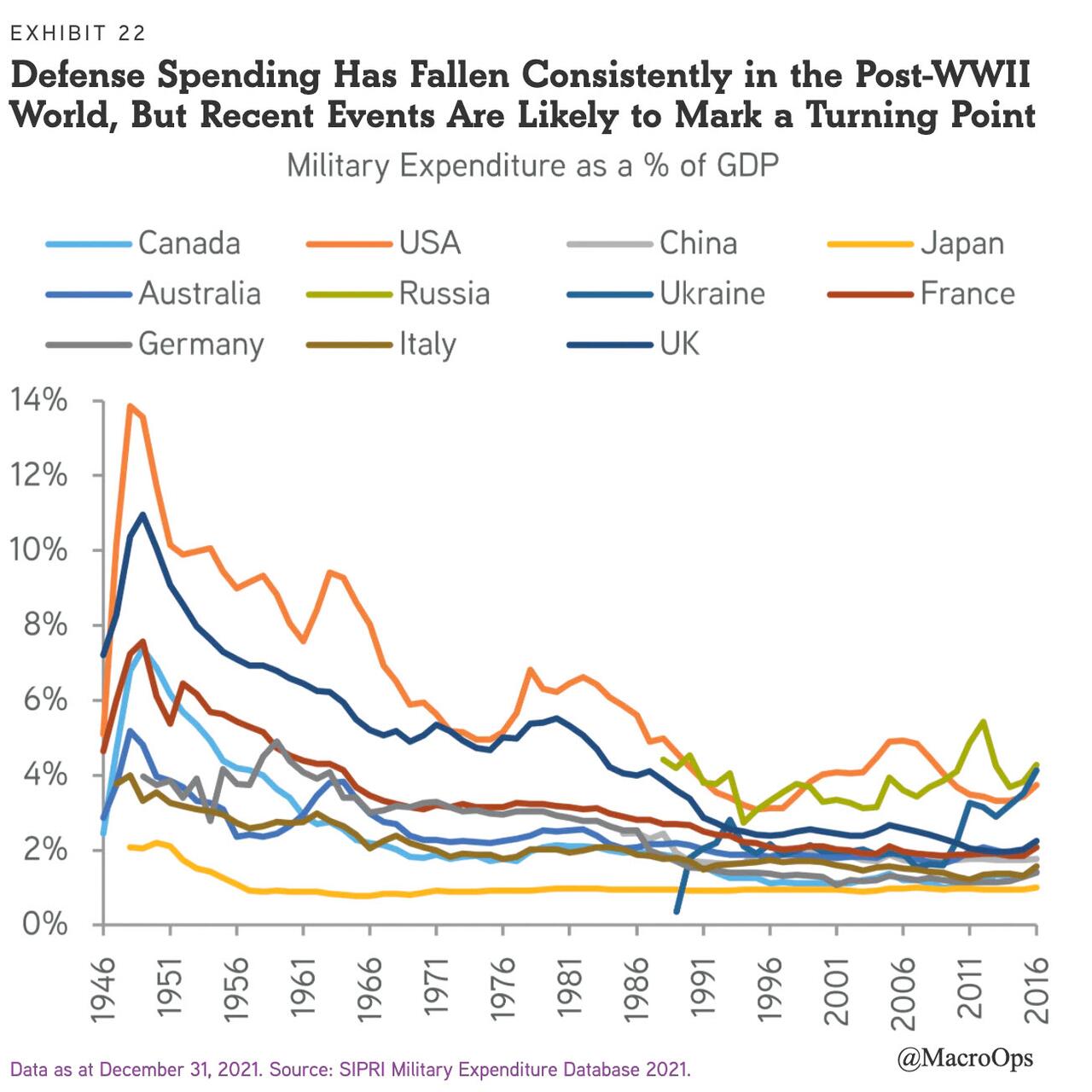
8. Sadly, it’s probably a pretty good bet that we’re starting a new secular bull in defense spending (chart via KKR).
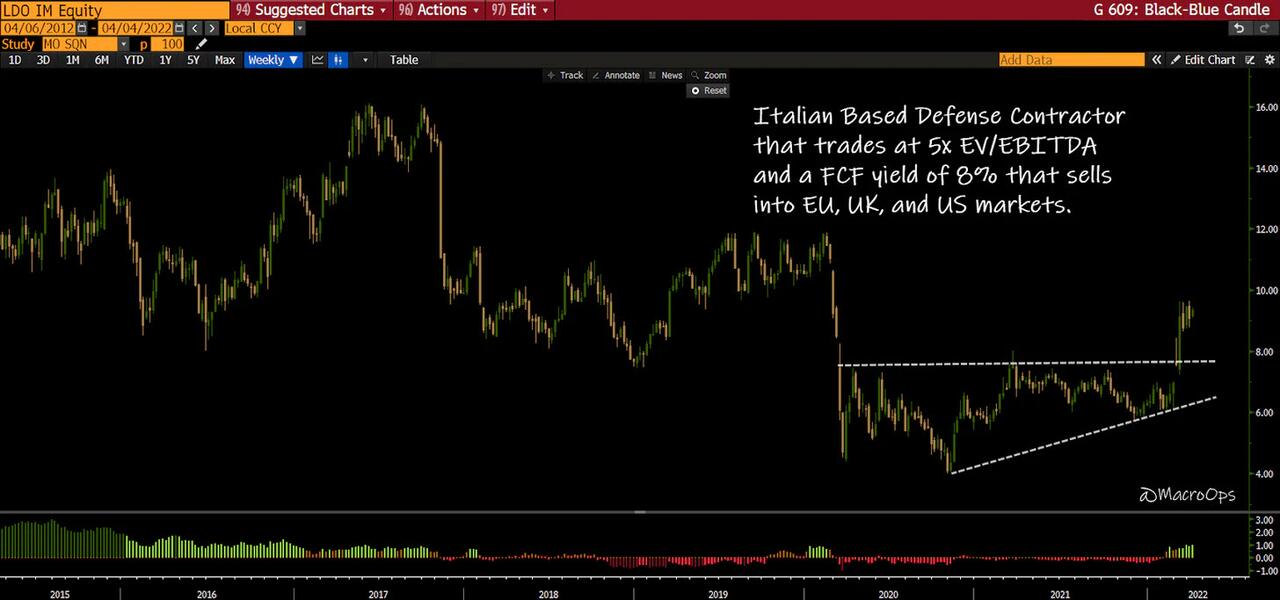
9. Leonardo (LDO:MIL), an Italian-based defense contractor, will be a big beneficiary of this trend. LDO sells into markets across the EU, UK, and the United States. The stock is cheap, has broken out from a major triangle bottom, and has a few fundamental catalysts coming down the pipe to drive improved growth and margins. We’ll be putting out a report to Collective members on the company soon.
10. Net-block order flows don’t paint a pretty picture for FB. Note that this gave a solid lead on the selloff.
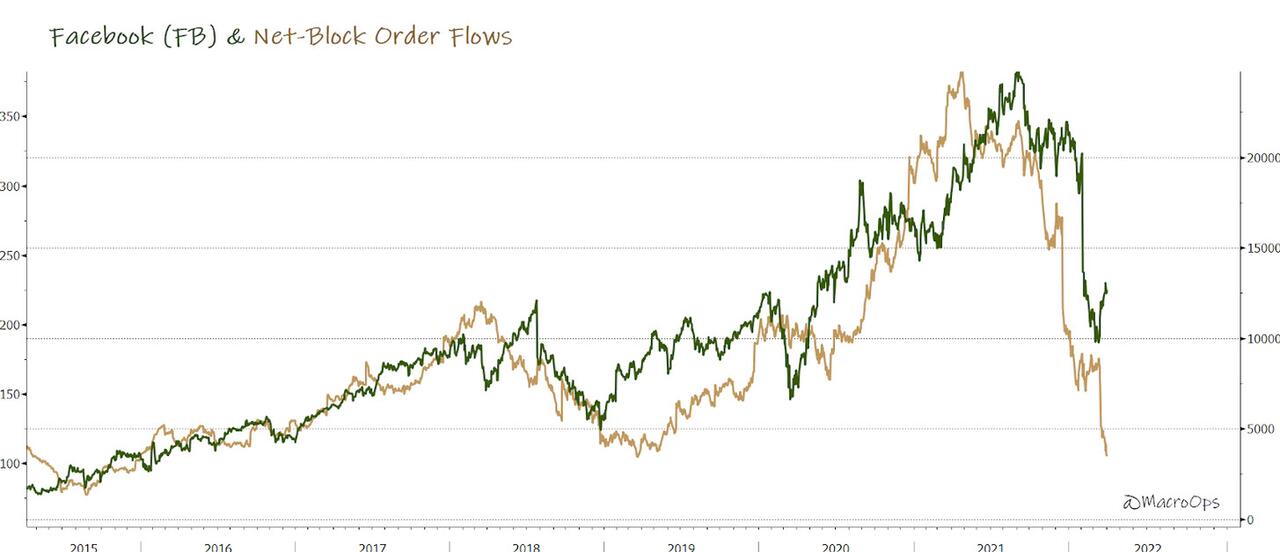
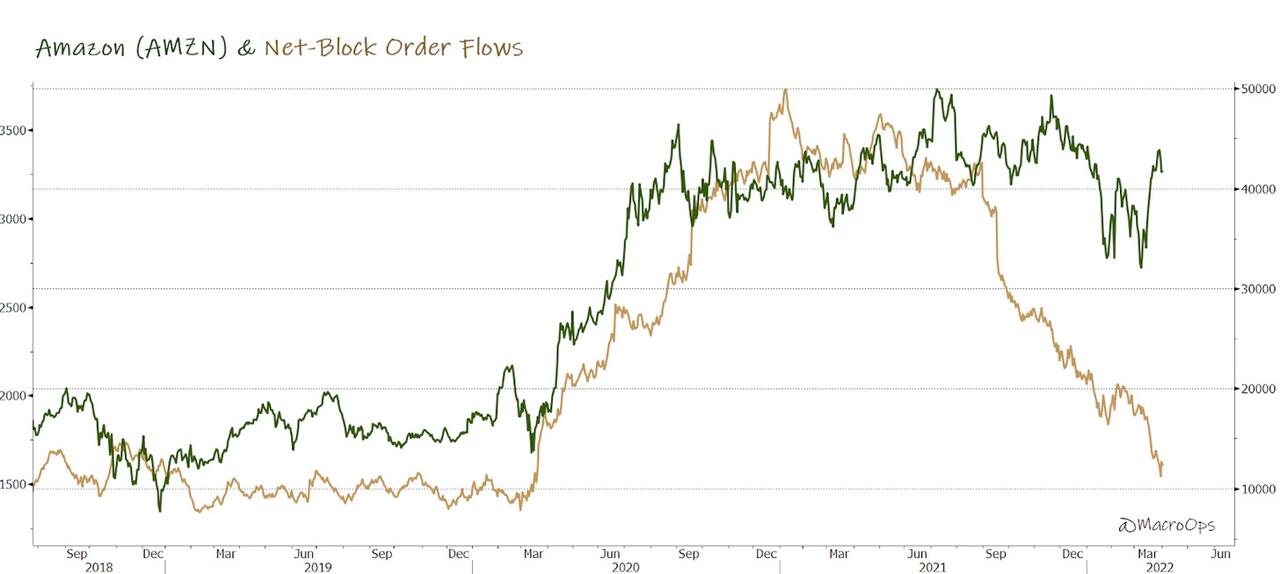
11. Same with AMZN... The whales are dumping their holdings of big tech, passing the shares to future bag holders.
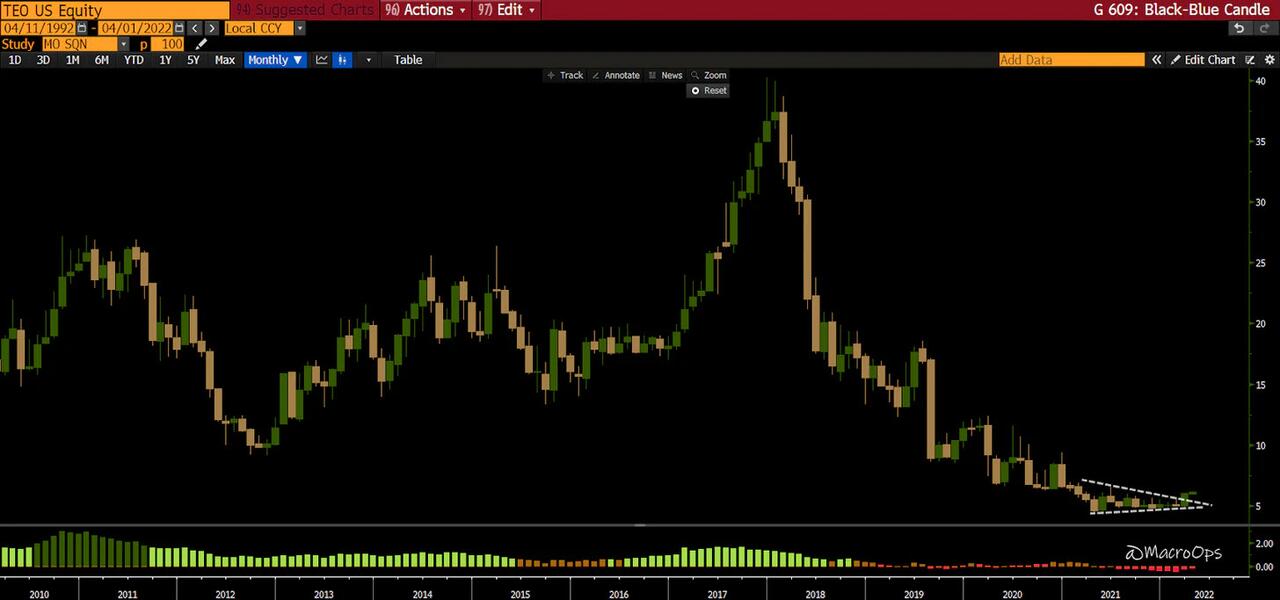
12. Here’s another Argentinian stock (last week I shared TGS). This one is TEO, a TelCo play. The chart below is a monthly. I know nothing about the fundamentals. They’re probably garbage. And, again, this is an Argentinian stock so full caveats apply. But… there are some great long-term technical setups in that market and they’re a large exporter of Ags, so *shrugs*...
Stay frosty and keep your head on a swivel.
(ZH) Iran Says Nuclear Negotiations Effectively Over, Blames US for Impasse

Iran Says Nuclear Negotiations Effectively Over, Blames US for Impasse

Officials with Iran’s Foreign Ministry are giving indications that the Vienna negotiations are not just "stalled" but effectively over. They say they are prepared to return to Vienna to sign the final deal, but not if it’s just for more negotiations.
Its not always clear how the Vienna talks are going since the US and Iran have been the only really negotiating parties for weeks, and they don’t meet face to face. Indirect talks through EU negotiators look similar no matter how active they are.
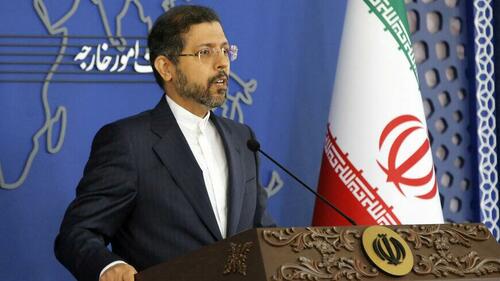
Iran's Foreign Ministry spokesman Saeed Khatibzadeh, IRNA/AFP via Getty Images
All the reports of things being "close" seem to be accurate, with Iran interpreting things as finished, and just waiting for the US to settle any internal issues on accepting the final pact.
The big question remains the removal of Iran’s Revolutionary Guards from the US terror blacklist, something that is politically difficult for the US. Iran is also keen to get a US assurance that the next president won’t unilaterally withdraw from the deal, but that may not be achievable.
Iran’s Foreign Ministry spokesman Saeed Khatibzadeh accused the United States during a Monday press conference:
Khatibzadeh accused the United States of bringing the talks to a "suspension point." He said, “What has become clear for us in the last two weeks is that [US President Joe] Biden and the White House have not made a decision.” He continued that the United States has made the nuclear talks a "hostage" in domestic partisan issues.
...He added, “The US is responsible for the suspension of the negotiations.” If talks are resumed, the United States must provide a “logical answer” to Iran’s demands, Khatibzadeh said.
State Dept officials offered an unusually upbeat assessment, saying they believe differences can still be overcome. This is a stark difference to their usual predictions that the deal will fall apart. It’s not clear if they picture more negotiations either, or if they, who also believe the deal is near, might resolve the last little bit on their own.
Iran’s Foreign Ministry also indicated openness to resume other talks in the region to resolve key issues outside of the nuclear deal, including getting back to bilateral talks with Saudi Arabia.
Efforts to keep regional issues separate from the nuclear one is probably a good idea, because some regional powers, like Israel and Saudi Arabia, are so generally hostile to Iran that they’re liable to use anything and everything as an excuse to pressure the US away from a nuclear pact.

WWD : Chanel Blocks Sales to Russian Passport Holders, But Not in China

Chanel Blocks Sales to Russian Passport Holders, But Not in China
As of Tuesday, it appears that the retail team in China was never instructed to ask Russian nationals to sign any declarations before making any purchase.

LONDON — While Chanel is restricting sales to overseas Russians in Europe, the Middle East and North America because of its invasion of Ukraine, it appears that Russians in China, a nation that has not yet imposed any sanctions on Russia, are not required to sign any papers when shopping at Chanel, according to salespeople working at the brand’s stores there.

A sales associate, who requested anonymity, told WWD that as of Tuesday, the retail team was never instructed to ask Russian nationals to sign any declarations before making a purchase. In China, there are a considerable number of Russians living and working in cities like Shanghai, Guangzhou, Shenzhen and Hong Kong, where Chanel has a retail presence. In theory, they can act as shopping proxies to help those in Russia buy from Chanel without a problem.

Over the weekend, Chanel was once again caught up in controversy as wealthy Russians, who fled to places like Turkey and Dubai to continue their luxury lifestyles, found out they are no longer welcomed at Chanel in those countries.

Lisa Litvin, a Russian interior designer at Partners Pro, was among the first to share her in-store experience.

“I went to a Chanel boutique in the Mall of the Emirates. They didn’t sell me the bag because (attention!) I am from Russia,” she wrote on Instagram last Friday.

She was told that Chanel “has a new order that they only sell after I sign a piece of paper saying that I won’t wear this bag in Russia,” and she has to provide ID details and a Russian phone number.

“Next, the manager said that starting from today they were selling to Russians only if they sign an agreement not to wear their items in Russia,” she added.

Her Instagram account has been private since Monday.

Fashion show presenter Anna Kalashnikova claimed that Chanel refused to sell her earrings and a bag in Dubai because she is a Russian celebrity.

She also claimed a manager at the store told her that, “We know you’ll be taking purchases to Russia, so we can’t sell our brand’s items.”

Russian influencer Yana Rudkovskaya, the wife of Olympic figure skating champion Alexander Plyushenko, who is said to have spent more than 1 million euros at Chanel over the years, said the ban is “somewhat humiliating.”

“This is a shock for a woman who’s been buying Chanel and Chanel Haute Couture for more than 20 years, and who sat at its shows in the front row,” she added.

Maria Zakharova, Moscow foreign ministry spokeswoman, later accused Chanel of joining “the Russophobic campaign to cancel Russia.”

In a statement sent to WWD, Chanel said “the most recent EU and Swiss sanction laws include a prohibition on the ‘sale, supply, transfer or export, directly or indirectly, of luxury goods to any natural or legal person, entity or body in Russia or for use in Russia.’ Under the applicable EU sanctions, this prohibition applies to luxury goods listed insofar as their value exceeds EUR 300 per item (CHF 300 under the CH sanctions).”

“This is why we have rolled out a process to ask clients for whom we do not know the main residency to confirm that the items they are purchasing will not be used in Russia. We recognize that this process of walking through the law has caused disappointment to some of our clients.

“We are currently working on improving this approach and we apologize for any misunderstanding this may have caused, as welcoming all our clients, regardless of where they come from, is a priority for Chanel,” the brand added.

Since the beginning of March, luxury players including LVMH Moët Hennessy Louis Vuitton, Hermès, Kering and Chanel have “temporarily” closed their stores in Russia in response to the escalating situation, although in some cases they continue to wholesale there.

Chanel at the time said it would no longer deliver to Russia.

“We will close our boutiques and we already suspended our e-commerce,” the company wrote. “The safety of our employees is our priority and we remain closely connected to our local teams who we will continue to support.”

WWD : KPMG Consumer Metaverse Study Indicates Enormous Potential and Enthusiasm

KPMG Consumer Metaverse Study Indicates Enormous Potential and Enthusiasm
It is estimated that 70 percent of brands will have a presence in the metaverse in the next five years.

While new applications of augmented reality might seem as surreal as the trailers for the upcoming Marvel movie, “Doctor Strange in the Multiverse of Madness,” the metaverse is more grounded, and safe. For brands, it offers a captured audience and seemingly endless new possibilities to engage.

According to a new consumer pulse survey report from KPMG, called “Go boldly, not blindly, into the metaverse: enabling a new consumer world,” nearly two-thirds of consumers are now familiar with the metaverse and, what’s more, they’re ready to interact.

Breaking down awareness, KPMG’s survey found 71 percent of males are familiar with the metaverse compared to 59 percent of female consumers. Awareness did trend higher from younger generations with 86 percent of Gen Z and 81 percent of Millennials reporting they are familiar with the metaverse.

With this in mind, the authors of the report said, “more likely than not, a big part of your customer base is already embracing the metaverse and is comfortable interacting virtually.” Put simply, by entering the metaverse, a company is meeting consumes where they are.

Moreover, just under half (46 percent) of consumers agree “the metaverse can provide a forum to interact with friends in a way that is as meaningful as in person” and 44 percent of respondents agree that “engaging with friends in the metaverse is an authentic way of interacting.”

For consumer and retail organizations, authors of the report said they are “limited only by the imagination” as they get ready to “take advantage of new business opportunities and selling channels” and win by developing a strategy for this market. In the luxury sector specifically, KPMG predicts tremendous growth opportunities, citing industry analysts who predict the growing demand for luxury goods in the metaverse could reach $50 billion by 2030.

Almost 60 percent of luxury consumers surveyed by KPMG reported they are participating on a metaverse platform — many of these platforms feature personalized avatars to reflect unique identities. “Luxury brands can offer digital products and services that help shape these identities — driving new revenue streams, testing new product innovations, increasing loyalty with existing customers and acquiring new customers,” authors said of the report.

Still, partnering with video games is just one way into the metaverse.

Underscoring the importance of continuing to provide an authentic, meaningful experience, KPMG notes it is important to ask the right questions to determine strategy:

• How are consumers engaging in the metaverse now?

• What is my brand strategy for the metaverse? What is it worth to my brand?

• Can you create an immersive experience?

• How will the decentralized internet improve customer engagement?

• What needs to be considered to address the data protection and privacy?

• Who will build your virtual kingdom?

Ultimately, the metaverse is still being built. The urgency, KPMG said in its report, should be placed on figuring out your brands impact on the metaverse and how it is impacting your brand rather than immediate execution.

WSJ : MIT Reversed Its Position on the SAT. How About Racial Preferences Next?

MIT Reversed Its Position on the SAT. How About Racial Preferences Next?
Admissions policies implemented in the 1990s restrict the number of Asian-American students.

James Freeman is right to praise the Massachusetts Institute of Technology, my alma mater, for bringing back standardized testing for admissions, which was suspended during Covid (“Go Tech!” Best of the Web, March 29). But he gives MIT too much credit. The school has not done anything to end the racially discriminatory admissions policies it implemented in the 1990s to restrict the number of Asian-American students and increase the number of black and Hispanic students.

As shown in a 2018 analysis of MIT enrollment data by Althea Nagai, the university implemented preferences and racial quotas to cap the number of Asian-American students admitted and to admit other minority students with lower academic qualifications, credentials and test scores. As a result, the admission rate of Asian Americans topped out at about a quarter of the freshman class.

In comparison, CalTech, MIT’s rival for the title of best engineering and science school in the country, never implemented racial preferences and quotas. Its percentage of Asian-American students rose steadily to above 40% by 2016, paralleling the “swift rise” in the “number of Asian undergraduates nationally,” as Ms. Nagai explains.

None of this is a surprise, given that the former MIT dean of admissions, Marilee Jones, commented that a Korean-American applicant “looked like a thousand other Korean kids with the exact same profile of grades and activities and temperament, . . . yet another textureless math grind.”

Stuart Schmill, the current dean of admissions, said nothing about ending MIT’s discriminatory admissions policy when he announced the reinstatement of standardized testing. Until he does that, no alumnus should give MIT any funding or support and the school should lose its holier-than-thou attitude.

Hans von Spakovsky

Heritage Foundation

Washington

WSJ : Neiman Marcus Gets $200 Million Investment From Farfetch

Neiman Marcus Gets $200 Million Investment From Farfetch
Farfetch to power online expansion of retailer’s Bergdorf Goodman brand overseas, while Neiman aims to put some brands on luxury platform

Online luxury retail platform Farfetch Ltd. is investing $200 million in Neiman Marcus Group, in a deal that shows how much the internet has upended luxury fashion.

The agreement initially will allow Neiman Marcus’s Berdgorf Goodman brand to expand overseas digitally by using Farfetch’s technology to power its digital business. The ultimate scope is far broader. Neiman Marcus is considering making some brands it carries—with their permission—available on Farfetch’s marketplace, the companies said. Eventually, Farfetch will use its technology to link Neiman Marcus’s stores more closely with e-commerce by arming sales people with technology that enables them to recognize online shoppers when they enter stores.

“We believe luxury customers will always want the opportunity to have a physical interaction with a human,” said Neiman Marcus Chief Executive Geoffroy van Raemdonck. “We are taking the best components of Farfetch and Neiman Marcus to enhance the experience.”

It wasn’t long ago that Neiman Marcus was the company making investments in a wired future. It bought online luxury retailer Mytheresa.com in 2014.

Behind the glitter, Neiman Marcus struggled under $5.1 billion in debt from two successive leveraged buyouts. When the Covid-19 pandemic temporarily shut its stores, the company tipped into bankruptcy in May 2020.

It had spun off Mytheresa in 2018, putting it out of reach of creditors, who waged a two-year campaign to win back the asset. An agreement was reached as part of a bankruptcy deal, and Mytheresa went public last year.

Neiman emerged from bankruptcy in September 2020 under new owners, including Pacific Investment Management Co., Davidson Kempner Capital Management LP and Sixth Street Partners LLC. Farfetch will hold a minority stake in the company, which now has $1.1 billion in debt.

Farfetch Chief Executive José Neves, a Portuguese businessman, started the company in 2008 as an online marketplace that matches buyers with sellers. It has evolved into a provider of e-commerce technology for luxury brands, including Chanel and Harrods, the British department store. It also owns Browns, which operates two luxury boutiques in London, and Stadium Goods, a sneaker and streetwear retailer and marketplace.

Based in London, Farfetch went public in 2018. For the year ended Dec. 31, it earned a profit of $1.47 billion on revenue of $2.26 billion.

In 2020, Farfetch formed a partnership with Chinese e-commerce company Alibaba Group Holding Ltd. and Swiss conglomerate Compagnie Financière Richemont SA, which owns brands from Cartier to Chloé, to provide luxury brands with greater access to the Chinese market and speed the digitization of the luxury industry.

Farfetch and Richemont, which also owns the online fashion retailer YOOX Net-a-Porter Group S.p.A, are in talks to expand their partnership, the companies have said.

The deal with Neiman Marcus will give Farfetch a foothold in the U.S. For Neiman Marcus, the partnership will make its brands more accessible to international customers, the retailer said. It operates 37 Neiman Marcus department stores and two Berdgorf Goodman stores in the U.S. but doesn’t have any locations overseas. It scaled back online operations in China in 2013.

Mr. van Raemdonck said that to bring the Bergdorf Goodman brand to shoppers around the world requires a host of capabilities from translation to payments to call centers. “All of that will be provided by Farfetch,” he said.

Neil Saunders, managing director of research firm GlobalData PLC, said aligning itself with Farfetch will also give Neiman Marcus access to younger customers and help it transform its digital business faster.

Rival Saks Fifth Avenue last year split its e-commerce and stores into two separate companies in a bid to become more competitive online.

Mr. Neves said that despite Farfetch’s push to digitize luxury, the experience doesn’t always translate well on the internet. “There is an element of physicality and human relationship to luxury shopping that cannot be replicated online,” he said.

Mr. Neves estimated two-thirds of luxury purchases will be made in stores for the foreseeable future. He said he wants to reinvent the store experience by adding more digital elements.

Mr. van Raemdonck recently toured Browns in London, where Farfetch has been putting some of its ideas into action. An app lets salespeople recognize shoppers when they enter the store and gives them access to their browsing and purchase history.

“Otherwise, when you enter a store, no one knows you, and they don’t know what you’re looking for,” Mr. Neves said. “We’re trying to elevate the experience without removing the human element.”

WSJ : Two Daughters of Putin Face Possible EU Sanctions Over Ukraine Invasion

Two Daughters of Putin Face Possible EU Sanctions Over Ukraine Invasion
Brussels also announced moves to restrict Russian coal, though measures still need approval from EU members

The European Union has proposed sanctioning two daughters of President Vladimir Putin, according to diplomats familiar with the plan, a move that would add the Russian leader’s closest family members to a growing list of individuals sanctioned in response to Russia’s invasion of Ukraine.

EU member states still must approve the sanctions, which are among dozens of newly proposed, targeted travel bans and asset freezes against Russian business people, politicians, officials and their families. EU officials announced details of other new sanctions earlier Tuesday. They include a ban on imports of Russian coal, slashing the access of Russian road carriers and ships into the bloc, restrictions aimed at oligarchs and their families, and the blocking of some high-technology machinery exports.

Mr. Putin doesn’t speak publicly about his family. He has two daughters with his former wife, Lyudmila Putina, according to the Kremlin. It isn’t known if Mr. Putin has other children, and it couldn’t be learned if the daughters being targeted in the EU sanctions were those he has publicly acknowledged.

In 2013, the couple said their marriage was over. The following year, the Kremlin confirmed that the Russian president had finalized the divorce of his wife of nearly 30 years. The Kremlin didn’t immediately respond to a request for comment about the EU sanction plans.

The president’s personal life is generally shrouded in secrecy. His separation in 2013 from his wife, a former stewardess for Russia’s national carrier Aeroflot, came in a surprise announcement in a brief appearance after a performance of the ballet “La Esmeralda” at the Kremlin theater. It set the stage for the first divorce, the following year, of a Russian leader since Peter the Great and ended years of speculation about the state of the couple’s union. Mr. Putin described the end of the marriage as a “joint decision.”

The couple’s daughters have largely kept out of public view, to such an extent that many Russians don’t know what they look like.

In 2020, presidential spokesman Dmitry Peskov told reporters that Mr. Putin doesn’t pay attention to various publications about his private life and his state of health. The Russian president usually explains his reluctance to talk about his personal life “as a matter of security and a desire to remain anonymous for his loved ones so they can live a normal life,” Russia’s state news agency, TASS reported that year.

FT : Poland blocks EU move to sign up to minimum corporate tax

Poland blocks EU move to sign up to minimum corporate tax
Warsaw move holds up implementation of landmark reform agreed last year

Poland has blocked progress of an EU directive seeking to implement the global minimum corporate tax agreed last year, setting back the bloc’s efforts to adopt the measure.

In a landmark agreement in October last year, 137 countries backed the introduction of a new 15 per cent minimum effective corporate tax rate on large businesses, known as pillar two.

The reform is set to raise global tax revenues by more than $150bn a year. The same agreement also backed forcing the world’s 100 biggest multinationals to declare profits and pay more tax in the countries where they do business, known as “pillar one”.

In order to make the deal a reality, countries need to put the minimum tax into their domestic law. The EU plans to do this via a directive and requires unanimity from all member states for the measure to go ahead.

However, on Tuesday, Poland disrupted the plans by opposing the proposed directive at a meeting of EU finance ministers in Luxembourg.

Magdalena Rzeczkowska, Poland’s finance minister, argued that the country could not support the minimum tax going ahead without first having “legally binding” assurances that reforms targeting the largest 100 companies would be enacted.

That part of the deal requires countries to agree a multilateral convention, and negotiations are running slower than the plans for the global minimum tax.

Rzeczkowska said: “We strongly believe that we should be mindful of the inadequacy of placing additional burden on European businesses under pillar two without ensuring the digital giants are fully taxed under pillar one.”

The decision sparked frustration from other member states including France, whose finance minister Bruno Le Maire has been leading negotiations on the directive as part of France’s presidency of the EU, which ends in June.

He pointed out that the deal had been supported by all EU member states, including Poland, at the international level via the OECD negotiations. The council had “addressed” Poland’s concerns by including wording that indicated the EU’s intention for the two parts of the deal to work as a package.

“I’ll say very clearly, I am absolutely not convinced by the Polish argument,” Le Maire said at the council meeting. All member states had worked towards finding consensus, he added, saying he “deeply regret[ed] that Poland does not understand that”.

Speaking after the meeting of the economic and financial affairs council, Valdis Dombrovskis, commission executive vice-president, said he was not in a position to interpret the motivations and justifications of Poland. But he was hopeful that there would be agreement at next month’s meeting.

“This mystery has to be brought up with Warsaw, rather than the French presidency,” added Le Maire.

Separately, Poland is engaged in negotiations with Brussels to unlock its portion of the EU’s recovery funds.

The development means that implementation of the global tax deal remains stalled on both sides of the Atlantic.

The draft legislation contained in US president Joe Biden’s build back better bill, which would align the US tax system with the international proposal on a global minimum tax, has been delayed as a result of the Democrats’ inability to gain backing from within the party.

No draft legislation has yet been brought forward in Washington and Brussels on pillar one.

However, when asked if the global tax deal was in “jeopardy” because of hurdles in the US and EU, Le Maire said that determination to pass the deal remained strong.

FT : Cryptocurrencies: UK should not be a light touch for DeFi heavy squad

Cryptocurrencies: UK should not be a light touch for DeFi heavy squad
Treasury’s ambitions for the City do not alter the case for stringent regulation of the sector

The City of London is forever trying on new mantles. In 2012, UK chancellor George Osborne spearheaded a push to make it the biggest renminbi trading hub outside China. Six years later, his successor Philip Hammond talked up the UK’s chances of leading the world in green finance. Now, the Treasury is turning its attention to blockchain. It declared an oxymoronic ambition to make Britain a “global hub” for the decentralised finance (DeFi) industry this week.

The announcement was not taken as seriously as the government would like. Chancellor Rishi Sunak billed plans for the Royal Mint to issue a non-fungible token as an emblem of the UK’s “forward-looking approach”. The reality, say lobbyists, is rather different. Earlier this year, ex-chancellor Hammond, now a senior adviser for crypto company Copper, claimed Britain had been outpaced by other finance hubs, including in the EU, in regulating the sector.

Champions of innovation have to contend with worried watchdogs. On the same day the Treasury rolled out the welcome mat, Bank of England governor Andrew Bailey was decrying cryptocurrencies as the new “front line” in criminal scams.

Crypto groups now have to pass money laundering checks to operate in the UK. More than 80 per cent of the companies that sought full registration from the Financial Conduct Authority have either withdrawn their applications or were rejected. But those businesses can still sell their services in the UK. That is likely to be bad for British consumer protection, as well as UK-based jobs.

The UK is not alone in struggling with these issues. In the US it is unclear which US financial regulator is supposed to oversee crypto businesses. Securities and Exchange Commission chair Gary Gensler this week proposed splitting oversight with another agency.

The Treasury should not be howled down for trying to spot new opportunities for the UK’s finance industry. Its plan to regulate a broader set of crypto activities is welcome. But its ambitions for the City do not alter the case for stringent regulation. This is not a sector that suits a light touch.