FT : Global investors pump money into Chinese equities

Global investors pump money into Chinese equities
Strong growth and attractive valuations put 3 ETFs in top 20 worldwide for net inflows

Investors are pumping money into exchange traded funds focused on Chinese equities despite jitters over Chinese government interventions which have rattled a number of stocks and sectors this year.

President Xi Jinping’s “common prosperity” agenda has wiped more than $1tn from the market value of Chinese equities since February as a series of regulatory blows have targeted sectors from video games and technology to property and education.

Yet three China-focused ETFs, ChinaAMC MSCI China A 50 Connect, E Fund MSCI China A 50 Connect ETF and China Universal MSCI China A 50 Connect ETF, were among the top 15 globally for net inflows in November, according to ETFGI, a London-based consultancy, pulling in a combined $4.6bn.

More strikingly still, KraneShares CSI China Internet ETF (KWEB) has seen $7.8bn of net inflows since mid-February, more than twice as much as any other US-listed thematic ETF, according to Goldman Sachs.

Some now see opportunities in the beaten-up Chinese equity market, which is down by a third from its February peak in dollar terms.

“We are modestly positive on Chinese equities. We think the equity risk premium compensates investors for the risk. In other words, they are cheap,” said Karim Chedid, head of investment strategy for iShares in the Emea region.

“Chinese equities are still under-represented in the global indices and the direction is going to continue to be upward. Now might be a good time to allocate on a long-term view,” he added.

Jose Garcia-Zarate, associate director, passive strategies research at Morningstar said the outlook looked attractive for investors. “The growth picture in China is rebounding much more quickly than other economies. That helps explain interest in the equity side.”

Matthew Bartolini, head of SPDR Americas research at State Street Global Advisors, agreed, saying “growth, while slowing, is still somewhat stronger than in developed nations”. He believed the latest inflows were partly a case of investors trying to buy the dip.

The KraneShares ETF’s asset-raising success has come despite Chinese technology companies enduring a year of regulatory turbulence in the wake of the cancellation of the $37bn initial public offering of Ant Group, Jack Ma’s online finance company, in November 2020.

KWEB’s share price has fallen 46 per cent so far this year partly as a result, yet some believe its key holdings, which include Tencent, Alibaba, JD.com, Baidu and Pinduoduo, remain integral to consumer spending in the world’s second-largest economy.

“You could argue that a third of all the retail sales in China go into companies in KWEB,” said Brendan Ahern, chief investment officer of KraneShares.

“In equities, investors see that China is becoming an asset class [in its own right],” he added pointing to similarities with what happened with Japan in the 1980s and 1990s when it bifurcated, in the eyes of many investors, from the wider Asia-Pacific region.

Strong demand for Chinese equity ETFs has been mirrored by that for the country’s bond ETFs — the $12.1bn iShares China CNY Bond Ucits ETF (CNYB) has the second-largest fixed-income ETF in Europe just two years after its launch.


China-focused ETFs’ fortunes contrast with that of the broader emerging market universe. Data from BlackRock’s iShares arm show that flows into broad global emerging market equity ETFs have collapsed in recent months, with money instead being pumped into regional or single-country funds, led by Chinese and, perhaps more surprisingly, Brazilian funds.

“Emerging markets are seeing more permanent damage from the Covid-19-related activity drop and recession. They are not coming back like developed markets,” said Chedid. “As a broad complex it’s looking more challenging, so ETF investors are going more granular.”

He noted that Brazil “has been an underperformer”, with the MSCI Brazil index down 21.6 per cent year-to-date in dollar terms, so some investors may be betting on it bottoming out.

Bartolini was unconvinced, however, with his data showing net outflows of almost $2bn from single-country EM equity funds this year, barring the $13bn of inflows to Chinese funds.

Instead, he saw signs of strategic allocation to sectors, with $77bn pumped into largely cyclical industries such as financials, energy and real estate this year — a trend that is now showing signs of reversing with defensive sectors such as healthcare and consumer staples back in vogue as investors finally start to price in expectations of a semblance of developed world monetary tightening.

TechCrunch : Rooftops for rent: Property owners should partner with 5G carriers

Rooftops for rent: Property owners should partner with 5G carriers

The race to deploy 5G infrastructure has unlocked a new use for the rooftops of restaurants, hotels, residential buildings, and even hospitals and churches. These rooftops are quickly becoming prime real estate targets for telecommunication leaders eager to establish 5G technology in highly populated areas.
In fact, next-generation wireless deployments are positioned to be one of the largest allocators of lease revenue in the United States over the next five years, creating a seismic opportunity for landlords and other business owners.
The Biden administration has made expanding the country’s 5G infrastructure a national priority. The $1.2 trillion bipartisan infrastructure package earmarks $65 billion in funding to expand broadband coverage to rural and underserved communities. Despite its speed and power relative to other wireless technologies, 5G has a much shorter range, only reaching up to about 1,500 feet.

In addition to the major wireless communications providers, new entrants in the 5G deployment race include traditional cable companies and Big Tech firms. Together, these companies are forecasted to invest an additional $275 billion to deploy their 5G macro and small-cell sites. The only effective and efficient way to deploy the sheer quantity of deployment sites required is to leverage existing buildings. In other words, the solution to the 5G race is to adopt a rooftop deployment strategy.
Historically, the wireless communications market has been challenging to navigate for real estate and other business owners. Wireless carriers and tower companies have in the past entered into long-term agreements that often were less than advantageous to the property owner.
In many communities, there’s strong opposition to building new towers and, moreover, the construction, zoning and permitting process can be time-consuming. However, 5G technology is uniquely suited to deployment on existing building rooftops because of the reduced antenna heights for the next-generation wireless network. Now, major institutional commercial real estate owners are better positioned than tower operators for carriers to achieve a faster, more efficient solution for their wireless real estate requirements.

A rooftop deployment strategy presents a solution that is mutually beneficial to the 5G carrier and the property owner. Carriers achieve their objective of deploying their infrastructure as quickly as possible in heavily trafficked areas, while property owners reap the financial benefits of leasing their rooftops and monetizing their existing buildings in new ways.
The impact on the net operating income for real estate owners and the revenue generated over the terms of a potentially 30-year lease can be substantial, increasing their access to capital. In addition to collecting payments in return for leasing its rooftop to the carrier, landlords are also able to provide better services to tenants with high-speed broadband connectivity.
What’s at stake in the 5G deployment race
The deployment of 5G infrastructure is critically important for the United States to keep pace and remain competitive internationally. Certainly, 5G is about faster connectivity, increased capacity and zero latency, but it’s mostly about driving innovation that will enable a range of business services from autonomous vehicles and expansion of telehealth to efficiencies in manufacturing and agriculture and improved supply chain management.
With all of these benefits considered, 5G is expected to contribute over $1.5 trillion to the U.S. GDP by 2025.
The Biden administration has also identified 5G technology and universal broadband as an economic equalizer for rural America. According to policy statements, rural Americans are over 10 times more likely to lack access to reliable internet compared to urban residents.
In the recently signed infrastructure law, the president and Congress prioritized investments in rural broadband infrastructure to bridge that digital divide, expanding internet access to these underserved areas. Because of this emphasis, landlords with properties in rural areas could stand to benefit more from the expansion of 5G infrastructure.
The path to establishing a strong 5G network across the United States will be a long one. While it need not be a deterrent, property owners partnering with 5G providers and wireless carriers should also be informed and cognizant of the cybersecurity considerations of the technology as they house the infrastructure and offer the wireless network to their tenants.
In a recent Aon survey of more than 2,300 risk managers and other executives, cyber risk was listed as the No. 1 current and predicted future risk globally. Increased connectivity and 5G are the future, which means the cybersecurity industry must continue to innovate and expand its use of machine learning and artificial intelligence to enhance defenses.
We’ve also seen the creation of organizations such as Building Cyber Security to help provide guidance and a framework to improve cybersecurity resiliency in the real estate sector.
For property owners to effectively monetize their rooftops and participate in the race to 5G, government and private industry must continue to work collaboratively on an expeditious deployment of 5G infrastructure, including timely review of 5G installation requests.
Additionally, more work is necessary at the state and local levels to improve the zoning and permitting process for the deployment of 5G antennas. Numerous state legislatures are already considering legislation to better address and develop a 5G strategy for their constituencies, which would also provide new opportunities for landlords.
There is more policy and technical work to be done to fuel the race to 5G, but the revenue opportunity for property owners is immediate and tangible. For restaurateurs or hoteliers rebounding from the economic slowdown of the COVID-19 pandemic, monetizing their rooftops could be the difference between shuttering their storefronts and turning a profit.

TechCrunch : Indian fintech giant Razorpay valued at $7.5 billion in $375 millio

Indian fintech giant Razorpay valued at $7.5 billion in $375 million funding
Razorpay has more than doubled its valuation to $7.5 billion from $3 billion in April as one of India’s largest fintech giants demonstrates fast growth and aggressively broadens its product offerings.
The Bangalore-headquartered startup, which is a market leader in payments processing in India, said Sunday evening it has raised $375 million in its Series F financing round. The new round, which brings more capital to the startup than all its other previous financings put together, was co-led by Lone Pine Capital, Alkeon Capital and TCV.
Existing investors Tiger Global, Sequoia Capital India, GIC and Y Combinator also participated in the new round, said Razorpay, which has raised over $740 million over the past seven years.

Razorpay accepts, processes for – and disburses money to – small businesses and enterprises. It also operates a neobanking platform, through which it offers credit cards and working capital to businesses. It also offers an international payments gateway that supports over 90 currencies.
Some of its other offerings include helping businesses with collating tax and compliance disbursements, generating payment links that can be shared via email or through instant messaging services, subscription plans with automated recurring transactions on various payment modes, and automatic reconciliation of incoming transactions using virtual accounts and UPI IDs.
The startup — whose offerings are similar to those of Stripe, the global payments giant that has little to no presence in India — has also entered a few nations in Southeast Asia in recent years.
Razorpay, which processes $60 billion in transactions annually (up from $5 billion in 2019), says it has amassed over 8 million businesses including Facebook, Swiggy, Cred, National Pension System, Indian Oil among its customers. Of the 42 startups that have become unicorns in India this year, 34 of them use Razorpay.

“Our payments business continues to keep getting stronger. In the last one and a half years, we have also been able to prove our thesis on neobanking and lending,” said Harshil Mathur, co-founder and chief executive of Razorpay, in an interview with TechCrunch this week.
“We want to ensure that when you start a company, and sign up with Razorpay, we do everything for you on the financial side – from opening a bank account to building payments and disbursals and salary payouts. You don’t have to step out and use multiple tools,” he added. As these businesses grow, Razorpay grows with them, he said.
Mathur and Shashank Kumar (co-founder of Razorpay) — pictured above — met at IIT Roorkee college. At the time, small businesses in India faced a myriad of challenges in accepting money digitally and existing payment processing firms weren’t focused on catering the needs of them.
At a $7.5 billion valuation, up from just a little over $1 billion last year, Razorpay is now one of India’s most valuable fintech startups. But getting to this stage hasn’t been easy.
The co-founders struggled to convince bankers to work with them in the initial years of the startup. The conversations were slow and the co-founders felt helpless explaining the same challenges to investors numerous times, they recalled in an earlier interview.
“Over the last seven years, we’ve tirelessly worked towards making Razorpay a technology and product company which is people-first. If there is one thing the Razorpay team has committed to doing since 2014, it is to never stop reinventing,” said Kumar.
The startup plans to continue to focus on expanding its product offerings and also hire over 600 people to fuel its growth in India and Southeast Asia.
But Razorpay, which recently introduced a feature that saves shoppers’ information — password, card details, addresses — during their first purchase and prefills those when they transact with the same business or any other that also uses Razorpay to process its payments, is not looking to offer a consumer-focused neobanking service, Mathur said.
“We might do some consumer-focused stuff, but we want to stay away from pure consumer offerings for two reasons. We don’t see any huge value add that we can bring that other players in that ecosystem aren’t already offering, and also we don’t see anything significant that we can gain by entering that business,” he said.
Razorpay is also gearing up to become IPO-ready, he said, but noted that the startup won’t be exploring the public markets for at least two and a half years.
“As the leading online payments player in the rapidly accelerating Indian digital payments market, Razorpay has continued to innovate and blaze new trails,” said Deepak Ravichandran, General Partner at Alkeon Capital, in a statement.
“With a broad set of products across payments, banking, and software that provide a seamless end-to-end experience for merchants (who have been historically underserved by legacy payment providers) and geographic expansion on the horizon, we are thrilled to be partnering with Harshil, Shashank and his team who have continued to execute on their vision. We could not be more excited for the journey ahead.”

9to5 : Shocking no one, Facebook/Meta earns title of the worst company of the ye

Who would have thought that changing a name would shift how people see a company? Unfortunately, if that was the case for Facebook, it didn’t work out, as an audience survey found that Meta is the worst company of the year.

As it does every year, Yahoo! Finance selects a “Company of the Year” based on its market performance and other achievements while it also selects a “Worst Company of the Year,” polling its audience about the company that upset them the most.
While one could say that these are different metrics, there are a lot of reasons why Facebook got this title as the worst company of the year. Yahoo! Finances said that while Robinhood, Nikola, and other companies appeared in this survey in which 1,541 readers responded, Facebook was the one that received the most write-in votes with 8%.
What is especially interesting about the Company Formerly Known as Facebook is just how many and varied the reasons people dislike it. It received 50% more votes than the second-place finisher, Chinese e-commerce giant Alibaba, not for one singular offense but for a litany of grievances from groups of people that may have little else to agree about.
One of the reasons that so many people got furious about Facebook/Meta was thr company’s effects on children and young people, something we’ve covered a lot lately regarding the Instagram controversy.
Even though it seems that Facebook could redeem itself as around 30% of Yahoo! readers think that.
One respondent said Facebook could redeem itself by acknowledging and apologizing for what it did and donating a “sizable amount” of its profits for a foundation to help reverse its harm. While some people saw the Meta rebrand as a cynical attempt to change the conversation, following Don Draper’s advice in scandal, others were excited by the potential of a new direction that could a) be interesting and b) something different from the aging social media model. A significant amount of responses focused on executives and founder and CEO Mark Zuckerberg.
Do you think Facebook/Meta deserves this title as the worst company of the year? Share your thoughts in the comment section below.

Business Of Fashion : What Fashion Can Learn From Chanel’s New Global CEO

What Fashion Can Learn From Chanel’s New Global CEO
The luxury giant’s appointment of Leena Nair, the former chief human resources officer at Unilever, marks the first time a woman of colour will lead a major global luxury brand. It’s a much-needed change for fashion.

This week, Chanel surprised the fashion world with its choice of a new global chief executive.
The luxury giant tapped Leena Nair, the former chief human resources officer at Unilever, generating front-page headlines in her native India. She received an outpouring of congratulations on social media, comparing her to other Indian business leaders who have risen to the top of Western companies including Microsoft, Twitter and Pepsi Co., whose former chief executive officer Indra Nooyi publicly congratulated Nair on her new role.
While her background in consumer packaged goods is not entirely unprecedented — a number of luxury industry leaders including Dior’s Pietro Beccari and LVMH’s Antonio Belloni at LVMH came from Henckel and Procter & Gamble, respectively — Nair’s appointment stands out because of her expertise in human resources.
“HR is no longer a backroom department, it’s a vital part of running any successful business,” Nair wrote in a LinkedIn post four months ago. “And if you want to support your people, you need to understand how the business works, and you need to be visible within the business.”

Young talent today seek employers that put diversity, inclusion and social responsibility front and centre. Luxury competitor Kering, for one, has spent the last few years focusing on sustainability through initiatives like its environmental profit and loss account and investment in secondhand marketplace Vestiaire Collective.
Chanel has been slower to change and has been reticent about its sustainability initiatives (Chanel declined to comment). One professor of fashion design told The Guardian that Chanel is still “adhering to a Eurocentric, colonialist approach to fashion.” By handing its top position to an HR pro, Chanel is signalling that modernising its culture is just as important as generating profits.
Nair’s ascension to the top job at Chanel also marks an important step for gender and inclusion within fashion. When she assumes her position in January, Nair will be the only woman of colour running a major global luxury brand.
For Nair, however, it’s not just the glass ceiling that she’s shattering. In contrast to luxury leaders like François-Henri Pinault or Bernard Arnault, she was born and raised in India. Nair climbed the ladder at Unilever throughout her 30-year tenure before eventually becoming the first woman and youngest-ever chief human resources officer at Unilever, which in itself makes her a strong candidate to take the lead of a global brand like Chanel.
But in an industry where the key customers are predominantly women, fashion has a poor track record in promoting women to top positions. Luxury, in particular, has long stuck with safe and familiar hires; often choosing white men from privileged backgrounds.
Fashion has a major opportunity to be a pioneer in giving women leadership roles and this week, Chanel has demonstrated that it is ready to take the lead.

(ZH) Balenciaga’s Cédric Charbit on Moving from Hype to Timelessness

Balenciaga’s Cédric Charbit on Moving from Hype to Timelessness
The brand’s CEO discussed a series of attention-grabbing moments in 2021 and its future in the metaverse.


This year, Balenciaga proved that building hype doesn’t have to come at the expense of timelessness — a common misconception, especially in fashion. Chunky dad sneakers and sweatshirts emblazoned with logos can be sold alongside little black dresses and classic tailoring.
“I often say we redefined luxury,” Cédric Charbit, the brand’s chief executive, said at BoF VOICES. “We became a platform where anything is possible.” Varied activations, from a special episode of “The Simpsons” screened at the end of the brand’s show at Paris Fashion Week to a couture exhibition at the Tank Museum in Shanghai demonstrate the “elasticity” of the brand, a key to its success, said Charbit.
In 2021, the 103-year-old brand continued to shape the discourse, reactivating its legacy in haute couture while forging a new path in digital fashion with a partnership with the gaming platform Fortnite. Looking ahead, Charbit said he sees the metaverse as vital to the future of marketing and commerce as today’s consumers become more “active participants” in the brands they follow, announcing the formation of a new business unit dedicated to virtual fashion.
“Right now the climax of interaction with a luxury brand is that you click like, or comment or buy something,” he said. “I think we can get to a next level.”

WWD : LVMH Settles Claims Related to Bernard Squarcini

LVMH Settles Claims Related to Bernard Squarcini
The luxury goods behemoth will pay 10 million euros in a settlement validated by the Paris judicial court.


CASE CLOSED: The Paris judicial court on Friday validated an agreement reached with LVMH Moët Hennessy Louis Vuitton, which will pay 10 million euros to settle claims that Bernard Squarcini, a former head of internal intelligence for France-turned-consultant, spied for the company.
This included allegations by filmmaker and journalist François Ruffin that he was subject to surveillance by Squarcini at LVMH’s request during the filming of “Merci Patron” (or “Thanks Boss,” in English). That “Roger & Me”-style documentary chronicled the struggles of a couple that loses their jobs at a Kenzo suit factory when production is moved to Eastern Europe. In it, Ruffin takes LVMH chief Bernard Arnault to task for their plight. The film won the César award for best documentary in 2017.


Squarcini, who founded his own intelligence firm in 2013, remains under investigation for other alleged crimes.

WWD : Chanel Handbag Sale Breaks Records at Karl Lagerfeld Estate Auction

Chanel Handbag Sale Breaks Records at Karl Lagerfeld Estate Auction
The second part of the late Chanel artistic director's estate auction at Sotheby's, in Paris, fetched 6.2 million euros.


KARL’S KEEPSAKES, TAKE TWO: More of Karl Lagerfeld’s possessions went under the hammer — this time at Sotheby’s in Paris, where 6.2 million euros’ worth of the late Chanel artistic director’s belongings were sold, and records were set for a Chanel handbag and a Martin Szekely work.
Digital bidding was open from Dec. 6 through Thursday, and live auctions took place on Tuesday and Wednesday in the French capital in what was part two of the estate sale, following a session in Monaco.
Sotheby’s Paris’ sales included decorative art, reflecting Lagerfeld’s passion for contemporary design dating from 2000 onward. He owned furniture by designers such as Marc Newson, Gino Sarfatti and Maria Pergay. Lagerfeld’s iconic socks, mittens and blazers, plus effigies of the man himself, changed hands. His drawings — of friends, relatives and his companion of more than 20 years, Jacques de Bascher — were also sold.

Tokidoki x Karl Lagerfeld
COURTESY OF SOTHEBY'S
Two world records were set. A black Chanel crocodile tote bag from 2010 that Lagerfeld carried daily fetched 94,500 euros, and Szekely’s “Miroir Soleil Noir,” from 2007, went for 375,500 euros.
The highest bid for Lagerfeld’s artwork was the portrait of de Bascher, called “Return From the Valley of Emeralds,” which sold for 163,800 euros, versus an estimate of 400 euros to 600 euros. A watercolor, featuring de Bascher and Anna Wintour at the Louvre, from 1985, took in 50,400 euros.
Numerous portraits of Lagerfeld were auctioned off, and his sketchbooks caused bidding wars. Two notebooks, which were estimated to sell for between 300 euros and 500 euros, went under the hammer at 201,600 euros.
Among his clothing, a Dior black wool jacket from 2008 commanded 35,280 euros, and a sequined Saint Laurent jacket from 2015 sold for 5,292 euros — five times its estimate.
The designer had expansive tastes and interests. Also in his estate were Philippe Starck-designed POAA dumbbells, a Shu Uemura makeup box dedicated to Karl Lagerfeld by Takashi Murakami from 2016, and two limited-edition “Karlito” Fendi key rings featuring Lagerfeld’s image.
The Paris auction results came in three times above the high presale estimate. Ninety-eight percent of its lots sold, and 90 percent of the lots went for more than their estimates. The auction garnered interest from more than 500 bidders from more than 25 countries. Of those, one-third were new to bidding and buying at auction.
Overall, almost 1,500 bidders from more than 60 countries took part in the Lagerfeld estate auctions, which started at Sotheby’s in Monaco and ran from Dec. 3 to 6 there. Altogether, the sale of almost 1,000 lots have brought in 18.2 million euros, four times the high estimate of 4.6 million euros.
A Karl Lagerfeld print
COURTESY OF SOTHEBY'S
“Act two of the Karl sale has kept its promises, following the historic success of the inaugural Monaco sale,” said Pierre Mothes, vice president of Sotheby’s France, in a statement Thursday night. “Collectors from the world over, snapping up Karl Lagerfeld’s objects and designs, have consecrated his status as a fashion icon. The ‘Kaiser’ would surely have been moved by this immense public success.”
Lagerfeld never remained attached to possessions for very long. “I find the joy of collecting, the fun of hunting for objects, the exciting thing,” he told WWD. “But once I [win] it, I lose interest. I don’t want to be a curator living in a museum.”


The third part of Lagerfeld’s estate auction will take place at Sotheby’s in Cologne, Germany, in March 2022.

(ZH) Moderna's COVID Vaccine 4 Times More Likely To Cause Heart Inflammation Tha

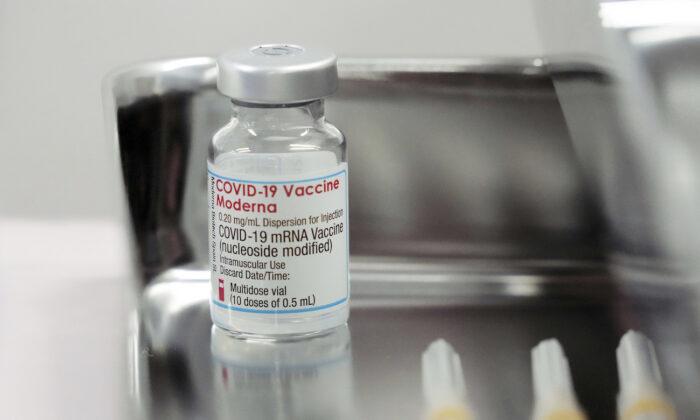
Moderna's COVID Vaccine 4 Times More Likely To Cause Heart Inflammation Than Pfizer's: Study

A study published in the British Medical Journal late Thursday suggests Moderna’s COVID-19 vaccine is up to four times more likely to cause heart inflammation—myocarditis or myopericarditis—than Pfizer-BioNTech’s COVID-19 vaccine.
“Vaccination with [Moderna’s vaccine] was associated with a significantly increased risk of myocarditis or myopericarditis in the Danish population,” and the rate was “threefold to fourfold higher” with the Moderna vaccine compared to the Pfizer-BioNTech vaccine, authors said in the study, which spanned almost 85 percent of Danes, or 4.9 million people aged 12 and older.
The increased risk of myocarditis or myopericarditis with the Moderna vaccine was “primarily driven by an increased risk among individuals aged 12-39 years,” said the researchers, from Denmark’s Statens Serum Institute.
The population-based cohort study, published Dec. 16 in the British Medical Journal (the BMJ), also corroborated previous studies and reports such as those from Israel and the United States that say there is an increased risk of myocarditis or myopericarditis with taking the mRNA-based Moderna or Pfizer vaccines.
Absolute Number of Cases ‘Low,’ Most Were ‘Mild’
Authors of the study wrote that the absolute rate of myocarditis or myopericarditis the mRNA-based vaccine “was low, even in younger age groups.
“The benefits of SARS-CoV-2 mRNA vaccination should be taken into account when interpreting these findings,” they added.
“Larger multinational studies are needed to further investigate the risks of myocarditis or myopericarditis after vaccination within smaller subgroups.”
In the study, researchers analyzed nationwide registers in Denmark that show the country’s population data on vaccination, hospital admissions, and results of laboratory assays of blood samples.
Within 28 days of vaccination, they found an absolute rate of myocarditis or myopericarditis for the Pfizer vaccine at 1.4 per 100,000 people (or about 1 case per 71,400), and for the Moderna vaccine at 4.2 per 100,000 people (or about 1 case per 23,800), according to the study results.
Most of the cases were “predominantly mild,” the authors wrote.
They noted that Pfizer’s vaccine “was only associated with a significantly increased risk among women,” which contrasts with results of studies from Israel and the United States. The discrepancy could be explained by the average age of the vaccinated population, the time span between the first and second shot, or because fewer Danes had tested positive for COVID-19, they said.
The authors also noted that the Pfizer vaccine was found “to be significantly associated with myocarditis or myopericarditis event when using a narrowed 14 day time window.”
In a statement, study author Anders Hviid said the findings of the study “do not generally overshadow the many benefits that come with being vaccinated.”
He added, “One must keep in mind that the alternative of getting an infection with COVID-19 probably also involves a risk of inflammation in the heart muscle.”
The researchers said they found both Moderna and Pfizer vaccines were associated with around a 50 percent reduced risk of cardiac arrest or death compared with unvaccinated people.
The observational study cannot establish any causal relationships, and there may be some sources of bias, such as increased public awareness of potential side effects of the mRNA-based vaccines that may have affected the results, the authors said.
In the United States, vaccine manufacturers are immune from liability for any adverse reactions unless there’s “willful misconduct” involved.
Health care providers who administer COVID-19 vaccines are required by law to report any serious adverse effects or vaccination administration errors to the Vaccine Adverse Event Reporting System (VAERS), hosted by the U.S. Department of Health and Human Services.