Asian stocks and U.S. equity futures rose Tuesday on wagers that vaccines can help tame the omicron virus outbreak and signs that President Joe Biden could yet revive his $2 trillion economic agenda.
MSCI Inc.’s Asia-Pacific share gauge snapped a two-session drop, bolstered by a rebound in Japan and a rally in Chinese property developers. S&P 500, Nasdaq 100 and European contracts were in the green, signaling stabilization after a global equity index dropped the most this month on Monday, Crude oil and iron ore pushed higher. In digital assets, Bitcoin held around the $47,300 level.
Turkey’s lira slipped in Asian trading, trimming some of Monday’s surge sparked by extraordinary government measures to bolster the currency.
In the latest virus developments, omicron accounted for 73% of all Covid-19 infections last week in the U.S. New Zealand is pushing back the phased reopening of its border until the end of February.
US After Hours MU +7% rises on earnings/guidance while ALDX -32% falls on results from Phase 3 TRANQUILITY trial
Nikkei +2.08% Hang Seng +0.93% CSI +0.64% Shanghai +0.85% Shenzen +0.95%
Eur$ 1.1280 CNH 6.3823 CNY 6.3743 JPY 113.67 GBP 1.3212 CHF 0.9217 RUB 73.9462 TRY 13.5420 WTI$ 69.35 +1.03% Gold 1,791.71 +0.05% BTC 48,750 +3.70% ETH 4,030 +3%
S&P +0.94% Nasdaq +1.30% EuroStoxx +1.64% FTSE +1.20% Dax +1.49% SMI
Macro :
- Infrastructure Stocks Slide After Manchin Rejects Biden’s Plan
- Infrastructure Stocks Slide After Manchin Rejects Biden’s Plan
- Omicron Now the Dominant Variant in U.S. at 73% of New Cases: AP
Keep an eye on :
Keep an eye on :
- AIR FP : Qatar Airways Issues Legal Proceedings Against Airbus
- BOL FP : Bollore Is in Talks to Sell African Logistics for $6.4 Billion
- BOL FP : Bollore Is in Talks to Sell African Logistics for $6.4 Billion
- CO FP : Casino, GreenYellow In Strategic Collaboration With Amazon AWS
- CTXS US : Elliott, Vista Are Said to Weigh Joint Bid for Citrix Systems
- COR PL : C. Amorim Says Implements EU11.6M Green Commercial Paper Program
- DBV GY : DBV Drops on Plan for New Phase 3 Study of Peanut Allergy Patch
- DKSH SW : DKSH to Acquire HTBA’s Distribution Business in Europe; No Terms
- DWNI GY : Deutsche Wohnen SE CEO Michael Zahn Resigns
- DRLCO DC : Maersk Drilling Makes Separate Unit for RigFlow, Seeks Investors
- EMR LN : Empresaria Sees Earnings Materially Ahead of Market Forecasts
- FSKRS FH : Fiskars Sells North American Watering Business to Lawn & Garden
- GVNV NA : EssilorLuxottica Holds About 99.84% of GrandVision
- IBAB BB : IBA, New Mexico Cancer Center Sign Contract for Proteus One
- KIT NO : Kitron Buys Danish EMS Provider BB Electronics for DKK600m
- M5Z GY : Manz: Britishvolt Order for Lithium-Ion Cell Assembly Equipment
- MRL SM : Merlin Management Denounces ‘Abusive’ Attempt to Control Firm
- MRL SM : Merlin’s Founder Fends Off Santander Bid to Unseat Him as CEO
- NKE US : Nike Sees 3Q Sales Rising at a Low-Single Digit Percentage
- NOVN SW : Novartis Treatment Granted Orphan Drug Status by FDA
- PHIA NA : Philips Gets Second Chance In Fight Over Anti-Piracy Tech
- SAN FP : Sanofi to Acquire Amunix for an Upfront Payment of About $1B
- SAN FP : Sanofi Ask Trade Agency to Block Spectrum’s Rolontis From U.S.
- SGRE SM : Siemens Gamesa Extends Revolving Tranche of Syndicated Credit
- GLE FP : SocGen Announces End of EU467.7M Share Buyback Program
- UBSG SW : UBS Says It Will Appeal $2 Billion French Tax Evasion Penalty
- VIE FP : Veolia’s Proposed Acquisition of Suez Not Opposed: ACCC
- VIFN SW : Vifor: Positive Outcome of Phase-IIIb Diamond Veltassa Trial
>>> Up
* Deutsche Boerse Raised to Buy at UBS; PT 165 euros
* ISS Raised to Buy at Handelsbanken; PT 145 kroner
* Straumann Raised to Outperform at Bernstein
>>> Down
* BillerudKorsnas Cut to Hold at ABG; PT 175 kronor
>>> Initiation
* Straumann Raised to Outperform at Bernstein
>>> Down
* BillerudKorsnas Cut to Hold at ABG; PT 175 kronor
>>> Initiation
* Kalera Rated New Buy at Roth Capital; PT 15 kroner
* Nordex Rated New Buy at Stifel; PT 20 euros
* Petrofac Coverage Dropped by Morgan Stanley
>>> Call
* Petrofac Coverage Dropped by Morgan Stanley
>>> Call
* Deutsche Boerse Upgraded at UBS as Cyclical Headwinds Abate
* TUI New Hold at Peel Hunt, Recovery Potential With Uncertainties
* TUI New Hold at Peel Hunt, Recovery Potential With Uncertainties
As China's Property Sector Continues Disintegrating, Much More Easing Will Be Needed
Evergrande's default may not have been a one-time "Lehman" event, but the painful, creeping consequences of China's property market getting hit - the single biggest asset class in the world...
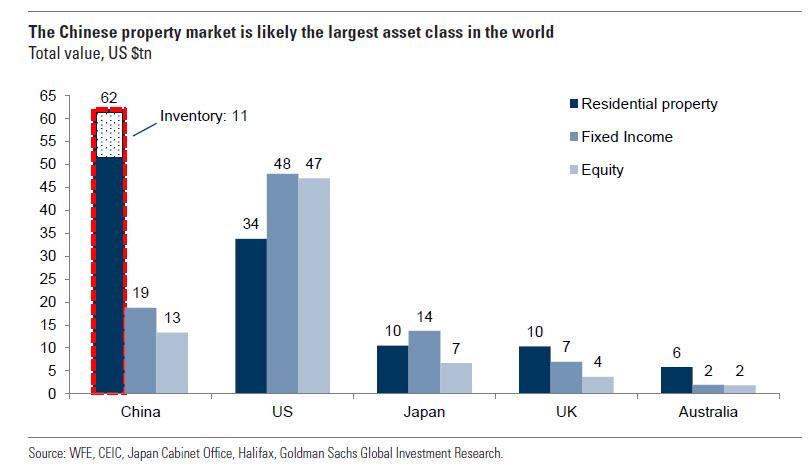
... will resonate for years in a slow, painful repricing - absent a major kick from the PBOC - and sure enough, Chinese property stocks tumbled close to a new five-year low - levels last seen in 2014 - after a series of asset sales underscored concern that equity investors will bear the brunt of losses as developers offload projects to repay debt (assuming defaults don't wipe out the equity tranche completely).
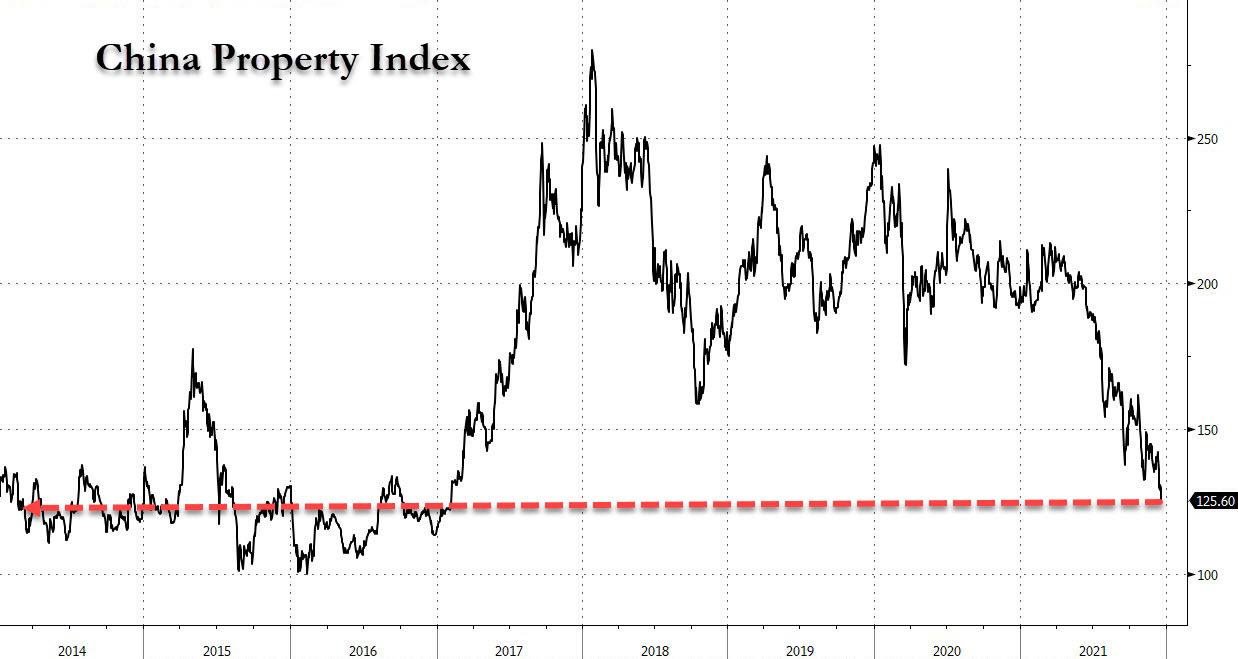
As Bloomberg reports overnight, Shimao Group Holdings agreed to sell stakes in a Hong Kong development at a loss while distressed property giant, Sunac China Holdings, unloaded assets in Shanghai as developers rush to raise cash. China regulators meanwhile signaled they will support “quality” real estate firms looking to buy assets from struggling rivals, according to a report.
An index of Chinese developers fell for the sixth day in seven, led by Sunac, which posted a record one-day decline of 18%. Trading in Chinese dollar bonds remained light during the seasonal end-of-year lull.
The plunge in developer shares means the richest bosses behind China’s real estate firms have lost more than $46 billion combined this year, according to the Bloomberg Billionaires Index. Evergrande founder Hui Ka Yan’s wealth alone has plunged by $17.2 billion.
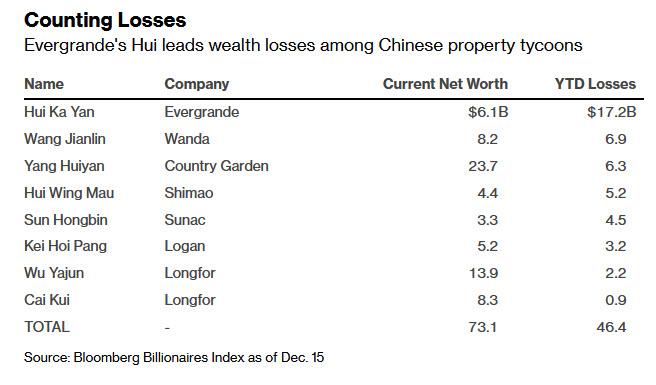
It's not looking good for a quick and painless rebound in the billionaire's net worth - here are some of the more notable recent developments, all of which paint a grim picture for China's developers:
- Evergrande Declared in Default by S&P for Failed Payments
Evergrande was labeled a defaulter by S&P Global Ratings, the second credit-risk assessor to do so after Fitch. S&P cut Evergrande to “selective default” Friday over its failure to make coupon payments by the end of a grace period earlier this month, a move that may trigger cross defaults on the developer’s $19.2 billion of dollar debt. S&P also withdrew its ratings on the group at Evergrande’s request.
Fitch Ratings was the first to declare the property developer in default on Dec. 9. Long considered by many investors as too big to fail, Evergrande has become the largest casualty of President Xi Jinping’s campaign to tame the country’s overindebted conglomerates and overheated property market. Concern has since spread to higher-rated firms like Shimao Group as liquidity stress intensifies.
- Evergrande Land Seized by Chengdu City on Lack of Development:
The local government in western China’s Chengdu city took two parcels back without repaying the developers, saying that Evergrande failed to start construction on time, according to Dec. 17 statements from a Chengdu land regulator (one could call this a partial nationalization of the now defaulted developer): one site, sized 83,997 square meters, was sold to a firm fully owned by by Evergrande’s onshore subsidiary Hengda Real Estate in 2010, according to a statement and corporate registry search platform Qichacha. Another site, sized 258,667 square meters, was sold to a developer in 2002 and transferred to another Hengda unit in 2011, according to a separate statement and Qichacha.
- China Offshore Bond Defaults Hit Record in December
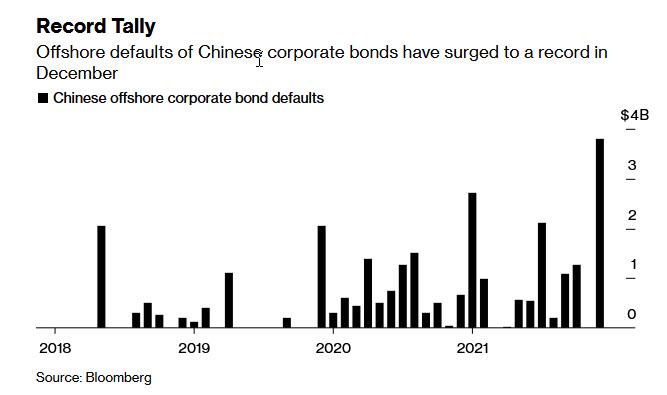
December is poised to be a record month for Chinese offshore corporate defaults after missed payments by indebted companies including China Evergrande and Kaisa Group Holdings Chinese firms have defaulted on a record $3.8 billion in offshore bonds so far this month, data compiled by Bloomberg show. The previous monthly high was in January when Chinese borrowers failed to repay $2.7 billion of such notes.
- China Regulators Encourage Property Acquisitions
China is ramping up support of the embattled real estate sector as growing stress in the industry threatens to deepen an economic slowdown (something we first discussed last month in "Beijing Capitulates: Urges Local Govts To Unleash Debt Flood As Cities Begin Backstopping Property Developers"). Authorities are encouraging banks to fund acquisitions of projects of distressed developers and pushing financially healthy property firms to make such purchases, the central bank-backed Financial News reported Monday.
China is also providing credit support to an economy showing strain from the property slump, with domestic banks on Monday lowering borrowing costs for the first time in 20 months. The move follows action by the People’s Bank of China earlier this month to cut the amount of cash banks must hold in reserve, freeing up 1.2 trillion yuan ($188 billion) of cheap long-term funds for lenders.
As Bloomberg notes, the support measures come as some developers such as Kaisa and Evergrande struggle to sell assets to raise cash and service mounting debts amid a crackdown on leverage in the industry. Meanwhile, after a relentless deleveraging property developer campaign which started a year ago with the three red lines, regulators have finally eased up on the clampdown in recent weeks, such as by encouraging stronger real estate firms to tap the onshore interbank bond market for financing.
- Kaisa Appoints Advisers; Shares Resume Trading
Kaisa has appointed Houlihan Lokey as its financial adviser and Sidley Austin as legal adviser after missing multiple offshore debt payments. The retention of the bankruptcy-focused financial adviser will evaluate Kaisa’s liquidity and explore all feasible solutions, the company said in a stock exchange filing on Monday. Kaisa said it hasn’t received any notice regarding acceleration of repayment by holders, and has been in talks with holder representatives about a comprehensive debt restructuring plan. That said, the hiring of HLHZ is a clear indication that a default is coming; Kaisa shares tumbled.
- Evergrande Backer’s Privatization Collapses
Chinese Estates Holdings Ltd. minority shareholders failed to give sufficient support to the company’s proposed privatization, derailing a plan by the long-time ally of Evergrande to delist next month. The stock plunged 30%. Among the 74 stockholders participating, 64 voted no and made up 10.8% of the shares among the investors, according to a stock exchange filing Friday. The Hong Kong real estate firm, owned by the family of billionaire Joseph Lau, announced plans in October to buy out investors at HK$4 a share. The stock last traded at HK$3.78 before being halted Friday afternoon ahead of the results. Chinese Estates requested a trading resumption and said its listing will be maintained.
- Shimao Sells Stake in Hong Kong Development Z
Shimao agreed to sell its 22.5% stake in three entities created for the Grand Victoria property development in Hong Kong for HK$2.1 billion ($270 million), according to an exchange filing. The buyers include entities owned by fellow developers SEA Holdings, Wheelock & Co. and Sino Land. Shimao expects to recognize a loss of about HK$770 million from the sale. Separately, Sunac China Holdings Ltd. sold three projects in Shanghai and Hangzhou for 2.68 billion yuan ($420 million), the 21st Century Business Herald reported, citing unidentified people.
* * *
Will all these adverse developments in mind, it is not only quite easy to understand why China cut its RRR last week, followed by a 5bps cut to its Libor, the Loan Prime Rate, but as Bloomberg notes, much more easing will be needed to revive China's market.
As a reminder, over the weekend Morgan Stanley predicted that China's credit impulse is due for a sharp rebound as a result of already implemented policy easing.

But the question is whether this isn't too little too late - as Bloomberg's Ye Xie puts it, markets have largely shrugged off the first cut in benchmark borrowing costs in 20 months in China. That in part reflects the fact that policy easing so far has been more measured. Even as the policy mix is becoming more market friendly, the bottom line is that the country needs credit growth to pick up more meaningfully. Here are some more observations from Xie:
- The combination of elevated inflation and renewed growth concerns from the spread of the omicron variant of Covid has complicated the job of policy makers around the world. While the Fed and other major central banks have shifted focus to taming inflation, markets are more nervous about the economic outlook. For instance, the market implied rate for the Fed’s benchmark in 2023 has declined since the FOMC meeting last week to about 1.25%, compared with the median forecast of 1.625% on the dot- plot.
- In contrast, Beijing, with less inflation pressure, is moving toward policy easing. Chinese banks cut the one-year LPR rate by 5 bps Monday, surprising most economists who had expected them to stay put. But market reactions were largely muted. Ten-year bond yields were little changed, while the CSI 300 declined 1.5%. What gives?
- For starters, while few economists had predicted the move, investors have been anticipating some policy easing since the central economic working conference earlier this month, when Beijing signaled that propping up the economy has become its top priority. The RRR cut in early December, plus a similar move in July, saved enough costs for banks to pass them on to borrowers. So the LPR cut did not exactly come out of the blue.
- The lenders held the five-year rate, which is tied to mortgage rates, steady. It signaled that Beijing may not intend to change overall control over the housing market, despite some recent policy fine-tuning. What’s more, the seven-day repo, a measure of interbank liquidity, has been stable. All of this suggests that the PBOC isn’t in a full-blown easing mode, yet.
- Historically, the stock, bond and currency markets’ performance has been mixed in the month following an LPR cut. As noted by Larry Hu, an economist at Macquarie Securities, cutting the rate is less important in China’s context, “where the monetary policy is more based on quantity than price.” In other words, the supply of money is more important than the price of money.
So as the world waits to see if the Fed will either taper its taper, or hint at far fewer rates hikes (if any) now that Biden's BBB plan isn't coming, and with it $1.75 trillion in fiscal stimulus is gone, China is already stepping on the monetary stimulus engine. It won't be alone, and we are confident that it is only a matter of time before Powell folds again. As for rampant inflation, it will take just one small change in the definition of CPI - one which is already on its way - to fix all that.
BioNTech CEO says vaccines alone not enough to fight Omicron
One of the scientists behind Pfizer-BioNTech’s COVID-19 shot said Monday that he believes vaccines alone will not be enough to fight the Omicron variant.
BioNTech CEO Ugur Sahin warned that other preventative measures need to be in place to stop the spread of the virus, especially with the emergence of the contagious variant.
“Even triple-vaccinated people can transmit the disease, and they will have to be tested, especially around vulnerable people,” Sahin told French newspaper Le Monde.
“With the Omicron variant becoming dominant, protective measures will remain essential, especially this winter.”
Sahin said the German company is working on an adapted version of its vaccine tailored to Omicron that could be available by March.
He predicted that those who have received the original Pfizer-BioNTech vaccine and its booster will see a drop in efficacy against Omicron after a certain amount of time.
Sahin said he’s waiting for more data to confirm the findings of a German study that suggested the vaccine’s efficacy against the virus dropped about 25 percent after three months, even after three doses.
“There will be a loss of effectiveness against Omicron over time, it is very likely, but we still have to measure the speed,” he said.
“It’s obvious we are far from the 95 percent effectiveness that we had against the initial virus. But after the third injection our vaccine seems to provide 70 percent or 75 percent protection against any form of the disease, which is still a good result for a vaccine in general — and I think we will be well beyond that for severe forms,” he continued.
Dutch vow to be EU’s locomotive rather than brake
Pro-European turn by new coalition government reflects shifting consensus about EU’s role
The same four parties. The same premier. Probably mostly the same ministers. Yet the fourth ruling coalition led by liberal Mark Rutte has struck a decidedly different tone when it comes to the Netherlands’ place in the EU. The new coalition agreement suggests The Hague will no longer act as a brake on the EU but as a locomotive. Rutte, who often relished his casting as Europe’s Mr No, now intends to be in the vanguard of European integration.
The Hague’s newly hatched enthusiasm for Europe bears the imprint of D66, the left-liberal pro-European party that was the big winner in the election. The big losers were the more Eurosceptic Christian Democrats. Rutte’s authority was weakened by the benefits scandal that brought down his third government and, chameleon-like, has an opportunity to reinvent himself.
But the new Dutch position is also a reflection of how geopolitical uncertainty, the pandemic and Britain’s Brexit mess have “reinforced the need for solidarity and collective action” within the EU, says Catherine de Vries, professor at Bocconi University.
The parsimonious Dutch who like to lecture other EU governments about fiscal discipline are turning on the spending taps. The incoming government will boost expenditure on housing, education, childcare and defence. It is creating a fund to finance decarbonisation worth a cumulative 4.3 per cent of gross domestic product and another one for rural diversification (including closing down polluting intensive farms) worth 3.1 per cent. Extra borrowing will push Dutch debt just above the 60 per cent EU limit. It is hardly the same category as Italy (155 per cent) or Greece (206 per cent), but the limit no longer seems sacrosanct. The agreement amounts to a “farewell to frugality”, according to Marcel Klok, senior economist at ING.
The four coalition parties now say they are open to the “modernisation” of the EU’s fiscal rules as long as its promotes fiscal sustainability and economic convergence. It is vague, but in line with the slightly more flexible approach promised by the new German coalition government.
After Britain’s departure from the EU, The Hague acted as ringleader of the so-called frugal states opposed to big EU spending, greater risk-sharing or any watering down of the bloc’s fiscal rules.
Rutte’s fourth administration also wants to become an advocate of deeper integration, such as ending national vetoes in foreign policy, strengthening the role of the European parliament and creating EU-wide carbon and digital taxes. Where a sub-set of EU capitals wants to pursue an initiative, the Dutch want to be in the vanguard.
The new Dutch stance is its second readjustment to post-Brexit Europe. The first was its leadership of an informal group of free-trading, economically liberal, fiscal hawkish governments, dubbed the New Hanseatic League, who needed to team up to defend their interests in place of their powerful British ally. The group shrunk to a hard core of frugals to try to block the EU dishing out recovery fund grants financed by common debt.
The New Hanseatic League made sure small countries were listened to in the EU, says de Vries. But the Dutch started to ask “could you gain more by being constructive and not being some naysayer”. However, she cautions that the strong strain of Euroscepticism in Dutch politics has not disappeared.
Pepijn Bergsen of Chatham House doubts there will be a fundamental Dutch shift on EU fiscal policy, but says the new coalition deal reflects a “slowly shifting consensus” on other areas of EU policy.
The coalition agreement is peppered with references to EU “strategic autonomy” and how it should use its economic power strategically through investment screening, level-playing field instruments and smart industrial policy.
“The Netherlands used to be this last stalwart of neoliberal, free trade, light-touch government thinking,” says Rem Korteweg of Clingendael, the Netherlands Institute for International Relations. “Even the Dutch are moving to a more confrontational, even protectionist-light approach to international economic affairs.” The Dutch are sounding a little less Dutch and a little more French.
Non-fungible tokens: tax enforcers circle as evasion risks mount
Authorities will not be prepared to overlook a market that is expected to grow to more than $75bn in the next four years
The popularity of non-fungible tokens (NFTs) soared in 2021. Multimillion-dollar sales of the blockchain-based ownership certificates featured everything from an autographed tweet to virtual sneakers. Not everyone is impressed. The steep carbon footprint of the digital assets irks environmentalists; their opacity worries those combating money laundering and tax evasion.
The art market already provides opportunities to launder money. Secrecy is pervasive, a US Senate report found last year. But the difficulty of transporting and storing art does not apply to NFTs. By buying and reselling NFTs, criminals can move coins linked to illicit activities into wallets unrelated to them.
Sales of individual NFTs at record prices are too high profile to be suspect. But tax authorities do not have a good grip on the NFT market. It is worth $14bn this year and growing fast, according to Jefferies. NFTs were invisible by design, said Internal Revenue Service boss Charles Rettig earlier this year, as he warned that cryptocurrencies were contributing to a $1tn yearly shortfall in US tax revenues.
The tax rules need to be better defined. Most tax authorities consider cryptos a type of property, like stocks or paintings, so tax can be levied on gains. But there are arguments about which jurisdiction should have taxing rights. There is also debate over which NFTs should be taxed. The latest global money laundering guidelines only target NFTs with investment or payment applications.
Tax authorities need better data. The largest revenue grab in President Joe Biden’s infrastructure act — estimated to raise $28bn over a decade — includes rules requiring brokers to disclose crypto transactions, potentially including those involving NFTs. Controversially, this could drive blockchain projects offshore. A new bill is trying to water down the reform.

Tax collection was always likely to pose difficulties for an industry with libertarian roots. But revenue authorities will not be prepared to overlook a market that is expected to grow fivefold to more than $75bn over the next four years. Nor should they, given the opportunities for evasion that NFTs present.
closing Stock Market SummaryThe S&P 500 fell 1.1% on Monday amid pestering growth concerns, although the benchmark index was down as much as 1.9% intraday. The Nasdaq Composite (-1.2%) and Dow Jones Industrial Average (-1.2%) both declined 1.2% while the Russell 2000 lagged with a 1.6% decline.
Growth concerns were driven by new COVID restrictions in Europe, word from Senator Manchin (D-WV) that he won't support the $1.75 trillion Build Back Better Act, and a view that the Fed could be tightening policy at an inopportune time next year.
Sellers maintained control of the market until shortly after the close of European markets (11:30 a.m. ET). Buyers stepped in, spying a good entry point with the S&P 500 trading below its 50-day moving average (4608) and down as much as 4.3% from its intraday high last Thursday.
The S&P 500 still closed below that key technical level, but two of its 11 sectors did sneak into positive territory, namely utilities (+0.1%) and consumer staples (+0.04%). The cyclical financials (-1.9%), materials (-1.8%), industrials (-1.7%), and consumer discretionary (-1.7%) sectors closed sharply lower.
Moderna (MRNA 276.38, -18.42, -6.3%) fumbled a 9% gain, and closed lower by 6%, even though the company announced encouraging preliminary data for its COVID-19 booster shots. Oracle (ORCL 91.64, -4.98, -5.2%) fell 5% on confirmation of its acquisition of Cerner (CERN 90.49, +0.72, +0.8%) for $95.00/share in cash, or approximately $28.3 billion in equity value.
Elsewhere, a steepened Treasury yield curve signaled a more constructive perspective. The 10-yr yield increased two basis points to 1.42% after trading at 1.35% overnight. The 2-yr yield decreased two basis points to 0.62% amid a view that the Fed could still lean cautiously next year given the economic uncertainty of the Omicron variant.
WTI crude futures fell 3% ($68.66/bbl, -2.27, -3.2%) on expectations for weaker demand amid tighter economic restrictions. The U.S. Dollar Index decreased 0.1% to 96.51. The CBOE Volatility Index closed higher by 6.0% at 22.87 after topping 27.00 intraday.
Monday's economic data was limited to the Conference Board's Leading Economic Index (LEI), which increased 1.1% in November ( consensus 1.0%) following a 0.9% increase in October. Looking ahead, investors will receive the Currant Account Balance for the third quarter on Tuesday.
- S&P 500 +21.6% YTD
- Nasdaq Composite +16.2% YTD
- Dow Jones Industrial Average +14.1% YTD
- Russell 2000 +8.3% YTD
After Hours Summary: MU +7% rises on earnings/guidance while ALDX -32% falls on results from Phase 3 TRANQUILITY trialAfter Hours Gainers:
Companies trading higher in after hours in reaction to earnings/guidance: MU +6.7%, BRZE +5.9%, NKE +3.7%
Companies trading higher in after hours in reaction to news: ACAD +5.2% (announced plans to resubmit sNDA for NUPLAZID), PSN +4.1% (awarded $38 mln Army task order), FTAI +2.7% (submitted documentation with respect to potential spin-off of infrastructure business), HAYW +2% (approved new $450 mln stock repurchase program), BDSI +1.8% (announced favorable opinion in patent litigation against Alvogen Group), JBL +1.3% (announced new manufacturing partnership with Carnival [CCL]), AMGN +1.3% (announced FDA approval of OTEZLA as treatment for plaque psoriasis)
After Hours Losers:
Companies trading lower in after hours in reaction to earnings/guidance: CVGW -2.7%
Companies trading lower in after hours in reaction to news: ALDX -32% (announced top-line results from Phase 3 TRANQUILITY trial in dry eye disease; primary endpoint of ocular redness was not met), CTMX -19.8% (announced preliminary results from Phase 2 expansion study of CX-2029 in patients with sqNSCLC or HNSCC), DBVT -14.8% (announced plans to initiate new Phase 3 clinical study for modified Viaskin Peanut patch and to withdraw the MAA for Viaskin Peanut in Europe)