>>> Europe : Brokers Upgrades & Downgrades - 17th of January 2022

>>> Up
* Admiral Raised to Hold at HSBC; PT 3,150 pence
* Andritz Raised to Overweight at Morgan Stanley
* BE Semiconductor PT Raised to 96 euros at Deutsche Bank
* Gulf Keystone Raised to Buy at Berenberg; PT 280 pence
* Kesko Raised to Hold at Handelsbanken; PT 27.50 euros
* Pandora Raised to Hold at SEB Equities; PT 800 kroner
* Sabadell Raised to Buy at HSBC; PT 85 euro cents
* Schindler Raised to Overweight at Morgan Stanley
* Synlab Raised to Overweight at Barclays; PT 25 euros
* UK Commercial Property Raised to Add at Peel Hunt

>>> Down
* Ageas Cut to Hold at HSBC; PT 52.50 euros
* Aker BP Cut to Sell at Berenberg; PT 255 kroner
* Alfa Laval Cut to Underweight at Morgan Stanley; PT 300 kronor
* Big Yellow Group Cut to Reduce at Peel Hunt
* Blue Prism Cut to Hold at HSBC; PT 1,275 pence
* EDF Cut to Hold at HSBC; PT 10 euros
* Electrolux Cut to Hold at Handelsbanken; PT 230 kronor
* Hiscox Cut to Hold at HSBC; PT 990 pence
* Legrand Cut to Equal-Weight at Morgan Stanley
* McKay Securities Cut to Hold at Peel Hunt
* National Grid Cut to Hold at SocGen; PT 1,080 pence
* Safestore Cut to Hold at Peel Hunt
* S Immo Cut to Hold at Raiffeisen Bank; PT 24 euros
* Supermarket Income Cut to Hold at Peel Hunt
* TUI Cut to Reduce at AlphaValue/Baader
* Unilever Cut to Underperform at Bernstein
* Unilever Cut to Equal-Weight at Barclays; PT 4,600 pence

>>> Initiation
* Link Mobility Group Holding Rated New Buy at Handelsbanken

>>> Call
* Berenberg ‘Broadly Positive’ on Oil Stocks, AkerBP Cut to Sell
* Henkel Raised at Morgan Stanley on ‘Deep’ Valuation Discount
* Danish Shipping Firms See 2022 Sales Topping Last Year’s: JP

>>> What to look at today - 17th of January 2022

Stocks were mixed Monday as traders weighed a global advance in sovereign bond yields and policy easing by China’s central bank to counter a slowdown in the nation’s economic expansion. Shares in China and Japan posted modest gains but Hong Kong equities dipped. S&P 500 and Nasdaq 100 futures fell, while European contracts climbed. U.S. stock and bond markets will be shut Monday for a holiday. The People’s Bank of China exceeded market expectations for stimulus by cutting two key policy interest rates ahead of a report showing economic growth slowed last quarter to 4%. A real-estate slump and partial Covid shutdowns are among the challenges for the world’s second-largest economy. China’s outlook, tighter Federal Reserve monetary policy to fight high inflation and the omicron virus strain are coloring sentiment. Billionaire investor Bill Ackman said the Fed should raise its key interest rate by a bigger-than-expected 50 basis points in March to “restore its credibility.” The start of the earnings season has also put the focus on corporate profits and whether they can help arrest a retreat in global equities led in part by a slide in U.S. technology shares. Meanwhile, oil extended its rally. High prices are justified and futures could rise even further, according to Vitol Group, the world’s biggest independent crude trader. Among cryptocurrencies, Bitcoin slipped below $43,000.

Nikkei +0.74% Hang Seng -0.90% CSI +0.77% Shanghai +0.54% Shenzen +1.41%

Eur$ 1.1419 CNH 6.3524 CNY 6.3467 JPY 114.41 GBP 1.3679 CHF 0.9143 RUB 76.2687 TRY 13.5442 WTI$ 84.08 +0.31% Gold 1,819.35 +0.08% BTC 42,390 -1.65% ETH 3,245 -1.10%

S&P -0.16 Nasdaq -0.32% EuroStoxx +0.32% FTSE +0.29% Dax +0.43% SMI +0.10%

Macro :
- Goldman Already Raised 2022 Junk Default Estimate: China Today
- France’s Dussopt Says Recovery Helped Cut 2021 Deficit: JDD
- Bitcoin Options Shift Has Some Bulls Calling $40,000 the Bottom
- Betting Against the U.K. Is a Favorite Trade in Currency Markets
- China Home Market Slump Deepens as Prices Fall for Fourth Month
- Goldman’s Most Elite Rank to Get Millions in Special Payouts
- Italy Bans Truffle Hunting After Swine Fever Outbreak Poses Risk

Keep an eye on :
- AIR FP : Airbus Space Business Sales Rise Over 10% in 2021: Les Echos
- AAPL US : Apple to Pay Higher Prices for TSMC’s N4P Chips: Comm. Times
- BAS GY : Macron to Unveil Over EU4B of Foreign Investment: Les Echos
- CRG IM : Carige Opens Data Room to Bper for Possible Takeover
- CTXS US : Citrix Is Said to Be in Advanced Talks for Elliott, Vista Buyout
- EDF FP : France’s Nuclear Champion Sacrificed to Stave Off Energy Crisis
- EQNR NO : Equinor, BP Finalize Wind Agreements W/ New York Authority
- ETL FP : Eutelsat, KPN Picked as Top Takeover Targets in Europe: Survey
- FRA GY : Fraport Dec. Frankfurt Airport Passengers +204.6%
- G IM : Former Cassa Depositi CEO Said to Advise Caltagirone on Generali
- GFJ1 GY : GFJ ESG Acquisition I Seeks to Combine With Tado
- GSK LN : Revealed: Unilever bids £50bn for GSK’s consumer empire
- GSK LN 2%: Unilever Is Said to Weigh Raising Offer for Glaxo Consumer Unit
- HEIA NA : Dutch Trade Union Suspends Strikes at Heineken Breweries
- IRE IM : Iren to Buy Italy’s Largest Photovoltaic Plant
- KPN NA : Eutelsat, KPN Picked as Top Takeover Targets in Europe: Survey
- LLOY LN : Lloyds Set to Announce ~GBP1b Buyback, Daily Mail Says (Jan. 15)
- MARS Inc : Mars Said to Buy Direct-to-Consumer Pet-Food Brand Nom Nom
- MOWI NO : Mowi Prelim 4Q Ebit About EU146M
- NORSE NO : U.S. Approves Norse Atlantic Airways’s Transatlantic Flights
- NOVOB DC : Novo Nordisk Says Securities Lawsuit Settled Without Payments
- RHK GY : Rhoen Klinikum in Pact With Hesse on Investment Subsidies
- SANT GY : S&T Sees 2022 Ebitda Margin 10%
- WAF GY : Siltronic Casts Doubt on $5.3 Billion GlobalWafers Takeover
- SRAIL SW : Stadler Gets Up To EU4B Rail Contract, Its Largest Ever
- TEL NO : Telenor Group to Sell 51% Stake in Wave Money to Yoma for $53m
- UNA NA : Revealed: Unilever bids £50bn for GSK’s consumer empire
- UNA NA : Unilever Is Said to Weigh Raising Offer for Glaxo Consumer Unit
- VIFN SW : Saudi Pharma Signs Pact With Vifor Pharma on Ferinject Injection
- VOW GY : VW May Sell Majority Stake in Battery Cell Business: F.A.S.
- VOW GY : VW to Expand China EV Capacity to 900,000/Yr in 2023: Welt

(ZH) Leveraged Trading Is Not The Source Of Recent Crypto Weakness: So What Is?

Leveraged Trading Is Not The Source Of Recent Crypto Weakness: So What Is?

By Marcel Kasumovich, One River Asset Management head of research
Macro narratives are driving digital asset sentiment, from asset swings to regulatory decisions. This alone speaks to a maturing ecosystem – investors want the macro story. But digital asset volatility has been mostly uncorrelated to other macro markets in the recent past. It is more about a shift in investor behavior.
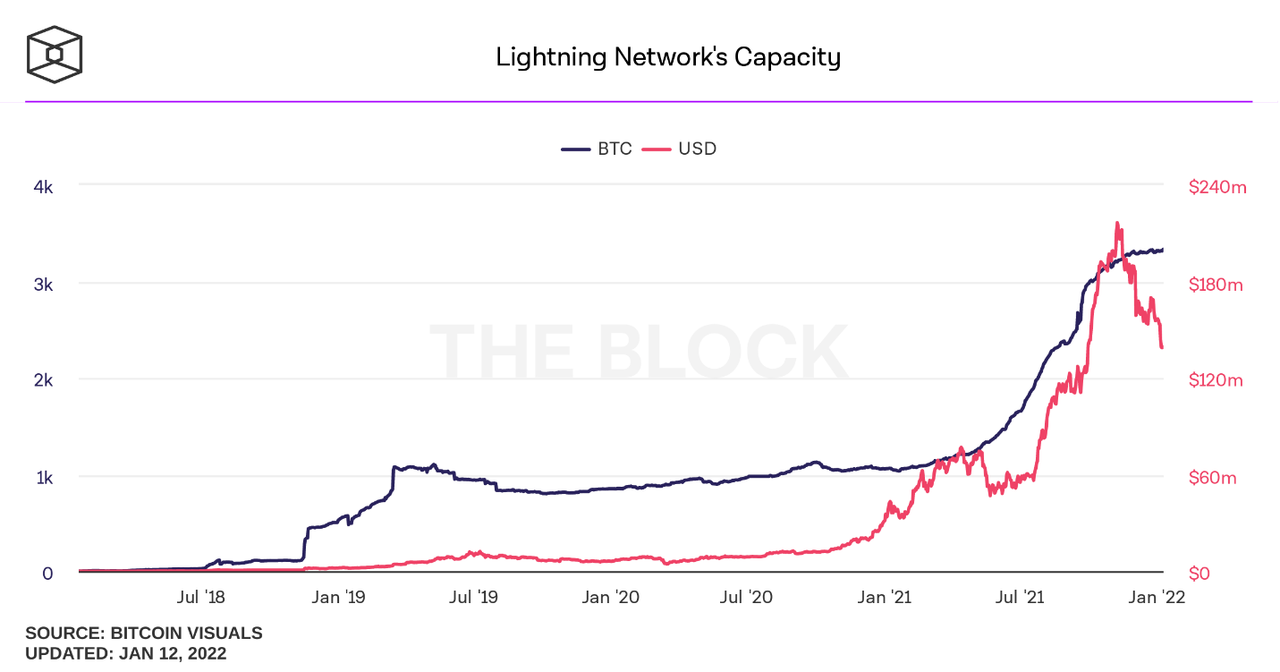
1/ As digital assets enter the mainstream, market commentary focuses on price. And in a world where exchange rate volatility is near all-time lows, attention has naturally shifted to digital assets where volatility against the US dollar is breathtaking by comparison. The megatrend towards the digitalization of finance will not be defined by the shorter-term gyrations. The innovation happening more behind the scenes will dictate the secular formations. Recent advancements in the Lightning Network illustrate the quiet determination to digitalize finance.

2/ The Lightning Network was proposed in 2015 as a way of scaling smaller payments, able to accommodate billions of transactions in a second (here). It addressed the tiring argument of Bitcoin’s inefficiency head-on. And after a slow start, user adoption surged last year with a 3-fold rise in network capacity (Figure 1). It is also integrating into the regulatory mainstream. This week, Bottlepay, a payment provider built on the Lightning Network, was approved by the UK Financial Conduct Authority. These new technologies can hold up to regulatory standards including anti-money laundering (here). It is a powerful example of technologists and regulators working together to encourage innovation in a complacent legacy system.
3/ Innovation may drive the megatrends, but investors are still left to manage and explain portfolio volatility from digital assets. And just as digital innovation is garnering more institutional attention, so too are the narratives around the volatility of digital assets. Investors are looking for macro thematic narratives, including the sharp downturn since November and the abrupt decline to start the year. Explanations center on the downturn in inflation expectations, the Fed pivot toward faster rate hikes and balance sheet normalization, as well as the decline in growth stocks tied to the rise in real interest rates. The high correlation of bitcoin returns to inflation expectations last year (56%) reinforces a desire to put a tidy macro narrative to the digital ecosystem.
4/ But the analytics tell a different story. We run a simple empirical exercise to evaluate bitcoin returns as explained by three macro factors: market-based inflation expectations (5y5y inflation swaps), the inflation-adjusted terminal policy rate (5y5y overnight interest rate swap less 5y5y inflation swaps), and Nasdaq 100 equity returns. These factors only explain 10-45% of the variation in bitcoin over the past two years and with various representations of the data. More importantly, there is almost no relevance of these factors in explaining the bitcoin downturn since November. Those factors would imply a bitcoin price of 50-60k, much higher than the current price.
5/ What does that mean for investors? Digital assets volatility has been largely independent of macro factors in the recent past. To be sure, the independent volatility that most investors hope for is skewed to the upside. But in assets where volatility expectations have ranged from 55% to 158% in the past two years, there will be plenty of periods where idiosyncratic moves detract from a portfolio. The test for any investor is asking about the structural trends. What tokens will prosper with the digitalization of finance? How broad will token pluralism extend? If the answers to the structural questions are positive, then downside volatility should be met with programmatic rebalancing into digital assets.
6/ Of course, idiosyncratic volatility is not satisfying. It is a polite way of saying we need to dig deeper for an explanation. What is behind the swings in digital assets if the macro narrative falls flat? The hunt for the explanation is partly a process of elimination and partly identifying new patterns of behavior. There are three key elements of the market microstructure of interest.
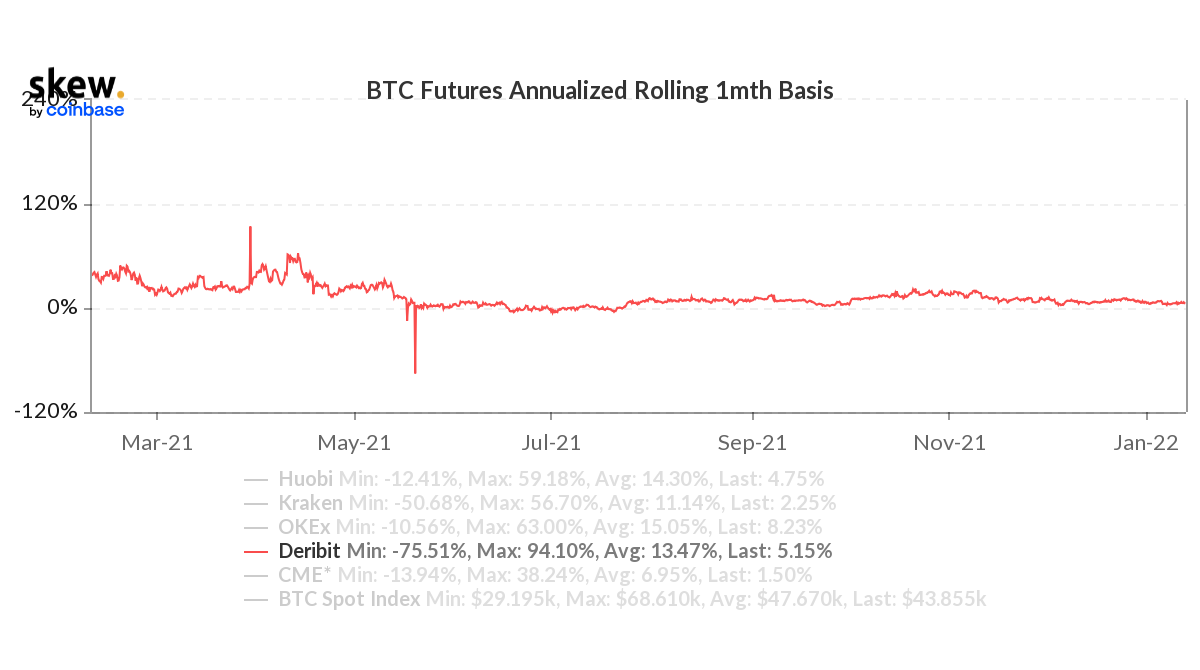
7/ First, the bitcoin forward yield curve has been stable, indicating leveraged trading is not a source of downside volatility. Figure 2 illustrates the one-month annualized yield implied by bitcoin futures on the Deribit exchange, where leverage is more readily available to traders. A rise in speculative demand leads to higher forward bitcoin prices and higher implied yields (vice versa). In periods of excess leverage, forward prices fall more than spot as speculative traders forced to close positions at unfavorable prices. Last May, one-month yields fell to an annualized –75%, reflecting a costly, steep inversion of the forward curve to speculative long traders. On this downturn, the compression in yields is barely visible.
8/ Second, option markets have decoupled from previous correlations to spot prices, with declining volatility expectations. The one-week implied volatility on Ether is 70%, near the lows of the past year (Figure 3). Ordinarily, declines in spot prices, particularly severe ones, would have seen a surge in volatility expectations. However, volatility is low despite a sharp decline in spot prices. The same pattern is evident in 25-delta put-call volatility skew. The one-week skew in Ether options is only marginally positive, near the average of the past year. This is strongly counter to past downturns in spot prices, where option skew spiked well above 40%! Again, leveraged trading is not the source of the recent price weakness.
9/ Third, a rise in the dispersion of digital asset prices hints at a change in investor behavior. We illustrate this point with a unique parsing of the data based on the last two downturns: May 8, 2021 and Nov 9, 2021. Dispersion is measured by the median difference between the individual returns on the 12 assets of our Core Index and bitcoin returns. When Index asset returns are evenly dispersed around bitcoin returns, the measure is zero. The one-month dispersion in the latest downturn measures near-zero (–0.4%). This is vastly different from May 2021, where the one-month dispersion index measured –9.1%. Index assets exhibited higher beta to the bitcoin downturn. No doubt, two cyclical periods don’t make a trend, but it does call for attention.
10/ Market behavior is bifurcating. It is evident in futures markets, where the decline in yields has been greater in regulated markets (CME) than in unregulated ones (Deribit). It is evident in active supply, where the percentage of longer-term holders has dropped alongside a more-than 20% fall in large-value bitcoin addresses (greater than $10mn). It is evident in the surge of interest in venture applications (here). Investors focused on macro narratives have mattered more than leveraged traders. And it is these ebbs and flows that should remind investors that we are at the very early stages in the digitalization of finance. It is precisely in those imperfect, inefficient early stages where megatrend assets are most additive to a portfolio.
Figure 1 – Lightning Network Capacity Surge, Adoption Rising
Figure 2 – Bitcoin Futures’ Yield Stable, No Sign of Speculative Excess
Figure 3 – Ether Volatility Low Despite Declining Prices

(ZH) Morgan Stanley: As The Fed's Balance Sheet Runoff Begins, The Withdrawal Of

Morgan Stanley: As The Fed's Balance Sheet Runoff Begins, The Withdrawal Of Liquidity Will Have Profound Impacts

By Vishwanath Tirupattur, head of Quantitative Research at Morgan Stanley
The Devil Is in the Details
The first two weeks of the year have reinforced the key message from our 2022 Strategy Outlook – the policy training wheels are indeed coming off, and fast! The hawkish shift in the minutes of the FOMC’s December meeting, reinforced by the rhetoric from a number of Fed officials, signals policy tightening through more hikes. They are coming sooner than expected, and the timeline between the first rate hike and the beginning of balance sheet runoff will be compressed. Our economists now expect the Fed to deliver four 25bp hikes this year, at its March, June, September,and December meetings, in addition to an August start for the balance sheet runoff announced last July. Market pricing already reflects this hawkish shift, with the March liftoff nearly fully priced in along with 3-4 hikes in the subsequent 12 months.

Given the size of the Fed’s balance sheet (US$8.2trillion, consisting of US$5.6 trillion in Treasuries of varying maturities and US$2.6 trillion of agency MBS), the runoff has important market implications. However, quantifying its impact is far from straightforward. One could look to the balance sheet expansion in the post-GFC years with the view that if the buildup lowered interest rates, the runoff should have the opposite effect. A rule of thumb (with a lot of handwaving) suggests a 4-6bp change in the 10-year interest rate from a US$100 billion change in the balance sheet. However, we would argue that the market effects are unlikely to be symmetric and a simple sign reversal between the buildup and the runoff ignores the complexity of the modalities. We expect different impacts for Treasuries and agency MBS, given the different ways they were acquired during the buildup and the share of the Fed’s holdings in their respective markets.
During the balance sheet buildup, Treasury securities were predominantly acquired through the US Treasury’s new issue process. The Fed consciously decided how much duration to take out of the market by picking securities with varying maturities. In contrast, we expect the balance sheet runoff to be implemented by allowing securities to mature without reinvestment. That means the impact on the yield curve depends on how the Treasury responds to its increased issuance needs as the Fed decreases its Treasury holdings. Our interest rate strategists estimate that US Treasury issuance needs will rise by ~US$850 billion by the end of 2023and ~US$1,300 billion by the end of 2024. If we assume that the Treasury follows the advice of the Treasury Borrowing Advisory Committee, the optimal targets for increased issuance would be at the 7-year and 10-year points of the yield curve. Consequently, our strategists now forecast 10-year rates to reach 2.30% by the end of 2022.
The story with agency MBS is quite different. Agency MBS were purchased in the secondary market,and we expect their runoff to come through paydowns resulting from prepayments and amortizations of the underlying mortgages. Since the Fed has been a non-price-sensitive and programmatic buyer, the Fed's portfolio of agency MBS would have received faster-prepaying mortgages (cheapest-to-deliver, in mortgage parlance). In addition, Fed holdings constitute a much larger share of the outstanding agency MBS market than of the Treasury market, hence the runoff will have a greater negative impact on agency MBS. In 2021, the Fed bought US$575 billion of agency MBS versus net issuance of US$875 billion, resulting in US$300 billion of MBS that the market absorbed. Our agency MBS strategists project that in 2022 the runoff will remove US$15 billion from the Fed’s balance sheet against projected net issuance of US$550 billion, implying that the market needs to absorb US$565 billion in mortgages, the largest amount of mortgages the private market would ever digest. What’s more, the market will have to find a more price-sensitive buyer for the cheapest-to-deliver mortgages. Putting it all together, the balance sheet runoff clearly will have more impact on agency MBS than other asset classes.
Of course, the markets have already begun to price in some of these effects,as mortgage spreads have widened about 20bp in the last two weeks. Still, our agency MBS strategists have advocated being short the mortgage basis for some time,and they think there is still room for modest widening (~10bp) in the mortgage basis from here, with mortgage rates rising towards 4%.
Do not underestimate the effects of liquidity withdrawal. The mammoth balance sheet the Fed has built up was a key determinant of liquidity across markets. As balance sheet runoff is put into motion, the withdrawal of liquidity will have profound impacts. Determining how it plays out is far from straightforward and will be determined by a variety of factors. Understanding the details matters. So hold on tight – there’s volatility ahead.

(ZH) Crypto Options Suggest Bitcoin Bottom Is In As Hash Rate Hits Record High

Crypto Options Suggest Bitcoin Bottom Is In As Hash Rate Hits Record High

After two months of brutal, constant pain for crypto longs on the back of fears the Fed is about to yank the punchbowl and drain enough liquidity to end the party (at least until the next recession and market crash, when the Fed will double-down on easing, launch NIRP, buy equity ETFs and upgrade helicopter money to tactical money ICBMs, finally sending all cryptos to the moon and beyond), the tide may finally be turning at least according to the options market.
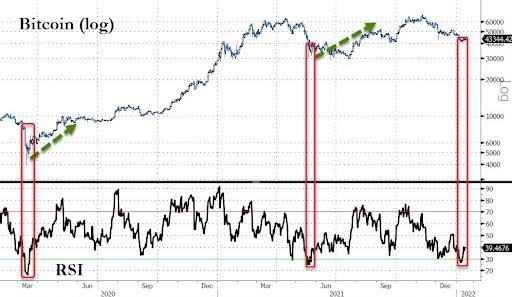
After bitcoin suffered its biggest drop since May 2021 as it tumbled more than 40%, sending the price to the most oversold level since the covid crash - traditionally a failsafe bullish indicator...

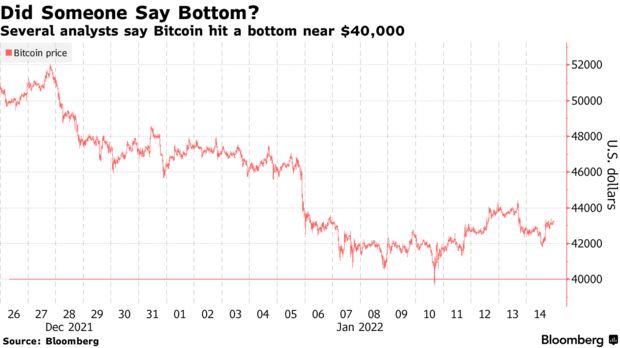
.... the world’s largest cryptocurrency rebounded this week after falling below $40,000 for the first time since September on Monday and has bounced as much 10%, just as we said last weekend it would.
In short, Bitcoin appears to have stabilized, and options activity suggests investors believe the test of $40,000 - a critical support level below which Mike Novogratz said last week is where he would buy more (and appears to have done just that)...
... is over, and more upside is ahead, according to Genesis Global Trading including Noelle Acheson.
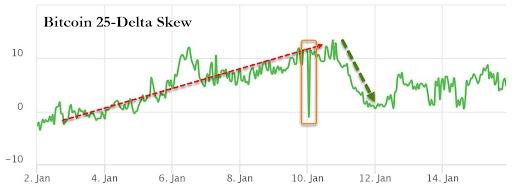
For one, the skew - or difference in implied volatility of bullish and bearish bets - has recently dropped from double-digits to near zero, and revealed a decrease in investor demand for put options and an increase for call options, Genesis data show.
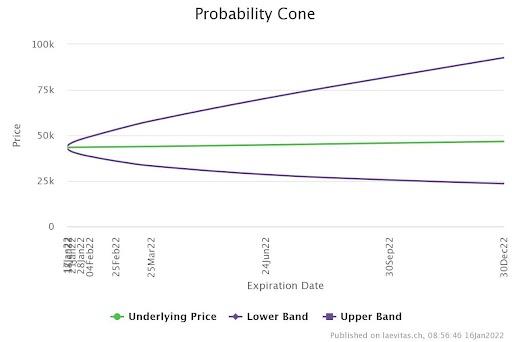
“That shift in preference may be bullish for the price of BTC, all else equal,” Acheson added, and indeed a look at the option-implied probability cone shows an upside target just shy of $10,000..
It's not just option traders and billionaire investors who see $40,000 as a bottom- it is a view echoed by many analysts in the famously optimistic world of crypto. Quoted by Bloomberg, Martin Gaspar and Katherine Webb at CrossTower said in a Friday note that Bitcoin’s reserve risk, a measure of confidence of long-term BTC holders, is currently lower than it was at the coin’s last bottom in July 2021, and now stands in the “buy” zone, which could give “more weight to the indication that this is a bottom.”
The $40,000 level “has been the key pivot point,” said Bloomberg Intelligence’s famously bullish crypto analyst, Mike McGlone. Up next, $50,000 comes into play before Bitcoin resumes its upward trend toward his forecast of $100,000, he said.
“Demand and adoption are increasing and supply is declining,” McGlone said. “Something has to reverse the increasing Bitcoin adoption trend or the rules of economics point to higher prices. I expect demand and adoption trajectories to remain favorable.”
McGlone isn’t alone in his calls for Bitcoin to more than double from current levels. According to Bloomberg, Jonathan Padilla, co-founder of Snickerdoodle Labs, a blockchain company focused on data privacy, expects Bitcoin to hit that level by the end of 2022, and also said that $40,000 is likely a floor, given the level of institutional capital he expects to flow into the market this year.
“The institutional nature is dramatically different from the primarily retail focus in 2017, 2018,” Padilla said. “That shows the strength of institutional buying and the demand from the long-term perspective.” Of course, this cuts both ways, because when institutions are deleveraging, they dump those assets first that have outperformed in 2021 - such as cryptos - which is also why crypto's correlation to risk assets has exploded as institutional adoption has grown.
David Tawil, president of ProChain Capital, was ready to watch the $38,000 level in this past week’s sell-off. But, he hoped to see U.S. tech stocks start to rebound, which signals to him that “the bottom is in” for Bitcoin, he told Bloomberg’s “QuickTake Stock” broadcast.
“This is a pretty good buying level, especially if we go ahead and just retrace the losses -- you’re talking about a 50%-plus gain from a year,” Tawil said.
A surprising view comes from some of the biggest crypto skeptics around - JPMorgan, and specifically their clients, who have recently initiated a new target price for Bitcoin for this year of 2022. In a recent report, America’s largest commercial bank asked its clients where they see Bitcoin by the end of 2022. Based on the results, nearly 41% of clients believe that Bitcoin could be trading at $60,000 or above by the year-end, or about 50% higher than the current levels and more than what other asset classes can offer.
Others are less bullish. Another 23% of JPMorgan clients believe that BTC will be available at a 50% discount from the current levels i.e. $20,000. While another 20 percent believe that Bitcoin will be trading flat at $40,000. Only a mere 5% believe that Bitcoin will be trading above $100,000 levels.
Marko Papic, chief strategist at Clocktower Group, is another skeptic - he warns that Bitcoin’s correlation with the S&P 500 remains at one of its highest readings in the past 12 months; this is happening just as tech names have swooned amid fears of a hawkish Fed. In this environment, “you don’t really want to own high-beta risk assets,” he said. “You want to own things that are much more sensitive to value, much more sensitive to global growth and cyclicals, and that’s why I don’t think crypto and Bitcoin are going to really do great over the next three to six months.”
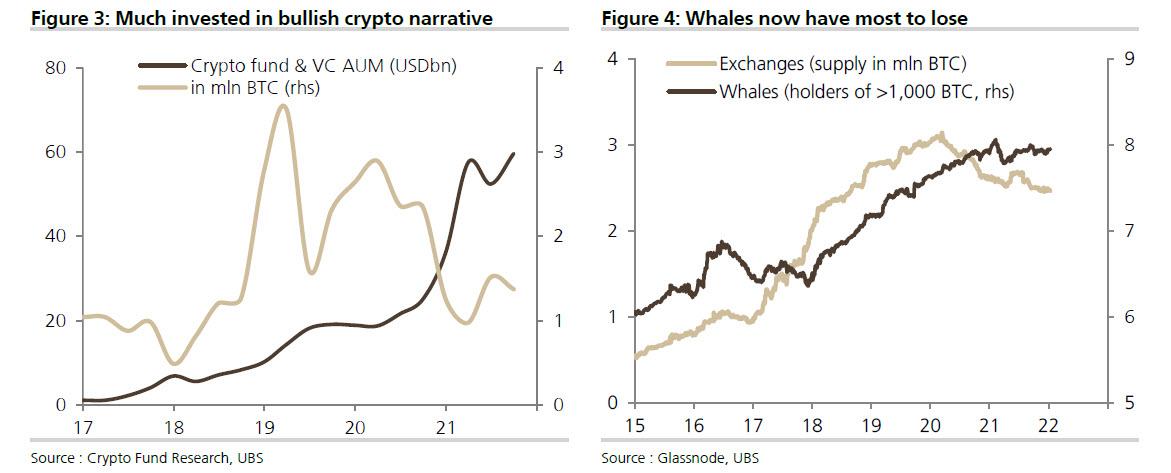
In his latest Crypto Keys note (available to professional subs), UBS FX strategist James Malcolm has turned quite bearish on crypto, writing that the recent drop in bitcoin prices is the result of disappointment with the SEC not approving ETFs, as well as three other reasons: 1. It's not better money; 2. The technology may prove subpar; 3. Regulation is a rising hurdle. While we disagree with all of these points, UBS does point out something notable: whales now own more bitcoin than ever before.
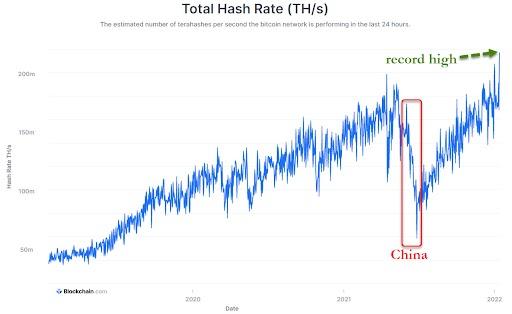
Meanwhile, as debates rage what's next for crypto, one thing that is certain is that China's attempt to crush the largest cryptocurrency last year when it banished all crypto miners has now failed (and backfired) spectacularly:
Bitcoin’s hash rate has returned to all-time highs despite losing a key hash rate contributor. Meanwhile, amid lackluster price action, Block CEO Jack Dorsey confirmed the creation of an open Bitcoin mining system. according to CoinTelegraph, while Kazakhstan, the network’s second-most important BTC mining country, experienced an internet blackout last week due to civil unrest, the hash rate faltered no more than 13.4% before regathering to reach all-time highs.
As shown in the data below from Glassnode, with the price checking into the $42,000 range on Thursday, the mean hash rate hit 215 million terahashes per second.
Said otherwise, Bitcoin miners continue to show resilience, and as Fidelity Digital Assets observed, the network is even “more widely distributed around the world.”
As testament to this, Jack Dorsey's Block confirmed it would develop open-source Bitcoin mining systems in 2022. In the Twitter thread, Thomas Templeton, a general manager at Block, addressed issues relating to the availability, reliability, performance and products pertaining to BTC mining. In sum, Block’s goals for BTC mining are the following:
“We want to make mining more distributed and efficient in every way, from buying, to set up, to maintenance, to mining. We’re interested because mining goes far beyond creating new bitcoin. We see it as a long-term need for a future that is fully decentralized and permissionless.”
Building a BTC mining system “out in the open” and alongside the community is no mean feat. Econoalchemist, an established home BTC miner and BTC magazine contributor, tweeted that developing products in open source would “build trust where no reputation exists currently and also might shift consumer expectations in that direction.”
Ultimately, Block’s mining solutions may pave the way for more DIY miners to enter the space.
Ultimately, it seems the sky’s the limit for Bitcoin’s hash rate, at least until the next 2,016 blocks, when the network difficulty resets.
FT : Net growth in ETF numbers almost doubles to a record 1,239 last year

Net growth in ETF numbers almost doubles to a record 1,239 last year
Robust markets limit fund closures and spur optimism in new launches

The global exchange traded fund industry not only attracted record inflows it also racked up extraordinary growth in the breadth and depth of its offering last year.

An overall total of 1,503 ETFs and exchange traded commodities were launched, far ahead of the previous record of 873 recorded in 2018, according to data from Morningstar.

Just 264 ETFs were liquidated or merged out of existence, down from 510 in 2020 and the lowest figure since 2014, when the industry was a fraction of its current size. The low closure rate meant net growth in the ETF count of 1,239 was almost twice the previous record of 656, set in 2010 when the industry was just getting into its stride, Morningstar’s data suggest.

The expansion comes as ETFs attracted more than $1tn of fresh cash in a calendar year for the first time in 2021, taking total assets to more than $10tn, according to ETFGI, a data consultancy.

“The market and the [ETF] structure just seems to be getting hotter as a destination for money,” said Eric Balchunas, senior ETF analyst at Bloomberg Intelligence.

“[In the US] flows were 80 per cent beyond their old record last year and launches 60 per cent. That is definitely correlation/causation,” said Balchunas, who argued that the strength of both flows and net ETF launches were driven by strong financial markets.


However, Kenneth Lamont, senior fund analyst for passive strategies at Morningstar, said the drivers of launches were different in each market.

“In Europe most new launches have been ESG [environmental, social and governance] and/or thematic. In the US, the story is different where more than half of launches have been active ETFs.”

The impact of robust markets was perhaps felt most keenly in the paucity of fund closures.

Recent years have seen a steady rise in the number of ETFs being culled, a trend that was increasingly seen as inevitable as the industry matured. The more ETFs there are, the more that will be liquidated every year if a fixed percentage fail to meet the $50m-$100m asset threshold typically needed to be profitable.

Yet closures slowed to a trickle in 2021, particularly in the second half of the year, when just 102 ETFs bit the dust.

Balchunas said this was a byproduct of the market being “so agreeable last year, borderline utopia”, with the S&P 500 rising 27 per cent.

In the US, 70.4 per cent of ETFs took in money in 2021, according to Bloomberg data, the highest percentage in the modern era.

“It wasn’t just the one thing that was working,” Balchunas said. “It was almost like the fish were jumping into the boat last year. It was just such a favourable year that there was no reason to close anything.”

Peter Sleep, senior portfolio manager at 7 Investment Management, said last year’s strong backdrop “potentially turned marginal funds into profitable funds,” with market gains attracting inflows “as money chases performance”.

Those funds that were pulled included a number of eurozone government bond ETFs, where yields have fallen to exceptional lows, said Sleep.

Among the 144 equity ETFs that drew their last breath were 15 domiciled in, and investing in, China. This tally included six that were only launched in 2020 and, extraordinarily, three that debuted in June or July 2021, only to be liquidated in November or December, demonstrating the often fickle, short-term nature of Chinese investors and fund managers.

When it comes to launches, Sleep pointed to the proliferation of ESG versions of pre-existing investment themes, as well as an increasing taste for thematic investment, as factors behind the upsurge.

Of last year’s new ETFs, 131 expressly included “ESG” in their name, while 21 claimed to be “sustainable” and a further eight “Paris-aligned”.

In the US, launch activity was turbocharged by mutual fund managers taking advantage of the relatively new freedoms to launch portfolio-shielding semi-transparent or non-transparent ETFs, enabling them to run actively managed vehicles without revealing their “secret sauce”.

“There is a big structural change that is driving activity in the US, with active managers relaunching the same, or a similar strategy, in a different wrapper,” argued Lamont, who said 60 per cent of US launches last year were actively managed.

He also noted that, in an industry traditionally concentrated on North America, Europe and Japan, “developing markets are also responsible for many of the new launches”.

“China in particular has seen a large number of new ETFs coming to market, the majority of which are highly targeted sector or thematic exposures, which hints at how ETFs are being used there,” Lamont said.

Morningstar’s data point to 281 equity ETFs being listed in mainland China last year, all of which invest domestically. The vast majority target specific sectors or themes, ranging from robots and virtual reality to livestock breeding and comics and games.

However, Sleep forecast that one trend in launches in 2022 could be for ETFs that allow foreign investors to steer clear of the Chinese stock market, an option that proved popular last year for the few funds that facilitate it.

Sleep also predicted the launch of more carbon offset, battery and green bond ETFs this year.

“We have seen lots of ESG equity but, as firms issue more green bonds, we could see more ESG green bond ETFs,” he said.

Balchunas foresaw the launch of more ETFs aimed at “older investors who are a little bit uneasy about how much the market is up,” such as buffered funds that offer some downside protection in exchange for capping the potential upside.

He also expected to see more ETFs focused on attempting to protect investors from the ravages of inflation.

“I think we will see about 20 this year,” he said. “We had 18 last year and every one saw inflows. That is unheard of.”

FT : Hedge funds oppose SEC’s reform plans after GameStop debacle

Hedge funds oppose SEC’s reform plans after GameStop debacle
Regulator’s ‘misguided’ securities lending proposals risk fuelling volatility, say managers

Hedge fund managers fear the painful losses they suffered in the meme stock trading frenzy of January 2021 will be repeated if US regulators press ahead with reforms to securities lending, one of the most opaque practices in financial markets.

Melvin Capital, Light Street and White Square all lost heavily when their bets against meme stocks, such as the struggling video game retailer GameStop, were pulverised by retail investors who swap trading ideas on bulletin boards such as Reddit’s r/wallstreetbets.

But the extreme volatility unleashed in the meme stock battle alarmed the Securities and Exchange Commission, the US financial markets regulator which is determined to prevent a repeat of the debacle.

Gary Gensler, the SEC chair, said in November that it was time to bring securities lending “out of the dark”.

The SEC has proposed extensive reforms to securities lending arrangements which allow hedge funds to pay a fee to borrow stocks and bonds in order to bet that an asset will fall in value — the process known as “short selling”.

Lenders and lending agents will together pay about $375m in initial costs and $140m annually thereafter to comply with the proposed reporting requirements, according to the SEC.

But the drastic changes in reporting and disclosure standards planned by the SEC have triggered opposition from hedge funds and other key players in securities lending, including BlackRock, the world’s largest asset manager.

Jennifer Han, head of regulatory affairs at the Managed Funds Association, the Washington-based trade body that represents hedge fund managers, said the SEC’s proposals were “misguided” and could create more meme-stock style volatility “leading to situations similar to the GameStop market event”.

Han said the MFA was “strongly concerned” that other market participants would be able to reconstruct or reverse-engineer a hedge fund’s trading strategy if the SEC insisted on highly detailed reporting of securities lending transactions, even if this information was anonymised.

Similar objections were voiced by the Alternative Investment Management Association, the London-based trade body that represents hedge funds and private credit managers with combined assets of more than $2tn.

The SEC’s proposals would allow other traders to “front-run or short squeeze” hedge funds that wanted to bet against a company’s stock, said Jiri Krol, head of government and regulatory affairs at Aima.

Several hedge fund managers said they saw little upside in talking about their short positions in the current environment. David Einhorn, founder of Greenlight Capital, which made big bets against Tesla and Lehman Brothers, has sharply curtailed his public discussions around his short positions. Einhorn declined to comment.

But Carson Block, the founder of Muddy Waters Research, said the new reporting requirements would benefit all market participants by “making it easier to gauge scepticism about a company and its propensity to be driven upward in a short squeeze, GameStop being the modern day poster child”.

Demand from hedge funds pushed the cost of borrowing GameStop shares to more than 100 per cent during the second quarter of 2020 — an exceptionally high level. By contrast, average lending fees on other US securities were around 1.5 per cent at the same time.

Revenues from lending GameStop shares reached $121.7m over the 18 months ending June 30, according to the data provider IHS Markit.

The SEC said that the high costs required to borrow GameStop shares could have constrained short sellers and contributed to a price bubble.

Many ordinary investors also lost out when the GameStop bubble popped and the value of the retailer’s shares collapsed from an intraday high of $483 in late January 2021 to $40.59 by mid-February.

“Speculators are not the only ones harmed when a bubble collapses. There is collateral damage to innocent bystanders including buy-and-hold retirement investors in index funds,” said James Angel, a finance professor at Georgetown University’s McDonough business school.

One of the SEC’s most contentious proposals is that all lenders of securities should be required to provide details of their transactions within 15 minutes to a central regulatory body, most likely the Financial Industry Regulatory Authority, which will publish some of the data.

BlackRock, which earned $555m from securities lending last year, said intraday reporting would provide “low informational value” to the SEC while imposing significant additional costs on lenders. BlackRock wants the deadline for reporting to be shifted to the close of the following trading day.

Better Markets, a Washington-based think-tank, warned that high-speed traders would be able to exploit the delay in reporting transactions and said shortening the deadline would be “eminently feasible without adding significant cost”.

Stephen Hall, legal director at Better Markets, urged the SEC not to dilute its proposals.

“The financial industry often seeks to weaken or eliminate regulations by arguing that the [proposed] requirements will have a devastating impact on their business which will in turn harm the public interest. These types of claims are typically exaggerated if not entirely groundless,” said Hall.

The scale of the business that could be affected is widely unappreciated.

IHS Markit reported the average daily value of US equities on loan at $540bn in the first half of 2021, compared with $428bn for the whole of the previous year. This created a revenue pool worth $1.9bn in the first half of last year and $3.3bn over the whole of 2020.

According to the SEC, the value of all securities on loan in the US stood at around $1.5tn at the end of September 2020. The data are, however, both incomplete and unavailable to the general public. Aggregate short interest for individual stocks is currently reported only twice a month, meaning market participants are often relying on stale data.

FT : Is it really OK to dress down at work?

Is it really OK to dress down at work?
The pandemic has undeniably changed things. But for all that a casual look brings, there remain times for convention

Workplace dress codes have metaphorically loosened their ties, poured themselves a drink and put their feet on the desk. But what does dressing more casually mean for our professional lives, beyond being able to concentrate in comfort? Does that hoodie channel tech-titan-in-waiting or give off the vibe that you are playing Animal Crossing under your desk during seemingly endless Zoom calls?

Jonathan Kewley, who chairs the tech group at law firm Clifford Chance, tells me over Zoom that the pandemic has visibly accelerated the process of wardrobe casualisation, and that the company has embraced it.

“When the pandemic happened, some of the grandest private equity houses, banks and hedge fund managers and the traditional gatekeepers at Wall Street are there on Zoom with their kids in hoodies,” he says. “There was a degree of familiarity. You can’t say all banks or hedge funds will be like this, but there has been an overall relaxation. It’s part of the blended life.”

When we speak, he wears a double-breasted APC blazer with gold buttons over a T-shirt, a look that’s more yacht party than typical lawyer. He describes the surprisingly “joyful eclectic fashion” adopted by colleagues before the UK’s most recent work-from-home directive: no suits but plenty of Steve Jobs-style roll necks, cool jumpsuits on women, more knitwear, sweatshirts and a move from monochrome to bold prints and patterns.

Kewley shows me a team photo from December of men in polo collar knits, fresh sneakers and Chukka boots, and women in separates from checked trousers to bright blazers and jeans. He observes: “Some people want to dress in a powerful way; some want to reflect the fact that they live in Hackney and do pottery at the weekend. There is a desire to be themselves, not put on a game face.”

Practicality aside, Kewley feels strongly that it’s “indicative of a profound cultural shift. It’s not superficial. Being able to express yourself through dress is linked to having a more progressive, diverse workplace. You can’t do that if you are telling people they have to look the same.”

His colleague Laura Yeates, head of graduate talent at Clifford Chance, also believes that relaxed dress codes help foster a more inclusive workplace. She says that around five years ago, the company changed its approach to dress codes for graduate recruitment events as many students “would self-select out due to not having traditional formal office wear”.

She adds that dressing more individually is in line with bringing your whole self to work, and that it “breaks down the barriers that mean people adopt a certain persona when they go into an organisation. People are feeling more comfortable interpreting what professional wear means to them.”

Allowing people to use their judgment builds trust. Just as companies offering unlimited holiday don’t necessarily find that staff decamp to the beach with an inflatable flamingo full time, relaxed dress codes don’t automatically foster scruffiness.

They are also more economical. With hybrid working and working from home directives, it no longer makes sense to have lots of expensive clothes languishing in a wardrobe providing a designer feast for moths. Across the board, professional women are swapping plain suits or dresses for separates that they can wear outside the office, and get more mileage from. Marine d’Hartoy, investment director at Stenham Asset Management, notes that “with going into the office less often you can have a smaller wardrobe of a few more expensive items.”

While employees might be more casual on Zoom or for internal meetings, client meetings can be a different story. Clifford Chance’s Kewley acknowledges “there are some guidelines. Our huge client base now is big tech companies on the West Coast who have always been progressive, but there will be clients where it’s appropriate to put a suit on and that’s respectful of them.”

Stenham’s d’Hartoy says that when she and her colleagues have been in the office during the pandemic many have worn jeans, which they never would have worn before. However, for external meetings her team “are supposed to dress professionally; [being scruffy] would not be acceptable”.

She says that in asset management people tend to tailor their outfits to clients and the occasion: “Before you meet a client you have usually had a lot of conversations and researched them. If you still have doubts about their style, then you dress up. With, say, traditional families from Switzerland, or older people, you wouldn’t wear jeans and sneakers, you’d wear a dress or suit. We have clients who are tech entrepreneurs and they actually prefer you to be dressed like them. Being more casual can be a way to get along and also remove some of the negative associations of people from the financial industries.”

Oliver, a 30-year-old consultant in London, says his managers only care about dressing casually “if we are more casual than the client. If they are in finance, a bank or a PE fund, they are normally dressed quite well. Or at least in a [collared] shirt.”

Without the reliable norms of suits and dress codes, striking the right note can be risky. De facto uniforms, like the calming certainty of the prix fixe menu, remove decision paralysis. “It’s one thing if you are going to a meeting in Paris, another in Milan,” says New York- and London-based executive recruiter Karen Harvey. “Do your research, look on social media. You don’t want to overdress because people read that as a cultural miscue.”

When we spoke she was on her way to a meeting with a fashion brand chief executive for which she had worn navy slacks and a sweater from The Row. “We live in a new world order,” she says. “I don’t think it’s so much about dressing down or dressing up, everyone has become more accustomed to thinking about how to feel and look good. Whether it’s on Zoom or in person, fashion has a huge role to play in the new lifestyle and I think we are still in flux.”

FT : Billionaire Leon Black targets New York elite in fight against rape claim

Billionaire Leon Black targets New York elite in fight against rape claim
Former Apollo leader’s attorneys seek phone records of leading PR figure and subpoena accuser’s law firm

Leon Black, the billionaire financier, is demanding access to private records involving some of New York’s most prominent businessmen as he tries to prove that a lawsuit accusing him of rape is the work of unidentified extortion artists.

Among his targets is Steven Rubenstein, a leading New York public relations executive whose firm’s clients have included Rupert Murdoch, Donald Trump and Apollo Global Management, the private equity firm that Black led until last year.

The fight over phone records represents just one front in an expanding legal battle between Black and his former mistress Guzel Ganieva. The dispute has already drawn in at least half a dozen law firms and threatens to embroil other wealthy figures in the worlds of finance and sport.

“The parties are going at each other with claws,” said Bennett Gershman, a former prosecutor in the New York state anti-corruption office who teaches law at Pace University. “This seems like a particularly vicious lawsuit where the lawyers are looking for leverage, looking for any angle that they can get.”

Rubenstein learned in December that Verizon was poised to hand over details of every call and text message sent to or from his iPhone over a 12-month period. The phone company advised Rubenstein of the impending disclosure after receiving what his lawyers called a “harassing” and “outrageous” subpoena from Black’s legal team.

According to the filings, Black wanted to know about any contact that Rubenstein had with nine named individuals, including reporters who have written about the rape allegations and Ganieva, a Russian fashion model who for several years had a sexual relationship with the married financier.

“Any private citizen should be aghast that [a bystander to a lawsuit] could be made the subject of a subpoena calling for all their telephone records simply at the whim of a litigant,” Rubenstein’s lawyers wrote in a motion to quash the order.

A representative for Rubenstein told the Financial Times: “We have had absolutely no relationship, or contact of any kind, formal or informal, direct or indirect, with the plaintiff in the underlying matter.”

The acrimonious exchange marks an escalation in a legal fight that began in June, shortly after Black resigned from Apollo following revelations about his financial ties to the late paedophile Jeffrey Epstein.

In a civil lawsuit filed in New York that month, Ganieva alleged that Black had sexually abused her for several years and then damaged her reputation by publicly accusing her of extortion after she posted her grievances on Twitter.

Lawyers for Black have branded Ganieva’s entire lawsuit “a work of fiction”, while acknowledging that Black made payments worth millions of dollars to secure Ganieva’s silence about their relationship.

Last autumn, Black supplemented his legal team with Susan Estrich, a feminist legal scholar who shot to national prominence as the manager of Michael Dukakis’s 1988 presidential campaign and later defended former Fox News executive Roger Ailes against claims of sexual harassment.

Estrich promptly filed a federal lawsuit that invoked a statute often used in mafia cases to allege that Ganieva and her lawyers at Wigdor, a high-profile New York firm, were perpetrators of a wide-ranging extortion scheme “to try to get even more from Mr Black — or destroy him in the process”.

The federal lawsuit alleged that Ganieva and Wigdor were the most visible actors in a scheme that also included two “flaks”, or public relations professionals, and a mysterious financial backer with the resources to “go head-to-head with a billionaire”.

Black’s lawyers have not named these alleged co-conspirators in court filings. Among their highest priorities has been finding out who is paying Wigdor’s fees.

According to an engagement letter signed last April and produced in federal court last week, Ganieva agreed to pay Wigdor 38 per cent of any money she received from Black. “There is a possibility that you will recover nothing,” the letter adds, “in which case we will receive no attorneys’ fee from you.”

But in a subpoena served on Wigdor itself in November, Black’s lawyers sought information on any communications or payments between the law firm and several people in Black’s extended orbit.

One person named in that subpoena was Josh Harris, who was among Black’s top lieutenants at Apollo for more than a decade and had hoped to succeed him as chief executive until the men fell out over the Epstein affair.

Another was Michael Rubin, a sports merchandise billionaire who along with Harris is a co-owner of the Philadelphia 76ers basketball team.

“It is completely preposterous that Michael Rubin’s name is even associated with this,” his spokesperson said.

A representative for Harris, who stepped down from Apollo in May, said he “has nothing to do with the situation Mr Black finds himself in or the deeply troubling allegations these lawsuits raise”.

Both men said they had never had any contact or financial dealings with Ganieva or any of her representatives.

In court papers filed last week, Wigdor argued that Black’s allegations were entirely unsubstantiated and asked a court to punish his lawyers for what they said was an abuse of the legal process. “Black, with his billions of dollars, may believe that he can levy baseless and legally defective . . . claims,” the firm wrote. “However, his lawyers should have stepped in and refused.”

But in a letter to Wigdor seen by the FT, Estrich rejected that criticism, stating: “We take issue with your accusation that we failed to investigate or substantiate the allegations of the complaint as it was first filed.”