WWD : The Documentary on Elio Fiorucci That Offers Motivation for 2022

The Documentary on Elio Fiorucci That Offers Motivation for 2022
With a special screening on Monday, “Free Spirit” looks to trigger nostalgia as well as inspire viewers to act — and react — fearlessly.

MILANFear: A concept as ancient as the world that inevitably influences the behavior of humans and animals alike.
Every person’s relationship with the feeling is personal and, given the context these days, increasingly an object for self-exploration and for research into coping mechanisms.
While many are looking for motivational quotes on social media or seek inspiration in the gestures of their favorite athletes, a little encouragement can also come from the words and technicolor world portrayed in “Free Spirit,” a documentary on Elio Fiorucci that will be celebrated with a special screening on Monday, as part of the eighth edition of the Fashion Film Festival Milano event that opens Friday.


“The end of unnecessary fears, [is] the beginning of life,” is one of the mottos the visionary designer, who died in July 2015 at age 80, shares with his signature smile in the one-hour film.

“It’s one of his biggest lessons, for me,” said Andrea Servi who, with Swan Bergman, stood on the other end of the camera, as both acted as authors and directors of this project, which began in 2008. “The way he thought about the future, always with creativity and imagination and not with fear like today. He used to unmask fears, shooed them with his work and colorful world. And you can see it in this documentary,” said Servi, adding that the goal of the film is to pass on to viewers the same energy to act and react fearlessly.
Yet nostalgia could be triggered, too: rather than simply celebrating Fiorucci’s life and career, the film intends to narrate episodes and key decades of change and explosive creativity through the designer’s filter and the memories of his inner circle.
The first part of the documentary features a string of interviews divided by topic and historic period — spanning from the ‘60s to the tail end of the ‘80s — and is supported by archival footage, while in the second part a more intimate portrait of Fiorucci is shown, as he shares thoughts and memories freely.
In addition to the designer, interviewees range from Vivienne Westwood, who shares glimpses of how she first heard of Fiorucci, to collaborators such as photographer Oliviero Toscani; stylist and artist Maripol, who doubled as the art director of Fiorucci’s famous store in New York; designer and scenographer Franco Marabelli, who has been creative director of the brand’s shops; curator Daniela Morera, and former Fiorucci sales assistant Biba Acquati, among others.
These characters populated the vast and eccentric world of the designer, who was the father of pioneering ideas, ranging from the creation of fashion denim and introduction of logos to revolutionary retail concepts.
He was the one who imported Swinging London’s energy and sense of freedom into Italy in the ’60s, when he opened his legendary emporium in Milan’s central San Babila, that anticipated the modern definition of a concept store.
A playground for experimentation, the location was a chaotic yet mesmerizing bazaar of objects of all sorts, references and iconography, presented in a flashy, colorful and fun way that clashed with the context of the ’70s, when terrorism and political tensions loomed over Italy.


Spontaneous, generous and open-minded, Fiorucci also became a patron for young artists, architects, graphic designers and performers, including Keith Haring who took over the store and entirely covered it with his graffiti art in a live event open to the public in 1983.
Elio Fiorucci and Andy Warhol
COURTESY OF "FREE SPIRIT"
The documentary also vividly retraces how, following the launch of the New York flagship in 1976, Fiorucci integrated into and fueled the vibrant scene of the city at the time, as Andy Warhol, Truman Capote and Jean-Michel Basquiat were among the personalities who gravitated to the location, which was commonly described as a “daytime Studio 54” for its lively atmosphere. For example, Warhol chose the store to launch his Interview magazine with an event and signing session while Donna Jordan and Pat Cleveland modeled for a live-action window concept, among others. As for the real Studio 54, Fiorucci threw a bash there to celebrate the 15th anniversary of the brand and invited a young Madonna — at the time a DJ — to spin the records, as he recalls in “Free Spirit.”
The documentary was quietly released in a small way in 2017. The inclusion at the Fashion Film Festival Milano will mark its real launch, as the directors said the film will have a wider rollout beginning in the spring.
The screening will be held digitally on the MyMovies platform, with 500 tickets available for the event. Originally this format was supposed to flank a physical event staged at the Triennale museum in Milan, but this was postponed to Milan Fashion Week next month due to the surge of the Omicron variant in the country.
The choice of location was not accidental, as the film project originated in the white halls of the venue. While visiting an exhibition dedicated to the ‘70s, Servi and Bergman stepped into a pavilion dedicated to Fiorucci that spotlighted his artistic connections and cultural influence.
“We were in awe: we discovered plenty of things about him and thought that many Italians didn’t really know everything he has done and that this would deserve a film. So the very same day we found a contact and called his press office to talk about this idea, and they passed the call to Fiorucci himself right away, which was pretty incredible,” recalled Bergman. “He told us he was extremely honored. I mean, him? Honored by us? We were shocked,” said Servi.


Everything quickly escalated and the production moved smoothly without a plan or schedule. “He was anarchic and we wanted to do something in tune with the spirit of those years and incredibly authentic, so it was very rock ‘n’ roll. We didn’t prepare questions, just went with the flow, and we had so much fun throughout the whole process,” said Bergman, underscoring that the footage mirrored this raw and not glossy style.
“He never arranged appointments because he believed that setting a date creates expectations in terms of performance,” he continued. “Plus, he used to share his agenda with us, all his patrimony of people he knew, without any sort of jealousy,” added Bergman, underscoring how this attitude informed his personal and professional path in the following years. “It was natural for him, and if you think about it, his stores were not for selling products but were meeting points.”
A WWD report about the opening of the Fiorucci store in New York, 1976.
WWD
With its unprecedented mix of elements that tickled the audience’s imagination, the San Babila store became the epicenter of a cultural revolution, as it introduced and promoted a language, attitude and lifestyle that younger generations at the time were waiting for. A community of younger consumers congregated around the location because they could recognize themselves in the energetic young staff, choice of music and cosmopolitan feel.
A director of music videos based in Bologna, Bergman used to travel frequently to Milan for work and always stopped by the store for inspiration. “I used to go there to stimulate my lateral thinking in order to create a story starting from an unusual object — and there were plenty there — rather than being academic in creating something from a song’s lyrics. That place pushed you to use the imagination and I believe that many of the videos I created subconsciously derived from the Fiorucci world, way before working on this documentary,” said Bergman.
Asked about the most challenging part in realizing “Free Spirit,” the directors pointed to the death of Fiorucci during the final stages of the production. “In addition to the sorrow for a loss of a friend, there was the big task of creating a common language and meaning out of the footage we had,” said Servi.


While the documentary turned out to be a compendium of firsthand recollections, Servi revealed that the initial project was to realize a miniseries à la Netflix’s Halston. The authors said there’s already a full script that was developed under Fiorucci’s guidance and that was eventually put aside as they preferred to start collecting materials from interviews instead.
“But the story is still there, we have all the ideas, even in terms of casting, we just lack a couple of millions to produce it,” joked Servi, who, on a more serious note, said the project is on the table with a few companies and is being discussed.
In addition to this, the duo is busy on other fronts — including two other docu-films and a movie — as well as searching for another project that would replicate “Free Spirit” and its intersection of themes related to fashion, culture and society.
“But nonconformists are difficult to find these days. There’s no one like Elio now,” concluded Bergman.
(ZH) China's True COVID-19 Death Toll 366 Times Higher Than Official Figure, Ana

China's True COVID-19 Death Toll 366 Times Higher Than Official Figure, Analyst Says

The Chinese regime has likely understated the COVID-19 death rate by as much as 17,000 percent in a systematic data suppression campaign to sustain its political image, according to a U.S. analyst.
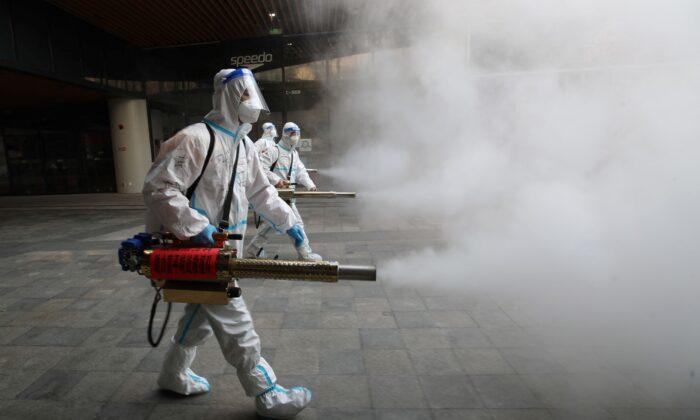
Staff members wearing personal protective equipment (PPE) spray disinfectant outside a shopping mall in Xi'an, China on Jan. 11, 2022. (STR/AFP via Getty Images)

That would put the number of COVID-19 deaths in China at around 1.7 million rather than 4,636, the two-year cumulative death figure that the Chinese authorities have maintained on the books. That’s 366 times the official figure.
Those findings made by George Calhoun, director of the quantitative finance program at Stevens Institute of Technology, were based on data as of January generated by a model developed by The Economist.
A vast majority of China’s officially recorded deaths came from Wuhan during the first three months of the pandemic, with only hundreds more reported in the rest of the country.
The Chinese regime only reported two additional deaths since April 1, 2020, ranking China as having the world’s lowest COVID-19 death rate, which Zhong Nanshan, the Chinese epidemiologist overseeing China’s outbreak response, boasted about just last week.
But that jaw-dropping data point—hundreds of times lower than that of America, gave Calhoun pause.
That’s impossible. It’s medically impossible, it’s statistically impossible,” Calhoun told NTD, an affiliate of The Epoch Times.
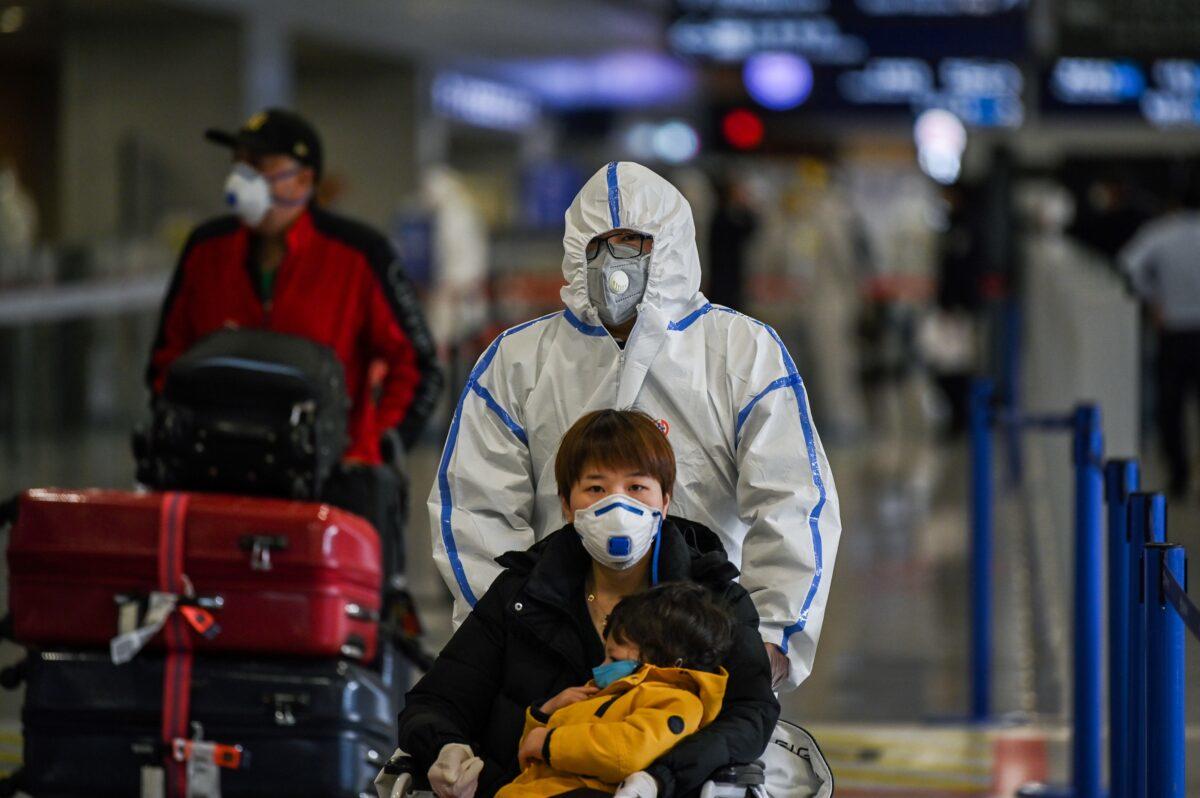
Passengers wearing masks arrive at Shanghai Pudong International Airport in Shanghai on March 19, 2020. (Hector Retamal/AFP via Getty Images)
Remember, in 2020, there was no vaccine, there was no treatment,” he said. “So you had an unprotected population that has shown zero COVID deaths, even though they’ve had tens of thousands of cases.
Curating public records and previous research reports, and analyzing the regime’s pattern of hushing up scandals in the past, Calhoun arrived at a conclusion that to him seems obvious: China has made its “zero-COVID” policy a political objective, and is systematically falsifying data to prop up the claim.
“Somebody put a message out at the end of the first quarter and 2020 and said, ‘Okay, we want to see zero-COVID. That’s our policy.’ And it became zero-COVID,” he said.
Anomalies
The first “smoking gun” is a sudden drop of COVID-19 deaths since April 2020 from mainland China after a “raging” rate of infection, Calhoun said.
From April 1, 2020, to Jan. 8, 2022, over 22,102 cases have been reported in mainland China, according to data from Johns Hopkins Coronavirus Resource Center. Only two deaths were recorded over the same period.
By comparison, Hong Kong, which counted about half as many COVID-19 infections over the period, reported 213 deaths.
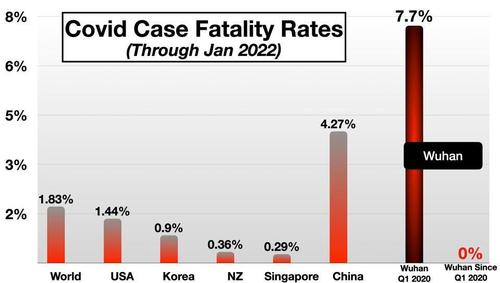
The case fatality rate (the proportion of those infected who died) in Wuhan during the first three months of the pandemic averaged around 7.7 percent, more than five times that of the United States and four times the world average.
Case fatality rate in Wuhan in comparison with other parts of the world. (Courtesy of George Calhoun)
Two scenarios are possible: either the virus was “far more deadly in early 2020 in Wuhan than anywhere else, at any other time,” or alternatively, the official infection numbers from China were too small by a factor of three or four, Calhoun said.
Over the following 20 months, there has been a consistent lack of COVID-19 data from China. As of September, China has become the world’s only country that has not provided complete data on excess mortality—unexplained deaths beyond normal trends that can offer a crude estimate of uncounted COVID deaths, a survey from the University of Washington shows.
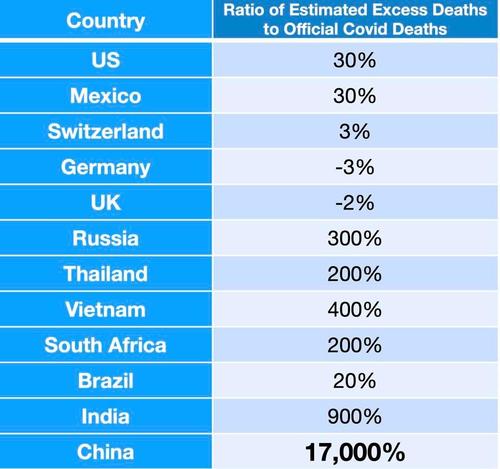
The Economist model seeks to make up for that data gap. Based on the model, Calhoun said China’s excess mortality was off by about 17,000 percent. This discrepancy, he added, surpasses those even by countries mired in large-scale civil unrest, such as Libya, Iraq, Afghanistan, and Venezuela, which has undercounted the COVID-19 mortality rate by up to 1,100 percent.
Excess mortality for China and several other countries. (Courtesy of George Calhoun)
Undercounting virus deaths is widespread across countries. Based on The Economist’s model, the United States’ official tally is short by about 30 percent. But China’s case is extreme.
“They are through the roof,” Calhoun said of the discrepancy between China’s official figures and the estimated true death toll.
Something’s driving that,” Calhoun said.
While the virus might not be all to blame for the jump, tight-lipped Chinese authorities have offered few clues as to what might have happened otherwise.
Calhoun’s estimate coincides with anecdotal evidence from local residents, troves of internal documents leaked to The Epoch Times, and research studies into the impact of the virus in China, all of which indicate that the official figures have been grossly understated.
During the early months when the pandemic first broke out in China’s Wuhan, some of the city’s funeral home workers told The Epoch Times they were working nonstop to cremate bodies. In March, thousands of ash urns were delivered to one of the crematoriums, when the official death number was over 2,000. The authorities raised the fatality figure by 50 percent a month later, attributing the gap to administrative inefficiencies.
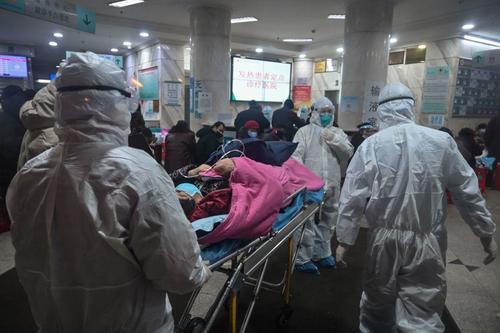
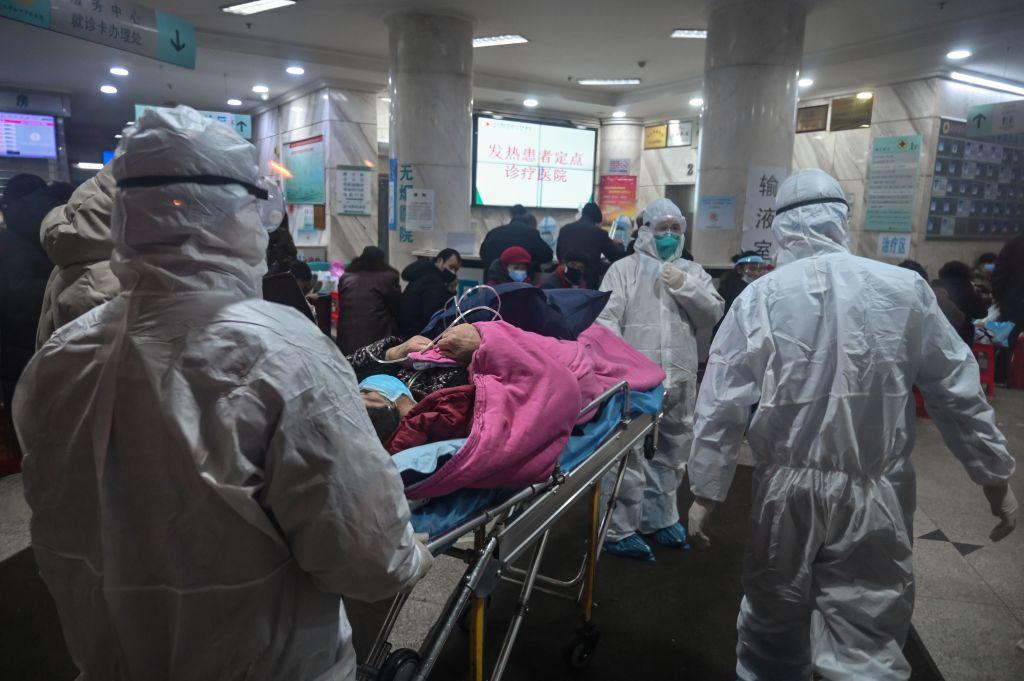
Medical staff wear protective clothing to protect against a CCP virus patient at the Wuhan Red Cross Hospital in Wuhan, China, on Jan. 25, 2020. (Hector Retamal/AFP via Getty Images)
A study published in The Lancet last March said as many as 968,800 people in Wuhan had antibodies by April 2020, which would mean they developed immunity to the virus after being infected.
The data inconsistencies are not limited to Wuhan alone. During a two-week period in February 2020, an internal document from Shandong health authorities showed that close to 2,000 people had tested positive for the virus, but only 755 infections were publicly recorded.
Leaked documents suggest that the regime has continued to deem virus control as a political task.
In files recently obtained by The Epoch Times, a top Chinese official of Shaanxi Province, where the virus-hit Xi’an is the capital, ordered the “toughest measures” to be put in place to block the virus’ further spread from Xi’an. With the Beijing Winter Olympics coming up, a spillover would create “systemic risk” and “smear the national image,” the document read.

WSJ : 5G Wireless Service and Flight Safety: What to Know

5G Wireless Service and Flight Safety: What to Know
As AT&T and Verizon roll out their faster wireless service and the FAA creates buffer zones around airports, here’s what it means for you

The rollout of a new 5G wireless internet service has gotten hung up because of a tussle about risk to cockpit equipment in airplanes. Following delays, Verizon VZ -0.45% Communications Inc. and AT&T Inc. T 1.42% plan to start offering the service this month.

What’s happening in the 5G flight-safety fight?
Telecom companies were supposed to roll out a new, faster wireless internet service in early December. The plan hit some hurdles after air-safety regulators prepared to impose disruptive flight restrictions, because they said the 5G service could potentially pose risks to cockpit equipment in aircraft. The telecom industry disputes the service would create any hazards.

So now what?
Verizon and AT&T, after two delays, are due to start offering the service on Jan. 19.

As such, the Federal Aviation Administration recently issued rules that prevent planes from landing in certain low-visibility conditions at sites where the 5G service has been activated. The agency is meanwhile planning to approve some aircraft as safe to perform such landings following testing, helping to ease any air-traffic disruptions.

Why has the aviation industry been worried about flights?
At issue is whether the new 5G signals affect aircraft equipment that helps planes land in difficult weather conditions and avoid crashes. The equipment, called radar or radio altimeters, uses radio frequencies to measure the distance between aircraft and the ground.

Aviation officials worry the cellular frequencies that telecom companies plan to activate could interfere with altimeters, potentially throwing off readings the devices take and endangering planes. The 5G service will operate in a frequency known as the C-band, which is close to the airwaves the altimeters use.

Telecom-industry representatives say connections over the C-band won’t interfere with cockpit devices, citing Federal Communications Commission technical experts and analyses by other regulators around the world.

So will the new 5G service make flights unsafe or not?
The FAA has said it is taking steps to ensure aircraft don’t operate in what it considers to be an unsafe situation because of the 5G service. The point of its restrictions on aircraft using certain radar altimeters, the agency has said, is to make sure the devices aren’t potentially impaired.

Telecom industry representatives say signals over the C-band won’t cause harmful interference to cockpit devices. They have pointed to the fact that the U.S. included a buffer band to separate the new 5G signals from those used by radar altimeters.

Does the new 5G service only affect commercial flights?
No. Helicopters and private planes also rely on altimeters. Some air ambulances and law-enforcement helicopters could be grounded if the new 5G services are switched on next week, the Helicopter Association International, a trade group, said.

Helicopters typically have more diverse flight paths than planes and fly more slowly, exposing them to more cell towers and longer bursts of potential interference, radar engineers and manufacturers said.

Private planes and helicopters also use a far larger number of airports and takeoff and landing sites than commercial planes, including 4,000 heliports next to hospitals. Airports Council International - North America, another trade group, has called for the 5G rollout to be delayed until what it called sufficient mitigations are in place to keep flying safe.

How big a deal is 5G for the telecom industry?
Fifth-generation cellular technology is substantially faster than previous services, easing activities like downloading software and streaming video. Such links are already available in parts of the U.S. from Verizon, AT&T and T-Mobile US Inc. TMUS -1.45% in several spectrum bands. Coverage isn’t uniform, and AT&T and Verizon in particular need more frequencies to keep their networks from becoming congested.

Verizon, for example, bid $45.5 billion for its C-band licenses, and plans to use them to offer more 5G service for mobile customers and provide home internet links in some areas where cable broadband isn’t available or costs too much.

Why did this battle emerge now?
The tussle is occurring in large part because federal agencies didn’t act earlier to work through their disagreements.

Concerns about potential interference with cockpit equipment had been on the FCC’s radar, according to a commission order published in March 2020. That order found, in part, that one study didn’t demonstrate that harmful interference was likely under reasonable scenarios and suggested that an industry task force continue to analyze the issue.

The FAA brought up its worries in a letter sent shortly before an FCC auction began in December that year, and asked for the sale to be postponed. Trump administration officials didn’t agree with the FAA’s last-minute concerns and the C-band auction went forward. But the aviation industry’s focus on the issue didn’t go away. By last autumn, the two regulators began sharing information both had been seeking for months.

How are other countries handling this issue?
Other countries have allowed telecom companies to offer wireless services around similar frequencies, though with some restrictions in place. For example, France has limits on 5G operations at almost 20 airports where pilots have less visibility during landings, while regulators in other countries have limited power levels for ground stations.

What does all of this mean for airline passengers?
The truce that transportation officials and the telecom companies reached in early January this year is expected to avert the most serious flight disruptions, officials from the aviation industry and government have said.

Under the agreement, the FAA selected 50 airports for buffer zones where telecom companies would limit, for six months, 5G signals expected to be turned on this month. On that list are some big passenger hubs like Chicago’s O’Hare International and facilities that often face fog and clouds, like San Francisco International.

Some busy airports, such as Hartsfield-Jackson in Atlanta and Ronald Reagan Washington National, weren’t included because they aren’t in areas where the new 5G service is first being deployed. And at other airports, towers for the 5G connections are far enough away to create a natural buffer, according to the FAA.

However, aviation industry and government officials have said they expect at least some flights to be canceled, delayed or diverted after Verizon and AT&T activate the new 5G service on Jan. 19. Flight operators and manufacturers, meanwhile, can follow steps to demonstrate to the FAA that their altimeters are able to operate reliably and accurately in the new 5G environment, the agency has said.

What about T-Mobile?
AT&T and Verizon paid premiums to snap up C-band spectrum early. T-Mobile also bid in the same FCC auction but only walked away with licenses that become available in late 2023, so its 5G network isn’t affected by the latest standoff with the FAA. That said, T-Mobile could face the same problem its rivals have now if the latest safety concerns aren’t settled over the next two years.

WSJ : Meet the Investor Who Spots Opportunities for Jeffrey Katzenberg

Meet the Investor Who Spots Opportunities for Jeffrey Katzenberg
Anthony Saleh oversees a growing venture-capital fund at the former Hollywood chief’s WndrCo, after its Quibi video app collapsed. He used to advise the rapper Nas.

When he was growing up in Los Angeles, Anthony Saleh said he found entrepreneurial inspiration in the VHS cassettes of Walt Disney Co. DIS -2.25% classics such as “The Little Mermaid” and “Aladdin.” After receiving the tapes for his birthday, he would rent them out to friends for 25 cents a night.

At the time, Mr. Saleh gave no thought to the company behind those movies, or the executive, Jeffrey Katzenberg, then largely responsible for their production throughout the 1980s and 1990s. Yet more than 25 years later, it is Mr. Saleh whom Mr. Katzenberg is turning to for help plotting a course out of the rubble formed when his first post-Hollywood venture, Quibi, imploded.

Mr. Saleh, 35 years old, has been Mr. Katzenberg’s point of entry to the early-stage technology companies the mogul is evaluating far outside the Hollywood bubble, both men said. After managing music and investments for rapper Nas for more than a decade, Mr. Saleh is overseeing early-seed investing at Mr. Katzenberg’s WndrCo, plugging the company into a lucrative but crowded venture-capital field following its high-profile failure with Quibi, the mobile-video app that shut after less than a year.

“Jeffrey can open any door, but he’s never done tech investing,” said Sujay Juswa, a managing partner at WndrCo who met Mr. Saleh when he and Nas invested in Dropbox Inc., DBX -0.08% where Mr. Juswa was chief financial officer.

Mr. Saleh’s investments provide a road map for where WndrCo is focused after Quibi’s demise, and so far have included Dapper Labs, the creator of NBA Top Shot, the digital collectibles company that has successfully ridden the cryptocurrency wave this past year. Mr. Saleh’s initial $150,000 investment on behalf of WndrCo is now valued at roughly $11 million.

Mr. Saleh says his background in music, where he had to manage fans and their expectations, has helped him guide tech firms that want a similar relationship with users.

“I apply my understanding to other industries, because for technology to be adopted by the masses, these companies need to understand how consumers think,” said Mr. Saleh.

After an initial $15 million investing portfolio, Mr. Saleh has started raising money for a new fund worth $100 million, according to a WndrCo filing with the Securities and Exchange Commission last year.

Mr. Saleh’s investments also function as a farm system for WndrCo at large, which can take larger stakes or potentially acquire the companies down the road, said WndrCo leadership. Quibi’s failure was one reason Mr. Saleh has dropped the pursuit of media investments, he said.

“I had a supercalifragilistic down,” is how Mr. Katzenberg, 71 years old, put the experience of Quibi’s failure.

The short-form video app premiered in April 2020 to much fanfare, having raised nearly $2 billion and recruited stars such as Liam Hemsworth and Reese Witherspoon to contribute to shows for the service. But subscriptions never caught on, and the entire venture folded after eight months.

Mr. Katzenberg’s work with Mr. Saleh in tech firms follows the trajectory of other one-time leaders in Hollywood, from Disney Chief Executive Michael Eisner to former Paramount and 20th Century Fox head Barry Diller, who have traded the backlot for venture-capital and broader investing.

For entertainers, venture-capital investing is hardly a stable Plan B, as some bets never pay off and years can go by without a return on investment. Yet Mr. Saleh and his team are capitalizing on a surge of interest in early-stage investments globally, in part spurred by the Covid-19 pandemic, which has boosted sectors that benefit from lockdowns and an increased reliance on technology.

In 2021, global venture investment hit a new high with $643 billion, nearly double the $335 billion seen in 2020, according to financial-data provider Crunchbase Inc. Funding for early-stage companies nearly doubled to $201 billion, with seed funding up 56% to $29.4 billion, the Crunchbase data show.

The two men acknowledge they aren’t the likeliest pairing. Mr. Saleh started working for Mr. Katzenberg after meeting him through his son, David, who had invited him over to his dad’s house for Sunday afternoon football watching. The elder Mr. Katzenberg and Mr. Saleh bonded over junk food in the kitchen.

Months later, Mr. Katzenberg asked Mr. Saleh for some guidance on whom he should meet with as he figured out what to do with WndrCo, the men recalled. Soon after another meeting at his son’s wedding in Italy, in 2016—conducted minutes before the men were expected at the ceremony—Mr. Katzenberg offered him a job.

Colleagues describe Mr. Saleh as WndrCo’s barometer of what is catching on in the broader culture. Last year, Mr. Saleh pushed one of WndrCo’s high-profile investments, the cybersecurity company Aura, toward an endorsement deal with an organization not immediately obvious as a partner: the National Basketball Association team the Minnesota Timberwolves, which put the Aura company name on the team jerseys.

Mr. Saleh knows he isn’t what some expect when they hear they are meeting with an associate of Mr. Katzenberg’s. They might expect someone older—and whiter, Mr. Saleh said. When he grew his hair long during the pandemic and braided it, he wondered, “Are people looking at me like I’m a gangster?”

He asked Mr. Katzenberg if he should shave. Mr. Katzenberg made it clear—with the help of an expletive—that he didn’t care.

“He understands consumer behavior not by reading market research,” said Mr. Juswa of Mr. Saleh. “He’s just in it.” Dapper Labs Chief Executive Roham Gharegozlou added that entrepreneurs today often want to be in touch with their audiences on a more cultural level, as opposed to “just software developers who don’t want to meet their customers.”

It is a shift in tech thinking that mirrors the entertainment industry’s embrace of fandom, said Mr. Gharegozlou.

Mr. Saleh knows something about fans. He started investing through his relationship with the musician Nas, a best-selling rapper since his 1994 debut “Illmatic.” Mr. Saleh met Nas in college, and soon started managing his career—booking him overseas gigs to expand his international reach, and getting him to show up on time for shows.

Several years into their working relationship, Mr. Saleh and Nas joined a multitude of entertainers parlaying their wealth and influence into investing, a trend that continues today and includes everything from Ryan Reynolds’s investment in telecom company Mint Mobile to Gal Gadot’s backing of Goodles, a plant-based macaroni-and-cheese startup. It soon became a significant part of the duo’s work.

“8 a.m. meetings—that changed my world,” said Nas.

While working with Nas several years ago, Mr. Saleh cold-emailed Ben Horowitz, the co-founder of the venture capital firm Andreessen Horowitz to discuss ideas, Mr. Horowitz said. The two men got to know one another, and in 2013, Mr. Saleh called Mr. Horowitz to say he and Nas were interested in bitcoin after seeing how many “unbanked” people in the world had no checking account but did have a cellphone—a dynamic he said could decentralize finance. When Mr. Horowitz later heard about Coinbase, the cryptocurrency exchange platform, he brought the duo into the investment.

Last year, Coinbase Global Inc. was one of six investments in Mr. Saleh’s personal portfolio that ended in a public offering.

FT : UAE steps up anti-dirty money measures to avoid global watchlist

UAE steps up anti-dirty money measures to avoid global watchlist
Middle East’s main financial hub, long seen as a magnet for illicit finance, is battling to keep itself off the FATF’s grey list

The United Arab Emirates has significantly increased its ability to clamp down on flows of dirty money, a senior official said, as the Middle East’s main financial hub battles to keep itself off a global money-laundering watchlist.

In April 2020, the Paris-based Financial Action Task Force warned the UAE, long seen as a global magnet for illicit funds, that it needed to work more closely with international counterparts and to tighten compliance in sectors vulnerable to abuse, especially gold trading and luxury real estate.

“We took on board the recommendations and started to change,” Ahmed Al Sayegh, a minister of state in the foreign ministry, told the Financial Times. “We think we have made significant progress — the bar has been set very high.” 

Western officials say the UAE has made steps forward but is unlikely to avoid being placed on the FATF’s so-called “grey list”, which includes 23 countries such as Panama, Syria, Yemen and Zimbabwe. The multilateral body is due to make a final decision in February. Only Iran and North Korea are on the black list. “Regardless of the outcome, we now have an action plan,” Al Sayegh said.

Al Sayegh is part of an anti-money laundering task force, headed by foreign minister Sheikh Abdullah bin Zayed Al Nahyan, that is charged with improving co-ordination among the federation’s seven emirates. That includes Dubai, which has become the go-to location for international lenders and deal advisers seeking to service the Middle East.

The US has described the UAE’s fast-growing economy as a “transshipment point for illegal narcotics and a pass-through for drug proceeds”. The tax-free comfort of Dubai has proven an ideal location to park money, especially in the city’s booming luxury property sector and thriving gold and precious stones markets.

But the federation also needs to build a reputation for probity as its financial centres attract the cream of the global industry, from bulge-bracket banks to top law firms. Binance, the world’s largest cryptocurrency exchange, which faces a series of global regulatory probes, last month signed a deal with a Dubai trade zone to help the emirate build a “new international virtual asset ecosystem”.

Inclusion on the FATF’s watchlist would probably not deter financial institutions looking to set up in the UAE, bankers said. Yet the reputational damage could raise costs for local banks doing business with global counterparts and complicate compliance issues for international lenders. “It wouldn’t be a deal-breaker, but it is not something we would like to see,” said one official.

In 2020, the FATF said the UAE’s limited number of money laundering prosecutions, especially in Dubai, were a “concern” and urged the country to strengthen its anti-money laundering measures.

In an effort to avoid the grey list, the task force had since created a register of corporate beneficial ownership that can supply requested information to international counterparties in just three days, Al Sayegh said.

The UAE has also signed extradition treaty agreements with 33 countries including the UK, India and China. Sectors prone to financial abuse, such as real estate, have also been brought under the umbrella of the federally managed anti-money laundering reporting system.

Previously, only financial institutions had to report suspicious transactions — a requirement now expanded to accountants, auditors, precious stones and gold dealers, and property brokers. About 40,000 of them have now registered with the system, leading to a sharp rise in reports of suspicious transactions, such as large cash purchases of property.

“We have thousands of new suspicious transactions reports and are using them to target investigations,” Al Sayegh said. Staffing at the UAE financial intelligence unit, which leads investigations, has more than doubled.

Between 2019 and 2021, the UAE’s 243 money laundering cases secured an almost 94 per cent conviction rate and, last year, the country confiscated more than $625m as part of its anti-money laundering and terrorist combating procedures.

In one recent example of enhanced international co-operation, Hamid Al Zaabi, head of the UAE’s recently formed Executive Office to Combat Money Laundering and Terrorist Financing, pointed to the December arrest of an Emirati national in London.

The 46-year-old was detained in Belgravia on suspicion of organising a group of couriers who allegedly moved an estimated £100m of criminal cash from the UK to Dubai. All related assets have now been frozen.

“We will continue to stand shoulder-to-shoulder with the UK in the global fight against illicit finance,” Al Zaabi said.

David Lewis, who stepped down as executive secretary of FATF late last year, said: “The UAE is a big complex jurisdiction, it’s a nexus point for a lot of illicit funds, but they’ve got a high level of political commitment to deal with this and they’ve shown that to the FATF.” He added that even if the UAE avoided the grey list, “they [will still] have some challenges and more work to do I’m sure”. 

FT : Weather events cost the US $145bn in 2021 as climate change took hold

Weather events cost the US $145bn in 2021 as climate change took hold
Global temperatures in 2022 expected to be among top 10 warmest on record


Global temperatures in 2021 were the sixth-warmest on record while the US experienced its fourth-warmest year and suffered 20 severe natural disasters that inflicted damage costing more than $145bn, according to the US National Oceanic and Atmospheric Administration (NOAA).

Even though 2021 temperatures were slightly cooler than the previous two years, the western US was still devastated by a number of wildfires that caused damage costing more than $10bn.


Other severe weather events included the Texas winter storm in February, inflicting $24bn in damages, and Hurricane Ida in late August, that caused destruction costing $75bn.

“Unfortunately, we expect to see more of these extremes in a warmer world,” said Russell Vose, head of climate monitoring for NOAA. “And some of these events were made much worse by global warming, such as the heatwave in the Pacific Northwest.”


For other events, such as the deep freeze in Texas, the role of climate was less clear, Vose added.

The last seven years were the warmest on record, reflecting the impact of global warming caused by increasing greenhouse gas emissions.

In 2022, global temperatures were highly likely to be among the top 10 warmest ever recorded, said Vose. “All of this is driven by increases in heat-trapping gases like carbon dioxide.”

Two factors contributed to make 2021 slightly cooler than the previous two years: the La Niña weather pattern across the Pacific as well as the resumption of economic activity that causes aerosols in the atmosphere.

Aerosols, which are small particles suspended in the atmosphere, can have a cooling effect as they reflect back some sunlight.

“In 2020, we estimated that lockdowns had increased the temperature of the planet slightly, due to the clearing out of nitrates and other aerosols,” said Gavin Schmidt, director of Nasa’s Goddard Institute for Space Studies. “So 2021 would have been a relatively cool year, even without La Niña.”

A similar study from Nasa, also released this week, found that 2021 was tied with 2018 for sixth-warmest year globally, due to a different baseline and methodology.

The temperature analysis from Nasa and NOAA closely tracked similar analysis from other institutions, including Europe’s Copernicus group, which calculated that 2021 was the fifth-warmest on record.

>>> Barron’s Weekend Summary

Barron’s Weekend Summary: Inflation will rage and stocks will stumble in the first half of 2022, as the Fed begins to raise interest rates

Cover Story:
The consensus of the 10 investors on the Barron’s Roundtable, which met this year on Jan. 10 suggests that inflation will rage and stocks will stumble in the first half of 2022, as the Fed begins to raise interest rates, although the year’s second half could bring more stability and positive returns. Their forecasts for the S&P 500 index range from a double-digit loss for the year to a gain of 8% or so, plus dividends, with most panelists in the middle. The ten investors also predict that momentum investing is out wand that research into company fundamentals is back.

Tech Trader:
While the Biden Administration’s recently signed $1 trillion infrastructure bill is targeted in part at expanding rural broadband access, Dish (DISH) and DirecTV remain the only pay-TV options in some parts of the country. That’s likely enough to keep regulators from approving any deal between DirecTV and Dish Network

The Trader:
Like many software stocks, Adobe has had a very tough couple of months. Since peaking at $688.37 on Nov. 19, the stock has slid 24%, even worse than the iShares Expanded Tech-Software Sector ETF’s (IGV) 19% drop over the same period. Some of the decline is simply a result of shifting sentiment—the prospect of rate hikes has a way of making investors reconsider stocks with high valuations—but Adobe’s pain has been well earned.
-More than interest rates, investors should be worried about earnings. December’s retail sales data, released on Friday, declined 1.9%, missing forecasts for a 0.1% decline. It may be nothing—a temporary decline caused by the Omicron variant and early holiday shopping. But it also suggests that the fourth quarter fizzled out, which could have an impact on earnings, says Tracie McMillion, head of global asset allocation at Wells Fargo Investment Institute.

Features:
-To stay independent, retirees should be tech-savvy and focus on their goals, whether it’s fitness, learning new skills, social interactions, or something else, says Tom Kamber, executive director Older Adults Technology Services from AARP, which creates technology programs for seniors. If a retiree wants to own only one device, Kamber recommends using a simple, portable device with a large screen that allows typing such as a tablet or Chromebook with a keypad.
-Angi could be the next Uber. The company has spent the past 25 years using internet ads to match homeowners with prescreened plumbers, carpenters, and landscapers. It was a decent business, but the model stalled during the pandemic. Overworked contractors, faced with overwhelming demand, have had little need to pay for advertising. So far, investors aren’t paying attention. Angi stock trades for just 1.8 times the $2.29B in revenue that Wall Street expects the company to generate in 2023. That compares with Angi’s five-year average of more than five times year-ahead revenue.

European Trader:
-Activist shareholder Third Point argues that Royal Dutch Shell would be worth more if the European oil company were broken up. But if the business remains whole, two key factors could enhance its value—the promise to return 20% to 30% of its cash flow from operations to shareholders in dividends and buybacks to 2025, and its shift to low-carbon energy.

Emerging Markets:
-Russia is a buy, if you forget about the little business with Ukraine. The VanEck Russia exchange-traded fund has plunged by a quarter from a late-October peak. The ruble is off more than 8% against the dollar. Oil prices, which usually drive Russian assets, are about even over that period. As Russian-Western diplomatic talks ended without visible progress, Russian stocks bounced, then sank back. Brent oil jumped 3%. But an agreement to jaw further is a bullish signal given Russia’s downtrodden valuations, says Christopher Granville, head of global political research for independent analyst TS Lombard.

Commodities:
Copper prices, for one, rose 0.2% this past week, their fifth gain in six weeks, and closed at their highest level since October, a good sign for the economy in general and mining stocks in particular. Concerns about inflation, which hit a nearly 40-year high in December, and tighter monetary policy have pushed investors out of growth stocks and into value, and mining stocks have been among the beneficiaries. The Metals & Mining ETF has gained 5% during the first two weeks of 2022 to $46.98, near its previous highs.

Streetwise:
Jack Hough recommends to Buy the dip, as J.P. Morgan’s strategists wrote early this past week. As calls to courage go, it wasn’t exactly Churchill during the Blitz. The dip in this case was a 2% decline, year to date, in the S&P 500, bringing its 10-year gain to 261%, not counting dividends. Also, many of the biggest individual dippers this year have been thinly profitable highfliers, like cloud player Snowflake, or assets that are backed by suspended disbelief, like crypto.

>>> Weekend Papers Summary

Weekend Papers Summary


NEW YORK TIMES
-Democrats will have to spend heavily to mobilize and register Americans after they lost their best chance to counteract voting restrictions.
-The stakes are high as Democrats approach the midterms with a low presidential approval rating, and as Republicans aim to further rewrite election laws.
-Democrats already were expecting a rough election year. But their struggle to advance priorities has some calling for a course correction.
-The Covid vaccines manufactured by Pfizer-BioNTech and Moderna drew upon long-buried discoveries made in the hopes of ending past epidemics.
-The nature of the omicron variant, combined with widespread vaccine use, may make it seem less severe. But it doesn’t always feel that like that in Brooklyn.
-Chinese authorities locked down a neighborhood where one case was detected and are testing thousands of people. The first free tests from the U.S. government will not ship for nearly two weeks.
-With the tournament starting Monday, some players feel that the Novak Djokovic situation is overshadowing everything else, our columnist writes.
-Game publishers are offering NFTs, but skeptical gamers smell a moneymaking scheme and are fighting back.
-Newly released documents show that top career officials at the Census Bureau had drafted a list of complaints about political interference in the 2020 count.
-After an underwater volcano eruption near Tonga, the waters prompted tsunami warnings and advisories on nearby islands and in parts of New Zealand, with surges affecting the United States.
-In Myanmar, as the government confronts a huge loss of revenue amid economic turmoil, the military has sent soldiers to act as debt collectors.
-After a New York judge ruled that a civil suit against the prince could move forward, he was stripped of his military titles. The NY Times speculates on possible scenarios.

THE FINANCIAL TIMES
-GlaxoSmithKline has rejected a £50B bid from Unilever to acquire its consumer health joint venture with Pfizer, saying it “fundamentally undervalued” the business and its future prospects.
-There are 100,000 Russian troops massed at Ukraine’s border, and Moscow has warned of “the most unpredictable and grave consequences” for Europe’s security if its demands are not met. Though western officials are unsure whether Russia has decided on a renewed invasion, Putin may never have a better time to do so.
-Boris Johnson’s tenure as prime minister stands on a knife edge as cabinet ministers and supporters expressed doubts that he would survive a scandal over Downing Street lockdown parties that prompted an apology to the Queen.
-JPMorgan Chase, the largest lender on Wall Street, said it plans to dramatically increase spending on technology and talent to fortify its competitive position, stirring investor worries about US bank earnings in 2022.
-Small and medium-sized companies are “breathing a sigh of relief”, over the complications involved to fulfill vaccination mandates. While the mandate was a “great source of work” for people in his profession, “for clients it was an administrative and logistical nightmare?.?.?.?not many of them were happy about it”.
-Victoria Nuland, the US under-secretary of state for political affairs, stopped short of blaming Russia for the cyber-attack, which targeted dozens of Ukrainian government websites. But she said the episode was part of a familiar and disturbing pattern of actions from Moscow.
-For Estelle Brachlianoff, appointed this week as new boss of the utility company from July, advances like these will be core to motivating staff after an acrimonious battle for control of Suez, a rival in the French water industry since the 19th century, which descended into the courts.
-By the time they were quelled nearly a week later, the demonstrations in Kazakhstan had spread across the country, mushrooming into wider protests about poverty, corruption and the influence of former leader Nursultan Nazarbayev. The unrest prompted the government to resign and President Kassym-Jomart Tokayev to ask Russian-led forces from former Soviet states for help.
-The loss of David McCormick — and a return to the twin chief executive model that prevailed until his ascension as sole CEO in 2019 — has rekindled questions about the management of Bridgewater at a time when the hedge fund contends with a long stretch of mediocre results and speculation about the future of its quirky founder.
-Although protected by world heritage organization UNESCO, Egyptian authorities are planning a major highway that will cut through Cairo’s oldest and largest necropolis to help ease traffic in the notoriously congested capital of 20M people.

THE NEW YORK POST
-Canada’s top diplomat will travel to Ukraine Sunday for an emergency visit to help fend off Russian aggression as tensions mount in the region.
“The amassing of Russian troops and equipment in and around Ukraine jeopardizes security in the entire region,” said Foreign Minister Melanie Joly. “These aggressive actions must be deterred.”
-If this medicine thing doesn’t work out, Dr. Anthony Fauci can always get a job on Wall Street. The president’s chief medical advisor and his wife had $10.4M in investments at the end of 2020, newly-released records show.
-Convicted “Pharma Bro” Martin Shkreli has been ordered to return $64 million in profits his company made by inflating the price of a life-saving drug, a federal judge in New York ruled on Friday. In 2015, Shkreli’s company, Turing Pharmaceuticals, acquired the rights to Daraprim, a life-saving drug that is used to treat infections that occur in patients suffering from cancer and AIDS. Shkreli, who is currently serving a seven-year prison sentence for securities fraud after he was convicted in 2017, has been barred from ever working in the pharmaceutical industry again.