>>> TradeGate Pre-Market Indications

DAX:
  • SAP (SAP TH) +0.6%
    • GERMANY DAYBOOK: SAP Results, Bayer’s Biotech Push, Record Cases
  • Zalando (ZAL TH) -1.2%
  • Infineon (IFX TH) -1.6%
    • Watch European Tech Stocks After Nasdaq Selloff on Fed Speakers
MDAX:
  • Wacker Chemie (WCH TH) +3.4%
    • Wacker Chemie Prelim FY Ebitda About EU1.5B, Est. EU1.41B
  • Aixtron (AIXA TH) -1%
    • Aixtron Raised to Hold at Stifel; PT 19 euros
  • Lufthansa (LHA TH) -1.2%
  • Thyssenkrupp (TKA TH) -1.6%
  • Software AG (SOW TH) -1.9%
    • Software AG Cut to Neutral at Goldman; PT 39 euros
  • Kion (KGX TH) -1.9%
    • Kion Reinstated Outperform at Exane; PT 126 euros
SDAX:
  • DWS (DWS TH) +2.4%
    • DWS Prelim 4Q Adjusted Pretax Profit Beats Estimates
  • LPKF (LPK TH) -1.2%
  • Salzgitter (SZG TH) -1.2%
  • Vitesco (VTSC TH) -1.4%
    • Vitesco Rated New Underweight at Morgan Stanley; PT 40 euros
  • Adler Group (ADJ TH) -1.7%
  • Kloeckner (KCO TH) -2%

>>> US Close Dow -0.49% S&P -1.42% Nasdaq -2.51% Russell -0.76% VIX 20.31 +15.3%

Closing Stock Market Summary

The S&P 500 fell 1.4% on Thursday, as the growth stocks succumbed to renewed selling interest in spite of lower interest rates. The Nasdaq Composite fell 2.5% while the Dow Jones Industrial Average (-0.5%) and Russell 2000 (-0.8%) declined more modestly. 

The information technology (-2.7%), consumer discretionary (-2.1%), and communication services (-1.4%) sectors -- which contain the mega-caps -- underperformed along with the health care sector (-1.6%). The utilities (+0.5%), industrials (+0.2%), and consumer staples (+0.2%) sectors were the only sectors that closed higher. 

The retreat in growth stocks started shortly after the open, even as the Treasury market remained calm and the 10-yr yield declined by one basis point to 1.71%. Some surmised that the recent rebound in growth stocks presented a good opportunity to take profits on the belief that growth will underperform value this year. 

The latter stems from the Fed's plans to tighten policy, possibly starting in March, to help keep inflation in check. On a related note, Fed Vice Chair nominee Lael Brainard told the Senate Banking Committee in her confirmation hearing that the Fed's most important task is to rein in inflation while sustaining an inclusive recovery.

Investors received more inflation data today in the Producer Price Index for December. The index for final demand increased just 0.2% m/m (consensus 0.4%) amid a sharp decline in oil prices, but it's important to note that oil prices have since reclaimed those losses. 

WTI crude futures decreased 0.7%, or $0.55, to $81.96/bbl today. The 2-yr yield, meanwhile, was unchanged at 0.89%. The U.S. Dollar Index decreased 0.1% to 94.87. 

In earnings news, Taiwan Semi (TSM 139.19, +6.96, +5.3%), Delta Air Lines (DAL 41.47, +0.86, +2.1%), and KB Home (KBH 49.38, +7.00, +16.5%) each beat EPS estimates, with TSM also guiding Q1 revenue above consensus. As a reminder, several big banks will report earnings prior to Friday's open.

Delta's earnings report catalyzed the gains in the airline space, evident in the 2% increase in the U.S. Global Jets ETF (JETS 22.55, +0.49, +2.2%). While TSM jumped 5%, the Philadelphia Semiconductor Index still dropped 2.3% as the chip stocks followed the other growth stocks lower. 

As an aside, the S&P 500 fell below its 50-day moving average (4681) on a closing basis. 

Reviewing Thursday's economic data:

  • The December Producer Price Index showed that the index for final demand increased 0.2% month-over-month ( consensus 0.4%) while the index for final demand, less foods and energy, increased 0.5% ( consensus 0.4%). That left the year-over-year increases on an unadjusted basis at 9.7% and 8.3%, respectively.
    • The key takeaway from the report is that most categories that saw decreases in December were due to a sharp drop in the price of oil at the end of November. That drop was reversed entirely in December and early January, so these savings will prove to be temporary.
  • Initial claims for the week ending January 8 increased by 23,000 to 230,000 ( consensus 202,000) from last week's unrevised level while continuing claims decreased by 194,000 to 1.559 million from last week's revised level of 1.753 mln (from 1.754 mln).
    • The key takeaway from the report is that roughly half of last week's increase in claims was owed to higher claims in states like New York, Pennsylvania, Connecticut, Washington, and Michigan. These increases took place as new coronavirus cases in these areas reached record highs.

Looking ahead, investors will receive Retail Sales for December, the preliminary University of Michigan Index of Consumer Sentiment for January, Industrial Production and Capacity Utilization for December, and Import and Export Prices for December on Friday. 

  • Dow Jones Industrial Average -0.6% YTD
  • S&P 500 -2.3% YTD
  • Russell 2000 -3.8% YTD
  • Nasdaq Composite -5.4% YTD

>>> US After Hours Summary: SAM -7.9% falls on lowered guidance; SAP +3% and PRO

After Hours Summary: SAM -7.9% falls on lowered guidance; SAP +3% and PRO +1.3% higher on upside guidance

After Hours Gainers:

Companies trading higher in after hours in reaction to earnings/guidance: SAP +3% (guides Q4 earnings and revs above consensus; also authorizes new €1 bln share repurchase program), PRO +1.3% (guides Q4 EPS and revs above consensus)

Companies trading higher in after hours in reaction to news: RRD +2.2% (believes systems intrusion incident has been contained), BHC +2.1% (Bausch + Lomb unit files IPO registration), EGO +1.5% (announces Q4 preliminary gold production), WGO +0.7% (to reveal an all-electric concept motorhome), ZEN +0.6% (ZEN issues letter re proposed acquisition of MNTV), OSUR +0.4% (its InteliSwab tests detect Omicron as effectively as previous variants), ASPN +0.3% (CFO to retire), ALB +0.3% (signs joint development agreement with 6K to develop lithium battery materials), PINC +0.3% (Contigo Health unit announces new partnership with OhioHealthy Plans), FB +0.1% (House Select Committee subpoenas social media cos)

After Hours Losers:

Companies trading lower in after hours in reaction to earnings/guidance: SAM -7.9% (lowers EPS guidance for 2021; shipment growth and gross margins will be below guidance)

Companies trading lower in after hours in reaction to news: PWP -6.4% (stock offering), CSTL -5.3% (data confirms DecisionDx-SCC as a significant and independent risk-stratification tool), SRC -4.5% (announces 6.5 mln share offering), FTI -0.4% (awarded integrated EPCI contract by EQNR), TWTR -0.1% (House Select Committee subpoenas social media cos), MA -0.1% (CEO says co has seen "relatively positive" spending trends thus far in 2022, according to CNBC)

FT : Oil and gas capex: investment in fossil fuels is far from fossilised

Oil and gas capex: investment in fossil fuels is far from fossilised
Private oil groups will want to maximise income from existing portfolios, hence continued spending beyond the state-owned sector

Here is more evidence — if proof were needed — that the great energy transition is a slow one. Oil and gas majors continue to plough money into fossil fuels and drill down for the viscous black stuff.

Global oil and gas investment will increase by $26bn this year to $628bn, analysts at Rystad Energy estimate. State-owned Saudi Aramco has already committed to increasing production capacity. Meantime drilling rig use, a leading indicator of production, is climbing. Last week 729 rigs operated in North America (including Canada), up by half from a year ago, according to Baker Hughes. Internationally the rig numbers have had a similar jump. State-owned Saudi Aramco has committed to increasing production capacity.

Fossil fuels were never going to make a swift exit. Combined, they make up 83 per cent of the energy mix. Oil and natural gas alone account for 56 per cent. These are fast declining assets; based on current global demand of 100m barrels a day the industry needs to invest enough to offset the 5m to 6m b/d normal rate of decline.

And demand does not stand still. Opec’s long-term outlook sees this rising to 108m b/d, or 28 per cent of energy requirements, by 2045.

Private oil companies will want to maximise income from existing portfolios, hence continued spending even beyond the state-owned sector. The oil and gas majors, led by Shell, BP and Exxon, will lift upstream spending to more than $75bn this year, estimates Jefferies. That is an increase on last year but still well below the $100bn spent in pre-pandemic 2019 — and steeply below the 2013 boom year of $200bn.

Expect the most investment going to natural gas production and liquefied natural gas, up 14 per cent to $149bn this year and to $171bn in 2024, surpassing pre-pandemic levels.

Much of this year’s spending is well-signalled, including $150bn into greenfield projects, a near-doubling of last year’s spend. For sure, majors are pumping more money into renewables. But fossil fuel spending is far from over.

Business Of Fashion : Will Brands Buy Into a Virtual Version of Rodeo Drive?

Will Brands Buy Into a Virtual Version of Rodeo Drive?
There’s a land rush happening in virtual spaces, where developers are grabbing up real estate to build immersive, digital shopping districts they’re pitching as the future of e-commerce.

Speculators are dropping millions of dollars on digital plots of land, in a bet these empty patches of virtual real estate will someday be home to thriving online shopping districts.

In November, a subsidiary of the crypto-investment site Tokens.com called Metaverse Group spent $2.4 million on a large plot in the Fashion Street district of Decentraland, a virtual world powered by the Ethereum blockchain. It followed on Decentraland purchases by other groups such as Boson Protocol, which bought land to build a virtual mall. Republic Realm opened a small shopping district called Metajuku in Decentraland and has also dropped $4.2 million for space in The Sandbox, another blockchain-based online world.

Despite the high-tech trappings, these deals have more than a little in common with past retail land rushes, whether it’s mall developers snapping up farmland in the 1960s or the transformation of Manhattan’s Soho into a destination for luxury shoppers — for these investments pay off, they’ll need brands and their customers to buy in.

Brands so far haven’t hurried to put down stakes, with one notable exception. Adidas recently secured its own piece of real estate in The Sandbox. It declined to provide specific details of its plans, including whether they entail selling products, but said in a statement that it is working to fill the space with “exclusive content and experiences.”

Generally speaking, the vision for these shopping districts is to take e-commerce from two dimensions to three, using the world-building capabilities seen in video games to create a new variety of online shopping destinations.

“If you think about cities in general, in New York you have Fifth Avenue and in LA you have Rodeo Drive. We want to create the equivalent of those streets in the metaverse,” Andrew Kiguel, co-founder and chief executive of Tokens.com, told BoF.

These projects are still in their early stages. The Sandbox, which along with Decentraland is among the most prominent of the dozens of new blockchain-based virtual worlds appearing, isn’t live to the general public yet and only recently opened to a limited number of players after four years in development.

There are also mechanics still to be worked out. Right now, customers can easily sort through hundreds or thousands of items on any website. That experience doesn’t easily translate to a 3D space, and the success of Decentraland or The Sandbox likely depends on whether developers can come up with an equally enticing alternative way to shop.

The emerging virtual shopping districts also face competition from online games and social networks, which are miles ahead in incorporating shopping. On the other hand, games like Fortnite and Roblox arguably show the potential for virtual shopping. In November, Morgan Stanley analysts estimated that social gaming — “e.g., online games and concerts attended by people’s avatars,” they explained — could contribute as much as €20 billion ($22.6 billion) to the luxury market alone by 2030 through revenue-sharing deals and sales of virtual items. Digital worlds like Decentraland, which hosted a music festival that drew more than 80 artists and nearly 50,000 attendees, fit in that category.

Brands may be less interested in picking winners than exploring what’s possible.

“I don’t think it’s necessarily a negative thing to be experimenting and to understand how a brand can be part of these virtual worlds,” said Emma Chiu, global director at Wunderman Thompson Intelligence, the consultancy and creative agency’s innovation think tank. “At some point in the next year to five years, they will need to have some sort of brand presence in these virtual spaces.”

Luring Brands

Metaverse Group is using its property to host a Metaverse Fashion Week from March 24 to March 27 in partnership with Decentraland and UNXD, the market for non-fungible tokens (NFTs) that worked with Dolce & Gabbana on its sale of a nine-piece NFT collection last year. There will be runway shows, pop-up shops and after-parties, the company said.

No participating brands have been announced yet, however. Kiguel said they’ve had conversations but they’re still in the beginning stages of organising the event. His hope is they’ll top the success of Decentraland’s music festival.

A fashion show is one thing; convincing brands to lease space in a virtual shopping district is a bigger leap. The rent on a virtual store may be cheaper than a real one, but that doesn’t factor in the time-consuming process and technical capabilities fashion companies need to build their digital space.

“It’s not like leasing in the real world,” said Republic Realm chief executive Janine Yorio. “You have to sign a lease and then you have to build a video game.”

Fad or Future?

Virtual shops have been attempted before, notably in the game Second Life, where brands including Adidas and American Apparel had stores in the mid-2000s. The game never grew beyond a niche audience, however. Recently, founder Philip Rosedale told Axios they overestimated how much time people would want to spend in the virtual world.

When Republic Realm’s Metajuku launched in mid-2020, two brands had signed leases: DressX and Tribute, both makers of digital garments. At the time, Yorio expected about two dozen other brands to join in the next three to six months. That didn’t happen, and Republic Realm is no longer signing leases.

Yorio said creating for the metaverse takes time and the talent available to build these spaces is in short supply. Republic Realm is focusing its resources on projects with greater potential returns.

“In terms of press and education, Metajuku has been a big success, and it’s unquestionably a proof of concept for what the future of metaverse commerce could look like,” she said.

Technology has evolved since Second Life’s launch, and consumers are spending far more time online, Chiu noted. She believes younger generations like Gen Alpha — the one after Gen-Z — will grow up seeing shopping in a virtual world as the norm.

Yorio contended that the advent of NFTs, which allow digital assets to be logged and tracked on a blockchain, also enabled a new type of ownership. They hypothetically allow you to use an asset anywhere online, though how items could work across different platforms, each with its own appearance and functionalities, is a technical puzzle still being solved.

Al Dente, a creative agency that counts a number of top luxury labels among its clients, is one of the smaller players to have bought a plot in The Sandbox. Founder Patrizio Miceli said they want to create an entertainment and e-commerce district for luxury brands and show them the enhanced possibilities for storytelling.

He’s unfazed by stumbling blocks like the visual style of these virtual worlds, which tend to be a bit cartoonish, in part to mitigate the demands on internet bandwidth and processing power needed for users to run more realistic graphics.

“It was the same thing when e-commerce was coming out,” he said. “They said, ‘Look, we cannot sell things on e-commerce… Everybody is selling now on the internet and it feels very natural.”

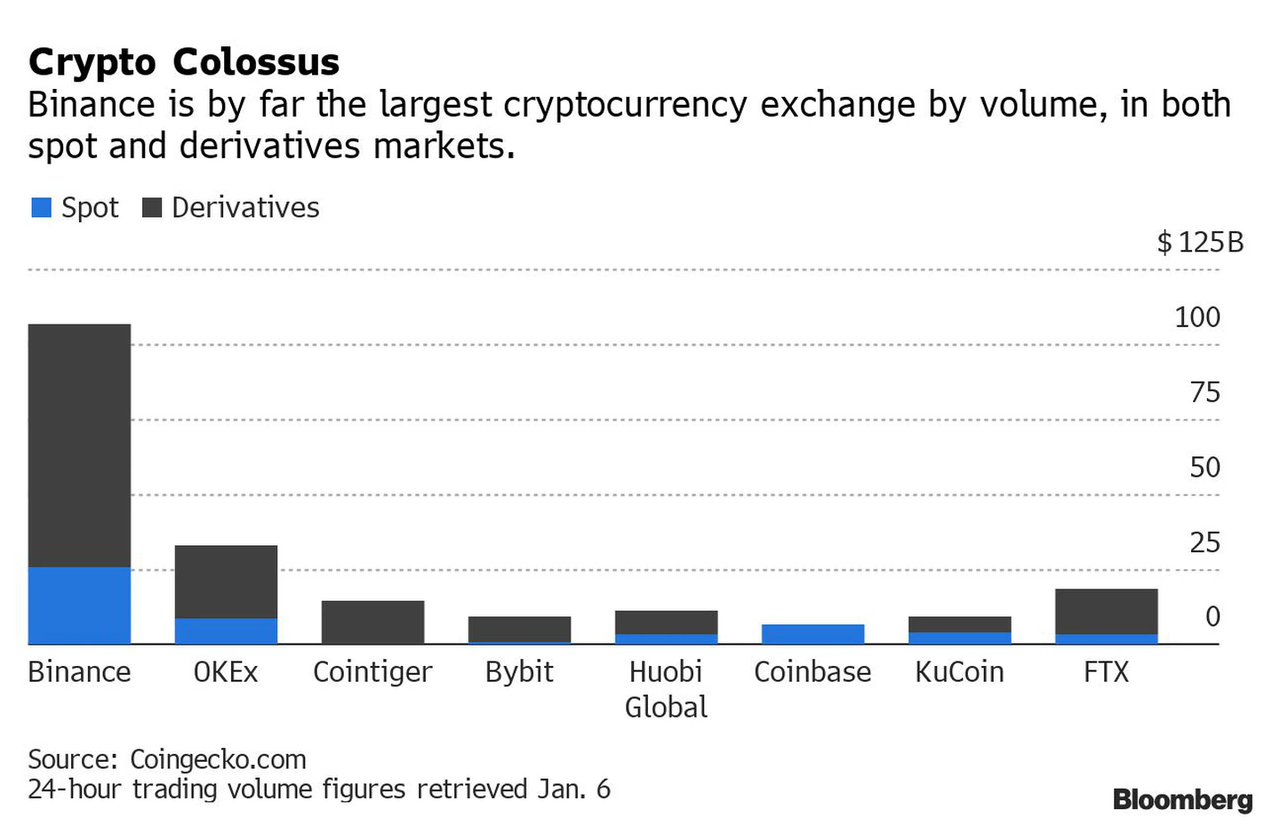
(ZH) Binance's Mysterious CEO Has Quietly Amassed A $96 Billion Fortune

Binance's Mysterious CEO Has Quietly Amassed A $96 Billion Fortune

The owner of the world's largest crypto fortune, which stands at $96 billion, is likely an unsuspecting name that you wouldn't recognize: Changpeng Zhao.
But despite the fact that you've likely never heard of the Binance CEO, who now spends his time meeting with royalty and living in the United Arab Emirates, doesn't mean that he isn't gaining on the list of the world's richest people, on the tails of well known celebrity CEOs like Elon Musk and Jeff Bezos. In fact, he's richer than Asia’s richest person, Mukesh Ambani, the report notes.
Described by Bloomberg as a " former McDonald’s burger-flipper and software developer" turned "the most prominent personality" in the UAE's crypto scene. Zhao is a Canadian citizen who was born in China’s Jiangsu province.
And his fortune could be getting even larger: he still owns a significant amount of Bitcoin and Binance Coin, which was up 1300% last year.
Zhao's rise to riches hasn't come without its bumps in the road. Binance has been banned from China and is facing a number of regulatory probes globally, for example. The U.S. Department of Justice and Internal Revenue Service are probing one of his entities, Binance Holdings, has been used for money laundering and tax evasion.
The Commodity Futures Trading Commission is also looking into potential market manipulation and insider trading within the company, as well as whether it "illegally allowed U.S. clients to trade derivatives tied to cryptocurrencies," Bloomberg wrote.
The company's future will likely hinge on whether or not it can appease regulators. Usually, in our experience, we've found that there's a number that can stave off such probes. We'll have to see if Binance finds itself as lucky.
DA Davidson & Co. analyst Chris Brendler says that Binance generated at least $20 billion in revenue last year, about triple what is expected from Coinbase. In a recent 24 hour span, Binanace did a whopping $170 billion in transactions. A "slow day" is about $40 billion, Zhao said recently. “I don’t care about wealth, money, rankings,” he told Bloomberg in November.
“Coinbase might appear to be the 800-pound gorilla from a U.S. perspective, but Binance is significantly bigger,” Brendler told Bloomberg.
Binance responded: “Crypto is still in its growth stage. It is susceptible to higher levels of volatility. Any number you hear one day will be different from a number you hear the next day.”
Zhao's fortune likely hinges on whether or not he can meet regulators in the middle, which is why it's not surprising that he's embracing regulation. “I’m not an anarchist. I don’t believe human civilization is advanced enough to live in a world without rules,” he said in November.
Binance makes it revenue through holding hundreds of different crypto tokens, which they don't convert to traditional currencies. A favorable regulatory resolution will likely be paramount for the continued existence of some of these tokens.
Zhao said of the tokens: “We just hold them. If you calculate the number today, it’s one number, and 5 minutes later it’s a different number because every price is changing.”
Tim Swanson, head of market intelligence at Clearmatics, cites Binanace's user stickiness as part of their success: "They don’t even have to be the first to list a coin anymore for liquidity to aggregate there."
Binance's goal of being able to operate anywhere has made it tough for regulators to pin down to one location. Brendler commented: “Their approach was, ‘We don’t need a regulator, we are decentralized'. That worked really well for growing and scaling and product innovations.”
But now it's time to see how long that attitude can last. After all, Zhao's fortune may depend on it...

WSJ : TransUnion Brings Credit Data Checks to Crypto Lending

TransUnion Brings Credit Data Checks to Crypto Lending
Credit-reporting firm will let consumers give blockchain companies access through Spring Labs’ ky0x Digital Passport

Cryptocurrency lenders are going to be able to start checking credit reports.

TransUnion, TRU 1.96% one of the three major U.S. consumer credit reporting firms, will let consumers give blockchain companies access to their personal credit data through the security firm Spring Labs’ ky0x Digital Passport.

Consumers will be able to receive better interest rates when borrowing money from financial-services companies that operate on public blockchains such as Ethereum by providing this information, the companies said.

Cryptocurrency investors can currently borrow money by putting digital assets such as bitcoin up as collateral. The companies said that because lenders will be able to check a borrower’s creditworthiness, they might issue loans that don’t require any collateral at all.

More large financial institutions have been starting to participate in the crypto boom. Bank of New York Mellon Corp. and Fidelity Investments have announced plans to provide crypto services for institutional clients such as asset managers and hedge funds. Banks outside the U.S., including Banco Bilbao Vizcaya Argentaria SA and Commonwealth Bank of Australia, have started to sample ways of offering customers the ability to invest and store bitcoin and other digital assets.

Traditional consumer U.S. banks have been more wary. An association representing large banks said that current regulations would prevent them from holding cryptocurrencies. The Basel Committee on Banking Supervision, which sets global standards for banking regulation, laid out a proposal last year that would require lenders to set aside a dollar in capital for every dollar of bitcoin and other cryptocurrencies they held, considering them among the riskiest assets a bank could own.

The market for decentralized finance, or DeFi, assets has grown significantly in recent years, analysts said. The total value of DeFi applications on the Ethereum blockchain soared to nearly $200 billion in November from around $20 billion the year before, according to JPMorgan.

DeFi faces several regulatory hurdles until it becomes mainstream, JPMorgan analysts wrote in a recent note.

“Enforcing know-your-customer and anti-money-laundering checks is a necessary first step, but a general perception that regulations would be naturally less effective on DeFi might prove a major obstacle going forward in terms of regulators allowing DeFi to transition into the mainstream,” said the bank’s analysts.

The Spring Labs’ digital passport currently shows anti-money-laundering and know-your-customer verifications after users go through the registration process and attach the passport to their digital wallets. No personal data are publicly shared, just attestations of the completed processes, the companies said. They expect consumers’ credit data to be available on the passport by the end of this year.

TransUnion’s president of U.S. markets and consumer interactive, Steve Chaouki, said that by providing credit and identity data on the blockchain, more companies will be able to access and develop DeFi and crypto applications while remaining compliant with regulators.

“By having this available, you begin to open the tap for capital coming in, and that increases the competition,” he said.

Last year Spring Labs announced that it had raised $30 million from investors led by TransUnion and that the two companies were working together to increase access to Spring Labs’ data-exchange network and products.

Venture-capital firms invested over $17 billion into digital-asset and blockchain companies during the first half of 2021, according to a Bank of America report, compared with 2020’s $5.5 billion in investments over the same period.

>>> US Gapping down

Gapping down
In reaction to earnings/guidance
:

  • PHG -16%, JEF -2.4%, DGX -1.9%, UTRS -0.7%

Other news:

  • HYZN -10.7% (discloses that it received a subpoena from the SEC for production of documents and information including related to the allegations made in the report issued by Blue Orca Capital)
  • BIIB -9% (Medicare proposes to cover Aduhelm only for patients in clinical trials according to NYT)
  • IAG -5.8% (reports FY21 production and FY22 production guidance)
  • RC -4% (prices offering of 7 mln shares of common stock for gross proceeds of $108.9 mln)
  • LLY -3.6% (in sympathy with BIIB news)
  • NSR -3.4% (entered into an agreement with a syndicate of underwriters that have agreed to buy on a bought deal basis 4400000 common shares at C$9.10 per Common Share)
  • ACRS -2.8% (Chief Medical Officer has stepped down; also provides R&D update)

Analyst comments:

  • KTOS -3.8% (downgraded to Neutral from Buy at Goldman)
  • PYPL -1.9% (downgraded to Hold from Buy at Jefferies)
  • PFC -1% (downgraded to Neutral from Overweight at Piper Sandler)
  • LUV -0.6% (downgraded to Peer Perform from Outperform at Wolfe Research)

>>> US Gapping up

Gapping up
In reaction to earnings/guidance
:

  • INMD +5.1%, PRCT +4.1%, ICLR +3.3%, VAPO +3%, IART +2.7% (guides Q4 revs slightly above consensus; also announces $125 share repurchase authorization), .

Other news:

  • DNA +7.2% (expects to meet or exceed 2021 performance targets)
  • SRLP +5.5% (receives takeover proposal at $16.50/unit)
  • ATAI +3.9% (announces FDA Investigational New Drug (IND) clearance for PCN-101 R-ketamine program)
  • PSTL +3.7% (provides an update on its portfolio)
  • MFG +3.6% (acquires Capstone Partners)
  • ALLY +2.6% (approves $2 bln share repurchase program; also increases dividend)
  • RDFN +2.3% (to acquire Bay Equity Home Loans for $135 in cash and stock)
  • CROX +2% (CEO appears on CNBC: says Wall Street may not fully appreciate HeyDude acquisition)
  • PEI +1.7% (reports holiday traffic and progress on key strategic initiatives)
  • X +1.3% (announces new steel production facility)
  • APAM +1.3% (reports December AUM)

Analyst comments:

  • WOLF +4.3% (upgraded to Overweight from Equal Weight at Wells Fargo)
  • LC +3% (upgraded to Buy from Neutral at Janney)
  • LAC +2.8% (upgraded to Outperform from Market Perform at Cowen)
  • AMBA +2.7% (upgraded to Overweight from Equal Weight at Wells Fargo)
  • DASH +2.4% (upgraded to Outperform from In-line at Evercore ISI)
  • SNOW +2.4% (upgraded to Overweight from Equal Weight at Barclays)
  • TTWO +1.4% (upgraded to Outperform from Market Perform at BMO Capital Markets)
  • WFC +1% (upgraded to Overweight from Neutral at Piper Sandler)