FT : Distressed debt titans Anchorage and Oaktree reveal industry shift

Distressed debt titans Anchorage and Oaktree reveal industry shift
Low levels of debt defaults have forced funds to adapt investing strategies

Two of the best-known scavengers on Wall Street shared similar thoughts about the state of distressed debt investing late last year. The two firms — Anchorage Capital Group and Oaktree Capital Management — each lamented how years of economic expansion and easy money had kept corporate defaults and bankruptcies low. In turn, that has left few openings for their respective firms to scoop up discounted corporate loans and bonds.

The pair’s similar thinking, however took them on different paths. Anchorage announced in December that it was closing its $7.4bn flagship credit hedge fund, ACP Capital, after 18 years and returning the capital to its backers.

Oaktree, on the other hand, announced in November that it had raised $16bn for a fund after convincing its investors that, even if traditional distressed debt investing had become more challenged for now, its skills could be transferred elsewhere.

While the external market developments in credit investing are noteworthy, the duo’s respective decisions also offer a window into how the internal structure of private investment firms affects their ability to function and ultimately make money.

Anchorage was founded in 2003 and is perhaps best known for owning MGM Holdings, which it sold last year to Amazon for $8.45bn including debt. It had also been a player in such distressed assets as retailer J Crew.

The firm’s soon-to-be-shuttered hedge fund is a traditional “evergreen” vehicle. In such a structure, the fund has an ongoing life in which investors can put in and withdraw their money with relative ease. In its letter to investors seen by the Financial Times, Anchorage wrote that the tradeable part of the leveraged credit world, a key return driver for an evergreen fund, had “to a large degree, been squeezed from the market”.

The firm said the marketplace for buying and selling debt had become more illiquid as “banks’ role in intermediating risk has been substantially reduced”. For hedge funds, the mismatch is obvious: their capital base is highly liquid and potentially unstable, but the opportunities in the market are no longer quickly flippable and instead require time, flexibility and patience.

Other industry observers point to how corporate restructurings and bankruptcies have evolved. Increasingly, if creditors are to have the chance to make real money, they must not only buy up existing bank loans and junk bonds, but also be willing to write big cheques to fund a stint in bankruptcy court or exit financing. Medium-sized hedge funds risk getting steamrollered by the handful of juggernauts such as Elliott or Apollo, which have enough heft to pull the strings in deal processes.

As it happens, the new $16bn Oaktree fund is the opposite of the unstable “evergreen” structure. Rather the Oaktree fund is a “drawdown” vehicle with a 10-year life where capital is requested when needed. Given the cut-throat competition for the limited number of troubled companies at the moment despite the pandemic, the massive capital raising might be surprising. Debt default rates are currently 1 per cent a year compared with historical levels of 5 per cent. But Oaktree thinks it has other tricks up its sleeve until the defaults revert to the higher levels.

“We believe the right move has been to broaden one’s mandate, eschewing boundaries”, the firm wrote in a recent memo. “By doing so, an investor 1) is well-positioned to take advantage of dislocation wherever it occurs 2) has the flexibility to tackle non-distressed situations in which a background in distressed credit can be a potential advantage.”

The Oaktree “Opportunities” fund, as the firm has labelled it, has already quickly deployed billions. This includes investment in the 2021 bankruptcy exit financing of Hertz as well as in funding companies going public through blank cheque companies, as well as in pre-IPO companies.

One former hedge fund executive explains that evergreen funds typically cannot move fast enough to execute when good ideas arise. “Cycles are quick. You can’t be a hedge fund that is already fully invested and also have the ready cash needed to reposition yourself,” says Dominique Mielle, a retired executive at Canyon Partners.

Still, other industry observers caution that one should not draw too many lessons from the choices of any single fund without considering idiosyncratic factors. The firms themselves have hedged their bets. Oaktree also has a small evergreen hedge fund. Anchorage, the broader firm, also is not folding. It still will manage its own existing drawdown funds.

WSJ : China GDP Grew 8.1% in 2021, Though Momentum Slowed in Fourth Quarter

China GDP Grew 8.1% in 2021, Though Momentum Slowed in Fourth Quarter
China’s GDP grew just 4% in the fourth quarter compared with a year earlier

BEIJING—China’s economy expanded 8.1% last year as a pandemic-plagued world snapped up its goods, though slowing growth in the final months of the year points to challenges ahead for its economy.

As expected, the annual gross domestic product figure easily topped Beijing’s official growth target of 6% or more, as exports surged to a record high. The 8.1% growth figure for 2021, which matched economists’ forecasts, adds to the country’s post-pandemic recovery, after China eked out a 2.2% expansion in coronavirus-ravaged 2020.

The challenge for the world’s second-largest economy this year is to keep the post-pandemic recovery rolling for a third year, even as momentum slows and Beijing continues to push longer-term reforms in the economy to boost its birthrate, reduce inequality, lower debt and make the country less dependent on the world.

China’s leader, Xi Jinping, is widely expected to break with recent precedent and seek a third term in power—a political goal that demands a measure of economic stability and continued growth.

Underscoring concerns about growth momentum this year, China’s central bank on Monday slashed two sets of interest rates, which will fuel expectations for an additional cut to China’s benchmark lending rates. The People’s Bank of China lowered its benchmark loan prime rate last month after leaders pledged to give priority to growth stability in 2022.

How China’s economy fares this year will also have ramifications for the rest of the world, which sells the country many of the natural resources it needs and, in turn, relies on its manufacturing might and central place in global supply chains.

After outperforming most other major economies in 2020, China was a relative laggard in 2021, registering below-potential growth for much of the year, said Tingting Ge, a greater China economist at JPMorgan Chase in Hong Kong.

“While the U.S. and some other economies were moving to gradually close the gap from the pre-pandemic path, China has fallen below [the] pre-pandemic potential path recently after a temporary above-trend growth,” Ms. Ge said.

The story of the Chinese economy last year had two distinct chapters: In the first half, GDP soared 12.7% from a year earlier, as the export-led recovery hit its stride and favorable comparisons to the darkest days of the initial Covid-19 outbreak flattered figures.

By contrast, in the second half of 2021, the economy began to feel the impact of measures imposed by regulators in Beijing to rein in some of the country’s most important engines of growth, chief among them the real estate and technology sectors.

The impact of those moves coincided with soaring commodity prices, power outages, snarled global supply chains, shortages of semiconductors and global rises in Covid-19 infections, including the Delta and Omicron variants.

“China’s economy is facing threefold pressure of demand contraction, supply shocks and expected growth weakening,” Ning Jizhe, China’s statistics chief, said Monday.

More difficult statistical comparisons to the stronger back half of 2020 also raised the bar. As a result, year-over-year GDP growth for the final two quarters of 2021 came in at just 4.9% and 4.0%, dragging down the full-year figure.

Much of the blame for the overall weakening economic outlook can be laid at the feet of Covid-19, which has continued to torment the world with outbreaks and new variants.

Within China, which is largely closed off from the rest of the world due to strict border restrictions, a steady drumbeat of domestic virus outbreaks nonetheless continued to drag down domestic consumption, which is entering its third year of underperformance.

In December, China’s retail sales, a key gauge of domestic consumption, rose just 1.7% from a year earlier, lower than November’s 3.9% increase and the 3.6% growth expected by economists.

In Xi’an, a city in central China that was locked down in late December after an outbreak of coronavirus infections, one listed chain restaurant, Xi’an Catering Co., said in a filing that it had been ordered to suspend all in-store dining, with no certainty about when it would be able to reopen.

Unlike the U.S.’s stimulus program, which sent cash directly to households, China focused its efforts on supporting businesses.

As a result, Feng Jungui, a housecleaner from northern Hebei province, said she hasn’t been able to regain the level of income she enjoyed before the pandemic.

Ms. Feng, who has been working in Beijing as a migrant worker for the past six years, estimates she is now only able to take home about 5,000 yuan, equivalent to less than $800, each month—roughly 40% less than before Covid-19 hit.

“I can’t afford any extra consumption,” she said, pointing to mortgage payments back home and rising living expenses in the capital.

The arrival of the Omicron variant in several Chinese cities in recent days, including in Beijing ahead of the Winter Olympics, when thousands of foreign visitors will travel to the country, has stoked concerns of a wider spread of the highly contagious variant.

Concerns about the virus have already prompted economists at Goldman Sachs to lower their forecast for China’s GDP growth in 2022 to 4.3% from 4.8%.

The Omicron variant also threatens to disrupt the country’s manufacturers and exporters, whose strong performance helped drive China’s trade surplus to a record high last year.

Coronavirus-related lockdowns and mass testing have already disrupted operations at factories like those operated by South Korean memory-chip manufacturer Samsung Electronics Co. and German auto maker Volkswagen AG .

So far, though, manufacturers appear to have held up. The fourth quarter’s GDP growth rate of 4.0% was actually stronger than the 3.8% pace expected by economists polled by The Wall Street Journal.

That is primarily because of an upside surprise in industrial production, which rose 4.3% in December from a year earlier, China’s National Bureau of Statistics said Monday, better than the 3.6% growth expected by economists and up from November’s 3.8% year-over-year increase.

China’s regulatory crackdowns—most critically, on property developers—have also taken a toll.

Fixed-asset investment, which measures investment in the infrastructure, property and manufacturing sectors, increased 4.9% in 2021 from a year earlier, slowing from the 5.2% growth recorded for the January to November period.

The slowdown in overall investment was dragged down mainly by the real estate slump. Property investment rose just 4.4% for the full year of 2021, weakening from the 6% growth rate for the first 11 months of the year. By comparison, property investment rose 7% in 2020.

New construction starts by property developers, meanwhile, dropped 11.4% in 2021, as China’s property developers faced a cash crunch.

“China’s economy headed into 2022 with multiple headwinds and the property downturn would be the biggest one,” said Larry Hu, chief China economist at Macquarie Group.

While the government’s regulatory moves were expected to slow growth, the rapid loss of momentum has prompted officials to tilt their policies ever so slightly in favor of growth and stability.

Commercial banks have extended more mortgage loans to home buyers amid signs of a deepening slump in the real-estate market. Regulators have also eased off on some of their more stringent measures to rein in coal production, a move that has relieved some concerns about power supply.

Economists widely believe Beijing will enact more easing measures in the coming months in a bid to defend what they expect will be a bottom line of 5% economic growth in 2022. The government will formally release its annual growth target in March.

FT : Citadel and TCI drive top 20 hedge fund managers to bumper $65bn gains

Citadel and TCI drive top 20 hedge fund managers to bumper $65bn gains
Group’s biggest rise in more than a decade comes despite patchy year for the sector

Large profits at Ken Griffin’s Citadel and Sir Christopher Hohn’s TCI helped the 20 best-performing hedge fund managers of all time to their biggest gains in more than a decade last year, although returns for the overall industry failed to keep pace with the rally in global stock markets.

The top 20 managers, who also include Izzy Englander’s Millennium Management and Paul Singer’s Elliott Management, made total gains of $65.4bn, ahead of 2020s $63.5bn according to research by LCH Investments. That was their biggest annual gain since the fund of hedge funds run by the Edmond de Rothschild Group began compiling its data in 2010.

The improved returns at some of the top funds comes despite a tough year for much of the $4tn hedge fund industry. While the sector drew plaudits for its performance during the early stages of the pandemic in 2020, a series of market shocks last year made life more difficult.

Hedge funds gained 10.3 per cent on average, according to data provider HFR, well behind the 27 per cent rise in the S&P 500 and the 20 per cent increase in the MSCI World index. Years of stubborn underperformance have caused many investors to quit the sector, with many instead turning to private equity and private debt markets.

“Hedge fund returns in 2021 varied greatly”, said Rick Sopher, chair of LCH Investments, adding that the overall industry’s gains “were quite modest, especially when compared with the strong performance of equity indices”.

Of the 20 funds, Hohn’s $44.4bn-in-assets TCI was the biggest winner in dollar terms, making $9.5bn for investors. The fund, a highly concentrated portfolio of equity positions, gained 23.3 per cent, said people familiar with its performance, helped by positions in stocks including Alphabet and Microsoft.


Citadel made $8.2bn, returning 26.3 per cent. The so-called multi-manager funds such as Millennium and Citadel, which employ multiple teams of traders, profited from diversification across a range of strategies and asset classes and their ability to cut risk rapidly when conditions sour.

However, a number of funds struggled last year, particularly those betting on rising and falling equity prices. While headline indices soared, many funds lagged behind because they tended not to hold large positions in the small number of mega-cap stocks that drove index gains. Funds were also hit as an army of retail investors pushed up the price of some meme stocks they were betting against.

Among those hit were several of the so-called Tiger Cubs — managers who came out of Julian Robertson’s Tiger Management — who have also lost out during the recent sell-off in technology stocks.

Chase Coleman’s Tiger Global lost $1.5bn for investors last year, according to LCH, and slipped from 14th to 16th place in the list of all-time moneymakers for investors. Its hedge fund lost about 7.5 per cent, with positions such as DoorDash and Pinduoduo falling sharply late in the year.

Andreas Halvorsen’s Viking slipped from sixth to eighth after gains of just $1.3bn, while Steve Mandel’s Lone Pine fell from third to sixth after making no money for investors, according to LCH.

“Equity long-short managers generally struggled. Shorting was difficult, especially in the face of meme stock rallies, and there were sharp market rotations,” said Sopher.

TCI’s gains lifted the hedge fund from 13th to ninth in the performance rankings, with $36.5bn of gains since inception. Also rising up the rankings from fourth to second place was Citadel, whose total gains since inception rose to $50bn, leaving it behind Ray Dalio’s Bridgewater with $52.2bn.

Englander’s Millennium, meanwhile, which made about 13 per cent or $6.4bn, advanced from seventh to fifth place.

FT : Has Sony become the entertainment group it always wanted to be?

Has Sony become the entertainment group it always wanted to be?
The Japanese corporation is on the cusp of full integration but critics say it needs to be wary of distractions like electric vehicles

When Sony released the trailer for its forthcoming swashbuckler Uncharted in October, the global fan base of the video game on which the film is based was outraged. Mark Wahlberg seemed perfectly cast as the roguish mentor figure Sully in the Indiana Jones-style adventure, but where on Earth was the character’s signature moustache?

The answer — in a move fans of the hugely popular PlayStation game now see as evidence of Sony’s masterful trolling in the social media age — came in the very final shot of the second trailer, released two months later. This time the moustache was there, but the world must wait until the film opens in February to discover the full mystery behind its dramatic re-emergence.

An even bigger puzzle surrounds the transformed nature of the company that put this trick together. Have investors truly worked out how to value the 76-year-old tech and entertainment company? Is Sony serious about getting into electric vehicles, which some see as a dangerous distraction? And, most importantly, has it finally got its swagger back?


The Uncharted moustache “bait-and-switch” is an example of a newfound confidence at Sony. The $157bn symbol of corporate Japan, say an increasing cohort of investors, may be on the verge of achieving an ambition decades in the making but which has long eluded it: to become the world’s most fully integrated entertainment company.

Over many years Sony has either created or bought the right instruments to achieve its goal: world-class music catalogues ranging from Miles Davis to Mariah Carey, Hollywood film and television studios, plus PlayStation, the leading games group. But it could never quite make the orchestra play in harmony.

Now, despite the seismic changes shaking all corners of the entertainment world — including streaming services for music, movies and TV, blockchain-based gaming and the disruptive promise of the metaverse — Sony appears to have finally found a way to make its distinct entertainment groups work together.

Its movie studio is producing Spider-Man and other Marvel blockbusters, while a deep library of films and TV shows is helping to fill the bottomless appetite for streaming content. A revived music business, the world’s second largest, is profiting from the growth of Spotify and TikTok. And with PlayStation, it has decades of experience in games — a sector that Netflix, Apple, Amazon and other deep-pocketed players are desperate to crack. All this with cutting-edge hardware, including the VR headsets and other gear that many believe will be the gateway to the metaverse.

“[Sony’s] strategy puts it in a uniquely powerful position,” says Pelham Smithers, an independent analyst who has covered the company for many years. “They have music, TV, films, video games: things that everyone [else] wants, but only Sony actually does at scale and in a joined-up way.

“Looking ahead to a time when entertainment is consumed in even more immersive settings, there is no company more obviously central to the metaverse,” he adds.

Strength and unity
Investors seem to agree. Sony shares are at a 20-year high, with the overwhelming majority of analysts covering the stock rating it as a “buy”.

The Uncharted series, a flagship title for two generations of players of Sony’s PlayStation consoles, is a good example of the strategy in action. The film release is the result of collaboration between the company’s games division and Sony Pictures — a partnership that might once have seemed impossible in the group’s notoriously siloed culture.

“The companies had been trying to do Uncharted for 10 years,” says Tony Vinciquerra, chair of Sony Pictures Entertainment. “When I first got here [in 2017], I asked, ‘Why can’t we get this stuff done?’”

The project got off the ground after Vinciquerra discussed it with Jim Ryan, president of Sony Interactive Entertainment. Once Uncharted achieved lift-off, 10 more projects went into development between the games unit and Sony Pictures.

“We just needed people to try to do what’s right for Sony as a whole,” Vinciquerra says in what could be seen as an implicit criticism that the company had been working more as a collection of independent empires.

During the past 20 years, investments often looked ill-judged. Business lines were retained for what former senior management now describe as “sentimental reasons”, leaving a misshapen conglomerate, institutionally resistant to streamlining or unity.


“Culture issues are very important,” says Kenichiro Yoshida, a 32-year veteran of the company who became Sony chief executive in 2018. “It is very important for us to collaborate.” The Uncharted project is an example of the cultural change he wants to foster at Sony. “I strongly recommended” that the Sony Pictures and PlayStation teams begin working together, he adds.

Mio Kato, an analyst who publishes on the independent investment research platform Smartkarma, says Yoshida has “executed and pushed things through” since taking charge. “I don’t think people see how big a competitive gap there is between Sony and others in this space. Sony just seems to have better ideas faster. They have recaptured their powers of innovation,” Kato says.

Opting out of the streaming wars
One of the most streamed programmes in America week after week is not an acclaimed original Netflix production such as Squid Game or Stranger Things, but Seinfeld, a dated sitcom that debuted 33 years ago, according to Nielsen data.

The comedy series is streamed exclusively on Netflix thanks to a five-year deal agreed in 2019 with Sony Pictures Entertainment, which holds the rights. The bidding between the streaming services was intense, and in the end, the rights sold for $500m.

Far smaller than its rivals in Hollywood, Sony Pictures decided the smartest strategy in the streaming wars was to opt out of them altogether. Instead of launching its own service, it took what Sony executives call an “arms dealer” approach of selling film and TV rights to the highest bidder.

It certainly appears to be a seller’s market, as Disney, Amazon, Apple, Warner Bros and others are expected to spend billions on content in pursuit of streaming subscribers. The top eight US media companies are forecast to spend about $140bn on content in 2022, with the streaming wars fuelling double-digit spending increases for the next few years, according to estimates by Morgan Stanley.

“The streaming wars are good for us,” Vinciquerra says. “[The streaming services] say they will be profitable in 2023, 2024 and they may well be, but the amount of investment to get there is phenomenal. It’s billions of dollars. And they’re doing that by buying from us.”

Last year Sony made deals with the top two streamers — Netflix and Disney+ — to give them streaming rights to its theatrical releases between 2022 and 2026. Together, the deals are estimated to be worth close to $3bn.

Some analysts say Sony’s arms dealer approach is looking smarter as subscriber growth slows at services like Netflix and Disney+, prompting questions among bearish investors about whether streaming will ever make much money. Across the industry there is an expectation that there will be a period of consolidation among the streaming groups once the “land grab” phase is over, leaving just a handful of services.

This is where the potential risk for Sony’s strategy lies. The arms dealer strategy is “certainly different from what everybody else is doing”, says Doug Creutz, an analyst at Cowen & Co in San Francisco. “Everybody else wants to be Netflix and is currently losing vast amounts of money [trying to achieve that].”

For Sony, he says the potential problem is that there will be fewer companies to sell its content to after the inevitable consolidation that will follow the streaming wars, eroding the price advantage it has now.

To hedge against this, Sony is betting on niche streaming services, or what Yoshida calls “communities of interest”, to serve small groups of dedicated viewers in areas ranging from anime to a faith-based service. Sony is also building a general entertainment streaming service in India following the acquisition of Zee Entertainment last year — a market also being pursued aggressively by Netflix and Disney+.

The other plank of the turnround of Sony’s entertainment businesses has been improvement in the motion picture division. Profits at the group have risen dramatically under Vinciquerra and Tom Rothman, who runs Sony Pictures Entertainment Motion Picture Group. Much of the division’s success is down to the Spider-Man franchise, which helped it prosper in 2021 — despite another dismal, Covid-racked year for the global box office.

Sony Pictures had three of the top 10 films in the US, led by Spider-Man: No Way Home, which brought in more than $668m after its December release and quickly became the sixth biggest grossing picture in US cinema history. The group is expected to report record profits of $950m in 2021 — up 150 per cent from 2017.

Sony executives readily admit that their film and TV studio is “subscale” compared with Disney, Warner Bros and other Hollywood groups. But Yoshida says he is committed to keeping the studio, despite industry consolidation as seen by Amazon’s $8.45bn acquisition of MGM last year.

“It’s no secret that we’re a very small player among giant competitors,” Vinciquerra says. “We are subscale but if you put the three [entertainment] companies together we have a lot of assets, a lot of [intellectual property] and we can compete where we need to.”

Defeat from the clutches of victory?
Yet several large shareholders believe there will always be risk and scepticism around the company. For all its globalisation, Sony remains a Japanese corporation at a time when global investors are either frustrated or dismissive of the profit and value-creating powers of managements in the country.

Since Yoshida took the reins, Sony’s shares have risen more than 180 per cent. But even at that elevation, it commands a valuation roughly 20 times smaller than that of Apple. Sony’s home stock market is lacklustre, but this vast disjoint remains in place, says Smithers, despite Sony standing out from most Japanese companies due to its greater focus on return on equity and on making the firm’s capital work hard through buybacks and unexpectedly successful acquisitions.

Damian Thong, a veteran analyst of Sony at Macquarie in Tokyo and one of the few analysts with a “neutral” rating on the stock, says there are a number of reasons for caution around the great Sony transformation story.

Particular alarm bells, he notes, were sounded by the company’s announcement at the start of January that it was creating a new subsidiary — Sony Mobility — to explore entering the electric vehicle market. The project, which emphasises the idea that cars of the future will essentially be rolling entertainment centres, may be more shopfront for its products than a true intent to take on Tesla or Toyota.

Locked into the ambition and pizzazz of the announcement, say a number of observers, was a flash of something of the “old” Sony and a historic propensity to lose focus at just the wrong moment. On one hand, says Thong, the ambition and willingness to take risks was impressive given the company’s conservative approach in other areas. The attractions of the $3tn automotive market is strong, as is the clear love among investors for automotive disrupters.

“On the other hand, we think the likelihood of Sony succeeding in cars is low, and we are concerned that a full-on push into the EV business will destroy value, bringing years of losses,” says Thong. He adds that although EVs demanded a lower minimum business scale than traditional carmaking, it was hard to expect any kind of profits from this venture for Sony in the 2020s.

Apple, he says, has been working on its car project for over seven years with no apparent result.

The problem, as ever with Sony, he adds, is that history is an imperfect guide. The company’s 1980s success in consumer electronics came despite the scepticism of US incumbents. Its success in games came despite the sneers of Nintendo and Sega. Its success in mobile phones and PCs, which at one point seemed highly probable, turned out to be wholly elusive.

It is no coincidence that Sony feels so attached to the Uncharted series — games whose far-fetched narrative of treasure-hunting hinges on the combination of luck and judgment. For years, Sony has struggled to have both at the same time.

Creutz says the company has finally got the mix right. “For a long time they were a big conglomerate in search of an identity,” he says. “But now they’ve figured out the right focus on entertainment, where they have a strong position in both music and video games — and are attractive in TV and movies because they can sell content to the highest bidder.”

FT : Family businesses in Saudi Arabia go public as stock market booms

Family businesses in Saudi Arabia go public as stock market booms
Companies willing to open up to external shareholders and greater scrutiny as pandemic exacerbates pressures

Saudi family-owned companies, long resistant to opening their books to outside shareholders, are lining up to list stakes as the country’s stock market booms, sometimes in the hope that bringing in outside investors will help them weather internal disputes.

Almunajem, one of Saudi Arabia’s largest food companies, in December became one such company to list on the bourse, known as the Tadawul, while the exchange was on a multiyear high. The Riyadh-headquartered group offered a 30 per cent stake which raised around $300m.

“It’s a very good move, at least to institutionalise the business from a governance and continuity perspective,” said chief executive Thamer Abanumay, a non-family member. The move should also help the company to “diversify our capital for growth”, he said.

Other family companies that listed last year include Theeb Rent a Car and Alkhorayef Water and Power Technologies. Nahdi Medical, the country’s largest pharmacy chain, has received regulatory approval to float shares.

Saudi Arabia has long been keen to boost its capital market as it seeks to diversify its oil reliant economy. In 2019, the government listed 1.7 per cent of state oil company Saudi Aramco raising $29.4bn in a blockbuster IPO. Yet going public has been treated with reluctance by many family-run companies wary of opening their books or answering to external shareholders, even though remaining private ran a greater risk of infighting — and in some cases even collapse — as new generations inherit businesses.

However the pandemic, which caused the Gulf kingdom’s economy to shrink by about 4 per cent in 2020 and heaped further pressure on companies that had been struggling with rising costs and subdued growth in recent years, prompted some to rethink their strategies said officials and analysts.

The economy bounced back in 2021, with a projected growth of almost 3 per cent according to the latest budget. Meanwhile, a rebound in oil prices last year helped propel the Tadawul to a multiyear high of almost 12,000, a 30 per cent growth year on year, further enticing companies to sell stakes.

The pandemic reminded a lot of private businesses “that in order to remain sustainable in all circumstances, I need to have all available financing options — and I think it became fairly clear if you are listed you have more financing options than if you are not”, said Mohammed bin Abdullah Elkuwaiz, chair of the Capital Market Authority.

As well as bringing in cash and access to capital markets, floating shares also encourages new talent to join companies and puts the onus on them to develop good governance.

Elkuwaiz said he had heard stories of family businesses “that were thriving from an operational standpoint” but had become mired because of disputes. Opening themselves up to outside shareholders was one of “the benefits of being listed in the capital market”.

Saudi Arabia’s private sector “is driven by family businesses”, said Basil Ghalayini, chief executive of BMG Financial Group, that often had large numbers of siblings and relatives. “There [are] a lot of stories of big family businesses who basically collapsed over the last 10 years, and they had hired hundreds or thousands of employees,” he said.

Munajem has gone against the grain of its peers and has been hiring external chief executives for a decade.


Last year, 15 companies listed on Tadawul or its secondary market Nomu, which has less stringent requirements to encourage smaller businesses, according to the CMA. This compared with eight in 2020, and Elkuwaiz added that dozens more were in the pipeline, of which some were family businesses.

The CMA’s list of requirements and disclosures for prospective floats includes some that family owners are unaccustomed to, such as the stipulation that they announce any action that could affect their share price.

Some that have listed have privately expressed regrets about the greater scrutiny to which they are now subjected said Ahmed BinDawood, chief executive of BinDawood Holding, one of Saudi Arabia’s biggest retailers. It floated a 20 per cent stake in late 2020, raising about $585m.

“They say it’s a nightmare and [would] prefer to take the company back to being private again,” he said. “When we ask them why, they say you have lots of committees and there is the board and we have to explain. [Shareholders] challenge us with ideas . . . a guy with maybe 10 shares coming questioning why I’m taking this action.”

This is despite most families choosing to only list a stake and remaining the majority owners. The Saudi market was included in the MSCI Emerging Markets Index three years ago, bringing in billions of dollars of foreign investment. But Tarek Fadlallah, chief executive of Nomura Asset Management in the Middle East, said global active fund managers are still underweight in the market which is dominated by local investors. 

More family-owned businesses are either taking the plunge or considering it, BinDawood added, saying he had been approached by more than a dozen such businesses asking for advice.

BinDawood does not regret going public and cited a study that he said showed only 14 per cent of family-owned businesses survived past the third generation. He added his father and uncles were willing to bring in outsiders “competent to handle the company” and to ensure good governance.

Private companies cannot afford bitter internal disputes. Many have struggled over the past five years with rising costs and in some cases being crowded out by state owned-entities, particularly the sovereign Public Investment Fund, and companies it controls.

“Covid did affect a lot of family businesses. Cash has shrunk. The best way to quickly access liquidity is to list, monetising shares,” said BinDawood.

The main incentive to list now comes from the strength of the market, said Fadlallah. “If you’re a company looking for a high valuation, this is an optimal opportunity,” he said.

A rash of non-family-owned companies are also planning to go public. Tadawul itself has announced plans to list, with the exchange targeting a valuation of more than $3bn.

Another is Jahez, a popular food delivery app, which will become the first Saudi tech start-up to do so in the region when it floats a 18 per cent stake on Nomu.

Chair Mishal Bin Sultan al-Saud said going public should make the company more attractive to top-tier hires. “It gives a new profile, a new edge, a new image to your company . . . and it results in being a talent magnet,” he said, adding it would bring more “transparency and corporate governance”.

FT : City Airport boss banks on revival of business travel to pre-pandemic level

City Airport boss banks on revival of business travel to pre-pandemic levels
Sinclair resists shift away from corporate to leisure customers as investors offer financial backing to help navigate crisis

London City Airport’s boss is banking on the revival of corporate travel to help it recover after turning to lenders and shareholders to raise hundreds of millions of pounds to navigate disruption from the pandemic.

Robert Sinclair said he is “very optimistic” the travel industry will recover rapidly from the impact of the Omicron variant, and predicted a “step change” in demand for flying from this summer.

“Two years into this pandemic, I think hopefully we are starting to see the end of it . . . the government’s messaging around living with Covid is hopefully resonating with people,” Sinclair told the Financial Times.

Significantly, he has resisted shifting the airport’s model away from lucrative corporate customers, despite fears business travel could struggle to recover to pre-pandemic levels in an era of videoconferencing, changing work patterns and climate awareness.

In the autumn, when passenger numbers hit their highest levels of the crisis, business travel returned to 35 to 40 per cent of normal levels, he said.

London City has the highest proportion of business flights of all UK airports, a status Sinclair guards “jealously” because it attracts airlines looking to generate more money per passenger through higher fares.

Shareholders are also backing the airport through new funding with £200m in loans and a £190m private placement to help it survive the collapse in passenger numbers.

The “strong support” from shareholders and lenders underlined the long-term resilience of airports as attractive investments, said Sinclair.

“It has been very good for us to see the response from the financial markets, that I think do not see this as being an existential event,” he added.

His optimism follows two torrid years for an airport that has built up a loyal following from business executives who value its proximity to London’s financial districts and emphasis on quick, hassle-free travel.

Just 714,000 passengers travelled through the airport in 2021, less than 15 per cent of 2019 levels and lower even than the 905,000 travellers in 2020, when there was a normal start to the year.

The collapse mirrors the trend at larger rival Heathrow, which carried fewer passengers in 2021 than in the first year of the pandemic.

But while Heathrow boss John Holland-Kaye was notably downbeat about the pace of the travel industry’s recovery as he urged the UK aviation regulator to allow him to raise landing fees, Sinclair said he expected to return to close to pre-pandemic levels of flying at London City this year.

“We do think it will return to pre-pandemic levels, but it will take longer [than leisure travel],” he said.

City Airport had spent the years before the pandemic diversifying to attract leisure customers to complement its regular stream of corporate travellers, providing a welcome buffer during the pandemic.

It is a strategy the airport intends to maintain, with the announcement of new leisure-focused routes for this summer, including Thessaloniki, the Greek port city, and Barcelona on British Airways.

“It is a large market which we are increasingly tapping into. But equally, it doesn’t come at the detraction of our core market, the bread and butter for London City, which is business travel,” Sinclair said.

(ZH) Flight Cancellations Soar As Brutal Winter Storm Slams Eastern US

Flight Cancellations Soar As Brutal Winter Storm Slams Eastern US

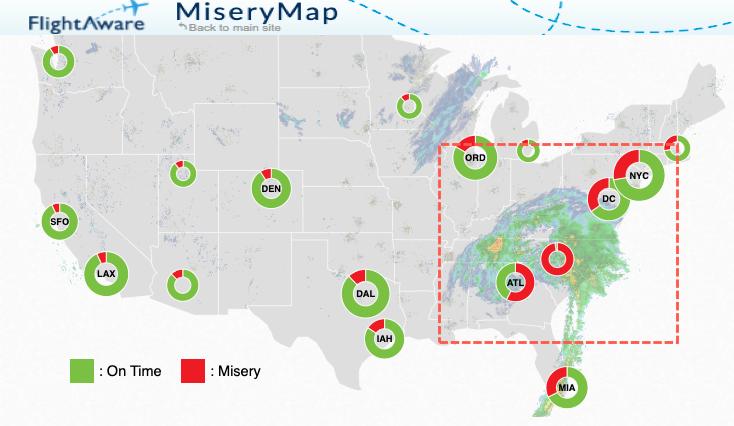
Update (1335ET): As the eastern half of the United States braces for a winter storm on Sunday, flight cancellations are rising this afternoon, making travel a huge pain for flyers.
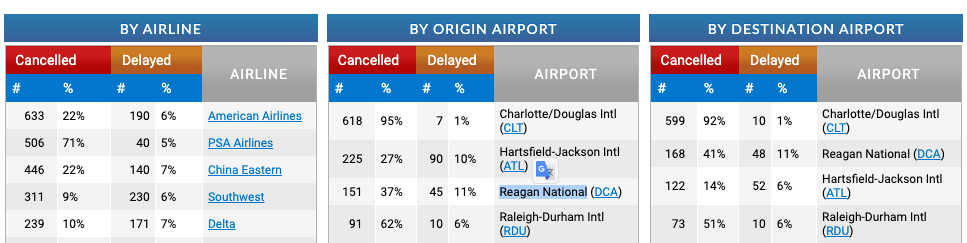
According to data provided by FlightAware, there are 2,748 flights cancellations within, into, or out of the US. Delays within the US are increasing as well, up to 1,466. American Airlines canceled 22% of its flights or about 633. Southwest canceled about 9% flights or about 311. Delta canceled 10% flights or about 239.
FlightAware revealed most of the canceled flights originated at airports in the Southeast, Mid-Atlantic, and Northeast, such as Charlotte Douglas International Airport (95% of flights canceled totaling 618), Hartsfield-Jackson Atlanta International Airport (27% of flights canceled totaling 225), and Ronald Reagan Washington National Airport (37% of flights totaling 151).

The high number of cancellations is a multiprong issue. First, crew shortages showed no signs of easing three weeks after Christmas Eve. Second, a winter storm is battering the Southeast and heading up the coast late evening.
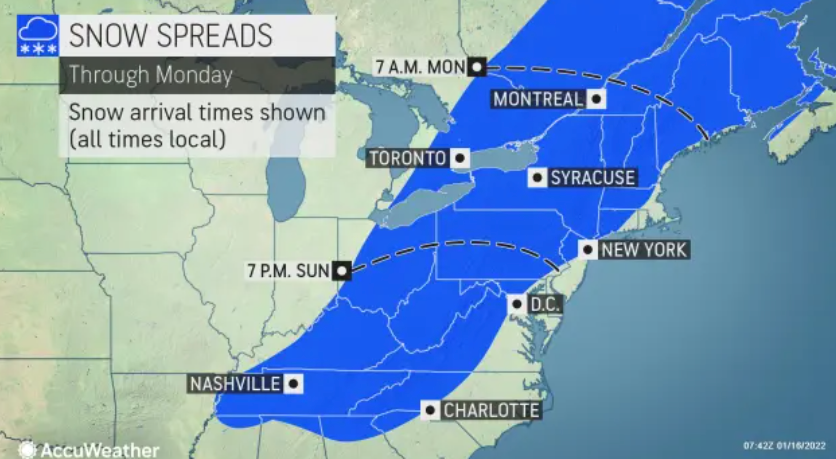
Flight cancellations and delays should only increase as the storm inches closer to the Baltimore–Washington metropolitan area. Much of the snowfall will be west of the Interstate 95 corridor.
* * *
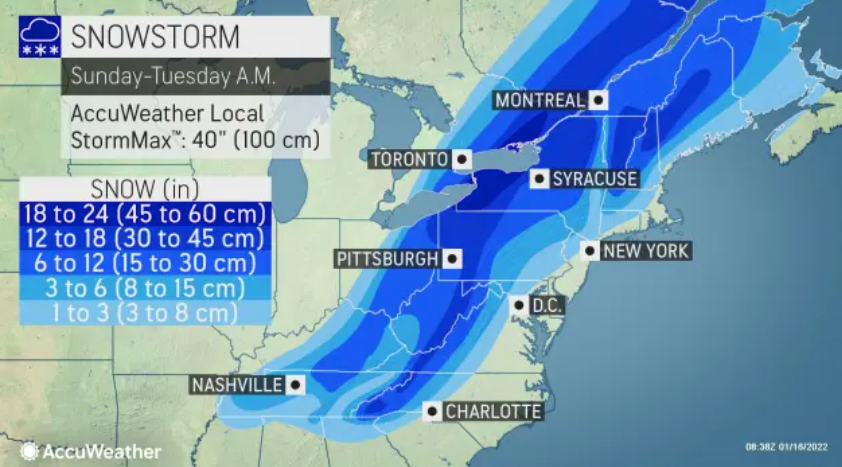
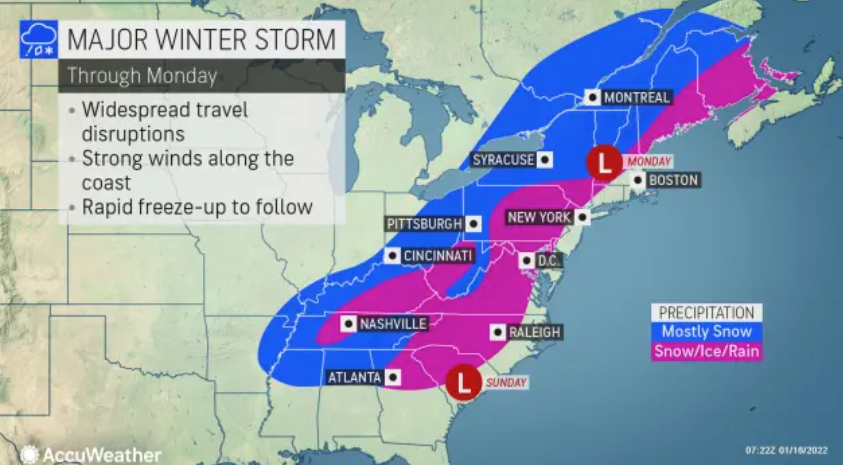
A massive winter storm could impact upwards of 100 million people across the Southeast, Mid-Atlantic, and Northeast during the latter part of the Martin Luther King Jr. holiday weekend.
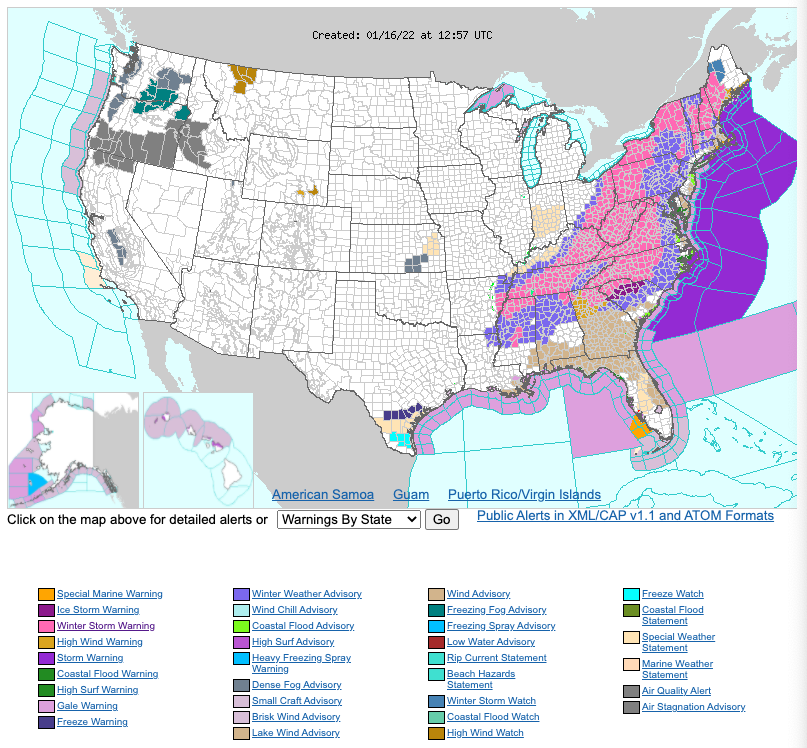
National Weather Service (NWS) issued winter storm warnings for 19 states, with some areas over the Appalachians could experience a snowfall rate of 1-3 inches per hour.
"A major Winter Storm will impact the eastern U.S. on Sunday into Monday. The highest snowfall totals are expected along the spine of the Appalachians as well as across the lower Great Lakes. The most significant icing is expected over the Carolinas this morning. Significant impacts to travel across these regions are expected," NWS warned.
Winter storm warnings have been issued for these states: New York, Ohio, Vermont, Virginia, Kentucky, Maine, Massachusetts, Arkansas, New Jersey, Pennsylvania, Georgia, North Carolina, South Carolina, Tennessee, West Virginia, Maryland, Louisiana, Alabama, Mississippi and the District of Columbia.
AccuWeather expects 6-12 inches of snow along the Appalachians and even into Ohio and western New York. There's a strong likelihood that snow accumulations of 3 feet could be seen at higher elevations in the Appalachians, Adirondacks, the Green and White mountains, and parts of southwestern New York near Lake Ontario.
Pittsburgh, Johnstown and Scranton, Pennsylvania; Buffalo, Binghamton, Albany and Syracuse, New York; Morgantown, West Virginia; Cleveland; Pittsfield, Massachusetts; Burlington, Vermont; and Caribou, Maine; all face accumulating snow through Monday. As for metro areas along the I-95 corridor, expect 1-3 inches of snow, with a mixture of ice and rain. The heaviest snowfalls will be in the interior Northeast.
On Friday, weather models forecasted the heaviest snowfall would be west of the I-95 corridor -- so far, they're right.

FT : European sales of electric cars overtake diesel models for first time

European sales of electric cars overtake diesel models for first time
Switch to battery-powered vehicles enjoys record growth on back of government subsidies and emissions regulations

Sales of electric cars in Europe overtook diesel models for the first time in December, preliminary estimates have shown, as drivers continued to choose subsidised emissions-free vehicles over those reliant on a fuel that was tarnished by the 2015 Volkswagen emissions scandal.

More than a fifth of new cars sold across 18 European markets, including the UK, were powered exclusively by batteries, according to data compiled for the Financial Times by independent auto analyst Matthias Schmidt, while diesel cars, including diesel hybrids, accounted for less than 19 per cent of sales.

Thanks to generous government subsidies in Germany and elsewhere, as well as strict regulations introduced in 2020 that force EU manufacturers to sell more low-emissions vehicles, electric sales have been rising steadily.

The trend accelerated in the final quarter last year, as Tesla proved to be better able than rivals to adapt to bottlenecks in semiconductor supply chains by delivering a record 309,000 electric cars.

European carmakers also pushed sales of electric vehicles in December to reduce their fleet-wide carbon footprint and avoid fines from Brussels, after prioritising the production of the most profitable models — mainly heavily polluting SUVs — during the supply chain crisis.

As a result, 176,000 battery electric vehicles were sold in western Europe during that month — an all-time record — and more than 6 per cent higher than the number sold in December 2020. By comparison, nearly 160,000 diesels were sold in the last month of 2021.

Sales of diesel cars have been in steady decline since Volkswagen was found to have cheated emissions tests for diesel engines installed in 11m vehicles. At the time, diesel models accounted for well above half the vehicles delivered in the 18 European countries surveyed.

“The diesel death march has been playing on repeat since September 2015 when ‘Dieselgate’ was first unveiled — causing VW to draw up the first plans of the ID.3 within 30 days of the scandal coming to light,” said Schmidt, referring to Volkswagen’s flagship electric vehicle, which has been on sale since 2020.

Volkswagen itself maintained its position as the leading electric vehicle producer in western Europe last year, selling more than 310,000 battery-powered models in the region in 2021, out of 3.5m in total.

While a number of new electric models enticed new customers, bans for older diesel vehicles in some cities and increased taxes for diesel in key markets had further harmed sales of diesel cars, Schmidt added.

The resale value of diesel vehicles in Germany — Europe’s largest car market — is also uncertain, as the new coalition government has signalled its intention to revisit tax credits for the fuel, which currently makes diesel roughly 14 cents per litre cheaper than premium petrol.

WWD : GSK Rejects Three Bids from Unilever for Consumer Healthcare Division

GSK Rejects Three Bids from Unilever for Consumer Healthcare Division
GSK's consumer division, which is run as a JV with Pfizer, includes Sensodyne toothpaste, Polident denture products, pain reliever Advil and Centrum vitamins.

LONDON – Unilever wants a slice of GlaxoSmithKline’s business, and it’s refusing to take no for an answer.

On Saturday, Unilever confirmed it approached GSK and Pfizer about a potential acquisition of their jointly held consumer health care business, which is one of the largest in the world and a market leader in the U.S., Germany and India.

The company’s three bids, the latest of which was for 50 billion pounds, have been rejected by GSK, which believes they undervalue the business. GSK’s consumer division, which is run as a JV with Pfizer, includes Sensodyne toothpaste, Polident denture products, pain reliever Advil and Centrum vitamins.

GSK holds a majority controlling interest of 68 percent in the JV, while Pfizer has a 32 percent stake.

In the statement, Unilever referred to GSK Consumer Healthcare as a “leader in the attractive consumer health space and would be a strong strategic fit as Unilever continues to re-shape its portfolio. There can be no certainty that any agreement will be reached.”

As reported, Unilever has been putting a strong focus on premium beauty, but also on health, wellness, and nutrition.

It is also looking to boost the value of its shares, which have fallen around 4.5 percent under ceo Alan Jope, whose mantra is people over profit and who is leading a sustainability crusade at the consumer giant, parent of brands ranging from Dove, Pond’s, Vaseline to Ben & Jerry’s.

On Friday, Unilever shares ended the day flat, closing at 39.37 pounds. GSK’s shares also closed flat at 16.43 pounds.

GSK announced last summer it was looking to spin off its consumer health care division with a new stock exchange listing, while GSK would focus on its vaccines and pharma businesses.

Last month, GSK named Sir Dave Lewis, a former Unilever executive and the man who turned the ailing Tesco around, as executive chair designate of the new consumer healthcare company, post-spinoff. Lewis was a graduate trainee at Unilever, and rose to become president of global personal care at the company before leaving to become ceo of Tesco.

In a separate statement issued on Saturday, GSK confirmed that it has received three unsolicited, conditional and non-binding proposals from Unilever plc to acquire the healthcare business.

It said the latest proposal, received on Dec. 20, was for a total acquisition value of 50 billion pounds, comprising 41.7 billion pounds in cash and 8.3 billion pounds in Unilever shares.

GSK said it rejected all three proposals “on the basis that they fundamentally undervalued the Consumer Healthcare business and its future prospects.”

The company said that its board is “strongly focused on maximizing value for GSK shareholders and has carefully evaluated each Unilever proposal. In doing so, the board and its advisers assessed the proposals relative to the financial planning assessments completed to support the proposed demerger of the business in mid-2022, including the sales growth outlook.”

It said the healthcare business had annual sales of 9.6 billion pounds in 2021, and an “exceptional portfolio of world-class, category-leading brands; global scale with footprint and distribution capability to serve more than 100 markets; strong brand building, innovation and digital capabilities; and offers a unique proposition that combines trusted science with human understanding.”

GSK added that the business is well-positioned to sustainably grow ahead of its categories in the years to come. “The fundamentals for the 150 billion pounds consumer healthcare sector are strong, reflecting an increased focus on health and wellness, significant demand from an ageing population and emerging middle class, and sizeable unmet consumer needs.

“The board of GSK is confident that the Consumer Healthcare business can sustainably deliver annual organic sales growth in the range of 4-6 percent (at constant exchange rates) over the medium term.”

GSK said it will move forward with the proposed demerger of the consumer healthcare business, to create “a new independent global category-leading consumer company which, subject to approval from shareholders, is on track to be achieved in mid-2022.”