WSJ : Kohl’s Is Urged by Macellum to Make Changes or Explore Sale

Kohl’s Is Urged by Macellum to Make Changes or Explore Sale
Activist with roughly 5% stake has been in talks with retailer and believes it has suitors

An activist investor is renewing a push to get department-store chain Kohl’s Inc. KSS -1.93% to take action to boost its lagging stock.

Macellum Advisors GP LLC, which has a roughly 5% stake in Kohl’s, has been urging the company to make changes including altering its board, people familiar with the matter said. Kohl’s has so far rejected Macellum’s request to add directors with retail experience or a shareholder to its board, the people said. The New York hedge fund, which was part of a group that ran a proxy fight at the retailer last year, now expects to do so again.

Kohl’s shares rose for the first several months of 2021 but are down roughly 20% since the activists reached a settlement agreement in April 2021 and are trading below where they were two decades ago. The Menomonee Falls, Wis., company has a market value of around $7.2 billion.

Macellum is telling Kohl’s that if it doesn’t change its board, the company should hire bankers to explore a sale or other transaction. Macellum has told the company it thinks there are potential buyers that have shown interest.

Kohl’s said in a statement it continuously examines all opportunities for maximizing shareholder value and that its strong performance in 2021 demonstrated its strategy is working. It said it plans to share more details about its strategic initiatives and capital allocation plans at its investor day March 7.

Late last year, another activist hedge fund, New York-based Engine Capital LP, said it owned a roughly 1% stake and urged Kohl’s to explore a sale.

Over the past year, Kohl’s has made a number of changes, including reinstating a dividend and boosting its share repurchases. It is also investing in its new partnership with cosmetics chain Sephora and updating over half of its more than 1,000 stores.

Macellum, with a focus on retail, nominated nine directors early last year along with three other activists—including Macellum Chief Executive Jonathan Duskin —and urged Kohl’s to monetize its real estate and make changes in its operations. Kohl’s has said it previously concluded that such sale-leasebacks for its real estate wouldn’t add value.

The group later reached a settlement agreement as Kohl’s stock was rebounding that put two of its nominees and a third director on the board. The agreement barred Macellum and the other firms from agitating at the company until last week.

The window to nominate directors to Kohl’s board opened Jan. 12 and closes in mid-February.

FT : UK looks at payments to energy suppliers to shield consumers from high bill

UK looks at payments to energy suppliers to shield consumers from high bills
Radical intervention one option to ease burden on household budgets as local elections loom

The UK is exploring a radical intervention in the power market, under which the state would make payments to energy suppliers when wholesale gas prices rise sharply in a bid to soften the blow to consumers.

The proposal, which is being promoted by energy companies, is described by government insiders as “plausible” and “logical”, but they admit there are also many downsides to such a step.

Under the initiative, energy suppliers would receive payments from government when wholesale gas prices exceeded a certain threshold so they would not then have to pass the increase on to consumers.

Some suppliers say the proposal — known as a temporary price stabilisation mechanism — could be self-funding over the course of several years as energy companies would have to return money to the government when wholesale prices traded below the agreed level.

Rishi Sunak, chancellor, accepts this could leave the taxpayer heavily exposed if wholesale prices remain high, but he has been discussing with Boris Johnson, the prime minister, ways to mitigate a cost of living crisis, officials say.

Without action by Downing Street, a price cap on household energy bills could rise from £1,277 a year to over £1,900 in April — fuelling inflation — and coming at the same time as tax rises take effect.

Johnson faces local elections on May 5 that could decide his political fate and is looking for “red meat” policies in the coming weeks to shore up his weakened premiership ahead of those polls.

Other options to cushion the impact of soaring energy prices have their own problems. A cut in VAT on domestic energy from 5 per cent to zero is still on the table, but has been described by Johnson as a “blunt instrument” helping both rich and poor households.

Ministers have also gone cold on providing government-backed loans to energy companies. Some estimates put the scale of the required lending at £20bn and one person briefed on discussions said: “Some of the firms would not be able to take on any more credit risk.”

Sunak is looking to offer targeted support to poorer households — possibly through an expansion of the warm home discount scheme — but ministers are looking to go considerably further.

Emma Pinchbeck, chief executive of the trade body Energy UK, confirmed on Monday that suppliers were discussing with the Treasury a mechanism to smooth out spikes in wholesale prices for consumers.

“The Treasury has asked industry to look at options for spreading the cost of the gas itself over a longer period of time,” she told BBC Breakfast.

She added that under such a mechanism, in “a year where the [wholesale gas] price is lower, the industry pays back government and in a year where it’s higher, the government helps the industry to spread the costs”.

Government insiders admit there is no easy way to manage the huge spike in energy costs, but say this scheme might at least offer some prospect of the Treasury recouping money when gas prices eventually fall.

“If this was a non-starter, we wouldn’t still be talking to the energy companies about it,” said one person briefed on discussions being held with the business department and the Treasury. “There are quite a lot of delivery issues, but it’s a plausible option.”

The mechanism would be similar in design to “contracts for difference” that support renewable energy generation in Britain by guaranteeing a minimum electricity price for power producers.

But the idea is not universally popular with suppliers. One senior industry executive said it was “unclear how you could bring it to an end and at what point do you bring it to an end?”

The executive added that such a mechanism would effectively be “shutting down the market to competition” as no consumers would want to move on to fixed-price deals while the stabilisation mechanism is protecting prices for households whose bills are dictated by Britain’s price cap.

Investec, an investment bank, on Monday revised its estimate for April’s rise in the price cap, due to be announced next month, following drops in wholesale prices in recent weeks. It is now expecting a £630 increase to £1,907 per household versus a previous forecast of £2,000.

But the bank’s energy analyst Martin Young warned the cap will have to increase for a second time to £2,100 in October, when it is next scheduled to be revised. Other analysts have estimated the cap will have to increase in October to £2,300-£2,400 based on forward energy prices.

FT : US airlines warn of ‘chaos’ as telecoms groups roll out 5G

US airlines warn of ‘chaos’ as telecoms groups roll out 5G
Aviation lobby says services will cause ‘incalculable’ disruption to passengers and cargo

The imminent rollout of high-speed 5G telecoms services threatens to ground flights across the US, America’s largest airlines warned on Monday, as they urged government agencies to intervene to avoid “chaos” for passengers and “incalculable” disruptions to supply chains.

“The harm that will result from deployment on January 19 is substantially worse than we originally anticipated,” warned Airlines for America, an industry lobby group, pointing to the potential for 5G services to interfere with the sensitive equipment that aircraft use to take off and land.

The letter, seen by the Financial Times and first reported by Reuters, was signed by the largest US carriers as well as the air freight arms of two of the biggest logistics groups, UPS and FedEx.

The companies called on Joe Biden’s administration to block the rollout of 5G to towers located within two miles of airport runways that the Federal Aviation Authority has identified as being prone to disruption.

“Unless our major hubs are cleared to fly, the vast majority of the travelling and shipping public will essentially be grounded,” the lobby group wrote in its letter to officials including Brian Deese, the National Economic Council director, and Pete Buttigieg, the transportation secretary.

The White House and the transportation department did not immediately respond to a request for comment. An Airlines for America spokesperson declined to comment.

AT&T and Verizon had planned to launch their 5G services on December 5, but delayed the launch a month to allow time for safety reviews. The two telecoms groups initially rejected a subsequent request from regulators to delay their rollout by another two weeks to January 19, but then agreed to do so.

The planned 5G services use frequencies in the C-band radio spectrum, which can be close to those used by altimeters that measure an aircraft’s height from the ground and feed information into navigation instruments and other onboard safety systems.

The FAA has planned buffer zones around 50 airports that have wireless transmitters in proximity to runways, including in New York, Los Angeles and Chicago. However, airlines maintain that this will not be enough to prevent disruptions.

The 11 executives who signed Monday’s letter said that the FAA’s latest statement on the issue had downplayed the threat of disruption and that continuing flight restrictions at those 50 airports could leave “huge swaths of the operating fleet” grounded indefinitely.

On Sunday, the FAA cleared aircraft using two models of radio altimeters to perform low-visibility landings at the 88 airports it expected to be most affected by 5G C-band interference.

The FAA’s clearance of those devices could still leave 1,100 flights and 100,000 passengers affected by cancellations or delays on a typical day, Airlines for America warned, saying that it had established that flight restrictions would not be limited to poor weather operations.

The airlines’ warning of “incalculable” effects on passengers, staff and cargo operations came as the industry has continued to struggle to rebuild its schedules to pre-Covid levels while dealing with seasonal disruptions from winter storms.

On Monday, FlightAware reported that more than 2,500 US flights had suffered delays, with more than 1,600 cancellations.

FT : London mayor looks to cut car journeys in push for net zero

London mayor looks to cut car journeys in push for net zero
Sadiq Khan prepares radical options on expanding ultra-low emission zone and charging drivers in capital

Sadiq Khan, the mayor of London, is considering radical new policies to reduce air pollution and meet climate targets, including a huge expansion of the city’s low emission zone for vehicles or pay-as-you-drive road charging.

The policy options revealed on Tuesday are part of a push to cut car journeys in London by 27 per cent to help the city reach net zero carbon emissions by 2030.

Khan said his mission was to “nudge” drivers away from all petrol and diesel cars and into either electric vehicles, public transport, walking or cycling.

He has asked Transport for London, the capital’s transport authority, to study the viability of several options drawn up by consultants Element Energy.

One is a significant expansion of the ultra-low emission zone, or Ulez, to cover all of Greater London, the area Khan oversees, by May 2024.

Drivers of older and more polluting vehicles have to pay a daily levy of £12.50 to drive into the current zone, which was extended in October from a small core of inner London to cover a 380-sq km area inside the north and south circular roads.

Greater London, the 32 boroughs and the City of London, is more than four times this size. It has a population of about 9m.

Another option in the report is a “small” daily charge across Greater London for “all but the cleanest vehicles”, either as a standalone measure or alongside an expanded Ulez.

While the precise definition of a clean vehicle would be decided by TfL, Khan predicted that it would exclude any petrol or diesel car.

The report also suggests a new charge for all non-London registered vehicles driving into the city, a topic which has been discussed with central government as part of separate negotiations over TfL’s pandemic-battered finances.

Any of the options would leave London with some of the most ambitious clean-air policies of any global capital and were welcomed by environmental groups.

But they are also likely to prove contentious. Some residents and businesses have complained that they had struggled to afford to upgrade to less polluting vehicles for the expanded Ulez late last year, despite a scrappage scheme to help with the switch.

Khan said he hoped the proposals would kick-start a “conversation” with Londoners and that politicians “simply don’t have time to waste” to tackle pollution and climate change.

“We have too often seen measures to tackle air pollution and the climate emergency delayed around the world because it’s viewed as being too hard or politically inconvenient, but I’m not willing to put off action we have the ability to implement here in London,” Khan said.

The mayor said central government support would be needed to help the capital reach net zero by 2030 and cut toxic air.

Between 2000 and 2018, workplace and household greenhouse gas emissions in London fell nearly 60 per cent and 40 per cent respectively, but transport emissions dropped by just 7 per cent. The number of people travelling by car has returned to pre-pandemic levels, while public transport ridership is still well down.

In the longer term, City Hall believes London will need to switch to a road-user charging system, which would abolish all current road charges and replace them with a system where drivers pay by the mile.

The scheme would mark a transformation in how drivers are taxed and is still several years from being ready as it would require new technology to measure road use. Still, Khan has asked TfL to begin exploring how the system could be developed.

Given the shift to electric vehicles, some transport policy experts expect road user charging to become widespread to help replace lost tax revenue from petrol and diesel duties.

Keith Prince, Conservative London Assembly member, said imposing “further emissions levies would be ludicrous” and that Londoners should not foot the bill for “fighting the climate emergency”.

The pathway to net zero by 2030 will also require 210,000 homes and 15,000 other buildings to be retrofitted each year to make them more energy efficient.

Electrek : Next Fiat Panda aims for ‘most affordable EV’ title, will slot below


What’s the most affordable EV you can buy? If rumors out of Fiat are to be believed, the answer to that question will soon be “the new Fiat Panda” as Stellantis targets the bottom end of the booming electric car market.

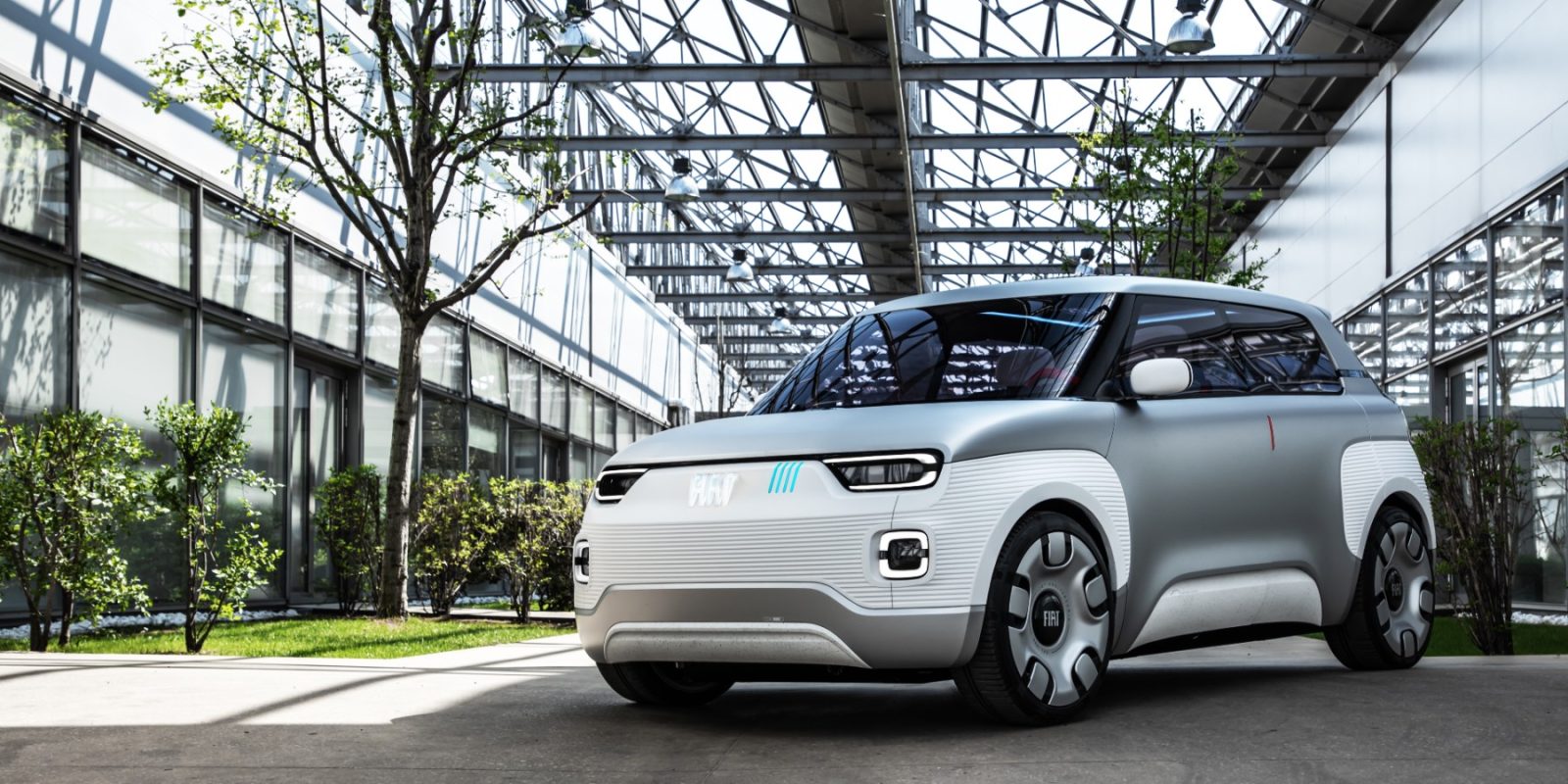
Set to arrive as soon as this spring, the new Fiat Panda will be an EV-only offering from Stellantis’ “entry” Italian brand, and is expected to slot in below the ell-electric Fiat 500e, price-wise, in the company’s lineup. Its main objective, as the brand’s President, Oliver Francois, told AutoExpress UK, is to “awaken the sleeping giant” he believes Fiat to be. “That’s exactly my point of view,” he says, when discussing new models. “We have not even started awakening the giant.”
As a product, the upcoming Fiat Panda is believed to be heavily based on Fiat’s 2019 concept, the award-winning Fiat Centoventi. At the time, the company said it would reduce the car’s build costs by adopting a spartan design with a limited color palette that was at once “minimalist and fully customizable.”
Modularity was built in from the start
“It will come in only one livery, which can be customized via the ‘4U’ program, with a choice between 4 roof covers, 4 bumpers, 4 wheel wraps and 4 paint wraps,” reads a statement issued at the 2019 launch of the Centoventi, in Geneva, where it won several design awards. “The interior accessories are interchangeable and can be installed in “plug-and-play” mode – from the cluster and storage pockets to the seats and child seats – directly by the customer. The exteriors are wrappable, the bumpers are customizable, and various roof covers are available to dress it up as the seasons change or according to your own preferences.”
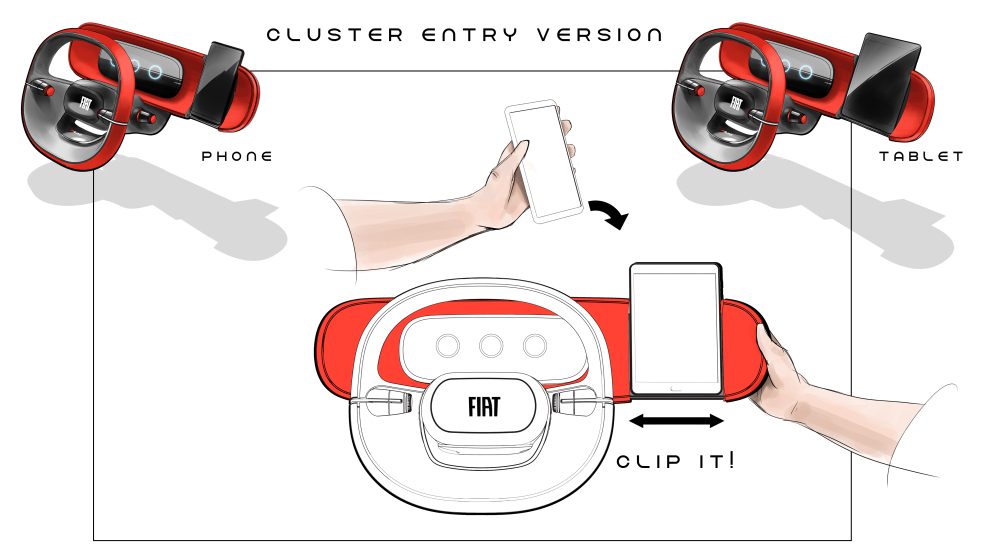
The level of customization goes beyond what you might expect from most EVs in a connected age. Take, for example, this adjustable “dock” in the Fiat Panda/Centoventi concept’s dash to hold a phone or tablet. It completely removes the expected (and expensive) center screen, and its associated need for infotainment software and firmware.
All cars should have an option like this; courtesy Stellantis.
It’s a very “Model T” sort of approach, and one that – hopefully – will enable a wider range of new car shoppers to get into a new electric car. If the concept is successful, we might see something like the culture that surrounded the original Type 1 VW “Beetle” emerge, with an appeal that defies the typical boundaries of income brackets.
That sort of “blurring of lines” seems to be exactly what Francois wants. “There will be a future for Panda as a name plate … that’s why I pitched the latest 500 initially as a convertible: high-end, full of options and 30,000 Euros. Because the day I introduce the future Panda, I’ll probably do the opposite. I’ll introduce the most naked version with an incredible price.”
We won’t have to wait too much longer to see how that plays out.
Electrek’s Take
I went to an event called “Further With Ford” way back in 2014 where company spokespeople talked about their envy of Apple’s iTunes ecosystem, which made people invest in it with purchased songs, apps, and movies. They very openly discussed creating a similar sort of software ecosystem within a connected car, one that would make switching from a Ford to a Chevy as complicated as switching from an iPhone to an Android.
This Fiat? It does the opposite, and – by inviting customers to bring systems that they already know and love into the car – they’ve enlisted the new Fiat Panda buyer in the design process. It’s an emotional investment that offers the value of a unique experience, rather than a financial one that carries with it a veiled threat, and I think Fiat and Stellantis will find that they catch more flies with honey, in this case.

FT : Xi warns of threats to global recovery

Xi warns of threats to global recovery
China’s growth slows, Credit Suisse chair quits after breaching quarantine rules, Dress codes for pandemic professionals

Xi Jinping today warned of “serious negative spillovers” if “major economies slam on the brakes or take a U-turn in monetary policies”.

The Chinese president, who was talking to global leaders by video at the World Economic Forum, warned against protectionism and called for greater co-ordination on global economic policy in the face of surging inflation, supply chain threats and tight energy supplies. “These risks compound one another and heighten the uncertainty about economic recovery,” he said.

Xi also spoke of the need to strengthen co-operation on medicines and address vaccine inequality.

The Chinese president’s remarks follow new data revealed earlier today that show the country’s recovery is continuing to lose momentum, with growth slowing to its lowest level in 18 months in the final quarter of last year, under the “triple pressure of demand contractions, supply shock and weakening expectations”.

China’s economy expanded 4 per cent in the final quarter of 2021, compared with the same period in 2020 — a better than expected headline figure, but down on the 6.5 per cent growth in the same period the year before. The People’s Bank of China also cut an important lending rate for the first time since April 2020.

One of the reasons for the slowdown is the country’s “zero-Covid” policy of lockdowns and restrictions to contain infections in the run-up to next month’s Winter Olympics. The policy is exacerbating supply chain problems in Xi’an, Tianjin and other parts of the country that host manufacturing facilities.

According to the FT’s Lex column, today’s data also highlight one of China’s key economic weaknesses: the drop in domestic consumption caused by the zero-Covid policy.

Exports accounted for just a fifth of the country’s 2021 GDP growth, while household consumption was two-thirds, it says, suggesting Beijing may not be able to afford to trade economic growth for the international prestige of the Games.

The country’s Covid policies also threaten Hong Kong’s status as a global financial hub. As our Big Read explains, the city’s strict quarantine measures have meant a low death toll from the virus — 213 people out of a population of 7.5m — but have caused severe disruption to business.

FT : Atlantia wins €950m bid to acquire Siemens’ traffic lights division

Atlantia wins €950m bid to acquire Siemens’ traffic lights division
Infrastructure group seals first big deal since resolving dispute over Genoa bridge tragedy

Atlantia, the Benetton-controlled Italian infrastructure group at the centre of the Genoa bridge disaster, has won a €950m bid to acquire a Siemens unit that operates traffic lights in more than 600 cities around the world.

German-based Yunex Traffic, which was spun out of Siemens Mobility last year, provides important traffic-management services, using advanced technology including artificial intelligence.

It is the first big deal for Atlantia since bringing to an end its three-year dispute with the Italian government following the collapse of the Morandi bridge in Genoa that killed 43 people in 2018.

The group had come under intense pressure to relinquish control of its toll road arm Autostrade per l’Italia following the tragedy, finally selling the division to Italy’s CDP for €9.3bn last summer.

Atlantia was chosen by German group Siemens over private equity firms Bridgepoint and KKR, US defence and transport group Cubic and China-based Hisense, said the infrastructure group.

It will pay the €950m in cash, funded by dividends and the sale of a 49 per cent stake of its subsidiary Telepass, which operates mobility services for toll roads. Mobility services involve using technology to enhance and improve transport systems.

“The management of infrastructure is now closely connected with innovation and sustainable mobility. We aim to deliver operating and growth synergies between our assets and Yunex . . . to improve the travel experience,” said Atlantia chief executive Carlo Bertazzo.

Yunex chief executive Markus Schlitt said: “Joining Atlantia is a fundamental growth opportunity for our company.”

Atlantia was considered an ideal strategic partner for a business that ran sensitive operations, said three people with knowledge of the transaction. The deal is also part of the infrastructure company’s revamped move to invest in mobility services.

Yunex Traffic, previously known as Siemens Intelligent Traffic Systems, has 3,000 staff and operates traffic lights and cameras in cities including London, Berlin, Dubai and Miami.

Its technology will be used to help Atlantia upgrade its toll road and airport operations. It would strengthen the group’s position when bidding to operate toll roads and airports, said people close to the deal.

Atlantia also owns Aeroporti di Roma, which operates Rome’s two main airports, Fiumicino and Ciampino, and has a 65 per cent stake in the operator of the French airports at Nice, Cannes and St Tropez. It also controls Spanish infrastructure company Abertis.

Although the Siemens subsidiary does not operate in airports, it will be able to develop a new business segment focused on monitoring passenger flows, car parks management and airport security, say the people with knowledge of the deal.

The sale is part of a broader Siemens’ strategy aimed at refocusing its portfolio through divestments and acquisitions.

WSJ : Iran Demands Legal Pledge That U.S. Won’t Quit Nuclear Deal Again

Iran Demands Legal Pledge That U.S. Won’t Quit Nuclear Deal Again
There are signs of progress in the Vienna negotiations, but the Biden administration has told Tehran’s diplomats it can’t accede to one of their firmest demands

VIENNA—As the Biden administration tries to revive the 2015 Iran nuclear deal, one of the biggest obstacles is Tehran’s demand that the U.S. provides a guarantee that it won’t again quit the pact and reimpose sanctions, diplomats involved in talks in Austria say.

The demand, a reaction to former President Donald Trump’s withdrawal from the 2015 nuclear deal, appears to be a paramount political objective for the government of Iran’s new hard-line president, U.S. and European diplomats here say. The diplomats said they don’t believe the demand is designed by Iran to simply drag out the talks.

The U.S. has consistently said no president can legally tie the hands of a successor without a treaty that would need to garner the backing of two thirds of the U.S. Senate. The U.S. has also said the current talks should remain focused on restoring the 2015 deal, not seeking new commitments on both sides.

The standoff over guarantees comes amid what U.S. and European officials say are signs of progress in the Vienna talks, involving Iran, the U.S., Britain, France, Germany, Russia and China. The 2015 deal suspended most international sanctions on Iran in exchange for tight but temporary restrictions on Iran’s nuclear program.

Western diplomats say a pathway to a deal is possible, showing more optimism since December when Iran’s demands left negotiations on the brink of failure. U.S. and European officials are privately eyeing mid-February as the moment to decide whether the diplomacy is exhausted.

There has been progress on the fine print, including how sanctions would be lifted, how Iran will scale back its nuclear work, and how a deal might be implemented over several months.

However, Western diplomats warn that a range of core political decisions on sanctions, nuclear steps and sequencing of an agreement must still be made and many worry whether Tehran is willing to cut a deal quickly enough. Western officials have repeatedly warned that the window for talks is closing given the advances in Iran’s nuclear work.

“This negotiation is advancing way too slowly to be able to reach a conclusion,” French Foreign Minister Jean-Yves Le Drian said Friday.

Saeed Khatibzadeh, a spokesman with Iran’s foreign ministry, said Monday that diplomats were making progress in Vienna but key issues remained that “require certain political decisions.”

“Washington should announce its decisions regarding the remaining issues and lifting of the sanctions,” he said.

By demanding an ironclad U.S. commitment to a deal, Iran’s concerns highlight a key weakness in the 2015 agreement. The deal was never signed as a treaty with clear legal guarantees. Its formal name—the Joint Comprehensive Plan of Action—underscored this was a set of political commitments, albeit pledges that were later backed up by a U.N. Security Council resolution.

Last spring, when talks to restore the deal started, Iran put a U.S. pledge not to leave the deal again on its wish-list, alongside other demands such as compensation for Washington’s 2018 withdrawal. Western diplomats felt that was largely for domestic show and that Iran would likely scale down its requests.

Last spring, under the previous Iranian government, Tehran did modify its position—saying it wanted a guarantee that Washington would stay in the deal as long as President Biden was in office. The new team, under President Ebrahim Raisi, has gone back to the original permanent guarantee demand.

In recent weeks, Western diplomats say they have started to see the demand for guarantees as a crucial objective for Mr. Raisi’s negotiators. Mr. Raisi is considered a possible successor to Iran’s Supreme Leader Ayatollah Ali Khamenei, who himself has demanded guarantees.

Ensuring that Mr. Khamenei isn’t again embarrassed by a future U.S. pullout appears to be a top political goal, two Western diplomats said.

“Absent guarantees, many in Tehran worry, sanctions relief will be ineffective, unsustainable and perhaps even detrimental to the Iranian economy as the specter of reimposed sanctions haunts long-term planning,” said Ali Vaez, director of Iran Project at Crisis Group, in a report published Monday.

In recent months, Washington has started to respond to Iran’s concerns.

On Nov. 1, on the sidelines of the Group of 20 nations in Rome, Mr. Biden and the British, French and German leaders issued a statement that was designed to address Iran’s concern head-on, diplomats say.

“In this spirit, we welcome President Biden’s clearly demonstrated commitment to return the U.S. to full compliance with the JCPOA and to stay in full compliance, so long as Iran does the same,” the leaders said.

Yet Iran has dismissed verbal pledges. A problem, Western diplomats say, is that Iran has at different times sought different types of assurances from Washington—political, economic and legal. Also complicating a solution: Iran refuses to negotiate directly with the U.S.

U.S. and European officials say they are exploring ideas to put to Iran which could generate additional confidence. Ideas that are being weighed are promises of letters of assurance from the U.S. Treasury Department for an agreed list of international banks and companies or a political commitment to some kind of phase-in of future sanctions. Yet these would fall short of ironclad, legal guarantees.

”Basically, there are proposals on the table on how economic operators can get some comfort if a new American administration reimposes sanctions,” said a person close to the talks. “In a democratic country, in three years time, [there] can be a new president and things can change. So we are working on that but there are no real magic ideas.”