China's Property Sector Is Crashing Again And This Time It Has Reached The Country's Biggest Developer
The crisis engulfing China's property sector - which has prompted Beijing to capitulate on its tightening ambitions yet again, and forced China to launch an increasingly more aggressive easing campaign, which so far culminated in the first rate cut in Chinese official rates in almost two years - has impacted the country's biggest developer, sending the shares and bonds of Country Garden Holdings - which is even bigger than Evergrande - plunging amid fears that a reportedly failed fundraising effort may be a harbinger of waning confidence.
Country Garden is one of the few remaining large, (arguably) better-quality private developers that had been largely unscathed by the liquidity crunch, even as peers such as Shimao Group Holdings - a recently investment grade developer whose collapse in December was viewed as "more devastating than debt crises at Evergrande and Kaisa" - dramatic reversals in their credit ratings.
At least until now... and now that Shimao has imploded, Country Garden remains perhaps the final and most visible bellwether for contagion risk, as unprecedented levels of stress in the offshore credit market threaten to drag good credits down with bad.
Since taking the top spot from China Evergrande Group in 2017, Country Garden has remained the nation's largest developer in China by contracted sales. It employs more than 200,000 people.
Headquartered in the southern city of Foshan in Guangdong province, the firm - like China Evergrande Group - has focused in recent years on building housing developments in lower-tier cities.
And, like Evergrande, Country Garden has also relied heavily on access to funding in the offshore credit market; actually not just Evegrande but virtually all developer peers that binged on debt to fuel growth in the past decade only to see the window slam shut now. According to Bloomberg, it has the largest pool of outstanding US dollar bonds among China's biggest property firms, excluding defaulters, with some US$11.7 billion outstanding, Bloomberg-compiled data showed.
Founding chairman Yeung Kwok Keung transferred his controlling stake to his daughter Yang Huiyan in 2005. She is now the firm's vice-chairman and is the richest woman in China, according to the Bloomberg Billionaire Index.
Or at least she was, because on some of Country Garden's US dollar notes plunged to record lows in the wake of a report that the firm failed to win sufficient investor support for a possible convertible bond deal. Longer-dated bonds were trading as low as 69 cents on the dollar as of late Friday.
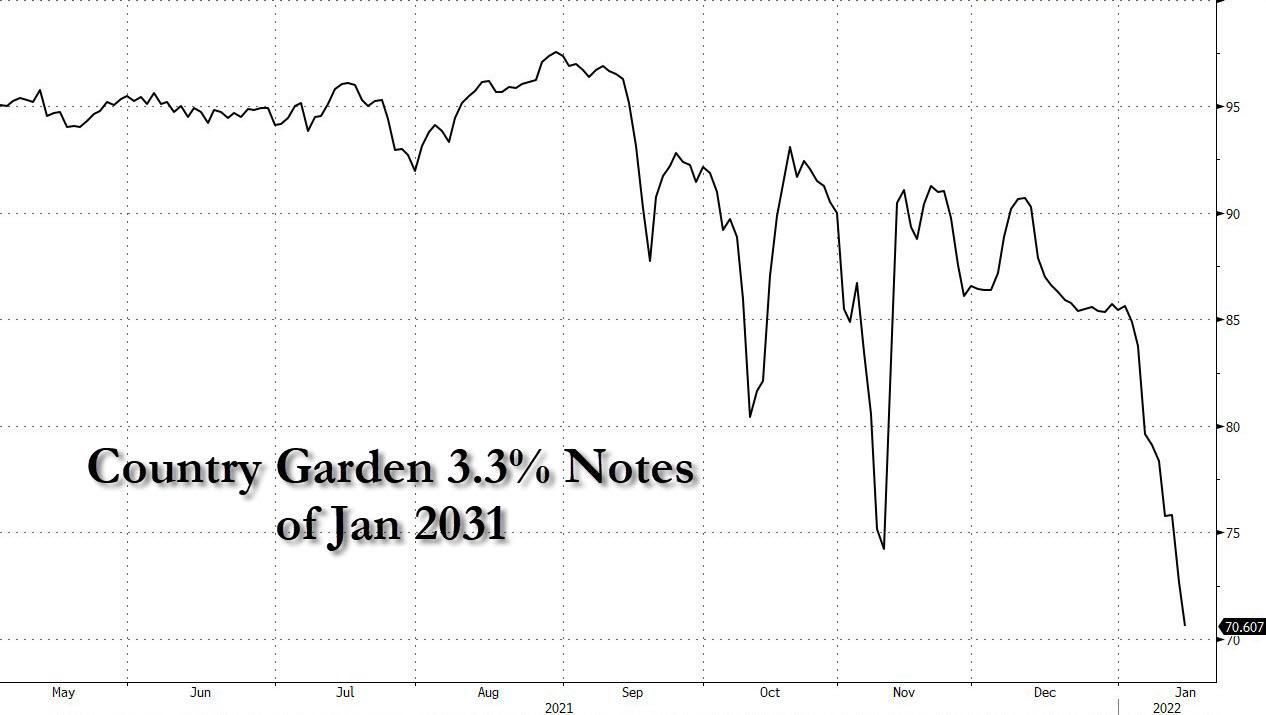
This is notable because China's developer was relatively resilient in the face of the liquidity crisis sparked by a government crackdown on excessive borrowing by builders and housing market speculation, and had been unscathed by the crisis at industry giant Evergrande. But just as we warned back in September, China's slow-motion real estate crisis which revolves around what Goldman calculated last year was the world's largest asset which absent significant stimulus from Beijing, is facing a very painful derating.

According to Bloomberg, while Country Garden is not facing imminent repayment pressure - it has US$1.1 billion of dollar bonds due this year and had 186 billion yuan (S$39.5 billion) of available cash as of June last year - risks may emerge if it is seen to have limited access to funding. Any sign of doubt in the firm's capacity to weather liquidity stress risks may prompt a widespread repricing of other higher-quality developers. With more than 3,000 housing projects located in almost every province in China, Country Garden's financial health has immense economic and social consequences, far greater than Evergrande.
Worse, if the firm starts showing signs of stress, it will severely damage already fragile investor and homebuyer confidence, posing threats to China's economy and even social stability. And that's when China's Lehman moment will truly emerge.
Where it gets challenging is that similar to Evergrande, more than 60% of Country Garden's contracted sales in mainland China came from the third- and fourth-tier cities, said its 2021 interim report. Demand in lower-tier areas may significantly weaken in 2022, said a forecast by Fitch analysts. Being a "pure developer", it is less flexible when it comes to raising cash by selling assets, said Bloomberg Intelligence analyst Andrew Chan.
Country Garden's strategy is to manage its current assets effectively, in addition to expanding its business, the told Bloomberg News, although it clearly did not anticipate the recent meltdown in its bonds. "The firm is experiencing less volatility than the overall market" amid a broader market downturn, it said. The developer sold bonds and asset-backed securities in the local market in December, reflecting support from both investors and regulators, and maintained its ratings at all 3 major rating firms last year, said the comments.
Country Garden holds both investment-grade and high-yield credit ratings from the 3 major risk assessors, making it a so-called crossover name that could be vulnerable to becoming a 'fallen angel'. That could in turn raise its borrowing costs and eliminate yet another builder from the dwindling pool of higher-rated developers that investors can turn to during the credit squeeze.
It has the equivalent of an investment-grade triple B rating at both Moody's Investor Services and Fitch Ratings, and the highest possible speculative-grade rating at S&P Global Ratings. Still, the borrower is likely to "strengthen its financial resilience by controlling debt growth and maintaining disciplined land acquisitions", S&P analysts wrote in a September report that reaffirmed its rating.
Still, the builder may find it difficult to revive sales in 2022 with weakening market sentiment in lower-tier cities, where 77 per cent of its land bank is located, said Bloomberg Intelligence analyst Kristy Hung. The firm's sizeable amount of newly acquired land continues to be located in such areas, raising further concern about cash collection, she wrote.
Meanwhile, in the latest wave of selling, investors are now scrutinizing Country Garden's capacity to raise funding from a variety of channels, particularly as the offshore credit market remains effectively closed to most developers. It needs to repay or refinance some US$1.3 billion on bonds this year, the majority of which are dollar notes. Its next maturity is a US$425 million bond due Jan 27.
The selling in Country Garden's bond accelerated last week after the company struggled to tap the market for fresh funds, reportedly pulling a $300 million convertible bond issue due to weak demand. At the same time, Sunac’s shares sank a record 23% after it sold new equity. Focus has also turned to the spillover effects of Country Garden's falling bond prices on the notes of other stronger developers as fears of contagion risks remain elevated.
Just to shore up confidence that it won't be the next Evergradnde, a statement on the Hong Kong stock exchange late Monday said that Country Garden bought back an aggregate principal amount of $5m of 4.75% notes due July 2022 and $5m of 7.25% notes due April 2026. And even though the company added that it would monitor market conditions and "may make further repurchase of its bonds", we are concerned that this tiny, theatrical $10MM buyback will do little to restore investor confidence.
And as investors nervously eye the fate of China's largest developer, fresh turmoil rocked Chinese property bonds on Monday on concern over the true scale of the industry’s hidden debts according to Bloomberg, deepening a selloff among higher-rated firms.
The latest selloff was catalyzed by a Debtwire report according to which Logan Group could be on the hook for $812 million of guarantees on outstanding obligations due through 2023. The news hammered Logan's note due 2023 which sank 14.1 cents to a record low 62.9 while Country Garden’s shorter-dated bond due 2024 tumbled 12.9 cents to 67.7 cents, extending last week’s selloff for the country’s biggest developer.
According to Bloomberg, the selling in Property stocks is morphing from one catalyzed by specific event to one sparked by mounting concerns about the transparency of China’s better developers, and is forcing bondholders to question the liquidity of firms whose finances appear sound. More debt would mean more creditors, some of whom could demand early repayment. There’s also the risk that hidden liabilities like trust loans, private bonds or high-yield consumer products receive preferential treatment over money owed to offshore creditors. China Evergrande Group, Kaisa Group Holdings Ltd. and Shimao Group Holdings Ltd. have all faced such obligations.
While Logan, whose bonds traded at close to par as recently as last month, and which rated the equivalent of a BB rating at all three major credit risk assessors, denied both the report and market speculation the company has privately sold debt, that did little to ease the puke in its bonds which quickly spilled over to the rest of the property segment.
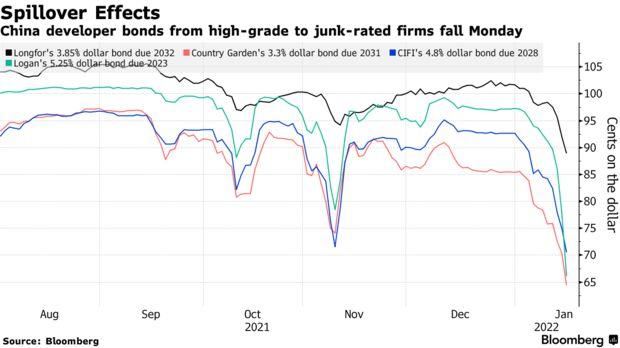
Already fragile investor confidence has taken a battering this year, effectively keeping the dollar bond market shut for developers. That’s left the sector with limited refinancing options, increasing the risk of companies failing to pay debt on time.
“Risks across the Chinese property sector are rising, evident from difficult refinancing conditions for even the most well-regarded firms,” said Wei Liang Chang, a macro strategist at DBS Bank Ltd. Greater clarity on the disclosure of liabilities as well as asset sales are crucial to shore up confidence, he added.
Real estate financing received by developers plunged about 19% in December from a year earlier, the sharpest decline in more than seven years, according to Bloomberg calculations based on full-year government figures released Monday. Home sales by value declined 19.6% in December from a year earlier, a sixth consecutive monthly drop, while property investment shrank 14%.
According to Bloomberg calculations, at least seven developers have defaulted on dollar bonds since October. That includes Evergrande, whose crisis has ensnared lender China Minsheng Banking, the world’s worst-performing bank stock. Guangzhou R&F Properties Co. was downgraded to restricted default by Fitch Ratings last week due to what the ratings firm called a distressed debt exchange.
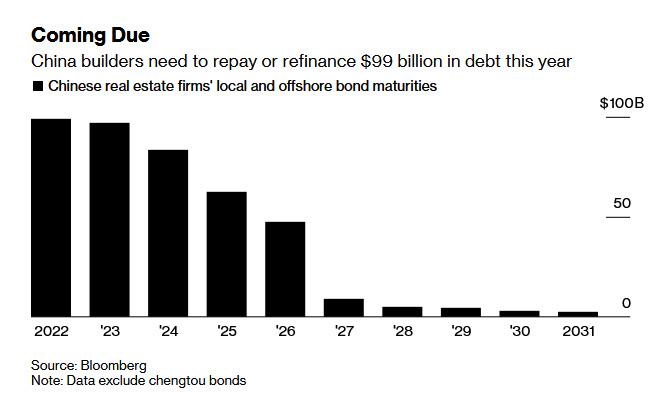
As if that wasn't enough, there remains the problem of the frozen bond market. With bond yields of property developers at stratospheric levels, Chinese property firms need to repay or refinance some $99 billion of local and offshore bonds this year. Just under half of that is outstanding dollar debt, Bloomberg-compiled data show.
Bottom line: as much as Beijing wants to, it will have to step in and bailout not just the property developers but the entire housing markets, where transactions have cratered and confidence has evaporated. And to do that, China will have to ease financial conditions much more aggressively than it has done so far - yes, overnight Beijing cut rates for the first time since 2020, but that step is nowhere near enough. To avoid an all out depression, Beijing will have to do much, much more... and not just Chine but the rest of the world's central banks too. Which is why anyone who believes that the current tightening euphoria will last more than a few months, well we have a bridge in Wuhan we'd like to sell you.
How to beat the shorts: THG edition
Matt Moulding’s empire warns on margins.
THG, or the artist formerly known as the The Hut Group, had a 2021 to forget.
The £2bn protein-powder-slash-beauty-retailer-slash-wannabe-e-commerce-platform-provider, led by sun’s-out-guns-out chief executive Matt Moulding, saw its stock crater by 71 per cent over the course of the year as concerns over its governance, its Shopify-competitor-to-be arm Ingenuity, its relationship with Softbank, and its gyrating strategic direction caused shareholders to vote with their feet.
So what do you do if your business is struggling to get its business case across to the market? Blame short-sellers of course.
And so it was with Mr Moulding who, at a GQ event held at yuppie nature reserve Soho Farmhouse in November, laid into this evil cabal of investors.
From The Times:
Moulding said THG shares had suffered from a “pretty aggressive short attack ... You wouldn’t rob banks any more, you’d just do short attacks, you can get away with it, it’s legal. And essentially, it cuts across a few industries from media, investment banks, fund managers, hedge funds, etc.“They come together. They’re not technically or legally together, but essentially operate in tandem.”
Ignoring the fact that attacks on short-sellers from chief executives have a storied history of being a reliable indicator to dump a stock, there is really only one way to get revenge against the bears: prove them wrong.
Perhaps the best example of this is Netflix chief Reed Hastings’ response to a note from short-seller Whitney Tilson way back in 2010. Writing on stock research site Seeking Alpha, he gently rebuffed Tilson’s points before — and this is the important part — delivering exceptional operating results at the company. Netflix went on to be one of the best performing US stocks of the decade, with a return of 4,135 per cent.
So, THG investors might have been hoping that the company’s fourth quarter results, published Tuesday, would bring some early signs of recovery.
Womp womp, from the FT:
THG has said profit margins for 2021 will miss analysts’ forecasts but the UK ecommerce group expects them to recover this year.Margins before interest, tax, depreciation and amortisation will be 7.4 to 7.7 per cent against market expectations of around 7.9 per cent, largely because of exchange-rate variations, the Manchester-based group said on Tuesday.It added that margins should improve throughout 2022 as investment in automation and new client wins offset inflationary pressure, though this will be weighted towards the second half of the year.
On the news, the shares are down 8.8 per cent at pixel time, to £1.69.
Let’s just hope the investor conference call, which kicked off just under an hour ago at the time of writing, goes better than the one in October.
Banks The New Favorites For Europe Equities Bulls
After a dismal decade, European banking stocks are finally on a tear, and bulls say the stars are aligned for further gains.
The Stoxx 600 subindex for lenders is the region’s top performer of 2022, up 10%, having made its best start to a year on record, including the longest winning streak since 2018. All but one of the 38 stocks that make up the group have risen since the start of last year and the gauge has broken out of a downward trend channel in place since 2015.
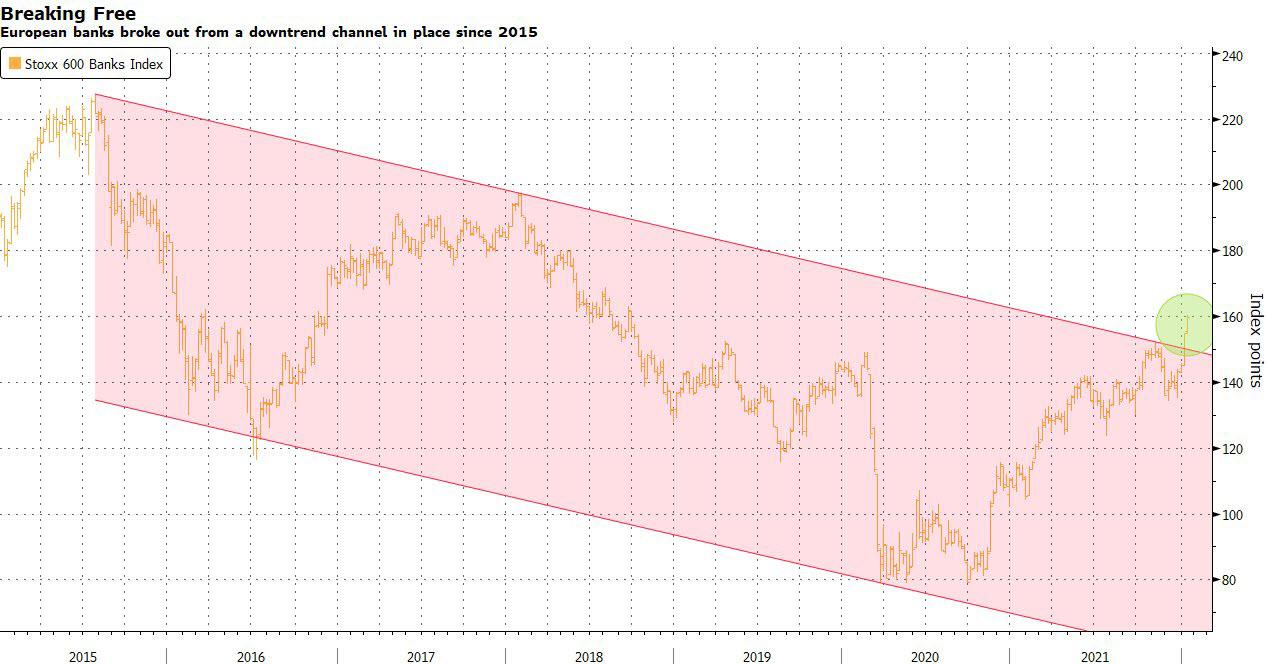
Expectations for tighter monetary policy from the Federal Reserve and other central banks have caused a surge in bond yields, which helps banks lend more profitably. The economy’s recovery from the pandemic also will lead to more borrowing by businesses and consumers.
“As stock investors have to find out who is benefiting the most from the upcoming central bank measures, it only seems logical to look at banks,” says Andreas Meyer, CEO at Fountain Square Asset Management. “There’s life in those old dogs yet.”
Despite the recent rally, the sector remains very cheap. With a forward P/E of less than 10, banks trade at a 40% discount to the broader market, still near record lows. Earnings expectations may continue to rise with bond yields, as every 100-basis-point increase in yields could add about 23 billion euros to bank earnings, according to estimates from Bank of America analyst Alastair Ryan.
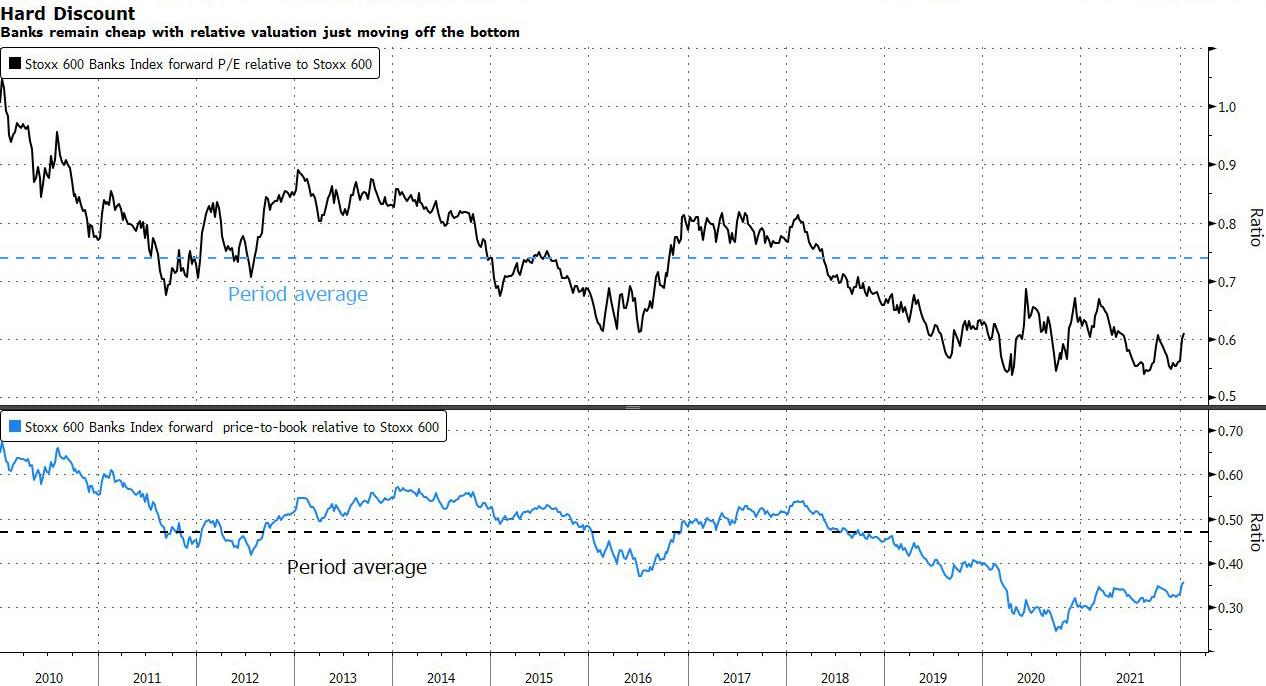
“Europe’s banks start the year with attractive valuations, high distribution yields from dividends and share buybacks as well as a strong earnings dynamic,” says Niall Gallagher, investment director for European equities at GAM Investments. The sector offers the second-highest forward dividend yield of the market at 5%.
The visibility of shareholder returns has improved since the expiry of the European Central Bank’s dividend and buyback ban, while banks’ asset quality remains solid despite the impact of the pandemic. Citigroup analyst Andrew Coombs estimates that lenders could increase capital returns to 81 billion euros this year, while Bank of America sees 134 billion euros as available for distribution through the end of 2023.
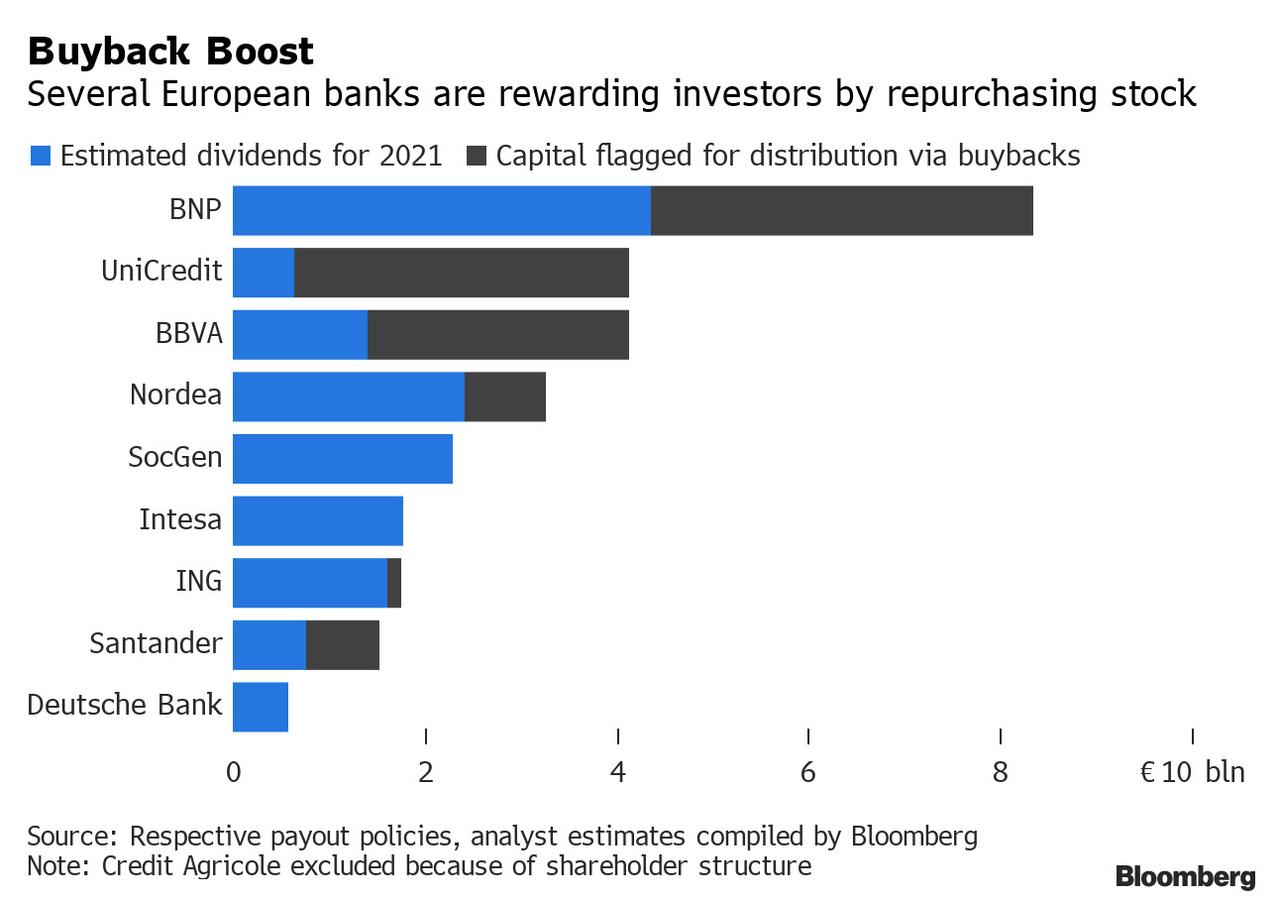
Some investors are scaling back on their bank holdings. Cerberus Capital Management this week sold about 450 million euros of shares in Deutsche Bank and Commerzbank, reducing the stakes it took in 2017. Yet one argument for continued optimism is the sector’s excess capital and solid balance sheets that could act as a catalyst for the long-debated consolidation of the fragmented European banking market.
“Merger activity may heat up,” predicts Crossbridge Capital’s chief investment officer Manish Singh, noting, for example, that French lender BNP Paribas will be sitting on a $16 billion “war chest” after selling its U.S. banking unit. “I’d only go for national champions as they will ultimately benefit from consolidation, forced or otherwise,” he says.
Burberry Sets First Sustainability-linked Loan With Lloyds Bank
The loan comes less than 18 months after Burberry issued a sustainability bond in September 2020.
LONDON — Burberry’s finances are going a deeper shade of green with a new sustainability-linked loan coordinated by Lloyds Bank.
The 300 million pounds loan is linked to Burberry’s ambition to be climate positive by 2040, and comes less than 18 months after the company issued a sustainability bond.
Burberry described the new loan as a revolving credit facility linked to the achievement of ESG targets, such as accelerating emissions reductions across its extended supply chain (Scope 3) 46 percent by 2030
and becoming net zero by 2040, 10 years ahead of the 1.5-degree Centigrade pathway set out in the Paris Agreement.
The company said the loan will also build on its efforts to embed ESG across its operations, including its sources of financing.
In taking out the loan, Burberry joins a legion of European luxury goods companies and fashion brands, including Prada, Moncler, Salvatore Ferragamo and Save the Duck, that are doing the same.
Fashion and luxury brands are under pressure to catch up with other industries, such as energy and automotive, food and beverage to make their mark in the sustainability space.
The banks here are only too happy to help, with institutions including Italy’s Intesa Sanpaolo and France’s Crédit Agricole working with luxury brands to put together deals aimed at assisting businesses hit their green targets, save money and future-proof.
Diana Verde Nieto, cofounder and chief executive officer of Positive Luxury, which certifies sustainable businesses, told WWD in an interview last year that companies with the most ambitious ESG goals are now the ones that are most valuable to investors. The risk of not working quickly enough toward serious climate change goals “is that you become a stranded asset,” Verde Nieto said.
In 2020, Burberry became the first luxury brand to issue a sustainability bond, enlisting the support of investors to finance sustainability projects including refurbishing properties across its portfolio to conform with stringent certification standards; ensuring that natural resources are sourced sustainably; and that pollution from packaging is prevented.
Julie Brown, chief operating and financial officer at Burberry, said the company’s “long-term success depends on creating a net zero future. Linking sources of funding to sustainable initiatives will help drive this, not only in the luxury industry, but also across the wider economy. We’re grateful for the support of our relationship banks in establishing this funding, which will help us on our journey to decarbonize our own operations and extended supply chain.”
Lloyds Bank said it created a new Sustainability and ESG Finance team last year to support corporate clients with their sustainability plans, providing funding and strategic insights.
Scott Barton, managing director of Lloyds Bank’s Corporate and Institutional Coverage team, said helping clients reach net zero “is a key priority for us. Working alongside a climate leader such as Burberry as it progresses its green journey will be crucial for helping the wider luxury fashion industry meet its ambitious goals.”
The Burberry bond is benchmark-sized, medium-dated and denominated in British pounds. It was offered to professional investors and eligible counterparties. It is traded on the main market of the London Stock Exchange.
The money raised from the bond has gone toward a number of sustainability initiatives at both a corporate and a brand level.
Burberry said it is protecting and restoring natural habitats in countries where it operates; supporting farming communities and seeking farm-level certifications and training in places where it sources raw materials, and helping to develop regenerative and holistic land management practices to grazing and farming systems, among other initiatives.
>>> Up
* Apple PT Raised to $200 from $175 at Deutsche Bank (+)
* Beiersdorf Raised to Buy at Deutsche Bank; PT 105 euros (+)
* Chr. Hansen Raised to Neutral at JPMorgan; PT 535 kroner
* Enad Global 7 Raised to Buy at Handelsbanken; PT 50 kronor
* Fevertree Drinks Raised to Buy at Jefferies; PT 3,400 pence
* Genuit Group Raised to Buy at Berenberg; PT 740 pence
* Hyve Group Raised to Add at Peel Hunt
* ID Logistics Raised to Buy at Berenberg; PT 360 euros
* J. Martins Raised to Accumulate at Biuro Maklerskie mBanku
* Johnson Matthey Raised to Hold at Panmure Gordon; PT 1,895 pence
* Marshalls Raised to Buy at Peel Hunt (+)
* Siltronic Raised to Outperform at Oddo BHF; PT 165 euros (+)
* Sydbank Raised to Buy at SEB Equities; PT 264 kroner
* Telia Raised to Buy at Goldman; PT 46 kronor
* WAG Payment Solutions Raised to Buy at Citi; PT 148 pence
* Xvivo Perfusion Raised to Buy at Pareto Securities (+)
* Zalando Raised to Buy at M.M. Warburg (+)
* *ZSCALER RAISED TO OVERWEIGHT VS EQUAL-WEIGHT AT MORGAN STANLEY (+)
>>> Down
* Adevinta PT Cut to 99 kroner from 105 kroner at Berenberg
* EDF Cut to Underperform at BofA; PT 7.60 euros
* Elisa Cut to Neutral at Goldman; PT 56 euros
* Enagas Cut to Hold at SocGen; PT 20.50 euros
* Howden Joinery Cut to Hold at Berenberg; PT 940 pence
* Hummingbird Cut to Hold at Canaccord; PT 15 pence
* Lufthansa Cut to Market Perform at Bernstein; PT 7.85 euros
* Orange Cut to Sell at Goldman; PT 9.20 euros
* Salvatore Ferragamo Cut to Underweight at Morgan Stanley
* SEB Cut to Underweight at Barclays; PT 111 kronor
* SpareBank 1 SMN Cut to Hold at SEB Equities; PT 163 kroner
* SSE Cut to Hold at HSBC; PT 1,740 pence
* Swatch Cut to Underweight at Morgan Stanley; PT 280 Swiss francs
* Tod's Cut to Underweight at Morgan Stanley; PT 42 euros
* Vantage Towers Cut to Neutral at Goldman; PT 33 euros
* Zurich Airport Cut to Hold at Deutsche Bank; PT 185 Swiss francs
>>> Initiation
* Daimler Truck Rated New Buy at DZ Bank; PT 42 euros (+)
* Deliveroo Rated New Outperform at Davy (+)
* Delivery Hero Rated New Outperform at Davy (+)
* DoorDash Rated New Neutral at Davy (+)
* Froey Rated New Buy at Arctic Securities; PT 65 kroner
* Iveco Rated New Neutral at Intermonte; PT 12 euros
* Just Eat Takeaway Rated New Outperform at Davy (+)
* National Bank of Greece Resumed Buy at Deutsche Bank (+)
* Norva24 Group Rated New Neutral at Citi; PT 36 kronor (+)
* Piraeus Financial Holdings Resumed Hold at Deutsche Bank (+)
* Rio Tinto Reinstated Outperform at Macquarie; PT 6,600 pence
* Signup Software Rated New Buy at Pareto Securities
>>> Call
* Berenberg Positive on Construction Sector, Genuit Upgraded
* Beverages Recovery Set to Continue, Fevertree Raised: Jefferies
* Elementis Still a Buy at Jefferies After ‘Solid’ Trading Update (+)
* Hugo Boss FY ‘Well Above’ Guidance, Also Beat Consensus: Citi (+)
* ID Logistics Upgraded at Berenberg on Attractive Entry Point
* Lindt 2H Sales Strong, ‘Bang in Line’ With Consensus: Bernstein (+)
- AUTO1 (AG1 TH) +4.7%
- AUTO1 Says ‘Very Well Positioned’ for Ongoing Growth in 1Q 2022
- Volvo (VOL1 TH) +1.5%
- Evotec SE (EVT TH) +1.3%
- Evotec Enters up to $1B Value Drug Discovery Pact With Eli Lilly
- UCB (UNC TH) +1.3%
- UCB’s Bimekizumab Second Phase III Study Met Primary Endpoint
- Unilever (UNVB TH) +1%
- Shares slumped 7% on Monday
- ASML (ASME TH) -1.1%
- Watch European Tech Stocks As Treasuries Slump on Fed Hike Bets
- Deutsche Bank (DBK TH) -1.1%
- BAT (BMT TH) -1.1%
- Lufthansa (LHA TH) -1.4%
- Prosus (1TY TH) -1.4%
- Banco Santander (BSD2 TH) -1.5%
- Randstad (RSH TH) -1.5%
- Sartorius Stedim Biotech (56S1 TH) -1.6%
- OMV (OMV TH) -1.8%
- Orange (FTE TH) -3.1%
- Orange Cut to Sell at Goldman; PT 9.20 euros
Marché auto : deux ans de suite, la grosse claque, partout en Europe
Comparer les chiffres de ventes de voitures neuves d’une année sur l’autre, c’est bien. Mais il est plus instructif de mesurer leur évolution depuis 2019, avant les grands bouleversements nés de la pandémie. Hélas ! Le constat n’est guère plus encourageant.
Nul besoin de travailler pour la presse à sensation pour s’autoriser à qualifier les douze mois passés d’annus horribilis. Vous connaissez la rengaine : dans les usines, la production d’automobiles a été enrayée — parfois carrément suspendue — par la conjonction d’un absentéisme dû à la covid-19 et des pénuries en tous genres. Les composants électroniques et les matériaux d’emballage ont manqué, quand ce n’étaient pas les chauffeurs routiers et les moyens de transport. Résultat, le marché automobile pointe en Europe à un niveau historiquement bas, qui le ramène à son niveau de... 1975.
Forcément, constructeurs et distributeurs ont le moral dans les chaussettes. Les ravages de la crise des semi-conducteurs perturbent tellement la production et les immatriculations, que certaines voix s’élèvent pour dire que l’année 2021 devrait être considérée comme proprement exceptionnelle — donc peu représentative de l’état de santé réel du marché et de la demande.
A voir ! Car remonter deux ans en arrière, pour examiner ce qu’était le marché avant la pandémie ne met pas vraiment de baume au cœur.
Si l’on en croit les chiffres rapportés par Inovev, il s’est immatriculé en France 0,5 % de voitures neuves en plus en 2021 qu’en 2020. Hélas ! Ce niveau est encore 25,1 % inférieur à ce qu’il était en 2019. Au total, la France a immatriculé 1.659.146 voitures particulières l’an dernier, contre 1.650.118 en 2020 et 2.214.428 en 2019.
A en croire Autoways, les pénuries évoquées plus haut ont suffi à effacer l’embellie enregistrée en début d’année 2021, comparée à la même période en 2020, quand les populations étaient confinées. “Malgré la reprise puissante de la consommation sur le premier trimestre, les immatriculations de voitures neuves par les particuliers ont encore reculé de 7,6 % en 2021, quand celles aux entreprises augmentaient de 10,2 %”, constate Autoways. Dommage, ce sont les ventes aux particuliers qui sont les plus rentables.
“Alors que le marché français progressait de plus de 50 % à fin mai”, renchérit AAA Data, il n’a cessé de s’éroder par la suite. Par rapport à 2019, le nombre de ventes perdues sur l’année dépasse ainsi les 555.000 unités”. Une paille.
Des voitures neuves de plus en plus chères
Inovev avance une autre explication au niveau historiquement bas de la demande, en France : “La forte augmentation du prix moyen des voitures ainsi qu’un attentisme des clients vis-vis du véhicule électrique freine les achats et incite les clients potentiels à garder leur voiture plus longtemps ou à acheter une voiture d’occasion”.
Le cabinet AlixPartners a calculé qu’en dix ans, le véhicule de tourisme neuf a vu son prix moyen enfler de 7.000 euros. Quant au journal spécialisé L’Argus, il arrêtait en 2020 le prix moyen d’une voiture neuve à 26.800 euros, contre 19.800 euros dix années plus tôt. La faute aux coûts de la dépollution des moteurs, relayés par ceux de l’électrification, auxquels est venu s’ajouter le renchérissement des matières premières.
Autre raison souvent évoquée, les incertitudes chez le consommateur, passablement déboussolé par la variété de nouvelles motorisations plus ou moins fortement électrifiées. Avant de s’engager, beaucoup aimeraient savoir si les hybrides rechargeables, par exemple, ne seront pas un jour bannies du centre-ville. La sentence conditionne la valeur de revente à moyen et long terme de ce type de véhicules.
En 2021, le marché allemand fait un peu mieux que le français
Comme en France, le marché allemand termine 2021 à son point le plus bas “depuis plusieurs décennies”. Ici comme en France et partout ailleurs en Europe, pénuries et perturbations en tous genres s’ajoutent à la circonspection des consommateurs. D’après Inovev, les Allemands ont ainsi immatriculé 2.622.132 voitures particulières l’an dernier, contre 2.917.678 en 2020 et 3.607.258 en 2019. C’est 27,3 % de moins qu’en 2019, donc, et encore 10,1 % de moins qu’en 2020.
Ailleurs, les mauvaises nouvelles s’enchaînent. Toujours d’après Inovev, le marché britannique recule de 28,7 % en 2021 par rapport à 2019. L’Italie immatricule 23,9 % de voitures neuves en moins en 2021 qu’en 2019. En Espagne, c’est 31,7 % de moins. La Belgique accuse une baisse de 30,3 %, quand la Suisse et les Pays-Bas reculent respectivement de 23,4 % et de 27,6 %. Bref, il y a de quoi tendre la main vers le tube de comprimés effervescents, dans l’espoir d’atténuer la douleur.
La seule lueur d’espoir provient de la Norvège, marché décidément à part, en raison de son fort taux d’électrification. Les immatriculations y ont augmenté de 24,8 % par rapport à 2019. Toutefois, le volume reste modeste, avec 113.715 voitures vendues, dont 64,5 % de pures électriques (contre 54,3 % en 2020 et 10 % en moyenne en Europe). Une exception qui s’explique par le maintien de nombreux avantages accordés aux véhicules électriques, dont une exemption de taxe.
DAX:
- Siemens Healthineers (SHL TH) +0.5%
- Daimler (DAI TH) -0.6%
- *EUROPE CAR SALES SLUMPED 22% IN DEC., DROPPED 1.5% FOR THE YEAR
- Infineon (IFX TH) -0.6%
- Watch European Tech Stocks As Treasuries Slump on Fed Hike Bets
- Airbus (AIR TH) -0.7%
- SAP (SAP TH) -0.7%
- Fresenius Medical (FME TH) -1.1%
MDAX:
- AUTO1 (AG1 TH) +5.9%
- AUTO1 Says ‘Very Well Positioned’ for Ongoing Growth in 1Q 2022
- Hugo Boss (BOSS TH) +3%
- Hugo Boss Prelim 4Q Sales Beat Estimates
- Evotec SE (EVT TH) +1.8%
- Evotec Enters up to $1B Value Drug Discovery Pact With Eli Lilly
- Lufthansa (LHA TH) -0.7%
- Lufthansa Cut to Market Perform at Bernstein; PT 7.85 euros
- Telefonica Deutschland (O2D TH) -0.8%
- Vantage Towers (VTWR TH) -1.4%
- Vantage Towers Cut to Neutral at Goldman; PT 33 euros
SDAX:
- RTL (RRTL TH) +1.3%
- Nordex (NDX1 TH) +1.3%
- Nordex FY Orders 7.95 GW Vs. 6.02 Y/y
- Sixt (SIX2 TH) -0.9%