WSJ : New Senior-Housing Projects Charge Big Bucks for Luxury Living

New Senior-Housing Projects Charge Big Bucks for Luxury Living
Developers bet that aging baby boomers will pay rents of over $25,000 for housing with all the extras

Developers are making bets that as baby boomers age demand will soar for ultraluxury senior-housing projects with rents that can exceed $25,000 a month.

A venture of developer Related Cos. and Atria Senior Living, one of the largest U.S. senior-housing operators, earlier this month opened the first of its Coterie line of senior-housing projects in San Francisco’s Cathedral Hill neighborhood. Amenities at the 208-unit project include five dining options, a rooftop terrace, an outdoor pool and a garden with bocce ball courts.

Monthly rents range between $8,000 and over $25,000 a month including meals, housekeeping, concierge services and cultural programming. Like many of the new luxury senior-housing projects, Coterie Cathedral Hill can support seniors whose needs range from no special care to assisted living and memory care.

Other developers that have targeted the luxury senior-housing niche include private-equity firm Kayne Anderson Real Estate Advisors, which has opened 13 properties with about 2,800 units and has one in development, a repurposed 1855 Greek revival structure in New Orleans. Average units in the firm’s Brooklyn project rent for $13,000 a month and include meals and housekeeping.

Developers are focusing on upscale senior-housing development because some baby boomers—people who were born between 1946 and 1964—are approaching the age that people typically enter senior housing, according to senior-housing industry participants.

“Between 2005 and 2018, the over-80 population grew by 200,000 or less per year,” said John Moore, Atria chief executive. “Last year it grew by 325,000. This year, probably 450,000. Next year over 600,000.”

Most private senior-housing operators target the middle market and charge average rents of about $5,500 a month for assisted living including food, housekeeping and activities. In recent years, developers and operators have started to focus on more upscale niches similar to the way lodging companies have created new upscale brands.

“You’re starting to see segmentation in the industry,” said Beth Mace, chief economist for the National Investment Center for Seniors Housing & Care, an industry organization.

One of the pioneers of the luxury end of the business was Vi Living, a company controlled by Chicago’s Pritzker family, which also is a major shareholder of Hyatt Hotels Corp. , according to Randy Richardson, Vi’s president. Founded in 1987, Vi Living is planning to launch a new rental brand with a 320-unit development in Scottsdale, Ariz., Mr. Richardson said.

Groundbreaking is expected early next year, Mr. Richardson said. “Over the next five to six years, we could have 10 of these communities open or under development,” he said.

Senior housing was one of the hardest hit commercial property types by the pandemic. Many people didn’t want to move into facilities because they feared infection and being cut off from their families by health protocols.

Conditions have steadily improved since vaccinations became widespread. The average senior-housing occupancy rate in the 31 primary markets was 81% in the fourth quarter of 2021, up from a pandemic low of 78.7%, but still off the pre-pandemic rate of 87.6% in the fourth quarter of 2019, Ms. Mace said.

Many of the new luxury senior developments are in downtowns, which have added to their rents because land prices and construction expenses are high. The Related-Atria venture is also planning to open a 120-unit facility under the Coterie brand later this year in Related’s sprawling Hudson Yards development on Manhattan’s west side.

“Seniors who are urbanites want to remain urbanites,” said Mr. Moore of Atria.
FT : Auto loans: rising rates and fuel prices will make lenders shift gears

Auto loans: rising rates and fuel prices will make lenders shift gears
Pandemic-era boom is slowing down and defaults have started to increase

Americans went shopping for cars in a big way during the pandemic. Auto-loan originations in the US hit a record $734bn in 2021, according to data from the Federal Reserve Bank of New York. Total outstanding debt in the sector grew by $84bn to $1.46tn, outpacing the increase seen in student and credit card debts combined. The Federal Reserve chair Jay Powell argued this week for more aggressive monetary tightening, which hints at augmenting credit risks.

For the four banks that dominate vehicle lending in the US — Ally Financial, Capital One, Wells Fargo and JPMorgan Chase — auto loans have offered a bright spot amid a sluggish recovery in loan growth elsewhere. Ally said 2021 was its best year for auto lending since the early 2000s. These types of loans account for almost all its pre-tax profits. At Capital One, auto loans jumped a third last year.

The avoidance of mass transportation by US commuters during the pandemic primed the pump for car sales during 2020. Since then sales have tailed off. Supply chain issues made cars harder to come by, crimping unit sales. But this supply crunch also drove up all car prices. Buyers in turn ended up paying more and taking on bigger loans.


High interest payments on these debts lined the coffers of auto lenders. Swelling prices for used cars have also allowed banks to more easily recoup their capital in cases of default. Used car values are not far off decade highs in the US, according to Manheim data.

However, rising interest rates, sharply higher petrol prices and an eventual easing of the car shortage all threaten to put the brakes on the auto loan boom. Already, shares of Ally Financial and Capital One have trailed the broader US Russell 1000 financials index since last summer.

When used car prices do weaken, lenders who have extended large loans may take a different view on collateral. Since July, auto defaults have been creeping up again, according to the S&P/Experian Auto Default Index. It is early, but shareholders will want to buckle their safety belts.

FT : Lebanon’s veteran central bank chief charged with money laundering

Lebanon’s veteran central bank chief charged with money laundering
Riad Salameh and his brother alleged to have used several companies they own to embezzle public funds

Lebanon’s central bank governor Riad Salameh has been charged with illicit enrichment and money laundering, the first criminal charges brought against the veteran banker who many believe played a central role in the country’s financial meltdown.

A judge in Lebanon’s district court on Monday charged Riad Salameh and his brother Raja with money laundering through several companies they own. Raja Salameh was arrested on Thursday and taken into custody. A Ukrainian woman, Anna Kosakova, was also charged on Monday of aiding them in the illegal enrichment.

Judge Ghada Aoun is probing Riad Salameh’s finances in Lebanon. The charges stem from a lawsuit filed last week by a group of activists, who accuse the brothers of embezzling public funds at the height of Lebanon’s economic meltdown through companies belonging to the Salamehs.

The charges follow weeks of mounting tensions between Riad Salameh and his political opponents, deepening the scandal surrounding the long-running governor of the Banque du Liban. They were the latest indication that the pressure was ramping up on a figure once seen as untouchable, analysts said.

Judge Aoun issued a travel ban on Riad Salameh in January and in February issued a subpoena after he failed to appear in court to be questioned over allegations of corruption and misconduct. State security forces charged with bringing him before the judge struggled to locate him, prompting many to speculate that he had gone into hiding.

Riad Salameh maintains his innocence and has long said that his wealth was acquired during his years as an investment banker.

“Judge Aoun has prior to these charges used her own tweets to express hostile comment[s] against me. The law allows any Lebanese citizen to ask to be questioned by another judge that is non-biased. Ghada Aoun refused to implement the law and pressed charges. In fact, I have commissioned an audit firm to examine my wealth and its source. The auditor confirmed that no public funds were involved in the build-up of my wealth,” Riad Salameh told the Financial Times.

Although he was long celebrated both at home and abroad for managing Lebanon’s precarious finances, Riad Salameh has been the subject of increasing scrutiny since the collapse of Lebanon’s economy in 2019 through his mismanagement of Banque du Liban. The central banker is also facing investigations relating to his finances in several other countries, including France, Germany and Switzerland.

But politicians supportive of Riad Salameh, including Lebanon’s prime minister Najib Mikati, accuse President Michel Aoun of orchestrating a campaign against the governor. Judge Aoun is considered close to the head of state, although they are not related.

The president has publicly blamed the central bank for the financial crisis. But the prime minister, who is a billionaire businessman, said in December that Riad Salameh should remain in his post, arguing that “one does not change their officers during a war”. Last week, Mikati accused certain judges in Lebanon of exacerbating political tensions in the crisis-ridden country.

Riad Salameh was charged in absentia, as he did not appear in court. Judge Aoun said she had referred his case to another judge who would decide whether to issue an arrest warrant. Raja Salameh remains in custody.

FT : Traders warn of looming global diesel shortage

Traders warn of looming global diesel shortage
A drop in Russian supplies could lead to European fuel rationing, says Vitol boss

Global markets face a squeeze on diesel, leading traders have warned, with Europe most at risk of a “systemic” shortage that could lead to fuel rationing.

The heads of one of the largest commodity trading houses and the biggest independent oil trader both estimated as much as 3mn barrels of oil and its products a day could be lost from Russia as a result of sanctions, following the country’s invasion of Ukraine. The corporate leaders were speaking at the FT Commodities Global Summit in Lausanne, Switzerland on Tuesday.

“The thing that everybody’s concerned about will be diesel supplies. Europe imports about half of its diesel from Russia and about half of its diesel from the Middle East,” said Russell Hardy, chief of Switzerland-based oil trader Vitol. “That systemic shortfall of diesel is there.”

Those imports mean that Russian supplies account for about 15 per cent of Europe’s diesel consumption.

Hardy said the shift to more diesel consumption over petrol in Europe had helped to create shortages of the fuel. He added that refineries could boost their diesel output in response to higher prices at the expense of other oil-derived products to shore up supply, but acknowledged that rationing was a possibility.

Torbjorn Tornqvist, co-founder and chair of Geneva-headquartered Gunvor Group, added: “Diesel is not just a European problem; this is a global problem. It really is.”

Tornqvist also said European gas markets were no longer functioning properly as traders faced huge demands from banks for cash to cover hedging positions.

“I think it’s broken. It really is,” he said. “I never thought that somebody could say ‘ah, gas has fallen below 100 per megawatt hours is really cheap’.”

Last week, Europe’s largest energy traders called on governments and central banks to provide emergency liquidity support to keep gas and power markets functioning as sharp price moves triggered by the Ukraine crisis have strained commodity markets.

Gas futures linked to TTF, Europe’s wholesale gas price, have whipped from about €70 a megawatt hour before Russia’s invasion of Ukraine to about €230 two weeks ago and then sliding below €100 this week. Before May 2021, European gas prices were below €20 a megawatt hour.

Commodity traders are faced with soaring margin requirements — the percentage of a security’s price that banks demand traders hold in cash.
Hardy said participation in the spot market for gas had dwindled because the cost of trading had risen so high. 

To move a cargo equivalent to 1 megawatt hour of liquefied natural gas priced at €97, traders must provide €80 in cash, straining their capital requirements, Hardy said. 

Tornqvist said European utilities would struggle to fill gas storage for next winter given the “paralysed” state of the spot market for gas unless policymakers stepped in to provide guarantees to protect buyers against price swings.

(ZH) Goldman Now Sees Fed Hiking 50bps In May And June, A First Since 1994

Goldman Now Sees Fed Hiking 50bps In May And June, A First Since 1994

In Jerome Powell's Tuesday speech before the NABE, the Fed Chair said, “There is an obvious need to move expeditiously to return the stance of monetary policy to a more neutral level, and then to move to more restrictive levels if that is what is required to restore price stability.” He repeated the call “to move expeditiously” at the end of the speech, a change from his January phrasing of "steadily", suggesting an even more hawkish conviction to the Fed's future tightening path than he revealed during last week's FOMC presser.
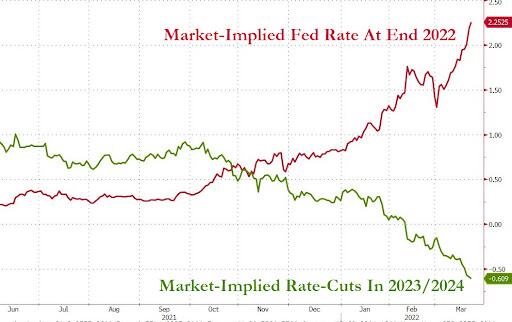
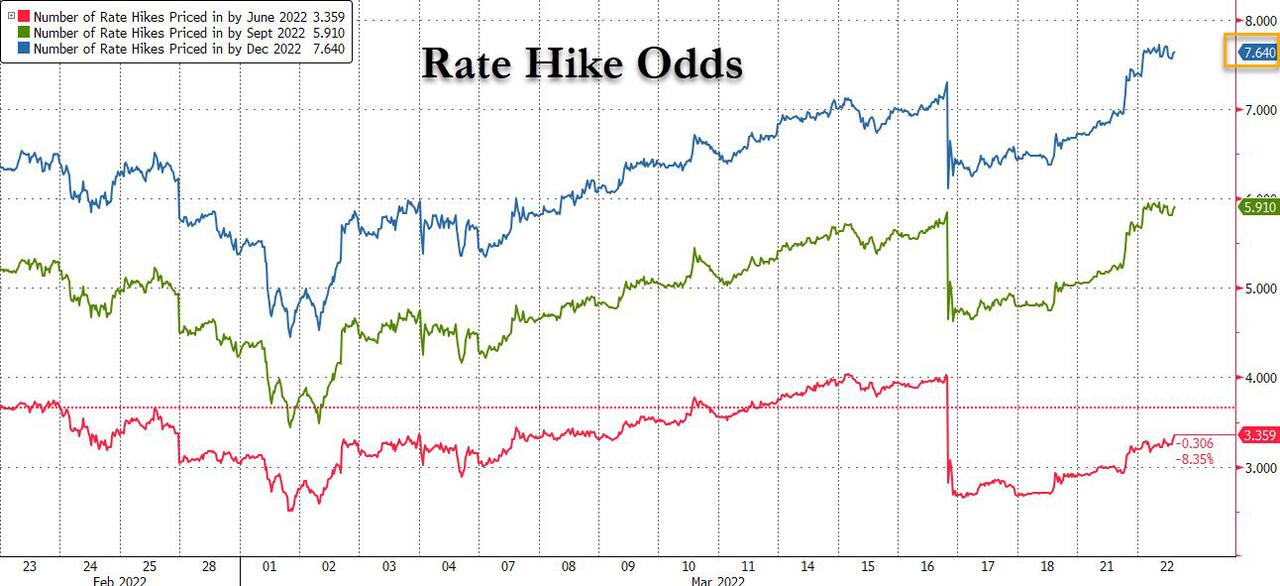
Indeed, on Tuesday morning, derivative traders priced in about 7.7 quarter-point rate hikes at the remaining six Fed meetings this year, effectively making provision for more than one half-point rise.
Breaking down the odds we get the following numbers, all conditional on each other:
  • 72% odds of 50bps in May
  • 65% odds of 50bps in June
  • 35% odds of 50bps in July
Overnight, Goldman Sachs economists agreed with this hawkish take and writing that the shift in wording from “steadily” in January to“expeditiously” today is a signal that a 50bp rate hike is coming. And not just one but two, because according to Goldman, the Fed will raise interest rates by 50 basis points at both its May and June policy meetings, and by 25 basis points in the four remaining meetings in the second half of the year, with three quarterly hikes in the first nine months of 2023.
We are now forecasting 50bp hikes at both the May and June meetings (vs. 25bp at each meeting previously). The level of the funds rate would still be low at 0.75-1% after a 50bp hike in May, and if the FOMC is open to moving in larger steps, then we think it would see a second 50bp hike in June as appropriate under our forecasted inflation path. After the two 50bp moves, we expect the FOMC to move back to 25bp rate hikes at the four remaining meetings in the back half of 2022, and to then further slow the pace next year by delivering three quarterly hikes in 2023Q1-Q3. We have left our forecast of the terminal rate unchanged at 3-3.25%, as shown in Exhibit 1.
Goldman leaves its forecast of the terminal rate unchanged at 3-3.25%; the bank continues to expect the FOMC to announce the start of balance sheet reduction at the May meeting, but after today’s comments they don't think this is necessarily an obstacle to also delivering a 50bp hike in May.
Powell’s comment last week that the shrinkage of the balance sheet is “the equivalent of another rate increase” was consistent with our estimate of its impact, but below the consensus estimate. If the impact of runoff is smaller, then pairing the balance sheet announcement with a 50bp hike at the same meeting might count as moving “expeditiously” but not excessively.
Moreover, since the FOMC will reveal some parameters of the balance sheet reduction process in the upcoming March minutes, the official announcement in May might not be such a major event for markets.
That said, the bank concedes that "the Russian invasion of Ukraine and the possibility that financial conditions could tighten more aggressively in response to a faster pace of Fed tightening both present downside risks to our new forecast of two 50bp rate hikes, though neither looks like an obstacle at this point." Additionally, Goldman notes that the invasion of Ukraine also presents upside risks to inflation, as Powell noted, "and our financial conditions index eased following last week’s hawkish March FOMC meeting and tightened only modestly today."
If Goldman is right and if the Fed proceeds with not one but two rate hikes in May and June, that would be the first time the Fed has hiked 50bps twice in one year since 1994.
Pouring gasoline on the hawkish fire, this morning St Louis Fed president James Bullard, who earlier this week said he favor raising rates above 3% this year, spoke to Bloomberg Television and urged the Fed to move "aggressively" to raise interest rates and shrink balance sheet.
“The Fed needs to move aggressively to keep inflation under control,” says Bullard, who dissented from last week’s quarter- point rate hike in favor of half-point increase. “Our policy as we sit here today is still a very large balance sheet and very low policy rates. We need to get to neutral at least so we’re not putting upward pressure on inflation during this period when we have much higher inflation than we’re used to in the U.S.”
Not everyone agrees, however, and Bank of America chief economist Ethan Harris writes today that "our view is that the bond market has it backwards: 50 bp hikes are more likely in the fall than at the next two meetings. The Fed had a great opportunity to endorse a 50 bp hike out of the gate when it was priced in a month ago and they passed on it."
Meanwhile as we wait until May for the Fed's next nailbiter, one day after fireworks rocked the front-end of the yield curve with the 2Y yield soaring 18bps the push higher continues and today the 2Y is higher by another 5.5pbs, rising to 2.17% with much of the yield curve beyond the 2Y point (including the 3s10s and 5s10s) now solidly inverted, as the flipside to the Fed's hawkishness now is a market which sees the Fed turning uber dovish later, and now pricing in more than 2 rate hikes by 2024.
Nomura's Charlie McElligott notes that while the equity market is currently "basking in the glow of a massive vol reset" as pre-Powell hedges are forcibly unwound but he warns, the REAL downside for Equities comes when the Fed STOPS hiking - because it confirms the slowdown / recession is imminent (coming to you in midyear / 2H ‘23!).
Will stocks 'look forward' to that recession once the negative delta overhang is erased?

>>> Europe : Brokers Upgrades & Downgrades - 22nd of March 2022 V2(+)

>>> Up
* Altria Raised to Buy at Goldman; PT $57
* Bechtle Raised to Buy at Stifel; PT 62 euros (+)
* Bodycote Raised to Hold at Panmure Gordon; PT 671 pence (+)
* Enel Raised to Outperform at Exane; PT 6.90 euros
* IVS Group Raised to Buy at Equita; PT 7 euros (+)
* Moncler Raised to Neutral at Goldman; PT 62 euros
* NatWest Raised to Outperform at KBW; PT 250 pence (+)
* Ryanair Raised to Outperform at Bernstein; PT 16.80 euros
* Ryanair ADRs Raised to Outperform at Bernstein; PT $107
* TP ICAP Raised to Buy at Shore Capital
* Virgin Money UK Raised to Outperform at KBW; PT 200 pence (+)

>>> Down
* Diploma Cut to Underweight at JPMorgan; PT 2,500 pence
* Ebro Foods Cut to Reduce at AlphaValue/Baader
* Mayr-Melnhof Cut to Hold at Erste Group; PT 168.50 euros
* Palfinger Cut to Hold at Hauck & Aufhaeuser; PT 29.80 euros (+)
* Philip Morris Cut to Neutral at Goldman; PT $100
* Schoeller-Bleckmann Cut to Hold at Wiener Privatbank

>>> Initiation
* GFT Rated New Hold at Berenberg; PT 49 euros
* Mister Spex Rated New Buy at Quirin Privatbank AG; PT 17 euros
* Sesa Rated New Buy at Stifel; PT 222 euros
* Stillfront Rated New Sell at SEB Equities; PT 25 kronor
* Vitesco Rated New Buy at Citi; PT 72 euros
* Western Bulk Chartering Rated New Buy at Arctic Securities

>>> Call
* BAE Systems, QinetiQ Win If U.K. Boosts Defense Spending: Citi (+)
* Goldman Sachs Cuts Luxury Growth Expectations, Lifts Moncler (+)
* Enel Upgraded at Exane BNP With Risks Now Seen Priced In (+)
* Lancashire’s Valuation a Buying Opportunity, Jefferies Initiates
* Partners Group to Take ‘Breather’ After Stellar Results: ZKB (+)
* Sinch a Global Player Primed For Growth, New Buy at Berenberg
* YouGov’s 28% 1H Sales Growth ‘Most Encouraging,’ Berenberg Says (+)

>>> Stoxx 600 Pre-Market Indications

  • CD Projekt (7CD TH) +5.8%
    • New Witcher Game in Development With Epic Games’ Unreal Engine
  • TotalEnergies (TOTB TH) +5.3%
  • Nemetschek (NEM TH) +4.1%
    • Nemetschek FY Ebitda Margin 32.6% Vs. 28.9% Y/y
  • Equinor (DNQ TH) +2.7%
  • Leonardo (FMNB TH) +2.6%
    • SES Buying Leonardo Defense Communications Unit for $450 Million
  • Rio Tinto (RIO1 TH) +2.2%
  • Prosus (1TY TH) +2.1%
  • Rheinmetall (RHM TH) +1.9%
  • Just Eat Takeaway (T5W TH) +1.5%
  • Adidas (ADS TH) +1.4%
    • Watch Adidas, Puma Shares After Nike Sales Beat in All Regions
  • TUI (TUI1 TH) -0.7%
  • Telefonica (TNE5 TH) -0.7%
  • Lufthansa (LHA TH) -0.7%
  • Ryanair (RY4C TH) -2.7%

>>> TradeGate Pre-Market Indications

DAX:
  • Adidas (ADS TH) +1.6%
    • Watch Adidas, Puma Shares After Nike Sales Beat in All Regions
  • Puma (PUM TH) +1.3%
MDAX:
  • Nemetschek (NEM TH) +4.7%
    • Nemetschek FY Ebitda Margin 32.6% Vs. 28.9% Y/y
  • Rheinmetall (RHM TH) +1.8%
  • Bechtle (BC8 TH) +1.2%
  • Siemens Energy (ENR TH) +1.2%
  • Uniper (UN01 TH) +1.1%
SDAX:
  • Dermapharm (DMP TH) +4.1%
    • Dermapharm Prelim FY Adjusted Ebitda EU351M
  • Vitesco (VTSC TH) +2.8%
    • Vitesco Rated New Buy at Citi; PT 72 euros
  • SAF-Holland SE (SFQ TH) +2.2%
  • Deutsche Euroshop (DEQ TH) +1.5%
  • Deutz (DEZ TH) +1.4%
  • AUTO1 (AG1 TH) -1.2%

FT : EU energy proposals to focus on gas storage

EU energy proposals to focus on gas storage
Price caps or decoupling gas from electricity markets remain a no-go

Stocking up for winter
The European Commission seeks to change existing legislation and oblige member states and commercial operators to fill up gas storage facilities to 90 per cent this year, according to a draft legal text seen by Europe Express that is due to be published tomorrow.

Possible measures with regard to intervention in energy markets should emerge tomorrow, though it is yet unclear what form they will take and the extent to which leaders will discuss them at the two-day summit starting Thursday.

The draft text setting out an obligation to fill up gas storage facilities amends EU legislation on gas security of supply from 2017.

The reasoning is that by filling up its gas storage facilities, the bloc can avoid major supply disruptions next winter, given that relations with Russia are only likely to worsen in the short term.

The text seeks to strike a balance between interventionist capitals that want the EU to set a price cap and/or decouple gas and electricity markets and free marketeers, who insist on doubling down on renewable energy, better isolating buildings and gradually weaning off Russian imports. No government has thus far taken issue with the need to replenish storage facilities.

“The current geopolitical situation requires additional short-term measures to deal with the market imbalances for energy and for securing supplies in the years ahead,” the draft reads. “As supply disruptions of pipeline gas may occur anytime, measures introducing an insurance policy regarding the filling level of EU storage facilities are introduced.”

According to the commission’s analysis, storage supplies 25-30 per cent of gas consumed in winter. But this past winter, with storage facilities at 10 per cent lower than usual, “an unbalanced gas market has led to a sharp increase in gas prices”.

As gas prices are very likely to rise again ahead of next winter, the commission argues that public intervention will be needed, “including financial support to incentivise the use of storage” — and for the filling process to start as early as April and reach 90 per cent by November.

As a side note, the text was drafted without an impact assessment or any external expertise, “due to the politically sensitive and urgent nature of the proposal”, though the commission did consult with stakeholders, it said.

FT : Tokyo faces blackout a week after quake shut power stations

Tokyo faces blackout a week after quake shut power stations
Businesses and residents asked to conserve energy as cold snap hits world’s biggest metropolitan sprawl

Tokyo businesses and residents have been told to limit their use of electricity or risk plunging the world’s biggest metropolitan sprawl into a blackout on Tuesday evening.

The warning, which affects the capital as well as surrounding areas that are home to about 45mn people, follows a violent earthquake in north-eastern Japan last week that caused several thermal power plants to suspend operations. It also piled pressure on a grid already strained by the 11-year closure of most of the country’s nuclear facilities.

The blackout alert, which was issued by the Ministry of Economy, Trade and Industry, is the first of its type since a system was installed in the aftermath of the 2011 Tohoku quake.

The area affected is covered by the Tokyo Electric Power Company, known as Tepco, whose reputation remains tarnished by the 2011 meltdown of the Fukushima nuclear power facility. Later on Tuesday, a second warning was issued to areas covered by the Tohoku Electric Power Company in the north-east of the country.

The warning sets up a challenge for both companies and individual homes to collectively cut their consumption by about 60mn kilowatt-hours, or around 10 per cent of the estimated demand from 8am to 11pm.

The alarm was sounded after power reserves fell below 3 per cent of total capacity. Between 11am and noon, the ratio of demand to power supply capacity hit 103 per cent, the highest of four levels of severity, according to Tepco.

Koichi Hagiuda, the trade minister, called for co-operation to save electricity “as much as possible”, saying that the supply of electricity was expected to be extremely tight.

The power crunch has coincided with unusually cold weather around Tokyo, with snow forecast for Tuesday afternoon.

On the night of last week’s 7.4 magnitude quake, more than 2mn homes across nine prefectures, including Tokyo, suffered power cuts that in some cases lasted until the following day. The quake initially forced more than 6 gigawatts of power capacity to go offline, of which roughly half remains suspended, according to the government.

Even before last week’s quake, which caused three deaths and 225 injuries, senior policymakers within the ruling Liberal Democratic party had privately discussed the need for a “national drive” to convince people to use less electricity as the Russian invasion of Ukraine drove up global energy prices.

Yuriy Humber, founder of energy consultancy Japan NRG, said the warning was a reminder of Japan’s heavy reliance on thermal energy, mostly coal and gas.

“I’m a bit surprised as to how prolonged this is likely to be,” said Humber, who added that the prospect of asking the world’s oldest population to conserve power was something the government would be keen to avoid in an election year.

The fact that the alert had been issued, he said, suggested that the damage done by last week’s tremors could be greater than acknowledged.