FT : Top oil traders warn prices could breach $200 a barrel

Top oil traders warn prices could breach $200 a barrel
Boycott of Russia since Ukraine invasion will have a lasting effect on energy markets

Some of the world’s most respected oil traders have predicted crude prices could climb beyond $200 a barrel this year owing to a growing international boycott of Russia and a lack of alternative sources of supply.

Pierre Andurand, one of the sector’s best-known hedge fund managers, said supplies of Russian oil into Europe would disappear in the aftermath of Vladimir Putin’s invasion of Ukraine, leading to a lasting reshaping of global energy markets.

“Wakey, wakey. We are not going back to normal business in a few months,” he told the FT Commodities Global Summit in Lausanne. “I think we’re losing the Russian supply on the European side for ever.” Crude could even hit $250 barrel this year, double current levels, he said.

Other veterans of the oil market speaking at the conference agreed that Russian crude and refined products such as diesel would not return to the European market any time soon, even if a ceasefire with Ukraine were agreed.

Analysts have estimated as much as 3mn barrels a day of Russian oil could be lost from the market.

Doug King, head of RCMA’s Merchant Commodity Fund, predicted that oil prices would soar to between $200 and $250 a barrel this year. “This is not transitory. This is going to be a crude supply shock,” he said.

Brent, the international oil marker, hit $122 a barrel on Wednesday ahead of a meeting between EU and Nato leaders in Brussels on Thursday that may result in fresh sanctions on Russia. Prices stretched as high as $139 immediately after the invasion of Ukraine, and even after the pullback from there, they stand 90 per cent above their level at this point last year.

“I don’t think given the way things are going, this is a temporary problem,” said Alok Sinha, global head of oil and gas at Standard Chartered. “You now have to deal with this as a long term issue which means you need to find alternative supply growth.”

Daniel House, senior crude trader at Socar, the Houston-based trading division of Azerbaijan’s national oil company, said the US shale oil industry was unlikely to ride to the rescue by cranking up production to pull prices down.

[Even] if they wanted to speed up, it’s a 12-month process,” he said, adding that some producers could take as long as 18 months to bring on new oil. “The cavalry is not coming as quickly as it did when we had previous incentives for them to grow”.

The US shale industry was once known for its debt-fuelled production binges but executives have since pledged not to outspend cash flow and burn through capital on costly projects.

King said oil prices in the futures market would need to rise significantly before the US shale industry could increase production and deliver the cash returns expected by investors. The contract for US benchmark WTI, for delivery in December 2024, was trading below $80 a barrel on Wednesday.

Ben Luckock, co-head of oil trading at Trafigura, predicted a peak Brent crude price of $150 a barrel this summer and warned that developing economies with less ability to reduce fuel taxes would be hardest hit.

“Whilst the US, western Europe and wealthier countries in the world will be able to afford some of these tax breaks, print some money . . . those poorer nations won’t have the same toolbox,” he said. “These are going to be the people who suffer first and these are some of the unintended consequences of the policies that are likely to come.”

FT : Toshiba shareholders reject management’s plan to split company

Toshiba shareholders reject management’s plan to split company
Proposal to reopen talks with private equity companies also voted down

Toshiba shareholders have voted down the management’s plan to split the industrial conglomerate in two, handing a fresh defeat to a company that has been at loggerheads with investors for four years.

The pivotal vote on Thursday revealed a sharp division among shareholders and diminished the prospect of a rapid turnround for one of Japan’s most famous industrial names. The vote triggered a heavy sell-off of Toshiba shares, which fell by as much as 5 per cent.

The vote concluded an extraordinary general meeting held in the hope of ending a period of turmoil that has forced the resignation of two chief executives and raised the possibility of the company being taken private in what would have been Japan’s biggest ever buyout.

A plan proposed last year by UBS bankers to split the company into three was strongly opposed by shareholders and later abandoned, with the two-way division then presented as the best and most cost-effective alternative.

But in yet another twist to the saga, shareholders also used the EGM to vote down a proposal from Toshiba’s second-largest shareholder — the Singapore fund 3D Investment Partners — that would have obliged the company to reopen talks with private equity firms and other investors towards a possible take-private deal.

Several of Toshiba’s largest investors, which include the Singaporean fund Effissimo, the US fund Farallon Capital and a variety of smaller hedge funds, have been agitating for a take-private deal. They have argued that at an earlier strategic review the company did not properly explore that possibility.

The rejection of both Toshiba’s and 3D’s proposals appears to create a stalemate, but some shareholders said that the outcome could have positive results. The lack of a clear mandate for action from shareholders could give Taro Shimada, the new chief executive appointed earlier this month, freedom to impose his own potentially radical ideas for a turnround, according to investors.

Shimada did not express his opinion on the proposals during the EGM, saying it was not “appropriate to express my personal thoughts today”. Investors have told the Financial Times that privately he has indicated his support for a take-private option, which could remain a possibility even with the formal vote defeated.

When announcing the vote result, Shimada only said the company will “consider various options to improve our corporate value”.

As the Tokyo market reopened for the afternoon session, Toshiba stock erased morning gains and joined the worst performers on the bourse, at one point falling 5 per cent from the day’s highs and touching ¥4,542.

Satoshi Tsunakawa, the previous chief executive of Toshiba who now serves as the chair of the board, has opposed the buyout option saying it could result in the company losing public orders and warning Toshiba would be forced to sell sensitive segments in its defence and nuclear divisions.

At the meeting on Thursday he told investors that a privatisation would mean that foreign funds will buy the company. “We made the proposal because we wanted to carry out the split on our own,” he said.

>>> US After Hours Summary: OXM +8.3%, FUL +4.2% higher on earnings; COOK -15.5%

After Hours Summary: OXM +8.3%, FUL +4.2% higher on earnings; COOK -15.5%, KBH -4.4%, SCS -4.1%, OLLI -2.3% lower on earnings

After Hours Gainers:

Companies trading higher in after hours in reaction to earnings/guidance: OXM +8.3% (also increases dividend), FUL +4.2%, SOL +0.1%

Companies trading higher in after hours in reaction to news: STGW +3.1% (authorizes new $125 mln share repurchase program), WIX +1.8% (authorizes $500 mln securities repurchase program), NVS +0.7% (Pluvicto approved by FDA as first targeted radioligand therapy for treatment of PSMA prostate cancer), DGX +0.6% (awarded CDC contract for COVID-19 infection and vaccination seroprevalence research), DDD +0.5% (enters partnership with Enhatch for personalized medical devices)

After Hours Losers:

Companies trading lower in after hours in reaction to earnings/guidance: COOK -15.5%, KBH -4.4%, SCS -4.1%, ENJY -2.4%, OLLI -2.3% (also launches a store remodel program), EXAI -1.3%

Companies trading lower in after hours in reaction to news: APLS -7.1% (announces $300 mln stock offering), ASND -4.4% (announces $500 mln convertible notes offering), SGHC -1% (stock offering), RIOT -0.4% (enters into a separation agreement with COO), PSB -0.1% (CEO steps down for health reasons), CS -0.1% (says Bermuda court to soon issue judgment against insurance subsidiary)

>>> US Close Dow -1,29% S&P -1,23% Nasdaq -1,32% Russell -1,73% VIX 23,57 +2,75%

Closing Market Summary

The stock market ended Wednesday on a lower note with the Dow (-1.3%), Nasdaq (-1.3%), and S&P 500 (-1.2%) recording comparable losses while the Russell 2000 (-1.7%) finished behind the large cap indices.

Equities spent the bulk of the session in the red, as the S&P 500 gravitated back below its 200-day moving average (4474), which offered support yesterday, while the Nasdaq made a brief appearance in the green in midday trade before reaching a fresh low ahead of the close.

Crude oil recovered its entire loss from yesterday, rising $5.78, or 5.3%, to $115.26/bbl. The resilience in the commodity weighed on overall sentiment, but it also kept the energy sector (+1.7%) atop today's leaderboard throughout the day. The sector extended this week's gain to 4.9% with ten of its components reaching fresh 52-week highs.

The utilities sector (+0.2%) was the only other advancer, benefiting from the cautious sentiment in the broader market.

On the downside, nine sectors recorded losses with six surrendering at least 1.0%. Financials (-1.8%) and health care (-1.8%) lagged throughout the day due to broad weakness. Wells Fargo (WFC 51.12, -2.27, -4.3%) was the worst performer among financials while ResMed (RMD 233.00, -22.05, -8.7%) was the biggest laggard in health care amid supply chain concerns.

Top-weighted technology (-1.5%) finished near the bottom of the leaderboard even though its largest component—Apple (AAPL 170.17, +1.35, +0.8%)—recorded a solid gain. Chipmakers displayed relative weakness with the PHLX Semiconductor Index sliding 2.5%, while Adobe (ADBE 422.90, -43.55, -9.3%) finished at the bottom of the tech sector after its Q1 beat was overshadowed by below-consensus EPS and revenue guidance for Q2.

In other earnings, General Mills (GIS 64.23, +1.55, +2.5%) beat Q3 EPS expectations and raised its FY22 EPS guidance above consensus. Archer-Daniels (ADM 89.09, +1.53, +1.8%) rallied to a fresh record in sympathy with General Mills, but the consumer staples sector still lost 0.9%.

Treasuries ended the day in positive territory with the 10-yr note reclaiming its loss from yesterday and sending its yield lower by five basis points to 2.32%.

In international news, President Biden traveled to meet with European NATO allies in the coming days.

Reviewing today's economic data:

  • New home sales decreased 2.0% month-over-month in February to a seasonally adjusted annual rate of 772,000 units (consensus 820,000) from a downwardly revised 788,000 (from 801,000) in January. On a year-over-year basis, new home sales were down 6.2%.
    • The key takeaway from the report is the recognition that the sale of lower-priced homes has lessened as a percentage of overall sales, likely due to less supply resulting from cost pressures for builders and emerging pressures from rising mortgage rates that are reducing affordability for lower-income buyers. That is leading to higher-priced homes accounting for a larger percentage of new homes sold, which is driving up both median and average selling prices.
  • The weekly MBA Mortgage Index fell 8.1% after decreasing by 1.2% during the previous week. The Purchase Index fell 1.5% while the Refinance Index fell 14.4%.

Weekly Initial Claims (consensus 210,000; prior 214,000), Continuing Claims (prior 1.419 mln), February Durable Orders (consensus -0.5%; prior 1.6%), Durable Orders ex-transportation (consensus 0.5%; prior 0.7%), and Q4 Current Account Balance (prior -$214.80 bln) will be reported tomorrow at 8:30 ET, followed by the preliminary March IHS Markit Manufacturing PMI (prior 57.3) at 9:45 ET

  • Dow Jones Industrial Average -5.5% YTD
  • S&P 500 -6.5% YTD
  • Russell 2000 -8.6% YTD
  • Nasdaq Composite -11.0% YTD

(ZH) Wall Street's Biggest Bear: This Is A "Vicious Bear Market Rally To Sell",

Wall Street's Biggest Bear: This Is A "Vicious Bear Market Rally To Sell", Stocks Will Drop Another 10-20% By Mid-April

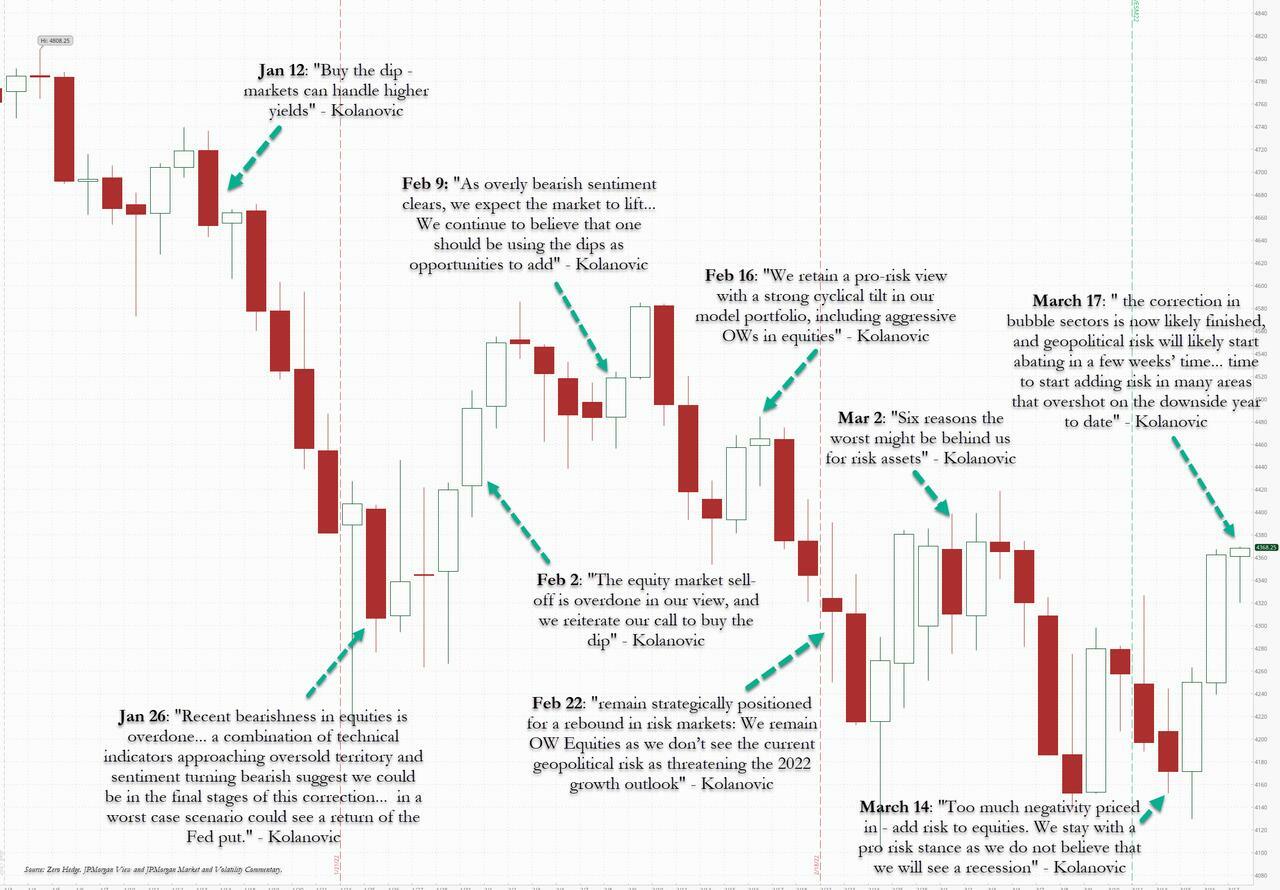
Two days after JPMorgan's Marko Kolanovic spun the broken record and not once but twice in the past week told his clients to buy the dip, something he has been saying every single week in 2022 with less than stellar results...
... he is about to get another brand new dip to urge clients to buy. We can only hope said clients have any money left.
Meanwhile, while JPMorgan keeps digging its permabullish grave deeper with every passing week, Morgan Stanley's bearish strategist Michael Wilson continues to build his credibility and fly circles above the rest of the Street which is desperately trying to extricate itself from its ridiculous trend-chasing optimism at the end of 2021, and one day after reminding clients that the current cycle is getting "late" and will burn out far sooner than expected, warning that the US economy could be in a downturn as soon as 5 months from now (read: recession) he is out with another note this morning in which he takes the diametrically opposite view of Kolanovic, and says that while "the rally in equities over the past week was one of the sharpest on record" and could go a bit higher, led by the Nasdaq and small caps, he remains convicted "it's still a bear market and we would use this strength to position more defensively."
But let's back up. For those who missed his Sunday Start note published yesterday, Wilson reminds readers that a year ago, he published a note with his Economics and Cross Asset Strategy teams arguing this cycle would run hotter but shorter than the prior 3. His view was based on the speed and strength of the economic and earnings rebound post the 2020 recession, the return of inflation after a multi-decade absence, and an earlier-than-expected pivot to more hawkish Fed policy.
In light of this, last Friday Morgan Stanley published an update that shows developments over the past year support this call—US GDP and earnings have surged past prior cycle peaks and are now decelerating sharply, inflation is running at a 40-year high, and the Fed has executed the sharpest pivot in policy we’ve ever witnessed.
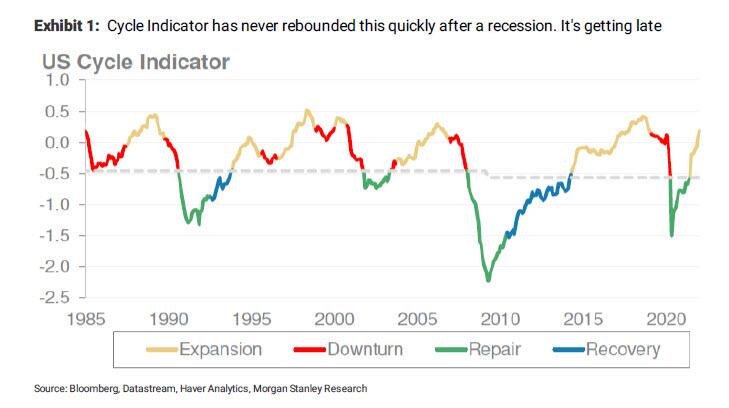
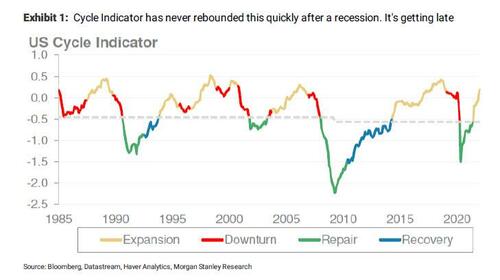
Meanwhile, just 22 months after the end of the last recession - which anyone with half a brain realizes never actually ended the prior business cycle as debt never dropped and in fact, spiked - Morgan Stanley's Cross Asset team’s US cycle model is already approaching prior peaks, as we noted last night. By way of background, this indicator aggregates key cyclical data to help signal where we are in the economic cycle and where headwinds/tailwinds exist for different parts of the market. Of course, the latest rebound has been unusually fast (and artificial, on the back of tens of trillions in monetary and fiscal stimulus). The model is currently in the “expansion” phase (data above trend and rising—i.e., mid-to-late cycle), and as Morgan Stanley warns, "at this pace, the indicator could peak in 2-4 months and move to "downturn" 5-10 months from today."
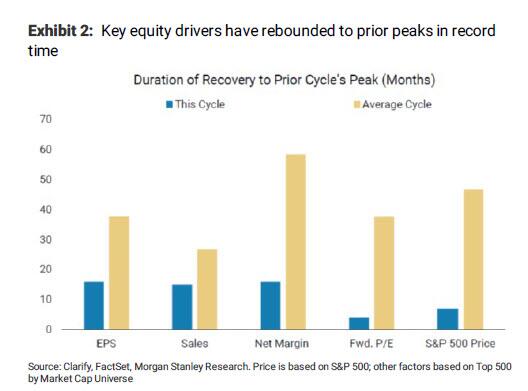
Stepping away from the economy and shifting attention to stocks, here too Wilson notes that "earnings, sales, and margins have all surged past prior cycle highs." In fact, earnings recovered to the prior cycle peak in just 16 months, the fastest rebound going back 40 years.
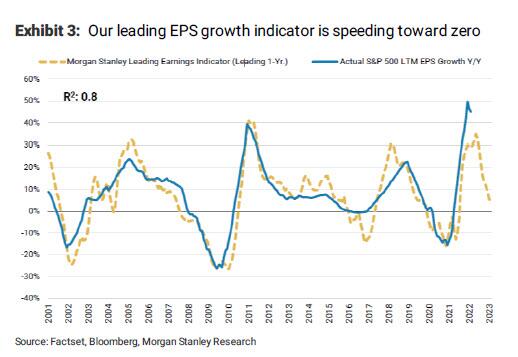
Meanwhile, the early-to-mid cycle benefits of positive operating leverage have come and gone, and US corporates now face decelerating sales growth coupled with higher costs, according to Wilson. As such, the bank's leading earnings model is pointing to a steep deceleration in EPS growth over the coming months and higher frequency data on earnings revision breadth are trending lower—driven by cyclicals and economically sensitive sectors—a set-up that looks increasingly “late” cycle.
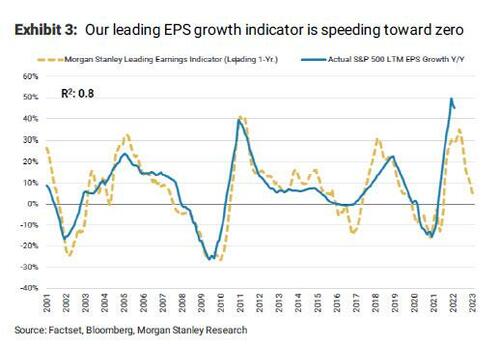
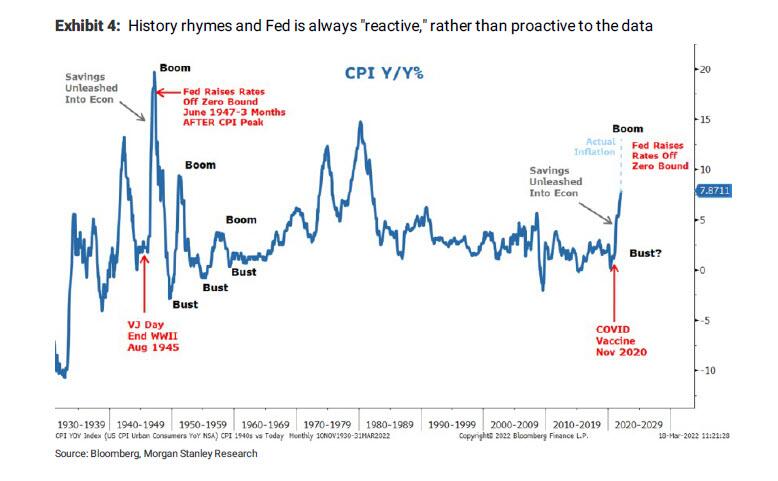
Another reason behind Wilson's conviction of a shorter cycle is his analysis of the 1940s as a good historical parallel. Specifically, back then excess household savings unleashed on an economy constrained by supply set the stage for breakout inflation... just like now. Developments since the bank published its original report in March of last year continue to support this historical analogue—inflation has surged, forcing the Fed to move off the zero bound aggressively in a credible effort to restore price stability.
Assuming the comparison holds, Wilson expects the next move to be a slowdown and ultimately a much shorter cycle. And although the end does not appear to be imminent, the slowdown in earnings that Wilson has been expecting looks incrementally worse than it did when he first published his fire and ice narrative last fall.
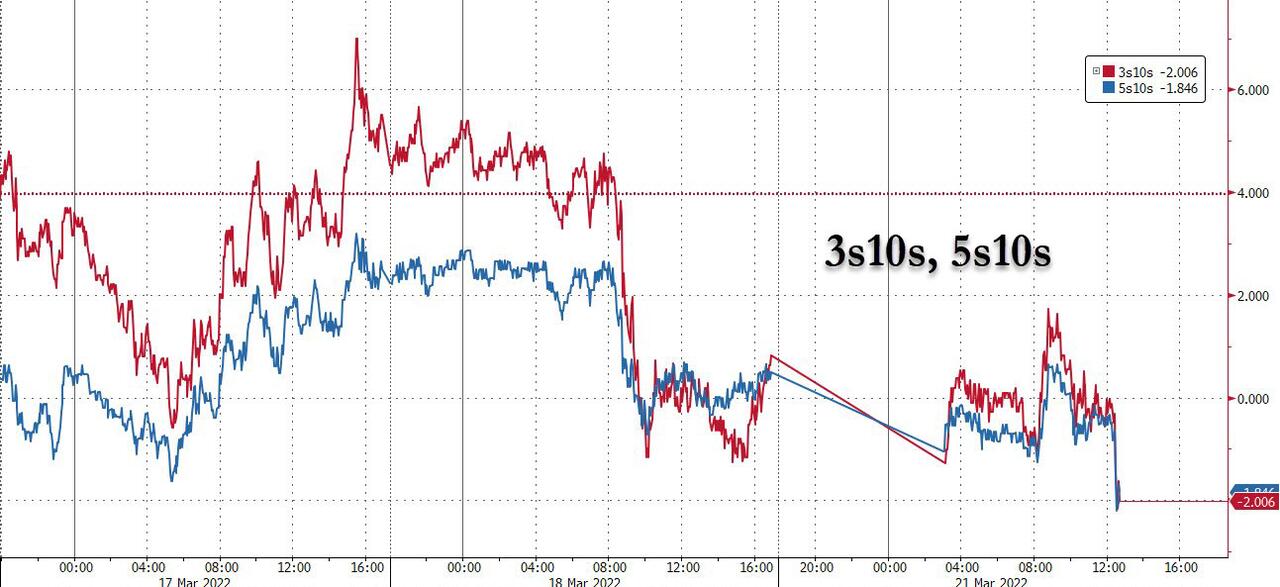
With that background in mind, and with the Fed finally raising rates this past week and communicating a very hawkish tightening path over the next year (something Powell did again just moments ago on Monday during his speech at the NABE annual conference), Morgan Stanley's rates strategists are looking for an inversion of the yield curve in 2Q, although one look at the sharp inversions already observed in the 3s10s and 5s10s, there may be a risk this is Q1 business.
Here Wilson hedges somewhat - knowing well that it is very much frowned upon for established Wall Street strategists to predict a recession - and says that while curve inversion does not guarantee a recession (and he is not forecasting one), it does support his view for decelerating earnings growth "and would be one more piece of evidence that says it’s late cycle."
It also justifies the bank's reco toward defensively oriented stocks and sectors, which is looking increasingly appropriate as the Fed pivots and growth slows—i.e. fire AND ice.
Here, energy is the real outlier for obvious reasons which are not helpful economically speaking. Such leadership is reflective of very late cycle dynamics.
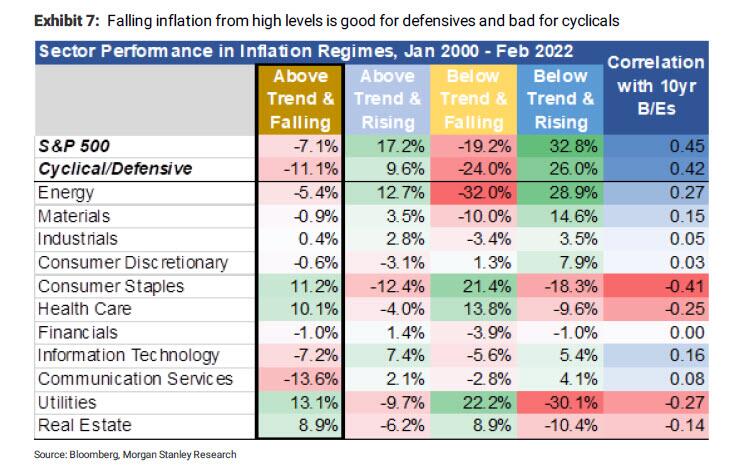
In addition to the above late-cycle analysis, Wilson also looked at what sectors do well when inflation is above trend and falling—a period he thinks is beginning now. He notes the fact that inflation is so high almost guarantees it's close to peaking from a rate of change standpoint. Furthermore, the Fed's aggressive pivot this past week should help, just as it did in the 1940s. Assuming that's the right framework, the argument for defensive positioning is clear; it also tends to be bad for cyclicals relative to defensive and the market more broadly.
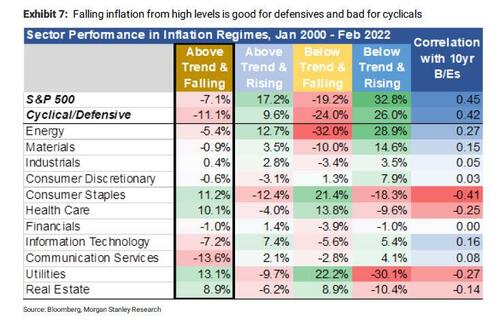
Wilson ends his macroeconomic tour de force recap by repeating his view that COVID did not create any real value for the economy or the average company: "In fact, it's more likely that the pandemic destroyed value by exposing the fragility of just in time inventory systems and the outsourcing of manufacturing and other forms of labor." It also may have impaired the domestic labor force in a way that will take years to fix, not to mention the government's balance sheet, which puts potentially productive investments in infrastructure on hold. Furthermore, the damage from 40-year high inflation will also leave a scar on the consumer and businesses that may take a long time to heal.
The point of these comments, Wilson explains, "is that it doesn't make sense that stock prices would be so much higher than the pre-pandemic levels, even adjusting for inflation and nominal prices. Yet, here we are."
Here we are indeed... so does that mean that one should listen to Kolanovic and wait for future dips to buy and ride out until things normalize? Not at all according to Wilson, who boldly takes the other side of Kolanovic's trade reco (i.e., the same as JPM's trading desk), and notes that his primary out of consensus call for 2022 was that "valuations were too high and ripe for a de-rating." Fast forward to today, and it's fair to say that call has played out, something no other Wall Street strategist can claim, certainly not those permabulls from Goldman or JPM.
The rationale for Wilson's view has been two-fold: the Fed was going pivot to a more hawkish position than most expected ("fire") while growth was likely to slow ("ice"). As part of this framework, Wilson set his target at 18x forward 12-month EPS, which assumed a 2.1% 10-year Treasury yield and an equity risk premium (ERP) of 350bps.
Since establishing that view in mid-November, a lot has happened that Wilson's "fire and ice" narrative has only gotten more extreme.
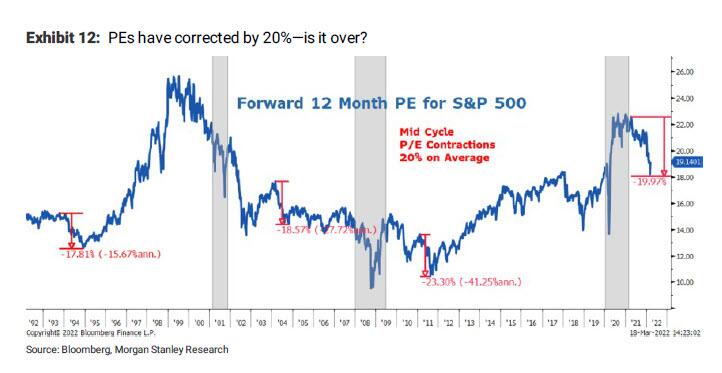
First, the Fed's action in January left the consensus convinced it will hike Fed Funds another 175 bps over the next year and reduce its balance sheet by half a trillion dollars. This has taken 10-year yields past the bank's prior year end targets of 2.1%. As such, MS rates strategists forecast 10-year yields to now end the year at 2.4%, with a bull case of 2.1%. The good news is that most of the damage is done now on rates and that has been reflected in PEs. At the lows last week, the S&P 500 traded right to our 18x target and then stopped. So, as Wilson reveals, "many are now asking us if that was enough."
The answer, it should come as no surprise, is no.
As Wilson explains, the overall macro environment has gotten worse, "which means we are likely to undershoot our 18x target, to the downside. The Fed (and other central banks) are very focused on inflation, and Russia's invasion of Ukraine only increases the pressure on prices, especially food and energy. Meanwhile, the situation is weighing further on both consumer and business confidence, which is not good for growth, nor is it priced."
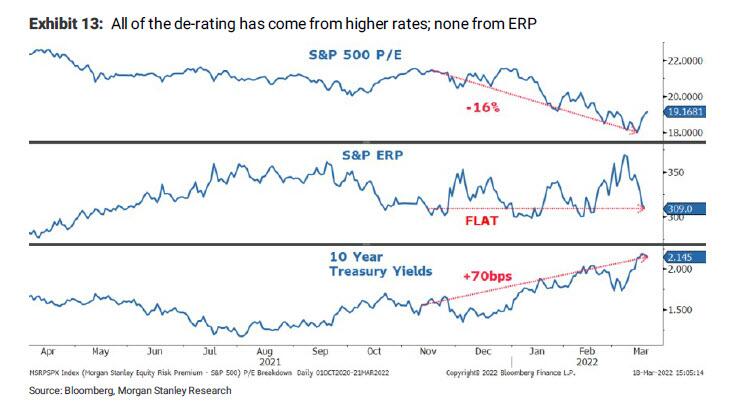
How do we know? Well, as noted, the PE is a function of 10-year yields and ERP. Think of rates as the component of PEs that reflects Fed tightening as well as growth and inflationary pressures. While many bond market participants are looking for the 10- year to back up much further, Morgan Stanley does not, particularly in the near term. In other words, the rates market has adjusted appropriately and fully reflects the Fed's pivot as it stands today. However, the entire PE compression since November is due to rates, while the ERP has remained flat
That means that the ERP has not adjusted for the rising risk to growth, whether that's geopolitical concerns, or the earnings risk from payback in demand, margin pressure from inflation and/or rising inventory.
So how much higher should the ERP be? That's a debatable question, but as Wilson has shown in prior research, just based on market volatility, one could argue the ERP is now 150bps too low
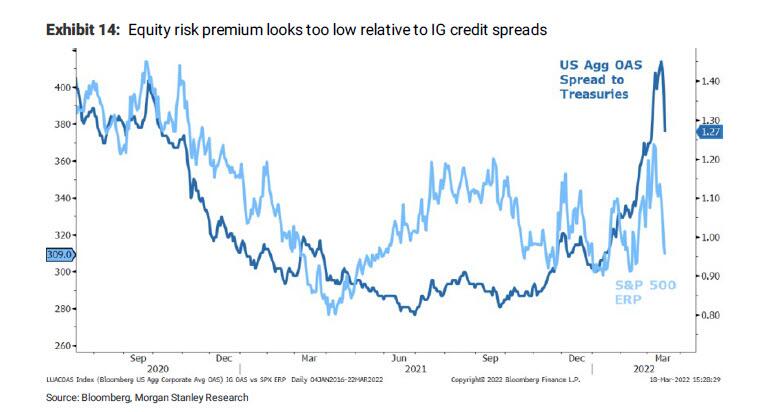
Similarly, given the substantial rise in investment grade credit spreads, one would expect the spread on equities would have risen proportionately. But that is not the case, instead we see that IG credit spreads widened significantly more than the ERP over the past month with the differential increasing last week. This is one of the reasons Wilson says he sold stocks last week and bought both long duration Treasuries and US investment grade credit in his Wealth Management asset allocations. Wilson also continues to like long duration bonds as a cheap hedge against a growth scare that could become the focus of markets as we move into April, something ERPs are not pricing.
Another question is how low can P/E multiples go?
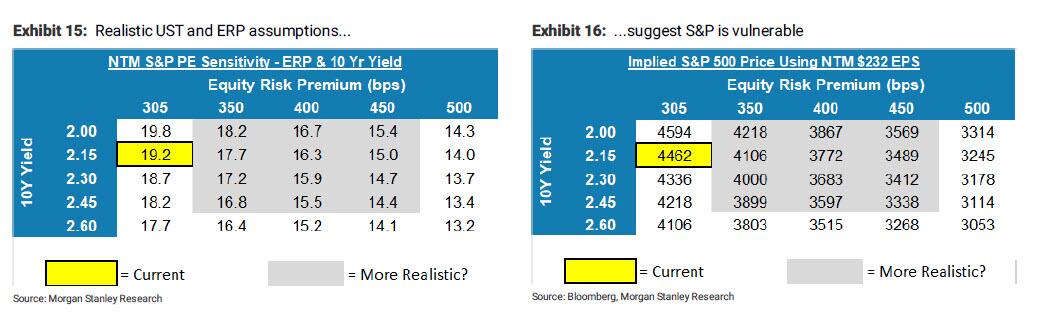
In recent notes, Wilson discussed this overshoot on PEs and suggested 16x NTM EPS as a level where we would get interested. That math is very simple as laid out in the matrices below
Bottom line, with rates having moved higher even faster than expected this year and the geopolitical environment deteriorating substantially, Wilson believes a much more realistic PE to think about adding equity risk is closer to 16x, if not lower. Based on the still strong NTM EPS forecast of $232 implies the S&P 500 is 10- 20% over valued after last week's rally, according to Wilson.
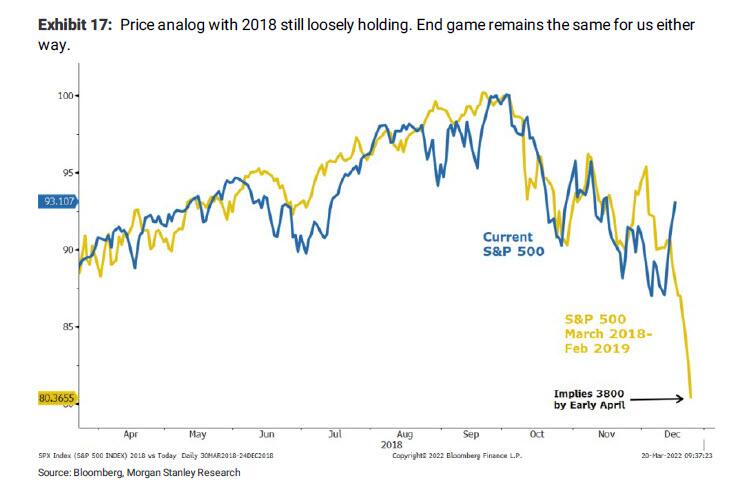
And speaking of last week's rally, it still lines up with Morgan Stanley's price analog from 2018 on time although it's not nearly as tight on price as it was earlier in the month.
Nevertheless, it still provides a loose guide when thinking about the next down leg, which the MS strategist expects to be completed by mid/late April,and is why he recommends that "investors use last week's strength as an opportunity to get more defensive if they haven't already."
Wilson's bottom line: "last week was nothing more than a vicious bear market rally, in our view, and while it may not be completely finished, it is a rally to sell."
One final point from Wilson who notes that when looking at the major indices, it appears that the Nasdaq and Russell 2000 may have more upside than the S&P 500 should the rally continue into this week: "This is merely a function of the fact these indices sold off harder and are further below their respective 200-day moving averages. There is also a larger short base in these indices and they would likely benefit from a pause or even reversal in back end rates, especially the Nasdaq." However, even with a rally, both of these indices' relative strength have broken down, and until that changes, they are not attractive on a relative basis from an investment perspective beyond this technical bounce.
There is much more in the full Michael Wilson note, available to pro subscribers in the usual place.

WSJ : Ukrainian President Asked Biden Not to Sanction Abramovich, to Facilitate

Ukrainian President Asked Biden Not to Sanction Abramovich, to Facilitate Peace Talks
Russian oligarch, facing sanctions, is trying to be go-between with Russian President Vladimir Putin

Early this month, officials inside the U.S. Treasury Department drafted a set of sanctions to punish Roman Abramovich, a prominent Russian oligarch, following Russia’s attack on Ukraine, say people familiar with the plans.

When it came time to announce those sanctions, which had been designed to go out in tandem with sanctions from the U.K. and European Union, the White House’s National Security Council told the Treasury to hold off. The reason: Ukraine’s President Volodymyr Zelensky advised President Biden in a recent phone call to wait on sanctioning the oligarch, who might prove important as a go-between with Russia in helping to negotiate peace, according to people with knowledge of the call.

President Biden consulted Ukraine’s president on a range of sanctions, including the planned penalties targeting Mr. Abramovich.

“We are not going to read out private conversations between President Biden and President Zelensky,” said Emily Horne, a spokeswoman for the White House’s National Security Council. The Treasury Department declined to comment.

State Department spokesman Ned Price declined to comment specifically on sanctions discussions regarding Mr. Abramovich, but said that Mr. Biden, who traveled Wednesday to Brussels to meet with his European and G-7 counterparts, is working “to ensure collectively we can do all we can to hold to account all those responsible for this war for this needless conflict.”

On whether Mr. Abramovich has been a go-between in talks between the Ukrainians and Russians, Mr. Price added: “There are a number of channels through which our Ukrainian partners and their Russian counterparts can engage in dialogue and diplomacy.”

The Ukrainian president’s office declined to comment.

“For the negotiations, and in the interest of them succeeding, it is not helpful commenting on the process nor on Mr. Abramovich’s involvement,” a spokesperson for Mr. Abramovich said in a statement. “As previously stated, based on requests, including from Jewish organizations in Ukraine, he has been doing all he can to support efforts aimed at restoring peace as soon as possible.”

The U.K. and the EU both sanctioned Mr. Abramovich earlier this month over his links to Mr. Putin, freezing his assets in their jurisdictions.

Several U.K. and European officials say they have no knowledge of Mr. Zelensky making a specific plea to their leaders not to levy sanctions on Mr. Abramovich. Several Ukrainian officials and officials from other Western governments are also skeptical about how deeply Mr. Abramovich is involved in the peace talks.

The U.S. decision to delay sanctioning Mr. Abramovich is an unexpected twist in the West’s strategy to punish rich oligarchs with Kremlin links in an effort to pressure Mr. Putin. While several high profile Russian businessmen have spoken out against the war, Mr. Abramovich is the only oligarch to publicly say he is trying to push Moscow to find a peaceful resolution to the conflict.

Mr. Abramovich is a billionaire former oil magnate and Kremlin insider for more than two decades, according to U.K. and EU governments. He owns numerous trophy assets including London’s Chelsea Football Club, several mega yachts and palatial homes in the U.S. and UK.

The Treasury Department took aim at him as Russia invaded Ukraine, researching his holdings and ways he could be penalized to pressure Mr. Putin, says a person familiar with the matter. It proceeded cautiously out of concern that penalties could affect global steel prices, this person said. Mr. Abramovich owns a minority stake in Evraz PLC which runs steel plants in Oregon and Colorado. U.S. officials discussed potential sanctions that could exempt such businesses.

Mr. Biden’s unusual consultation with Mr. Zelensky about these and other specific sanctions targeting individual Russian elites underscores efforts by the U.S. to coordinate closely with Kyiv and other allies as it continues to look for new ways to stifle the Russian government.

U.S. officials who spoke with The Wall Street Journal emphasized that they have no reason to believe Mr. Abramovich has been particularly helpful in the talks between the Ukrainian and Russian governments, and intelligence assessments have, in fact, suggested otherwise.

Mr. Abramovich got involved after Ukrainian government officials reached out to people with Russian contacts who might be able to provide a bridge to Mr. Putin. One of them was film producer Alexander Rodnyansky, the father of an adviser to Ukraine’s president, according to the producer’s publicist Lera Paksyalina. Mr. Rodyansky founded a Ukrainian television channel that screened shows produced by Mr. Zelensky while he was an actor.

Responding to the request for assistance, he reached out to Mr. Abramovich, a person familiar with the matter said. Mr. Abramovich knew Mr. Rodnyansky through his funding of arts projects in Russia, the person said.

Mr. Abramovich has told associates that he was trying to act as a go-between in the conflict, according to people familiar with the matter.

Days after Russia’s invasion, Mr. Abramovich’s spokeswoman confirmed his involvement, saying he had offered to help the Ukrainian government in “achieving a peaceful resolution.”

The offer to capitalize on his relationship with Mr. Putin was a significant turnaround from Mr. Abramovich’s earlier messaging. For years he has, through various spokespeople, attempted to put distance between himself and the Kremlin.

After buying Chelsea in 2003, he told the Financial Times in a rare interview that he had “no special relationship” with the Russian president. In 2010, his then-spokesman denied a story from leaked U.S. Embassy cables that alleged he had a close financial relationship with Mr. Putin as “entirely absurd.”

Mr. Abramovich feels he can try to use his standing in the Russian business community to try to facilitate talks between the two nations, according to a person close to him. It is unclear whether Mr. Abramovich has succeeded in speaking to Mr. Putin or what he has done to mediate. An official at Ukraine’s Embassy in Israel said “we have no information that he is or was involved” in peace talks.

People who have spoken to Mr. Abramovich say he is spending a significant amount of time on the process. His private jets have zigzagged between Russia, Turkey and Israel in recent weeks, according to flight tracking data. He was seen in the capital of Belarus in late February during a round of talks, according to one person familiar with the matter.

Before the invasion of Ukraine, several representatives of Israeli charities and other organizations signed a letter to the U.S. ambassador in Israel warning of the financial consequences of sanctioning Mr. Abramovich, a major donor to Israel’s Yad Vashem holocaust memorial.

FT : Egypt asks for IMF support to help it weather Ukraine crisis

Egypt asks for IMF support to help it weather Ukraine crisis
Soaring grain and oil prices add to pressure on North African country hit by collapse in tourism from Russia

Egypt has asked for support from the IMF, the fund said, as the country struggles to weather the economic impact of Russia’s invasion on Ukraine.

Cairo is facing mounting pressures on its public finances as Moscow’s assault in Kyiv has sent grain prices soaring and increased the price of oil. Egypt is the world’s biggest wheat importer, is heavily reliant on supplies from Russia and Ukraine and has a subsidised bread programme which feeds 70mn people.

Its predicament underscores how the war is rippling into Arab and African states that rely on food and energy imports.

“The rapidly changing global environment and spillovers related to the war in Ukraine are posing important challenges for countries around the world, including Egypt,” said Celine Allard, IMF mission chief for Egypt in a statement released on Wednesday evening.

“In that context, the Egyptian authorities have requested the International Monetary Fund’s (IMF) support to implement their comprehensive economic programme.”

Egypt, the Arab world’s most populous nation, has benefited from previous IMF loans and programmes. In 2016 it secured a $12bn loan over three years after a crippling foreign currency crisis as it emerged from the political upheavals that followed its 2011 revolution.

It also received $8bn in 2020 to deal with the impact of the pandemic, making it one of the biggest borrowers from the fund after Argentina. At the time of the 2016 agreement it devalued the currency, which lost half its value against the dollar.

Analysts have been expecting this latest announcement after the country devalued its currency on Monday in a move seen as a prelude to discussions with the fund on a potential loan. Egypt also announced a package of tax breaks and increases in social spending worth $7bn.

The Egyptian pound has fallen 14 per cent against the dollar since Monday when the central bank allowed its value to slip, citing the role of exchange rate flexibility as a shock absorber. The dollar traded at E£18.4 on Monday up from E£15.66 on Sunday.

Goldman Sachs said the devaluation “smooths the path for an IMF programme which we believe will help anchor confidence in Egypt’s fiscal and reform trajectory”.

Allard’s statement welcomed the devaluation and the expansion of the social protection network and added that “continued exchange rate flexibility will be essential to absorb external shocks and safeguard financial buffers during this uncertain time. Prudent fiscal and monetary policies will also be needed to preserve macroeconomic stability.”

The war has also hit the country’s tourism, a main source of foreign currency, because it stopped the flow of visitors from Russian and Ukraine — both important markets for the sector.

Foreign debt investors have also pulled billions of dollars from Egypt in recent months, adding to pressure on its currency. “There were around $5bn of net outflows in September-December and further outflows accompanied news of the Ukraine conflict,” said Fitch Ratings agency in a note last week.

“In our view, these outflows reflect tighter global financial conditions, as well as investor concerns about Egypt’s external funding needs in the absence of an IMF programme, the impact of rising inflation on Egypt’s real interest rates, and the sustainability of Egypt’s exchange-rate level, after significant real appreciation in recent years.”