Closing Market SummaryThe stock market ended Thursday on a firmly higher note with the Nasdaq (+1.9%) finishing ahead of the S&P 500 (+1.4%) and Dow (+1.0%).
Equities followed yesterday's weak finish with an opening advance and a daylong extension of the early gains. The S&P 500 clawed back above its 200-day moving average (4476), which has been in focus since Friday, while the Nasdaq continued this week's outperformance.
Nasdaq faced some pressure in early trade, but it took the lead in midday action with chipmakers fueling afternoon gains in the tech-heavy index. The PHLX Semiconductor Index jumped 5.1% with all but one of its component gaining at least 2.0% while NVIDIA (NVDA 281.50, +25.16, +9.8%) and Intel (INTC 51.62, +3.35, +6.9%) finished in the lead. NVIDIA rallied to its best level in ten weeks while Intel overtook its 50-day moving average (48.75), approaching its 200-day moving average (52.04).
The technology sector (+2.7%) was the only group with a gain of more than 2.0% while the materials sector (+2.0%) finished just behind after outperforming throughout the day. Steelmaker Nucor (NUE 153.52, +6.38, +4.3%) and fertilizer producers Mosaic (MOS 68.57, +0.64, +0.9%) and CF Industries (CF 106.40, +2.81, +2.7%) hit fresh 52-week highs as concerns about supply and rising prices persisted.
Crude oil, meanwhile, was a soft spot today, but not before it touched its best level in almost two weeks in overnight trade. It finished today's session with a loss of $4.02, or 3.5%, at $111.24/bbl. However, the energy sector (+0.1%) was able to eke out a slim gain, extending this week's advance to 5.0%.
The consumer discretionary sector (+0.7%) finished near the bottom of today's leaderboard as modest losses in influential components like Home Depot (HD 315.78, -1.27, -0.4%) and Lowe's (LOW 219.17, -1.75, -0.8%) overshadowed gains in most remaining components. HD and LOW retreated after KB Home (KBH 34.38, -1.65, -4.6%) missed Q1 expectations, but reaffirmed its guidance for FY22 revenue.
Elsewhere in the discretionary sector, travel names finished among the leaders with Booking.com (BKNG 2261.99, +102.24, +4.7%) ending in the top spot after Trip.com (TCOM 24.50, +0.48, +2.0%) beat Q4 expectations.
Treasuries slumped out of the gate but rebounded as the day went on. The 30-yr bond turned positive in the afternoon, sending its yield lower by a basis point to 2.51% while the 10-yr note finished with a modest loss, lifting its yield by two basis points to 2.34%.
On the international front, an Axios reporter tweeted that he has been told by the chief of staff to Ukraine's president that some progress has been made in cease-fire negotiations.
Reviewing today's economic data:
- Initial jobless claims for the week ending March 19 decreased by 28,000 to 187,000 (consensus 210,000), which is the lowest level since September 6, 1969. Continuing jobless claims for the week ending March 12 decreased by 67,000 to 1.350 million, which is the lowest level since January 3, 1970.
- The key takeaway from the report is that it is consistent with a tight labor market; however, the multi-decade low in initial and continuing claims is going to feed into concerns about a pickup in wage-based inflation pressures that might compel the Fed to take a more aggressive approach in removing its policy accommodation.
- Durable goods orders for February declined 2.2% month-over-month (consensus -0.5%) after increasing 1.6% in January. Excluding transportation, durable goods orders fell 0.6% month-over-month (consensus +0.5%) after increasing 0.8% in January.
- The key takeaway from the report is that the weakness follows on the heels of a solid January report despite the effects of the Omicron variant. The downturn likely reflects some natural slowing, meaning it is too early to tell if this is the start of a weaker trend.
- The IHS Markit Manufacturing PMI increased to 58.5 in the preliminary reading for March from February's final reading of 57.3.
- The IHS Markit Services PMI increased to 58.9 in the preliminary reading for March from February's final reading of 56.5.
- The Current Account deficit narrowed to $217.90 bln in Q4 from a revised deficit of $219.90 bln (from -$214.80 bln) in Q3.
February Pending Home Sales (consensus 1.2%; prior -5.7%) and the final reading of the Michigan Consumer Sentiment survey for March (consensus 59.7; prior 59.7) will be released tomorrow at 10:00 ET.
- Dow Jones Industrial Average -4.5% YTD
- S&P 500 -5.2% YTD
- Russell 2000 -7.6% YTD
- Nasdaq Composite -9.3% YTD
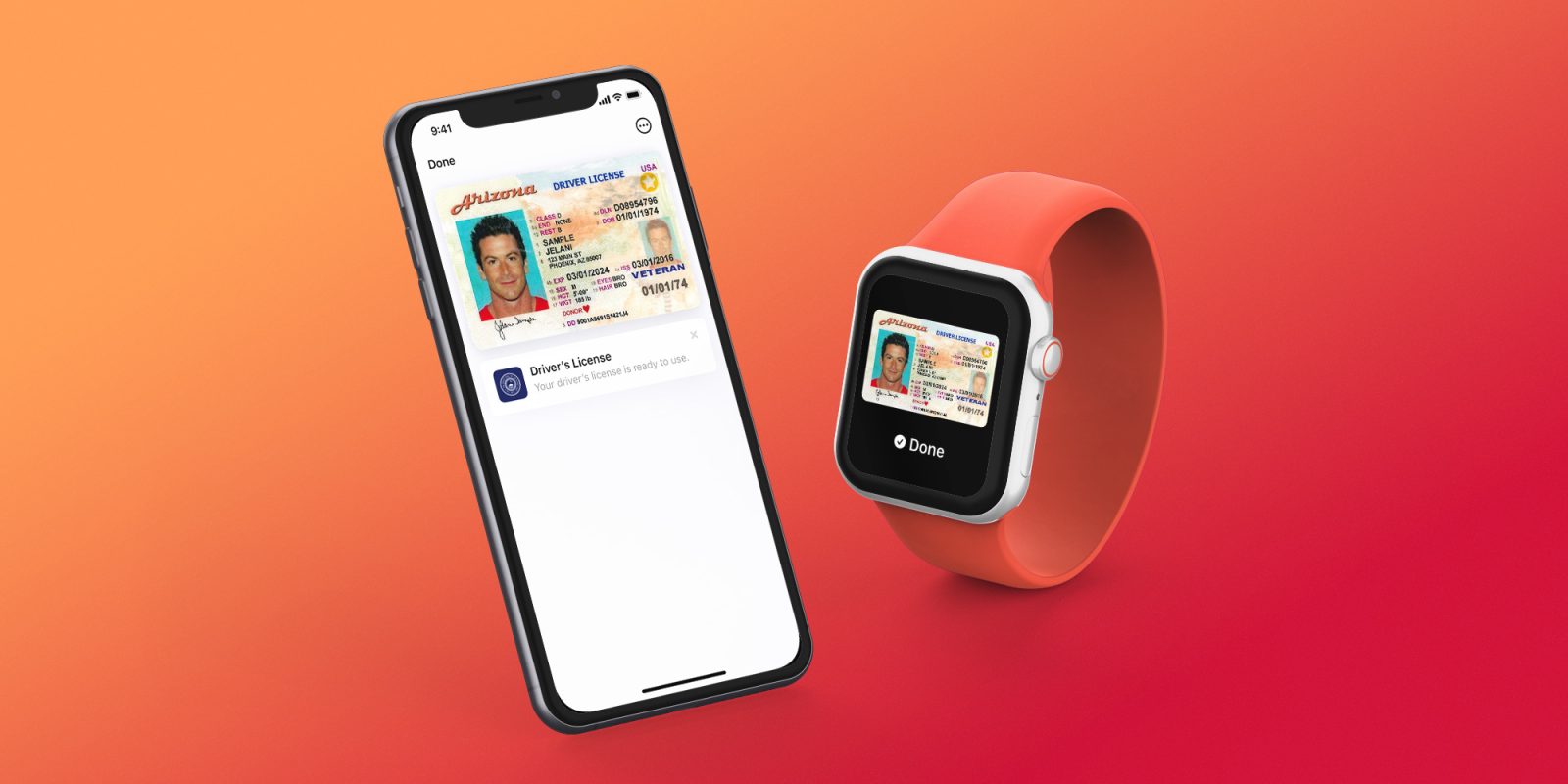
Support has officially launched for Apple Wallet to securely store driver’s licenses and state IDs on iPhone and Apple Watch. While there is excitement around the new feature, there are also a number of questions and concerns. Let’s dive into how Apple digital IDs work in the real world, where they’re available, where they’re accepted, and more.
Table of contents
Apple digital IDs background
After first unveiling support for digital IDs in the Wallet app back in June 2021 and pushing back the debut until March 2022, the first US state has officially launched support for the feature.
With support for Apple digital IDs, states can allow users’ existing physical ID to be stored securely on iPhone and Apple Watch with the same encryption that makes Apple Pay possible.
The goal with Apple digital IDs is to offer the security and privacy of iPhone and Apple Watch like Face ID and Touch ID, strong encryption, and other benefits that “a physical ID can’t match.”
Apple digital IDs availability
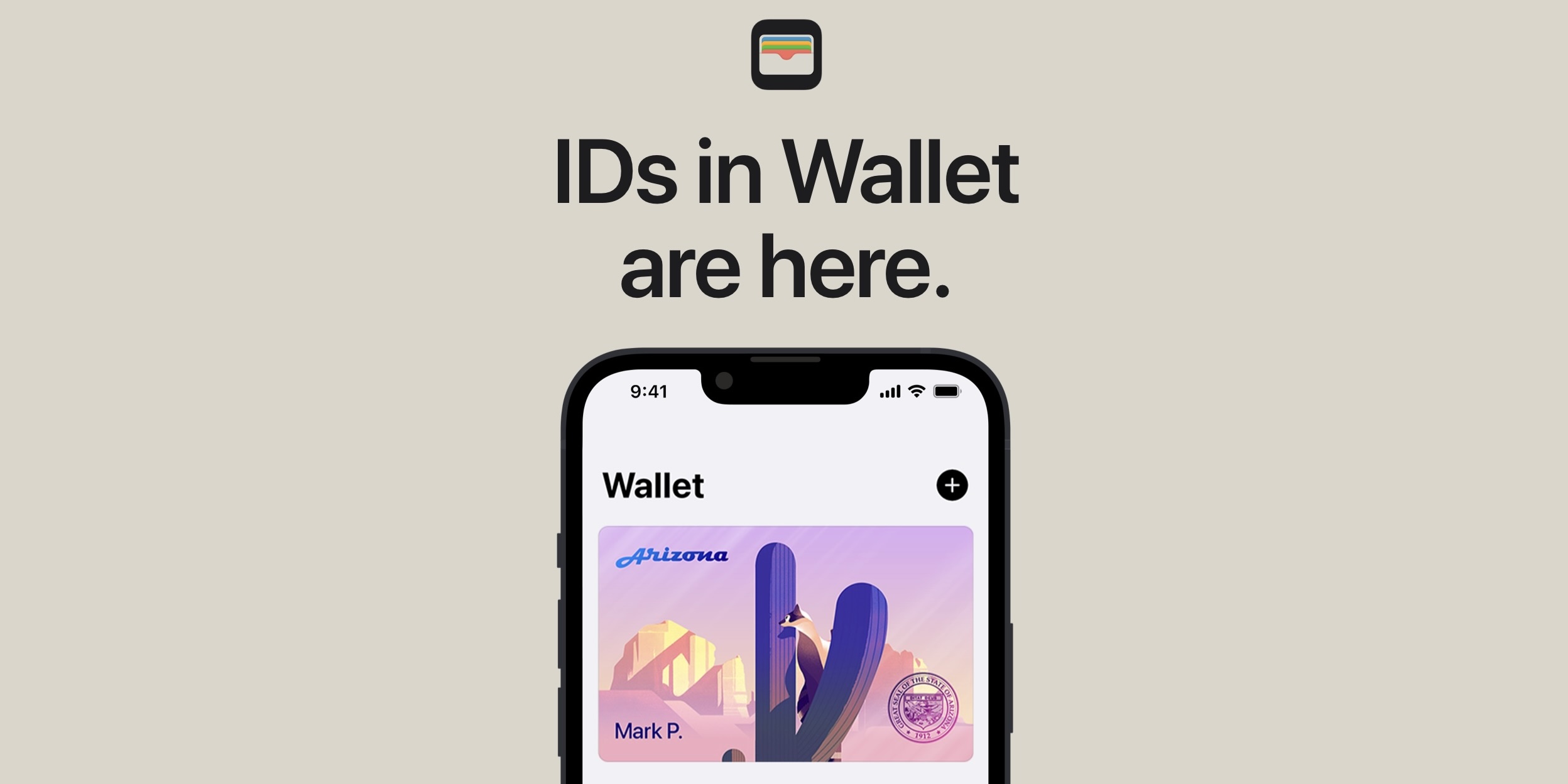
Support for Apple digital IDs is determined by each state/territory and is opt-in for users.
Now available
- Arizona
Coming soon
Apple hasn’t shared exactly which states will launch next. But per the company, this is the short-list that should offer availability “soon”:
- Colorado
- Connecticut
- Georgia
- Hawaii
- Iowa
- Kentucky
- Maryland
- Mississippi
- Ohio
- Oklahoma
- Territory of Puerto Rico
- Utah
In total, we know that Apple has been in talks with at least 30 states about adopting support for its digital IDs with those listed above having committed to the feature.
How Apple digital IDs work
Adding your ID
- iPhone 8 and later with iOS 15.4 required and Apple Watch Series 4 or later with watchOS 8.4 required
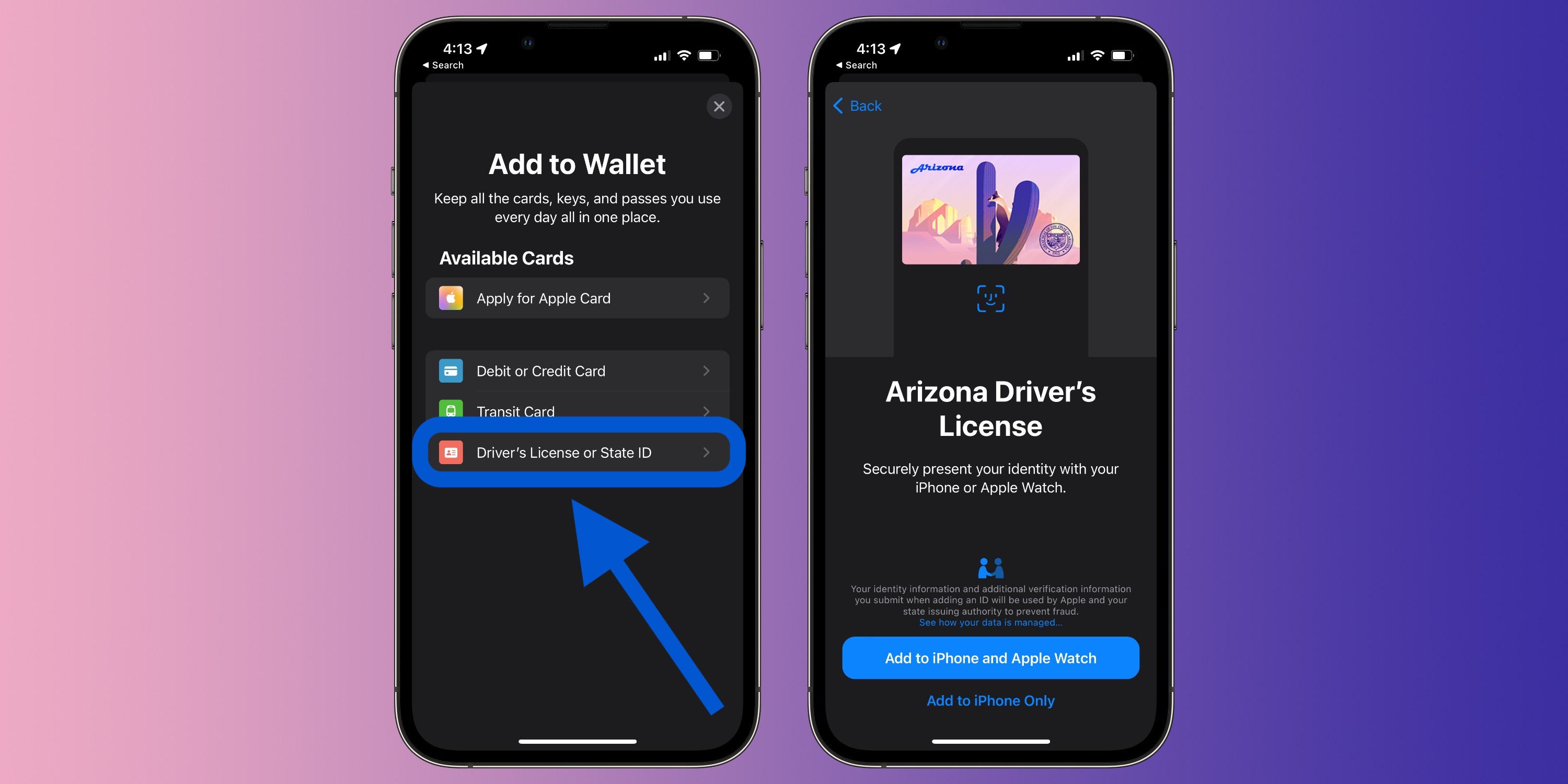
- Open the Wallet app on iPhone and tap the + icon in the top right corner
- Choose Driver’s License or State ID
- Currently only for Arizona residents – tap Add to iPhone and Apple Watch or Add to iPhone
- You may be required to log in to your state’s DMV/MVD website to authorize adding your ID to Apple Wallet
Apple notes “To help ensure that the person adding the identity card to Wallet is the same person to whom the identity card belongs, the user will be asked to take a selfie and scan the front and back of their driver’s license or state ID card, which will be securely provided to the issuing state for verification.”
Part of the fraud prevention will include completing “a series of facial and head movements during the setup process.” Apple also highlights that each state is responsible for “verifying and approving the user’s request…”
Where and how are Apple digital IDs accepted?
One of the challenging aspects to all of this is that each state will have its own laws and procedures around how Apple digital IDs can be used and official support will take time to build.
For now, it looks like certain TSA checkpoints at the Phoenix International Airport are the only officially supported places to use Apple digital IDs.
ID cards in Wallet are currently available for use in select states at select TSA checkpoints within Phoenix Sky Harbor International Airport (PHX). Travelers should refer to checkpoint signage to confirm availability.
These will work via NFC reader and users won’t have to hand over their devices to TSA staff.
What about law enforcement, banks, etc.?
However, as 9to5Mac reader Robert P pointed out, Arizona will still require drivers to carry their physical driver’s license “at all times” – an Apple digital ID will not be a substitute, at least for now.
Addressing privacy concerns, the Arizona Motor Vehicle Division says that police officers will not take devices. But that soon, “technology will be available for law enforcement to request permission to access your digital driver’s license from a dedicated law enforcement device.”
This brings up the point that government, businesses, etc. will need to build out formal NFC support to accept Apple’s digital IDs to preserve all of the privacy benefits.
However, it’s unknown if we could see places like wireless carriers, banks, and more accept them for proof of identity by checking it visually – instead of or ahead of accepting it with an official NFC device. There’s really no way to know how that will go or how slow adoption could take.
Getting states to officially adopt digital IDs is a big step for Apple, but expect it to take years for them to become widely accepted as an official form of ID.
Apple digital ID privacy features
As governments and businesses do begin to adopt official NFC support for Apple digital IDs, here are how the privacy features work:
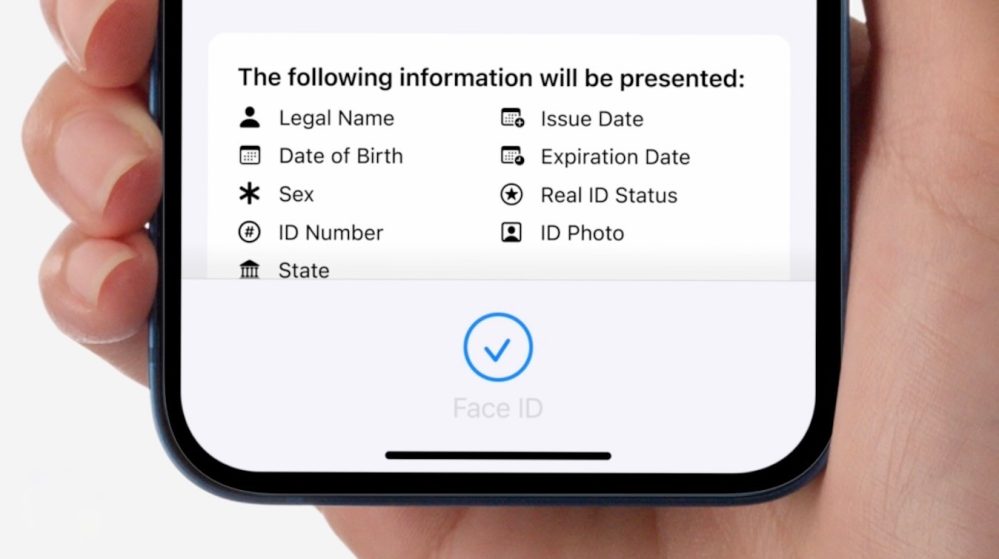
- Driver’s license and state ID in Wallet presents only the information needed for the interaction
- Users have the opportunity to review and authorize information being requested before it is shared
- Digital IDs are shared through encrypted communication directly between iPhone/Apple Watch and the identity reader (similar to Apple Pay)
- If a device is lost, Find My allows you to remotely lock or erase it
-
For supported TSA locations, users do not need to show or hand over their device, just scan it
- TSA will also capture a picture for verification purposes
Top Russian military leaders repeatedly decline calls from U.S., prompting fears of ‘sleepwalking into war’
Lack of communication leaves the world’s two largest nuclear powers in the dark about explanations for military movements from senior officials
Repeated attempts by the United States’ top defense and military leaders to speak with their Russian counterparts have been rejected by Moscow for the last month, leaving the world’s two largest nuclear powers in the dark about explanations for military movements and raising fears of a major miscalculation or battlefield accident.
Are you on Telegram? Subscribe to our channel for the latest updates on Russia's war in Ukraine.
Since Russia’s invasion of Ukraine, Defense Secretary Lloyd Austin and Gen. Mark A. Milley, the chairman of the Joint Chiefs of Staff, have tried to set up phone calls with Defense Minister Sergei Shoigu and Gen. Valery Gerasimov but the Russians “have so far declined to engage,” said Pentagon spokesman John Kirby in a statement Wednesday.
The attempted calls by Austin and Milley, which have not previously been reported, come as Russia conducts operations near the borders of NATO members Poland and Romania while the United States and its European allies conduct air-policing operations over the Baltic Sea and pour weapons and equipment into Ukraine by ground transport.
Moscow and Washington maintain a deconfliction channel but current and former officials say contact from higher-ranking military leaders is needed to avoid unnecessary escalation or confusion.
“There is a high risk of escalation without the firebreak of direct contact between the most senior officials,” said James Stavridis, who served as the Supreme Allied Commander at NATO from 2009 to 2013. “Very young people are flying in jets, operating warships, and conducting combat operations in the Ukrainian war. They are not seasoned diplomats, and their actions in the heat of operations can be misunderstood.”
“We must avoid a scenario of NATO and Russia sleepwalking into war because senior leaders can’t pick up a phone and explain to each other what is happening,” he added.
The rise and evolution of Russia’s oligarchs
In response to Russian President Vladimir Putin’s invasion of Ukraine, the West sanctioned some of his closest advisers. (Luis Velarde/The Washington Post)
As allies meet, splits emerge in NATO about how to deter Russia
Russia’s recent use of hypersonic missiles and other sophisticated weaponry against targets in western Ukraine have underscored the threat of spillover into a broader confrontation.
“The risks are obviously elevated currently,” said Rob Lee, a senior fellow at the Foreign Policy Research Institute. “Russia is striking targets in western Ukraine, which are not far from the border with NATO members, and the Ukrainian Air Force apparently continues to operate from that region, which means there is a risk that its aircraft could be mistaken for NATO aircraft across the border.”
U.S. defense officials have described the deconfliction phone line as a tactical mechanism to avoid miscalculations, especially when it comes to protecting NATO airspace or territory, but its functionality can be limited.
“It’s not set up to be a complaint line where you can just call in and just grouse about stuff,” said a U.S. defense official this week when asked about whether anything had been communicated through the channel. The official spoke on the condition of anonymity under ground rules set by the Pentagon.
Sam Charap, a senior political scientist at Rand Corporation, said calls by Austin and Milley serve a “fundamentally different purpose” than the deconfliction channel.
“One is about tactical accident avoidance. The other about strategic engagement,” he said. “It’s always important to maintain the strategic level to communicate our interests clearly and better understand theirs. When there’s no communication at that level, their worst-case assumptions, often based on poor information, are more likely to drive their behavior.”
As Russia’s battlefield setbacks become more pronounced and the conflict nears its second month, U.S. officials are concerned that Russian President Vladimir Putin may escalate militarily in the hopes of changing the trajectory of the war. As more dangerous weaponry and tactics are deployed, the risks of a wider conflict grow.
Russia’s war for Ukraine could be headed toward stalemate
“A nightmare scenario would be a Russian missile or attack aircraft that destroys a U.S. command post across the Polish-Ukrainian border,” said Stavridis, a retired admiral. “A local commander might respond immediately, thinking the event was a precursor to a wider attack. This could lead to rapid and irreversible escalation, to include potential use of nuclear weapons.”
Stavridis said when he was Supreme Allied Commander, he could dial his Russian counterpart anytime “and did on several occasions to clarify a situation and de-escalate.”
The Pentagon holds the view that engagement between the U.S. and Russian defense leaders is “critically important at this time,” Kirby said. Besides the deconfliction channel, the United States and Russia can also engage through the defense attache at the U.S. Embassy in Moscow or the relaying of messages to the Ministry of Defense.
Communications between the United States and Russia have been much more sparse since the war began last month. The U.S. ambassador to Russia, John J. Sullivan, has met with Russian officials most frequently with on and off visits and calls in Moscow. President Biden’s national security adviser, Jake Sullivan, spoke to his counterpart, Nikolay Patrushev, last week for the first time since the start of the conflict. Some U.S. and Russian military officials met last week at the Russian Ministry of Defense, CNN first reported.
Secretary of State Antony Blinken has not attempted any conversations with his counterpart, Russian Foreign Minister Sergei Lavrov, since the start of the conflict, according to U.S. officials.
It remains unclear why Russia’s top generals have refused to hold calls with their U.S. counterparts.
“I suspect that the problem lies with the Russian insistence that this is a ‘special military operation’ and unwillingness to admit the real nature of the war,” said Angela Stent, a Russia scholar at Georgetown University who served as a senior intelligence officer in the Bush administration.
The generals may also be waiting on Putin’s approval to make the calls, given the high stakes of the conflict, and he may not be signing off, Charap said.
Another theory is that Putin may now view the United States as a determined adversary bent on his downfall and not worth engaging. Russian officials bristled at Biden calling Putin a “war criminal,” saying it could lead to a complete break in relations.
Biden has sought to avoid a conflict by keeping U.S. troops out of Ukraine and U.S. aircraft out of its airspace.
“You’re talking about avoiding incidents with aircraft or at sea,” said Ben Hodges, a retired Army officer who served as commanding general of the U.S. Army Europe. “I’m sure they would’ve wanted to convey to Gerasimov and Shoigu that Russian pilots should not be launching missiles too close to the Polish border, but they would also want to talk about other places, not just Ukraine, where you have Russian aircraft.”
“I would also imagine they would want to convey — here’s what we’re doing, don’t interpret what we’re doing as a provocative act,” he added.
Nickel Halted Limit Up Again As Chinese Tycoon Begins Covering Giant Short, Sparking Fears Of Another Mega Squeeze
For the second day in a row, Nickel traded in London surged by the 15% exchange limit on the scandal-plagued London Metals Exchange, putting the spotlight back on bearish position holders just two weeks since the market was roiled by an historic short squeeze, and sparked speculation that a second, even more vicious short squeeze may be forming.
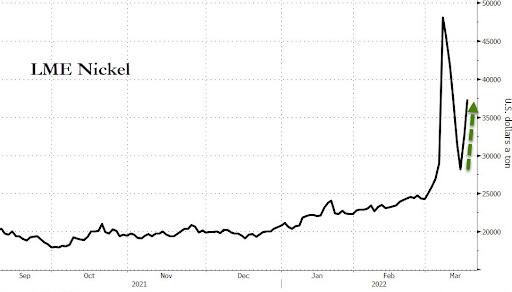
Nickel futures remained locked at the price limit by late morning on the London Metal Exchange, as the latest spike extends a period of unprecedented turmoil for the market. Prices soared over 250% over two trading sessions in early March during the short squeeze centered on China’s Tsingshan Holding Group Co., before the market was suspended to avoid bankrupting China's biggest stainless steel producer and potentially leading to billions in losses for its OTC counterparties, among which JPMorgan was the largest.
As we reported last week, Tsingshan struck a deal with its banks to avoid further margin calls, allowing the market to reopen last week, and said it would reduce its short position in the future. But the sharp two-day jump will be piling pressure on its banks and brokers who have to make margin calls of their own to cover short positions on the LME when prices rise.
Speaking to Bloomberg, Michael Widmer, head of metals research at Bank of America, said that “ultimately the short position is still out there, and they will have to close it out" adding that sharp daily price moves are likely to continue “at least until the short position is out of the market.”
And sure enough, in a separate report from Bloomberg today, we learn that Xiang "Big Shot" Guangda, the owner Tsingshan, bought some contracts on the London Metal Exchange to reduce his short bet as the nickel market briefly unfroze this week.
Tsingshan and its peers have covered tens of thousands of tons of their short positions, one of the people said. Xiang had short holdings of over 150,000 tons when the market was halted on March 8, and his business and trading partners held additional large short positions on top of that - Bloomberg
While the move modestly reduces the size of the potential pain for Xiang and his banks as nickel prices soar once again - prices on the LME are up more than 30% over the past two days - the risk is that now that markets know that the big short is covering, they may refuse to sell any metal at any price forcing yet another squeeze. Indeed, as Bloomberg first reported, the businessman and his allies have only reduced a portion of their total short position, and still hold large bets on falling prices.
On March 10, Bloomberg reported that Xiang told his banks that he didn’t want reduce his short position; that clear lie - which removed the possibility of a squeeze - helped send the nickel price sharply lower since then, falling as low as $26,675 a ton this week, compared with $48,078 a ton on March 7 -- the last price that the LME allowed to stand when it closed the market. Clearly, Xiang was lying, and has been quietly seeking to cover at least some of his short.
The LME reopened the nickel market last week after Tsingshan announced a deal with its banks to avoid further margin calls; in the meantime, and following an unprecedented trading suspension, the LME canceled billions of dollars of transactions sparking outrage among the industry and destroying overnight any positive reputation the exchange may have had.
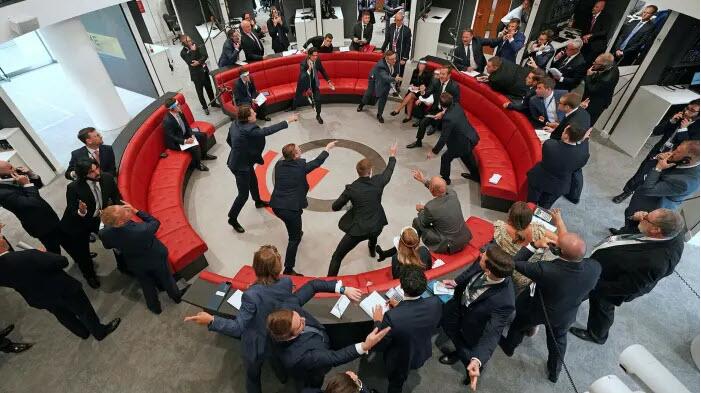
While Tsingshan holds an outsized short position on the LME, there are many other industrial users and physical traders who hold short positions to hedge their price risk, raising the threat of another squeeze if those parties need to buy their positions back, or brokers seek to close them out to avoid further margin calls.
Total short positions held by commercial parties stood at 74,166 contracts at the end of last week, according to data from the bourse. As Bloomberg correctly notes, they’ll need to turn to bullish hedge funds to liquidate their contracts: on a net basis investment funds are the largest holders of long positions in the LME nickel market.
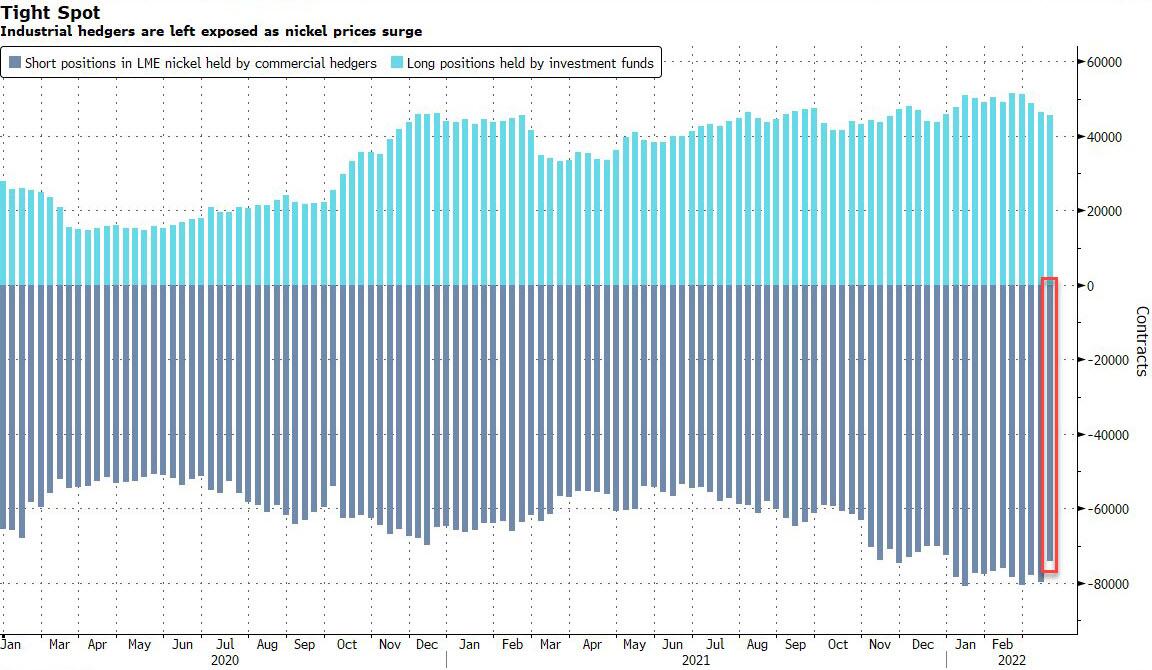
That said, once the shorts come under renewed pressure - and now that Xiang is covering it's just a matter of time - the new daily price limits introduced by the LME should help prevent a repeat of the extreme price swings seen earlier this month. On the other hand, if the buying pressure is big enough, we may just end up with a locked market, one where every single day we see Nickel trade immediately limit up and stay there, only to repeat that again the next day.
Finally, and perhaps confirming that we are about to see another huge squeeze, overnight nickel also surged to the maximum daily limit on the Shanghai Futures Exchange earlier - tracking the overnight gain in London - despite a cloudy short-term demand outlook due to Covid-19 restrictions in China. It indicates that traders are looking for venues where to go balls to the wall long, knowing that they may not have much chance on the LME once it locks limit up for the foreseeable future.
Moscow Claims Roman Abramovich No Longer Involved In Ukraine Peace Talks
As Russian oligarch Roman Abramovich scrambles to find a buyer for Chelsea Football Club while moving two of his yachts to Turkey to avoid them being seized by European authorities, the Ukrainian government rode to the rescue yesterday by claiming that Abramovich was acting as a critical go-between during the ongoing peace talks between the Ukrainian government and Russia.

Abramovich's involvement in the talks was widely reported last month, but in spite of this, the west hasn't spared him from their sanctions against Russian oligarchs. Now, the US media is reporting that one of Abramovich's properties in Aspen, Colo. could be seized if Washington orders more sanctions against him (the US unveiled its latest round of sanctions against Russia). Fortunately for him, Abramovich wasn't included in the latest round of sanctions announced Thursday morning as President Biden met with his fellow leaders across NATO, the G-7 and EU.
But that doesn't mean he's in the clear.
Because on Thursday, the Kremlin said that while the sanctioned oligarch played an early role in peace talks between Russia and Ukraine, the process was now in the hands of the two sides' negotiating teams.
"He did take part at the initial stage," Kremlin spokesperson Dmitry Peskov told reporters. "Now the negotiations are between the two teams, the Russians and Ukrainians."
Abramovich, who is Jewish and has Israeli citizenship, was one of the most powerful businessmen who earned fabulous fortunes after the 1991 break-up of the Soviet Union. Forbes has estimated his net worth at $13.3 billion. He purportedly earned a fortune during the post-Soviet collapse during the looting and general insanity.
A commodity trader who thrived in the post-Soviet disorder of the 1990s under then-President Boris Yeltsin, Abramovich acquired stakes in the Sibneft oil company, Rusal aluminium producer and Aeroflot airline were also among the businesses he acquired.
He has repeatedly denied having ties to Putin or the Kremlin, although claims to the contrary have persisted in the Russian press.
Now that the Ukrainian government's claims that he is still essential to the peace process have been exposed as false, how much longer now until Abramovich's properties in the US are seized?