>>> TradeGate Pre-Market Indications

DAX:
  • Daimler Truck (DTG TH) +2.9%
  • Continental (CON TH) +1.5%
MDAX:
  • Varta (VAR1 TH) +1.5%
  • Siemens Energy (ENR TH) +1.2%
  • Freenet (FNTN TH) +1%
  • ProSieben (PSM TH) +0.7%
    • Prosieben Is Cheap Even Without MFE Deal, Unit IPO Soon: Makor
  • Duerr (DUE TH) -0.5%
    • Duerr Rated New Underperform at Exane; PT 29 euros
  • K+S (SDF TH) -0.9%
SDAX:
  • Eckert & Ziegler (EUZ TH) +7%
    • Eckert & Ziegler Sees 2022 Net Income About EU38M
  • PVA TePla (TPE TH) +2.8%
  • SGL (SGL TH) +1.9%
  • Deutsche PBB (PBB TH) +1.6%
  • AUTO1 (AG1 TH) +1.5%
  • Deutz (DEZ TH) +1%
  • Vitesco (VTSC TH) -0.3%
    • Vitesco Sees FY Revenue EU8.6B to EU9.1B

>>> Europe : Brokers Upgrades & Downgrades - 25th of March 2022

>>> Up
* British Land Raised to Hold at Jefferies; PT 455 pence
* CompuGroup Raised to Equal-Weight at Morgan Stanley; PT 59 euros
* Drax Raised to Overweight at Morgan Stanley; PT 930 pence
* Hemnet Raised to Buy at Nordea; PT 175 kronor
* Indra Raised to Equal-Weight at Morgan Stanley; PT 11 euros
* Next Raised to Buy at SocGen; PT 7,331 pence
* Software AG Raised to Equal-Weight at Morgan Stanley
* Teva ADRs Raised to Outperform at Bernstein; PT $11

>>> Down
* Autoliv GDRs Cut to Neutral at Oddo BHF; PT 830 kronor
* Bunzl Cut to Hold at HSBC; PT 3,050 pence
* Ina Invest Holding Cut to Add at Baader Helvea
* Ovh Groupe SAS Cut to Underweight at Morgan Stanley; PT 20 euros
* Restaurant Group Cut to Underweight at Barclays; PT 70 pence
* Telenor Cut to Sell at Goldman; PT 120 kroner
* VIB Vermoegen Cut to Hold at Berenberg; PT 56 euros

>>> Initiation
* Argo Blockchain ADRs Rated New Hold at Stifel Canada; PT $11
* BillerudKorsnas Re-Initiated Buy at Handelsbanken
* Deliveroo Rated New Hold at HSBC; PT 140 pence
* Duerr Rated New Underperform at Exane; PT 29 euros
* Indivior Rated New Equal-Weight at Morgan Stanley; PT 330 pence
* Knorr-Bremse Rated New Outperform at Exane; PT 83 euros
* Norma Reinstated Outperform at Exane; PT 39 euros
* PhotoCure Rated New Buy at Handelsbanken
* Versarien Rated New Buy at Berenberg; PT 35 pence

>>> Call
* Morgan Stanley Flags EV Demand Destruction as Lithium Soars

>>> What to look at today - 25th of March 2022

Stocks in Asia fell Friday amid a drop in the Chinese technology sector and as investors evaluated economic risks from Federal Reserve monetary-policy tightening and Russia’s war in Ukraine. MSCI Inc.’s Asia-Pacific equity gauge slipped for a second session. Tech shares in Hong Kong slid following U.S. comments that it’s “premature” to speculate about a deal to keep Chinese firms from being kicked off American exchanges. U.S. and European futures edged up after a jump in the S&P 500 on Thursday. Treasuries made modest gains but remain on course for one of their worst quarterly routs since at least the early 1970s.  Oil dipped after European Union leaders refrained from fresh steps to cut imports of Russian crude. The U.S. may unveil measures to help Europe reduce flows of Russian natural gas.
Investors are continuing to grapple with the ramifications of Russia’s invasion and isolation, including elevated raw-material costs that have stoked expectations of higher inflation and more aggressive Fed interest-rate hikes.
The yen snapped a prolonged drop against the greenback that was spurred by the monetary-policy divergence between the U.S. and a still-dovish Japan. A gauge of the dollar declined.  Global shares are set for their first consecutive weekly gains in 2022, suggesting some equity investors foresee economic growth weathering the conflict, high inflation and the Fed’s campaign against price pressures. US After Hours Pretty quiet after hours; HNST -18.9%, SMRT -16.4% fall on earnings; RKLB -2.9% lowers Q1 rev guidance due to weather-related launch delay

Nikkei +0.14% Hang Seng -2.81% CSI -1.82% Shanghai -1.18% Shenzen -1.41%

Eur$ 1.1025 CNH 6.3765 CNY 6.3621 JPY 121.76 GBP 1.3214 CHF 0.9276 RUB 100.2608 TRY 14.8223 WTI$ 112.33 -0.02% Gold 1958.80 +0.06% BTC 44,190 +0.68% ETH 3135 +1%

S&P +0.15% Nasdaq +0.15% EuroStoxx +0.26% FTSE -0.09% Dax +0.31% SMI +0.06%

Macro :
- Pamplona Capital Says It Will Liquidate Funds Tied to LetterOne
- Morgan Stanley Flags EV Demand Destruction as Lithium Soars
- Spain Announces Fuel Subsidies, EU450m Direct Aid for Truckers

Keep an eye on :
- ABBN SW : ABB Plans Further Share Buyback up to $3B
- AED BB : Aedifica to Spend GBP29M on Two U.K. Care Home Projects
- AIR FP : Boeing May Not Win 737 Max 10 Certification by Year-End: Reuters
- AAF LN : Airtel Africa Holder Singapore Telecommunications Offers Shares
- AMS SW : Plastic Omnium Is Said to Near Deal for AMS Lighting Unit
- AAPL US : Apple Is Working on a Hardware Subscription Service for IPhones
- BAYN GY : Monsanto Reaches $80 Million Settlement with Ohio Over PCBs
- BP/ LN : U.K. Targets Tenfold Increase in Electric Vehicle Charge Points
- BT/A LN : Drahi’s Altice International Loans $639m to BT-Holding Altice UK
- CARLB DC : Carlsberg Reviews Possible Corruption in Belarus: Berlingske
- CNHI IM : Titan, CNH Industrial Enter Three-Year, $400m Supply Agreement
- AM FP : Greece Buys 6 Dassault Rafale planes and 3 Naval Group Frigates
- DTE GY : Deutsche Telekom Closing Activities in Russia
- DGE LN : Diageo Agrees Sale of Windsor Business for About GBP124M
- DYS LN : Dyson to Invest $1.1 Billion in Singapore, Its New Global Hub
- EUZ GY : Eckert & Ziegler Sees 2022 Net Income About EU38M
- ZIL2 GY : ElringKlinger FY Dividend per Share Misses Estimates
- EQT SS : EQT Said to Weigh Sale of Hollywood Payroll Firm Cast & Crew
- EQUI IM : Equita, Gianni & Origoni Picked to Advise on ITA Sale: Rtrs
- EXO IM : Exor FY Net Assets $31.07B Vs. $24.04B Y/y
- ES FP : Esso Refineries in France Seek Alternatives to Russian Crude
- ECMPA NA : Eurocommercial FY Net Property Income EU155.1M Vs. EU154.6M Y/y
- GLPG NA : Galapagos to Name CEO Stoffels Chair of Proposed Unitary Board
- GAZP RM : Nord Stream 2 to File Bankruptcy Petition Next Days: Stuttgarter
- GBLB BB : GBL’s Sienna Buys Acofi Gestion; No Terms
- G IM : Generali Needs More Independence: Investor Caltagirone in Sole
- HSV LN : Brookfield Considering Possible Offer for HomeServe
- HUSQB SS : Husqvarna Prelim 1Q Net Sales About SEK15B
- LTI SS : Litium Offers SEK25m Shares via ABG Sundal Collier
- LSEG LN : LSE Holders to Sell 5.78m Shares, Terms Show
- ORA FP : Aschenbroich Tapped as Next Orange Chairman: Echos
- POM FP : Plastic Omnium Is Said to Near Deal for AMS Lighting Unit
- PAH3 GY : Porsche 911, Taycan Drive IPO to Electrify VW's Value: BI Focus
- RENE PL : REN FY Net Income EU97.2M Vs. EU109.2M Y/y
- REP SM : Repsol Offers Fuel Discount to Truckers in Spain
- SPM IM : Saipem Approves EU2b Capital Increase
- SDRL NA : Seadrill Names Simon Johnson to Replace Stuart Jackson as CEO
- TIT IM : CVC, Vivendi Said to Seek Stakes in Telecom Italia Unit
- TEL NO : Telenor Sees NOK800M Hit on Income Statement From Myanmar Sale
- TFI FP : TF1, M6 Would Buy France Televisions’ Salto Stake for EU45m
- TRELB SS : Trelleborg Sells Tires Unit to Yokohama Rubber for $2.3 Billion
- HO FP : Greece Buys 6 Dassault Rafale planes and 3 Naval Group Frigates
- UN01 GY : Uniper Hasn’t Received Official Russian Gas-for-Rubles Request
- UU/ LN : United Utilities Says Performance is in Line With Expectations
- VTSC GY : Vitesco Sees FY Revenue EU8.6B to EU9.1B
- VIV FP : CVC, Vivendi Said to Seek Stakes in Telecom Italia Unit
- VOLVB SS : Eicher-Volvo JV may plan to float new unit for EVs

FT : Four Russian government employees charged with hacks targeting energy secto

Four Russian government employees charged with hacks targeting energy sector
US indictments for past attacks come as Washington warns companies of cyber threats amid Ukraine invasion

The US Department of Justice has charged four Russian government workers in connection with hacking campaigns that targeted the global energy sector as Washington warns companies to be on high alert for potential cyber attacks amid Moscow’s invasion of Ukraine.

The criminal charges unsealed Thursday allege the four Russian nationals were “attempting, supporting and conducting” cyber attacks that targeted hundreds of companies in the energy sector across more than 135 countries, including some from which Moscow had sought economic, military and security assistance.

While the crimes allegedly occurred between 2012 and 2018, DoJ and FBI officials said they provided examples of activities that US agencies fear could happen again as Russia tries to undermine western countries’ support of Ukraine.

“The conduct alleged in these charges is the kind of conduct that we are concerned about under the current circumstances and has been addressed by various parts of the federal government, including the president himself,” said a senior DoJ official. “These charges show the dark art of the possible when it comes to critical infrastructure.”

Joe Biden, president, on Monday had warned a Russian cyber attack on the US is coming and told members of the Business Roundtable, a large corporate lobbying organisation, it was their “patriotic obligation” to strengthen their digital defences.

“Although the criminal charges unsealed today reflect past activity, they make crystal clear the urgent ongoing need for American businesses to harden their defences and remain vigilant,” Lisa Monaco, deputy US attorney-general, said in a statement on Thursday.

A senior FBI official said: “For weeks now, we’ve been asking US businesses and critical infrastructure owners to have an incredibly low threshold for reporting any unusual activity”.

In one of the two cases unsealed on Thursday, Evgeny Viktorovich Gladkikh, a computer programmer working for a Russian defence ministry research institute, and others were accused of conspiring to hack the systems of a refinery abroad, leading twice to an emergency shutdown.

The 2017 attack sought to cause “physical damage” and have the refinery operate in an unsafe manner while appearing to function ordinarily, the DoJ alleged.

The following year, the defendants allegedly sought, and failed, to attack similar refineries in the US, authorities said.

In the second case, Pavel Aleksandrovich Akulov, Mikhail Mikhailovich Gavrilov and Marat Valeryevich Tyukov — officers at Russia’s Federal Security Service — and others allegedly targeted oil and gas companies, nuclear power plants as well as utility and power transmission businesses with a supply chain attack between 2012 and 2014. They were accused of installing malware on more than 17,000 devices in the US and abroad.

They also allegedly launched spearphishing attacks between 2014 and 2017 against more than 500 companies in the US and abroad as well as US government agencies including the Nuclear Regulatory Commission. One successful attack involved the Wolf Creek Nuclear Operating Corporation, which operates a nuclear power plant in Kansas.

John Hultquist, vice-president of intelligence analysis at cyber security company Mandiant, called the indictments a “warning shot” intended for Russian groups carrying out “disruptive cyber attacks”.

“These actions are personal and are meant to signal to anyone working for these programmes that they won’t be able to leave Russia any time soon,” he added.

All four defendants remain at large. The Russian embassy in Washington did not immediately respond to a request for comment.

>>> US After Hours Summary: Pretty quiet after hours; HNST -18.9%, SMRT -16.4% f

After Hours Summary: Pretty quiet after hours; HNST -18.9%, SMRT -16.4% fall on earnings; RKLB -2.9% lowers Q1 rev guidance due to weather-related launch delay

After Hours Gainers:

Companies trading higher in after hours in reaction to earnings/guidance: SGHT +3.9% (also announces treatment of first patient in TRIDENT trial), JOBY +1.9%, MCW +1.3%

Companies trading higher in after hours in reaction to news: TWI +2.5% (TWI and CNHI enter into long-term supply agreement), NVCR +0.9% (presents updated results from Phase 2 2-THE-TOP trial), KBR +0.2% (to collaborate with ExxonMobil on propane dehydrogenation technology), NFLX +0.2% (adds game development studio Boss Fight Entertainment to co)

After Hours Losers:

Companies trading lower in after hours in reaction to earnings/guidance: HNST -18.9%, SMRT -16.4% (also acquires SightPlan for $135 mln), ONL -8.8%, RKLB -2.9% (lowers Q1 rev guidance due to weather-related launch delay), MAXN -2.3%, AMPS -1.3%

Companies trading lower in after hours in reaction to news: MEIP -45.2% (MEIP and Kyowa Kirin provide regulatory update on zandelisib; FDA discourages filing based on Phase 2 TIDAL study data), PRPL -7.7% (announces $65 mln stock offering), GTES -4.5% (stock offering), SEIC -2.1% (HSBC Private Bank terminates one of its agreements), CHK -1.7% (stock offering), ASAN -1.2% (files mixed securities shelf offering), ABT -0.4% (awarded $1.02 bln Army contract)

NYP : Russia will likely default with April 4 payment due of $2.2B: experts

Russia will likely default with April 4 payment due of $2.2B: experts

Investors breathed a sigh of relief last week after the Russian government made a $117 million interest payment on its foreign debt. But a much bigger payment comes due April 4 — to the tune of $2.2 billion — and creditors are far less optimistic Russia will pony up this time.

“The last payment was a small investment in credibility, but when Russia has to start writing billion dollar checks it’s a different calculation,” Jay Newman, former Elliott Management portfolio manager and author of “Undermoney,” told The Post. “I don’t think it’s realistic that Russia comes up with the $2.2 billion.

The bond payment last week panicked investors because it was unclear whether Russia’s central bank would be able to able to use its frozen reserve of US dollars to make the payment — and whether US banks would work with the country to transfer the money. There was also a dispute about whether Russia could pay the debt in its own currency. The Russian Finance Ministry insisted the country could pay in rubles but people with knowledge of the contract say it’s required to be paid in dollars.

For some smaller installment payments Russia is allowed to pay in rubles. But for the previous payments of $117 million and the upcoming payment of $2.2 billion, the terms mandate Russia must pay in US dollars.

Russia came through last time. But debt experts take a grim view of what comes next. These people tell The Post they don’t think Russia’s ability and willingness to service its previous debt obligation means anything when it comes to the future — especially because Russia faces nearly $4.8 billion in debt payments this year.

And April 4 will be the first big test: “Two billion is real money,” Newman warns.

The Treasury Department clarified Russia can use frozen funds to make debt payments until May 25. After that, the country likely needs to scrape up the money from other sources — borrowing cash or selling oil to countries like China or India.

“If they’re making payments with funds they can’t access otherwise, it’s basically funny money,” said Newman, who spent 15 years recovering $2.4 billion in debt from Argentina after it defaulted. “But once they have to scrape cash together and choose to pay bonds over buying guns and food, that’s a harder decision.”

And it’s not just an economic issue. Even if Russia is able to make another payment, some experts worry Russia may simply refuse.

Newman argues the harsh sanctions imposed by the US may backfire — and that removing Russia’s ability to access markets and global trade eliminates the country’s motivation to keep paying debt.

“If Russia is cut off form the rest of the world, you have to doubt they’ll keep paying,” Newman said. “It’s unusual for a country under increasing and persistent economic sanctions to keep up payments — these sanctions have unintended consequences.”

Newman is not alone in his belief that Russia may fail to make the multibillion payment in April.

“I expect a full default of Russian debt,” Robert Kahn of political risk consulting firm Eurasia Group told The Post. “It’s a political — not just economic — issue. Why do they want to pay us back when we’re extraditing them from the economic system?”

While Russia owes US banks almost $15 billion, economists don’t expect a default on debt would significantly tank global markets over the long-term. According to the International Monetary Fund, Russia’s relative isolation from the rest of the world makes it “not systemically relevant.”

Still, the conflict — and continued fallout — has already hurt the global economy.

The Organization for Economic Cooperation and Development estimates the conflict will decrease global growth by a percentage point and increase inflation by more than two percentage points. Other economic experts say the war has increased the likelihood of a U.S. recession from 10% to 35% over the next year.

FT : Two US billionaire-led bids lead £3bn race to buy Chelsea FC

Two US billionaire-led bids lead £3bn race to buy Chelsea FC
LA Dodgers owner Todd Boehly and private equity tycoons Josh Harris and David Blitzer become frontrunners

Two bids backed by US billionaires have become the frontrunners to win the £3bn race to purchase Chelsea football club, which is rushing to replace its Russian oligarch owner Roman Abramovich who has been hit with sanctions.

The preferred bids are from an investor group led by Todd Boehly, the financier and owner of baseball’s Los Angeles Dodgers, and another led by Josh Harris and David Blitzer, the private equity billionaires who own sport teams including basketball’s Philadelphia 76ers, according to people with knowledge of the matter.

On Thursday, other bidders including Saudi Media Group were informed that they had been eliminated from the process, they said.

The unique circumstances of Chelsea’s sale have garnered strong interest for what is seen as a rare trophy asset in football’s most lucrative domestic division, the Premier League. The auction process for the club based in west London, England, is being managed by US merchant bank Raine Group.

Bids are being assessed based on a complicated set of criteria, including how much of the offer will be delivered to charity and how much funding will be available to invest in Chelsea and its stadium, those with knowledge of the matter said. The record of bidders in managing high-profile assets is also being assessed.

The frontrunners in the contest sought to distinguish their offers not only in terms of price but also by collaborating with members of the British establishment.

Boehly’s group has the backing of Daniel Finkelstein, a Conservative party peer and columnist for The Times newspaper in London, while Harris and Blitzer turned to City grandee Sir Martin Broughton and Sebastian Coe, World Athletics president.

California-based investment firm Clearlake Capital, which has more than $60bn in assets under management, is providing financial backing for Boehly’s bid. The Boehly group also has support from Goldman Sachs. 

The bid from Saudi Media Group was not competitive and relied heavily on debt financing, an unattractive prospect for the club, one person with knowledge of the situation said.

Bids from British property developer Nick Candy, who was working on a behalf of an investor consortium, and London-based investment manager Centricus are also not expected to progress.

An offer from the Ricketts family, which owns the Chicago Cubs baseball team, was weakened by renewed scrutiny of leaked correspondence in which the family’s patriarch wrote that Muslims are the “enemy”. The Ricketts bid has financial backing from US hedge fund billionaire Ken Griffin.

The Ricketts family has stressed that “racism and Islamophobia have no place whatsoever in our society” after Chelsea fans criticised Joe Ricketts, founder of brokerage TD Ameritrade, for the comments in the leaked emails.

The level of interest in Chelsea underlines the growth of the Premier League, Europe’s top football division by revenue and global reach, in America, where the value of its broadcast rights soared in the latest tender.

Chelsea has won every major honour in football under Abramovich, who bought the club in 2003 and broke Manchester United’s domestic dominance by spending millions on buying star players and paying their multimillion-pound salaries.

The club won last season’s Uefa Champions League, the most prestigious club tournament in Europe, and the Fifa club world cup.

Abramovich is selling the club as a result of Vladimir Putin’s invasion of Ukraine, which has forced the sport industry to confront its ties with Russia and oligarchs accused of being close to the Kremlin.

However, the UK’s decision to sanction Abramovich and freeze his assets has added complexity to the sale, which will require special approval from the UK government.

Ministers are adamant that Abramovich, who has pledged to donate the net proceeds of any sale to charity, must not benefit from the transaction. He has also said that he plans to forgive the £1.5bn debt owed to him by Fordstam, the entity through which he owns Chelsea.

Chelsea’s revenue totalled £434mn in the year ended June 2021, up from £407mn a year earlier, bolstered by winning the Champions League.

Despite sanctions, Chelsea is able to play matches because of a licence granted to the club to prevent wider disruption to the Premier League, one of the UK’s biggest cultural exports.

The government amended Chelsea’s licence on Wednesday to allow Abramovich’s Fordstam entity to inject up to £30mn into the club to “resolve any cash flow or liquidity issues”.

If their bid group is successful, Harris and Blitzer will probably be forced to sell their minority shareholding in Crystal Palace, a rival Premier League club which is based in south London.
CB : Debt Financing Could Heat Up As Venture Capital Slows

Debt Financing Could Heat Up As Venture Capital Slows

t’s much too soon to proclaim the demise of venture capital raises as the market seems to be in the midst of an adjustment, but debt financing seems to be popping up in the news more.

Earlier this week, corporate card and expense automation startup Ramp announced a $750 million raise at $8.1 billion—$550 million of which was debt financing backed by Citi and Goldman Sachs. Earlier this month, banking service provider Mercury announced it will launch its own venture debt offering—looking to lend more than $200 million this year and up to $1 billion over the next two years—following other fintech brethren like Brex into the debt offering realm.

Those headlines are against a backdrop of what many see as a slowdown in startup funding as geopolitical issues, public market tumult and a lingering pandemic has brought uncertainty to the market. Investors have told Crunchbase valuations are off about 20 percent or more for many startups from late last year.

That type of decrease may explain why those in debt say things are getting busy.

“Are the conversations changing? Yes, over the last month or so,” said Dan Allred, senior market manager at Silicon Valley Bank. “The equity markets are choppy.”

What is it?
Venture debt can be defined differently even by those in the industry. Traditionally, venture debt has referred to debt a VC-backed company raised—usually in unison with raising equity—to both elongate its runway and cut down on dilution.

The debt—often less structured and with less financial covenants than other forms of debt—is used for traditional growth purposes and is often lent based on the startup’s investors and/or where the company is in its growth.

Now, with the rise of fintech companies, different kinds of asset-backed debt like “warehouse financing” have become popular. That type of debt can be secured by assets and loans those companies generate—something a typical SaaS company may lack. The debt Ramp raised has been this type.

However, all debt has the similarity of giving companies cash they may need while not diluting the stakes of founders and shareholders. And while venture debt—if raised in conjunction with equity—may not prevent a “down round” in this environment, it can lessen the amount of more expensive venture capital needed and also lower dilution.

“Obviously, the last couple of months has evolved the conversation around venture debt,” said Benjamin Wu, CEO of Brex Asset Management, which launched the company’s venture debt product last August. “But more broadly, this is something that has been around for decades … it’s a product people are better understanding.”

A fit for this market
Brex currently lends anywhere between a couple of millions of dollars and $15 million, and rates can range—depending on the company—from 4 percent to around 10 percent. Despite being in the market for less than a year, Wu said Brex’s venture debt product is nearing the $800 million mark in terms of lending to a broad array of companies from SaaS to e-commerce.

With the current state of the market, he expects that lending pace to continue.

“With the market volatility … there is strong inbound interest,” he said.

David Spreng, chairman and CEO of Runway Growth Capital, also called deal flow strong so far this year. Runway will lend to companies with no venture backing but normally looks for late-stage clients with $75 million or more in revenue.

With the current slowdown in the growth-stage rounds in venture capital, Spreng said he has no doubt debt will have a strong year.

“VCs have a lot of dry powder, but they are focusing on their ‘big winners,’” he said. “So a lot of companies may get orphaned.

“I expect a record year,” he added.

We’ve been here before
This isn’t the first time the market has faced uncertainty and interest in debt has increased.

Allred said venture debt saw significant growth in 2008 as the global financial crisis took hold. Much more recently, venture debt became very popular in March 2020 as the COVID-19 pandemic started. While it wasn’t so much companies raising debt, more startups started to use their credit facilities then as they were eager to hold on to cash and shore up their balance sheets.

“As equity capital becomes more expensive, interest in debt goes up,” Allred said.

With rising interest rates and markets that can look unstable at times, it is fair to wonder if, like equity, debt will also dry up.

“It’s true credit markets tighten when equity markets tighten,” Allred said. “But in general, debt capital … remains more open.”

While the framework around venture debt can differ—from no covenants to facilities that are more structured—it can be a viable option not just for startups looking to weather a storm but also extend their runway and the money they’ve raised.

“It’s always been a good tool against expensive equity,” he said. “It can prolong the life of that expensive equity.”

(ZH) Goldman Now Expects Yield Curve To Invert Next Quarter, Sees Inversion Last

Goldman Now Expects Yield Curve To Invert Next Quarter, Sees Inversion Lasting Three Years

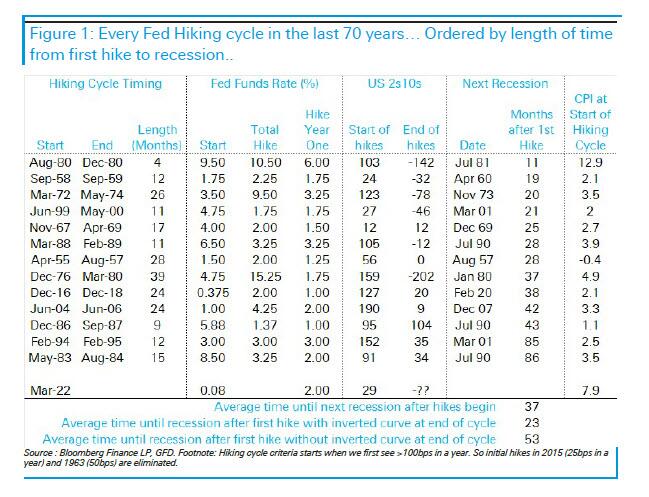
Yesterday, in our discussion of the "battle of the yield curves", where we made it clear only the 2s10s matters due to its infallible recessionary signaling, we pointed out that while on average it takes 12-18 months from inversion to recession during a Fed hiking cycle...
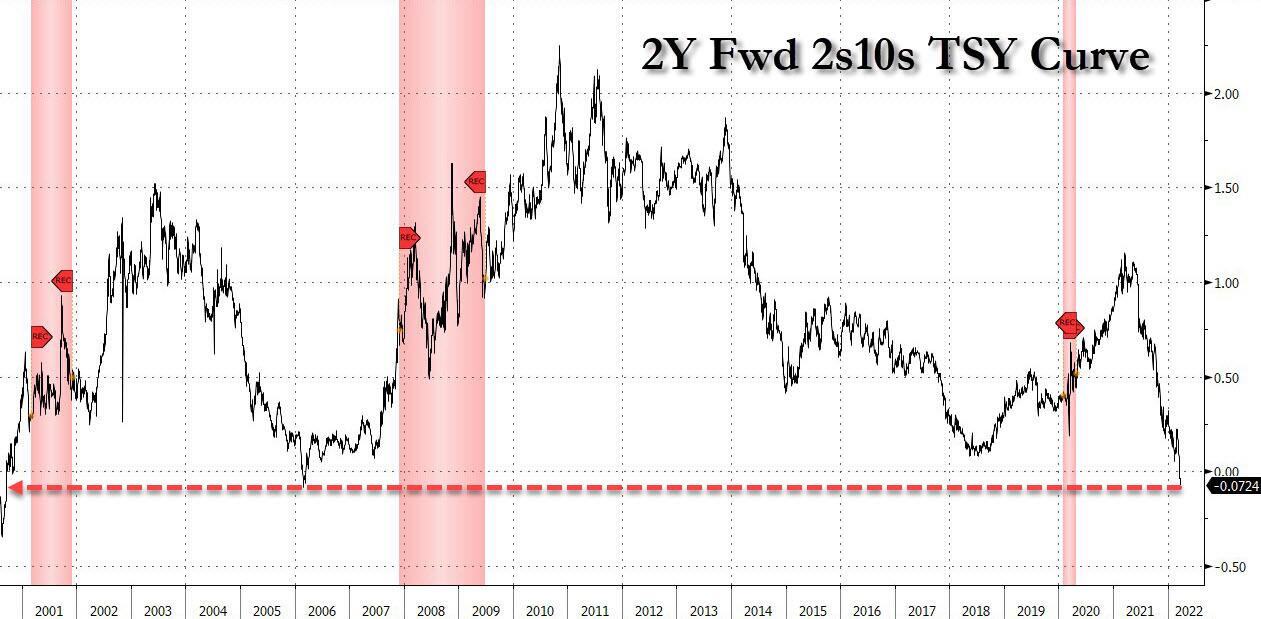
... not only has the Fed never before started a rate hiking cycle when inflation was already 7.9% (suggesting that the onset of a recession will be much faster than usual this time), but that the debate over a yield curve inversion (and thus recession) was already moot, as the 2Y forward 2s10s had inverted and on Thursday the inversion accelerated taking out the inversion lows hit in 2006 ahead of the global financial crisis.
The only question at this point is when the inversion will take place, and begin the official countdown to a recession which BofA CIO Michael Hartnett believes will start some time in the second half.
Well, moments ago we got an answer from Goldman Sachs, which this afternoon - just hours after we showed that the forward 2s10s had already inverted, updated its forecasts for US Treasury yields across the curve "to reflect more broad-based and persistent price pressures and the accompanying hawkish Fed pivot."
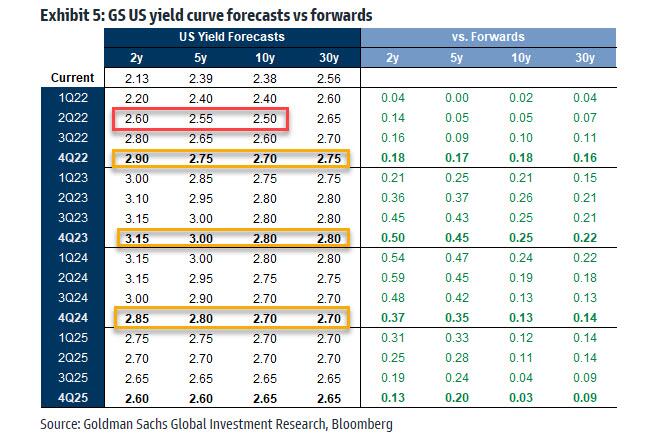
As a result, Goldman now sees the 10y UST yields ending the year at 2.7%, up from its prior projection of 2.25% (the bank notes that risks to its forecast are two-sided: on one hand "a deescalation of the war in Ukraine or more persistent inflation could mean even higher realized levels", whereas the opposite could result in lower levels).
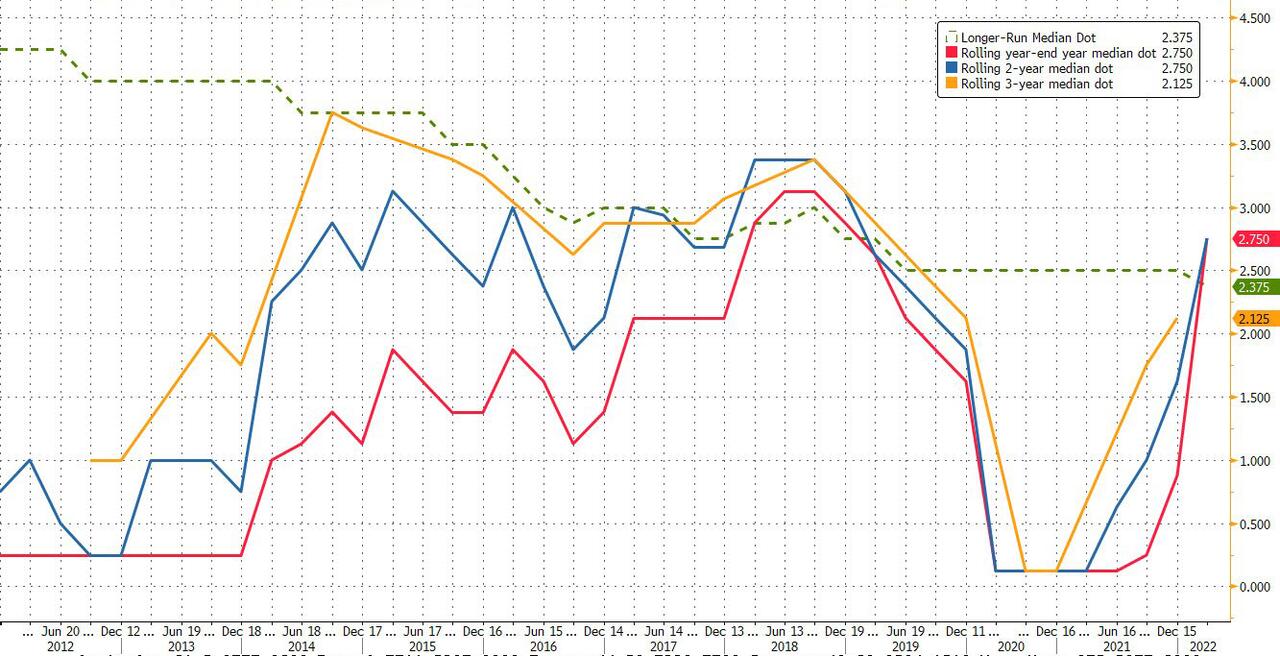
Goldman's forecast revisions at the front end far larger: the 2y forecasts for YE22 and YE23 are 2.9% and 3.15%; while the former is only about 20bp above current forwards, the latter is roughly 50bp higher, reflecting Goldman's higher terminal rate assumption... which incidentally are dead wrong because as we showed recently, the terminal rate (dashed line below) continues to slide as a result of record-er debt and shrinking output and productivity.
Its woefully wrong terminal rate assumptions aside, the bank also expects that longer maturities will increase more gradually given the bank's expectations for strong demand from liability-driven investors. As such, the vampire squid now expects the 30y yields to end the year at 2.75%.
To summarize yet another bafflingly clueless Goldman forecast, the bank now expect the 2s10s yield curve to invert next quarter, and to remain inverted until Q2 2025... without any dire economic consequences. In other words, in some bizarro universe, Goldman sees the US financial sector existing under an inverted yield curve for exactly three years, and even more magically, the US somehow manages to avoid a historic depression during this period.
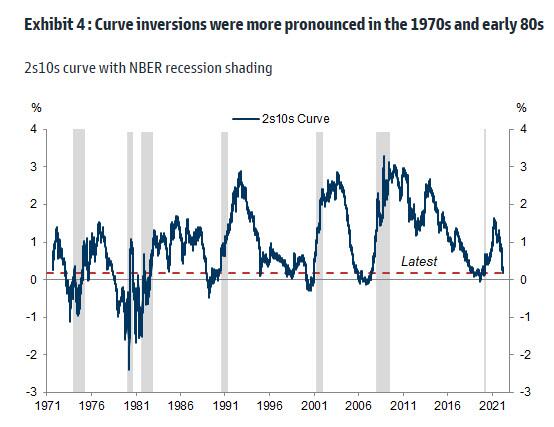
Not surprisingly, even Goldman concedes that this makes little sense, and tries to explain away its ludicrous forecast by saying that it's bad... but not as bad as it was in the 1970s. Which, considering the amount of debt in the economy and the hyperfinancialization in the markets, is a completely spurious and meaningless comparison (if the US was to undergo through a 1970s style stagflation, the S&P would crash 90%), and is precisely why Goldman used it:
A notable aspect of our forecasts is that they feature a roughly 20bp inversion of the 2s10s UST curve as we progress through the year. Although this appears significant in the context of the business cycles since the late 1980s, where this curve has not inverted by more than 50bp ahead of a recession, inversions were significantly more pronounced in the 1970s and early 80s (Exhibit 4). We’ve argued in a previous report that earlier and/or deeper nominal curve inversions should not be that unusual in high inflation environments with significantly inverted inflation curves, requiring only modest flattening of the real yield curve flattening. As a result, in such periods we think modestly inverted nominal curves are a less definitive signal of recession probability than when using information about both the real and inflation curves.
What's the take home message here? Well, Goldman is right in predicting that the 2s10s will invert as soon as next quarter - after all, we said just that last night - and as we also explained, this means that the next recession could start as soon as 11 months after the first hike (last week), and potentially much sooner considering where inflation currently is. The rest of Goldman's note - namely the part about how one can ignore the recession and it's really no big deal - one should simply ignore.
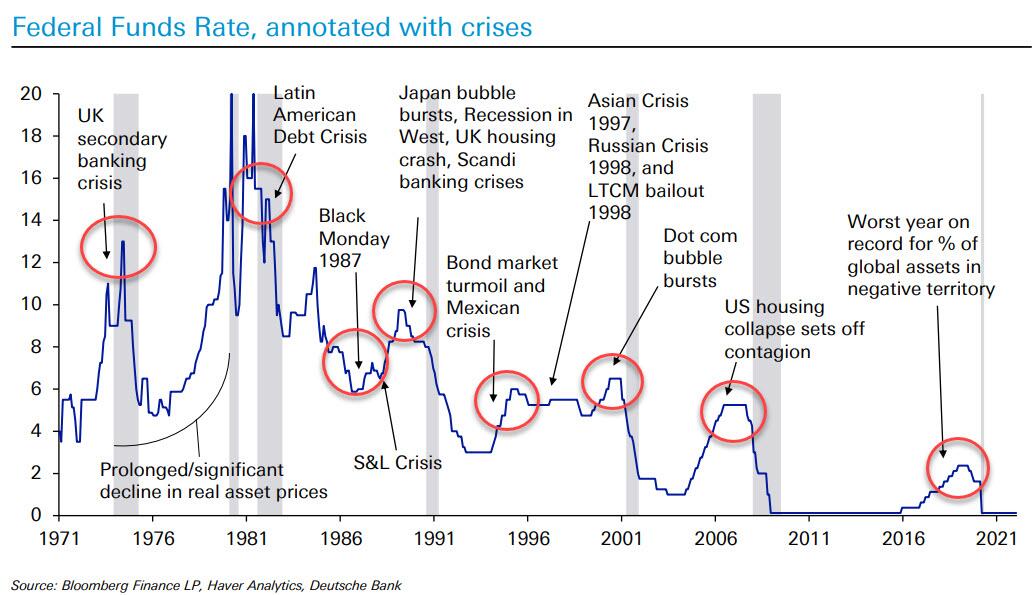
Actually, there is another reason why one can ignore most if not all of the above: with the act of hiking, the Fed has doomed the US, because as this chart from Deutsche Bank makes clear, in the modern (fiat high debt) era, every single Fed hiking cycle has led to some kind of financial crisis somewhere across the world
Masochists can read much more in the full note available to pro subscribers in the usual place.