"You Know What Would Be Really Irritating? A Crazy Rally To New Highs"
It would be very irritating to have a rally suck in all the bears salivating for a crash from a bear-market rally peak and then decimate the shorts with a rally that soars rather than collapses to new lows.
As a contrarian, I'm always squinting at the consensus and wondering if it is really that easy to be right. Now that everyone is bearish for reasons we all know--global recession, a hot war, energy scarcities and stagflation-- I'm thinking, you know what would be really irritating? A bat-dung crazy rally to new highs in U.S. equities.
Irritating, indeed, because few are positioned for this eventuality due to odds of it happening appearing to be near-zero. What's odds-on is all the assets that bubbled up in the Everything Bubble sagging back to pre-bubble levels, or lower as global growth craters and stagflation stymies the easy fixes of money-printing and fiscal stimulus.
How could stocks soar in such confounding, catastrophic circumstances?
It doesn't seem remotely possible, but when the herd starts running, rationality is not high on its list. When the herd is spooked and panics, rationality is not exactly the order of the day. The herd might thunder off a cliff absolutely convinced of the rightness of the stampede.
Alternatively, rationalists stare with growing annoyance at a rally that makes no sense, and then with great reluctance are forced to join the herd in its irrational euphoria lest the rationalist fail to match the returns of the herd and suffer banishment to Financial Siberia.
What could cause such an irritating, bat-dung crazy rally? I see three potential sources of bat-dung craziness:
1. Market contrariness. As Jesse Livermore observed, the market tends to take along the fewest possible punters in big moves. Some will say sentiment is poor but positioning is still bullish, so sentiment doesn't matter. Perhaps. But a global recession is generally bad news for stocks, ditto hot wars, energy scarcities and stagflation (inflation in essentials and stagnant growth in employment, GDP, etc.).
What's the most punishing move for punters and pros alike--a crash or an irrational rally? I tend to think it's not a crash, as too many people expect that now and punters who HODLed or bought the dip have been ill-treated by this year's erratic decline.
The smart money sold early and heavily, rotated out of tech into commodities, but alas, that hot trade is blowing up, too as the speculative positioning that pushed commodities to the moon is evaporating like mist in high-noon Death Valley.
There are numerous powerful reasons to be in cash and remain wary of bear-market rallies. Given that backdrop, the most punishing move would be higher, tempting punters to short the bear-market rally every step higher, and then forcing them to cover with face-ripping losses.
2. Things aren't as bad as everything now expects. The consensus is the economy is going over the waterfall and the only sound we'll hear above the roar is the screams of punters who went long.
But just suppose the blow-torch of inflation cools, employment holds up and the consumer ignores all the prognosticators of doom. Weirdly, consumers have deleveraged during the pandemic and the debt to income ratio isn't that bad. Corporations that overshot staffing are slashing headcount by attrition and hiring freezes, along with layoffs. But lots of jobs are still going begging.
Corporate profits will take a hit but as commodity inflation cools and their super-costly headcount drops, profits will look better a quarter out, and the market being what it is, a bizarre combination of irrationality, price discovery and forward-looking crystal-ball gazing, the hope for fatter profits a quarter or two out could spark a frenzy.
3. Core and periphery. We tend to forget that we're all currency speculators, regardless of the asset we're holding, be it cash, commodities, bonds, stocks, cryptos or real estate. Everything is arbitraged against the super-liquid currencies, an exclusive club of the yen, euro and U.S. dollar. (The Chinese RMB, being pegged by the Chinese government to the USD, is a derivative of the USD).
As the charts below reveal, the USD has formed a long-term bowl-bottom and an inverse heads-and-shoulders in the USD-JPY pair.
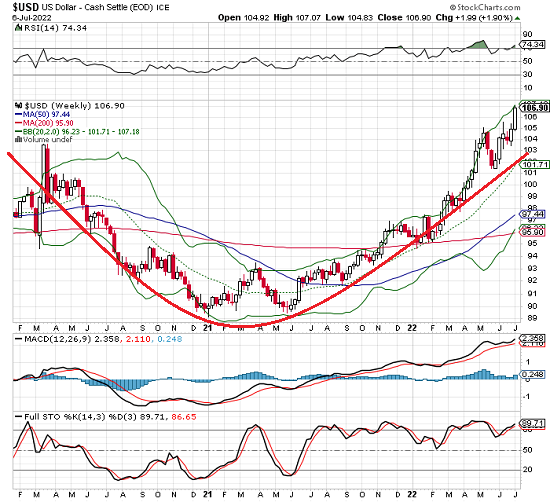
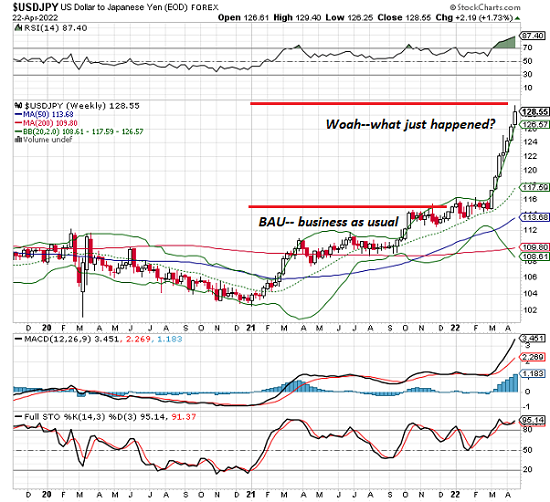
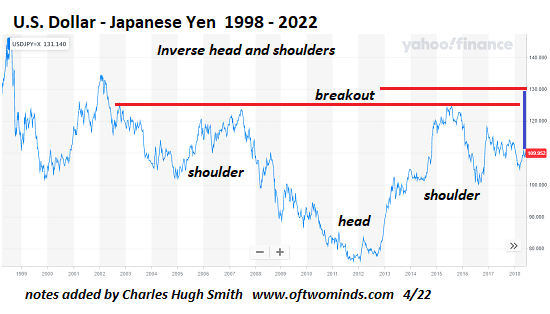
Yes, the USD may sag back to support but the bottom line is the USD rising makes everything cheaper for those holding U.S. dollars and much more expensive for everyone holding other currencies or assets in other currencies. Capital goes where it's treated well and U.S. markets are 1) a way to capture the gains of the U.S. dollar; 2) liquid and 3) relatively transparent compared to other markets.
A couple of trillion seeking safe haven here, a couple trillion seeking safe haven there and pretty soon that influx of capital starts pushing U.S. markets higher. Note that everyone who sold assets priced in yen in January and moved their stash into USD cash just made 20% in six months. That's a pretty nice return.
Capital moves from the periphery to the core when things start wobbling.
It would be very irritating to have a rally suck in all the bears salivating for a crash from a bear-market rally peak and then decimate the shorts with a rally that soars rather than collapses to new lows. The rally would be even more irritating if it left all the smart money on the sidelines because a rally simply doesn't make sense.
With great weeping and gnashing of teeth, the smart money is then forced to chase the rally higher.
Yes, this is implausible, impossible, etc. That's why it's increasingly likely. Is it really that easy to be right? As a general rule, no.
* * *
Alaska On Fire: Stunning Satellite Imagery Shows Blackening Skies Over State
Alaska's fire season is off to a fiery start, possibly a historic one as more than 2 million acres burned, the earliest date for this milestone in decades.
As of Wednesday, more than 200 wildfires rage across the state, with worsening air quality over the central and eastern interior and the western Yukon Territory, Alaska Wildland Fire Information noted on their website.
New satellite imagery (via Visible Infrared Imaging Radiometer Suite on the NASA-NOAA Suomi NPP satellite) shows smoke and hundreds of wildfires blackening skies over the state.
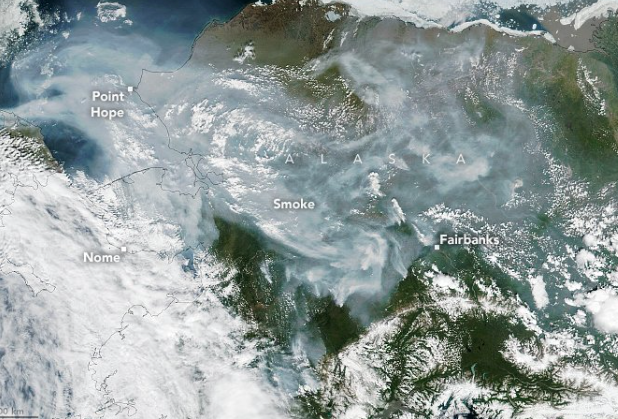
The Alaska Interagency Coordination Center reported 210 active fires, and 42 were large, with firefighters working to control the blazes.

"Wildfires are a regular feature of Alaskan summers, but this year's fires have been exacerbated by drought, unusual heat, and several intense lightning storms. In early July, the area burned was on track to be among the largest on record," according to University of Alaska Fairbanks climatologist Rick Thoman, who NASA cited.
Voyager Digital Ltd. marketed its deposit accounts for cryptocurrency purchases as safe, protected by the nation’s banking insurance system in the event of a failure.
This week, when the company tumbled into bankruptcy, customers learned they didn’t exactly have the protection they expected and a banking regulator began an inquiry, according to a person familiar with the matter.
Voyager, a brokerage and lender, was caught in a spiral of plunging crypto prices that is collapsing hedge funds and companies and which blew a hole in its assets. Bitcoin, for example, has lost more than half of its value so far this year.
Voyager froze all activity, including withdrawals on $350 million in customer deposits that are stored at Metropolitan Commercial Bank, a small New York bank. Voyager said customers would be able to access those dollars after “a reconciliation and fraud prevention process is completed.”
The funds are expected to be paid in full to the customers, people familiar with the accounts said. That may not be the case for crypto assets held at Voyager.
Still, some customers online said they were only just learning their deposits weren’t insured by the Federal Deposit Insurance Corp. in the way they thought. Voyager had marketed the accounts as protected by that national safety net, an attractive pitch in the volatile world of cryptocurrency.
“In the rare event your USD funds are compromised due to the company or our banking partner’s failure, you are guaranteed a full reimbursement (up to $250,000),” Voyager wrote in 2019.
Thursday its website said “Your USD is held by our banking partner, Metropolitan Commercial Bank, which is FDIC insured, so the cash you hold with Voyager is protected.”
The individual customer accounts are eligible for insurance, but only in the case of a failure of the bank, not Voyager, Metropolitan Commercial Bank said this week. That is typical since the FDIC only backstops participating banks.
The confusion drew the attention of the FDIC, which is looking into Voyager’s marketing, according to a person familiar with the matter.
A Voyager spokesman declined to comment further.
Voyager has what is known as a For Benefit of Customers account at Metropolitan Commercial Bank.
That is standard for crypto firms and other fintech companies that act like banks in taking customer deposits but don’t have the licenses or ability to actually be a bank. At Voyager, the accounts hold the cash customers use for buying crypto assets or accumulate from selling them.
Metropolitan Commercial Bank held the money in one custodial account. Inside that, customers’ assets were separated into individual accounts by Voyager.
Voyager didn’t have access to the customer funds for its own purposes, according to bankers and analysts. The money is also segregated from Voyager’s assets in bankruptcy and protected from creditors, people familiar with the matter said.
The amount of cash in the customer accounts tripled in the last three months, a sign customers were pulling back on crypto assets.
Metropolitan Commercial Bank is one of a small group of banks willing to work with crypto firms. It held about $1.1 billion in deposits tied to crypto, 19% of its total, according to disclosures. It doesn’t hold any crypto assets and doesn’t make loans backed by crypto.
The bank has said it expects volatility in the deposit accounts due to swings in crypto markets. A hot market will have customers spending cash to buy crypto assets, while a crypto winter tends to see deposits increase.
For that reason, Metropolitan holds the deposits as cash and doesn’t use them for other investments or loans, said Keefe, Bruyette & Woods analyst Christopher O’Connell. The bank had $1.4 billion in cash and cash-like securities at the end of March.
Mr. O’Connell said losing Voyager’s deposit relationship would reduce Metropolitan’s earnings by only about 2% or 3%.
“We expect no additional fallout,” he wrote in a note.
Twitter Defends Spam Accounting Amid Elon Musk Takeover
Company officials say spam accounts represent less than 5% of daily users based on closely held user data
Twitter Inc. TWTR 1.41% officials on Thursday doubled down on defending the accuracy of their calculation of spam on the platform, addressing an issue that has become a potential stumbling block in Elon Musk’s $44 billion deal to buy the company.
The officials, who asked not to be named, reiterated on a call with reporters Thursday that spam accounts make up less than 5% of the company’s daily monetizable users, which Twitter defines as daily users who are logged in and authenticated by Twitter. They added that it would be difficult for outsider auditors to accurately measure the figure that is based on private user information, such as internet addresses, geolocation data and contact information, that Twitter doesn’t share.
The issue of bots and spam has emerged as a complicating factor in Mr. Musk’s deal to buy Twitter. In May, Mr. Musk said his deal was “on hold,” as he questioned the way Twitter calculates spam and fake accounts. Mr. Musk has suggested he thinks the number could be closer to 20%, without providing evidence that the company’s disclosures were unreliable.
Twitter’s board has insisted it is moving forward on the deal as agreed. Executives have told employees that there is no such thing as a deal being put on hold, The Wall Street Journal previously reported. After some legal back-and-forth between the two sides, Twitter in recent weeks provided Mr. Musk with historical tweet data and access to its so-called fire hose of tweets, people familiar with the matter have said
In the briefing with reporters, the Twitter officials declined to say whether the company shared the private user information with Mr. Musk. They would only say that Twitter has fully complied with the obligations of the purchase agreement and that the privacy of user information was important to the company.
Twitter and rival platforms have spent years trying to stamp out bots and fake accounts through content-moderation teams and artificial intelligence tools, but many describe spam and fake accounts as a whack-a-mole problem since bad actors are constantly updating their methods.
The Twitter executives said their estimate of spam is based on sampling a portion of its accounts and human reviews of account activity. Those reviewers, Twitter executives said, analyze public information like what that account tweets and interactions with other accounts. They also factor in information that is available only to Twitter, including IP addresses, client and browser signatures and contact information.
Twitter said it typically removes more than one million spam accounts daily while they are being set up or soon after. Additionally, the company said, it locks millions of suspected spam accounts a week if humans can’t verify they aren’t spam.
Executives said that some legitimate users might appear to be fake because they kept automatically generated usernames and never took the additional step of making their username their own. There, private information, not available to the public, can help Twitter determine whether it is real.
Twitter officials added that because outsiders don’t have access to its internal data, those spam estimates can’t be accurate. They said the company hasn’t found a way to share this information with outside experts in a privacy-safe way.
Watches of Switzerland defies downturn with high demand for luxury brands
Maker of Rolex and Patek Philippe timepieces predicts sales will rise by a fifth this year
Watches of Switzerland has defied the growing gloom around consumer spending, predicting that sales will rise by around a fifth this year as buoyant demand continues to meet a scarcity of supply.
The group’s 171 stores in the UK and US sell brands such as Rolex, Patek Philippe and Breitling, with an average price of about £6,000.
Sales for the year to May 1 rose 40 per cent to £1.23bn as consumers spent savings that had piled up during lockdowns. Pre-tax profit almost doubled to £126mn.
Shares in Watches of Switzerland have almost halved this year following fears about the effect of a looming spending downturn on products that are both expensive and entirely discretionary.
But chief executive Brian Duffy said that while the group was “mindful” of the macroeconomic environment there was no indication of a slowdown in demand yet.
“Our average sales price is around £6,000 so it is clearly a higher-income demographic that is less affected by cost of living pressures but more conscious of asset valuations,” he said, adding that watches were increasingly regarded as an investment or an heirloom rather than straightforward consumer goods.
Supply is also constrained by the skilled nature of watchmaking and its concentration in one country. “The luxury watch industry is a microcosm, it’s a very conservative Swiss industry that has been producing below demand for some years now,” said Duffy.
“The numbers of people registered with us is many times the number of products we have to sell them,” he added. Around three-quarters of watch sales are of products for which there is a waiting list.
Geographic factors have also helped Watches of Switzerland. It is not present in either Russia or China, where demand has been more fragile, but has benefited greatly from its expansion in the US market.
Sales in America have gone from 19 per cent of the company’s total in 2019 to 35 per cent now, growing by almost half in the year just ended. Duffy forecasts that they will overtake UK sales in 2026 or possibly sooner.
Analysts at HSBC said there was “a clear supercycle of growth in the US market”. Per capita ownership of luxury watches is just 40 per cent of UK levels, partly because of a relative lack of dedicated retail outlets.
The company is in the early stages of expanding into Europe, with stores set to open in Ireland, Sweden and Denmark in this year.
Aside from the uncertain economic outlook, the only real trouble spot was travel retail. Since the start of 2021, it has no longer been possible for tourists to reclaim sales taxes on items purchased in the UK but then taken out of the country.
Watches of Switzerland has renegotiated its store at Heathrow airport to reflect its expectation that tourism-related sales will not recover to pre-Brexit levels because of this change.
Oil market madness
Crude prices have been dragged sharply lower this week on fears that a recession could undercut fuel demand.
Brent crude prices briefly fell below $100 a barrel on Tuesday for the first time since April, before settling at $100.69 yesterday. The US West Texas Intermediate benchmark was trading at less than $96 a barrel at one point, also its lowest in months. Crude prices are down more than $20 a barrel over the past month.
Oil’s fall this week has been part of a broader wipeout across commodity markets. Investors fear that as central banks tighten monetary policy to tame soaring inflation, the move could inadvertently tip economies into recession. For oil, that would likely mean a reduction in fuel demand, which could take pressure off supplies and boost low inventories, which have driven prices to more than $100 a barrel.
Yet oil analysts, who have mostly been bullish on the price outlook for the remainder of this year, are warning that oil supply remains tight and the sell-off has pushed prices too low. Expect a rebound in the coming weeks, they say.
Amrita Sen, an analyst at the consultancy Energy Aspects, told ES that the shift lower was not supported by any shift in supply and demand.
“It’s a macro move, equities came off, all commodities came off. So it’s a broader risk-off move rather than being rooted in fundamentals,” she said.
You don’t want to “catch a falling knife” betting against rapidly dropping oil prices she said, but “fundamentally nothing shifted”.
“The under-investment story hasn’t shifted. Recessionary fears are there but the demand numbers are still strong. Asia’s [oil demand] is still growing, so no, it’s not justified,” she said of the big move down in prices.
That view was echoed by Damien Courvalin, an analyst at Goldman Sachs, who wrote in a note to clients that the bank sees crude demand still outpacing supply by about 1mn barrels per day, which should support high prices.
“While risks of a future recession are growing, key to our bullish view is that the current oil deficit remains unresolved,” said Courvalin, adding that higher prices are needed to cool demand.
Goldman, at least, still sees crude’s bull run intact and expects prices to shoot back up well above $100/barrel later this year.
Still, there could be at least a temporary reprieve from high energy prices. US gasoline futures are also down sharply over the past month to its lowest level since April. If prices hold, it could pull the national average price of petrol at the pump back towards $4 a gallon, which could ease some of the inflationary pressure on the US economy. It could also ease political pressure on president Joe Biden. (Justin Jacobs)
Methane emissions are only getting worse
With everything that is going on in energy geopolitics, talk of climate change often seems to have faded into the background — a problem to be dealt with, it is argued, when the upheaval has passed.
Just a year ago, efforts to rein in methane leaks dominated the public comments of oil and gas executives. Today, amid a scramble to increase supply, it has been knocked down the list of talking points.
But a new report from consultancy Kayrros suggests that while the chatter may have died down, the problem certainly hasn’t. In fact, methane pollution is getting worse — significantly so.
Emissions of methane — which have more than 80 times the warming power of carbon dioxide in the short term — from the US’s biggest oil and gasfields and other major basins around the world are set to rise sharply this year. Here are some of Kayrros’s takeaways from global hotspots:
Permian: Methane emissions from America’s most prolific basin jumped by a third in the first quarter of the year — leaving them about 15 per cent above pre-Covid levels as activity increases amid sky-high prices and calls to open the taps.
Marcellus and Utica: In Appalachia, the engine room of US natural gas production, methane leaks in the first quarter hit their highest level since mid-2020.
Appalachian coal: The region’s coal industry notched a rise in methane emissions that far outstrips any bounceback in output.
Outside the US: There was some apparent progress in places such as Iraq and Kuwait, where emissions appeared lower than they were before the pandemic. But in Turkmenistan and Algeria they shifted significantly higher. And western countries’ moves to wean themselves off Russian oil and gas has removed many of the earlier incentives for Moscow to clean up its act.
In other words, as producers ratchet up supply to deal with the current crisis, the methane problem is getting worse. And things only look set to deteriorate as the year progresses.
That is obviously bad news for the climate. But it is especially jarring given that methane emission reduction was an area of significant progress for Biden amid a pantheon of climate disappointments.
The president’s administration has reinstated Barack Obama-era regulations that were scrapped under Donald Trump. And the Environmental Protection Agency is finalising regulations to clamp down further.
At the COP26 talks in Glasgow — where signs of real climate progress were few and far between — John Kerry, the president’s top climate diplomat, successfully brokered a commitment from 110 countries to slash emissions 30 per cent from 2020 levels by the end of the decade.
It may only be six months since the launch of the so-called Global Methane Pledge, but, as Kayross notes, “the overall trend in global methane emissions so far appears to be going in the wrong direction”.
In other words, despite all of the commitments and policy progress, methane emissions are on the march. That makes it hard for even the most optimistic climate watcher to trumpet tangible progress.
As Kayrros puts it: “The lack of progress achieved so far is a concern.”
Given the warming effects of methane and the narrow window that exists to keep emissions in check, that is probably an understatement.
We’ll have more on the methane question in the coming days, including a slick new video report from Derek. Watch this space.