(ZH) Demand Destruction Has Begun

Demand Destruction Has Begun

One month ago, Brent jumped above $100/bbl for the first time in eight years as Russia executed a full-scale invasion of Ukraine, and it became clear that western governments would impose sanctions. The oil market has been in triple digits for practically the entire time since.
And, after a month of oil prices we have not seen in nearly a decade and weeks of record-high fuel prices, JPMorgan has published a research report (available to pro subs) which finds that high-frequency data suggest that consumers are beginning to react resulting in what the Fed has desperately wanted to achieve all along: commodity demand destruction.
That said, high prices are clearly not the only demand-destructive force in the world at the moment, however. The crisis in Ukraine, crippling financial sanctions in Russia, and the continued spread of the highly infectious Omicron variant in China have an even more direct impact on regional fuel consumption than high prices.
As a result, JPMorgan has cut 1.1 mpd off its 2Q22 demand forecasts, followed by about 0.5 mbd cuts to both 3Q and 4Q. On net, this trims 420 kbd on average from the bank's expectations for 2022 global oil demand as high prices, COVID restrictions, and geopolitical conflict drive demand destruction in Russia, China, India, and Europe.
While the US has been relatively isolated so far (despite the highest gasoline prices on record), JPM's demand revisions are heavily concentrated in Europe, which remains the epicenter of the geopolitical shock. Since the start of the Russia-Ukraine war, the bank's economists have downgraded the growth in the region by over 2%-pts and have raised inflation forecasts by nearly 3%-pts.
Moreover, after sliding sharply in February and bottoming in early March, COVID infections are up over 40% in the past two weeks across Europe with large increases across the UK, Germany, France, and Italy. Zero-tolerance COVID policy, combined with less effective vaccines and lack of natural immunity, presents a challenge to China's growth outlook.
As a result, JPM now sees activity contracting in March and April, prompting a 1.1%-pts cut to China’s 2Q GDP growth. With the downward revisions to the Euro area and China, the largest US commercial bank now projects 1H22 global growth dipping below potential. Displaying limited sensitivity to near-term downside growth risks, major central banks continue to tilt hawkish. Chair Powell reiterated prospects for an accelerated pace of hikes and reinforced the notion that the Fed could soon start moving in 50bp increments. EM central banks also remain on the move.
The clearest example of demand destruction can be seen in Eurasia, a region which includes both Russia and Ukraine, where mobility has fallen to its lowest level since early 2021.
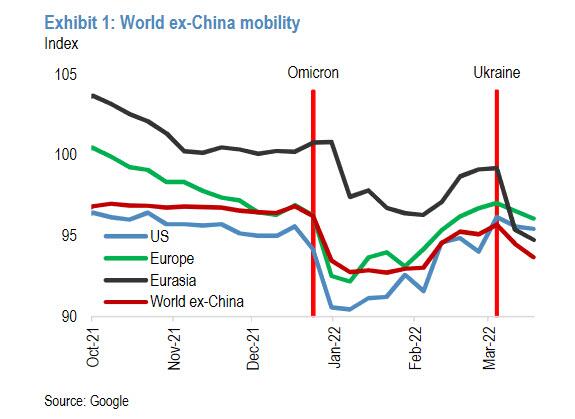
And in Europe, while mobility trends have reversed after a recovery from Omicron-driven lows earlier this year, they are now once again declining.
Consequently, JPM has cut its expectations for 2022 Eurasia oil demand by 270 kbd due to sanctions imposed on Russia. Eurasia demand for jet fuel will come in 130 kbd lower than the previous estimate as roughly half of Russian civil aircraft will end up grounded as a result of airspace bans and shortages of parts. JPM also revised Europe oil demand down by 160 kbd on average for 2022 due to sensitivity to high prices and lower expectations for economic growth in the region
The good news is that for now, US mobility has been relatively resilient in spite of higher oil prices, but here too we are seeing the first signs of hampered driving demand recovery in California, where on-road fuel prices are more than $1.50 above the national average. California vehicle miles traveled (VMT) has been tracking closely to 2018-19 levels since late last year, but has deviated from the 2019 trend twice so far this year: once, as Omicron cases spread through the state, and again starting at the end of February.
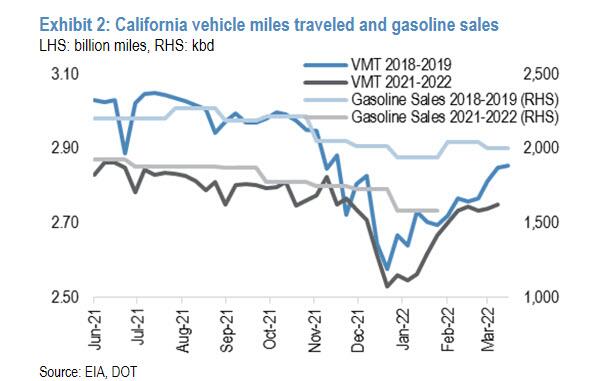
This flattening in VMT growth is likely due to the increase in gasoline prices following the Russian invasion and, while if this trend persists or spreads to other regions in the US, JPM said that it will likely revisit its assumptions for US fuel demand for 2022 as well.
JPM then does a similar exercise for China and India, and likewise cuts its forecasts for Q2 2022 oil demand there too (by 520kb/d and 120lb/s, respectively), and turns its attention to the mounting concerns over stability of Russian supplies.
Here, as reported previously, JPM finds that large quantities of Russian oil continue to be boycotted by Western refiners. Meanwhile, logistical issues are becoming entrenched as transport remains a significant challenge for Russian sales, with UK and European ports banning vessels flagged, operated or owned by Russia from docking at their ports. Reports of Saudi Arabia actively discussing pricing some of its oil sales to China in Yuan further point to difficulties facing Russia in shifting large volumes from Western consumers to China, where Saudi Arabia is a main supplier of crude. Given that Russia has very limited onshore storage capacity, a halt in exports would trigger production shut-ins within weeks, perhaps on an even larger scale than seen in April 2020.
Equally important are the developments in Kazakhstan— a country that ships around 1 mbd of its crude oil production through the CPC pipeline to the Russia’s Black Sea port of Novorossiysk. The pipeline was "damaged" on Tuesday, impacting around 1 mbd of export volumes for up to two months. The supply interruption was timed to coincide with the EU's meeting on Thursday, prompting speculation that Moscow was prepared to retaliate against western sanctions by curbing both its own and Kazakh energy supplies, possibly leading to significantly larger disruptions than the current consensus base case assumes. Needless to say, finding alternative routes for all CPC volumes would be difficult, likely forcing the shut-in of fields in Kazakhstan. For now, JPM has removed 1 mbd from Kazakhstan’s April production.
Despite the nascent demand destruction, JPM writes that its baseline still assumes that the market's current extreme aversion to Russian oil will subside. Volumetrically, this means that stranded Russian oil barrels will decline from 3.0-3.5 mbd in March to 2 mbd
in April and a perpetual 1 mbd thereafter, leading to Brent oil price averaging $114/bbl in 2Q22 and $101/bbl in 2H22, with prices rising over $120 in the interim.
That said, the bank's commodity strategist recognize that the European consumer could force the governments’ hand as the human toll from Russia's invasion mounts. Ominously, JPM cautions that as the single largest buyer of Russian oil, "the more rapidly Europe seeks to cut Russia’s imports, the higher global oil prices will rise" and in the event of a full 3.8 mbd drop in Russian exports, crude oil prices could soar to $185/bbl.
Of course, all of the above is predicated upon an "all else equal" framework, however as we have reported recently, it now appears that developed government such as the US, UK and Europe are planning to offset demand destruction with what gas stimmies or cutting gas taxes, what some have called "demand construction" which will achieve just the opposite of what it hopes to achieve as Bloomberg's Kavier Blas noted two days ago: "Exactly the opposite that the current market requires. Rather than support poorer families, it goes for a blanket, regressive tax policy."

(ZH) Russian Superyachts 'Go Dark' To Avoid Tracking

Russian Superyachts 'Go Dark' To Avoid Tracking

Since the invasion of Ukraine, Russian oligarchs have been panic-moving private jets, superyachts, and other trophy assets away from Western countries to avoid sanctions.
Marine data compiled by Bloomberg show at least nine superyachts owned by Russian tycoons have switched off tracking systems. These devices, also known as automatic identification systems or AIS, are required for all passenger ships to broadcast positions for other vessels and coastal authorities.
"There's no reason why their AIS transmissions should be off for days," said Gur Sender, a program manager at Windward Ltd., which specializes in maritime risk and intelligence.
"Even if you're in the middle of the ocean you have a satellite picking up your transmission once in at least eight hours. If you're a big yacht, it's in your interest to have it on so everyone can see the ship to prevent accidents," Sender said.
Most of the yachts went dark on Feb. 24, the day Russia invaded Ukraine. Then more went dark after President Biden announced sanctions on Russian oligarchs on Mar. 11. The oligarchs are all part of Russian President Vladimir Putin's inner circle.
Russian oligarchs who have been sanctioned have either had their yachts commandeered by European authorities (like Rosneft CEO's $120mln superyacht) or have sailed to more friendly waters out of the Mediterranean and Northern Europe to the Indian Ocean and or the Middle East.
According to vessel data, at least eight ships were last seen near the United Arab Emirates, Oman, or Saudi Arabia.
Meanwhile, two superyachts owned by Russian businessman Roman Abramovich fled from Western Europe for Turkey.

WWD : French Sustainable Label Circle Sportswear Raises 2.5 Million Euros

French Sustainable Label Circle Sportswear Raises 2.5 Million Euros
Investors include Bpifrance, AA & Sons and private investors drawn from the sports, fashion and tech spheres.

PARIS — French sustainable label Circle Sportswear has raised 2.5 million euros of funding, the company revealed this week.

The investment is earmarked to expand the team with experienced profiles in marketing and sales; accelerate its development of the wholesale business and expansion in new markets, such as the U.S., and continue materials research and development, especially on plant-based fibers.

After working for five years at L’Oréal in various positions from human resources to buying, and founding cloud-based talent platform Yoss, later sold to human resources firm Adecco, cofounder Romain Trébuil wanted to bring together his desire to work toward a circular economy and a personal passion for sports.

Launched via community fundraising platform Ululule in March 2020, Circle Sportswear hinges on Trébuil’s idea that “sportswear is everywhere but everyone is doing the same thing, manufacturing in Asia from petrol-based materials,” he said.

“The lockdown was an accelerator for the values that we support. People started looking closely at where clothes they are wearing were made and by whom, in the same way they did for food,” said Trébuil, who launched the brand with Alex Auroux, formerly general manager of health club aggregator Classpass, and Solène Roure, a designer who has worked for the likes of Hogan, Alexander McQueen, Nike and Lululemon.

Products are developed with performance in mind and tested by some of the 30 high-level athletes who are in the brand’s orbit, such as French Paralympic tennis player Stéphane Houdet, who won gold in the doubles at the 2020 Toyko Olympics, and ultra-trail specialist Stéphanie Gicquel, who was the first French person to run a marathon around the North Pole. “There’s bit of pressure when you hand someone like that a prototype of your leggings and they take off for a 24-hour run to test them out,” remarked Trébuil.

Interest from consumers was strong: within 48 hours of launching the six-week preorder campaign, the initial 200 orders the brand wanted to garner were filled. By the end of it, they had 600 preorders. A first round of investment, in the first quarter of 2021, yielded a million euros from business angels.

Two years on, the company posted a 300,000-euro turnover in 2021 and is aiming for the 1-million euro mark in 2022. “We’re aiming for strong growth backed by our sustainability and circularity credentials because that’s how we’ll have the greatest impact,” said Trébuil, pointing out that 20 percent of its business was already done internationally.

Among the investors of this second funding round are London-based venture capital fund AA & Sons, founded by Romain Afflelou, a scion of the French eyewear retail empire Alain Afflelou; the Bpifrance state-owned investment bank, as well as individual investors.

“We wanted business angels that could support us on specific angles,” he said, naming Déborah Janicek, who was formerly president of shirting specialist Figaret and general manager of contemporary label Pablo; Chantal Barrat Duc Dodon, whose track record includes sustainable footwear label Melissa and circular-economy projects; Arthur de Soultrait, founder of menswear brand Vicomte A, and Sébastien Borget, a cofounder of The Sandbox. Others hail from the tech and sports sphere.

In the next few months, Circle Sportswear’s product line will be expanded from 30 to more than 90 stock keeping units, and the brand will make its first steps with retailers, launching at Le Bon Marché in late April before heading to La Samaritaine and Galeries Lafayette Haussmann, in a new sports-centric space, from July.

Further on the horizon, the development of the brand in new territories is slated for 2023. Ahead of a full launch in the U.S., the brand has already signed a partnership with SoulCycle. Putting the newly developed materials in consumers’ hands is the best way to convince them and drum up interest, Trébuil said.

But making and selling products isn’t the largest part of the challenge ahead. Material development is. As it stands, the company uses regenerated materials such as Econyl polyamide and Newlife polyester, or organic-certified lyocell, which is made from wood fibers.

At the end of their life cycle — although very few products have gotten there yet, he admits — items can be returned to the brand, which then takes the back to its factories to be disassembled back to threads that can be reused for new products, except for the recycled elasthane, which cannot be reused and is transformed into insulation material in buildings. Still, avoiding consuming resources at each step “all adds up,” he said.

But the French sports label wants to take it one step further, replacing any recycled petrol-based materials with bio-based alternatives. It doesn’t plan on making any discoveries the company makes proprietary, either. “If we have a positive impact on the environment, say with a fiber that doesn’t give off any microplastics, that’s great. But our goal is to create solutions for ourselves and other brands. If tomorrow, it’s Balenciaga, Decathlon or Nike, it’s great. They have a very large impact so if their products are environmentally better, we’ll be glad to have contributed because it means that we all win,” he said.

WWD : Furla Owners Said to Be Considering Sale of Stake

Furla Owners Said to Be Considering Sale of Stake
Market sources say Furla has tapped Lazard and its owners are looking at selling a stake in the accessories company.

MILAN — Furla’s owners are considering a sale of a stake in the Italian accessories company, according to market sources.

Sources say Furla has tapped Lazard as its adviser and a dossier is circulating in Milan. It is also understood that former Valentino chief executive officer Stefano Sassi is consulting with Furla on a potential deal.

As reported, Sassi most recently worked with Etro and is said to have helped the Italian fashion brand achieve the sale of a 60 percent stake to private equity giant L Catterton last year, in a deal valued at 500 million euros. The executive joined Valentino in 2006 and was instrumental in leading and growing the company through the acquisition in 2012 by Mayhoola.

Furla had no comment on the speculation and a representative for Lazard could not be reached.

“Obviously, an injection of capital is always useful and we know that many private equity funds are flush with cash now, but at Furla, I believe there is an issue of succession,” said a source, who spoke on condition of anonymity.

In 2016, owner Giovanna Furlanetto set in motion plans to take Furla public, but this project never materialized. “She changed her mind,” said the source, and “now is not the time to reconsider this decision.” Furla was founded in Bologna in 1927 by Aldo Furlanetto, Giovanna’s father. Her son Giuseppe Costato, who is one of the owners, is not involved in the company’s management.

“These are early days, she is testing the market. It is not clear whether she is seeking an industrial partner or merely someone to help finance the company’s development to be competitive in a crowded accessories arena. In any case, the brand’s appeal remains strong,” believes the source. Furla has a strong and expansive network of stores globally, with a solid business in Europe and growth potential in Asia-Pacific. Japan has historically been the company’s main single market.

In 2016, TIP Tamburi Investment Partners invested 15 million euros to issue a convertible loan for a capital increase, which would have been automatically swapped into Furla shares at an initial public offering that was supposed to happen within 2018 but never took place. At that time, TIP also committed to underwrite an additional 15 million euros on the day of the listing at the same economic conditions offered to the market. A further quota of shares would have been allotted to TIP and sources estimated another 15 million to 30 million euros would have been paid then. TIP, which included the Marzotto, Loro Piana and Ferragamo families among its investors, has over the years invested in Remo Ruffini’s holding company, Ruffini Partecipazioni, indirectly buying a stake in Moncler, Hugo Boss and Ferrari.

Furla is helmed by chief executive officer Mauro Sabatini, who in January last year succeeded Alberto Camerlengo, named executive president of the board. Sabatini leverages in-depth knowledge of both Furla and the leather goods industry. For more than 18 years, he was CEO of Effeuno, a leather goods manufacturing company he founded in Tuscany and Furla’s supplier and longtime partner.

In 2018, Furla took control of Effeuno, which is based in Tavarnelle Val di Pesa, a 40-minute drive from Florence. At the time, Effeuno already exclusively produced Furla’s accessories, employing more than 100 workers and producing 2 million bags and small leather goods a year. The takeover was part of Furla’s strategy to invest in Italy and to strengthen the group’s supply chain, boosting production.

As per the latest figures available, Furla group sales in 2019 totaled 502 million euros.

WWD : Tiffany & Co. Stops Sourcing of Russian-Mined Diamonds

Tiffany & Co. Stops Sourcing of Russian-Mined Diamonds
The jeweler has taken a stance against Russian-mined stones, which accounted for about one-third of its general supply.

Tiffany & Co. is the first global luxury jeweler to take a stance against Russian-mined diamonds. The LVMH Moët Hennessy Louis Vuitton-owned jeweler revealed Friday that it has stopped sourcing diamonds mined in Russia, effective March 21.

“Tiffany & Co. has been a leader in championing ethical sourcing practices for over 20 years. These bold changes reflect our continued effort to ensure that we set the bar high not only for ourselves, but for the entire industry,” said chief executive officer Anthony Ledru. “We are deeply concerned about the ongoing crisis in Ukraine,” he added.

An executive order signed on March 11 by President Joseph R. Biden banned, along with other high-end products, the import of Russian-mined diamonds into the U.S. But if the stones are cut and polished elsewhere, it makes it difficult to impose such restrictions — particularly due to the diamond industry’s sometimes murky supply chain traceability.

But this is an easier proposition for Tiffany, which since 2020 has offered its clients a full supply chain dossier on all stones weighing in excess of 0.18 carats. The jeweler’s new ban on Russian diamonds, however, extends to all diamond sizes. Tiffany says it has fully stopped the purchase of rough diamonds from Russia, as well as stones that were mined in Russia and cut and polished elsewhere.

Tiffany’s new standard also includes melee, which are traditionally parcels of tiny diamonds that look like precious sand particles. This mandate may be more difficult to pull off, but a Tiffany spokesperson said it has asked its suppliers to separate Russian-sourced melee from parcels sourced elsewhere.

According to a spokesperson, about one-third of the world’s diamond supply comes from Russia and Tiffany’s own supply chain was on par with these numbers. The jeweler does not expect any supply chain constrictions, it said, and has taken measures to ensure a smooth transition.

Russian-mined diamonds that are already in Tiffany’s stock or retail network will remain in circulation, but a spokesperson said customers will be able to choose whether or not to buy these stones due to the jeweler’s supply chain transparency.

Tiffany said it has taken similar such measures in the past, by halting purchases of lapis sourced in Afghanistan and rubies mined in Myanmar (often referred to as Burmese rubies).

Earlier this month, Tiffany’s parent company LVMH said it would halt all retail operations in Russia. Until then, Tiffany operated two shops-in-shop in Moscow that are now listed on its website as “temporarily closed.”

WSJ : Meituan Outperforms China Tech Peers With 31% Revenue Growth

Meituan Outperforms China Tech Peers With 31% Revenue Growth
Fourth-quarter sales were boosted by food delivery and new businesses

Meituan’s fourth-quarter revenue rose 31% from a year earlier on the back of significant new business sales and stable food-delivery growth, outperforming much of China’s technology industry that has been hit by a government crackdown.

Meituan, which is China’s third-most valuable internet company, posted revenue of 49.52 billion yuan, equivalent to $7.78 billion, thanks to a 21% rise in its food-delivery business, its main source of income. An extra boost came from a 59% jump in revenue from new businesses, including grocery delivery and group-buying offerings.

Meituan’s revenue growth well surpassed that of China’s other two biggest tech companies Tencent Holdings Ltd. and Alibaba Group Holding Ltd., whose revenues in the past quarter rose by 8% and 10%, respectively. Those were the two companies’ weakest top-line growth rate since they went public—Tencent in 2004 and Alibaba in 2014.

Meituan’s growth came at the expense of heavy investments that weighed on profitability. The company’s net loss during the period widened to 5.34 billion yuan from a loss of 2.24 billion yuan a year earlier, as its sales and marketing expenses surged 46%. This marked Meituan’s fifth consecutive quarter in the red, after the company embarked on a spending spree since late 2020 to build up new business lines.

The company’s revenue and loss figures beat expectations of analysts polled by FactSet.

Meituan’s new businesses include community group-buying operations, which is an emerging e-commerce niche in China where people band together to buy food and household goods at lower prices. That business has accounted for the bulk of Meituan’s losses in recent quarters, but it also attracted most of its new users in the past year.

“Strictly adhering to regulatory requirements is our top priority, as we continue to strive for balanced, high-quality growth,” Meituan said. The emerging community group-buying market has begun to draw some regulatory attention over the past year, as companies raced to gain users with aggressive price competition and steep discounts.

For its overall operations, Meituan echoed its peers’ muted tone about its growth outlook for early 2022, as China battles with its latest surge of pandemic outbreaks and a slowing economy.

“We still face challenges from Covid control measures and a weakening consumption environment,” Meituan said.

WSJ : SoftBank’s Alibaba Stake in Spotlight Amid Stock-Market Turbulence

SoftBank’s Alibaba Stake in Spotlight Amid Stock-Market Turbulence
Shares in the Chinese e-commerce giant have been hit hard over the past year by Beijing’s clampdown on the sector

The turmoil in Chinese technology shares is damping the financial firepower Japan’s SoftBank 9984 -1.75% Group Corp. has for new investments, and prompting debate about whether it might sell some of its huge stake in Alibaba BABA -1.88% Group Holding Ltd.

Shares in Alibaba—SoftBank’s single biggest investment—and other Chinese tech companies have been hit hard over the past year by Beijing’s clampdown on the sector and have been highly volatile in recent weeks. Outside of Chinese shares, some other fast-growing tech companies backed by SoftBank have also fallen in value, such as Uber Technologies Inc. UBER -1.84% and Coupang Inc. CPNG -6.45%

The Nasdaq Golden Dragon China Index of U.S.-listed Chinese stocks has declined 52% over the 12 months through Friday. Alibaba has fallen 49%, and SoftBank’s Tokyo-listed stock has dropped 40%.

Falling valuations for its holdings have pushed SoftBank close to its self-imposed debt limit of a loan-to-value ratio of 25%, estimated David Gibson, a senior research analyst who covers the Japanese internet sector at MST Financial in Australia. That would imply limits on new borrowing, investments and share buybacks, Mr. Gibson said.

Mr. Gibson pointed to SoftBank’s Vision Fund, which includes holdings such as Didi Global Inc., whose U.S.-listed shares have fallen more than 70% from its offering price of $14 last summer. “SoftBank is constrained by capital now, and that’s because of not just Alibaba’s market-cap decline, but also the Vision Fund as well,” he said.

Founder Masayoshi Son has said SoftBank’s loan-to-value ratio, or net debt divided by the equity value of its holdings, should usually be 25% or lower. S&P Global Ratings in March said it expects SoftBank to manage the ratio at about 30%, by adjusting the pace of investment in its fund business.

Investors have been watchful recently for signs SoftBank could potentially sell part of its near-25% stake in Alibaba. SoftBank recorded a gain equivalent to $558 million in the last three months of 2021 after using what Mr. Son called a “tiny bit” of Alibaba stock to settle contracts.

“SoftBank might need to sell more of [its] Alibaba stock because they have a lot more funding needs going forward,” said Atul Goyal, an analyst covering tech, games and telecommunications at Jefferies. A SoftBank spokeswoman declined to comment on listed holdings.

In its quest to fund new investments, Mr. Son’s company has in recent years already raised tens of billions of dollars backed by shares in the Chinese e-commerce giant and some of SoftBank’s other listed holdings, while stopping short of an outright sale.

This so-called asset-backed funding, using a mix of derivatives and loans, shows SoftBank’s openness to bold and sometimes complex financial arrangements. The figures don’t affect the loan-to-value ratio, which reflects conventional debt.

In April through December 2021, SoftBank said it had raised a net $6.9 billion of asset-backed financing using Alibaba shares. It has also raised funds against its holdings in T-Mobile US Inc., Deutsche Telekom AG and SoftBank Corp., the company’s telecommunications affiliate.

Overall, asset-backed financing using Alibaba stock was valued at the equivalent of about $25.8 billion at the end of 2021, SoftBank said last month, equivalent to about 35% of its Alibaba holding.

The funding is obtained partly through margin loans, and partly through prepaid forward contracts. The contracts are agreements in which banks or brokers pay SoftBank upfront, and it agrees to settle the obligation later, either in stock, cash or a mixture.

The contracts could be one way in which SoftBank reduces its stake in Alibaba. However, they don’t commit SoftBank to selling any shares in future, and how it chooses to settle could depend on issues such as its liquidity and Alibaba’s share price.

Some deals set minimum prices for shares used to settle the contract, while others set both a minimum and a maximum. A recent SoftBank presentation said the use of forwards “hedges against a fall in share price below the floor price.”

Alibaba’s contribution to SoftBank’s overall net asset value has fallen sharply, to 24% as of December 2021, down from a peak of 60% in September 2020. The figures exclude Alibaba shares that have been used for fundraising.

Despite the pullback, Alibaba remains among the most successful investments for SoftBank, which started with a $20 million investment in the Hangzhou, China-based company in 2000. “I think Alibaba is still a great company,” Mr. Son said in February.

A recent intervention by Chinese policy makers to restore market confidence, and a move by Alibaba to increase its buyback program to a record $25 billion, have helped the Chinese company’s shares recoup most of their year-to-date losses.

FT : Italian authorities search for clues about superyacht linked to Putin

Italian authorities search for clues about superyacht linked to Putin
Kremlin denies opponents’ claim that Russian president is owner of luxury vessel


Since Russia’s invasion of Ukraine last month, Italian investigators and curious onlookers have had their eyes on a particularly conspicuous superyacht moored at the bustling Tuscan resort of Marina di Carrara.

The Scheherazade dwarfs all the other vessels berthed at one of luxury yachting’s high-end workshops, the Italian Sea Group shipyard. The 140-metre ship boasts six deck levels, two helicopter pads, a swimming pool and — some speculate — possibly even an anti-drone defence system. Russian opposition groups allege it belongs to their country’s president Vladimir Putin.

Italian authorities — who are moving to enforce EU sanctions imposed on Russia’s political and business elite following the invasion — confirm an investigation is under way but say they so far lack conclusive proof of the owner’s identity.

“It’s talk of the town — it’s sensational,” said retired boat welder Walter Ciancianoni, 67, who for decades worked on luxury yachts, including one owned by Ivana Trump, ex-wife of former US president Donald Trump. “Everyone who passes by stops to look at it . . . everyone wonders what’s inside: maybe gold handles, or extra-luxury rooms. Who knows what will happen: will it be impounded or remain in circulation?”

Italy’s financial police, the Guardia di Finanza, have been active enforcers of EU sanctions against prominent Russian oligarchs allied to Putin. Italy is a favoured playground for many of the multibillionaires.

Assets frozen so far include luxury superyachts and sprawling seaside properties. Some of Russia’s wealthiest men — including Alexei Mordashov, the controlling shareholder of steelmaker Severstal; longtime Putin friend Gennady Timchenko, founder of investment vehicle the Volga Group; Petr Aven, a partner in finance and investment group Alfa; and financier Alisher Usmanov — have had property seized.

Italian authorities estimate they have so far frozen oligarchs’ assets worth around €800mn But the Scheherazade — one of the world’s largest superyachts, said to be worth about $700mn — would eclipse any single property yet seized in Italy were it to be confiscated.

Associates of the imprisoned Russian anti-corruption campaigner Alexei Navalny are publicly promoting the case that the mystery superyacht is probably Putin’s. In a video this week, activists from Navalny’s Anti-Corruption Foundation alleged that most of the Scheherazade crew were Russian and that several were employed by the country’s Federal Protection Service, which is responsible for Putin’s security.

The Italian Sea Group, which has been carrying out maintenance and repairs on the boat since it arrived last September, has sought to quell speculation that it belongs to the Russian leader.

In a statement issued on March 10, the company, which is listed on the Euronext Milan index, said that “based on the documentation in our possession and following the controls carried out by the competent authorities, the ownership of Scheherazade, which is currently at the shipyard for maintenance activities, is not ascribable to Russian president Vladimir Putin”.

According to documents seen by the Financial Times, the yacht is nominally owned by Beilor Asset Limited, an entity based in the Marshall Islands. However, a Guardia di Finanza official, speaking on condition of anonymity, told the FT that it was difficult to establish Beilor’s true beneficiary.

“It is unclear whether the property is Putin’s or any other Russian oligarch’s because of the complicated company structure these individuals set up to shield their assets,” the official said.

However, the official said investigators had been in touch with Navalny’s team and had confirmed that some of the crew on the ship’s register were Russian security officers.

The Russian crew members do lead us to believe the legal owner or the beneficiary is indeed a Russian billionaire,” the official said.

Speaking to the Italian parliament this week, Ukrainian president Volodymyr Zelensky named the Scheherazade as he urged Italians to step up Russian asset seizures. “Don’t be a resort for murderers,” he told them.

In recent weeks, several superyachts owned by or associated with high-profile Russian oligarchs have set sail from various European ports to safer waters to escape EU sanctions. Some have sought refuge in Maldives, while tycoon Roman Abramovich has dispatched his vessels to Turkey.

The Graceful, an 81-metre luxury yacht frequently used by Putin and said to belong to him, left Germany for the Russian enclave of Kaliningrad two weeks before the Ukraine conflict began.

Russian oligarchs appear to have been more complacent about the luxury yachts moored in Italy, where they have long had deep relations with the business elite and where some members of the country’s national unity government — from the rightwing League and anti-establishment Five Star Movement — have previously expressed unabashed admiration n for Putin.

“Russians hoped — were convinced — that we were the weak link in the EU on issues of implementing sanctions and freezing assets,” said Italian journalist Jacopo Iacoboni, author of the book Oligarchs: How Putin’s Friends are Buying Italy.

But the oligarchs had been proven wrong, he said: Mario Draghi, Italy’s prime minister, was deeply committed to the EU and its ideals and had been among the “toughest” on oligarch assets.

Kremlin spokesman Dmitry Peskov told the FT on Friday that Putin had “absolutely nothing to do” with either the Graceful or Scheherazade. “None of this is true,” he said.

Amid the intense spotlight on the Scheherazade this week, the Russian crew had been replaced by British sailors, shipyard workers said.

Paolo Gozzani, an Italian union leader representing the shipyard staff, expressed frustration at the lack of transparency and the uncertainty this posed for jobs. “It makes me very angry that workers do not actually know who they are working for — you get the impression that everything could change one day to the next,” he said.

Peering at the Scheherezade through a fence on a recent afternoon, Cecilia Cazzato, a 51-year-old housewife, expressed revulsion at the yacht and all that it symbolised.

“What an ugly situation,” she said. “Even if the war is far away, we feel the pain of all these people who’ve had to flee their home, whose lives have been destroyed. Quite a contrast to this super luxury yacht.” 

FT : Evergrande crisis locks Chinese developers out of global debt market

Evergrande crisis locks Chinese developers out of global debt market
Industry’s issuance of dollar bonds slows to a trickle in the first quarter of 2022

Chinese property developers’ issuance of dollar debt has come to a near standstill as the escalating Evergrande crisis severs other real estate companies’ access to global capital markets.

High yield dollar bond issuance by Chinese developers during the year to date is down a record 97 per cent compared to the first quarter of 2021, according to Financial Times calculations based on data from Refinitiv.

So far just two deals worth less than $295mn in total have gone through, compared with more than $8.7bn in the first three months of last year raised across 30 deals. At the same time, developers’ costs to borrow on international markets has leapt to an all-time high.

The drought in issuance and soaring borrowing costs highlight how the crisis at Evergrande is bleeding more widely across the market, and may make it prohibitively expensive for companies in the sector to either raise new debt or refinance existing borrowings. Mounting worries about disclosures from property developers have added to the angst.

“There’s hardly any [deals] being done,” said the head of China debt capital markets at one international bank, who added that even larger, more robust developers were beginning to feel pressure from the lack of ready access to global capital markets. “All of them have some debt maturing . . . we’re definitely not out of it yet.”

The average yield on a Bank of America index tracking Chinese high-yield bonds jumped to 32.9 per cent in March, beyond the previous high of almost 32 per cent in 2008, at the height of the global financial crisis.

The index is a gauge of international investor confidence about the health of China’s vast property businesses, several of which defaulted last year as part of a liquidity crisis centred around Evergrande.

Rising yields, which make it more expensive for developers to access the cash they need to run their highly indebted businesses, also signal a significant further deterioration in market sentiment from early February, when they traded close to 20 per cent.


Bankers and fund managers say Evergrande’s default late last year spurred concerns over a lack of disclosure as international investors struggle to assess the company’s hidden debts.

Those worries were compounded this week after six Chinese property groups including Evergrande said they would miss a deadline to file audited annual results in Hong Kong this month.

The fall in debt fundraising by Chinese real estate groups comes as international bondholders move closer to taking legal action against Evergrande. The group revealed this week that mystery lenders to its property services units had claimed more than $2bn of its cash, diminishing the chances of offshore bondholders recouping their losses.


“It’s down to trust,” the debt capital markets banker said, adding that the second quarter would see little or no issuance if doubts about developers’ books persisted. “Because if I cannot trust your financials, what do I have?”

While Evergrande has borrowed heavily outside of China, the vast majority of its over $300bn in liabilities are on the Chinese mainland and offshore investors have largely been left in the dark. Its bonds maturing in 2025 are trading at just 13 cents on the dollar.

One Hong Kong-based fund manager said that both global and Chinese investors had been selling off developers’ bonds regardless of whether the issuers faced imminent repayment issues.

“They’re dumping almost everything, good names, bad names — if people want out [of the sector] they’ll dump the good names because they have trading liquidity,” the fund manager said. “There’s a lot of cynicism now on believing anything developers say.”

FT : A superyacht is a terrible asset

A superyacht is a terrible asset
Russians hold a disproportionate number of the biggest ones

Last November, a Van Gogh painting of wooden huts set among olive and cypress trees sold at auction for $71.4mn. A Van Gogh is a pretty thing to hang on a wall and it certainly announces to anyone who visits that you are wealthy.

It is also a store of value. Keep it safe and you can sell it back at auction, if you need to, for liquid dollars. A superyacht, too, is a nice thing to have. It proves that you are wealthy. And you can sell it on, although you might have to wait as long as a year to find a buyer.

The problem with the yacht, though, is that unlike the painting, it is constantly trying to sink. Salt water is a harsh environment and every boat in the ocean right now is actively corroding, seizing up, weathering and falling apart.

It is only with the regular application of careful list checking, maintenance and repair that you can keep a boat on the correct side of the ocean’s surface. You cannot just drop anchor, helicopter away and return a year later. Owning a superyacht is like owning a stack of 10 Van Goghs, only you are holding them over your head as you tread water, trying to keep them dry.

A superyacht is a terrible asset. The bigger the yacht, the worse. And for the biggest yachts, the marginal pleasure of each extra metre is so hard to imagine, and the marginal yearly maintenance cost so high, that a massive yacht only makes sense for people who need a hard, reasonably liquid asset in their portfolio and don’t have any better options.

“Superyacht” is a broad term, referring to any private vessel over 30 metres long. Industry analysts use different categories, but a megayacht is longer than 70 metres and anything over 90 metres is a gigayacht. These are rare, shy leviathans. Only a half-dozen of them launch every year.

There are only about a hundred in total. And, according to a report by The Superyacht Group, 18 are owned by Russians. In the US, there is a gigayacht for every 34 billionaires on the Forbes list. In the UK, there’s one for every 19. But in Russia, there’s a leviathan for every seven billionaires. For some reason, wealthy Russians seem to prefer the biggest boats.

The problem with size, as any yachtie will immediately tell you if you are foolish enough to stand near them, is that costs do not increase in neat proportion to waterline.

Right now the Dilbar, a 157-metre beast, is stuck in a dry dock in Hamburg, covered to the top of its radar dome in scaffolding. According to the US Treasury department, Dilbar belongs to Alisher Usmanov, who holds interests in metals and telecommunications, and is close to Vladimir Putin, Russia’s president. Usmanov is under sanction by both the US and the EU. It is unfortunate for him that his boat happened to be on hard ground in Germany when sanctions were imposed, but it is also not surprising.

There just are not that many people who know how to build gigayachts, and almost all of them are German, Dutch or Italian. Dilbar was launched by the German shipbuilder Lürssen in 2016. It had come home for a refit.

Superyachts look big and independent, like arks that will withstand any flood. But they are complicated and delicate. They have problematic openings for toys and swimmers right at the waterline, exactly where boats should not have openings. You cannot fix them with duct tape and miracles. Gigayachts have to come home to the people who built them.

Gigayachts also have to be fuelled and provisioned, even just to run generators in port. Management companies hire sailors and engineers, run visas and payroll. Crew costs are double for the biggest yachts, according to The Superyacht Group — anyone with the experience to run something that large can demand to be flown home for six months at a time, as the manager swaps in a second crew. Just as with the gigayacht builders, skippers and managers come from a short list of stable, liberal, boat-y democracies, friendly to the US and the EU. Climb up to the bridge, and you might hear a Kiwi talking.

According to Marine Traffic, a company that tracks identifier signals from ships at sea, the last signalled position of the 141-metre yacht Nord was off Singapore on March 22, heading north-east. Normally, ships broadcast a destination, but Nord has not signalled where it is going. It is steaming at 18 knots, its maximum speed.

Nord, launched last year by Lürssen, has been widely reported to belong to Alexei Mordashov, a steel magnate under sanction by the EU. It could be heading to a place where it is welcome, but it will have a hard time finding a place where it can be cared for. Right now, Nord is a stack of old masters, about to get wet.