(ZH) "The Move Is A Big Deal" - Yen Tumbles After BOJ Intervenes To Cap JGB Yiel

"The Move Is A Big Deal" - Yen Tumbles After BOJ Intervenes To Cap JGB Yields Amid Global Selloff

Last Friday, when the BOJ unexpectedly failed to intervene with one of its trademark offers to purchase an unlimited amount of bonds when the 10Y JGB broke above 0.23% - a level which just one month ago prompted Kuroda to step into the market to contained further yield gains - and spiked the yen while pushing the 10Y JGB yield to a 6-year high and on the verge of rising above the 0.25% upper boundary of the BOJ's Yield Curve Control corridor, we said that "Japan, that paragon of MMT crackpots everywhere, suddenly finds itself trapped in a lose-lose dilemma: intervene in the bond market and spark a furious, potentially destabilizing and uncontrolled plunge in the yen which would also lead to galloping (if not worse) inflation, which could collapse what little faith remains in the BOJ, or do nothing and contain the slump in the yen while risking far higher yields which in a country where the debt is orders of magnitude greater than GDP, could also spell fiscal and monetary doom."
We then added the following: "As a result, the market - having long gotten used to amicable interventions from the BOJ - will now surely test one of these two outcomes, and how the BOJ responds could have dramatic consequences for this original MMT test case. Should the BOJ's reaction spark further erosion of faith in either Japan's fiscal or monetary policies, the outcome for the world's most indebted nation would be disastrous."
So fast forward to today, when bond traders pushed the 10Y JGB yield even more, rising as high as 0.245%, and clearly intending to force the BOJ to make a decision...
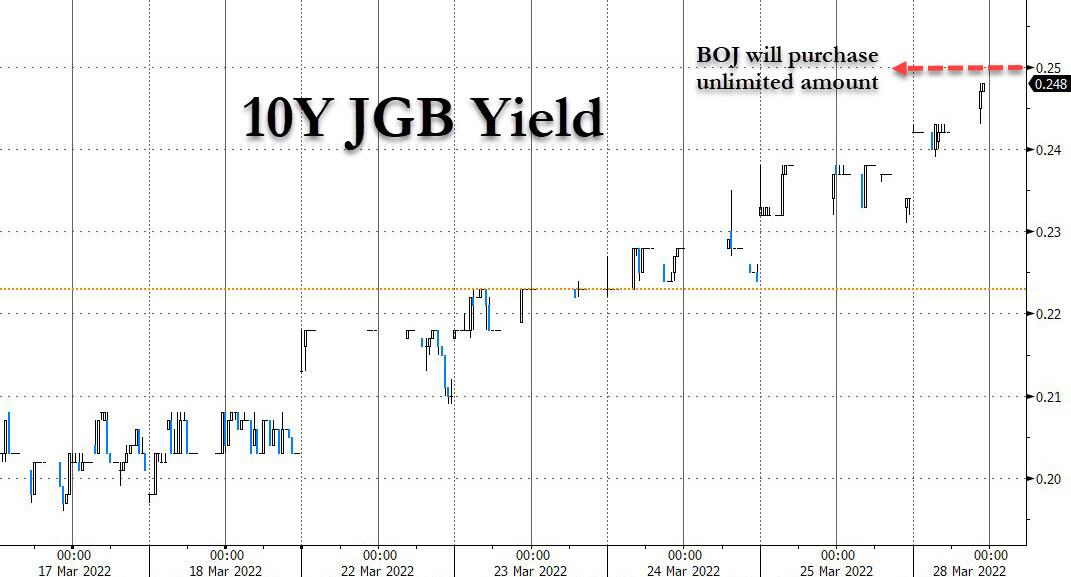
... Kuroda did just that and it was to keep JGBs in line while risk an accelerating collapse in the yen.
On Monday morning, one day after the BOJ left many stunned with its refusal to announce an open-ended bond market intervention as yields spiked, the central bank changed its mind and conceded that it was not willing to risk a bond market collapse, announcing that it will purchase an unlimited amount of 10-year bonds at a fixed rate of 0.25%.
The decision comes as interest-rate hikes by major peers such as the Federal Reserve have sent yields across the globe soaring, adding upward pressure on Japan yields. The 10-year yield stood at 0.242% at 10:23 a.m. in Tokyo, compared to a tolerated level by the BOJ of 0.25% under its yield-curve control policy.
And while JGB yields will remain at or below 0.25% (for now) courtesy of the BOJ's verbal intervention which however failed to actually prompt any actual trades...
  • *BOJ SAYS NO BIDS TENDERED FOR FIXED-RATE BOND-BUYING OFFER
... the same can not be said of the Yen which fell to a fresh 6-year low of 123.11 against the U.S. dollar, with little stopping the USDJPY rising as high as 130.
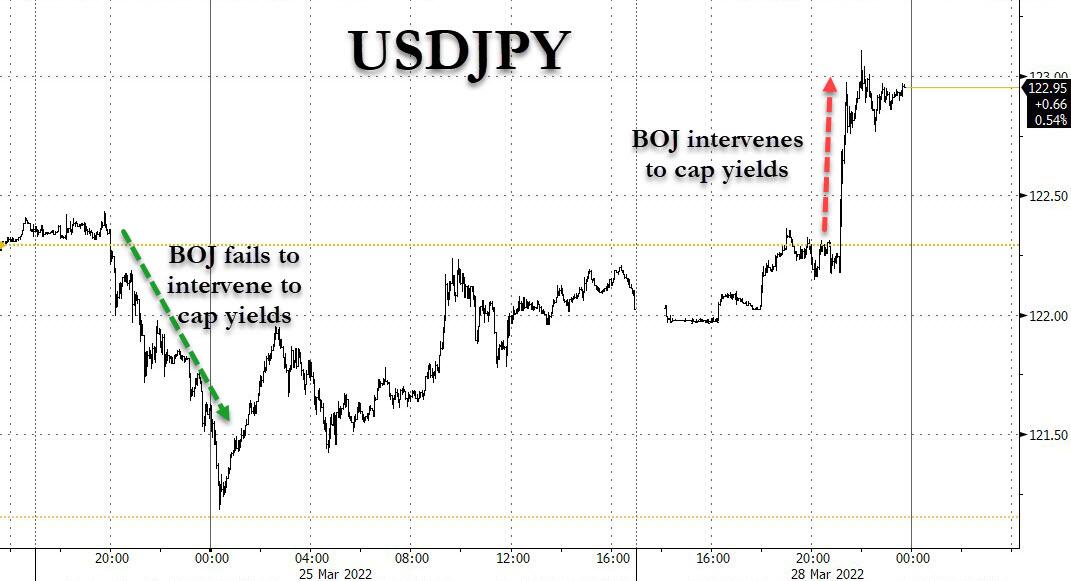
The move underscores the central bank’s commitment to keep monetary settings loose, following Governor Kuroda’s earlier remarks that policy will remain unchanged even if inflation jumps. Japan’s bond yields have been moving higher after the BOJ’s fixed-rate buying offer on Feb 14 - the first such operation since 2018 - helped push them lower.
Meanwhile, the dilemma facing the BOJ grows: the growing policy divergence between the BOJ and the Fed has heaped pressure on the yen, with the currency slipping to a six-year low against the dollar in March. Of course, by failing to keep a floor under the yen, the BOJ invites even higher inflation, which will - sooner or later - force the BOJ to break, and when it does it will lose control over both the yen and JGBs.
“The BOJ will automatically conduct such operations when the 10-year yield approaches 0.25%, as waiting for the yield to rise past that would invite unnecessary speculation and also prompt players to test yield upside,” said Takafumi Yamawaki, head of local rates and currency research at JPMorgan in Tokyo. “The BOJ probably separates bond purchases from risk of a weaker yen as changing its stance on bond purchase operations would undermine the current yield curve control framework.”
Meanwhile, much of the "developed" world tightening (with the sole exception of China), traders had been speculating that the BOJ will also have to start normalizing policy at some point. However, clearly that time is not now and Kuroda has repeatedly ruled out the possibility of near-term policy adjustments. Providing a modest buffer, Inflation in Japan is also far from a 2% target, unlike other countries where red-hot price gains have stoked concerns.
Meanwhile, the collapse in the yen is set to accelerate. As Bear Traps Report Larry McDonald reminds us, by collapsing to levels last seen in 2015, the Yen's freefall has reignited fears of a re run of events that led to the 2015 renminbi devaluation. In a recent note from last week, SocGen's Albert Edwards called this "an earthquake in the world of foreign exchange." So as Japan weakens the Yen to save the economy China is the loser and could force it to pursue another currency devaluation in a beggar they neighbor world.
This, as McDonald writes, is bullish hard assets; how can the Fed get aggressive into that? JPY weakness likely has the most negative impact on South Korea within emerging markets and won’t make China happy either.
Finally, McDonald quotes a CIO from a Florida based hedge fund, who writes that "I'm in the camp that the Yen move is a big deal. This is what happens when money printing goes too far... Zervos at a dinner this week in Miami said he thinks BOJ stays easy and has to ... he sees the USD/Yen at 130 by year end. This would make Japan very competitive very quickly, what will that mean for emerging markets?"
And more importantly, what does that mean for China and its untenably strong currency. We are about to find out.

FT : Shanghai imposes lockdown as officials struggle to contain Covid outbreak

Shanghai imposes lockdown as officials struggle to contain Covid outbreak
China’s financial centre hit by panic buying ahead of public transport shutdown and mass testing

Shanghai pushed ahead with a stringent lockdown on Monday that will divide China’s biggest city into two zones, as authorities struggled to stem record coronavirus cases in the country’s most important financial centre.

The government will shut down public transport this week as it conducts mass testing across Pudong, the city’s financial district, located east of the Huangpu river. Similar restrictions will apply from April 1 to the district of Puxi, west of the river.

The measures, which marked the first time authorities in Shanghai have imposed a lockdown that confined residents to their homes, sparked panic-buying across the city as shoppers rushed to stock up on vegetables.

The outbreak in mainland China’s most international financial centre is proving a big test for the country’s wider strategy to contain coronavirus. Authorities have instituted severe restrictions on other cities to eliminate outbreaks, although recently there had been signs that the approach was being tempered.

President Xi Jinping this month emphasised the need to “minimise the impact” of the virus on the country’s economy after southern tech hub Shenzhen was locked down. In Shanghai, authorities had indicated that a full-scale lockdown was not necessary a few weeks ago, although buildings with positive cases were often sealed off.

Some factories in China have set up isolated “bubble” systems, an approach comparable to the closed system employed for the Winter Olympics in February, which allowed staff to work during lockdowns as long as they did not leave the premises.

Shanghai, with a population of 26mn, recorded just 50 symptomatic cases on Sunday, according to official data, but notched a record 3,450 asymptomatic cases, compared with 5,134 asymptomatic cases across the rest of mainland China.

Over the weekend, the Shanghai World Expo and Exhibition Centre, a vast building in the Pudong district that hosted the Shanghai World Expo in 2010, was opened as a quarantine centre for mild and asymptomatic cases.

The city’s response to the outbreak contrasts with that taken in Hong Kong, which has recorded more than 1mn cases over the past two months after being largely free of infections for almost two years. Plans for mass testing in the territory, which also sparked panic buying, have been downplayed recently given the sheer scale of infections.

China’s stock market started the week lower following news of the lockdowns in Shanghai, with the country’s benchmark CSI 300 index falling as much as 2 per cent on Monday morning as traders weighed the implications for the country’s broader strategy.

“In the near term, China will stick to its zero-tolerance approach,” said Bruce Pang, head of research at China Renaissance. He added that while supply chain shocks had been minimal, the outbreaks would probably weigh on economic growth as Chinese consumers grappled with greater uncertainty.

Pang said that official statements, including from the latest meeting of the Chinese Communist party’s politburo, “imply any adjustment [to containment strategies] will come with the precondition of eliminating infection”. 

>>> What to look at today - 28th of March 2022

Sovereign bonds and U.S. equity futures fell Monday as economic risks from inflation and tightening monetary policy sapped sentiment. A key section of the Treasury yield curve inverted, stoking fears of a growth downturn.  The U.S. 10-year Treasury yield climbed past 2.5%, above a technical trendline that has served as a ceiling since the late 1980s. The yield on the five-year note rose above the 30-year -- an inversion that’s heralded recessions in the past, and raises concerns about a policy misstep as the Federal Reserve hikes interest rates. S&P 500 and Nasdaq 100 contracts dipped and those for Europe climbed as investors also monitored Russia’s war in Ukraine, now in its second month. Asian shares were mixed, with a technology rally bolstering Hong Kong.  China’s mobility curbs to stem a Covid outbreak weighed on crude oil. West Texas Intermediate slid to around $110 a barrel as a Covid-linked lockdown in Shanghai stirred concerns that China’s virus resurgence imperils oil demand. The yen declined after the Bank of Japan said it will purchase an unlimited amount of 10-year bonds at a fixed rate to check yields. The dollar rose. The war continues to disrupt supplies of key commodities, stoking inflation risks that are contributing to expectations of more aggressive Fed tightening. Traders are pricing in two full percentage points of Fed rate rises over the rest of 2022. Mobility restrictions in China may fan worries about rising costs. In cryptocurrencies, Bitcoin scaled $46,000 following a recent rally that’s enabled the digital token to erase losses and turn positive for the year.

Nikkei -0.55% Hang Seng +1.19% CSI -0.80% Shanghai -0.17% Shenzen -0.88%

Eur$ 1.0951 CNH 6.3919 CNY 6.3755 JPY123.10 GBP 1.3143 CHF 0.9338 RUB 99.4909 TRY 14.8355 WTI$110.30 -3.20% Gold 1,941.40 -0.96% BTC 47,250 +2.40% ETH 3,330 +2.85%

S&P -0.42% Nasdaq -0.58% EuroStoxx +0.16% FTSE +0.07% Dax +0.11% SMI +0.04%

Macro :
- Moscow Exchange to Expand Limited Trading to All Stocks Monday
- IPO Market Plunges 70% as Higher Rates, War Curb Risk Appetite
- Stocks Defying Bond-Market Danger Put Wall Street On Notice
- Kaspersky, China Telecom, China Mobile Added to FCC Threat List
- Roth Sees 95% Chance U.S. Opens China Solar Import Investigation

Keep an eye on :
- AED BB : Aedifica Buys German Care Home for About EU7.5m at 5% Yield
- ALTA FP : Primonial Shareholders Sue Altarea After Deal Dropped: Echos
- AMUN FP : Amundi Sets Up Equity Capital Markets Desk to Capture More Deals
- AAPL US : Apple Pays Another Round of Rare Bonuses to Some Staff
- CS FP : AXA Halts Insurance Deals on Russian-Owned Assets in Russia
- BATS LN : Scottish Widows to Exit Investment in Some Tobacco Firms: Times
- BAYN GY : Temasek Is Said to Push for Removal of Bayer CEO Werner Baumann
- BPT LN : Bridgepoint Acquires Majority Stake in U.K.’s Inspired Thinking
- IAG LN : British Airways Slows Flight Ramp-Up on New-Hire Logjam
- CPRI US : Versace Owner Capri Looking at Isabel Marant: Miss Tweed
- CSGN SW : Credit Suisse Pressured Over Absolving Execs on Greensill: FT
- ELM LN : Chemical Maker Elementis Said to Explore Sale of Chromium Unit
- ENG SM : Enagas, Omers to Sell Respective Stakes in Chile’s GNL Quintero
- ENGI FP : France to Build New LNG Terminal in Le Havre: Echos
- EVD GY : CTS Eventim-Kapsch JV Wins Germany Compensation Arbitration
- INPST NA : InPost Is Said to Draw Takeover Interest From Buyout Firms
- INSTA NO : Lunar to Buy Instabank for NOK3.75/Share in Cash
- KORI FP : France's Korian to Launch Shareholding Operation for Employees
- 3690 HK : Meituan Shares Surge as Much as 14% After Earnings Report
- NG/ LN : Macquarie Buys Stake in National Grid’s $13 Billion Gas Unit (1)
- QFUEL NO : Quantafuel Reaches Proof of Concept for Skive Recycling Plant
- RLF SW : Relief’s APR: Data Shows Possible Benefits for PKU Treatment
- RR/ LN : Rolls-Royce Shares Jump After Betaville ‘Uncooked Alert’ Mention
- SPM IM : Saipem Said to Be in Talks With KCA Deutag on Onshore Asset Sale
- UHR SW : Low-Priced Omega Speedmaster Prompts Global Swatch Store Chaos
- TIT IM : Telecom Italia Says Talks With KKR Still On, Received CVC Offer
- TIT IM : CVC Is Said to Bid for Stake in Telecom Italia’s Enterprise Unit
- TTE FP : France to Build New LNG Terminal in Le Havre: Echos
- UCB BB : UCB’s Fintepla Oral Solution Gets U.S. FDA Approval

>>> Europe : Brokers Upgrades & Downgrades - 28th of March 2022

>>> Up
* BASF Raised to Buy at HSBC; PT 65 euros
* Moonpig Raised to Add at Peel Hunt; PT 300 pence
* Temple Bar Investment Trust PLC Raised to Buy at Investec
* VIB Vermoegen Raised to Buy at SRC Research; PT 51 euros

>>> Down
* Heineken Cut to Underweight at Barclays; PT 81 euros

>>> Initiation
* Hertz Rated New Buy at Tigress; PT $32
* MorphoSys Reinstated Buy at Berenberg; PT 65 euros

>>> Call
* Solid Cash Flow, Low Leverage Boost European Cash Returns, M&A

FT : Zelensky says Ukraine ready to discuss neutrality in talks with Russia

Zelensky says Ukraine ready to discuss neutrality in talks with Russia

Ukraine is ready to declare neutrality, abandon its drive to join Nato and vow to not develop nuclear weapons if Russia withdraws troops and Kyiv receives security guarantees, President Volodymyr Zelensky has said.

Zelensky told Russian independent journalists yesterday that Kyiv was prepared to meet some of Moscow’s demands on the condition that the changes were put to a referendum and third parties promised to protect Ukraine. He said his main goal was to end the war as quickly as possible.

Washington, meanwhile, denied that it was seeking to overturn Vladimir Putin’s regime after Joe Biden appeared to call for the Russian president’s ousting in a speech in Warsaw on Saturday, saying: “For God’s sake, this man cannot remain in power.”

The US president’s increasingly vitriolic descriptions of Putin have raised concerns that Washington is losing control of its message. Biden also warned democracies of a “long fight ahead” to protect freedom in Europe.

FT : Oscars ceremony delivers drama as Will Smith slaps Chris Rock

Oscars ceremony delivers drama as Will Smith slaps Chris Rock
Netflix hopes dashed as Apple’s ‘CODA’ becomes the first Best Picture winner for a streaming service


Will Smith slapped Chris Rock after the comedian a joke about Jada Pickett Smith, Smith’s wife © Chris
After the miserable ratings of last year’s coronavirus-tainted Oscars show, the Academy of Motion Picture Arts and Sciences looked for ways to speed up the ceremony and reconnect with the zeitgeist.

Sunday’s broadcast of the Oscars certainly succeeded in making headlines — though not in ways the Academy could have expected — after an extraordinary moment when the actor Will Smith charged the stage and slapped comedian Chris Rock. Rock had made a joke about Smith’s wife, Jada Pickett Smith, who has a shaved head and has spoken publicly about her hair loss.

In the US, audio was cut from the broadcast as Smith yelled profanities at Rock after returning to his seat. Later in the show, Smith won the Best Actor award for his performance in King Richard and gave a long, rambling speech in which he called himself “a fierce defender of his family”. The actor also apologised to the Academy, but not to Rock.

Going into the ceremony, the focus was on the contest between Apple and Netflix, which were vying to become the first streaming service to win the Best Picture award. Both had spent tens of millions of dollars campaigning for the Oscar, which would send a strong message to filmmakers and A-list actors about the ability of tech groups to deliver Hollywood’s top prize.

In the end, CODA, Apple’s first-ever Oscar nominee, emerged as the Best Picture winner. It was the first film to win the top Oscar after debuting at Sundance, the independent film festival, and as with other streaming nominees, was released in a limited number of cinemas to qualify for the award. CODA also earned the Oscars for Best Adapted Screenplay and Best Supporting Actor.

The win by Apple, the world’s most valuable company, will be seen as deeply symbolic in Hollywood, where traditional studios have been disrupted by streaming services.

It also came after a tumultuous year for the industry. Not only did Covid-19 weigh heavily on cinema attendance, but 2021 marked a moment when the financial underpinnings of the film business began to unwind. Big film studios, including Disney and Warner Bros, released movies directly on to their streaming services instead of allowing an exclusive run in theatres, threatening the performance-related bonuses that top talent have come to expect.

This has created tension in Hollywood between the studios, which view streaming as the future of the industry, and directors, producers and actors

Netflix, the streaming industry pioneer, had been the favourite at this year’s Oscars with The Power of the Dog, which entered the ceremony with 12 nominations after enjoying a strong run at the Golden Globes. Netflix also had a Best Picture nominee in the political satire Don’t Look Up, starring Leonardo DiCaprio and Jennifer Lawrence.

But The Power of the Dog took home only one Oscar, with Jane Campion winning the award for Best Director.

In contrast with Apple, a relative newcomer to streaming, Netflix has worked for years to enter Hollywood’s bloodstream. Ted Sarandos, its co-chief executive, serves as the head of the Academy Museum, which opened last autumn to great fanfare. The company also waged an expensive campaign for its first Best Picture nominee, Roma, in 2019.

Some Academy members have blamed the ceremony’s rating decline — only 10.4mn Americans watched last year’s awards, a 56 per cent drop from a year earlier — on a failure to nominate commercially popular films. But Dune, which has taken in more than $400mn, was the biggest winner of the night, with 10 awards.

(ZH) Nava Capital: Fasten Your Seat Belts

Nava Capital: Fasten Your Seat Belts

Submitted by Damien Cleusix of NAVA Capital
Why we have never felt more bearish in our 25 years career.
The background:
Households and non-financial companies’ health are deceiving. First you must analyze the distribution. Few households own an incommensurate share of assets and few companies earn an incommensurate share of profits. The asset side of both balance sheet contain many items whose valuation are in unchartered territory so every debt to asset ratios looks good by definition. Don’t be fooled.
One of the poster children of increasing debt for the purchase of existing capital is buybacks and M&A. While both can be justified when they are done in a price sensitive, opportunistic way, today’s binge buying cannot be justified (https://corpgov.law.harvard.edu/2020/10/23/the-dangers-of-buybacks-mitigating-common-pitfalls/).
Buybacks and dividends are not yet siphoning 100 % of operating earnings (https://www.yardeni.com/pub/bbdivepsyield.pdf) but remember that earnings have been pushed way above trend thanks to the huge recent fiscal deficits which are now waning ().
Buybacks are one of the current best example of passive, value agnostic, buying activity pushing the markets higher.
To the Passive, value agnostic buying and selling, we also have to had risk-parity and other target volatility strategies and trend following. All of them also bolstered by the rise of the robot advisors.
The explosion of option trading where the notional traded in options is now surpassing the trading in the stock markets has add also profound implications in sustaining the current boom (https://www.zerohedge.com/markets/shocked-goldman-trader-admits-after-following-market-18-years-i-could-never-imagine-typing) If buying such large amount of extremely short-term options is not market manipulation then what is?
A final point to consider (and we are not exhaustive we know…) is the fact that households have embraced the stock market again, big ways. Households have increased their share of the overall stock market by USD 1.6 Trillion in 2021 (in comparison the whole Hedge Fund US equity holding is 2.3 trillion)!
Some people (SPACs?) have taken advantage (literally) of this.
OK now enough for the background and let’s look at what has been happening recently
  • In November, our LT warning models (we have many of them) triggered sell signal one after the other. We ended up with a total which was making the other historical precedent (beginning of 2000, Summer 2007, Spring 2015, September 2018 and December 2019) look trivial.
  • Since the start of the year we have witnessed a flurry of +1% and -1% days. When we see such concentration of volatility after a long period of calm, the probability is high that we have entered a cyclical bear market.
  • The Fed which has been the chief enabler of the current massive bubble seems to understand that it is now cornered and won’t be able, as long as inflation remains high, to offer the now expected Fed put anytime soon. J. Powell even said that it could continue to raise rate in a recession if inflation remains sticky. The Fed restrictive policy will not be limited to aggressively raise rate but with an accelerated Quantitative Tightening. We doubt that it will deliver everything the market expect if a cyclical bear market materialize but the damage to investors psychology would be large enough that even a reversal would not save the market immediately.
  • This brings us to the recession debate. While our recession indicators have yet to flash a definitive signal, most of them are very close to trigger. Given what we have said about the Fed above and the fragility of the markets, our guess is that the lead time of those indicators will be shorter than what they have been historically and the recession could well start in 2022 in the US. It is significant because bear markets tend to be much more severe when a recession occurs (https://www.yardeni.com/pub/stmktsp500recess.pdf)
We have now entered the buyback blackout period where opportunistic buybacks are not allowed.
At the same time the S&P 500 has staged an impressive rebound from last week low and yet we are still seeing more 52 weeks new lows than highs. This (almost) only happen in bear markets.
Given the quarterly bonds and equities relative performance we should witness some sizable rebalancing towards bonds (even if bonds increased volatility could make it less sizable than some commentators are expecting).
With the S&P 500 slightly more than 5% below its all time high we see it as a perfect opportunity for those who haven’t yet done so to aggressively de-risk their portfolio.

>>> Russia oligarch and Rusal owner Deripaska: 'These' people preparing to fight

Russia oligarch and Rusal owner Deripaska: 'These' people preparing to fight for a few more years as all participants in the conflict have at least 2 more years before the next election
- Personally, it always seemed to me that this particular armed conflict is madness (for which we will be ashamed of it for a long time before our descendants) could have been ended three weeks ago through reasonable negotiations.
- Now some hellish ideological mobilization is taking place from all sides.