FT : Can US natural gas relieve Europe from Russian supply dependency?

Can US natural gas relieve Europe from Russian supply dependency?
Moves to provide LNG face short and long-term obstacles in terms of infrastructure and shift to clean energy

The US and EU last week announced a breakthrough deal to wean Europe off Russian natural gas. The “groundbreaking” pact, said Joe Biden, would strip Vladimir Putin of the ability to “coerce and manipulate” the continent’s energy consumers.

The “joint game plan” involves three steps. First, the US will help the EU secure short-term liquefied natural gas supplies to begin displacing Russian gas. Second, Europe will work “toward the goal of ensuring” a bigger market for US gas by 2030. Third, the US would help Europe accelerate its transition to clean energy, eventually reducing its gas demand.

How much more gas has the US offered?
The US said it would strive to add 15bn cubic metres of liquefied natural gas to the EU this year, with more in years to come. It did not specify the origins of the gas, noting it would “work with international partners”.

By comparison, Russia currently exports 155bn cubic metres a year of gas to the EU.

The baseline for the pledged 15bn is not clear. But the US shipped about 22bn cubic metres of gas to Europe in 2021 and has already sent 10bn in the first quarter of this year, according to Refinitiv. All of it is in the form of LNG, gas that has been condensed so it can be carried on a ship.


Some extra US supplies will come from a recently opened export project in Louisiana, the Calcasieu Pass plant. But these volumes were already expected in the market, and plants elsewhere along the coastline are operating at maximum capacity.

So for now, any extra LNG will have to be coaxed to Europe via higher prices, diverting ships originally bound elsewhere. That could prove painful for consumers.

“Any incremental LNG cargoes sent from the US to Europe are more likely a redirection of existing US LNG cargoes — and hence will do little in terms of material ‘price relief’,” said Bank of America.

How can the US get other LNG supplies to Europe?
Most US LNG contracts are not necessarily restricted to a particular destination. So if prices remain high enough in Europe, shippers may keep redirecting cargoes there.

And if the EU succeeds in replacing the roughly 15bn cubic metres of LNG that it currently imports from Russia — a much smaller amount than is imported through pipelines — those seaborne Russian cargoes could in turn flow to other places.

“A big reshuffling is about to happen,” said one industry executive, referring to this possibility.

This is part of the Biden plan. Jake Sullivan, the president’s national security adviser, said the administration would rely on a “cargo diversion strategy”.

But commercial terms still make this plan tricky.

“I think in the shorter term, it’s going to be fairly tough,” said Inosi Nyatta, a partner at law firm Sullivan & Cromwell. “Maybe they’ll have some sort of incentive regime where they incentivise the sellers to renegotiate.”

The US tack to date has been to lean on governments — in big importing countries such as Japan or South Korea, but also in Qatar, which sits with the US and Australia in the top tier of LNG exporters. Freeing up yet more cargoes will “involve a lot of diplomacy”, said a senior administration official.

Does Europe have infrastructure to receive more seaborne gas?
Yes, but not in the right place. Eastern Europe and Germany are most dependent on Russian gas. But most of the available LNG regasification infrastructure is in southern Europe.

Germany has proposed building new terminals to receive LNG, or renting regasification vessels that can float offshore. Either way, the shift from pipeline dependency to LNG dependency will be expensive and take time.

Investors in costly new import terminals — whether taxpayers or capital markets — will need assurances that a transition to cleaner energy won’t simply render these fossil fuel assets worthless in a decade’s time.

Does the LNG pact compromise US climate commitments?
The White House’s promotion of LNG has been welcomed by American fossil fuel producers, which even before Russia’s invasion of Ukraine were touting these exports as a “green initiative” that would allow Asian importers to burn natural gas instead of coal to make electricity.

It is also a huge shift for the EU, which was growing more hostile to gas even before the invasion.

“This is a U-turn from previous EU purchasing decisions as many buyers had stopped negotiating with US developers for LNG due to ESG [environmental, social and governance] concerns,” said Sindre Knutsson at Rystad Energy, a consultancy.

Environmentalists were scathing. “Allowing for the expansion of new and expanded gas export facilities would lock in decades of reliance on risky, volatile fossil fuels and spell disaster for our climate,” said Kelly Sheehan at the Sierra Club.

What about the longer run?
Biden and Ursula von der Leyen, European Commission president, also discussed a bigger plan for the US to ship 50bn cubic metres a year of more LNG to Europe by 2030.

This is feasible on paper. According to the investment bank Cowen, the US government has approved a dozen export projects with a total capacity of 206bn cubic metres a year — about twice current US capacity.

But LNG plants cost billions of dollars and take years to build, and no one expects all 12 of the projects to go ahead. Developers and their financial backers typically want contracts with purchasers — some lasting 20 years or more — before they start ploughing cash into projects.

In its statement with the White House, the European Commission said it would work “toward the goal of ensuring” demand for 50bn cubic metres of US gas — an apparent concession to the LNG industry’s anxieties about future demand.

At the same time, US officials were clear that the longer-term aim was still to stop using fossil fuels, including LNG.

“The true path to energy security runs through clean energy,” said a senior administration official. “The first part is getting Europe off Russian gas. The second part is getting Europe off gas altogether.”
FT : ‘Don’t confuse patriotism and Nazism’: Ukraine’s Azov forces face scrutiny

‘Don’t confuse patriotism and Nazism’: Ukraine’s Azov forces face scrutiny
Nationalist regiment has been instrumental to the country’s resistance to Russia’s invasion

From what looked like a basement in the besieged port city of Mariupol, a deputy commander of the nationalist Azov Regiment, a part of Ukraine’s National Guard that Russia has described as “neo-Nazi”, wanted to make something clear.

“You have to understand what Azov is. These are the men who, for the most part, took arms because we were attacked by Russians,” said the stocky bearded fighter, identifying himself only by his nom de guerre Kalyna, in a post on the Azov Regiment’s Telegram channel. “I ask you not to confuse the concepts of patriotism and Nazism,” he added.

The infantry unit was created in 2014 by volunteers with nationalist and often far-right political leanings to fight separatists in eastern Ukraine. But, as Russia’s invasion enters its second month, the regiment has been key to the nationwide resistance effort, with prominent roles in key battles in Kyiv, Kharkiv and, mainly, Mariupol.

Andriy Biletsky, a founding commander of the Azov forces and a former MP under its splinter political wing, the National Corps, told the Financial Times by telephone from Kyiv that “they are the spine of Mariupol’s defences”, adding that there were about 1,500 Azov fighters in the city. “We are leading in the most serious battles,” he said.

Having started as a militia of just over 300 troops fighting Moscow-backed separatists, now “there are scores of thousands” of Azov fighters, said Biletsky. He added that most were serving within Ukraine’s territorial defence units, including more than 1,000 in Kharkiv. The interior ministry would not comment on the estimated size of Azov’s forces.

“Azov’s history is rooted in a volunteer battalion formed by the leadership of a neo-Nazi group. But it is certain that Azov depoliticised itself. Its history linked to the far-right movement is pretty irrelevant today,” said Anton Shekhovtsov, a Vienna-based Ukrainian expert on Russia’s connections to Europe’s far-right.

Most Azov fighters “are patriotic, many of them are nationalists. But the majority of Ukrainians today are nationalists”, said Biletsky. He claimed that many Ukrainians now looked up to “heroes” like Stepan Bandera, a nationalist leader who opposed both Nazi and Soviet efforts to prevent Ukraine’s independence.

Azov fighters count Israelis, Azeris, Georgians and even Russians in their ranks, according to Biletsky. They post videos of themselves attacking the enemy — blowing up Russian tanks or bundling tied-up and half-undressed Russian soldiers into a truck.

Its members and supporters shrug off the neo-Nazi label as “Russian propaganda”, especially after the repeated insistence of Vladimir Putin, Russia’s president, that he invaded Ukraine to “de-Nazify” the country.

“If we look at the actions of Russia, for example destruction on ethnic grounds of cities for being Ukrainian, it seems this more closely resembles the label of Nazism,” said Biletsky.

President Volodymyr Zelensky — who is Jewish and this month awarded the title of Hero of Ukraine to an Azov commander — on Monday said that in attempted peace talks Ukraine refused to discuss Russia’s wish for “denazification” and “demilitarisation”, which he called “completely incomprehensible things”.

“The way that Putin and the Kremlin use the terms ‘Nazism’ and ‘fascism’ is rooted in the Soviet era when, then and now, it means anybody who does not want to be either part of the Soviet Union or part of the Russian world,” said Taras Kuzio, a British-Ukrainian research fellow at the Henry Jackson Society, a think-tank.

Sergei Lavrov, Putin’s foreign minister, accused Azov troops at a shelled maternity hospital in Mariupol of “turning people into human shields . . . placing their attack equipment there and opening fire on the positions of Russian troops”. Ukrainian and US officials denied those claims.

“They are under constant fire from Russian propaganda because Russians don’t like the idea of a Ukrainian nation, they see that as a threat,” said Alex Kovzhun, a Kyiv-based consultant who helped develop the programme of Azov’s political wing. He said the National Corps’ ideology was akin to a “European rightwing conservative party, but it is definitely not ultra-right”.

He explained that Azov was formed of historians, football hooligans and men with military experience, some sporting “dubious tattoos” — including the Black Sun and the Wolfsangel used by the Nazis but now claimed as pagan symbols by some battalion members.

They first fought alongside a Ukrainian army which had been weakened by the pro-Kremlin presidency of Viktor Yanukovych and were incorporated into the national guard after they helped retake Mariupol in fierce battles in 2014.

“From the beginning I saw the unit as a part of Ukraine’s armed forces,” said Biletsky, who left Azov to run for parliament as elected officials cannot be in the armed forces.

In 2016, the UN documented that members of Azov embedded their troopers and weapons in civilian buildings in the Donbas region. Two years later, the US state department labelled the National Corps a “nationalist hate group” and linked it to a group that “attacked” an ethnic-Roma camp in Kyiv.

The political leanings of some Azov members have never been popular with most Ukrainians. The National Corps was part of a bloc with other far-right parties that received just over 2 per cent of the vote in parliamentary elections in 2019.

But liberal Ukrainians fear that the regiment may stand to benefit politically from its battlefield prowess. “Are these the kind of fascists we want to run our country after this war is over?” asked a linguist in Kyiv.

For now the political programme is taking a back seat. “Azov does not follow any political ambitions or goals during the war,” said Oleksandr Alfyorov, a historian and former spokesperson for Azov. The National Corps, he explained, had also “suspended political activities” because all active members had “now taken up arms or become volunteers”.

With Azov fighters vital to the war effort, its volunteers feel they are earning the support of Ukrainians who are more concerned about defending the country than political affiliations.

“Interest in our movement increased even before Russia’s open aggression,” said Serhiy Bevz, an Azov combatant in Kyiv, citing the regiment’s training of civilians in preparation for the conflict. “We are ready to defend our state from the occupiers with all our might.”

In his Telegram post, Kalyna, the deputy commander, said: “Patriotism is when you defend your country and don’t attack others.” Slamming Russian warmongers, he added: “We have never tried to seize foreign lands, but we have to confront the real Nazis of the 21st century. Slava Ukraini! [‘glory to Ukraine!].”

FT : Brussels calls for sanctioned oligarchs to lose EU citizenship

Brussels calls for sanctioned oligarchs to lose EU citizenship
So-called golden passport schemes allowed wealthy Russians permanent residency

Golden, no longer
The European Commission has had a long struggle with countries selling passports or offering permanent residency to wealthy investors in the country. Malta, Cyprus and Bulgaria in particular have come in the crosshairs during the past decade, though all of them have scrapped (or, in the case of Malta, suspended) the schemes by now.

Still, the commission yesterday issued a recommendation urging countries to fully abolish these regimes and even look into ways to revoke the citizenship or residency granted to the 30-odd Russian oligarchs who have been sanctioned by the EU in connection with Putin’s war in Ukraine, write Valentina Pop in Brussels, Eleni Varvitsioti in Athens and Peter Wise in Lisbon.

EU justice commissioner Didier Reynders said the schemes were in breach of the bloc’s treaties and posed security risks, as well as opened possibilities for corruption, money laundering and tax avoidance.

“All member states concerned should end their investor citizenship schemes immediately,” Reynders said. “In addition, they should assess whether they should revoke any ‘golden passports’ already granted to sanctioned individuals and others significantly supporting Putin’s war.”

In Cyprus, authorities confirmed that one sanctioned oligarch had previously acquired Cypriot nationality via its now defunct golden passport scheme that applied to people investing over €2mn in the country.

Russian agriculture billionaire Vadim Moshkovich, sanctioned by the EU and reportedly a beneficiary of the Cyprus golden passport scheme, fits the profile, but Cypriot authorities refused to confirm his name on privacy grounds. Moshkovich’s name was revealed in an Al Jazeera investigation in 2020 that obtained the records of the Cyprus golden visa scheme and led to street protests, high-level resignations and the abolition of the scheme.

When asked yesterday whether authorities would revoke the person’s passport, Cyprus president Nicos Anastasiades said “we will see”.

“Up until this point, Cyprus has fully supported [the sanctions regime based on] international law. Be sure that we will continue in the same direction,” Anastasiades said.

In Portugal, authorities are separately in the process of reviewing the naturalisation process of Russian billionaire Roman Abramovich, who has also been placed on the EU’s asset freeze and travel ban list because of his connections to the Kremlin.

Wealthy investors buying property in Portugal can be granted permanent residency in the country — and thus travel visa-free in the EU — but Abramovich acquired his Portuguese passport last year via a different process that enables the descendants of Sephardic Jews expelled from Portugal in the late 15th century to become citizens. He could still be stripped of it if the investigations disclose any wrongdoing.

Earlier this month, the Lisbon government altered its nationality legislation in relation to the descendants of Sephardic Jews, making it a requirement to demonstrate “a strong and lasting contemporary link to Portugal” in addition to Sephardic ancestry. This was “to prevent a generous and just law from being perverted by manipulation”, said Augusto Santos Silva, foreign minister in the outgoing government.

As a Portuguese passport holder, Abramovich cannot be prevented from entering the country, Santos Silva said. But he added that he was “very unlikely to do so” as EU sanctions meant he would be stripped not only of any assets he was found to own in Portugal, but also those he carried with him.

On its so-called golden visa scheme, Portugal has said that it only uncovered one pending application from someone in the sanctions list and suspended it. The residency scheme has been tightened and Portuguese authorities no longer issue those permits for Russian citizens. Of the roughly 430 Russian nationals who had already obtained permanent residency, none were on the sanctions list, according to Portuguese authorities.

In Sofia, the Bulgarian government is currently reviewing the roughly 200 golden passports already granted before the scheme was scrapped. “The sanctioned Russians are a clear case in point, I think their passports will be revoked faster,” said a Bulgarian official familiar with the matter.

And in Malta, a spokesman for the government yesterday said that no sanctioned Russian or Belarusian nationals had acquired Maltese citizenship under its currently suspended scheme.

Brussels’ renewed efforts to crack down on golden passports was welcomed in the north, with Sweden’s minister for integration and migration, Anders Ygeman, saying his government “has pushed for this” and that “people from outside the EU should not be able to buy civil rights in an EU country in exchange for money”.

>>> What to look at today - 29th of March 2022

Asian stocks rose Tuesday as a drop in oil and the prospect of more cease-fire talks between Russia and Ukraine helped sentiment. Bets on aggressive U.S. monetary tightening sapped shorter maturity Treasuries.  Shares climbed in Japan and Hong Kong but wavered in China. U.S. futures fluctuated and European ones advanced after the S&P 500 rallied for a third day. Oil extended a slide, taking West Texas Intermediate to about $105 a barrel, on concerns that China’s mobility curbs against Covid will sap demand. The U.S. 10-year Treasury yield edged up closer to 2.50%. Inversions along the bond curve, where some short-term rates exceed longer tenor yields, point to concerns about a looming economic downturn as the Federal Reserve hikes interest rates to quell high inflation.  The yen traded around a six-year low against the dollar on the divergence between the Fed and a dovish Japanese central bank. The latter continued with bond-market intervention to cap a surge in yields. Global shares are up about 8% from the lows reached after Russia invaded Ukraine. Such resilience contrasts with a rout in bonds and inverting yield curves, which are shaking economic confidence. Investors are trying to parse developments in the war, elevated commodity costs and the Fed’s fight against price pressures. Bitcoin traded above $47,000 after turning positive for 2022. The token’s rally is among the signs of improved appetite for speculative investments. US After Hours FDX +2.6% gets a new CEO; NEO -22.1% falls as CEO steps down, co lowers Q1 guidance; JEF +3.8% higher on earnings

Nikkei +0.78% Hang Seng +0.57% CSI +0.03% Shanghai -0.08% Shenzen -0.15%

Eur$ 1.0981 CNH 6.3839 CNY 6.3697 JPY 123.62 GBP 1.3091 CHF 0.9343 RUB 95.9740 TRY 14.8174 WTI$ 105.24 -0.67% Gold 1,923.18 +0.01% BTC 47,600 -0.75% ETH 3,400 -0.30%

S&P +0.24% Nasdaq +0.24% EuroStoxx +0.94% FTSE +0.60% Dax +0.95% SMI +0.44%

Macro :
- BlackRock Strategists Reduce European Equities on ‘Energy Shock’
- NATO Allies Are Split on Whether They Should Talk to Putin
- China Smartphone Stocks Drop on Apple Report; Xiaomi Sinks
- China Lockdowns Cost at Least $46 Billion a Month, Academic Says
- Billionaires, Private Equity Would See Tax Hikes in Biden Plan

Keep an eye on :
- YOU GY : About You Prelim 4Q Adjusted Ebitda Loss EU4M to EU15M
- AB FP : AB Science Fined EU1 Million for Publishing Key Information Late
- BAG LN : A.G. Barr FY Revenue Meets Estimates
- AAF LN : Airtel Africa CEO Carves Out Fiber Unit Ahead of Investor Hunt
- AAL LN : Anglo Looks to the Sea as Water Scarcity Hits Chile Copper Mines
- ANTO LN : Antofagasta CEO Sees Chile Averting Radical Changes to Mining
- MT NA : Four ArcelorMittal Plants Halted Due to Spanish Truckers Strike
- AT1 GY : Aroundtown Sees 2022 FFO I EU350M to EU375M
- BARC LN : Top Barclays Holder to Sell $1.1 Billion of Shares in Block Sale
- BAS GY : BASF’s Vassiliadis Says Russia Gas Cuts Would Halt Output: DLF
- CATE SS : WDP to Buy 9.09% Stake in Catena Through Directed Share Issue
- CLN SW : Clariant Wins 3 Petrochemicals Contracts For Lihuayi; No Terms
- CTEK SS : CTEK Holders Altor and Faustina Offers Up to 5.75m Shares: Terms
- DMP GY : Dermapharm Sees 2022 Revenue Up 10% to 13% Versus Prior Year
- FAST NA : Fastned FY Revenue Related to Charging EU12.4M Vs. EU6.25M Y/y
- HEM SS : Hemnet Share Sale By Holder General Atlantic Is Covered: Terms (8m shares)
- JEN GY : Jenoptik FY Dividend per Share EU0.25 Vs. EU0.25 Y/y
- MUL LN : Mulberry Sees Earnings Moderately Ahead of Expectations
- NESTE FH : Neste Studying Investment Into Waste Plastic Chemical Recycling
- NDX1 GY : Nordex 2022 Revenue Forecast Beats Estimates
- NOVOB DC : Novo Nordisk’s Ozempic 2.0 MG Approved in U.S. for Diabetes
- PFV GY : Pfeiffer Vacuum Sees 2022 Ebit Margin About 14%
- QDT FP : Quadient FY Ebitda Beats Estimates
- ROTH FP : Rothschild & Co. Names Javed Khan as Managing Partner Swatch Group: Mougahed Darwish to Retire on April
- SANN SW : Santhera, ReveraGen Start NDA Submission to FDA for Vamorolone
- SAN FP : Sanofi, IGM Biosciences to Develop IGM Antibody Agonists
- SOON SW : Sonova to Launch New 3-year Buyback Program of Up to CHF1.5B
- STLA IM : Stellantis to Cut Jobs at Illinois Jeep Plant Starting in May
- SAABB SS : Lockheed Beats Out Saab for $17 Billion Canada Warplane Fleet
- UHR SW : Swatch Group: Mougahed Darwish to Retire on April 1
- TEF SM : *TELEFONICA, DAZN SIGN EU1.4B SOCCER RIGHTS CONTRACT: EL CONFI
- UCG IM : UniCredit Backs CEO’s $2.7 Million Pay After Proxy Dissent
- WCH GY : Wacker Chemie Sees 2030 Sales Above EU10B
- WEW GY : Westwing Group SE Sees 2022 Rev. -12% to +3%

>>> Europe : Brokers Upgrades & Downgrades - 29th of March 2022

>>> Up
* Admiral Raised to Overweight at Barclays; PT 3,050 pence
* Bankinter Raised to Equal-Weight at Barclays; PT 5.50 euros
* Delivery Hero Raised to Neutral at Exane; PT 45 euros
* HelloFresh Raised to Outperform at Exane; PT 48 euros
* Kamux Raised to Buy at Handelsbanken
* Just Eat Takeaway Raised to Outperform at Exane; PT 40 euros
* Tullow Raised to Buy at Peel Hunt; PT 80 pence
* Valmet Raised to Buy at SEB Equities; PT 38 euros

>>> Down
* Direct Line Cut to Equal-Weight at Barclays; PT 323 pence
* Hapag-Lloyd Cut to Hold at Deutsche Bank; PT 305 euros
* Kuehne + Nagel Cut to Hold at Deutsche Bank; PT 300 Swiss francs
* Maersk Cut to Hold at Deutsche Bank; PT 22,500 kroner
* Royal Mail Cut to Sell at Deutsche Bank; PT 275 pence

>>> Initiation
* Alan Allman Associates Rated New Neutral at Oddo BHF
* AstraZeneca Rated New Buy at Goodbody; PT 11,250 pence
* GSK Rated New Buy at Goodbody; PT 1,950 pence
* J. Martins Rated New Neutral at Oddo BHF; PT 21.70 euros
* QuantumScape Rated New Neutral at SMBC Nikko; PT $20

>>> Call

(ZH) DoorDash Is Dominating The US Food Delivery Market

DoorDash Is Dominating The US Food Delivery Market

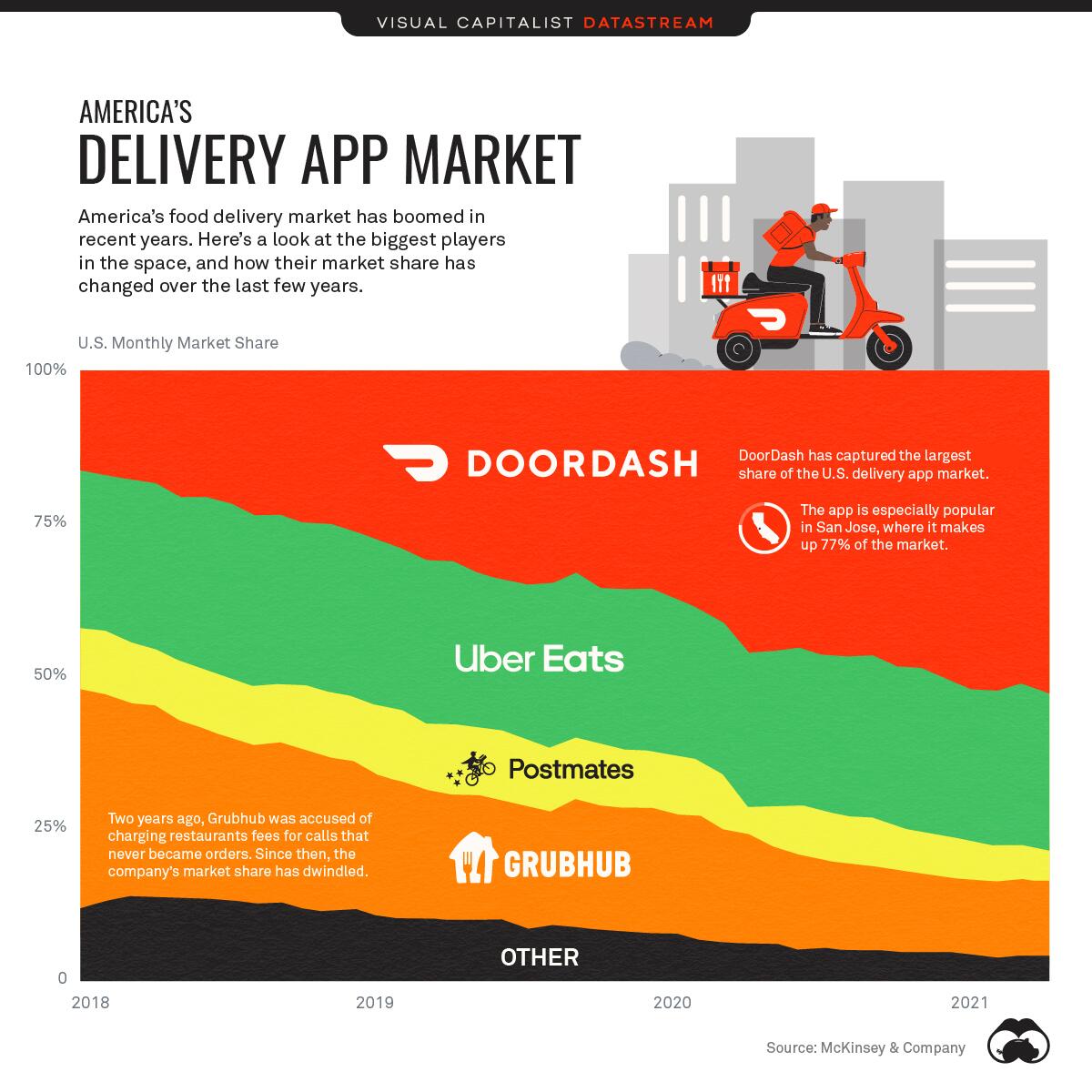
The food delivery app market in the U.S. is shifting from an oligopoly, where market control was shared amongst four companies, to more of a duopoly setting.
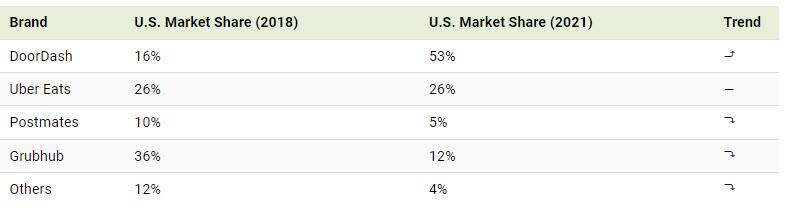
As Visual Capitalist's Carmen Ang details below, according to McKinsey & Company, two major players—DoorDash and Uber Eats—control close to 80% of the food delivery market as of 2021.
Here’s how the overall food delivery app market has shifted since 2018:

The Most Popular Food Delivery App in the U.S.
The COVID-19 pandemic has helped accelerate DoorDash’s rapid growth and market dominance. The food delivery company increased its market share from under 20% in 2018 to 53% in 2021.
As the world stayed indoors to weather the pandemic, the entire U.S. delivery app market grew 48.3% within the first couple months of 2020. And over the course of the year, DoorDash’s individual share of the market grew by about 12.5 percentage points, helping the company’s annual revenue to balloon from $0.85 billion in 2019 to $2.88 billion in 2020.
While an easy-to-use interface was a critical component of this success, many market analysts attribute DoorDash’s pandemic boom to a combination of superior customer data and brand positioning as an ally to struggling restaurants during the pandemic.
This success culminated in a widely-discussed IPO in December 2020, where in its first day of trading, DoorDash stock prices soared 86% to $190 per share.

DoorDash and Uber Eats Crowd Out the Competition
Throughout DoorDash’s growth, Uber Eats has remained their biggest competitor and maintained roughly 25% of the U.S. delivery app market since 2018.
These achievements have come at the expense of Postmates, Grubhub, and other smaller players, which have seen their market shares decrease substantially. It is worth noting that both Postmates and Grubhub have still seen increases in their annual revenue, in part due to the increasing size of the overall market.
That said, lesser-known platforms such as Delivery.com and ChowNow are decreasing in significance to the industry. As the delivery app market matures, control is increasingly consolidating in the hands of a smaller number of companies.

(ZH) "Sexual Get-Together": Rep. Cawthorn Says He Was Invited To DC Orgy, Has Wi

"Sexual Get-Together": Rep. Cawthorn Says He Was Invited To DC Orgy, Has Witnessed Lawmakers Doing Cocaine

Rep. Madison Cawthorn (R-NC) says that in the 14 months he's been in Washington DC, he's been invited to DC orgies and has witnessed lawmakers using cocaine, according to Just the News, citing the freshman lawmaker's recent appearance on the "Warrior Poet Society" podcast.
"I look at all these people, a lot of them that I’ve looked up to through my life, I've always paid attention to politics. Then all of the sudden you get invited to: 'Well hey we’re going to have kind of a sexual get together at one of our homes, you should come," said Cawthorn.
"I’m like: 'What did you just ask me to come to?" he continued. "Then you realize they are asking you to come to an orgy."
Link to Video :
Later, Cawthorn revealed that some of the very lawmakers who are "leading on the movement to try and remove addiction in our country" are on drugs themselves. "You watch them do, you know, a key bump of cocaine right in front of you and it’s like 'Wow, this is wild."

>>> US After Hours Summary: FDX +2.6% gets a new CEO; NEO -22.1% falls as CEO st

After Hoursaze Summary: FDX +2.6% gets a new CEO; NEO -22.1% falls as CEO steps down, co lowers Q1 guidance; JEF +3.8% higher on earnings

After Hours Gainers:

Companies trading higher in after hours in reaction to earnings/guidance: JEF +3.8%, DNA +3.8%

Companies trading higher in after hours in reaction to news: HBM +4.1% (provides annual reserve and resource update), FDX +2.6% (Raj Subramaniam to become new CEO), STNG +2.5% (enters into MoU with Carbon Ridge to develop onboard carbon capture), CWK +0.6% (to transfer business in Russia to local operator), RJF +0.5% (to acquire SumRidge Partners), AIG +0.2% (to rebrand Life & Retirement business as Corebridge Financial), BHLB +0.1% (expands partnership with FinTech firm Narmi to enhance its digital banking experience)

After Hours Losers:

Companies trading lower in after hours in reaction to earnings/guidance: AVAH -18.4%, ZEV -10.4%, PLAY -9.4%, LIDR -6.3%

Companies trading lower in after hours in reaction to news: NEO -22.1% (CEO steps down, co lowers Q1 revenue and EBITDA guidance), SKYH -3.8% (stock offering), SWX -1.9% (commences $400 mln common stock offering), ATER -1.6% (stock offering), BLL -1.5% (to reduce operations in Russia), AMBA -0.7% (names new CFO), NVO -0.4% (FDA approves 2.0 mg dose of Ozempic), LUV -0.1% (reaches tentative labor agreement with customer service employees union)

>>> US Close Dow +0,27% S&P +0,71% Nasdaq +1,31% Russell +0,00% VIX 19,62 -5,72

Closing Stock Market Summary

The S&P 500 gained 0.7% on Monday, as positive momentum and a hopeful-sounding geopolitical headline helped outweigh growth concerns. The Nasdaq Composite rose 1.3% while the Dow Jones Industrial Average rose 0.3%. The small-cap Russell 2000 (unch) finished flat.  

Eight of the 11 S&P 500 sectors closed higher, led by the consumer discretionary (+2.7%), information technology (+1.2%), and real estate (+1.3%) sectors. The energy (-2.6%), materials (-0.5%), and financials (-0.3%) sectors closed lower. 

Early on, the market was slowed down by growth concerns attributed to Shanghai announcing a two-phase Covid lockdown, The Nikkei reporting that Apple (AAPL 175.60, +0.88, +0.5%) plans to cut production of the iPhone SE and AirPods, the White House proposing tax increases in the FY23 budget, and the prolonged Russia-Ukraine situation.

The latter showed some progress in the afternoon after the Financial Times reported that Russia is prepared to allow Ukraine to join the EU as part of ceasefire talks as long as it doesn't join NATO. That report appeared to catalyze a late-session push, further supported by quarter-end rebalancing within the Nasdaq. 

While equities reacted positively, the growth concerns didn't necessarily go away. The cyclical sectors (except for the consumer discretionary sector) still underperformed, WTI crude futures still fell 6.5%, or $7.36, to $106.47/bbl, and the Treasury yield curve still flattened. 

The 2-yr yield rose five basis points to 2.34%, while the 10-yr yield decreased two basis points to 2.48%. On a related note, the $50 bln 2-yr note auction saw weak demand while the $51 bln 5-yr note auction was met with solid demand. 

The U.S. Dollar Index increased 0.4% to 99.14 amid relative weakness in the British pound (-0.7%) and Japanese yen (-1.5%). The yen fell after the Bank of Japan offered to buy an unlimited amount of JGBs at 0.25% as part of its policy to control the yield curve.

Separately, shares of Tesla (TSLA 1091.84, +81.20, +8.0%) jumped 8% after the company said it will ask shareholders to vote at this year's annual meeting to authorize additional shares for a stock split. 

Reviewing Monday's economic data:

  • The Advance report for International Trade in Goods for February showed a deficit of $106.6 billion, versus an unrevised $107.6 billion in January. The Advance report for Retail Inventories for February rose 1.1%, while the Advance report for Wholesale Inventories for February rose 2.1%.

Looking ahead, investors will receive the Conference Board's Consumer Confidence Index for March, the JOLTS - Job Openings report for February, the FHFA Housing Price Index for January, and the S&P Case-Shiller Home Price Index for February on Tuesday.

  • Dow Jones Industrial Average -3.8% YTD
  • S&P 500 -4.0% YTD
  • Russell 2000 -7.5% YTD
  • Nasdaq Composite -8.3% YTD