(ZH) Trading Houses Will Collapse As "Margin Call Doom Loop" Goes Global, Trafig

Trading Houses Will Collapse As "Margin Call Doom Loop" Goes Global, Trafigura CFO Warns

Sometimes repo guru Zoltan Pozsar is so far ahead of his time, it takes the "experts" weeks just to read up on all the required source docs to even grasp what he is talking about.
Last week we reported that the Bloomberg news that one of the world's largest independent energy merchants - the secretive Trafigura which trades hundreds of billion in commodities every year - was facing "margin calls in the billions of dollars" meant that the commodity "margin call doom loop" idea floated more than three weeks ago by Pozsar who warned that commodity traders and clearinghouses could be facing a liquidity crisis of historic proportions, was coming true and despite Barclays' earnest attempts to minimize its impact, could threaten broader financial stability and was manifesting itself in broad liquidity squeezes which could be observed in the surge in such unsecured funding markets as the FRA-OIS.
That was just the start, because the very next day Zoltan was proven correct again, after the FT reported that Europe’s largest energy traders have taken the place of Europe's insolvent banks in calling on governments and central banks to provide “emergency” assistance to avert a cash crunch as sharp price moves triggered by the Ukraine crisis strain commodity markets.
Yes, that's what happens when a "margin call doom loop" goes global.
The FT wrote that in a letter it had seen, the European Federation of Energy Traders, a trade body that counts BP, Shell and commodity traders Vitol and the margin-call stricken Trafigura as members, said the industry needed “time-limited emergency liquidity support to ensure that wholesale gas and power markets continued to function”.
“Since the end of February 2022, an already challenging situation has worsened and more [European] energy participants are in [a] position where their ability to source additional liquidity is severely reduced or, in some cases, exhausted,” EFET said in its letter, dated March 8 and sent to market participants and regulators.
It was "not infeasible to foresee . . . generally sound and healthy energy companies . . . unable to access cash", the letter warned, clearly ignoring that "generally sound" companies would have anticipated such a fat tailed scenario. The fact that they didn't suggests that they were either not "generally sound", or "healthy" and certainly did not plan accordingly. And yet somehow their stupidity and/or greed makes them eligible for Fed bailouts?
Days came and went, with nothing but silence from the central banks who perhaps ignored the severity of the coming liquidity crisis, and why not - after all most of the world's biggest commodity traders have more than one billionaire in their org chart, let them spend money to bail out their companies. But while this particular bailout request may have sounded too grotesque to both central banks and the general public, to the commodity firms the sudden margin-call induced liquidity shortage was all too real.
Fast forward to today, when in a follow up to its report from last week, the FT writes that according to Christophe Salmon, Trafigura’s chief financial officer, the crisis in global energy markets will force some smaller commodity traders out of business and unleash a wave of consolidation in the sector.
Salmon warned that the spike in capital needed to keep commodities flowing around the world since Russia invaded Ukraine would squeeze smaller trading houses out of the market.
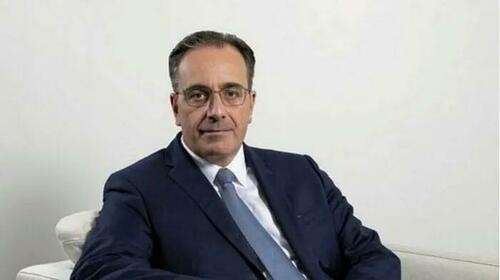
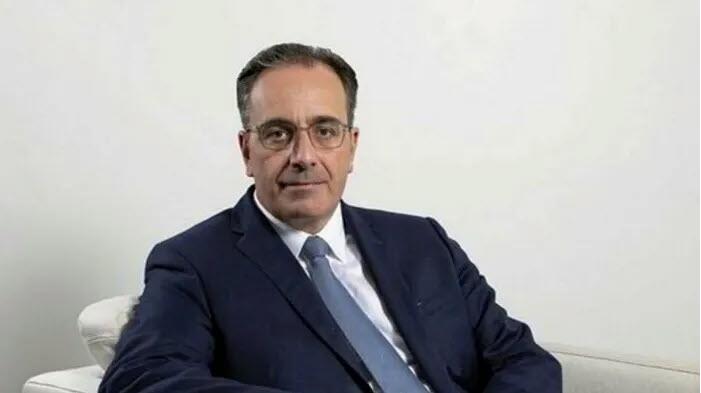
Christophe Salmon: ‘The barriers to entry to our sector as supply chain managers are increasing’
“When we go through these crises — and let’s not forget we’re getting out of two-and-a-half years of Covid situation — there will be another set of consolidation of the commodity trading sector,” Salmon told the FT Commodities Global Summit in Lausanne on Wednesday.
The global commodity trading sector is dominated by large groups such as Trafigura, Vitol and Gunvor but Salmon said many smaller traders were facing a multitude of problems from rising capital requirements to a lack of access to credit.
“The barriers to entry to our sector as supply chain managers are increasing,” he said.
Salmon's dire comments come as every day we see confirmation of Pozsar's worst case scenario, and amid the rising concerns about a liquidity crisis sweeping commodity financing, Europe’s largest traders continue to plea with banks and governments to offer “emergency” assistance to prevent a cash crunch as large swings in commodity prices push up the cost of trading. Of course, since these are independent trading houses which several years ago their paid-for lobbyists were trotted out to explain that they are not - in fact - systematically important, we fail to see how they could possibly make a case where taxpayer funds goes to bail out a handful of billionaires, when simple nationalization would do.
It is this worst case scenario that has prompted nothing short of panic among traders at the FT conference, who have voiced concerns that difficult conditions such as banks demanding hefty initial margins — cash for hedging future contracts — had contributed to a breakdown in the proper functioning of commodity markets, particularly gas and nickel.
Fears over hydrocarbon supplies from Russia, the world’s second-largest gas producer and third-biggest in oil, have rattled markets. Europe has yet to impose sanctions on Russian energy exports but banks, shipping companies, insurers and refiners are “self-sanctioning” and avoiding touching oil from the nation.
In a delightful irony, this is not the first time that commodity trading houses have been this close to collapse: back in 2013/2014 during their last near-death experience when Chinese commodity financing imploded and pushed trading giants such as Glencore close to collapse, the industry promptly trotted out its "paid for hire" mercenary consultant to draft white papers (even more ironically, the White Paper was commissioned by Trafigura) that the sector was not, in fact, too big to fail (the alternative would have been partial or complete nationalizations). Oh how they wish they could reverse on this optimistic take now.
So just to make sure that the message is heard loud and clear, Salmon said that if the commodity traders go down, they will drag the rest of the world with them, and that "ruptures to commodity financing would feed through to consumers."
“We are already in a vicious cycle on the futures market. I want to stress the impact that it will have on the physical market," he said.
"We are more and more engaged with governments in order to inform the governments of the likelihood of market disruptions, meaning stock-outs of certain products in certain regions."
Translation: watch for 1970s style lines at your local gas station, something that is probably taking place in Europe as we type: European gas prices jumped to more than €300 per megawatt hour this month before easing below €100, while Brent crude, the international oil benchmark, has risen 20 per cent since the invasion of Ukraine to $118 per barrel.
Furthermore, as discussed yesterday when we observed the coming diesel crisis, these same traders expect to have higher levels of working capital tied up with more barrels on the sea since Russian oil must travel further to Asian customers and replacement supplies for Europe must also spend more time in transit.
Salmon’s observation over the viability of smaller traders comes amid uncertainty over the future of Gazprom’s UK trading arm, which Boris Johnson’s government is on standby to put into “special administration”, a de facto nationalization. The unit is vital to the cheap supply of energy for many British industrial businesses.
And while Salon waits for some response from central banks, he isn't taking any chances and on Wednesday, Trafigura said it had closed a $2.3 billion revolving credit facility, adding to a $1.2 billion package arranged earlier this month and after exploring funding from private equity groups. As reported previously, Trafigura has also been holding talks with private equity groups to secure additional financing, although for now it appears that those talks haven't gone anywhere.
Trafigura aside, things among the trading giants are going from bad to worse: earlier today we reported that Mercuria Energy Group, a Swiss commodity trading giant, secured a $2 billion emergency credit facility from banks as commodities prices surge following Russia’s invasion of Ukraine. The credit facility, which was secured earlier this month, can be renewed or closed in six months time, Bloomberg reported, adding that trading houses have been seeking funds to maintain their physical and derivative positions as prices of everything from natural gas to metals soar. With markets upended and sanctions threatening to disrupt raw materials supplies, traders are facing a liquidity squeeze that could reshape the sector.
“We do have to size our activity and our risk appetite with our financing capability. It’s as brutal as that,” Frederic Barnaud, group chief strategy and commercial officer at Mercuria, said Wednesday in a panel discussion at the FT Commodities Global Summit in Lausanne.
Hilariously, the Geneva based Mercuria was facing a mini liquidity crunch not long after it posted a record profit in 2020 as it cashed in on wild swings in gas, power and oil markets during the pandemic. “You cannot be too hungry on profit and risk taking and not have the infrastructure and relationship with banks or other ways of capital forming to endorse your businesses,” said Barnaud.
The report prompted us to point out that between Trafigura, Gunvor, Mercuria, "every commodity trader hit with massive margin calls", explaining their desire to get some of that sweet, sweet central bank bailout money.
There was more turmoil elsewhere in the commodity world today. Qatar, the biggest shareholder of the world's best known commodity trader Glencore sold a stake worth $1.1 billion (the Qatar SWF is selling 159 million shares out of its stake of 1.22 billion shares). After the sale, Qatar will drop to 2nd largest holder in Glencore, and former CEO Ivan Glasenberg will climb to 1st.
Another commodity trading giant, Gunvor Group, a leading oil and liquefied natural gas trader, also rushed to shore up its liquidity saying that it may boost its equity by selling a stake, the latest sign of how volatile commodity markets are pushing trading houses to scour for new sources of capital.
Torbjorn Tornqvist, Gunvor’s chief executive officer and controlling shareholder, said that the company had reduced its trading volumes as a response to higher and more volatile prices. An equity partner would allow the company to grow, he said.
“For us to go and really, shall I say, exploit the potential of the company, it would be desirable to explore additional equity,” Tornqvist said at the Financial Times Commodities Global Summit. “We are open to find an alliance which could increase the size of the company.”
As we reported at the time, Gunvor was one of a clutch of large natural-gas traders facing huge margin calls in October, when prices spiked in Europe. The company has adapted its trading to accommodate higher and more volatile prices, it said this week.
“We are doing less volume than we normally do,” Tornqvist said on Tuesday. “In the right time, we can size this up in no time. This is our business model.”
Tornqvist took a majority stake in Gunvor in 2014, after co-founder Gennady Timchenko was sanctioned by the U.S. over ties to Vladimir Putin following Russia’s 2014 annexation of Crimea. Timchenko subsequently exited the company. The trader, based in Cyprus with major trading operations in Geneva, has repeatedly denied any connections to Russia’s leadership. In a statement this week, it highlighted that only 6% to 11% of its trading book over the past five years has originated in Russia, and said it was doing no new business in the country.
Tornqvist, who owns 88.4% of Gunvor, has been looking to reduce his stake for a number of years. In 2019, the company held talks about selling a stake to Algeria’s state oil and gas producer, Sonatrach. But the talks ended amid political upheaval in Algeria. The rest of the company is owned by other employees. Any potential equity partner would need to complement Gunvor’s existing business, and Tornqvist said he doesn’t intend to step back.
“I’m not in the market to sell out,” he said, confirming he was in the market to sell out, and if commodity volatility persists at the current pace for a few more months, all of his colleagues at the helm of the handful of giant commodity traders, will be doing the same. The question is whether there will be any buyers.

(ZH) Goldman: How China's COVID Lockdowns Could Disrupt Global Supply Chains

Goldman: How China's COVID Lockdowns Could Disrupt Global Supply Chains

As China continues to struggle with its worst COVID outbreak since the virus first emerged in Wuhan more than two years ago, one of the biggest questions on the minds of American companies (not to mention investors) is how badly the lockdowns ordered by the CCP will disrupt production in the country's factories, which form a critical link in the global supply chain.
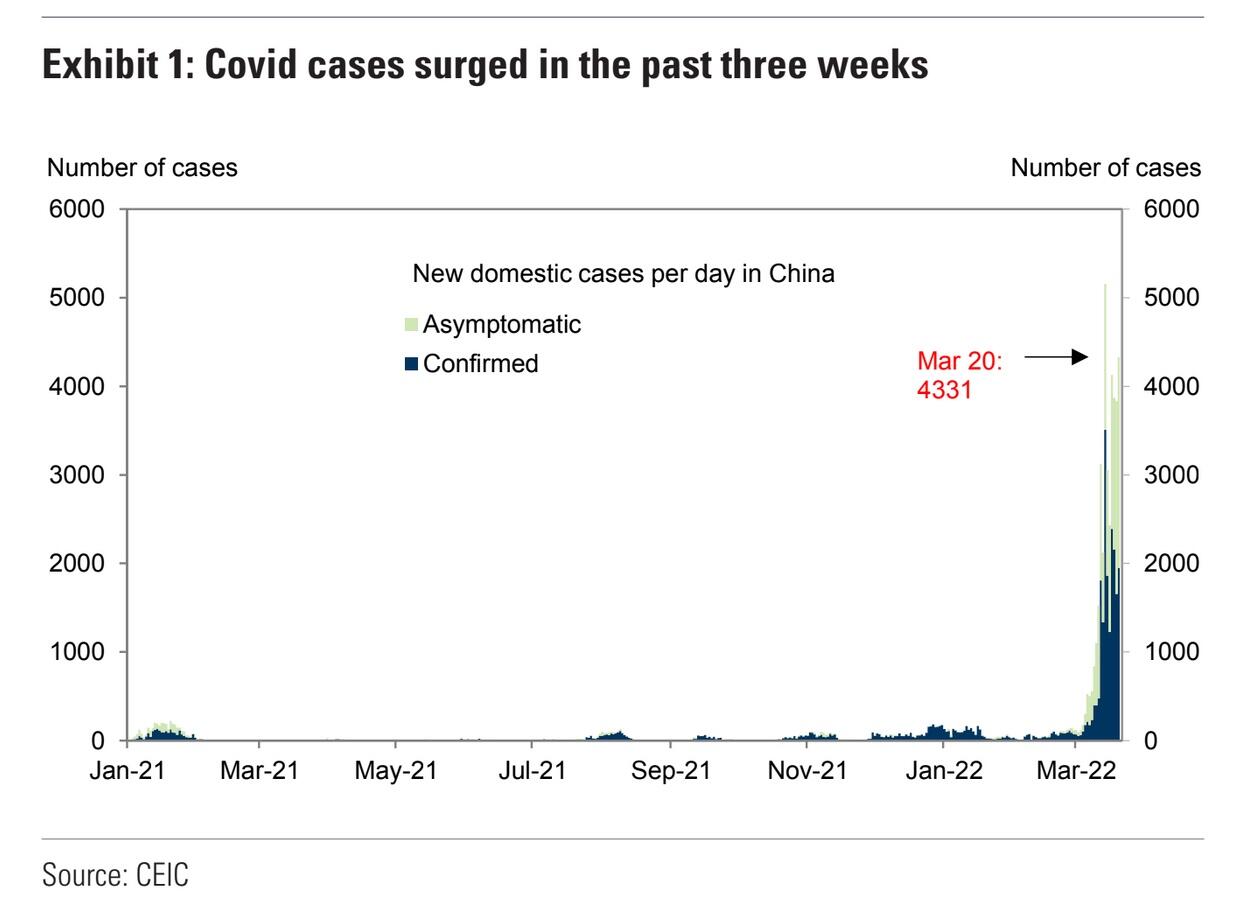
Unsurprisingly, investment banks have been peppered with questions about the economic backlash stemming from China's 'zero tolerance' approach to combating COVID (and this latest omicron-driven outbreak in particular). As COVID cases continue to climb (with Shanghai recording a record case tally this week that's inspired a wave of panic buying), Goldman estimates that lockdowns have impacted population centers responsible for roughly 30% of China's GDP.
Overall, daily cases have declined slightly from their peak on March 20. But that doesn't mean the outbreak is over.
In its latest sell-side research report on the issue, a team of Goldman analysts "assess potential disruptions to China’s supply chains from intermediate goods, exports, final output and logistics perspectives, mainly through analyzing provincial level input-output tables."
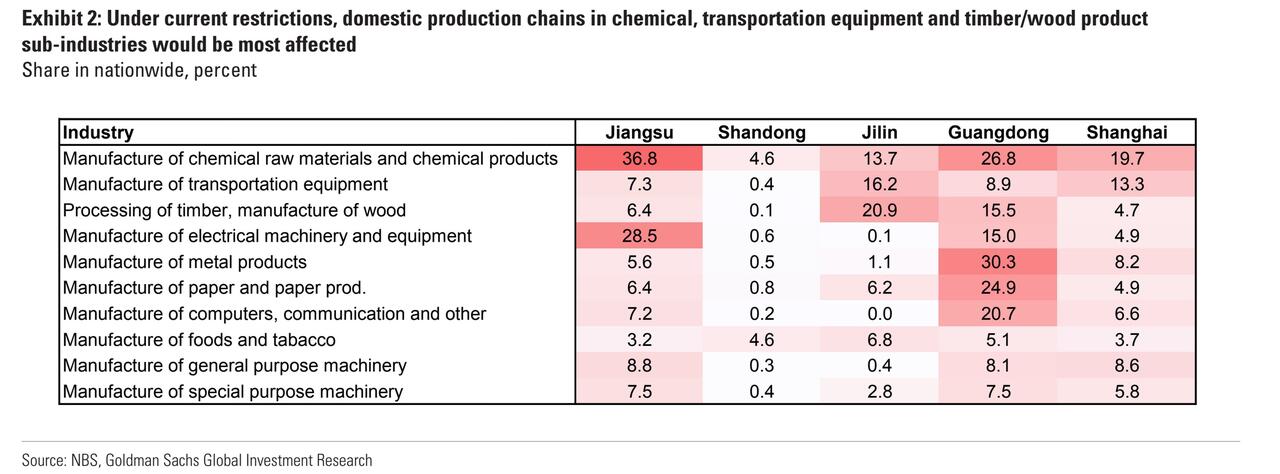
Here's what they found: the greatest impact from the lockdowns will be on China's chemicals, transportation equipment and timber/wood product".
Furthermore, Goldman's analysis suggests that "Jiangsu, Jilin, Guangdong, Shaanxi and Shanghai are more important among the virus-impacted provinces in terms of their roles in nationwide supply chains."
The Goldman team breaks down the potential impact of lockdowns on various industries across several of the worst-hit Chinese provinces and/or cities.
The report also cites "anecdotal evidence" to suggest that regions with mid-to-high risk districts are indeed facing delivery delays or production suspensions to various degrees that could have a cascading impact.
While CCP policymakers have taken steps to mitigate the impact of lockdowns on China's economy (the most recent example would be the reopening of factories in Shenzhen, as well as its port), they have continued to stress a "people first, lives first" approach.
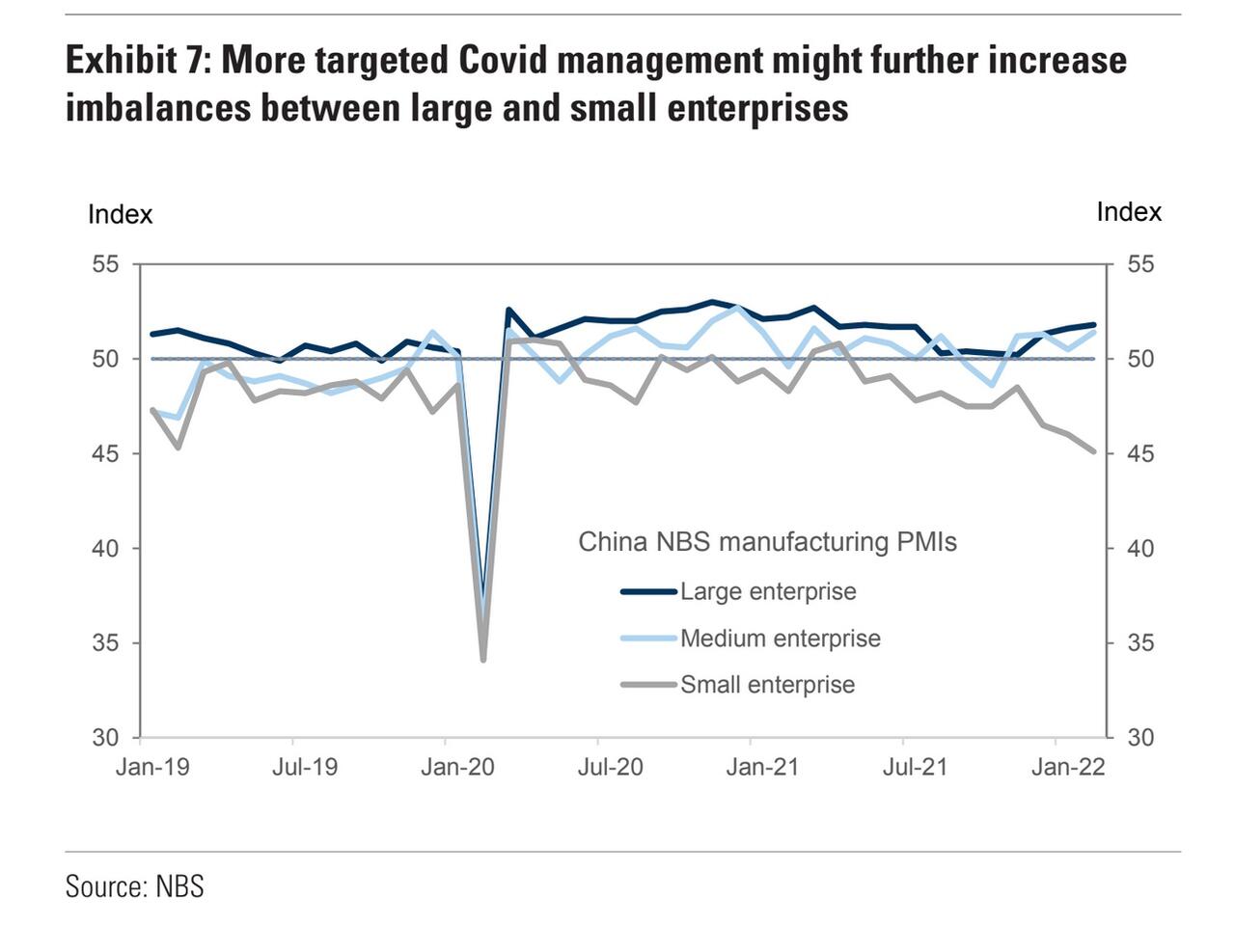
Taken together, all of this suggests a couple of potential outcomes: Possible implications: "1) overall supply chain might be more resilient than before given the same outbreak severity, as policymakers are moving more swiftly to resume production once local Covid situation appears to be under control; 2) structural imbalances between large and smaller companies might further increase, as major production/investment projects, which are usually handled by large companies, might be given the “green light” and resume production ahead of other projects when policymakers relax restrictive policies."
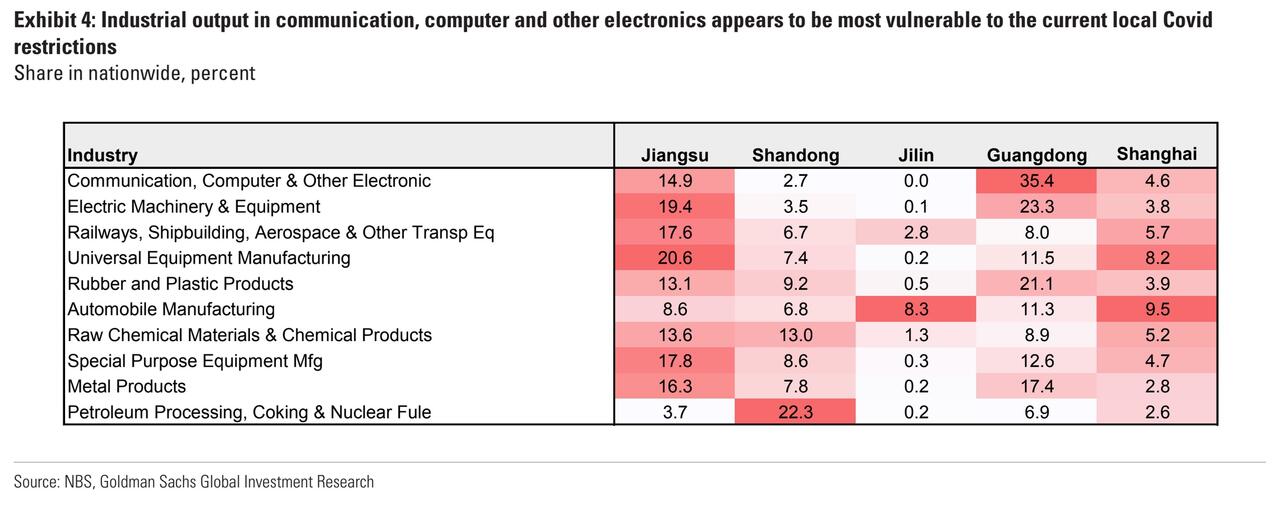
Moving beyond the most heavily impacted industries, the Goldman team also analyzed the impact of supply chains on other critical industries like computer components, paper and paper products (including the toilet paper that memorably disappeared from American supermarkets during the early days of the pandemic). The chart below reflects the current impact of lockdowns on these industries.
Finally, Goldman also published an analysis examining the most vulnerable industries to Chinese lockdowns.
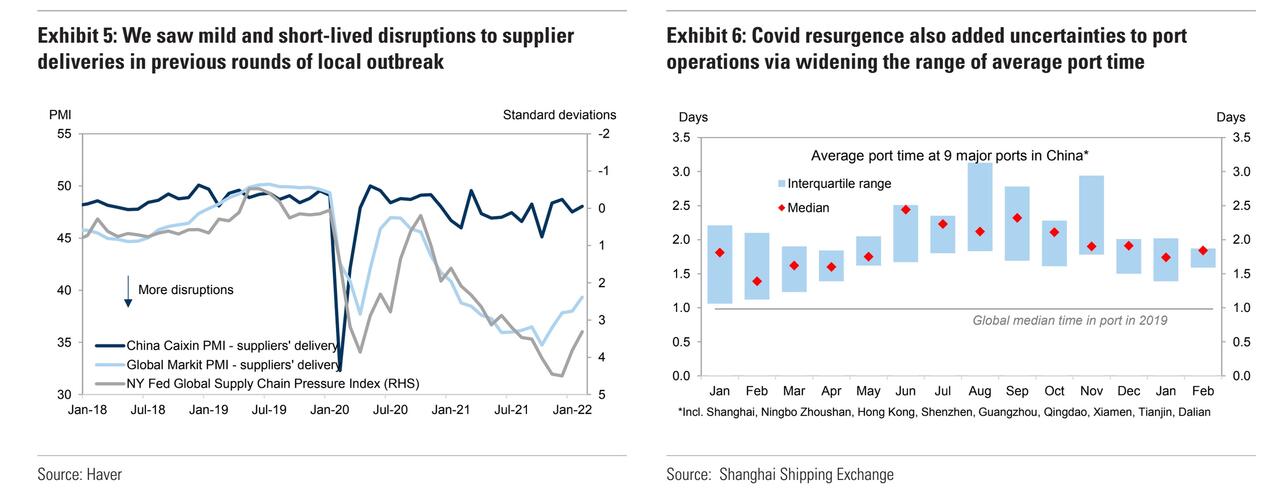
Using the past as a guide, Goldman also charted the impact on deliveries via the ports.
As the CCP switches from broad-based lockdowns to more "targeted" measures, Goldman expects the impact will be worse for smaller firms as opposed to larger enterprises with more flexible and robust supply chains.
Goldman's analysis concluded that should 30% of the Chinese economy experience a COVID shutdown lasting a month, it would reduce annual GDP growth by a whole percentage point.
But the bigger question is: as these issues cascade throughout the global economy, what might the impact be for the US?

>>> Stoxx 600 Pre-Market Indications

  • Daimler Truck (DTG TH) +3.5%
    • Daimler Truck Sees Rising Returns as Supply Bottlenecks Persist
  • CTS Eventim (EVD TH) +3%
    • CTS Eventim FY Net Income Beats Estimates
  • Mips (7M1 TH) +1.9%
  • Leonardo (FMNB TH) +1.8%
  • Rational (RAA TH) +1.5%
    • Rational Sees 2022 Sales +10% to +15%
  • Vestas (VWSB TH) +1.4%
  • Raiffeisen (RAW TH) +1.3%
    • Swiss FINMA Sees Gaps in Banks’ Recovery, Resolution Planning
  • FDJ (1WE TH) +1.3%
  • Rio Tinto (RIO1 TH) +1.3%
  • LVMH (MOH TH) -0.7%
  • Siemens Energy (ENR TH) -0.7%
  • Novo Nordisk (NOVC TH) -0.7%
  • TUI (TUI1 TH) -0.8%
  • Axa (AXA TH) -0.8%
  • Zalando (ZAL TH) -0.9%
  • Lufthansa (LHA TH) -1.4%
    • Three Airlines Downgraded at Deutsche Bank on Tough Outlook
  • Renault (RNL TH) -1.5%
    • Renault Shuts Down in Russia and Weighs Quitting Venture (1)
  • Glencore (8GC TH) -1.6%
    • Glencore Offering Expected to Price at GBP4.97/Share: Terms
  • Uniper (UN01 TH) -2.9%

FT : Lloyd’s predicts Ukraine war will prove ‘major claim’

Lloyd’s predicts Ukraine war will prove ‘major claim’
Insurance market says financial losses should be manageable and not create solvency challenges

Lloyd’s of London, the city’s specialist market for insurance, has warned that the war in Ukraine will represent a “major claim” this year as it swung back to profit last year.

In annual results announced on Thursday, Lloyd’s said the market had made an aggregate £2.3bn pre-tax profit last year, as higher premiums and much-reduced losses from the Covid-19 pandemic had outweighed a costly year for natural catastrophes.

That marked a recovery from the £900mn loss in 2020, when Lloyd’s was stung by billions of pounds in pandemic-related claims and expected claims in areas such as business interruption and event cancellation.

The run-up to the results has been characterised, however, by mounting anxiety within the market over the impact of Russia’s invasion of Ukraine and the wider economic fallout.

Areas such as aviation insurance and trade credit are expecting billions of dollars in claims as a result of unrecoverable planes and soured debts resulting from the conflict. The Financial Times reported earlier this month a preliminary estimate of Lloyd’s taking a hit of $1bn-$4bn, net of reinsurance, according to a person familiar with the matter.

But the crisis is rapidly evolving, and analysts’ estimates of the potential claims in each area are rising.

Lloyd’s did not put a number on the market’s overall potential Ukraine exposure on Thursday, but said it was “in close dialogue with market partners” to get a sense of the scale of it.

But it added that direct and indirect claims relating to the conflict were “expected to fall within manageable tolerances and will not create solvency challenges”.

“In a world buffeted by increasingly complex and connected risks — from the pandemic to a geopolitical conflict — the Lloyd’s market is standing by its customers and supporting their recovery when things go wrong,” chief executive John Neal said.

The market’s combined ratio for the year — claims and expenses as a proportion of premiums — came in at a profitable 93.5 per cent, after the lossmaking 110.3 per cent in 2020.

Lloyd’s puts its turnround down to a “keen focus on underwriting profitability” and insurers’ ability to drive through price increases, with 16 consecutive quarters of rate rises. Premiums were up almost 11 per cent during the year.

A drive to improve efficiency at the insurers within the market had resulted in a 1.7 percentage point boost to its aggregate expense ratio, which measures costs as a proportion of premiums.

The market’s overall capital levels also increased over the period. Its central solvency ratio, which shows its capital as a proportion of its regulatory requirement, rose from 209 per cent in 2020 to 388 per cent at the end of 2021.

>>> TradeGate Pre-Market Indications

DAX:
  • Daimler Truck (DTG TH) +4.3%
    • Daimler Truck 2022 Revenue Forecast Beats Estimates
MDAX:
  • CTS Eventim (EVD TH) +3.6%
    • CTS Eventim FY Net Income Beats Estimates
  • Varta (VAR1 TH) +2%
  • Lufthansa (LHA TH) -1.6%
    • Three Airlines Downgraded at Deutsche Bank on Tough Outlook
  • Uniper (UN01 TH) -2.9%
SDAX:
  • PVA TePla (TPE TH) +3.3%
  • MorphoSys (MOR TH) +3%
  • Deutz (DEZ TH) +2.2%
  • SMA Solar (S92 TH) +2.1%
  • LPKF (LPK TH) +2%
  • AUTO1 (AG1 TH) -1.3%
  • SGL (SGL TH) -1.4%
    • SGL FY Sales Revenue EU1.01B Vs. EU919.4M Y/y
  • Krones (KRN TH) -1.9%
    • Krones Plans to Pay Out a Dividend of EU1.40 Per Share for 2021
  • Heidelberger Druck (HDD TH) -2.8%

>>> Europe : Brokers Upgrades & Downgrades - 24th of March 2022

>>> Up
* BAM Raised to Buy at ING; PT 3.50 euros
* BAT Raised to Overweight at JPMorgan; PT 4,000 pence
* Bechtle Raised to Buy at Jefferies; PT 63 euros
* Burford Capital Raised to Buy at Peel Hunt; PT 1,000 pence
* Enel Raised to Buy at Jefferies; PT 7 euros
* Orsted Raised to Hold at Jefferies; PT 750 kroner
* OVB Holding Raised to Buy at SRC Research; PT 30 euros
* Rightmove Raised to Sector Perform at RBC; PT 630 pence
* Schnitzer Steel Raised to Overweight at KeyBanc; PT $58

>>> Down
* Alcoa Cut to Equal-Weight at Morgan Stanley; PT $100
* Drax Cut to Hold at Jefferies; PT 700 pence
* eQ Cut to Reduce at Inderes; PT 27 euros
* Finnair Cut to Sell at SEB Equities; PT 35 euro cents
* IAG Cut to Hold at Deutsche Bank; PT 155 pence
* JDE Peet's Cut to Sell at Berenberg; PT 24 euros
* L'Oreal Cut to Underperform at Jefferies; PT 314 euros
* Lufthansa Cut to Hold at Deutsche Bank; PT 7.90 euros
* Nokian Renkaat Cut to Hold at Nordea
* Wizz Air Cut to Hold at Deutsche Bank; PT 2,900 pence

>>> Initiation
* Aker BioMarine ASA Rated New Buy at Nordea; PT 60 kroner
* Befesa Rated New Overweight at Morgan Stanley; PT 81 euros
* Freenet Rated New Neutral at Oddo BHF; PT 25 euros
* Scatec Rated New Hold at Arctic Securities; PT 140 kroner

>>> Call
* European Utilities Stocks Facing ‘Defining Moment’: Jefferies
* Rightmove Upgraded at RBC on Confidence It Can Meet Expectations

>>> What to look at today - 24th of March 2022

Stocks in Asia struggled back from early lows after a tough session for global equities, while oil turned lower as investors assess the risks of rising inflation and the impact of the war in Ukraine. Treasuries held losses. An MSCI Inc. gauge of Asia-Pacific equities fell for the first day in three as equities in Japan declined. The Hang Seng erased losses, though Tencent Holdings Ltd. weighed on tech stocks after reportingits slowest pace of quarterly growth on record. U.S. futures edged higher after the S&P 500 erased the prior session’s gains, and European contracts fluctuated. Treasuries look shaky again, and resumed their slide to unprecedented losses. Investors returned to the market in U.S. trade, snapping up a sale of 20-year bonds and driving the benchmark 10-year yield back to 2.3%. The dollar edged higher. Oil reversed its earlier advance to trade around $113 a barrel amid reports that the U.S. and European Union are close to a deal aimed at slashing Europe’s dependence on Russian energy, while President Joe Biden’s prepares to announce new sanctions on Russia.  The extreme volatility in commodity markets caused by the conflict and global response is sapping liquidity, according to some of the world’s biggest trading houses.  the Biden administration plans to reinstate exemptions from Trump-era tariffs on about two-thirds of Chinese products that were previously granted waivers, most of which expired by the end of 2020. European gas prices swung sharply and the ruble staged its biggest one-day gain in years after Russian President Vladimir Putin pushed on with plans to demand that dozens of countries use the local currency for natural gas purchases.  US After Hours OXM +8.3%, FUL +4.2% higher on earnings; COOK -15.5%, KBH -4.4%, SCS -4.1%, OLLI -2.3% lower on earnings

Nikkei +0.25% Hang Seng -0.25% CSI -0.46% Shanghai -0.50% Shenzen -0.69%

Eur$ 1.0983 CNH 6.3852 CNY 6.3719 JPY 121.49 GBP 1.3197 CHF 0.9323 RUB 98.1875 TRY 14.8239 WTI$ 114.51 - 0.37% Gold 1,940 -0.20% BTC 43,200 +2% ETH 3,055 +2.45%

S&P +0.33% Nasdaq +0.46% EuroStoxx +0.11% FTSE +0.08% Dax +0.11% SMI -0.10%

Macro :
- Stock Traders Brace for a Chaotic Reopening to Russia’s Market
- Fidelity Launches Business Mimicking Hedge-Fund Strategies
- Putin Demands Ruble Payment for Gas, Escalating Energy Fight
- Autos Demand Estimate for 2022 Cut at RBC on Supply Challenges
- U.K. Faces $5 Billion Bill If Government Has to Bail Out Gazprom

Keep an eye on :
- AKH NO : Mitsui Buys 27.5% Stake in Mainstream Renewable Power for EU575m
- ANTIN FP : Antin FY Net Income EU74.4M
- ARGX BB : Argenx Offering of 1.55m ADR, Offering of 782,290 Shares by Co.
- BYW6 GY : BayWa Sees No Material Impact to Business From Ukraine War
- CAI AV : CA Immo FY Ebit Beats Estimates
- CPR IM : Campari to Reduce Business in Russia to Minimum Necessary
- CARM FP : Carmila Holder LVS II Lux VII Offers Around 6.8m Shares: Terms
- CO FP : Casino Said to Mull Sale of Stake in Renewables Firm GreenYellow
- CLN SW : Clariant Joins Renewable Carbon Initiative
- COTN SW : Comet Says It Wins Lawsuit Against XP Power LLC
- CSGN SW : Credit Suisse May See Bermuda Court Judgment Over $500M
- DTG GY : Daimler Truck 2022 Revenue Forecast Beats Estimates, Sees Rising Returns as Supply Bottlenecks Persist
- EVD GY : CTS Eventim FY Net Income Beats Estimates
- DAN IM : Danieli Awarded Orders Valued More than $650M by Nucor
- ENGI FP : GTT Share Sale by Engie Order Book Is Covered: Terms
- FCT IM : Fincantieri FY Revenue Beats Estimates
- GTT FP : GTT Holder Engie Offers About 3m Shares: Terms
- GLEN LN : Qatar’s Sovereign Wealth Fund to Sell $1 Billion Glencore Stake
- HHFA GY : Hamburger Hafen Sees 2022 Port Logistics Ebit EU160M to EU195M
- HEI GY : HeidelbergCement Proposes Dividend of EU2.40 Per Share for 2021
- HELN SW : Helvetia FY Dividend per Share CHF5.50 Vs. CHF5 Y/y
- IBAB BB ; Ion Beam FY Revenue EU313.0M Vs. EU312.0M Y/y
- ICOS IM : Intercos FY Revenue EU673.7M Vs. EU606.5M Y/y
- IPH FP : Innate Pharma FY Net Loss EU52.8M
- KRN GY : Krones Promotes Uta Anders to CFO From January 23, Plans to Pay Out a Dvd of EU1.40 Per Share for 2021
- LONN SW : Lonza Proposes Marion Helmes and Roger Nitsch to Board
- MBTN SW : Meyer Burger FY Ebitda Loss CHF72.5M Vs. Loss CHF44.6M Y/y
- NOVN SW : Novartis’s Pluvicto for Treatment of Cancer Approved by FDA
- PGGM NA : PGGM, DIF Capital Partners Agree to Buy Enexis-Subsidiary Fudura
- PINF IM : Italian Designer Pininfarina Looks at M&A After Return to Profit
- PAH3 GY : Porsche Family Leaders to Extend Board Mandates: Manager Magazin
- RAA GY : Rational Sees 2022 Sales +10% to +15%
- RNO FP : Renault Is Said to Mull Curbing Russia Operations Over Ukraine
- ROTH FP : Rothschild’s Wealth Unit Will Not Accept New Russian Clients
- SAN FP : Sanofi Says It Will Stop All Non-Essential Activities in Russia
- G24 GY : Scout24 Proposes Dividend of EU0.84 Per Share
- SGL GY : SGL FY Sales Revenue EU1.01B Vs. EU919.4M Y/y
- SOF BB : Sofina FY Dividend per Share Matches Estimates
- TIT IM : KKR Said to Confirm Interest for Telecom Italia in Letter
- TRI FP : Trigano 2Q Like-for-Like Sales +8.4%
- UBSG SW : Swiss FINMA Sees Gaps in Banks’ Recovery, Resolution Planning
- VACN SW : VAT Group to Be Included in Swiss Leader Index on March 31: SIX
- VLA FP : Valneva FY Operating Loss EU61.4M Vs. Loss EU55.1M Y/y
- VIV FP : KKR Is Said to Confirm Interest for Telecom Italia in Letter
- ROSE SW : Zur Rose FY Adjusted Ebitda Loss CHF128.9M Vs. Loss CHF31.2M Y/y
- FHZN SW : Zurich Airport Says Josef Felder to Succeed Schmid as Chairman

FT : Should foreign owners of UK property worry about new registration rules?

Should foreign owners of UK property worry about new registration rules?
Requirement for overseas companies to declare ownership, raises tax issues

People from all over the world own UK property and those who want to protect their privacy often do this through an overseas entity, usually a company.

There are currently 93,877 properties owned in this way in England and Wales according to Land Registry data. During the past 10 years, 58,426 such properties have been added.

Keeping your name off public records comes at a cost: non-resident companies automatically pay 15 per cent Stamp Duty Land Tax (SDLT) when buying residential property of over £500,000. Personal buyers pay the maximum rate of 12 per cent on property values of £1.5m though most personal buyers in the UK pay just 2 per cent or 5 per cent.

There is nothing wrong with owning UK property via an overseas company, as there can be legitimate commercial or personal protection reasons involved.


Nor is such ownership blocked by new rules which, after a hiatus, the government is now introducing rapidly.

The Economic Crime (Transparency and Enforcement) Act 2022 received Royal Assent this month: the aim is to increase transparency, something which remains high on the government agenda.

In addition to changing the rules about sanctions, the Act introduces a new requirement for overseas entities owning UK property to register at Companies House and provide details of beneficial owners. Criminal offences may be committed by those who fail to comply or who provide incorrect information.

The register will be publicly available at Companies House. However, HM Revenue & Customs will have access to more details than are publicly available and will be able to cross reference this against other government databases.

It is therefore prudent to check that both companies and beneficial owners are UK-tax compliant in all periods since the property’s original acquisition.

The new law builds on a 2016 requirement for corporates to declare at Companies House who exerts significant influence and control. The intention is to make it easier for everyone to know who is the ultimate beneficial owner of overseas entities with UK land interests and dissuade those planning to buy UK property with illicit funds.

HMRC, the police and other enforcement agencies consider that overseas entity ownership of a UK property can be used to conceal crime, such as tax fraud and money laundering, so will take a keen interest in the companies that now register. HMRC will feed the information into its Connect system, the data mining technology used to analyse all taxpayer data.

This includes the Common Reporting Standard data on financial accounts and transactions from overseas banks and open source data to identify cases for further investigation.

For example, HMRC is likely to investigate if individuals living in the property are UK-resident for tax purposes. If they are, UK tax may be due on their worldwide income.

HMRC can also assess whether there were taxable “remittances” (usually money transfers) to the UK by non-UK domiciled individuals. Questions about the source of funds to purchase a property can often arise. Overseas landlords will be taxable on UK rental income.

HMRC will also want to check whether any annual tax on enveloped dwellings (ATED) is due; this is generally payable on residential property with a value of more than £500,000, where an individual occupies a UK property and is connected to the company that owns it.

The new law applies to overseas companies, partnerships and foundations. Overseas trusts owning UK land directly — without another entity in the ownership structure — are not required to register with Companies House. These trusts already register and declare beneficial owners under the HMRC’s Trust Registration Service.

The requirement to register will apply to freehold property and land, and leaseholds of longer than seven years. When in force, overseas entities must register before acquisition. Transitional rules broadly require registration within six months of the rules coming into force.

Under the Act, officers of overseas companies must take reasonable steps to identify any registerable beneficial owners and provide the information to Companies House, complete an annual return and request removal from the register at the appropriate time.

Overseas entities must issue “information notices” to anyone that they know or have cause to believe are beneficial owners, and the recipient must respond within one month. Share ownership or voting rights of more than 25 per cent will put someone in the “beneficial owner” category, along with all directors.

Failure to register is a criminal offence for the overseas company’s directors. Other offences can be committed by the beneficial owners for failure to comply.

For those who have not complied with tax rules, full voluntary disclosure to HMRC is the best approach. It is sensible to take expert tax advice: there may be penalties but disclosure usually minimises these.

Current UK tax rules mean that where a property is sold by an overseas company, there will be UK tax issues to consider from capital gains tax for the company to possible ATED charges. If the owner wants to “de-envelope” the property and hold it in their own name in future, then there is also the stamp duty to consider and possibly an income tax charge if the property is simply transferred to the owner -likely to be treated as a dividend “in specie”. 

The new register will give the authorities more data to track UK property and its owners than ever before. An increase in resources for Companies House and the Land Registry will be crucial to ensure the processes are smooth.

HMRC and other enforcement agencies will also need more skilled investigators to “join the dots”. There are always methods and places for criminals to hide in the world, but this will make it much harder for UK property to be used for such ends.