>>> Soros Fund (George Soros) discloses updated portfolio positions in 13F filin

Soros Fund (George Soros) discloses updated portfolio positions in 13F filing: New ZNGA FRSH positions
Highlights from 2022 Q1 filing as compared to Q4 2021:
  • New positions in: ZNGA (~13.2 mln shares), FRSH (~1.95 mln), STRY (~1.42 mln), LCID (~0.6 mln), MGM (~0.35 mln), STEM (~0.3 mln), FLNC (~0.26 mln)
  • Increased positions in: DIDI (to ~5.84 mln shares from ~2.72 mln shares), CERN (to ~2.73 mln from ~1.17 mln), FIGS (to ~2.9 mln from ~1.8 mln), INDI (to ~4.36 mln from ~3.5 mln), NKE (to ~0.3 mln from ~0.11 mln), JPM (to ~0.19 mln from ~0.01 mln), CRM (to ~0.26 mln from ~0.16 mln) APTV (to ~0.24 mln from ~0.16 mln), COLB (to ~0.24 mln from ~0.15 mln), ACN (to ~0.12 mln from ~0.05 mln)
  • Maintained positions in: RIVN (~19.84 mln shares), BOWL (~9.4 mln shares), IGSB (~1.11 mln shares)
  • Closed positions in: MQ (from ~1.02 mln shares), ATVI (from ~1.01 mln), AUR (from ~1 mln), GM (from ~0.86 mln), ALLY (from ~0.69 mln), UBER (from ~0.53 mln), HTZ (from ~0.4 mln), PTON (from ~0.37 mln), HAIN (from ~0.34 mln), ONB (from ~0.34 mln)
  • Decreased positions in: PTRA (to ~2.92 mln shares from ~7.97 mln shares), ARMK (to ~3.62 mln from ~5.4 mln), ELAN (to ~0.83 mln from ~2.2 mln), OPEN (to ~1.86 mln from ~3.2 mln), DHI (to ~3.01 mln from ~3.63 mln), WRBY (to ~0.13 mln from ~0.33 mln), SYF (to ~0.01 mln from ~0.19 mln), ASO (to ~0.21 mln from ~0.34 mln), DIS (to ~0.03 mln from ~0.1 mln), ADI (to ~0.15 mln from ~0.21 mln)

>>> Trian Fund (Nelson Peltz) discloses updated portfolio positions in 13F filin

Trian Fund (Nelson Peltz) discloses updated portfolio positions in 13F filing: Confirms increased JHG IVZ holdings, Exited CMCSA
Highlights from 2022 Q1 filing as compared to Q4 2021:
  • Increased positions in: IVZ (to ~54.03 mln shares from ~45.47 mln shares), JHG (to ~31.87 mln from ~28.27 mln)
  • Maintained positions in: WEN (~25.33 mln shares), FERG (~11.4 mln shares), GE (~4.03 mln shares)
  • Closed positions in: CMCSA (from ~19.99 mln shares)
  • Decreased positions in: SYY (to ~11.5 mln shares from ~12.85 mln shares), PG (to ~0.01 mln from ~0.24 mln)

WSJ : Sheikh Khalifa, Who Oversaw U.A.E.’s Stark Transformation, Dies at 73

Sheikh Khalifa, Who Oversaw U.A.E.’s Stark Transformation, Dies at 73
Sheikh Khalifa bin Zayed, the second leader of the U.A.E., had been ailing following a stroke in 2014

DUBAI—Sheikh Khalifa bin Zayed al Nahyan, the second president of the United Arab Emirates and the ruler of Abu Dhabi who shunned the limelight even as he oversaw his country’s remarkable transformation, has died. He was 73.

Sheikh Khalifa took power in 2004 following the death of his father, the U.A.E.’s founder, but had been ailing in recent years. He underwent an operation after suffering a stroke in 2014 and was pronounced stable, but was rarely seen publicly thereafter.

The U.A.E. government in a statement said the leader died on Friday. The country would hold 40 days of official mourning, with flags at half-staff, while government offices and private-sector firms would close for three days, the statement added.

There was no immediate announcement of his successor. But Sheikh Mohammed bin Zayed, the emirate’s crown prince and the deputy supreme commander of the country’s armed forces, is expected to succeed Sheikh Khalifa, his half-brother, both as Abu Dhabi ruler and U.A.E. president. Leaders of Abu Dhabi’s royal family have traditionally held the role of president of the federation of seven emirates that make up the U.A.E.

“The U.A.E. lost its righteous son,” Sheikh Mohammed tweeted, praising his half-brother for empowering the country. “Khalifa bin Zayed, my brother, my mentor and my teacher.”

Sheikh Mohammed bin Rashid al-Maktoum, the ruler of Dubai and the U.A.E. vice president, in a statement posted on Twitter said the president had served his country. “We witness that Khalifa bin Zayed has fulfilled his trust, and served his flock, and loved his people.”

Condolences were sent from across the Middle East and around the world. The U.S. Embassy in the U.A.E. in a statement said it expressed its deep condolences to the U.A.E. president’s family and the country’s people. “He was a true friend of the United States,” it said.

The U.A.E. and Israel established diplomatic relationships under the monarchy of Sheikh Khalifa. Israeli Prime Minister Naftali Bennett in a statement said, “Sheikh Khalifa’s great legacy and deeds were appreciated by many in Israel.”

The office of Turkish President Recep Tayyip Erdogan said it would organize a visit to the U.A.E. to offer condolences, after the two countries in recent months have tried to repair once-strained ties. Gulf states, Iraq, Jordan and Egypt also sent their condolences.

With a smooth transition in leadership expected, Sheikh Khalifa’s death is unlikely to have an economic or political impact. As his half-brother grew more frail, Sheikh Mohammed took on a more prominent role over the past decade, establishing deep ties with Saudi Arabia’s young crown prince and projecting power across the region.

While never quite as brash as neighboring Dubai, Abu Dhabi built out its infrastructure and undertook large new building projects during Sheikh Khalifa’s 18 years at the helm. The projects included new islands with residential and office towers and a cultural district that includes a Louvre museum opened in 2017.

During his time in power, Sheikh Khalifa also oversaw Abu Dhabi’s economic strategy and massive energy wealth—the U.A.E. capital has most of the country’s oil, the seventh-largest proven reserves in the world.

Like many of its peers in the Persian Gulf, Abu Dhabi is trying to diversify economic activity away from energy, and has seeded new industrial projects and set up funds for local entrepreneurs to help make that happen.

The city’s rapid development hasn’t come without challenges, however. The government has come under fire repeatedly from human-rights groups that have alleged instances of forced labor and unsanitary living conditions for low-wage foreign construction workers.

The U.A.E. has also been criticized for its response to Arab Spring upheaval elsewhere in the Middle East. Scores of people were arrested on Sheikh Khalifa’s watch. They were tried for associating with Islamist groups and plotting to overthrow the state. Rights groups have alleged government security forces used torture in state security facilities.

The U.A.E.’s prominent role in the Saudi-led intervention in Yemen’s civil war also drew criticism, though that eased after it pulled out most of its forces in 2019. The U.A.E. won plaudits in 2020 for establishing normal relations with Israel under the U.S.-brokered Abraham Accords.

The country’s response to the Covid-19 pandemic, involving one of the world’s most aggressive vaccination rollouts and short lockdowns, also has meant the country has drawn more wealthy expatriates, already roughly 90% of the population.

Kristian Ulrichsen, Middle East fellow at Rice University’s Baker Institute for Public Policy, said Sheikh Khalifa would “be remembered as a transitional figure, a bridge between the old guard of nation builders such as Sheikh Zayed and the assertive new generation of leaders represented by Mohammed bin Zayed and his full brothers.”

If announced as the successor, Sheikh Mohammed is widely expected to continue on the path set under Sheikh Khalifa.

As the crown prince and chairman of the strategy-setting Abu Dhabi Executive Council, Sheikh Mohammed has been involved in charting the emirate’s economic course. Despite Sheikh Khalifa’s title of ruler, it was Sheikh Mohammed who spearheaded Abu Dhabi’s growth strategies, especially in Sheikh Khalifa’s later years.

Sheikh Khalifa bin Zayed al Nahyan was born in 1948 in the arid interior of Abu Dhabi, part of what was then the Trucial States, a collection of sheikhdoms under British protection.

He was the first son of the late Sheikh Zayed, then a rising figure in local tribal politics who wanted to turn Abu Dhabi’s newly discovered oil wealth into a better living standard for his people. Aided by the British, Sheikh Zayed replaced his half-brother, the more old-fashioned Sheikh Shakhbut, as Abu Dhabi’s ruler in 1966.

Immediately after the bloodless coup, Sheikh Zayed began grooming Sheikh Khalifa to lead. At just 18 years old, Sheikh Khalifa got his first posting in 1966 as the ruler’s representative in Abu Dhabi’s eastern region, a sparsely populated area consisting of small desert settlements ringing the oasis town of Al Ain.

Sheikh Khalifa became Abu Dhabi’s crown prince two years later, making him his father’s designated successor. That position gained prestige in 1971, when the British withdrew from the region and the U.A.E. was formed with Sheikh Zayed as its president and pre-eminent political figure.

Sheikh Khalifa held numerous positions under Sheikh Zayed thereafter, including in the military and as head of the Abu Dhabi Executive Council. He played a part in the development of local roads and institutional infrastructure, as well as the creation of a modern governmental administration.

In 1976, he oversaw the establishment of the Abu Dhabi Investment Authority to invest surplus energy receipts in overseas markets, aiming to secure a return for future generations. The fund, which initially attracted little attention, has grown to an estimated value of $700 billion, in concert with Abu Dhabi’s growing oil wealth.

Over the years, Sheikh Khalifa also accrued vast personal wealth including a portfolio of property holdings in the U.K. estimated in the billions of dollars. The properties have become the focus of a high-court dispute that has revealed a possible competition among family members for control of his assets.

The death of Sheikh Zayed in 2004 marked the beginning of the U.A.E. under Sheikh Khalifa.

In the years that followed, the pace of Abu Dhabi’s infrastructure growth quickened. Massive new investments in renewable energy and diversified non-oil industries multiplied. The U.A.E. also took steps toward democracy—albeit incomplete ones—by holding the first elections for the Federal National Council, the country’s advisory legislature, in 2006.

Sheikh Khalifa kept up a close alliance with the U.S. during his tenure, and the American military has used U.A.E. military bases extensively in recent Middle Eastern conflicts. This relationship helped the U.A.E. secure a nuclear cooperation agreement with the U.S. in 2009, paving the way for it to build several reactors for peaceful power generation.

Regionally, the U.A.E. projected itself as a neutral country interested in doing business more than inserting itself in political disputes, but more recently its outsize military strength has earned it the title “Little Sparta” among some U.S. military officials. Over the past decade, it has intervened in regional conflicts, like Yemen, Syria and Libya, and flexed its diplomatic muscle, most notably by helping to broker a 2018 peace deal between Ethiopia and Eritrea.
FT : Car bosses warn of supply chain threat to electric vehicle rollout

Car bosses warn of supply chain threat to electric vehicle rollout
Tesla and VW lower delivery expectations because of chip shortages and raw material costs

The world’s largest carmakers have warned supply chain disruptions and higher raw material prices threaten the rollout of electric vehicles, even as demand for battery-powered models vastly exceeds manufacturers’ current production capacities.

Speaking at the Financial Times’ eighth Future of the Car summit this week, Tesla boss Elon Musk cast doubt on his company’s ability to reach its target — put in place just months ago — of delivering 20mn electric cars a year by the end of the decade, calling it an “aspiration, not a promise”. 

“We may stumble and not reach that goal,” an unusually conservative Musk told the conference. “There are some raw material constraints that we see coming, in lithium production, probably in about three years, and in cathode production,” he added.

Musk’s comments were echoed by several other industry leaders at the annual event, in contrast to past summits where executives have announced ever more ambitious electric vehicle targets.

In 2021, even as the semiconductor shortage showed few signs of abating, Mercedes-Benz boss Ola Källenius told attendees that his company would go “faster” when it came to phasing out combustion engine models and building electric alternatives.

But the tone at the summit this week was markedly more reserved. Not a single leading executive announced higher targets for electric vehicle sales, or battery production. Tesla’s closest competitor, Volkswagen, which has long aimed to overtake its rival in electric vehicle sales by 2025, played down its prospects of reaching that goal, calling it “very, very tight”.

“Many people are now, I think, a bit over-optimistic,” said VW chief executive Herbert Diess, referring to the rollout of electric vehicles worldwide.

Speaking from the back seat of VW’s latest electric model, an emissions-free version of the 1960s camper van, he added: “We need the energy, we need the charging networks, we need the infrastructure, for sure, we need the cars, but we also need the batteries and the raw materials.”

Industry analysts, Diess said, were not taking the “amount of effort which has to go in to make this change happen seriously enough”.

The warnings by the top two electric vehicle producers came as consumers’ appetite for battery-powered vehicles continues to exceed the sector’s expectations.

After VW, which plans to sell roughly 700,000 electric vehicles in 2022, revealed it has sold out of battery models in the US and Europe for the rest of the year, Mercedes-Benz’s Källenius told the summit that this was “largely true for us as well”. 

Tesla’s Musk said he thought “zero about demand generation and a lot about production and engineering and supply chain”, adding that he would not rule out buying a mining company to secure the raw materials necessary to ramp up electric vehicle manufacturing.

Persistent bottlenecks in the supplies of crucial raw materials for batteries have tempered analysts’ expectations for the electric car industry as a whole.

Researchers at Wells Fargo who this week examined the raw material prices for components in a Tesla Model Y found “several ‘surprises’ that challenge the notion of imminent [battery electric vehicle] adoption”.

“The rise of battery raw materials costs has delayed [battery electric vehicle] cost parity to [internal combustion engines] by at least a decade,” the bank warned, referring to the moment at which emissions-free vehicles become as cheap as petrol or diesel equivalents.

As a result, Wells Fargo analysts downgraded General Motors and Ford, as the US manufacturers would “likely be forced to sell money-losing compliance [battery electric vehicles]”, to meet ever-stricter regulatory targets.

Their assessment was matched by Renault chief executive Luca de Meo, who told the FT conference that supply chain crises meant “the game has changed” and that carmakers “have to play by new rules”, which would see them reliant on the efforts of energy and mining companies.

He cautioned that the French group might not achieve cost parity for mid-range models by 2025, and that this could damp demand for electric cars. “We know that the purchasing power [of] people in many regions of the world will not necessarily increase,” said De Meo.

At the same time, generous subsidies for purchasers of electric cars in China will be phased out by the end of the year, making it harder for those on low incomes to switch.

Stellantis, which owns budget brands such as Dacia, warned that batteries would become scarce in just two or three years’ time, complicating the rollout of affordable electric cars.

“The speed at which everybody is now building manufacturing capacities for batteries is possibly on the edge to be able to support the fast-changing markets in which we are operating,” said Stellantis boss Carlos Tavares.

“We are not addressing this transformation on a 360-degree strategic approach,” he added. “Everybody is going to pour EV vehicles on the market. So what’s next? Where is the clean energy? Where is the charging infrastructure? Where are the raw materials?”

To help with the commodities crunch, Mercedes’ Källenius called for Europe to mimic the raw materials procurement strategies implemented by China and the US and develop “more bilateral trade agreements . . . beyond maybe the three traditional regions”. 

The EU, he said, should look at inking deals with mineral-rich countries such as Australia and India as well as South American states, and create closer relationships with “economies that may have some of those raw materials that we need for electrification”.

But most executives agreed the industry’s woes would not fade fast.

“[This is] totally different from what I used to say one year before, that you know, we are improving, we are getting better, one day we will be perfect,” said Nissan’s chief operating officer Ashwani Gupta.

“For me today, the supply chain crisis is the new normal.”

(ZH) The Biggest Crash In History Is Coming? Kiyosaki Says So...

The Biggest Crash In History Is Coming? Kiyosaki Says So...

Robert Kiyosaki recently tweeted, “The best time to prepare for a crash is before the crash. The biggest crash in world history is coming. The good news is the best time to get rich is during a crash. The bad news is the next crash will be a long one.”
Is Kiyosaki just being hyperbolic, or should investors prepare for the worst?
Importantly, I received Kiyosaki’s comment in an email that I could find out more by just clicking on the link to get a “free” report.
I can save you time, and future spam emails, by telling you that Kiyosaki will be correct.
Eventually.
However, the problem, as always, is “timing.”
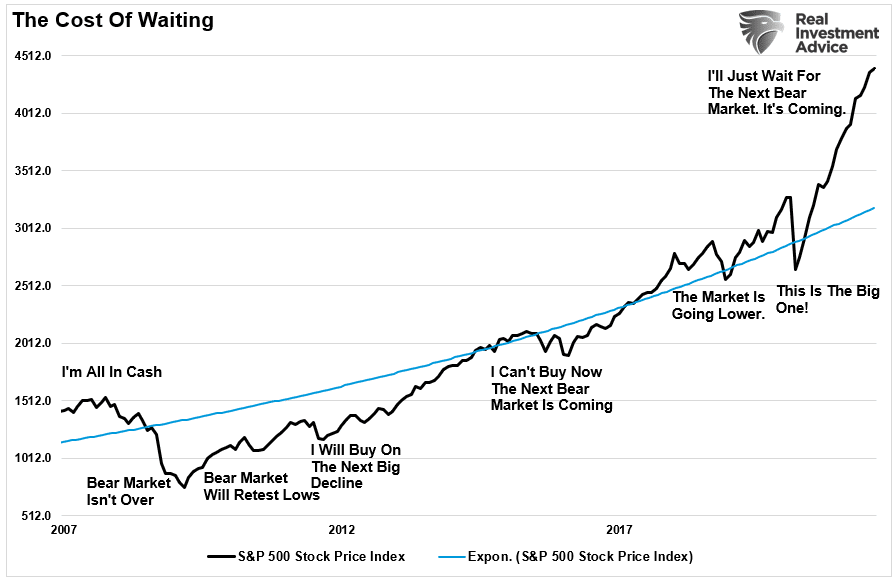
As discussed previously, going to cash too early can be as detrimental to your financial outcome as the crash itself.
Over the past decade, I have met with numerous individuals who “went to cash” in 2008 before the crash. They felt confident in their actions at the time. However, that “confidence” gave way to “confirmation bias” after the market bottomed in 2009. They remained convinced the “bear market” was not yet over, and sought out confirming information.
As a consequence, they remained in cash. The cost of “sitting out” on a market advance is evident.
As the market turned from “bearish” to “bullish,” many individuals remained in cash worrying they had missed the opportunity to get in. Even when there were decent pullbacks, the “fear of being wrong” outweighed the necessity of getting capital invested.
The email I received noted:
“If such a disaster could be in the making, your assets are at risk and this requires your immediate attention! And if you believe that now isn’t the time to protect yourself and your family, when will it be?”
Let’s start with that last sentence.
The Biggest Crash In History Is Coming
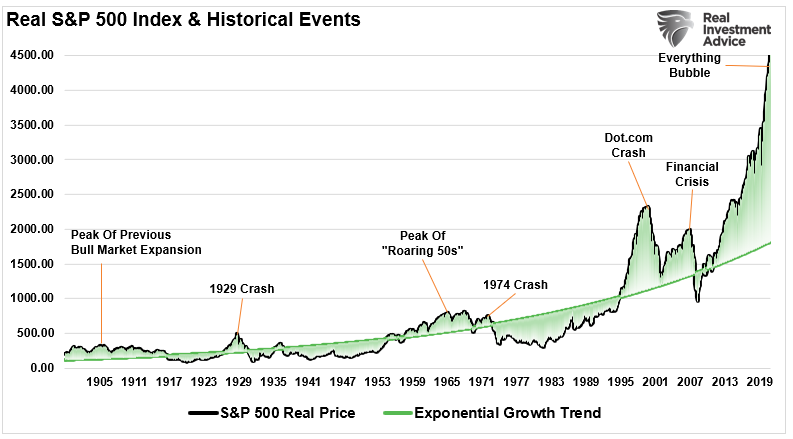
As I stated, Kiyosaki is right. The biggest crash in world history is coming, and it will be due to the most powerful financial force in the financial markets – mean reversions. The chart below shows the deviation of the inflation-adjusted S&P 500 index (using Shiller data) from its exponential growth trend.
Note that the market reverted to or beyond its exponential growth trend in every case, without exception.
(Usually, when charting long-term stock market prices, I would use a log-scale to minimize the impact of large numbers on the whole. However, in this instance, such is not appropriate as we examine the historical deviations from the underlying growth trend.)
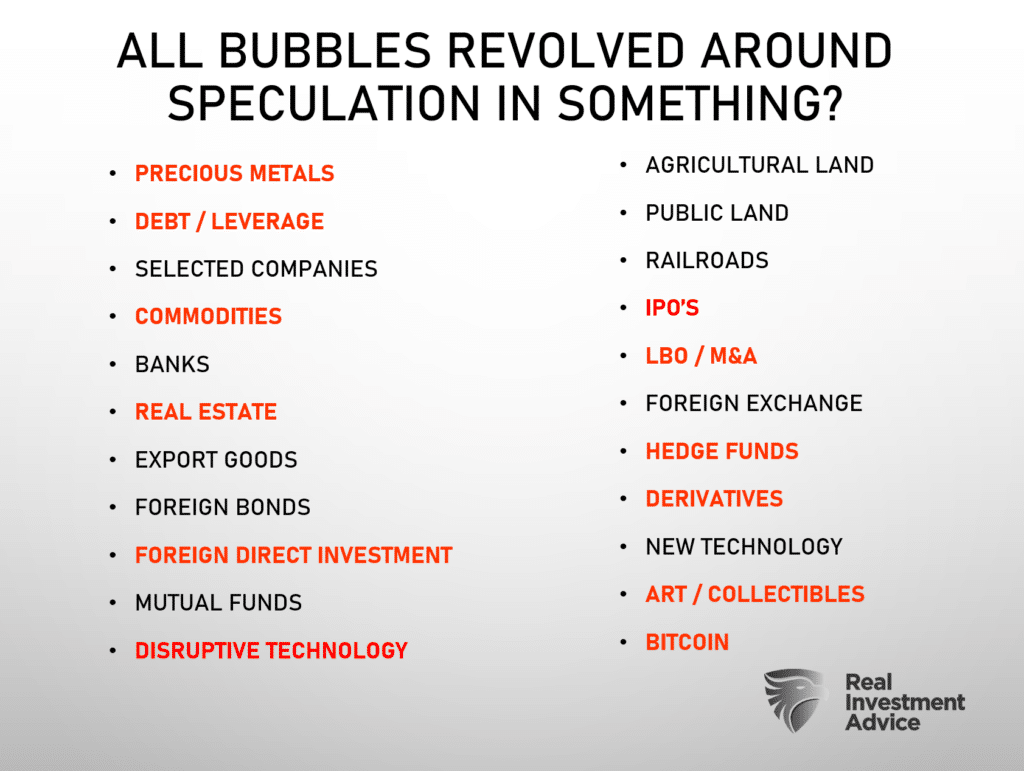
Importantly, this time is not different.There has always been some “new thing” that elicited speculative interest. Over the last 500 years, there have been speculative bubbles involving everything from Tulip Bulbs to Railways, Real Estate to Technology, Emerging Markets (5 times) to Automobiles, Commodities, and Bitcoin.
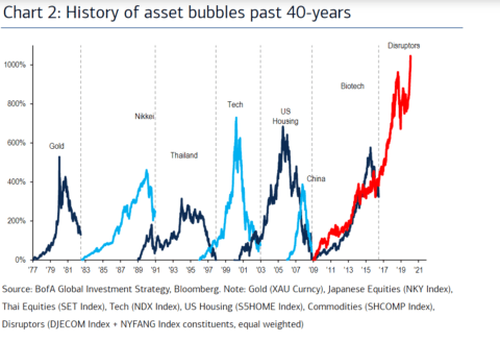
Jeremy Grantham posted the following chart of 40-years of price bubbles in the markets. During the inflation phase, each period got rationalized as “this time is different.”
Again, every financial bubble, regardless of the underlying drivers, had several things in common:
  1. Tremendous amounts of speculative interest by retail investors.
  2. A sincere belief “this time was different:” and,
  3. A tragic ending that devastated financial fortunes.
This time is likely no different.
Timing Is Everything
So, yes, a crash is coming.
However, the problem is the “when.”
A crash could come at any time, next month, next year, or another decade.
In the meantime, as noted, sitting in cash or some other asset that vastly underperforms either inflation or the market impedes the progress in achieving your financial goals.
Notably, crashes require an event that changes investor psychology from the “Fear Of Missing Out” to the “Fear Of Being In.” As noted previously,this is where the current lack of liquidity becomes extremely problematic.
The stock market is a function of buyers and sellers agreeing to a transaction at a specific price. Or rather, “for every seller, there must be a buyer.”
Such is an important point. Every transaction in the market requires both a buyer and a seller, with the only differentiating factor being at what PRICE the transaction occurs. When the selling begins in earnest, buyers will vanish, and prices will fall lower. Such is why the correction in March 2020 was so swift. There were indeed people willing to buy from panicking sellers. They were just 35% lower than the previous peak.
What could cause such a shift in psychology?
No one knows. However, historically speaking, crashes have always resulted from just a few issues.
  1. An unexpected, exogencous event that changes economic outlooks (Geopolitical Crisis, War, Pandemic)
  2. A rapid increase in interest rates.
  3. A sudden surge in inflation.
  4. Credit-related events that impact the financial system (Bankruptcies, Real Estate foreclosures, defaults)
  5. Monetary event (currency crisis)
Almost every financial crisis in history boils down ultimately to one of those five factors and mainly a credit-related event. Importantly, the event is always unexpected. Such is what causes the rapid change in sentiment from “greed” to “fear.”
Preparing For The Crash
As investors, we should never discount “risk” under the assumption some force, such as the Fed, has eliminated it.
Every era of speculation brings forth a crop of theories designed to justify the speculation, and the speculative slogans are easily seized upon. The term ‘new era’ was the slogan for the 1927-1929 period. We were in a new era in which old economic laws were suspended.” –Dr. Benjamin Anderson – Economics and the Public Welfare
So, we know two things with certainty:
  1. Robert Kiosaki will be correct about the next crash; and,
  2. We have no idea when it will happen.
Fortunately, we can take certain actions to protect portfolios from a crash without sacrificing financial goals. However, such actions are not “free” of cost.
  1. Properly sizing portfolio positions to mitigate the risk of concentrated positions.
  2. Rebalancing portfolio alllocations
  3. Take profits from extremely overbought and extended positions.
  4. Sell laggards
  5. When you are not sure what to do, do nothing. Cash is a great hedge against risk.
  6. Don’t dismiss the value of bonds in a portfolio.
  7. Look for non-correlated assets to mitigate risk.
As noted, there is a “cost.” Adding any strategy to a portfolio to mitigate or diversify risk will create underperformance relative to an all-equity benchmark index.
However, as investors, our job is not to beat some random benchmark index but to make sure our investments meet just two goals:
  1. Exceed the rate of inflation
  2. Meet the rate of return required to meet our long-term financial goals.
Any objective that exceeds those two goals requires an undertaking of increased risk and ultimately increases losses.
So, if you are afraid of the next crash, click here for a FREE REPORT.
Okay, I don’t actually have one.
However, you can certainly take some actions today to mitigate the risk of catastrophic losses tomorrow.

>>> US Research Calls

Research Calls

  • Upgrades:
    • Blackstone Secured Lending Fund (BXSL) upgraded to Outperform from Mkt Perform at Raymond James; tgt $26
    • Constellation Energy (CEG) upgraded to Buy from Neutral at Guggenheim; tgt $70
    • Copa Holdings (CPA) upgraded to Overweight from Underweight at Barclays; tgt $96
    • Duolingo (DUOL) upgraded to Outperform from Mkt Perform at Raymond James; tgt $98
    • Endeavor Group (EDR) upgraded to Overweight from Equal Weight at Barclays; tgt $27
    • First Solar (FSLR) upgraded to Overweight from Neutral at Piper Sandler; tgt raised to $90
    • Krispy Kreme, Inc. (DNUT) upgraded to Buy from Hold at HSBC Securities; tgt $17
    • Mercury (MRCY) upgraded to Buy from Hold at Truist; tgt raised to $71
    • Old National Bancorp (ONB) upgraded to Overweight from Equal-Weight at Stephens; tgt $19
    • Squarespace (SQSP) upgraded to Outperform from Neutral at Wedbush
    • WEC Energy Group (WEC) upgraded to Buy from Neutral at BofA Securities; tgt $109
  • Downgrades:
    • Atmos Energy (ATO) downgraded to Neutral from Buy at Goldman; tgt $113
    • Avaya Holdings (AVYA) downgraded to Market Perform from Outperform at Cowen; tgt lowered to $6
    • Carvana (CVNA) downgraded to Hold from Buy at Jefferies; tgt lowered to $40
    • Equinor (EQNR) downgraded to Hold from Buy at Jefferies
    • Fluence (FLNC) downgraded to Neutral from Buy at Goldman; tgt lowered to $9.50
    • ironSource (IS) downgraded to Neutral from Buy at BTIG Research
    • KB Home (KBH) downgraded to Underperform from Peer Perform at Wolfe Research; tgt $28
    • Meritage (MTH) downgraded to Peer Perform from Outperform at Wolfe Research
    • Outbrain Inc. (OB) downgraded to In-line from Outperform at Evercore ISI; tgt $9
    • PetIQ (PETQ) downgraded to Perform from Outperform at Oppenheimer
    • TuSimple Holdings (TSP) downgraded to Sector Perform from Outperform at RBC Capital Mkts; tgt lowered to $7
  • Others:
    • Alcon (ALC) assumed with an Outperform at Credit Suisse; tgt $96
    • ESAB Corp. (ESAB) initiated with a Hold at Loop Capital; tgt $52
    • Henry Schein (HSIC) assumed with an Outperform at Credit Suisse; tgt $100
    • indie Semiconductor (INDI) assumed with a Buy at The Benchmark Company; tgt $17
    • Inseego (INSG) resumed with a Hold at Stifel; tgt $2.50
    • Patterson Companies (PDCO) assumed with an Outperform at Credit Suisse; tgt $36
    • Royalty Pharma (RPRX) initiated with a Sector Outperform at Scotiabank; tgt $53

>>> US Gapping down

Gapping down
In reaction to earnings/guidance
:

  • FIGS -24.7%, NEWR -12.8% (also CFO to retire), SKYH -7.5%, ENFN -6%, HLI -2.9% (also increases dividend and authorizes new $500 mln share repurchase program), PAM -2.1%, NVTS -1.9%, MCW -1.8%, LAW -1.7%, BLND -1.3%, EMBC -0.9%

Other news:

  • TWTR -13.8% (Elon Musk tweets "Twitter deal temporarily on hold pending details supporting calculation that spam/fake accounts do indeed represent less than 5% of users")
  • WSR -1.1% (files for $500 mln mixed securities shelf offering)
  • HBM -1% (receives court ruling regarding Rosemont copper project) .

Analyst comments:

  • TSP -1.8% (downgraded to Sector Perform from Outperform at RBC Capital Mkts)
  • PETQ -1.1% (downgraded to Perform from Outperform at Oppenheimer)
  • ATO -1% (downgraded to Neutral from Buy at Goldman)