SMCP : Satellite images ‘suggest China is practising missile strikes on targets

Satellite images ‘suggest China is practising missile strikes on targets in Taiwan and Guam’
  • Analysts say new images of mock targets in the Taklamakan desert suggest the PLA is refining its strike capacity to hit smaller ships
  • One of the mock targets is described as resembling a base in northeast Taiwan that would be a key target in the event of conflict


CrunchBase : The Week’s 10 Biggest Funding Rounds: Faire Adds On $416M, Investor

The Week’s 10 Biggest Funding Rounds: Faire Adds On $416M, Investors Are Warming Up To Climate Change
Climate change and biotech ruled the list this week, as more traditional enterprise software solutions—once a favorite of VCs—were hard to find. However, the biggest bet was an extension of a round from a marketplace for retailers, and one of three rounds of a quarter-billion dollars or more this week.

1. Faire, $416M, retail: Some startups are having trouble raising cash right now. San Francisco-based Faire is not one of them. In November, the marketplace for retailers raised a $400 million Series G co-led by Durable Capital Partners, D1 Capital Partners and Dragoneer Investment Group at a $12.4 billion valuation. This week, Faire more than doubled the size of the round, raising a $416 million extension, according to TechCrunch. The new cash infusion values the company, which allows retailers to buy wholesale from smaller independent brands, at $12.59 billion post-money. The company has now raised $1.5 billion, according to Crunchbase data.

2. Summit Carbon Solutions, $300M, fossil fuels: Fighting climate change is big—even with investors right now. Ames, Iowa-based Summit Carbon Solutions, which captures and stores carbon in the U.S. Midwest, raised $300 million from TPG Rise Climate. In addition, the company said it raised another $100 million-plus in secured commitments. Summit previously had raised more than $600 million from investors that included Continental Resources and Tiger Infrastructure Partners. The company’s carbon storage project aims to annually capture and permanently store up to 20 million tons of carbon dioxide from industrial facilities.

3. Rippling, $250 million, HR tech: Although layoffs are in the news, many companies continue to search for talent and are using tech to help that cause. That has made the HR tech sector hot for investment. The latest to raise a big round is San Francisco-based startup Rippling, which raised a $250 million Series D co-led by Kleiner Perkins and Bedrock. The new cash takes Rippling’s total funding to about $700 million and increases its valuation to more than $11 billion, from around $6.5 billion after its $250 million Series C in October. The company’s platform helps automate management of employee systems—from payroll, benefits and what apps they have access to—all from one place. The company was founded by Parker Conrad, the former CEO of Zenefits.

4. Abnormal Security, $210M, cybersecurity: Few sectors mint unicorns as fast as cybersecurity. The newest is San Francisco-based AI-based email security platform Abnormal Security after its $210 million Series C led by Insight Partners that values the company at $4 billion. While often overlooked in the security sector, one of the most common ways bad actors attack companies is through email. Abnormal’s valuation makes the company the 12th unicorn to be minted this year in cybersecurity, according to Crunchbase data. The company has raised nearly $284 million, according to Crunchbase.

5. Arcadia, $200M, energy: As mentioned earlier, fighting climate change is popular with investors right now. Washington D.C.-based Arcadia closed a $200 million round led by an inaugural investment from J.P. Morgan Asset Management’s Sustainable Growth Equity Team. The company’s platform gives energy companies access to data and renewable energy sources, enabling them to deliver power to their customers and decarbonize the grid. With the new money, Arcadia plans to broaden its data coverage to include commercial utility data and help assist companies to reach their sustainability goals. Founded in 2014, the company has now raised more than $370 million, according to Crunchbase.

6. Chainalysis, $170M, crypto: The combination of crypto and venture capital is amazing sometimes. Even as the crypto market continued a rocky week with bitcoin rising and falling and the so-called stablecoin TerraUSD being anything but, startups in the space continue to raise money at a break-neck pace (yes, we do realize this money was likely raised weeks ago). New York-based Chainalysis raised a $170 million Series F at an $8.6 billion valuation led by Singapore’s sovereign wealth fund GIC. The company detects fraud and gives analysis of blockchain data and crypto transactions to governments, banks and businesses.The new round more than doubles Chainalysis’ valuation from its $100 million Series E led by Coatue that gave it a $4.2 billion valuation last June. The company has now raised more than $536 million, according to Crunchbase numbers.

7. Moma Therapeutics, $150M, biotech: Cambridge, Massachusetts-based Moma Therapeutics, a precision medicine company focusing on disease-causing targets, completed a $150 million Series B financing led by Goldman Sachs Asset Management. Founded in 2020, the company has raised $236 million to date, according to Crunchbase data.

8. Aspen Neuroscience, $147.5M, biotech: San Diego-based Aspen Neuroscience, which is developing an autologous cell therapy for Parkinson’s disease, closed a $147.5 million Series B co-led by GV, Lyfe Capital and Revelation Partners. Founded in 2018, Aspen has raised more than $220 million, according to the company.

9. Stord, $120M, supply chain: Atlanta-based supply chain startup Stord announced an additional $120 million to its Series D led by Franklin Templeton. This brings the total of the round to $210 million and ups its valuation to $1.3 billion. In September, the company announced it raised a $90 million Series D funding led by Kleiner Perkins that valued the company at $1.1 billion.

10. Tifin, $109M, fintech: Boulder, Colorado-based AI-powered fintech platform Tifin closed a $109 million Series D valuing the company at $842 million. New investors include Franklin Resources and Motive Partners. Founded in 2018, the company has raised nearly $206 million, according to Crunchbase.

WWD : Prada’s Lorenzo Bertelli on Group’s Sustainability Journey

Prada’s Lorenzo Bertelli on Group’s Sustainability Journey
Lorenzo Bertelli believes 2021 was one of the “important milestones for the Prada Group’s sustainability journey,” presenting its most recent CSR report.

MILAN — Emphasizing its commitment to environmental, social and governance issues, the Prada Group on Friday presented its 2021 corporate social responsibility report.

Last year was one of the “important milestones for the Prada Group’s sustainability journey,” wrote Lorenzo Bertelli, head of CSR, in the report noting how ESG initiatives are “becoming more and more visible for internal and external stakeholders.”

As reported, in January, the Italian luxury group appointed two new independent non-executive directors, Pamela Culpepper and Anna Maria Rugarli, selected for their professional background in ESG. The appointments also signaled the establishment of an ESG board committee led by Bertelli, Culpepper and Rugarli.

The committee is supporting the board in its sustainability assessments and decisions with regard to the three courses of action that form the basis of the group’s ESG strategy: people, environment and culture.

“Throughout 2021, we were engaged in promoting an internal culture more focused on social and environmental topics. The strong awareness, along with the group’s long-term investments, enabled [the group] to advance quickly on key matters that have had a strategic role for some time, such as environmental protection and the fight against climate change,” Bertelli said.

Prada, which is part of the Fashion Pact, during its Capital Markets Day in November revealed that its greenhouse gas emissions reduction targets had been approved by the Science-Based Targets initiative and that its goal was to reach net-zero emissions in 2050.

Bertelli pointed out that, in 2022, Prada is beginning its carbon-neutral scope 1 and 2, aiming at a 29 percent cut in GHG emissions by 2026, and a 42 percent reduction by 2029. It has also set “a series of other goals in terms of sustainable raw materials and packaging,” he said.

The young executive emphasized the group’s commitment to diversity, equity and inclusion and the ongoing partnership with UNESCO’s Intergovernmental Oceanographic Commission for the Sea Beyond education project, which was launched in 2019 and is dedicated to the promotion of ocean literacy and ocean preservation.

“These choices demonstrate the consistency between the Prada Group’s core values and its commitment to carrying out concrete projects. I believe that it is crucial to pursue a more sustainable business model, capable of an agile and coherent response to the increasingly complex challenges of the upcoming years, thanks in part to the fundamental engagement of our key stakeholders,” concluded Bertelli.

Among the highlights last year, Prada, which reported revenues of 3.4 billion euros, listed the number of its workforce — 13,140; 635 directly operated stores; 23 industrial facilities; investments of 217 million euros, and donations amounting to 3 million euros.

The group secured two new sustainability-linked loans in 2021 and organized specific training programs for the industrial divisions to provide constantly updated tools for managing and analyzing the sustainability issues that most impact the supply chain, the report stated.

Last year, the group also achieved full conversion to Re-Nylon.

The Information : Musk’s Latest Twitter Move May Not Be as Crazy as It Seems

Musk’s Latest Twitter Move May Not Be as Crazy as It Seems

What would business journalists do without Elon Musk? It’s a Friday, after all, when business news tends to be scarce. So we appreciate Musk’s decision to liven up our day with his early morning tweets, declaring the Twitter acquisition to be “on hold” and then proclaiming his continued commitment to it. What’s going on? The simplest explanation is probably correct: Musk wants to cut the price, having realized he is massively overpaying. And he wouldn’t be wrong in thinking that.
Before Musk disclosed his Twitter stake in early April, Twitter shares were trading—as they had for a couple of years on average—at roughly half the forward sales multiple of Snap, a social media company of comparable size, according to Koyfin data. But in recent weeks, as Snap stock fell with the market while Twitter did not, the multiple on the two stocks has converged to the point where they’re nearly equal. Twitter stock would have to be trading around $24 to restore that historical relationship, which it would be if Musk walked away. If Musk were making his offer today, he might pay only around $28, including a premium. In other words, his original $54.20 price is nearly 50% too high.

Of course, the Twitter board has no reason to agree to a price reduction. Obviously, Musk should have anticipated how the market would move when he made his offer. As we pointed out on April 25, the day his bid became public, he was taking a big risk in buying Twitter at that moment. Then (as now) we looked to be on the verge of a recession. (CEO Parag Agrawal confirmed the parlous state of the ad industry with his cost-cutting moves this week, which he elaborated on publicly today.) And while the market has deteriorated in the last few weeks, conditions were volatile when the deal was done. Musk can’t credibly claim things have changed meaningfully since then. Even if they had, Twitter’s business isn’t in such bad shape that the board would need to sell at a fire-sale price in the middle of a major market meltdown.

All of that suggests Musk will either have to live with the existing deal, or walk away and accept the consequences. He can afford to handle those consequences. After all, Musk is a little like Donald Trump: He acts like the usual rules don’t apply to him and manages to get away with figurative murder. The real pity, if the deal collapses, is that Twitter could use the fresh ideas and energy Musk would have brought to the company. Someone, somewhere will probably end up buying out Twitter—if not Musk, maybe a private equity firm that sees the potential to cut enough costs to boost the company’s profits. The only question is who and at what price.

FT : G7 warns of global hunger crisis unless Russia lifts Ukraine blockade

G7 warns of global hunger crisis unless Russia lifts Ukraine blockade
German foreign minister says alternative export routes are urgently needed as wheat price soars

German foreign minister Annalena Baerbock said the G7 group of industrialised nations was urgently seeking alternative routes for the export of Ukrainian grain as Russia’s war against its western neighbour raised the risk of a global “hunger crisis”.

Speaking at the conclusion of a three-day meeting of G7 foreign ministers in Germany, Baerbock said some 25mn tonnes of grain were stuck in Ukrainian ports that were being blockaded by Russian forces — “grain that the world urgently needs”.

“Every tonne we can get out will help a bit to get to grips with this hunger crisis,” she said. “In the situation we’re in, every week counts.”

Wheat prices have been soaring in recent weeks over supply concerns caused by the Ukraine war, as well as a number of droughts around the world.

The US Department of Agriculture forecast that global supplies for the coming crop year would fall for the first time in four years.

Worries about the supply situation deepened on Saturday when India announced it was banning wheat exports, a move that is likely to push up food prices and fuel hunger in poor countries that rely on imports of Indian grain.

The government in New Delhi said the ban was designed to “manage the overall food security of the country”.

The issue of food emerged as one of the key issues in the G7 ministers’ weekend deliberations. Their final communique said Russia’s war had “generated one of the most severe food and energy crises in recent history, which now threatens those most vulnerable across the globe”.

It said the G7 was “determined to accelerate a co-ordinated multilateral response to preserve global food security and stand by our most vulnerable partners in this respect”.

Baerbock said the easiest way to resolve the food crisis would be for Russia to stop its combat operations and allow grain out of Ukrainian ports, a move that would help to “normalise global food prices”. But she said Russian president Vladimir Putin showed no inclination to do that.

Instead, western governments were looking at alternatives to the sea route. She said some 5-6mn tonnes of grain per month are normally exported via Ukraine’s ports and the G7 was “analysing different rail routes that will allow us to get the grain out as soon as possible”.

So far, she said, the Ukrainians had succeeded in transporting only a “fraction” of their grain harvest by rail, via Romania. “But the bottleneck there is due to the fact that Ukraine has a different track gauge [to Romania],” she said. “That’s the same for other connections too, for example, with Poland — freight cars can’t just pass through.”

She said the G7 ministers had also discussed using Baltic ports to export grain. “But you have to reach them first”. “There won’t be a perfect solution so long as the [Russian] bombardments are continuing,” she said.

In their communique, the G7 ministers expressed “deep concern” at the worsening state of food insecurity and malnutrition across the world, which had been exacerbated by the Covid-19 pandemic and the Russian war in Ukraine.

“Food prices and costs for humanitarian agencies to deliver assistance to those in greatest need are both rising, at a time when 45mn people are already one step away from famine,” it said.

FT : Turkey’s president objects to Finland and Sweden’s Nato applications

Turkey’s president objects to Finland and Sweden’s Nato applications
Recep Tayyip Erdoğan accuses the two countries of supporting Kurdish militants

Turkey’s president Recep Tayyip Erdoğan has come out against allowing Sweden and Finland to join Nato, putting the two Nordic countries’ hopes of joining the western military alliance in jeopardy.

In a move that could undermine Turkey’s efforts to strengthen ties with the US and Europe in the wake of Russia’s invasion of Ukraine, Erdoğan — whose country has been a Nato member since 1952 — on Friday said he could not take a “positive view” of the two nations’ potential bids for membership.

The obstacle was their support for the Kurdistan Workers’ party (PKK), which has waged a decades-long armed insurgency against the Turkish state, he said. It is classified as a terrorist organisation by Ankara, the US and the EU. Turkey’s president also named a far-left extremist group.

“Scandinavian countries are like some kind of guest house for terrorist organisations,” Erdoğan told reporters, referring to the Nordic countries. “They are even in parliament.”

He added: “At this point, it’s not possible for us to look positively at this.”

Some Swedish officials and MPs have been worried that Turkey could pose the most dangerous opposition to a potential Nato bid, which appears to be backed by most of the alliance’s other 29 members but requires unanimous support.

“There are a lot of Kurds in Sweden, there are a lot of MPs with Kurdish background, Sweden has been active on the Kurdish issue — I’m afraid there could be a backlash,” one senior Swedish official said earlier this month.

Finnish and Swedish diplomats have been crossing Europe and the Atlantic to curry favour with Nato members, whose ratification is necessary for them to become members.

German foreign minister Annalena Baerbock said on Saturday that Sweden and Finland were strong countries in terms of their defence capabilities “and for that reason alone their contribution would make Nato stronger”.

“Sweden and Finland are also stable democracies that have lived in peace with all their neighbours for decades,” she said. “And for that reason every democratic country should be delighted that democracies with strong defence capabilities would in this way make our defence alliance stronger.”

Russia has threatened “serious military and political consequences” if either country joins Nato, and on Friday said it would suspend electricity exports to Finland because it had not been paid.

Ann Linde, Sweden’s foreign minister, told Swedish radio on Friday that Turkey could be trying to use the membership push to gain something it wanted. “We know that ratification processes always involve uncertainties, not least that the ratification could be used for domestic politics,” she added.

Pekka Haavisto, Finland’s foreign minister, urged patience, saying: “You can expect everything in the application process . . . let’s take issues step by step.”

Some Finnish officials said Turkey’s problems seemed to be mostly with Sweden and that their own discussions with Ankara had been positive.

Finnish officials have focused particularly on Hungary, which they feared could seek concessions to approve their membership.

Finland’s president Sauli Niinistö spoke with Erdoğan on April 4, describing the phone call as “positive” on Twitter and adding: “Turkey supports Finland’s objectives.”

Niinistö on Friday night said he and Sweden’s prime minister Magdalena Andersson had spoken with US president Joe Biden, including about Finland’s next steps towards Nato membership. “Finland deeply appreciates all the necessary support from the US,” the president added.

Nato officials have said they expect Finland and Sweden to become formal invitees within “a couple of weeks” but that it could take six to 12 months for all 30 existing members to ratify their applications.

Finland’s government will meet on Sunday with president Niinistö set to finalise the country’s application. On the same day, Sweden’s ruling Social Democrats will make their position known before an announcement by the government next week. The countries could choose to send their applications to Nato jointly next week during a state visit of Niinistö to Stockholm.

Turkey had suffered from strained relations with Nato allies in recent years. The US imposed sanctions in 2020 in retaliation for Erdoğan’s decision to buy and take delivery of a Russian-made S-400 air defence system.

Western nations had been buoyed by Turkey’s support for Ukraine in the aftermath of Russia’s invasion, with Ankara supplying armed drones to Kyiv and taking steps to limit the transit of Russian warships and military planes through its airspace — although it has refused to sign up to western sanctions against Moscow.

WSJ : U.A.E. Names Mohammed bin Zayed as New Leader Following His Half-Brother’s

U.A.E. Names Mohammed bin Zayed as New Leader Following His Half-Brother’s Death
Leadership change is likely to have few short-term political or economic implications as Sheikh Mohammed for years has steered the country’s policy

The United Arab Emirates named Mohammed bin Zayed al Nahyan as its new president following the death of his half-brother, elevating the Abu Dhabi crown prince after nearly a decade as de-facto ruler of the U.S. partner.

The leadership change is likely to have few short-term political or economic implications for the U.A.E., as Sheikh Mohammed for years has steered the country’s domestic and foreign policy, alongside a cadre of powerful brothers and other leaders of the federation.

The country’s Federal Supreme Council, comprising the rulers of the country’s seven emirates, unanimously elected Sheikh Mohammed as president, state news agency WAM said Saturday. Leaders of Abu Dhabi’s royal family have traditionally held the role of president of the seven-member federation, which includes Dubai.

The new leader’s half-brother, Sheikh Khalifa, died a day earlier. He underwent an operation after suffering a stroke in 2014 and was rarely seen publicly afterward.

Since then, Sheikh Mohammed, 61 years old, has directed the U.A.E. to be more outward looking. The country has intervened in regional conflicts, used its vast oil wealth to buy influence abroad and established itself as the Middle East’s commercial hub, giving the expatriates that make up nine 10ths of the population a lifestyle akin to that in their home countries.

Sheikh Mohammed, known as MBZ, is widely considered to be the driving force behind the country’s move to agree diplomatic relations with Israel and its efforts to lobby the U.S. and other states to contain what he considers to be an expansionist Iranian policy in the Middle East.

Since Russia invaded Ukraine, the U.A.E. has sought to play a neutral role, condemning the Russian actions while avoiding implementing U.S. and European sanctions and remaining open to Russians seeking refuge or moving wealth.

That position so far has strained ties with the Biden administration and raised concerns that the country will become a bypass for sanctioned Russians.

Following the invasion, the White House unsuccessfully tried to arrange a call between President Biden and Sheikh Mohammed, as well as a separate call with Saudi Arabia’s de-facto leader, to build international support for Ukraine and contain a surge in oil prices, The Wall Street Journal reported.

Central to the U.A.E.’s frustration with its relationship with the U.S. has been Iran. The Emiratis say they have expressed concerns to U.S. officials about what they see as the restrained U.S. response to missile strikes earlier this year by Iran-allied Houthi militants in Yemen against the U.A.E. and Saudi Arabia.

U.A.E. officials also have said they were concerned about the potential revival of a nuclear deal with Iran, negotiations over which have recently stalled.

Sheikh Mohammed becomes president as the U.A.E. is benefiting from oil prices that have been hovering above $100 for the first time since 2014, and are likely to help drive strong economic growth in the country over the next few years.

“They are rolling in oil revenue, there is a spring in the step in the real-estate market driven by Russians and others finding the U.A.E. a safe haven,” said David Butter, a Middle East politics and economics analyst at London-based think tank Chatham House. “The downside is that there is a risk of volatility in the future.”

Born in 1961, Sheikh Mohammed was educated at the U.K.’s Royal Military Academy at Sandhurst and trained as a pilot, later holding roles in the U.A.E. military. Under his leadership, the U.A.E. military became one of the most powerful forces in the Middle East as Emirati forces participated in regional operations such as Afghanistan.

Sheikh Mohammed’s mother, Fatima, was reputedly the favorite wife of U.A.E. founder Sheikh Zayed, and the former leader long groomed his son for power. He and his five full brothers are known as the “Bani Fatima,” or children of Fatima, and have for years held the most senior positions in Abu Dhabi and the U.A.E. government: Sheikh Abdullah is the country’s foreign minister, Sheikh Tahnoun is the spy chief and Sheikh Mansour is the deputy prime minister.

Sheikh Mohammed’s successor as Abu Dhabi’s crown prince hasn’t been announced.

Over the past 18 months, Sheikh Mohammed has pulled the U.A.E. back from a more interventionist foreign policy—in which it entered conflicts like Yemen, Syria and Libya—and instead tried to project an image as peacemaker.

The U.A.E. helped to broker a 2018 peace deal between Ethiopia and Eritrea, and Sheikh Mohammed last year visited Turkey, seeking a rapprochement with a Middle East neighbor with which the U.A.E. has had strained ties.

Sheikh Mohammed also in recent years has sought to publicly deepen his relationship with Sheikh Mohammed bin Rashid of Dubai, the second most powerful of the emirates and the country’s commercial hub.

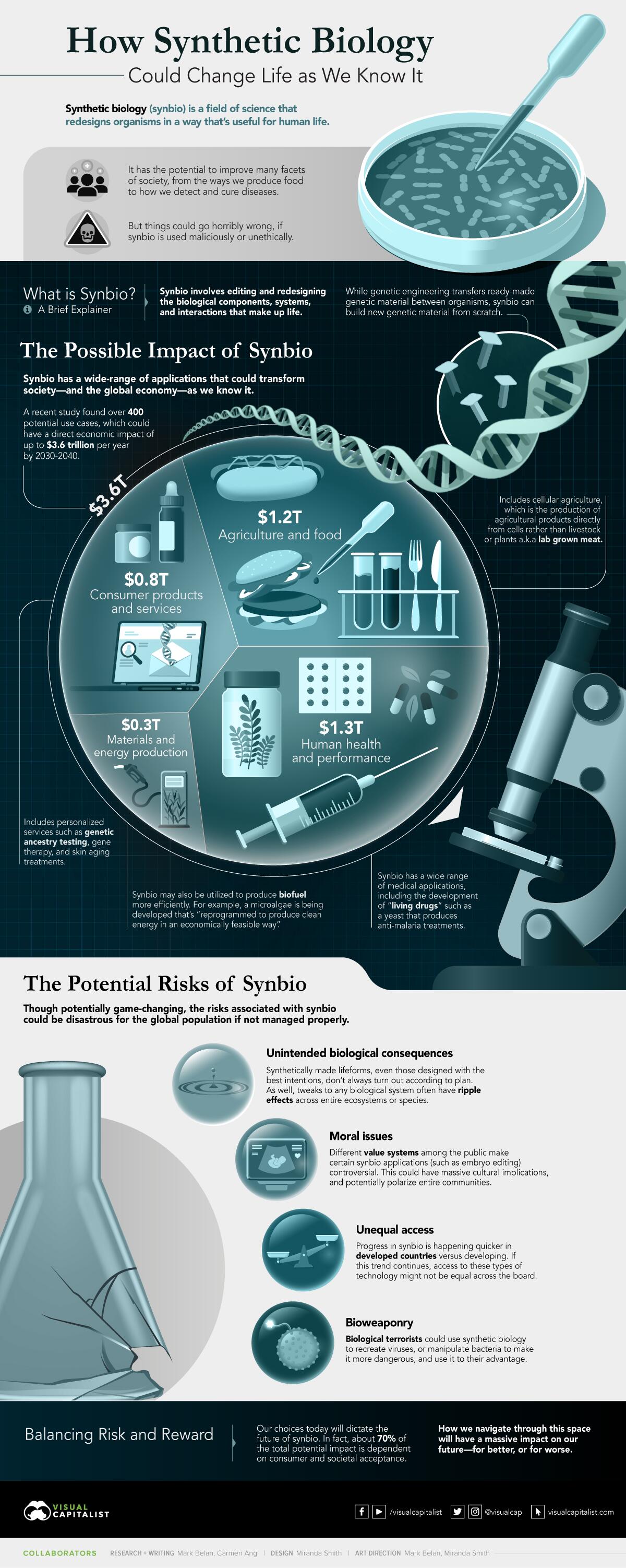
>>> Synthetic Biology: The $3.6 Trillion Science Changing Life As We Know It

Synthetic Biology: The $3.6 Trillion Science Changing Life As We Know It

Synthetic biology (synbio) is a field of science that redesigns organisms in an effort to enhance and support human life. According to one projection, this rapidly growing field of science is expected to reach $28.8 billion in global revenue by 2026.
As Visual Capitalist's Carmen Ang details below, although it has the potential to transform many aspects of society, things could go horribly wrong if synbio is used for malicious or unethical reasons. This infographic explores the opportunities and potential risks that this budding field of science has to offer.
What is Synthetic Biology?
We’ve covered the basics of synbio in previous work, but as a refresher, here’s a quick explanation of what synbio is and how it works.
Synbio is an area of scientific research that involves editing and redesigning different biological components and systems in various organisms.
It’s like genetic engineering but done at a more granular level—while genetic engineering transfers ready-made genetic material between organisms, synbio can build new genetic material from scratch.
The Opportunities of Synbio
This field of science has a plethora of real-world applications that could transform our everyday lives. A study by McKinsey found over 400 potential uses for synbio, which were broken down into four main categories:
  • Human health and performance
  • Agriculture and food
  • Consumer products and services
  • Materials and energy production
If those potential uses become reality in the coming years, they could have a direct economic impact of up to $3.6 trillion per year by 2030-2040.
1. Human Health and Performance
The medical and health sector is predicted to be significantly influenced by synbio, with an economic impact of up to $1.3 trillion each year by 2030-2040.
Synbio has a wide range of medical applications. For instance, it can be used to manipulate biological pathways in yeast to produce an anti-malaria treatment.
It could also enhance gene therapy. Using synbio techniques, the British biotech company Touchlight Genetics is working on a way to build synthetic DNA without the use of bacteria, which would be a game-changer for the field of gene therapy.
2. Agriculture and Food
Synbio has the potential to make a big splash in the agricultural sector as well—up to $1.2 trillion per year by as early as 2030.
One example of this is synbio’s role in cellular agriculture, which is when meat is created from cells directly. The cost of creating lab-grown meat has decreased significantly in recent years, and because of this, various startups around the world are beginning to develop a variety of cell-based meat products.
3. Consumer Products and Services
Using synthetic biology, products could be tailored to suit an individual’s unique needs. This would be useful in fields such as genetic ancestry testing, gene therapy, and age-related skin procedures.
By 2030-2040, synthetic biology could have an economic impact on consumer products and services to the tune of up to $800 billion per year.
4. Materials and Energy Production
Synbio could also be used to boost efficiency in clean energy and biofuel production. For instance, microalgae are currently being “reprogrammed” to produce clean energy in an economically feasible way.
This, along with other material and energy improvements through synbio methods, could have a direct economic impact of up to $300 billion each year.
The Potential Risks of Synbio
While the potential economic and societal benefits of synthetic biology are vast, there are a number of risks to be aware of as well:
  • Unintended biological consequences: Making tweaks to any biological system can have ripple effects across entire ecosystems or species. When any sort of lifeform is manipulated, things don’t always go according to plan.
  • Moral issues: How far we’re comfortable going with synbio depends on our values. Certain synbio applications, such as embryo editing, are controversial. If these types of applications become mainstream, they could have massive societal implications, with the potential to increase polarization within communities.
  • Unequal access: Innovation and progress in synbio is happening faster in wealthier countries than it is in developing ones. If this trend continues, access to these types of technology may not be equal worldwide. We’ve already witnessed this type of access gap during the rollout of COVID-19 vaccines, where a majority of vaccines have been administered in rich countries.
  • Bioweaponry: Synbio could be used to recreate viruses, or manipulate bacteria to make it more dangerous, if used with ill intent.
According to a group of scientists at the University of Edinburgh, communication between the public, synthetic biologists, and political decision-makers is crucial so that these societal and environmental risks can be mitigated.
Balancing Risk and Reward
Despite the risks involved, innovation in synbio is happening at a rapid pace.
By 2030, most people will have likely eaten, worn, or been treated by a product created by synthetic biology, according to synthetic biologist Christopher A. Voigt.
Our choices today will dictate the future of synbio, and how we navigate through this space will have a massive impact on our future—for better, or for worse.

(ZH) Food Riots In Sri Lanka Turn Deadly As Protesters Beat Up Police, Burn Down

Food Riots In Sri Lanka Turn Deadly As Protesters Beat Up Police, Burn Down Politicians' Houses

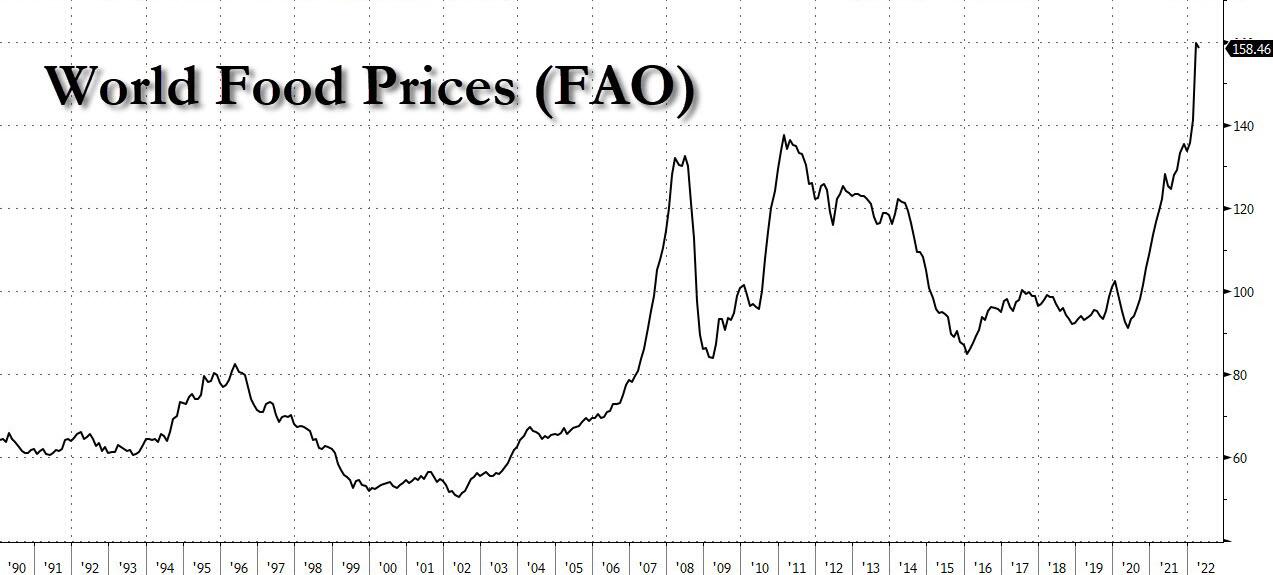
Two months ago, we noted the first Arab Spring 2.0 incident when, as a result of soaring food, energy (and everything else) prices, thousands of angry Iraqis took to the street to protest. Needless to say, their complaints did not get much traction, and in the meantime food prices have only exploded to fresh record highs, far surpassing the levels hit in 2011 when riots against, you guessed it, food prices toppled most MENA political regimes (not without some CIA backing).
And as food prices keep rising, the protests across poor nations keep escalating, and on Thursday protests broke out in Iran leading to at least 22 arrests, after the government cut subsidies for food, sending prices through the roof as authorities braced for more unrest in the following weeks, Fox News reports.

In videos shared on social media, protesters can be seen marching through Dezful and Mahshahr in the southwestern province of Khezestan, chanting “Death to Khamenei! Death to Raisi!” referring to Iranian President Ebrahim Raisi has promised to create jobs, lift sanctions, and rescue the economy.

Iranian state media has not publicly addressed the protests, but they have been covered by the National Council of Resistance of Iran, an opposition group. Footage shared by the NCRI shows protesters setting fire to a Basij military base in Jooneghan, a city in the Central District of Jooneghan county.
"Every so often we see these types of protests in Iran. Each time it is under a different premise – the price of eggs, the price of gas, the price of bread, but the underlining message which is supported by the slogans heard throughout the demonstrations is the same; they are protesting the entirety of a brutal regime," Lisa Daftari, Iran expert and editor-in-chief of the Foreign Desk, said in a statement.
"It is also evident in the fact that these protests are no longer just contained to Tehran, the capital city, and other urban areas. We are seeing protests throughout the country in urban and rural areas and throughout the very vast and diverse Iranian population."
Daftari is right, and not just about Iran (and Iraq), but also Sri Lanka, where protesters angry at the soaring prices of everyday commodities including food, have burned down homes belonging to 38 politicians as the crisis-hit country plunged further into chaos, with the government ordering troops to "shoot on sight."
Police in the island nation said Tuesday that in addition to the destroyed homes, 75 others have been damaged as angry Sri Lankans continue to defy a nationwide curfew to protest against what they say is the government's mishandling of the country's worst economic crisis since 1948.
The Ministry of Defense on Tuesday ordered troops to shoot anyone found damaging state property or assaulting officials, after violence left at least nine people dead since Monday, according to CNN; it is unclear if all of the deaths were directly related to the protests. More than 200 people have been injured.
The nation of 22 million is grappling with a devastating economic crisis, with prices of everyday goods soaring, and there have been widespread electricity shortages for weeks. Since March, thousands of anti-government protesters have taken to the streets, demanding that the government resign.
The military had to rescue the country's outgoing Prime Minister Mahinda Rajapaksa in a pre-dawn operation on Tuesday, hours after he resigned following clashes between pro- and anti-government protesters. The military were called after protesters twice tried to breach the Prime Minister's Temple Trees private residence compound overnight, a senior security source told CNN.
Rajapaksa's resignation came after live television footage on Monday showed government supporters, armed with sticks, beating protesters at several locations across the capital, and tearing down and burning their tents. Dozens of homes were torched across the country amid the violence, according to witnesses CNN spoke to.
Armed troops were deployed to disperse the protesters, according to CNN's team on the ground, while video footage showed police firing tear gas and water cannons.
It remains unclear if the curfew and the Prime Minister's resignation will be enough to keep a lid on the increasingly volatile situation in the country.
Many protesters say their ultimate aim is to force President Gotabaya Rajapaksa -- the Prime Minister's brother -- to step down, something he has so far shown no sign of doing.
* * *
Going back to the same soaring food prices which tend to have quite a deadly and destabilizing impact on the world's mostly poor nations, the ones who have no social safety net, Goldman recently published a Q&A on global food inflation (available to Professional Subscribers in the usual place), in which the bank look at the consequences of the global food crisis which is only getting worse by the day. Below we excerpt several sections from the Q&A:
Q. How large is the shock to global food prices?
A. Quite large but not unprecedented, and less large than the shock to energy prices.
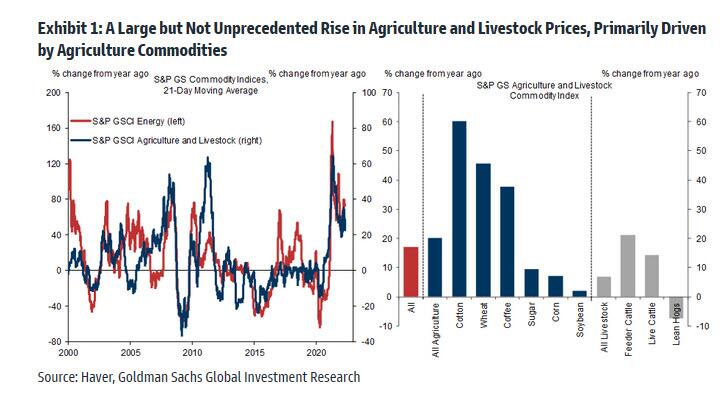
Our GSCI Agriculture and Livestock index has increased by 17% over the past year and by 75% since the start of the pandemic (Exhibit 1, LHS). These moves are similar to those in 2008 and 2012 but less large than the current rise in energy prices. Our GSCI Energy index has increased by 70% over the past year and by 110% since the start of the pandemic. Agriculture commodities have seen sharper price gains than livestock commodities with increases in the GSCI Agriculture Index of 21% over the last year and 90% since early 2020 (Exhibit 1, RHS). Wheat prices have risen particularly sharply since 2020H2 due to unfavorable weather conditions and higher input costs.
Q. How is the war in Ukraine affecting global food prices and what is the outlook?
A. War-related supply disruptions have contributed to the rise in wheat and oilseed prices. Our commodity strategists expect wheat prices to rise up to 15% over the next few months, with upside risk for the next year.
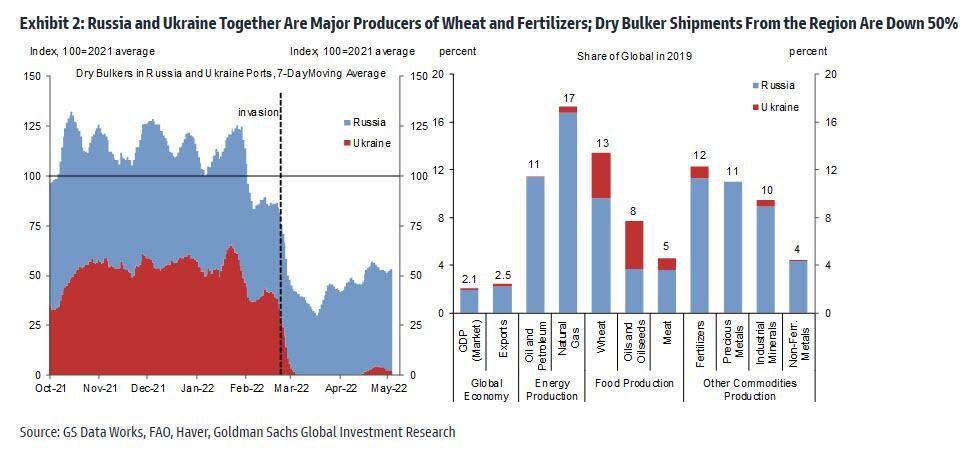
The war in Ukraine has severely disrupted shipments of grains and oilseeds from the region. Combined dry bulk shipping activity in Russia and Ukraine ports has dropped by 50% compared to the 2021 average (Exhibit 2, LHS). The war is also likely to depress future production by disrupting Ukrainian spring planting of corn and sunseed and tillering of wheat. Russia and Ukraine together account for 13% and 8% of global wheat and oilseeds production, respectively (Exhibit 2, RHS), with CEEMEA countries especially relying on food imports from the region. As a result, wheat and oilseed futures have increased by 30% and 25% since the invasion, respectively, from already high levels.
Although the region plays an important role in global food production, Russia’s share in global energy production is even higher. This helps to explain why energy prices have generally risen more since the invasion than food prices.
Q. How does the hit from higher food prices to consumer purchasing power compare across economies?
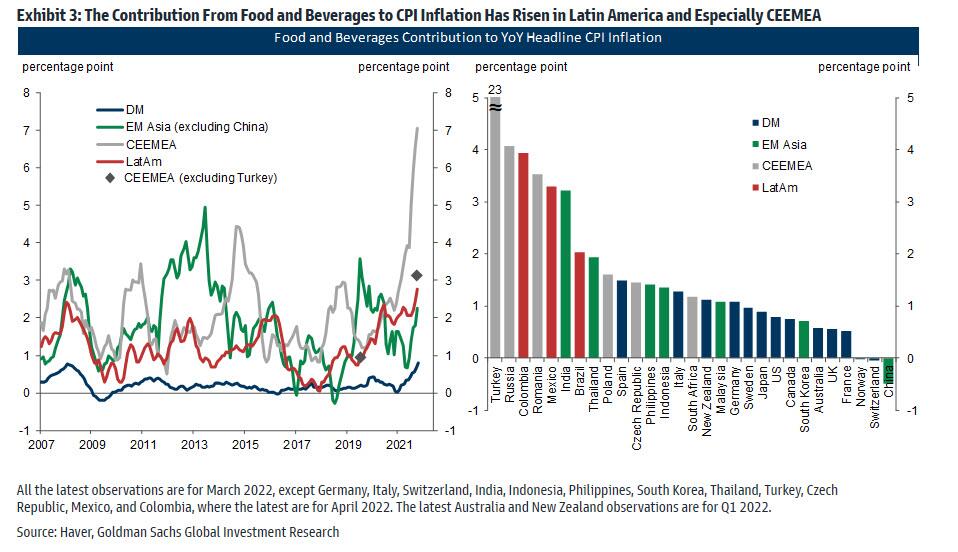
A. The contribution from food and beverages to year-over-year headline CPI inflation is the largest in CEEMEA (7.1pp, PPP-weighted average), followed by Latin America (2.8pp). The contributions are less large in EM Asia excluding China (2.3pp), in DMs (0.8pp), and China (-0.5pp).
The food contribution to inflation is larger in EMs than DMs, although it is not unprecedented for Latin America and EM Asia (excluding China). While less elevated than in comparison to EMs, the current DM food contribution of 0.8pp is the highest on record, going back to 1996 (Exhibit 3, LHS).
By country, the food contribution is the largest in Turkey (23pp) and Russia (4pp), but negative in China at -0.5pp (Exhibit 3, RHS). The very large contribution in Turkey reflects sharp currency depreciation, reliance on imports of cereal, oilseeds, and oils from Russia and Ukraine, and droughts. The large food contribution in Russia partly reflects recent war-triggered demand from hoarding of non-perishable food. Finally, food deflation in China reflects oversupply of hogs.
* * *
Q. What are the key implications of elevated food inflation for financial markets?

A. Upward pressure on EM policy rates and negative effects on credit and FX markets in frontier economies facing sharp “food-only” terms of trade deteriorations.

Further food price increases would likely put upward pressure on global and especially EM policy rates given the already very elevated inflation levels, and often less well anchored inflation expectations. The impact on DM policy rates should be more limited smaller, although food prices also influence DM short-term inflation expectations.
High food inflation can also have negative effects on credit and FX markets in frontier economies facing sharp terms of trade deteriorations. “Food-only” terms of trade have worsened in about 80% of the EMs this year. Using data on these terms of trade moves, food CPI weights, and fiscal balances, our EM strategists conclude that frontier sovereign credit markets in Egypt, Ghana, Tunisia, and Morocco are particularly vulnerable to food inflation shocks. Rising food inflation may also contribute to sociopolitical unrest in lower-income countries, as is currently the case in Sri Lanka