Can blockchain smooth global supply chains?
Digitising shipping processes throws up a range of regulatory challenges
From finance to art, blockchain enthusiasts have long claimed the technology can transform a range of industries. But, now, lawyer Martyn Huckerby believes the technology could help solve the global supply chain crisis.
Huckerby is head of competition law at Tiang & Partners, a Hong Kong-based law firm. And, recently, he led a team of lawyers as they helped establish the Global Shipping Business Network (GSBN), which was launched last year with the aim of increasing digitisation in the global logistics industry.
“There are a lot of challenges in the [shipping and logistics industries] at the moment,” he says. “The founding members [of GSBN] have seen an opportunity.
“It is the kind of thing most lawyers would like to have the chance to work on. And it is something that will hopefully help the world,” he adds.
The supply chain is a very fragmented market with participants who largely rely on paper
Bertrand Chen, GSBN
The global supply chain certainly needs assistance. From the outbreak of Covid-19 to the war in Ukraine and China’s recent lockdowns, a string of extraordinary events has upended the system that ensures the smooth movement of goods across the world.
GSBN’s aim is to use blockchain to build a repository of digital data on global trade flows that will help “streamline operations across the entire supply chain”.
To try to achieve this ambition, Huckerby and his team had to tackle a number of legal and regulatory obstacles, not least because some of the founding members are Chinese state-owned companies.
“The supply chain is a very fragmented market with participants who largely rely on paper,” explains Bertrand Chen, chief executive of GSBN. He believes digitising logistics will speed up trade. “The biggest issue is: how do we share the data?”
Blockchain — a technology typically associated with cryptocurrencies — is a catch-all term for a type of encrypted digital ledger used for recording transactions.
GSBN, whose membership comprises eight shipping and port operators across the world, hopes to use it as the backbone for a secure database that various businesses can contribute to, and draw insights from.
From supermarkets across the world struggling to fill shelves to carmakers waiting for parts, fractures have emerged quickly in the network of manufacturers, shippers and financial institutions that work together to deliver goods. By helping these businesses to work collaboratively, GSBN believes that its technology may “simplify global trade for all”.
However, the prospect of some of the world’s largest shipping and port groups pulling together to share proprietary data was always likely to raise questions about the project’s compliance with competition laws.
Convincing US regulators to get on board has been a particular challenge, given nervousness among officials in the country about the integration of Chinese technology into international infrastructure. GSBN, based in Hong Kong, counts Chinese state companies Cosco Shipping and Shanghai International Port Group among the alliance, for instance.
“In the context of the political environment, we had to tread very carefully,” Huckerby says. But he notes that GSBN received the go-ahead in July 2020 from the US’s Federal Maritime Commission, which regulates international ocean transportation.
Addressing regulators’ concerns was made more complicated by the Covid pandemic. Because GSBN is international in scope, Tiang & Partners had to ensure the project was compliant with a range of national antitrust laws — and, in one case, that meant testimonies being given to Chilean authorities via video chat.
The use of a technology so closely associated with crypto was also likely to make regulators wary. “Because GSBN is based on blockchain technology, we are dealing with issues the competition regulators have not seen before,” says Huckerby.
To Chen, though, the technology is key to the project’s success. “Blockchain is actually the most inefficient way to store data — we don’t want to do it if it’s not essential,” he says. But the encryption technology ensures that GSBN management cannot read the data and that authorised users will “only see the data they are supposed to see”, he explains.
In July 2021, GSBN announced it had launched a service called Cargo Release in China. It said that, by eliminating the need for the exchange of paper documents, the time taken to process forms to release cargo in Shanghai has been cut from two to three days to less than three hours. The service has since been rolled out across south-east Asia and in Rotterdam, the EU’s biggest port.
More recently, GSBN has announced the launch of a finance advisory group with Singapore’s DBS, HSBC bank, and Bank of China, to consider how banks can use its data for risk assessment when providing financing to the shipping sector.
GSBN’s products are still in the early stages, but both Huckerby and Chen argue that blockchain has a long-term role to play in global supply chains. With other blockchain projects for the shipping industry in the works, however, there is no guarantee that GSBN’s project will emerge as the blockchain tool of choice.
“It does not have to be us, we are not that arrogant,” says Chen. But, he adds: “We believe that long term, the industry has to adopt some form of technology. Blockchain has to stay in the industry”.
FTX chief takes stake in online brokerage Robinhood
Sam Bankman-Fried’s disclosure of $648mn in share purchases sends company’s stock soaring
Sam Bankman-Fried, the billionaire founder of cryptocurrency exchange FTX, has amassed a 7.6 per cent stake in online retail brokerage Robinhood, calling it an “attractive investment”.
Bankman-Fried said in a securities filing he has no “intention of taking any action toward changing or influencing the control of [Robinhood]” and bought the stake purely as an investment. However, he left open the possibility of calling for the company to consider “strategic alternatives or operational or management initiatives”.
Shares in Robinhood rose 25 per cent in after-hours trading following the announcement.
Bankman-Fried purchased $648mn in Robinhood shares at an average price of $11.52. The purchases disclosed by Bankman-Fried began in mid-March and continued through Wednesday, when he purchased $27.5mn in shares, according to a regulatory filing.
Robinhood went public last July in a hotly anticipated debut. But shares in the brokerage have stuttered as retail enthusiasm for stock trading has faltered in recent months. Shares in the broker had fallen more than 70 per cent since then, ahead of Thursday’s disclosure.
The investment points to the massive wealth Bankman-Fried, a former Jane Street trader, has accumulated during the most recent run-up in cryptocurrencies. Forbes estimates the 30-year-old FTX founder’s net worth is $21bn, even after this week’s sell-off in digital assets.
Bankman-Fried purchased the Robinhood shares through Emergent Fidelity Technologies, an investment vehicle he controls.
He is a vocal proponent of effective altruism, a philosophical movement centred on doing as much good as possible with a person’s resources.
FTX, which investors have valued at $32bn, has also waded into Robinhood’s core business. The company’s US arm opened a wait-list for a new stock trading platform in February, and one of its top executives recently previewed the function on Twitter.
Robinhood has pushed heavily into cryptocurrencies as revenue from equity trading has tumbled, launching crypto wallets on its platform and adding new currencies, bringing it more in line with competitors such as Coinbase. It plans to expand internationally as a crypto brokerage, and purchased the UK crypto company Ziglu in April.
Retail trading has fallen to pre-coronavirus pandemic levels in recent weeks, as a market sell-off and rising inflation have soured investor enthusiasm for stock trading. Robinhood missed its first-quarter revenue targets after reporting a 73 per cent decline in stock trading from the previous year. Its cryptocurrency trading revenue dropped 39 per cent.
Bankman-Fried has spoken about the strength of the broker’s brand: “Robinhood barely even needs to advertise; their name conveys their brand and message without the need for any additional colour,” he wrote on Twitter.
He has also been critical of the broker, particularly Robinhood’s decision to halt trading in certain equities at the height of the meme-stock trading frenzy. The company was later called before the House financial services committee to explain the incident.
“I don’t think Robinhood did something evil,” Bankman-Fried tweeted. “I think they did something incompetent: they weren’t prepared for heavy usage.”
Closing Stock Market SummaryThe S&P 500 declined 0.1% on Thursday, as risk sentiment remained pressured by growth concerns, ongoing selling in large-cap technology stocks, and heightened volatility. The Dow Jones Industrial Average lost 0.3%, while the Nasdaq Composite gained 0.1% and Russell 2000 gained 1.2%.
The price action was a big focal point today, with the S&P 500 being up as much as 0.8% in the morning and then down as much as 1.9%, which took the benchmark index within a few points of bear market territory. The latter is often defined as a decline of 20.0% or greater from a recent high.
Flirting with bear market territory might have triggered a mechanically-oriented bounce that lifted six of the 11 S&P 500 sectors into positive territory by the close. The health care (+0.9%), consumer discretionary (+0.8%), and real estate (+0.7%) sectors outperformed in positive territory.
The information technology sector (-1.1%), however, was a heavy drag on the market and for sentiment, too, considering Apple (AAPL 142.56, -3.94, -2.7%) continued to struggle after losing its spot as the largest company in the world by market cap yesterday. The utilities sector (-1.2%) was the weakest link.
Growth concerns, meanwhile, lingered as Russia threatened retaliation if Finland joins NATO as planned, the IEA lowered its global growth demand forecast, and Walt Disney (DIS 104.31, -0.90, -0.9%) warned that Disney+ subscriber growth is apt to slow down in the second half of the year. On a related note, Disney missed top and bottom-line estimates.
The Treasury market continued to signal growth concerns via another drop in rates, which was also a byproduct of some safe-haven positioning amid the market volatility and peak inflation expectations following the Producer Price Index (PPI) for April. The PPI report featured a better-than-feared core PPI reading along with a moderation in the year-over-year increases.
The 2-yr yield fell 13 basis points to 2.51%, and the 10-yr yield fell ten basis points to 2.82% (recall, it hit 3.20% early this week). The U.S. Dollar Index remained strong in these uncertain times, rising 0.9% to 104.80 -- setting a fresh 20-year high. WTI crude futures rose 1.2%, or $1.26, to $106.40/bbl despite the IEA's reduced forecast.
As for the data, the Producer Price Index for final demand increased 0.5% m/m, as expected, while the index for final demand excluding food and energy, increased just 0.4% (consensus 0.6%). On a year-over-year basis, they were up 11.0% (versus 11.5% in March) and 8.8% (versus 9.5% in March), respectively.
Looking at some positive news, St. Louis Fed President Bullard (FOMC) and San Francisco Fed President Daly (non-voter) said they prefer 50-bps rate hikes instead of 75-bps, and Treasury Secretary Yellen said she doesn't think the huge losses in stable coins will cause systemic issues for the financial system. On a related note, Fed Chair Powell was confirmed by the Senate for a second term.
Separately, the session was filled with short-covering activity, which was notably evident in the sharp gains in Bumble (BMBL 22.36, +4.73, +26.8%) and Rivian (RIVN 24.30, +3.70, +18.0%) following their positive earnings reports, as well as the surge in Carvana (CVNA 37.40, +7.40, +24.7%) despite being downgraded to Hold from Buy at Stifel.
Reviewing Thursday's economic data:
- The Producer Price Index for final demand increased 0.5% month-over-month in April, as expected, following an upwardly revised 1.6% increase (from 1.4%) in March. Excluding food and energy, the index for final demand jumped 0.4% ( consensus 0.6%) following an upwardly revised 1.2% increase (from 1.0%) in March. There was a moderation in the year-over-year growth rates. The index for final demand was up 11.0%, versus 11.5% in March, and the index for final demand, excluding food and energy, was up 8.8%, versus 9.5% in March.
- The key takeaway from the report is that there was some moderation in the year-over-year changes, but even so, inflation rates for producers remain at intolerably high levels that will pressure profit margins if not passed along to customers.
- Initial jobless claims for the week ending May 7 increased by 1,000 to 203,000 (consensus 191,000). Continuing claims for the week ending April 30 decreased by 44,000 to 1.343 million. That is the lowest level since January 3, 1970.
- The key takeaway from the report is that jobless claims continue to run near historically low levels that are consistent with a tight labor market that can continue to create wage-based inflation pressures.
Looking ahead, investors will receive Import and Export Prices for April and the preliminary University of Michigan Index of Consumer Sentiment for May on Friday.
- Dow Jones Industrial Average -12.7 YTD
- S&P 500 -17.5% YTD
- Russell 2000 -22.5% YTD
- Nasdaq Composite -27.3% YTD
After Hours Summary: AFRM +27.7%, TOST +4.1% higher on earnings; HOOD jumps +23.9% as fund takes 7.6% stake; FIGS -27.1%, NEWR -9.8%, TBLA -8.8% fall on earningsAfter Hours Gainers:
Companies trading higher in after hours in reaction to earnings/guidance: AFRM +27.7% (also announces multi-year extension of exclusive partnership with SHOP in the US), PAYO +15.3%, HRT +13%, EDR +11.7%, INDI +11.1%, COMP +9.6% (also CFO to leave co), DUOL +9.4%, TOST +4.1%, ACET +2.3%, VZIO +2.1%, MSI +1.4%, NVTS +0.7%, VTEX +0.7%, CDRE +0.5%, LZ +0.2%, MLNK +0.1%
Companies trading higher in after hours in reaction to news: HOOD +23.9% (Emergent Fidelity Technologies discloses 7.6% active stake; Sam Bankman-Fried, CEO of crypto exchange FTX, is majority holder in fund), DVAX +9.5% (to join S&P SmallCap 600), AOSL +9% (to join S&P SmallCap 600), COIN +6.5% (in sympathy with HOOD news), OI +3.9% (completes sale and leaseback transaction), HBM +0.7% (receives court ruling regarding Rosemont copper project), CHPT +0.6% (stock offering), EXFY +0.4% (authorizes $50 mln share repurchase program), BOX +0.3% (files for offering related to possible conversion of preferred shares)
After Hours Losers:
Companies trading lower in after hours in reaction to earnings/guidance: FIGS -27.1%, NEWR -9.8% (also CFO to retire), TBLA -8.8%, ENFN -6%, PAM -2.2%, BLND -2.1%, LAW -1.7%, MCW -1.4%, UP -1.2%, RYAN -0.4%, POSH -0.2%, HLI -0.1% (also increases dividend and authorizes new $500 mln share repurchase program)
Companies trading lower in after hours in reaction to news: IRT -3.6% (to move to S&P MidCap 400 from S&P SmallCap 600), EDIT -1.8% (FDA grants Orphan Drug Designation to EDIT-301), UNP -1.4% (increases dividend), GM -0.3% (to increase wages at Mexico plant, according to Bloomberg), SHOP -0.2% (AFRM announces multi-year extension of exclusive partnership with SHOP in the US), MYE -0.1% (acquries molding manufacturing assets of Step2), PAG -0.1% (increases dividend, increases share repurchase authorization to $250 mln), WSR -0.1% (files for $500 mln mixed securities shelf offering)
Nexi, the Italian payments giant, buys Germany’s Orderbird for $140-150M to expand its SMB strategy
More consolidation is apace in the world of payments: Nexi, the Italian fintech that scooped up rivals Danish-based Nets and then Italy’s SIA to create a $12.5 billion European payments giant, has made another acquisition, this time to dig deeper into financial services for small and medium businesses in the region. It has fully acquired Orderbird, a startup out of Germany that provides point of sale products and related services for restaurants and other businesses in the hospitality industry, with 14,000 active clients.
Terms of the deal are not being disclosed — Nexi notes an “aggregate cash out of ca. €100 million including also previous share purchases” — but sources have confirmed to us that the all-cash deal values Orderbird in the range of €130 million -140 million ($140 million – $150 million). The previous share purchases refers to an existing relationship between the two: Nets already had a stake in Orderbird as a result of an acquisition it had made of payments company Concardis, and it increased that stake to 40% in a secondary transaction in September 2021. At that time, the deal valued Orderbird at €100 million, making today’s price a bump on that.
In addition to payments company Nets/Concardis, Orderbird’s other investors had included Digital+ Partners and Metro Group, and it had raised around $55 million in all.
Orderbird will continue to operate as its own brand, becoming a central part of Nexi’s push into the SMB segment. Current management, which includes CEO Mark Schoen and CSO/founder Jakob Schreyer (pictured below), will also stay on board post-transaction.
From what we understand, Orderbird had been looking at other acquisition offers, including one from another point of sale company, as well as investment options. One of those investment options would have included Toast, the U.S. restaurant point of sale giant, taking stake in the company. Ironically, now it’s become part of a company that will realistically represent an even bigger rival to Toast in Europe (and potentially elsewhere).
Given the state of the public markets at the moment, and the trickle-down effect for later-stage companies finding it challenging to close rounds, the valuation that Orderbird was seeing in those potential deals was first viewed as decent, then not bad at all, to ultimately lucky. Warm is the new hot, it seems.
In the end, Orderbird went for an exit rather than an investment, as a more assured path for the kind of scaling that it wanted to do.
“Making neighborhood businesses more successful is what Orderbird is all about. One of the reasons our customers are successful is because they are always digitally up to date with us and can use the same technologies as their larger competitors,” said Schoen in a statement. “Joining forces with the Nets / Nexi Group, a recognized European PayTech leader, allows us to take this mission to the next level. This will collectively enhance our business presence in Europe while continuing to provide our customers with the best and most relevant solutions they need today – and tomorrow.”
“I want a great future for the company,” Schreyer told me in a phone interview. “What Clover did for First Data, we want to do for Nexi. We want to be at the heart of its SMB strategy.” That will likely include deeper moves into providing more banking and credit services to its customers, in addition to point of sale solutions.
The deal points to a new chapter for companies in this space after a dramatic period of getting through Covid-19 and the ups and downs associated with that. Lockdowns threw the hospitality businesses into disarray: some went into a kind of hibernation, others pivoted and worked on how to provide their services through the pandemic (for example with big shifts into home delivery of prepared food and away from in-person dining), and yet others closed up shop altogether. All that had a huge knock-on effect for companies like Orderbird, which adjusted to those “new normal” cases, too.
Schreyer said that Orderbird flitted between being an uncomfortable and ill-fitting partner through to “hero” depending on the state of each individual business and what was shifting in the wider market. Despite all of that, the company overall grew ARR by 35% during the period and actually turned profitable — not because business boombed but because Orderbird itself turned to right-sizing and cutting out all of the cash-burning efforts it was making to grow pre-Covid.
It will be interesting to watch how Orderbird flies on the windstream of a new, much bigger owner.
“Together with Orderbird, we underline our commitment to the integrated software market, while enhancing our offer to hospitality clients.” said Robert Hoffmann, CEO of Nets Merchant Services and Concardis, in a statement. “Our goal is to support European businesses benefit from the rapid digitization of payments, via solutions like Orderbird’s hospitality-focused SaaS platform, which enhances the customer experience while enabling merchants to run their business more efficiently. We’re proud to fully welcome Orderbird to the Nexi family as it continues to meet evolving customer preferences in restaurants and beyond across Europe.”
Prepare For More Chinese Capital Controls As Exodus Worsens
Strict capital controls made it impossible for several European companies to send dividends abroad and a Japanese beverage maker could not get paid due to “tougher restrictions on cross-border wire transactions.” This is not Russia in 2022, but China in late 2016 and early 2017, when the yuan plunged toward 7 per dollar.
Those types of curbs could soon be brought back as part of Beijing’s arsenal to manage currency depreciation, especially in a context similar to 2016-17: Once again, the Fed hikes and capital flees. Besides the headline exchange rate, how much and how quickly money can leave China will become equally, if not more, important.
Global portfolio managers, foreign businesses and the local rich are either leaving China or bringing much less capital onshore. The nation suffered an unprecedented outflow from bond and stock investors in March and net selling continued into April, according to estimates from the International Institute of Finance.
Total capital outflows, including errors and omissions, may surge to about $300b this year from $129b in 2021, IIF said in a report last week. While that figure is well below $725b, IIF’s estimate for 2016, Beijing’s options for combating it are much narrower this time around.
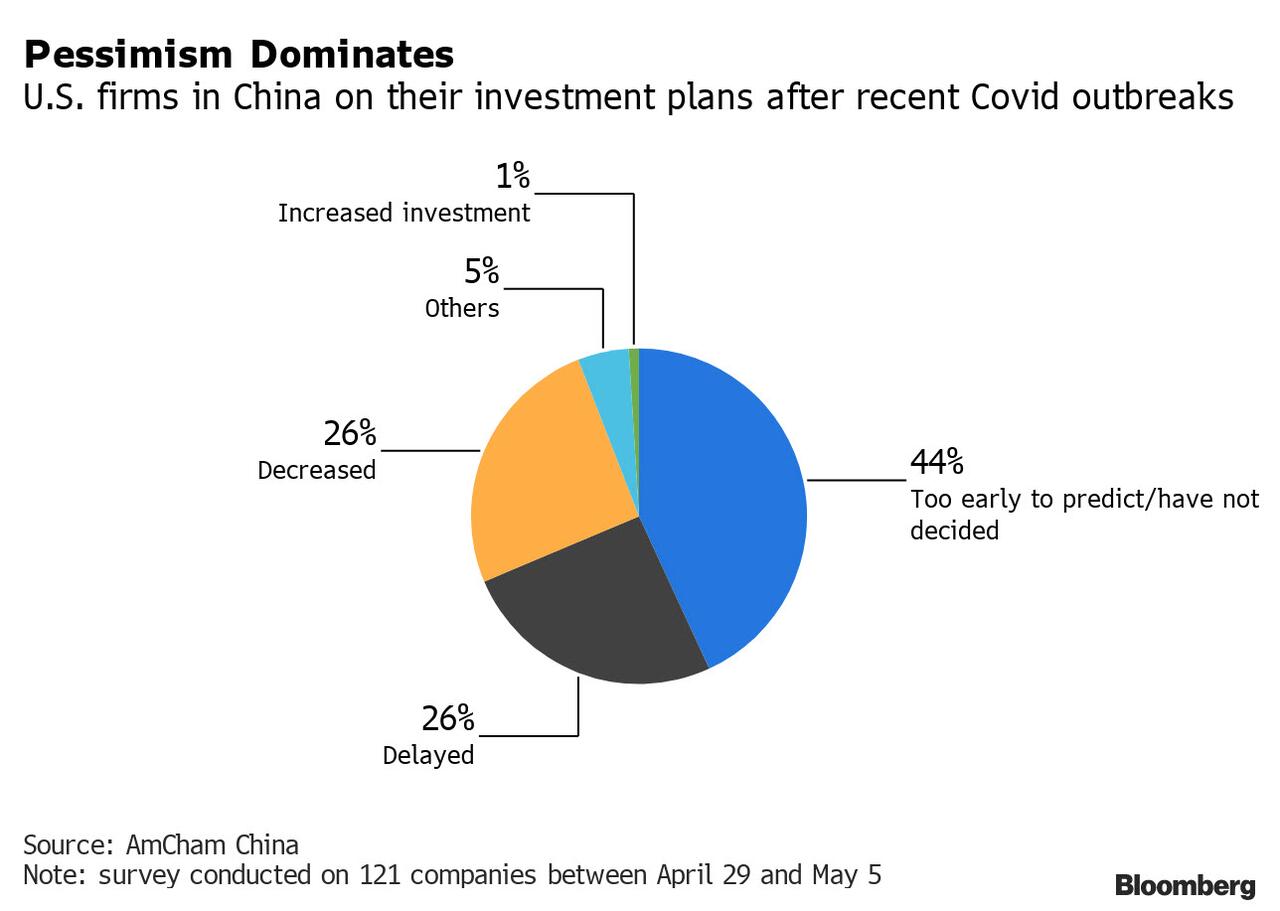
Trade wars, Covid and supply-chain disruptions were not on the minds of foreign executives back then. In 2022, however, 52% of 121 companies polled by the American Chamber of Commerce in China have either cut or delayed investments. With only 1% planning to increase local investment, authorities have a daunting task to boost foreign direct investment as long as China sticks to its Covid Zero strategy.
Anecdotal evidence suggests the local rich are also on the run. In Singapore, BNP Paribas’ Southeast Asia assets are growing in “single digits” whereas Greater China assets are in “high double digits,” according to Arnaud Tellier, Asia Pacific CEO of the French bank’s wealth management arm. CNBC reported that inquiries at an accounting firm in the city state about setting up family offices have doubled over the past 12 months, mostly from Chinese residents or emigrants.
Between 2014 and 2016, China’s FX reserves fell by almost $1 trillion as the onshore yuan lost more than 11% versus the dollar. With reserves barely above $3.1 trillion as of April, Beijing can not afford to draw down its dollar stash in a similar way. Raising interest rates is also out of the question given the dire economic situation.
As my colleague Ye Xie pointed out, the PBOC still has plenty of other tools to cushion any yuan free fall. And Russia’s experience with the ruble should give policy makers more confidence to dust off their playbook for capital controls. Back in 2016, regulators suggested to Deutsche Bank that it remit proceeds from a $3.9 billion stake sale in batches rather than in one go. More companies may soon have to face the same predicament.
Early premarket gappers
- Gapping up:
- RIDE +17.2%, CPNG +16.8%, SMRT +15.4%, APP +15.4%, PCT +8.6%, ENVX +7.9%, ZIP +7.8%, BMBL +7.2%, GRPN +6%, SONO +5.9%, FLNC +5.8%, SWIR +5.4%, CE +5%, NICE +4.6%, STM +4.1%, METC +3%, AZEK +2.9%, SQSP +2.8%, RIVN +2.2%, DOX +2%, MQ +1.4%, PAAS +1.3%
- Gapping down:
- BROS -41.8%, BYND -24.4%, FOSL -6.4%, HIMX -5.9%, ABC -5.8%, FORG -5.7%, MFC -5.4%, VCTR -5%, DIBS -4.9%, DIS -4.9%, COCO -4.6%, ATCO -3.3%, LYRA -3.1%, ASND -2.8%, VORB -2.7%, SFL -2.3%, LRCX -2.1%, DIDI -2%, TWTR -1.9%, MSFT -1.1%, STE -1.1%, DDD -1%
SoftBank Reports $13 Billion Annual Loss, Hit by Tech-Share Slump
Japanese technology investor sees worst result in its four-decade history
TOKYO—Japanese technology investor SoftBank Group Corp. 9984 -8.03% on Thursday reported the biggest annual loss in its four-decade history because of the global selloff in technology shares.
SoftBank, known for its $100 billion Vision Fund, reported a net loss of ¥1.71 trillion, equivalent to $13.2 billion, for the year that ended March 31. That was its biggest full-year loss, topping a record set two years ago, and followed a nearly ¥5 trillion net profit the previous fiscal year.
The company’s results tend to swing widely because they follow the volatile movements of the technology shares in which SoftBank has invested, including U.S. companies such as Uber Technologies Inc. UBER -4.65% and DoorDash Inc. DASH -13.16%
Interest-rate increases by the Federal Reserve and other central banks, as well as tighter Chinese government regulations on the tech industry, have weighed on valuations of high-growth tech stocks.
In the year ended March 31, SoftBank reported a loss of ¥3.74 trillion, equivalent to $29 billion, on investments at its Vision Fund 1, Vision Fund 2 and others.
The publicly listed stocks that compose much of the Vision Fund have fallen by more than half since the start of the year. Shares of Chinese ride-hailing leader Didi Global Inc., in which the Vision Fund holds a stake, have fallen more than 80% since its debut on the New York Stock Exchange last summer. Didi is planning to delist from the NYSE.
Shares of e-commerce giant Alibaba Group Holding Ltd. , SoftBank Group’s most valuable holding, fell about 50% during the last fiscal year.
SoftBank’s shares fell 8% on Thursday in Tokyo trading, which ended before the release of the results. Thursday’s close of ¥4,491 was less than half the level a year ago.
Chinese property developer Sunac defaults as lockdowns hit house sales
Beijing’s pandemic restrictions have worsened a liquidity crisis in real estate
Chinese property developer Sunac became the latest company in the sector to default, as strict lockdown measures to combat the country’s Covid-19 outbreak exacerbate a liquidity crisis across the real estate sector.
The company said in a statement to the Hong Kong exchange on Thursday that it had failed to make payments on one bond ahead of a deadline this week. It said there was “no assurance” it would be able to make others worth over $70mn before grace periods expire this month.
The missed payments from Sunac came as part of a wider cash crunch across China’s property sector, which first emerged last year and has weighed on the country’s wider economy. The highly leveraged industry is subject to intense scrutiny in international bond markets, where borrowing costs have soared, making it difficult for developers to fund their projects.
China’s real estate crisis originally centred around missed payments from Evergrande, the world’s most indebted property developer with more than $300bn in liabilities, after Beijing introduced rules in 2020 designed to rein in property developers’ debt.
In its statement to the Hong Kong exchange, Sunac said its access to new financing has “not been notably improved” since the start of the year.
Its comments also suggested that a series of strict and often indefinite lockdowns imposed across Chinese cities to halt its worst coronavirus outbreak in two years were compounding the crisis.
Shanghai, the country’s leading financial centre, has been locked down since late March with little indication of when the restrictions may be lifted. Investment bank Nomura this week estimated 41 cities were under full or partial lockdown, affecting almost 300mn people.
Sunac pointed to the “liquidity issues” that emerged within the sector last year but also said that its sales had been “significantly affected by the Covid-19 outbreak”, plunging 65 per cent in March and April this year.
Another developer, Zhenro Properties, last month blamed the “unforeseen scale and duration” of a lockdown in Shanghai for its own default.
The default of Evergrande, which first began missing payments in September and was not declared to have defaulted until December by rating agency Fitch, has symbolised the dramatic reversal of fortunes for the sector. It is now in the early stages of what is expected to be China’s biggest-ever restructuring.
In March, Fitch downgraded Sunac to double C and said it faced about Rmb17bn ($2.5bn) in maturities over the rest of 2022.
Shares in Sunac fell 5 per cent on Thursday. The company said it had hired financial adviser Houlihan Lokey, which is also advising Evergrande.