Bernard Arnault rachète l'hôtel de l'oligarque russe Nikolay Sarkisov à Courchevel
LVMH continue ses emplettes dans la station des milliardaires. Le groupe de luxe s'est discrètement emparé avant l'été d'un hôtel détenu par l'oligarque russo-arménien Nikolay Sarkisov à Courchevel 1850. L'établissement était voisin d'un vaste palace déjà possédé par l'empire de Bernard Arnault dans la station huppée.
Edition du 31/08/2022 Lecture 3 minutes
Bernard Arnault a mis la main sur l'hôtel Les Anémones détenu par le milliardaire russo-arménien Nikolaï Sarkisov. © Benoît Tessier/Reuters / Maxime Jegat/MaxPPP
Lorsque LVMH a appris que la mairie de Courchevel (Savoie) allait déclasser en août dernier le bâtiment abritant l'office du tourisme pour le louer à des commerces, le groupe de Bernard Arnault n'a pas tergiversé avant de présenter sa candidature. L'occasion était rêvée pour installer une nouvelle boutique dans le très convoité quartier de la Croisette, juste en face de l'hôtel de luxe White 1921 déjà détenu par LVMH. Raté : le bail commercial a été confié le 16 août à un bijoutier, revendeur exclusif de Rolex.
L'épisode le prouve à nouveau : Bernard Arnault ne loupe pas une opportunité d'étendre son royaume dans la prestigieuse station savoyarde. Dernière emplette en date, l'homme d'affaires, qui possède le célèbre palace Cheval blanc à Courchevel 1850, a, selon nos informations, mis la main début mai sur l'hôtel Les Anémones détenu par le milliardaire russo-arménien Nikolay Sarkisov. Son emplacement est stratégique pour LVMH. Il jouxte en effet le White 1921 et les magasins des maisons du groupe qui l'entourent dont Dior, Louis Vuitton, Fendi, ou encore Bulgari. L'établissement un peu vieillot avait été racheté fin 2019 par l'oligarque pour 9,25 millions d'euros via deux sociétés offshore immatriculées au Luxembourg, Aixette SA et Monhill SARL. Il avait alors été fermé et n'a apparemment jamais rouvert ses portes.
Niel, Arnault et Courbit en concurrence
LVMH va-t-il exploiter cette surface de 1 262 m² pour agrandir le White 1921 en ouvrant de nouvelles chambres ou préférera-t-il construire de nouvelles boutiques ? Contacté, le groupe n'a pas souhaité confirmer ni commenter cette acquisition.
Malgré cette vente, Nikolay Sarkisov conserve pour sa part un beau patrimoine à Courchevel. Avec son frère Sergey Sarkisov, l'homme d'affaires a fait fortune dans l'assurance grâce à leur compagnie Reso Garantia. Dans la station, il participe depuis plusieurs années au Monopoly alpin aux côtés de Bernard Arnault, du fondateur de Free, Xavier Niel, du producteur Stéphane Courbit ou encore du créateur de l'enseigne Grand Frais, Denis Dumont, dernier joueur à avoir rejoint la partie (LLA du 21/01/22). Nikolay Sarkisov compte plusieurs chalets à son actif, tels que Croix du Sud (2 029 m²) ou Apopka. Il avait racheté ce dernier palace de 2 753 m² racheté aux enchères pour 24 millions d'euros l'an dernier après plusieurs années de bataille judiciaire contre son ex-associé, le promoteur corse François-Xavier Susini.
Une vingtaine de sociétés immobilières
Nikolay Sarkisov possède par ailleurs plusieurs biens immobiliers de grand luxe en France : un duplex avenue Foch à Paris, le château Malet à Cap-d'Ail en périphérie de Monaco, le domaine viticole de Pascati à Ramatuelle (Var), des villas à Saint-Tropez ou encore la résidence Carlton Riviera à Cannes (Alpes-Maritimes), d'après la vingtaine de sociétés immobilières déclarées au registre du commerce. Celles-ci sont contrôlées par des sociétés écrans domiciliées au Luxembourg, aux îles Vierges britanniques ou à Chypre, et leur gestion est presque toujours confiée aux Russes Svetlana Bugaeva et Tatiana Kiryanova, résidant respectivement en Italie et à Chypre.
Si de nombreux Russes ont quitté "Kourchevelovo" - le petit nom donné par les Russes à Courchevel - au déclenchement de la guerre en Ukraine en février dernier, le porte-parole de Nikolay Sarkisov fait savoir que la vente de l'hôtel Les Anémones n'a aucun lien avec le contexte géopolitique. L'oligarque ne figure pas à ce jour dans la liste des personnalités russes sanctionnées par l'Union européenne pour leur proximité avec le régime.
Le magnat de l'assurance connaît toutefois d'autres démêlés avec la justice française. A la suite de révélations de Mediapart, le Parquet national financier (PNF) a ouvert une enquête préliminaire pour "trafic d'influence" à propos d'un contrat de conseil signé entre l'ancien président Nicolas Sarkozy et le groupe Reso Garantia, contrôlé par les frères Sarkisov aux côtés d'Axa. Actionnaire à hauteur de 36,7 %, le groupe du CAC 40 a décidé dès mars de retirer ses administrateurs du board de l'assureur russe dans le contexte de guerre en Ukraine.
Research Calls
- Upgrades:
- ASML (ASML) upgraded to Buy from Neutral at UBS
- PayPal (PYPL) upgraded to Buy from Neutral at BofA Securities; tgt raised to $114
- Rocket Lab USA (RKLB) upgraded to Outperform from Market Perform at Cowen; tgt raised to $8
- Downgrades:
- Ambarella (AMBA) downgraded to Hold from Buy at Summit Insights
- Paysafe (PSFE) downgraded to Neutral from Positive at Susquehanna; tgt lowered to $2
- Pt Sarana Menara Nusantara, Tbk (SMNUF) downgraded to Neutral from Buy at Citigroup
- Redwood Trust (RWT) downgraded to Neutral from Buy at BTIG Research
- Robinhood Markets (HOOD) downgraded to Underweight from Equal Weight at Barclays; tgt $10
- Snap (SNAP) downgraded to Neutral from Buy at Citigroup; tgt lowered to $10
- Others:
- Apollo Global Management (APO) initiated with an Overweight at Barclays; tgt $70
- Ares Management (ARES) initiated with an Overweight at Barclays; tgt $92
- Bicycle Therapeutics (BCYC) initiated with an Outperform at Cowen
- Blackstone (BX) initiated with an Overweight at Barclays; tgt $120
- Charles Schwab (SCHW) initiated with an Equal Weight at Barclays; tgt $81
- Coinbase Global (COIN) initiated with an Equal Weight at Barclays; tgt $80
- Interactive Brokers (IBKR) initiated with an Overweight at Barclays; tgt $77
- Landstar System (LSTR) initiated with a Hold at The Benchmark Company
- LSB Industries (LXU) initiated with a Buy at UBS; tgt $20
- P10, Inc. (PX) initiated with an Overweight at Barclays; tgt $15
- Satsuma Pharmaceuticals (STSA) initiated with a Buy at Ladenburg Thalmann; tgt $16
- Shattuck Labs (STTK) initiated with a Buy at BTIG Research; tgt $12
- Shore Bancshares (SHBI) initiated with a Neutral at Janney
- Signify Health (SGFY) initiated with a Buy at BTIG Research; tgt $35
- StepStone Group (STEP) initiated with an Equal Weight at Barclays; tgt $33
- T-Mobile US (TMUS) named Catalyst Driven Idea at Morgan Stanley
- Welltower (WELL) resumed with an Overweight at Morgan Stanley; tgt $90
Gapping down
In reaction to earnings/guidance:
- CHWY -11.3%, AMBA -8.2%, HPQ -6.8%, PVH -6.6% (also to reduce people costs in global offices by ~10%)
Other news:
- BBBY -25.1% (sees Q2 revs below consensus; provides outlook and update on strategic changes to strengthen its financial positioning and drive growth; files common stock offering for an undisclosed amount)
- SNAP -7.5% (NFLX names two SNAP execs to lead its ads business according to AdAge)
- OSCR -3.1% (Health First to terminate services agreement)
- EYPT -1.9% (receives subpoena from US Atty relating to DEXYCU)
- AOSL -1.9% (to delay form 10-K)
- BCPC -1.7% (acquires acquires Cardinal Associates operating as Bergstrom Nutrition)
Analyst comments:
- RWT -1.7% (downgraded to Neutral from Buy at BTIG Research)
- HOOD -1.7% (downgraded to Underweight from Equal Weight at Barclays)
Gapping up
In reaction to earnings/guidance:
- CHPT +2.8%, DBI +1.8%, DCI +0.7%
Other news:
- CPTN +9.2% (receives non-binding LoI for a $100 mln investment from Koito Manufacturing)
- SRNE +7.2% (receives FDA Fast Track Designation for SP-103 (Lidocaine Topical System) 5.4%)
- MREO +6.7% (sends letter to Rubric Capital Management; Letter reiterates Mereo's updated strategic plan to maximize value for all shareholders and corrects Rubric's assumptions; Announces further extension of cash runway into Q2 2025)
- CACI +4.3% (awarded $5.7 bln US Air Force blanket purchase agreement)
- ZEV +3.2% (enters into purchase agreement for up to $50 mln with Lincoln Park Capital)
- NFLX +1.8% (NFLX names two SNAP execs to lead its ads business according to AdAge)
- DBRG +1.7% (DBRG and EQIX in final round of talks for data center business of Malaysia's Time Dotcom unit according to Bloomberg)
- JELD +1.5% (initiates strategic review for its Australasia business)
- SAP +1.2% (names Dominik Asam as new CFO)
- BCRX +1.2% (FDA grants orphan drug designation for BCX9250 for the treatment of fibrodysplasia ossificans progressiva)
- PRVA +1% (its ACOs achieved shared savings of $99.9 mln through Medicare Shared Savings Program)
Analyst comments:
- PYPL +2.4% (upgraded to Buy from Neutral at BofA Securities)
- ASML +1.2% (upgraded to Buy from Neutral at UBS)
Early premarket gappers
- Gapping up:
- CPTN +16.2%, SRNE +11.3%, CACI +4.3%, ZEV +2%, DBRG +1.7%, NFLX +1.6%, CHPT +1.6%, JELD +1.5%, PRVA +1%, HIL +0.9%, JEF +0.8%, SAP +0.7%, DCI +0.7%, AMGN +0.5%
- Gapping down:
- CHWY -10.9%, EYPT -8.4%, AMBA -8%, HPQ -7.2%, SNAP -6.6%, OSCR -5.3%, PVH -3.7%, BCPC -1.7%, HPE -1.1%, HON -0.8%, BA -0.5%, DELL -0.5%, CRWD -0.5%
China Is Aggressively Reselling Russian Gas To Europe
One month ago, we were surprised to read how, despite a suppressed appetite for energy amid its housing crash and economic downturn (for which "zero covid" has emerged as a convenient scapegoat for emperor Xi), China has been soaking up more Russian natural gas so far this year, while imports from most other sources declined.
In July, the SCMP reported that according to Chinese customs data, in the first six months of the year, China bought a total of 2.35 million tonnes of liquefied natural gas (LNG) – valued at US$2.16 billion. The import volume increased by 28.7% year on year, with the value surging by 182%. It meant Russia has surpassed Indonesia and the United States to become China’s fourth-largest supplier of LNG so far this year!
This, of course, is not to be confused with pipeline gas, where Russian producer Gazprom recently announced that its daily supplies to China via the Power of Siberia pipeline had reached a new all-time high (Russia is China’s second-largest pipeline natural gas supplier after Turkmenistan), and earlier revealed that the supply of Russian pipeline gas to China had increased by 63.4% in the first half of 2022.
What was behind this bizarre surge in Russian LNG imports, analysts speculated? After all, while China imports over half of the natural gas it consumes, with around two-thirds in the form of LNG, demand this year had fallen sharply amid economic headwinds and widespread shutdowns. In other words, why the surge in Russian LNG when i) domestic demand is just not there and ii) at the expense of everyone else?
“The increase in Russian LNG could be a displacement of cargoes going to Japan or South Korea because of sanctions, or weaker demand there,” said Michal Meidan, director of the China Energy Programme at the Oxford Institute for Energy Studies.
One thing that was clear: China wanted to keep its arms-length gas dealing with Russia as unclear as possible, which is why the General Administration of Customs of China stopped publicizing the breakdown in trade volume for pipeline natural gas since the beginning of the year, with spokesman Li Kuiwen confirming that the move was to “protect the legitimate business rights and interests of the relevant importers and exporters”.

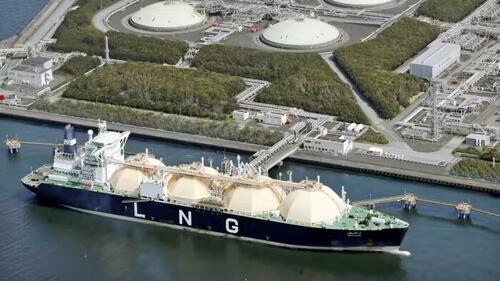
An LNG ship docked at a port in Chiba, Japan. China’s resales of LNG have added supply to the spot market
Well, we now know the answer: China has been quietly reselling that evil, tainted Russian LNG to the one place that desperately needs it more than anything. Europe... and of course, it is charging a kidney's worth of markups in the process.
As the FT reported recently, "Europe’s fears of gas shortages heading into winter may have been circumvented, thanks to an unexpected white knight: China." The Nikkei-owned publications further notes that "the world’s largest buyer of liquefied natural gas is reselling some of its surplus LNG cargoes due to weak energy demand at home. This has provided the spot market with an ample supply that Europe has tapped, despite the higher prices."
What the FT ignores, perhaps intentionally, is that it's not "surplus" - after all, if it was Chinese imports of Russian LNG would collapse. No - the correct word to describe the LNG that China sells to Europe is Russian.
Going back to the story, the details are intuitive: with Russian pipeline gas to Europe effectively shuttered...

... Europe’s imports of LNG have soared 60% year on year in the first six months of 2022, according to research firm Kpler.
Some more details:
China’s JOVO Group, a big LNG trader, recently disclosed that it had resold an LNG cargo to a European buyer.A futures trader in Shanghai told Nikkei that the profit made from such a transaction could be in the tens of millions of dollars or even reach $100mn.China’s biggest oil refiner Sinopec Group also acknowledged on an earnings call in April that it has been channelling excess LNG into the international market.Local media have said that Sinopec alone has sold 45 cargoes of LNG, or about 3.15mn tonnes. The total amount of Chinese LNG that has been resold is probably more than 4mn tonnes, equivalent to 7 per cent of Europe’s gas imports in the half year to the end of June.
Make no mistake: all of this "excess" LNG was soured in part or in whole in Russia, but since it has been "tolled" in China, it is no longer Russian. It is instead - drumroll - Chinese LNG.
The good news is that the 53 million tonnes that the bloc purchased surpasses imports by China and Japan and has brought Europe’s gas-storage occupancy rate up to 77%.If this continues, Europe is likely to reach its stated goal of filling 80% of its gas storage facilities by November (at which point it will start draining the reserves at a breakneck pace to keep warm during the winter). But while China’s economic slump has brought much-needed relief to Europe, it comes with a major footnote. As soon as economic activity bounces back in China, the situation will quickly reverse, and Beijing will no longer re-export Russia LNG to keep Europe warm.
Hilariously, it also means that instead of being dependent on Russia for gas, Europe is now becoming dependent on Beijing instead for its energy - which is still Russian gas, only this time imported from China - which makes a mockery of US geopolitical ambitions to defend a liberal international order with its own energy exports.
Worse, while Europe could buy Russian LNG for price X, it instead has to pay 2X, 3X or more, just to virtue signal to the world that it won't fund Putin's regime, when in reality is is paying extra to both Xi and to Putin, who is collecting a premium price thanks to the overall market scarcity.
Amusingly, without expressly stating it, the FT does imply that Europe is buying Russian LNG by way of China:
If Russia ends up exporting more gas to China as a means to punish Europe, China will have more capacity to resell its surplus gas to the spot market — indirectly helping Europe.
Why not just admit the obvious - that China is helping Russia skirt sanctions as both countries get very rich in the process? Because then the FT's own judgment - after all, the newspaper is a conduit of the neoliberal thinking that demanded a complete embargo on Russian energy, an embargo which even the WSJ now admits (see "Russia Confounds the West by Recapturing Its Oil Riches") has backfired spectacularly - would be put into question.
FT's flaws aside, the newspaper is correct that the longer this kind of circuitous bypass of Russian sanctions by a hypocritical Europe (which signals its virtue so loudly when the adversary is Russia but doesn't dare say peep when it's China) continues, the bigger China's influence on Europe will be:
The more desperate Europe becomes about its energy supplies, the more China’s policy decisions will have the power to affect the bloc. As Europe attempts to wrestle out of its dependence on Russia for energy, the irony is that it is becoming more dependent on China.
In the end, all Europe has done is replace one energy master (as Trump warned in 2018) with another, even though both are joined at the hip and laughing at the stupidity of Brussels which, under the sage advice of a petulant Scandinavian teenager, made all of this possible just in time for China - which together with Putin now determines Europe's daily energy intake - to invade Taiwan without a peep from Europe's virtuous signalers.
U.S. Life Expectancy Fell Again in 2021 as Covid, Overdoses Took Toll
Preliminary data from CDC show life expectancy among Americans decreased nearly one year on average to 76.1 years
Life expectancy in the U.S. dropped in 2021 for a second consecutive year as Covid-19 and overdoses drove up mortality rates, preliminary data showed.
Americans’ life expectancy last year fell 0.9 year on average to 76.1 years, according to data from the Centers for Disease Control and Prevention released Wednesday. It was a smaller drop than in 2020, when life expectancy decreased 1.8 years, the data showed, but the combined figures for the two years were the largest since the 1920s, the CDC said. “None of us are OK,” said Steve Woolf, director emeritus of the Center on Society and Health at Virginia Commonwealth University.
The data demonstrated that some groups have been hit particularly hard by the pandemic as well as the opioid crisis, which claimed some 108,000 lives last year. Indigenous Americans had the biggest drop in life expectancy in 2021 at 1.9 years, the data showed, bringing their life expectancy to 65.2 years, down 6.6 years since 2019.
The decline among Native Americans was driven by higher Covid-19 death rates than in 2020, unintentional injuries including overdoses and chronic liver disease and cirrhosis.
“We have a crisis of early deaths among American Indians,” said Donald Warne, associate dean of diversity, equity and inclusion at the School of Medicine and Health Sciences at the University of North Dakota and a member of the Oglala Lakota tribe.
Covid-19 accounted for more than half of the increase in deaths among white people in 2021, the data showed, while unintentional injuries including overdoses accounted for about 12%.
Life expectancy declined less among Black people than white people in 2021, the data showed, reflecting in part the higher burden of deaths among some minority groups in the early phases of the pandemic. Black people in the U.S. had a life expectancy of 70.8 years last year, according to the CDC, compared with 76.4 years for white people.
“We continue to see disparities for people of color,” said Ada Stewart, a family physician with Cooperative Health in Columbia, S.C., and board chair of the American Academy of Family Physicians. “They did not fare well during the pandemic.”
Black and Hispanic Americans have been hard hit by an overdose crisis driven primarily by the spread of fentanyl produced in makeshift Mexican labs. Higher rates of death in the category that includes overdoses reflects poorer access to treatment for many minority groups, said Karen Scott, president of the nonprofit Foundation for Opioid Response Efforts.
“Addressing the overdose crisis requires acknowledging that you have to work on many fronts at one time,” she said.
Deaths attributed to flu, pneumonia and Alzheimer’s dropped in 2021, the data showed. For Alzheimer’s in particular, a lower death toll in 2021 reversed a high tally in 2020, when deaths from the disease rose 18% from the year before.
“The truly vulnerable were left in drastic situations,” said Beth Kallmyer, vice president of care and support for the Alzheimer’s Association.